The Funhouse (1981)

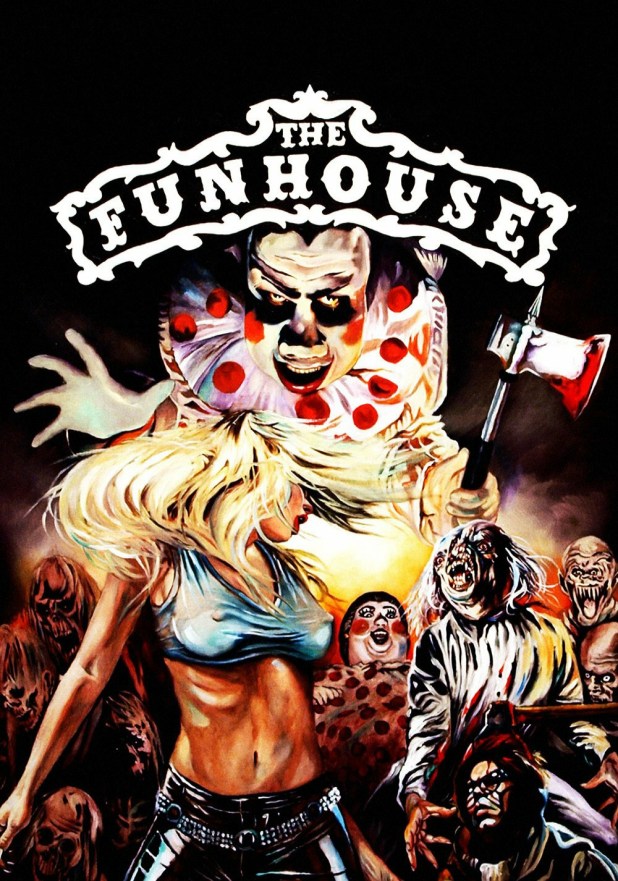
This movie seems like it’s going to be a slasher, yet much like Eaten Alive, it exudes a level of real fear, sleaze and menace that few films reach. Yet it has a heart and joy to it that makes me love it. It’s also one of Becca’s favorite childhood films!

We open on Amy (Elizabeth Berridge, Amadeus) as she showers, but the killer isn’t a killer. It’s her little brother Joey, which is troubling on a few levels. He’s a horror film fan who loves practical jokes. And he goes along with Amy and her boyfriend Buzz, Liz and Richie to a traveling carnival.

They don’t follow any of the rules as they go to the event. Of course, they smoke weed. And then look at naked women. And heckle Madame Zena (played by Sylvia Miles, who was the original Sally on The Dick Van Dyke Show and earned Oscar nominations for Midnight Cowboy and Farewell, My Lovely before becoming close pals with Paul Morrissey and Warhol). And then sneak in and spend all night inside the Funhouse.

They decide to ride into the funhouse when they watch a man in a Frankenstein mask have sex with Zena. He comes too fast and then tries to get out of paying, at which point Zena makes fun of him. He goes crazy and murders her as the teens are trapped. And Richie is dumb enough to steal money from the carnival after all of that!

It turns out that the man in the mask is really Gunther, the son of the owner Conrad Straker. He’s hideously deformed, with long fangs and white hair. He’s played by The monster was played by Wayne Doba, a professional tap dancer and former mime who was also the otherworldly Octavio the Clown in Scarface.

His father riles him up and he kills Richie and goes after the rest of the kids. Liz is killed with an industrial fan. Buzz kills Conrad, but Gunther offs him. Finally, Amy is able to kill the monster with two gears. She barely escapes with her life as the robotic fat lady laughs at her. After all, it ain’t over until the fat lady sings.

There’s a book version of the film by Owen West (Dean Koontz) which adds plenty of back story. As the film was delayed in post-production, it came out a long time before the movie.

Interestingly enough, Hooper would Tobe Hooper reuse several props when he directed the music video for Billy Idol’s “Dancing With Myself.”

My favorite scene here is the reveal of Gunther. And I almost forgot that William Finley from The Phantom of the Paradise shows up as a magician! This is a near-forgotten piece of horror film that is worth you finding and watching for yourself. You can grab a copy from Scream Factory or the Arrow UK import at Diabolik DVD.

MESSED UP AND MUSICAL: One from the Heart (1981)

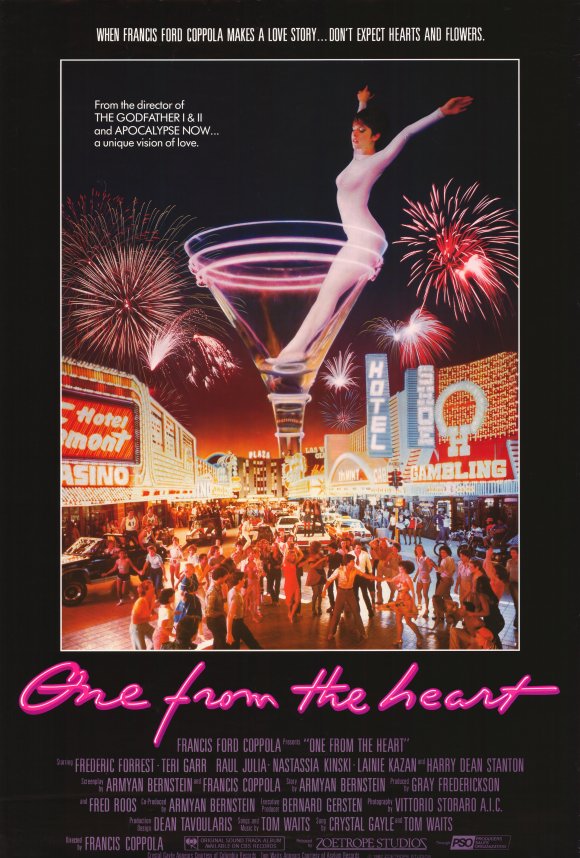
In his series, My Year of Flops, Nathan Rubin said, “It’s telling that when a filmmaker succeeds in running his own studio, it’s because he’s learned to let his inner businessman veto his inner artiste. Coppola ran Zoetrope with his heart. It nearly destroyed him.” One from the Heart wasn’t just director Francis Ford Coppola’s dream project. It was his way of saying to producers like Robert Evans, who Coppola famously warred with as he made The Godfather, “Hey. I don’t need you. I can control costs and production and make a movie all on my own.”

Somehow, One from the Heart went from a personal love story to a $28 million dollar epic. It went from a movie to a Quixotic odyssey. Or was that 1979’s Apocalypse Now, a film that went from Joseph Conrad cover version to a sprawling epic that nearly killed several of the people in its orbit? From typhoons to nervous breakdowns, actors getting replaced mid-production, Martin Sheen having a heart attack, Marlon Brando showing up out of shape and not ready to perform, Dennis Hopper high on drugs before disappearing for days in the jungle and so much more, the film was delayed and delayed and delayed. The director himself succinctly put it this way: “We were in the jungle, there were too many of us, we had access to too much money, too much equipment and little by little, we went insane.” Yet the movie that emerged was a classic.

Now that Coppola was making a movie on his own terms, the odds were higher than they’d ever been before. The film had to be a winner with the public’s hearts, minds and wallets.

Coppola wanted to create something that he called Electric Cinema (I’ve also heard it called Live Cinema). There would be long takes, performances that felt like they belonged on the theater stage and cameras that would shoot from every angle to ensure coverage so that Coppola’s editing team could craft magic from the wealth of available film. This technique — which involves modern video editing years before it was used or even feasible — isn’t something that Coppola has given up on. He was part of what is said to be “an ambitious “Distant Vision” project as a “live cinema” experiment at his alma mater, the UCLA School of Theater, Film and Television” in 2016 and published a book, Live Cinema and Its Techniques, in 2017.

Roger Ebert stated in his January 1, 1982 review, “Everybody knows that Coppola used experimental video equipment to view and edit his movie, sealing himself into a trailer jammed with electronic gear* so that he could see on TV what the camera operator was seeing through the lens. Of course, the film itself was photographed on the same old celluloid that the movies have been using forever; Coppola used TV primarily as a device to speed up the process of viewing each shot and trying out various editing combinations.” In short, Coppola did exactly what every modern production does today, particularly commercial shoots, using a more advanced version of the Video Assist that Jerry Lewis claimed to have invented (in truth, Jim Songer was the patent holder, read more in this fascinating article).

What emerged is a film that is just as much theater as it is a movie as it is live TV. It begins and ends with a curtain. And what is in-between is a mix between heartfelt passion and pure cinematic gloss. Everything that can be neon will be — even the names of the cast and crew. Yet the story that is told is between two people and could happen to anyone.

This isn’t the real Las Vegas, though. This is the Vegas of movies, of dreams, of what Vegas feels like but can’t be. It’s a world where the music of Crystal Gayle and Tom Waits provide their voices, as the film becomes a musical. Kind of. Sort of.

Hank (Frederic Forrest, The RoseApocalypse Now) and Frannie (Teri Garr, Close Encounters of the Third KindYoung Frankenstein) are a couple who’ve been together too long. Five years too long. They’re sick of one another, they’ve left another one too many times and now, this is the end of their story.

They spend their fifth anniversary with their dream lovers. Hank falls for Leila, who is youth and beauty and pure sex (it’s no accident that Nastassja Kinski plays her). Frannie picks the dark, handsome and mysterious Ray (Raul Julia, who I really don’t want to say is also in Street Fighter, but he was), a man who will give her what she always wanted: he will sing to her.

It’s not enough for Hank, who tracks down Frannie and tells her that he loves her, but she refuses his advances. He even follows her to the airport, where she is due for Bora Bora with her new lover, ready to leave reality behind for a life of idyllic passion. He tries to sing to her in his cracked voice but leaves in tears.

Back in their broken home, he’s lost, but she comes home to him, realizing that they are meant to be together.

My question is, “Why?” The film never shows us why the real world is better than a dream. Would you choose a ramshackle house and a life of arguments over dancing with Julia or a neon sign graveyard with Kinski gyrating against a Technicolor sky? No. You wouldn’t.

That’s my main issue with One from the Heart. Its heart seems in the wrong place, that these two mismatched souls belong together when the film repeatedly shows us that no, they belong with their fantasies.

Another nod to the stage is that the film features understudies, including Rebecca De Mornay. I’d also be remiss if I didn’t call out one of the best parts of the film — Harry Dean Stanton, who elevates every single piece of film he ever wandered into. Here, he’s the owner of the neon graveyard.

What amazes me is that Coppola would try to direct another musical, particularly after his work on 1968’s Finian’s Rainbow led many in Hollywood to brand him as someone who was hard to work with and hard to keep on budget. Again, I turn to the superior words of Nathan Rabin, who had this to say about the film: “As Coppola tells it on Finian’s Rainbow‘s shockingly candid audio commentary, he was the wrong man for the job in every conceivable way. Coppola fancied himself a New Wave-style auteur. Warner Bros saw him as a cheap gun-for-hire.”

While One to the Heart was intended as a small follow-up to Apocalypse Now, obviously things didn’t turn out that way. For Coppola, it meant going back to the studio system. Every movie he made for almost two decades — The OutsidersThe Godfather: Part IIIJackThe Rainmaker and even a return to working with Robert Evans (this one’s a whole other tale in and out of itself) on The Cotton Club was all to pay back the debts from this film.

Should you see it? You better after I wrote over 1,200 words about it! But seriously, the color palette of this film is something you won’t see outside of Suspiria. It’s a music video in an era where that art form was still growing. And it informs later works like Bram Stoker’s Dracula, which is even more overt in its reference to the works of Mario Bava than simply loving his brighter color choices. And if you watch this on DVD, you even get the choice to simply watch the musical numbers, which may improve on the film for some.

*Indeed, Coppola would direct a lot of the film from “The Silver Fish, a mobile HQ, fully equipped with a kitchenette, espresso machine and onboard Jacuzzi,” which had a loudspeaker that he could issue orders from. Insane. And by insane, I mean brilliance.

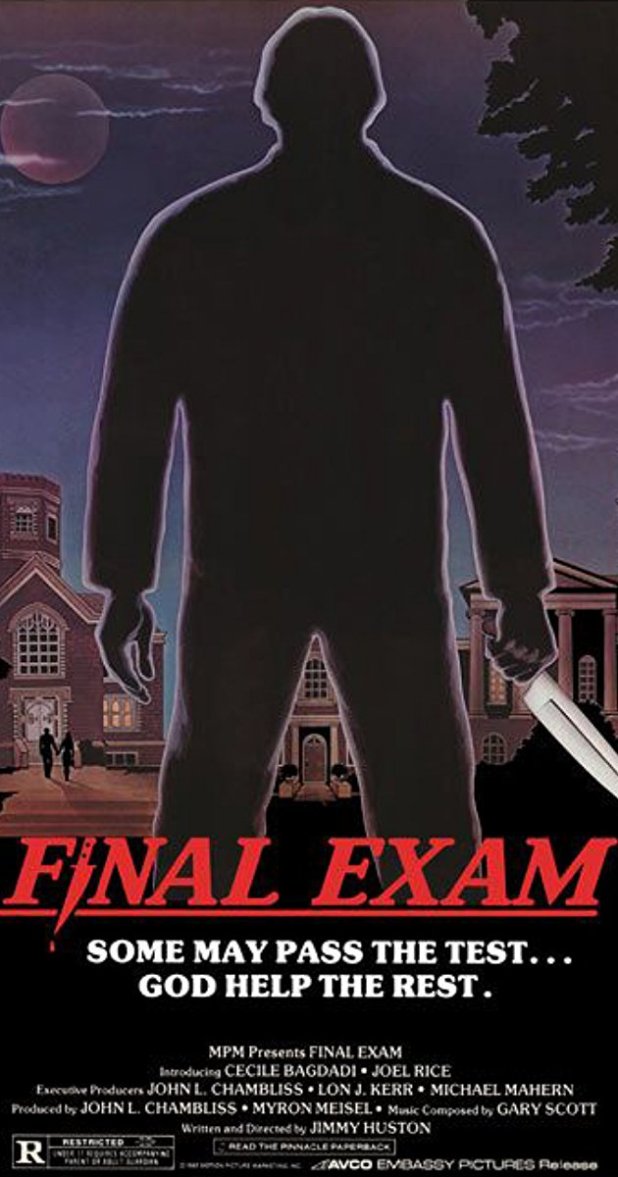
Final Exam (1981)

You remember that interview where Vanilla Ice tried to explain why he didn’t steal Queen/David Bowie’s “Under Pressure?”

I’d like to hear whoever did the music for this movie to explain how they added a “da na na” to the theme from Halloween. Then again, there’s plenty more that this movie owes to that film.

A killer with a kitchen knife is on the prowl, killing off college kids. And he’s on the way to Lanier College during finals.

Meanwhile, a fraternity stages a mass shooting to help their members pass a chemistry test. How does this plan work? Who comes up with such a plan?

While students prepare for the end of the year, the killer is hiding among them. We have Courtney, who is the Final Girl, of course. Her roommate is Lisa, who is all into the hot professor. Well, not really hot. He’s a professor, though.

For some reason, all of the pledges can’t dare anyone. But Gary is in love with Janet and pins her, so he gets punished by being tied up to a tree, his underwear filled with ice and then sprayed with shaving cream. What? Where did this ritual come from? Who goes through with this? Even the rest of the town, like the security guard, follow these rules. What is the deal with this school?

Well, he’s tied up and the killer gets him. Then it gets his girlfriend, too. While that’s going on, Wildman, a frat guy, is looking for pain pills when he gets killed by a Universal weight machine. His friend Mark tries to find him and he gets killed.

Then we have Radish, who isn’t gay in the movie but would totally be a proud out character if this was made after 1981. He’s constantly looking for killers and has a great poster collection of old films. All his knowledge of murder doesn’t help, as he’s instantly killed.

Lisa tries to model for her boyfriend in the nude, but she gets killed, too. And now we’re down to one and the killer even catches an arrow and stabs the coach with it when he tries to save Courtney. But then he falls into a hole and she stabs him to death. That’s it. That’s the fight he puts up.

Written and directed by Jimmy Huston (My Best Friend Is a Vampire), this is pretty much Halloween with a killer who was too lazy to get a mask (he was also the fight coordinator for the film).

That said, I wasn’t bored, I laughed out loud at many of the things that Radish did and said, and I enjoyed the arrow catching scene. If you want to see it for yourself, Shout! Factory has released it on blu-ray and you can also watch it for free on Amazon Prime. You’ll be filled with questions. Like, how much chaffing did the short shorts of the 80’s cause?

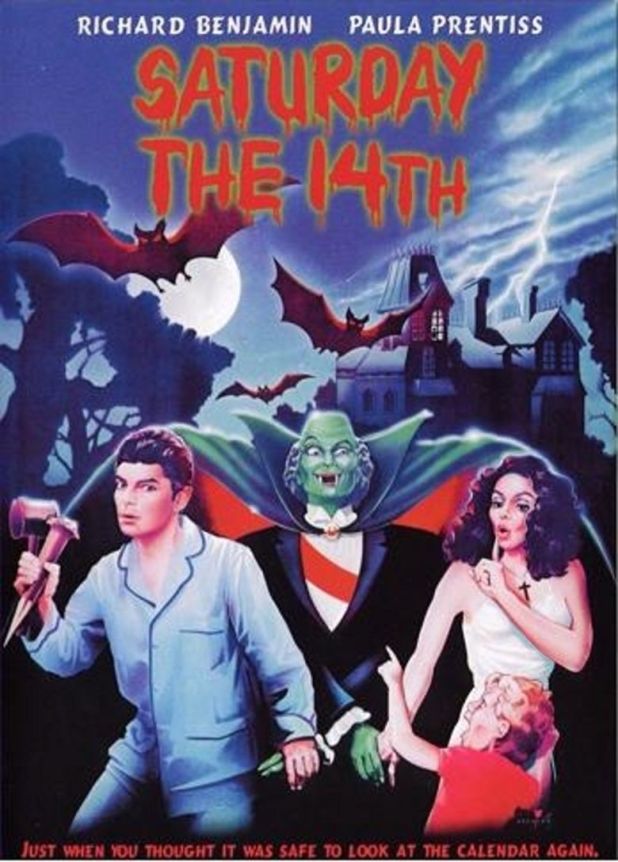
Saturday the 14th (1981)

Real-life husband and wife Richard Benjamin (Catch-22 and the original Westworld) and Paula Prentiss (The Stepford Wives) play John and Mary, who have inherited his uncle’s house in Eerie, PA. If that line made you laugh, then Saturday the 14th is for you.

Along with their kids Debbie and Billie, they try and fix the house up. But they’re opposed by Waldemar (Jeffrey Tambor, Arrested Development) and Yolanda, two vampires who want the book of evil within the house. Billy finds the book and with each turn of the page, he unleashes monster after monster into the house.

Soon, the TV can only get The Twilight Zone, sandwiches, dishes and nosy neighbors all disappear and eyeballs show up in John’s coffee cup. It’s nothing out of the ordinary to our heroes, who seem blind to the supernatural going on all around them.

Waldemar gets into the house as a bat, so they hire an exterminator (Severn Darden, Kolp from Conquest of the Planet of the Apes) who turns out to be Van Helsing.

After a housewarming party where the monsters kill every guest, we learn that the vampires are the good guys and Van Helsing just wants the book so he can rule the world. The good guys — now who include the vamps — win and Jon and Mary get an upscale home while Waldemar and Yolanda settle into the cursed home.

Director Howard R. Cohen also wrote Unholy RollersDeathstalker and Barbarian Queen before choosing this as his first film. He also directed Space RaidersTime Trackers and Saturday the 14th Strikes Back.

Some trivia — every time you see Prentiss, look closely. She’s hiding the cast on her arm, as she broke it before filming began.

Also, this is Benjamin’s last feature film as an actor, as he started directing with 1982’s My Favorite Year.

While sold as a parody of slasher films, this movie more accurately makes light of monster movies as a whole. If you’re looking for other funnier horror films of a similar bent, I’d recommend WackoPandemoniumStudent Bodies or Class Reunion.

I remember this movie running on HBO quite often in my youth. It’s a pleasant enough diversion, almost an Airplane! version of horror or a Mad Magazine come to life. The monsters are way better than you’d think they’d be, too!

WATCH THE SERIES: Friday the 13th part 1

At this point, this is the longest that we’ve ever gone without a Friday the 13th film since the break between Jason Goes to Hell and Jason X in 1993 and 2001. But at one point, these movies owned the box office, with one nearly every summer from 1980-1989. Why did people love them so much? And what were they all about? That’s why we’re here.
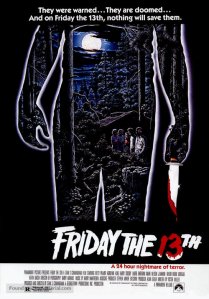
Friday the 13th (1980)

After the success of John Carpenter’s Halloween, every studio wanted a piece of the horror pie, which to this point had been exploitation fodder. Paramount Pictures was first. Sure, critics salvaged the film, but after $40 million in profit, no one really cared.

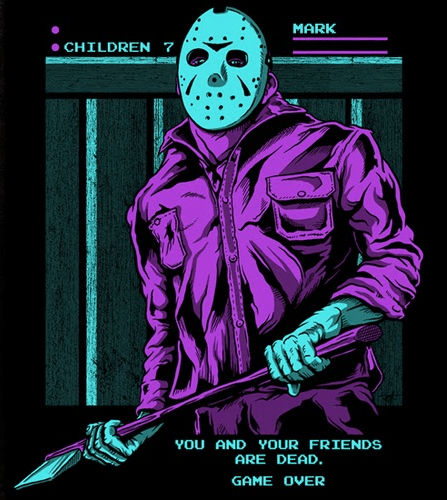
Produced and directed by Sean S. Cunningham (Last House on the Left), this movie was envisioned as a roller coaster ride. The script came from Victor Miller, a soap opera scribe. And spoilers — but this movie doesn’t even really have Jason in it!

The movie starts in the summer of 1958 at Camp Crystal Lake, where two counselors sneak off and have sex before being killed. This sets up one of the many rules of slasher films: never fuck in the woods.

The camp closes for 21 years, but on Friday, June 13, 1979, that’s all about to change. That said, no one in the town wants it to happen. When Annie Phillips arrives in town, everyone treats her strangely or acts like Crazy Ralph (Walt Gorney, who shows up in the next film and was the narrator for Friday the 13th Part VII: The New Blood). She lasts for about five minutes, as she gets killed after her third hitchhike of the day. I’d say this is more of a warning against hitching in the late 1970s than I would serial killers in the woods.

The other counselors — Jack (Kevin Bacon!), Ned, Bill (Harry Crosby III, son of Bing), Marcie, Alice and Brenda (Laurie Bartram, The House of Seven Corpses) — and owner Steve Christy all show up to get the camp ready. This is where you’ll notice just how different fashion is. Becca and I have seen this live several times in a theater now and everyone laughs as soon as Steve shows up in his short shorts and bandana.
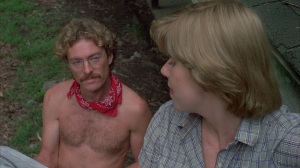
Ned is killed pretty quickly, then Jack is killed with an arrow and Marcie takes an axe to the face. Brenda is murdered as she responds to the voice of a child. Steve gets killed on the way to camp. Before you know it, Alice and Bill are the only ones left, but Bill lasts pretty much seconds. Then we have another future slasher trope: every body is discovered, hung like trophies.

Now, we have our Final Girl: Alice, who ends up meeting Mrs. Vorhees, who tells the tale of how her son Jason drowned and the horrible counselors who allowed it to happen. Much like the giallo/pre-slasher film Torso, the movie now focuses on the battle between Alice and the real killer. Alice ends up beheading her and sleeping in a canoe. As the police arrive, she has a dream that Jason rises from the water to kill her. This scene wasn’t in the script, but special effects king Tom Savini thought a Carrie-like ending would be more powerful.

Another way that the film pays sort of homage to Italian filmmaking is in the snake scene. It was another Savini idea after an experience he had in his own cabin during filming. The snake in the scene? Totally real, including its on-screen death — someone alert Bruno Mattei!

Some trivia: the film was shot just outside Lou Reed’s farm. The rock star performed for the cast and even hung out with them! Sweet Jason?

To me, the film works because of how great Betsy Palmer is as Jason’s mom. It’s a fine film, but nowhere near the excesses that the series would grow into. This was also the start of critics really hating on slasher films. Gene Siskel was so upset about Betsy Palmer being in the film that he published her address in his column and encouraged people to write her and protest. Of course, he published the wrong address.
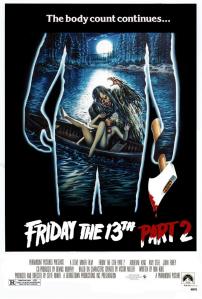
Friday the 13th Part 2 (1981()

Of course, there was going to be a sequel. Sean S. Cunningham refused to direct it because he was against the studio plan to bring Jason back from the dead. He said that it was too stupid and would never work. Hmm.

Beyond a plan to be an anthology of stories on Friday the 13th (which sounds a lot like the plans for Halloween), another thought was that Alice would be a reoccurring hero in this series, continually facing off against Jason again and again in sequel after sequel (again, think Halloween and Laurie Strode). Sadly, after was stalked by a fan, she said she wanted out (she even stayed out of acting for a long time).

That’s why this movie starts with her death. I always wondered why this happens, because it invalidates all of the emotional investment that you put into the last film!

So of course, everyone decides that re-opening Crystal Lake would be a great idea. We’ve got Ginny (Amy Steel, April Fool’s Day), Sandra, Jeff, Scott, Terry, Mark, Vickie and Ted, who sit around a campfire and listen to the legend of Jason. Even Crazy Ralph from the last movie shows up to warn everyone before getting killed.

Here’s my problem with this sequel: it rips a lot off. Jason doesn’t have his trademark hockey mask, so he steals the look of the Phantom of The Town that Dreaded Sundown. And then there’s the issue of taking two murders shot for shot from Mario Bava’s A Bay of Blood. A machete to the face and a couple stabbed together by a spear? Attention director Steve Miner: Bava did it first and better. Miner would go on to direct Halloween H20, so his sins are many.

Just like Shakespeare, everyone dies. Except Ginny. She discovers Jason’s altar to his dead mother and ends up stabbing him in the should with a machete. And then the movie does another shock ending, making you think Jason survived. He, of course, did not. Or he did. You know how these things go.

My question is: Did Jason rise from the dead? Or was he alive in the forest all these years? And how did he learn how to use a telephone? Let’s just stop asking questions.
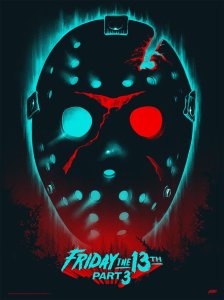
Friday the 13th Part III 3D (1982)

With Amy Steel uninterested in returning to the series, the filmmakers had to reboot and figure out what made Jason tick. And that ticking was a hockey mask — three movies into the series. The original plan was that Ginny would be confined to a psychiatric hospital and he would track her down, then murder the staff and other patients at the hospital. If this sounds kind of like Halloween 2 to you, well surprise. This is not a movie series known for its originality.

He starts the film by killing a store owner and his wife just for clothes. Then, he goes after the friends of Chris Higgins: Debbie (Tracie Savage, who played the younger Lizzie in the awesome made-for-TV movie The Legend of Lizzie Borden), Andy, Shelley, Vera (Catherine Parks, Weekend at Bernie’s), Rick, Chuck and Chili. They run afoul of bikers Ali, Fox and Loco, who follow them back to their vacation home.

Jason starts killing quick, but he’s already mentally scarred Chris, as she survived an attack from him two years ago. This has left her with serious trauma and an inability to enjoy intimacy (which, come to think of it, comes in handy in these movies).

Jason takes the mask from the dead body of prankster Shelley and it’s on, with speargun bolts to the eye, heads chopped in half with machetes, knives through chests, electrocutions, hot pokers impaling stoners and even someone’s skull getting crushed by Jason’s supernaturally powerful hands.

Of course, it ends up with Final Girl Chris against Jason, who she kills by hitting him in the head with an ax before falling asleep on a canoe and having a nightmare of Jason killing her. It’s OK. Don’t worry. We see that all is right in the world and the killer’s body is at the bottom of the lake.

Here’s some trivia: To prevent the film’s plot being leaked (I could tell you the plot in less than a sentence, so this seems like bullshit), the production used the David Bowie song “Crystal Japan” as the title of the movie. They’d use Bowie songs as working titles during several of the other films.

There is a ton of footage that was cut from the film so that it didn’t get an X rating. And there’s an alternate ending where Chris dreams that Jason decapitates her. None of these things make this a better movie.

Whew! We made it through three Friday the 13th movies. Let’s take a little break and then we’ll be back in a bit with three more!
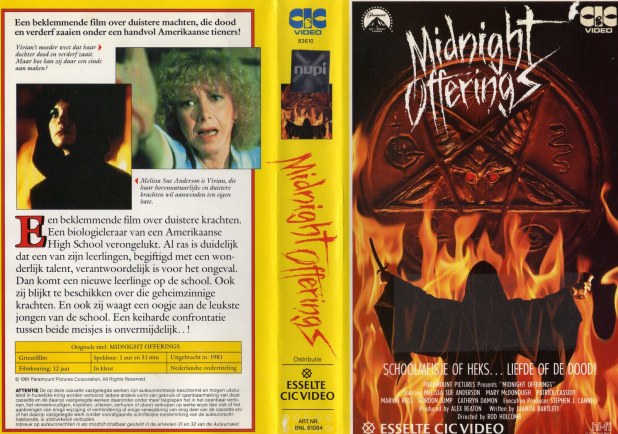
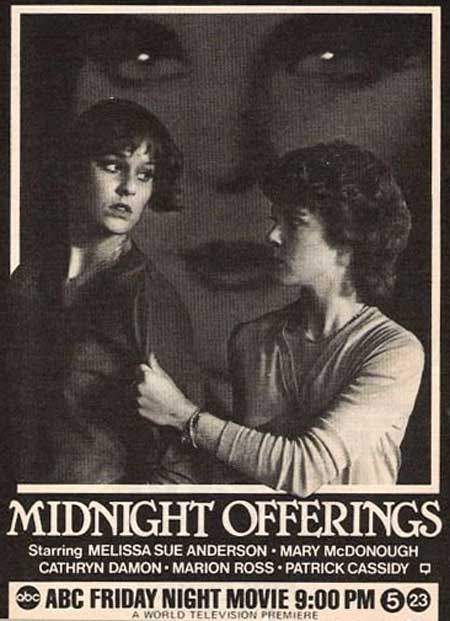
Midnight Offerings (1981)

Vivian Sotherland (Melissa Sue Anderson, Happy Birthday to Me) starts this movie in front of a pentagram, conducting a ritual that will send one of her teachers up in flames and keep her boyfriend David (Patrick Cassidy, brother of Shaun and half-brother of David). Light the black candles, it’s time for witchcraft in the 1980’s suburbs!

Originally airing on February 27, 1981, Rod Holcomb (the Captain America TV movie, as well as episodes of E.R.China Beach and more) directed this occult themed effort that mines the same territory as The Craft, albeit 15 years earlier.

Despite all that Vivian has done for David, he’s bored with her. Or maybe afraid of her. She’s the most popular girl in school with everything she wants. When new girl in school Robin (Mary Beth McDonough from TV’s The Waltons) arrives, David — and Vivian — are both fascinated by her.

Vivian’s parents (Gordon Jump from WKRP in Cincincati and Cathryn Damon from Soap and She’s Having a Baby) live in denial of their daughter’s power. Meanwhile, Robin’s father (Peter MacLean, Squirm) has already moved her far away from her last school as her powers made her an outsider.

Vivian gets her powers from sacrifices to Hecate, whereas former witch Emily Moore (Marion Ross from Happy Days) believes that Robin comes from a long line of witches. There’s an awesome scene here where Vivian’s mom reminds her that she was once a witch and her daughter basically decimates her psyche. There’s also a lot of dark eyeliner and poutiness, so if Vivian her been a student at my high school, I would have totally asked to do her homework and made her mixtapes with lots of Sisters of Mercy, The Cure and Ministry (back when they were a synth band) on them.

I wouldn’t mind that Vivian put Robin’s dad in the hospital or tried to set her house on fire. It’d be a pure teenage love. I mean, I fell head over heels for mean girls all the time who couldn’t set crows loose on their enemies. All they could do was talk down to me!

Basically, this film descends into Little House on the Prarie (Anderson starred on that show as Mary Ingalls) vs. The Waltons (as mentioned above, McDonough was Erin Walton). A wood shop becomes a war zone as the two young women battle one another to the death.

I really love the dichotomy that is set up between the two witches, one who has her power from trickery who only wants corruption and who hates her mother versus a good witch who lost her mother when she was young and who comes from a lineage of witches, with a name that is even filled with strength. The fact that all of this craziness is happening within the soul-crushing boredom of the California suburbs is even better.

The ending — with the burn witch burn line being shouted — is awesome. And dark. And doomy. And perfect.

Plus, stars like Vanna White, Dana Kimmell (Friday the 13th Part 3), Jeff Mackay (Lt. McReynolds from Magnum P.I.), Gary Dubin (Jaws 2) and Jack Garner (who is also in the TV movies This House Possessed and Fantasies) show up.

This movie has never been released on DVD, but you can find it through gray market sources and on YouTube. You should totally check it out!

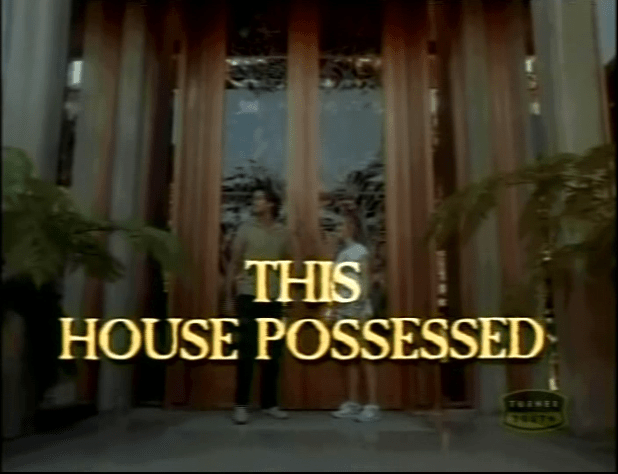
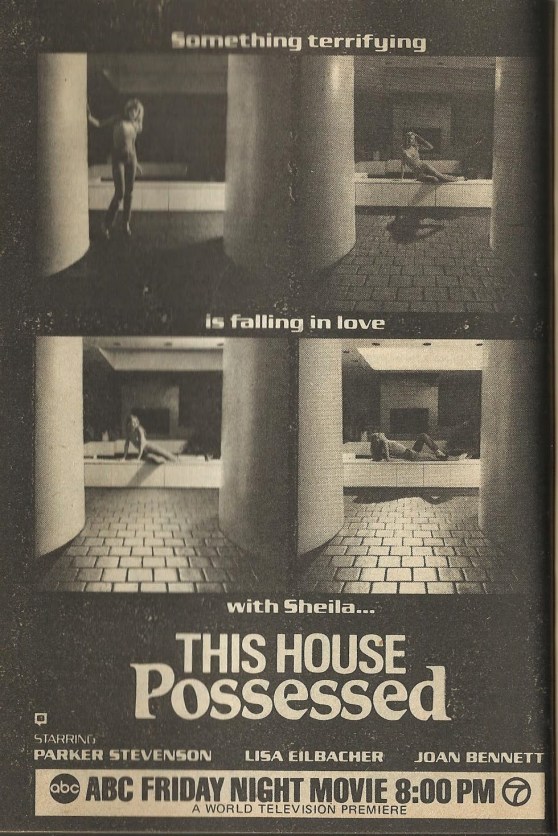
This House Possessed (1981)

A rock star has a nervous breakdown and decides to recuperate in a remote house. Yet he finds himself asking, “Am I insane? Or is this house haunted?” Just by reading the title of this movie, I think you know the answer.

Gary Straihorn (Parker Stevenson, former husband to Kirsty Alley and one of TV’s Hardy Boys) has hired a nurse named Sheila (Lisa Eilbacher, Bad Ronald) to help him. The house they settle in seems way too familiar to her, but she can’t remember a lot of her life. Like the fact that she may be named Margaret. But everyone who either screws with her — like Gary’s girlfriend Tanya — or tries to help her, like a woman who gives her some newspaper clippings, all get killed by the house. Can a house fall in love with someone? After you see this, you’ll answer: YES.

There’s a great cast in this as well, including Slim Whitman (The Howling), Joan Bennett (Suspiria and TV’s Dark Shadows), character actor David Paymer, Amanda Wyss (the first person Freddy kills in A Nightmare on Elm Street) and even Philip Baker Hall (Magnolia) shows up in a blink and you’ll miss him role.

This movie was directed by William Wiard (his 1980 TV movie The Girl, The Gold Watch and Everything was a big deal when it came out) and was written by TV writing and producing vet David Levinson. They’d also work together on another TV movie, Fantasies.

This has never been released on DVD. You’re at the mercy of the grey market and YouTube. Trust me, it’s worth it.

Feed Shark

LARRY COHEN WEEK: Full Moon High (1981)

Four years before Teen Wolf (and 24 years after I Was a Teenage Werewolf), Larry Cohen wrote, produced and directed Full Moon High, a comedic take on what it’d be like to be a werewolf in high school. Ironically, it came out in the same year as An American Werewolf in London, covering some of the same ground, but from a very different perspective.

The tie to Michael Landon’s werewolf turn is that the opening of this film is in the 1950’s. There, Tony Walker (Adam Arkin, Halloween H2O) is a high school football player whose dad, Colonel William Walker (Ed McMahon!), is in the CIA. He takes his son with him to Romania for a secret mission where he’ll shove some microfilm up his own ass. Yes, if you ever wanted to see Johnny Carson’s sidekick yell things like, “Did you get laid?” and act like he’s being butt plugged, then this is the film for you!

Tony gets his palm read by a gypsy while his dad is having sex with a prostitute — yes, this is a comedy — and finds out that he’ll be an eternal doomed to wander the earth. Soon, he will return home to find his destiny and he shouldn’t make any plans during the full moon. On his way back to the hotel, Tony is killed by a werewolf and returns from the dead the next morning.

On their way back to the U.S., Cuban terrorists hijack their plane, but Tony transforms into a werewolf and takes them out. However, Tony’s curse keeps him too distracted to play football, so he misses the big game and costs his school the championship. He also starts to hide from his girlfriend Jane (Roz Kelly, New Year’s Evil) as he’s worried that he will kill her. His dad is convinced that Tony is a neighbor’s dog until he catches him transforming and tries to shoot his son. The bullet ricochets and kills the Colonel and Tony skips town after the funeral.

The film descends into pathos here — not the last time it’ll happen — as Tony wanders the earth for twenty-five years before returning home. It’s just in time, as Tony’s football team hasn’t scored a touchdown since he left town.

His old girlfriend, Jane, is married to his old friend Flynn and still calls out his name during sex. She figures out that Tony Jr., as he calls himself as he returns to town, is really Tony. And she’s fine with having sex with a werewolf. There’s also Ricky (Joanne Nail, The Visitor), a high school girl who falls for him. Oh yeah — and Tony also goes full werewolf and kills his principal before turning himself in. His court-appointed shrink, Dr. Brand (Adam Arkin’s dad, Alan) really wants to conduct experiments on Tony, but acts like he’s trying to help him.

There are plenty of character actors and strange personalities in this strangely cast film. In addition to Ed McMahon, there’s also Laurene Landon (Maniac Cop…All the MarblesThe Stuff), Sanford and Son‘s Demond Wilson, 1980’s sitcom and Hollywood Squares star Jim J. Bullock, Bob Saget in an early role as a sportscaster and Pat Morita (The Karate Kid) as a silversmith.

Cohen said of the film, “It has some interesting ideas about how life in America has changed sexually and politically since the early sixties. All of Arkin’s friends have changed but he hasn’t. And whereas he changes into a werewolf all of the time, his friends change into middle-aged people while he is gone, with different values and different ideas. They change as much as he does, actually.”

Where most of Larry Cohen’s films succeed in spite of their high concept and low budget, Full Moon High was a bit of a struggle for me. That said, Alan Arkin is great in this and elevates every scene he’s in.

Shout! Factory is finally releasing this film on blu-ray. It’s been available in grey market form for awhile, but it’s getting their full treatment and comes out on April 10th, complete with plenty of extras.

Free Plagiarism Checker

FULCI WEEK: The House by the Cemetery (1981)

It’s impossible for me to be objective. The House by the Cemetery is one of my favorite films ever. I cannot defend it’s lack of story, the fact that it’s influences are pinned to its sleeve or that it makes little to no sense. The first time I watched it — at a drive-in marathon that also included Zombi 2 — was an experience that burned the film into my brain.

The beginning will grab you in seconds, as a woman searches for her boyfriend in an abandoned house. She finds him dead, stabbed with scissors. Just then, she’s stabbed in the back of the head and the blade of the knife comes out of her mouth! We see her dragged away as the movie begins.

Meanwhile in New York City, Bob Boyle (Giovanni Frezza, Warriors of the WastelandManhattan BabyDemons) and his folks, Norman (Paolo Malco, The New York Ripper, Escape from the Bronx) and Lucy (Katherine MacColl, City of the Living Dead, The Beyond) are moving to the abandoned house we saw in the beginning of the film. Sure, Norman’s friend Dr. Peterson killed his mistress and committed suicide there, but why would that be a problem?

In one of the eeriest scenes in the film, Bob looks at a photo of the house and notices a young girl moving from room to room. This is the most subtle of all frights, a small moment where reality is not as it should be, and far more potent than even the goriest of grue that Fulci will soon serve up with glee. Only Bob can see this vision, which warns him to stay away.

As his parents get the keys to the house, Bob sees the girl again. Inside the rental office, Mrs. Gittleson (Dagmar Lassander, Hatchet for the Honeymoon) is upset that the couple has the Freudstein keys to Oak Mansion, but she promises to find a babysitter from Bob.

The mansion is a mess. Yet when the babysitter (Ania Pieroni, Inferno) comes, she enters the previously locked and nailed shut cellar door. Strangeness follows, like a librarian recognizing Norman despite never meeting him, the discovery of a tomb inside the house and a bat attack.

The Boyles demand a new house as Norman goes to the hospital. Mrs. Gittleson comes to tell them that she’s found a new property, but the Freudstein tombstone in the ground holds her while a figure stabs her in the neck. The next morning, Ann the babysitter cleans up the blood and avoids questions.

While the Boyles are at the hospital to treat Norman’s injuries from the bat, Mrs. Gittleson arrives at the house to tell them of a new property. Letting herself in, she stands over the Freudstein tombstone, which cracks apart, pinning her ankle. A figure emerges, stabs her in the neck with a fireplace poker, and drags her into the cellar.

The next morning, Lucy finds Ann cleaning a bloodstain on the kitchen floor while eluding Lucy’s questions about the stain. As they drink their morning coffee, Norman tells Lucy that the house was once home to Dr. Fruedstein, who conducted horrific experiments in the basement. He decides to go to New York City to learn more and on the way, he finds out that Freudstein killed his old friend Peterson’s family.

Ann can’t find Bob, so she goes to the basement where Freudstein slashes her throat and decapitates her. Bob finds her head and screams, but his mother refuses to believe the story. Bob goes back to the cellar but gets locked in. His mother tries to open the door, which can’t be unlocked. Norman returns and they make their way down to see Freudstein’s hands holding Bob. One axe slash later and the hand is cut off as the monster goes away to recover.

Inside the basement, Norman and Lucy find mutilated bodies, surgical equipment and a slab. Turns out that Freudstein is 150 years old and has learned to escape death. He returns and attacks Norman, who returns the favor by stabbing him. The twisted doctor replies by ripping out Norman’s throat. Lucy and Bon try to escape, but Freudstein drags her down to the basement where he rams her head into the floor until she dies.

Finally, the doctor grabs Bob, who is rescued by Mar and her mother, Mary Freudenstein. Mary tells them that it’s time to leave as she leads Mae and Bob down to a world of gloom and ghosts. The film ends with this quote:

House by the Cemetery is a mash-up of FrankensteinThe Amityville Horror and The Shining. And it’s another in the series of classics that Dardano Sacchetti (working with Giorgio Mariuzzo here) wrote for Fulci. If you think it’s nonsensical, imagine how early American audiences felt when the original VHS copies released in the U.S. had several of the reels out of order!

Seriously, this movie makes no sense whatsoever. There aren’t plot holes because there’s not even a plot. And sure, some say there’s too much gore. Yes, I’ve heard these complaints and I say no to all of them! Look, you’re either going to become an evangelist for this film (if you meet me in person, there’s a good chance I’ll have on a t-shirt with this film’s logo, I wear the shirt all the time) and you’ll think it’s the biggest piece of garbage ever made.

Decide for yourself! It’s on Shudder!

FULCI WEEK: The Black Cat (1981)

There’s a moment in The Black Cat where Patrick Magee is lying on a grave, begging a voice to speak to him while the black cat looks on with hatred in his eyes, as fog rolls across the graveyard, where you say to yourself: this is gorgeous art, far above the hack title that so many give to Fulci. In fact, this is a film packed with moments just like this.

Based on the Edgar Allan Poe story, the film starts with the titular black cat hypnotizing a man and making him crash his car. He smashes through the windshield and catches fire, all while beautiful music plays and the cat explores his neighborhood. This sequence is so perfect, a wordless way to show how this cat can be seen as pure evil yet is above the morality of humanity.

We follow the cat to the home he shares with Robert Miles (Magee, who also appeared in Asylum and Tales from the Crypt), a medium obsessed with speaking with the dead. We also meet Jill Travers (Mimsy Farmer, Autopsy), an American tourist who is taking photos of crypts when she finds a broken microphone. She meets Sergeant Wilson (Al Cliver, The Beyond), who warns her that his father told her not to bother the dead. He reminds her that this is a small British town and not London, so even a cop can be superstitious.

Meanwhile, a young couple goes to a boathouse to have sex. However, the key disappears, the air conditioning breaks and they are left to die as the air runs out. Fulci cuts back and forth between what’s happening in the outside world and then dying hand in hand.

The girl’s mother, Lillian (Dagmar Lassander, The House by the Cemetery) asks the police to help find her daughter, bringing Inspector Gorley (David Warbeck, The Beyond) from Scotland Yard. Jill seeks the owner of the broken microphone and discovers Miles. He explains how he can easily hypnotize her and make her do whatever he wants before the black cat attacks him, breaking his hold over her.

Later that night, the cat kills a drunk by causing him to fall in.a barn and get impaled. With no one else to take photos, Gorley asks Jill to take photos for him. She notices the dead man has scratches on his hands just like the cuts the cat gave to Miles.

Lillian begs Miles to find her daughter, even offering to fall back in love with him again. After falling into a trance, he gives clues that lead the police to the boathouse, where the bodies of the couple are found. However, the room is locked from the inside, leaving the murders a mystery. Hours later, the black cat kills Lillian in a house fire.

Jill accuses Miles of using his evil on the cat, but Miles claims the cat has possessed him. Later, he drugs the feline and murders it, but that only gives the cat more power. Even Gorley — an unbeliever — sees the cat, which puts him in a trance, causing him to walk right in the path of a car.

Jill then breaks into Miles’ house to listen to his recordings of the dead. He returns home and she hides in the cellar where the cat begins to appear and disappear. Miles finds her and says that the cat is attacking on his hatred of the townspeople. Jill tries to run, but is attacked by bats (oh Fulci, you do so love bat attacks) and then Miles knocks her out and traps her inside a wall.

However, Gorley has survived, leading the police to Miles’ house. While they find no trace of Jill, they do hear the cry of a cat from the basement. Jill is found at the last minute and the black cat leaves, defeating Miles in the end.

The Black Cat gives Fulci plenty of opportunities to fill the screen with foggy atmosphere. There are moments of gore, but it’s not drenched in the red stuff like his later films. You can see it for yourself on Shudder and for free with a membership at Amazon Prime. Or you can grab the Arrow Video reissue at Diabolik DVD.