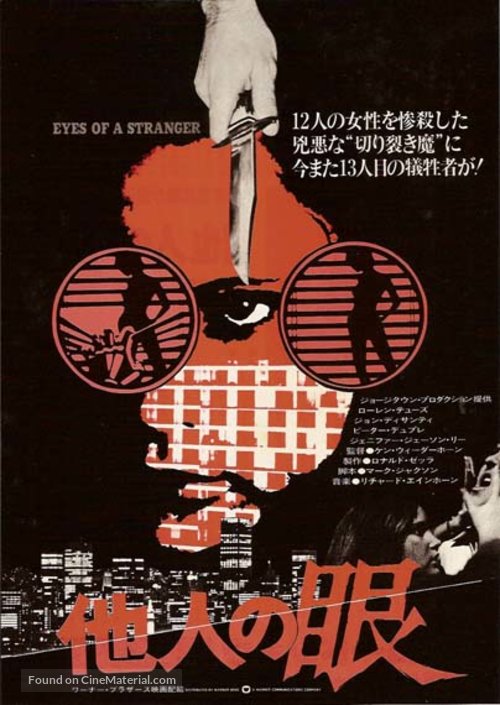
I read a review of this movie that really talked down on it, describing it as a “sleazy TV movie-of-the-week punctuated with gory murder scenes.” That’s positive ink in my neck of the woods, so of course I hunted this down. It’s the first movie that Jennifer Jason Lee — the daughter of Vic Morrow — was ever in.
It’s also a Ken Wiederhorn film, the guy who brought you stand-outs like Shock Waves, Return of the Living Dead Part II and Meatballs II, not to mention the never on DVD movie Dark Tower.
A rapist and murderer has the modus operati of stalking and calling his victims before he takes them out. Now, TV reporter Jane is on the case, feeling like the killer could be a next-door neighbor. She’s played by Braddock, PA’s (the adoptive home of Martin, of course) Lauren Tewes, who was Julie McCoy on The Love Boat.
The film was planned as a straight-forward mystery before the slasher boom took off. So to get to the blood and gore quotient required, they hired Tom Savini to do the special effects. However, the grisly visions he conjured could never get an R rating, so most of his work was exorcised from the film. That said — the 2007 DVD release of the film has an uncut version.
While it’s never explained, Jennifer Jason Leigh’s character is deaf, blind and mute, perhaps the result of a past assault. When the killer targets her in the last ten minutes, the film really picks up the pace.
Wait — am I finally stooping to reviewing the film that single-handledly led to every bastardized MTV slasher wanna-be that littered the shelves of video stores as they died a sad death and even now enraged me as I scan past them on my streaming services?
No. Nope. Not at all.
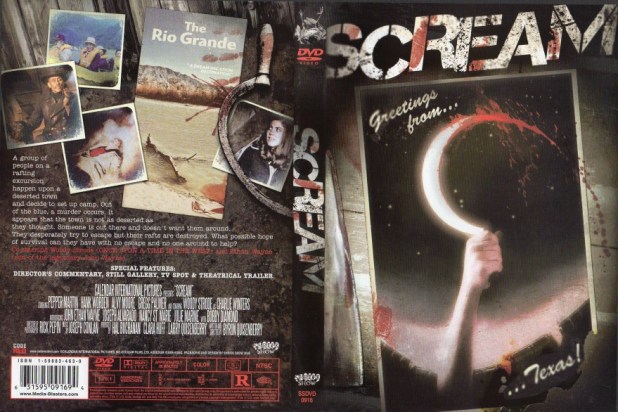
Instead, we’re talking about 1981’s Scream, also released as The Outing.
It was the auteur project for Byron Quisenberry, which sounds like the name of one of the suitors for the Little Women, but he was also the director of 2004’s Hollywood, It’s a Dog’s Life and did stunts for movies like 1972’s Enter the Devil, Mannequin on the Move and Return of the Living Dead.
Beyond writing, producing, directing and doing stunts for this movie, his wife C.L. Huff was the costume designer, nurse, caterer and make-up artist.
I’ll tell you the story of Scream short and sweet: twelve people go camping on the Rio Grande, make the dumb decision to spend the night in an old ghost town, then have to deal with an unseen killer that takes them all out one by one.
To wit: Allen is hung, Rod and John are hacked with a cleaver, Andy gets hit in the face with an axe, would-be leader Bob gets his head chopped off, throws a bunch of dirt bike kids through a door, and Jerry is just found dead.
In between all that, a mysterious cowboy named Charlie Winters (Woody Strode, in addition to being in Spartacus, Jaguar Lives!, Keoma and many more films, was also a pro wrestler from 1949 to 1962) arrives and claims to have been hunting the killer — the ghost of an old sea captain — for forty years.
Woody Strode wasn’t the only pro wrestler in this movie. Pepper Martin plays Bob and he had a long career mainly in the Pacific Northwest. At one point in his career, Strode invited Pepper to Hollywood where they and Lee Marvin ended up screaming in director John Ford’s lawn at 3 in the morning. Somehow, he became friends with the legendary Ford after this.
Another John Ford regular, Hank Worden, also shows up here. You may know him as a senile waiter from the Twin Peaks series or from being in The Searchers. And another actor from that film — John Wayne’s son Ethan — is in this film, too.
Alvy Moore — Hank Kimball from Green Acres — also shows up, making this the fourth slasher I’ve seen him in (for those playing trivia, the others would be Intruder, Mortuary and The Horror Show).
Quisenberry was influenced by Agatha Christie’s Ten Little Indians and was really loose with the story while shooting, not even telling the cast who the killer was.
The results are a movie that isn’t well-considered thanks to its plodding pace, lack of good kills, bad acting and a killer that never shows up, not to mention a hero who runs away after he shoots the villain.
If you can say anything nice about the movie, it’s that the location — the Paramount Movie Ranch — looks great. It’s also where the original Westworld and parts of Bone Tomahawk were also shot there.
DAY 10: ANALOGUE MANIPULATORS: Practical effects are the truth. No CGI will be tolerated.
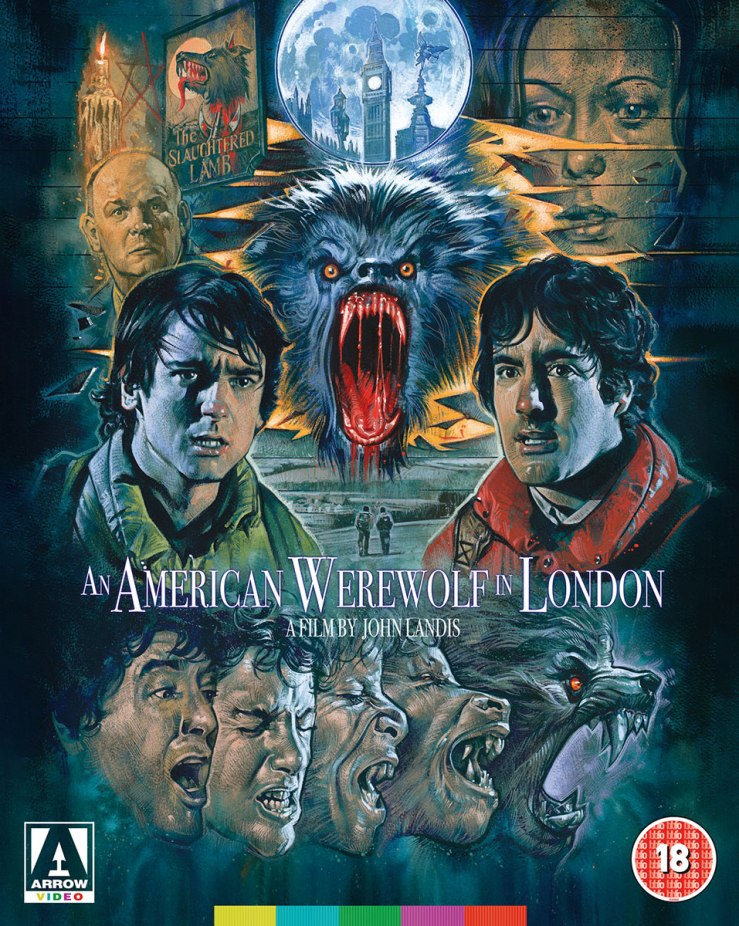
There must have been something in the waters of the Los Angeles River in 1981, as The Howling, Wolfen, Full Moon High and this film all came out in those same twelve months. While all three are interesting films for different reasons, An American Werewolf In London astounded audiences with its special effects.
Rick Baker’s vision was to have the main transformation — set to Sam Cookie’s “Blue Moon” — happen in real-time, with no cutaways or dissolves. Director John Landis compounded the difficulty of this sequence by insisting that it be shot in bright light. This all led to six ten-hour days of prosthetic make-up, but the results were an Oscar — the first of its kind — for special effects make-up and Baker became a household name. Well, in the house of kids who subscribed to Fangoria.
While he was a production assistant in Yugoslavia on the film Kelly’s Heroes, he witnessed an elaborate gypsy funeral where a criminal was wrapped in garlic and buried feet first in the middle of a crossroads so that he would never rise again. This moment of real-life horror stayed with him for over a decade as he built his career in Hollywood.
The money people thought that this movie was too funny to be scary and too frightening to be hilarious. Time has proven them wrong.
David Kessler and Jack Goodman (David Naughton from March Madness and Griffin Dunne from After Hours) are backpacking through Europe. As they make their way across the moors, they stop at a local club called the Slaughtered Lamb. In the midst of all the fun they’re having, they innocently inquire about the star on the wall and are asked to leave. Seriously — the bar just shuts down and forces them into the night, knowing that they’ll die out there.
Look for Rik Mayall in this scene, playing chess with former pro wrestler Brian Glover. Adrian Edmonson had been invited to be at the shoot but blew it off.
As they walk into the night, the pub owners can only say, “Keep to the road, stay clear of the moors and beware of the full moon.” Of course, that means that our heroes wander off the path and are surrounded by a creature that howls at the full moon. Jack is milled and David barely survives when the pub’s patrons come out to save him. As he passes out, he sees that it wasn’t an animal that attacked, but a nude man.
Three weeks later, David wakes up in a hospital where Inspector Villiers tells him that he and his friend were attacked by a lunatic, while our hero insists that it was a wolf. That’s when things get even weirder — Jack appears, even though he’s dead, and demands that David kill himself before the next full moon. As long as the bloodline of the werewolf continues, Jack will be undead, forced to haunt the world.
As David heals up, he moves in with Alex Price (Jenny Agutter, Logan’s Run), a nurse who helped him get back on his feet. Instead of being able to celebrate young love, Jack’s warnings — and decay — grow more insistent as we get closer to that epic transformation scene.
The rest of the film is a rollercoaster of werewolf attacks and David trying to reason with Jack, who is joined by all of David’s victims inside an adult movie theater. Finally, the police — and Alex — close in.
Today, Landis regrets some of his choices as he made the film, such as cutting certain sequences to earn an R rating. For example, the sex scene when Alex and David finally consummate their relationship was a lot more explicit and there was an action sequence where David as a werewolf would wipe out the homeless along the Thames. The director also felt that he spent too much time on the transformation scene sequence because he was so fascinated by Baker’s effects.
That said, Landis and Baker were never on the same terms after this film. It took eight years to make the movie and Baker decided to use all of the work he’d created so far for The Howling. Right around the same time, Landis finally got the movie greenlit and called Baker, who had to tell him he was already lining up a werewolf project. After getting screamed at over the phone, Baker left the project in the hands of his assistant Rob Bottin and only consulted on that film.
Special effects would never be the same after this film. Today, the entire transformation would be computer rendered, with those amazing monsters only truly existing on the screen. This film’s effects were so upsetting to even the actors that it caused depression when they first saw how damaged their faces were.
Arrow Video’s release of this film — which you can order from Diabolik DVD — is packed with everything you’ve come to expect from this label. There’s a new 2018 4K restoration from the original camera negative supervised by Landis, as well as two commentaries — one from filmmaker Paul Davis and another with actors David Naughton and Griffin Dunne. There’s also Mark of The Beast: The Legacy of the Universal Werewolf, a newly produced and feature-length documentary by filmmaker Daniel Griffith, Beware the Moon (Paul Davis’s feature-length exploration of the film complete with extensive cast and crew interviews), a new interview with Landis entitled An American Filmmaker in London, and a video essay by Jon Spira (who made Elstree 1976, a movie about ten extras who were in Star Wars) called I Think He’s a Jew: The Werewolf’s Secret. There are also discussions on how the movie impacted today’s filmmakers, special effects artists and archival making-of features. If it sounds like Arrow went above and beyond, well — they do this on just about every movie they release.
PS — Please, by all means, avoid An American Werewolf In Paris (starring Tom Everett Scott of Tom Hank’s That Thing You Do!), a movie made by none of these people that has extreme bungie jumping in it. That’s probably the only reason to watch it, actually.
DISCLAIMER: We were sent this movie by Arrow Video, but we’ve alreayd bought it several times and were planning on purchasing this new version anyway. This has no bearing on our review.
William Asher was credited by many as inventing the TV sitcom. He brought Our Miss Brooks from radio to TV, directed 100 out of 179 episodes of I Love Lucy, produced and directed Bewitched (which starred his second wife Elizabeth Montgomery) and also had episodes of Make Room for Daddy, The Twilight Zone, The Patty Duke Show, Gidget, The Dukes of Hazzard and Alice on his resume. He even planned JFK’s inauguration ceremony along with Frank Sinatra.
He was also one of the leading beach party directors, with Beach Party, Muscle Beach, How to Stuff a Wild Bikini,Beach Blanket Bingo and Bikini Beach to his credit. Of this time in his life he would say, “The scripts of the Beach Party films were sheer nonsense, but they were fun and positive. When kids see the films now, they can get some idea of what the ’60s were like. The whole thing was a dream, of course. But it was a nice dream.”
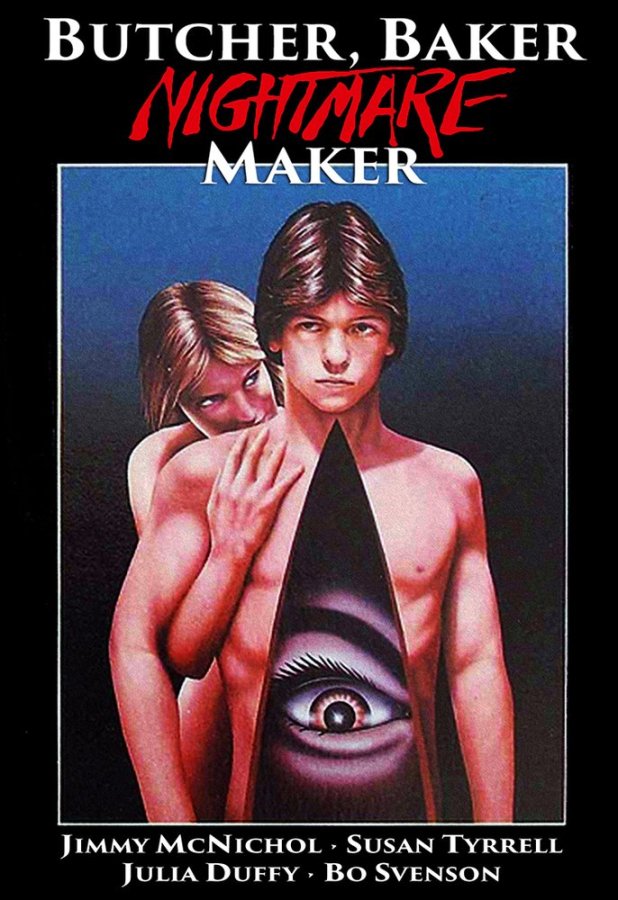
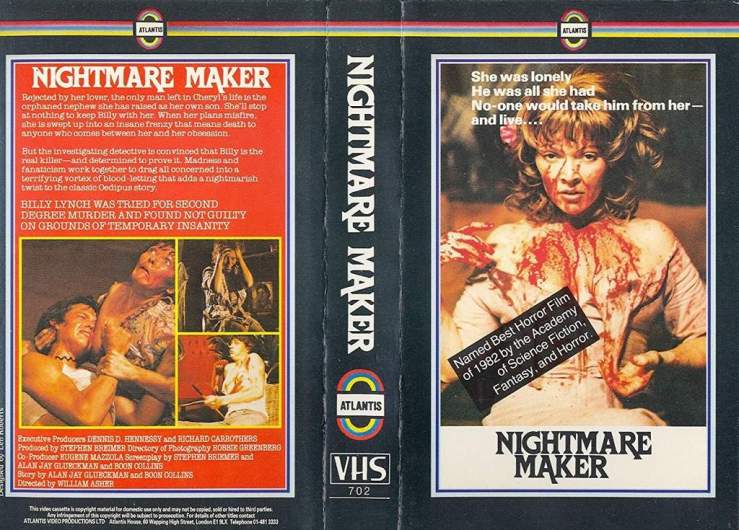
I tell you all this to set you up for one of the strangest films I’ve ever seen — imagine what that entails — and one that has stuck with me for years:: Butcher, Baker, Nightmare Maker.
Originally, Michael Miller (Jackson County Jail,Silent Rage) was set to direct this film, but he was replaced by Asher (he had also recently lost the job on The Eyes of Laura Mars to Irvin Kershner). He did direct the opening, however.
And what an opening it is!
Years ago, Billy (Jimmy McNichol, brother of Kristy, who is shirtless pretty much for the entire film) was sent to stay with his aunt Cheryl (Susan Tyrell, owning this movie like no one has ever owned a movie before). However, not only did their brakes give out, but a giant log beheads Billy’s dad and the car goes off a cliff, where we see a photo of young Billy float out into the water as the car explodes. Yes, all of that, in the very first scene of the movie!
Now, Billy is a high school senior living with his aunt. He has a dream of playing basketball on a scholarship at the University of Denver, but Cheryl is having none of it. His school life isn’t much better, as his teammate Eddie (Bill Paxton!) is jealous of his closeness to their coach Tom Landers (Steve Eastin, Field of Dreams). But there’s a bright silver lining in that the school’s newspaper photographer, Julia (Julia Duffy from TV’s Newhart) is into him.
On Billy’s seventeenth birthday, his aunt changes her mind about the scholarship just in time for her to put the moves on TV repairman Phil Brody (William Caskey Swaim, Friday the 13th: A New Beginning), who rebuffs her, only to then pull down his pants and tell her to “work it.” She flips out and attacks him, so he shoves her down. She retaliates with a kitchen knife as Billy watches from outside the window as blood sprays all over his birthday balloons.
Cheryl hysterically tells the police that Phil tried to rape her. But his blood is all over Billy and so are the kid’s prints on the knife. That brings in Joe Carlson (a brutal Bo Svenson), whose homophobic mindset deduces that Billy’s coach Tom was his love and that Billy killed Phil — who was Tom’s lover — as part of a love triangle gone wrong. He thinks Cheryl is just covering up for her nephew when the truth is anything but that.
What follows is Cheryl going bonkers, doing all manner of things like drugging Billy’s milk so that his basketball tryout goes wrong and shearing her hair into an unmanageable chunk of a hairstyle. Oh yeah — she also treats her nephew way too lovingly, to the point that it’s uncomfortable. And then she goes completely insane when she catches Billy in bed with his new girlfriend.
Of course, by the end of the film she’s nearly murdered that girlfriend twice, stabbed a noisy neighbor, killed a cop and we discover that she’s really Billy’s mom and his birth father’s body is mummified in the basement while his head floats in a jar of formaldehyde.
Even after their final confrontation, Billy must deal with Joe the cop and his bigoted ways. To say that this movie builds to a fever pitch is an understatement. And I really don’t want to give all that much more away. Yes — even with those spoilers above, there’s so much more to explore here.
Nearly all of the major creative forces of this film came from places of personal pain. Asher lived through the Depression, losing his father before he was even a teenager. His mother (stage actress Lillian Bonner) became an alcoholic so he escaped by way of the Army Signal Corps at the age of 15.
Screenwriter Alan Jay Glueckman (his script Russkies was made into a film directed by Halloween IIand Halloween: Resurrectiondirector Rick Rosenthal, plus he wrote two home invasion made for TV movies, The Fear Inside and Face of Fear. Plus, his short film Pickup was the first film appearance of Glenn Close) continually wondered about who his birth parents were and had a tumultuous relationship with his adoptive ones due to their refusal to accept his homosexuality.
And Susan Tyrell, the heart of this film, was born into show business. Her father was a top agent at the William Morris Agency, representing Loretta Young and Carole Lombard. Yet she always described her proper upbringing as miserable, due to her demanding British mother, a socialite and member of the diplomatic corps in China and the Philippines during the 1930s and 1940s.
By her teenage years, Tyrell had cut off contact with her mother, of whom she would say, “The last thing my mother said to me was, “SuSu, your life is a celebration of everything that is cheap and tawdry.” I’ve always liked that, and I’ve always tried to live up to it.”
She stayed in contact with her father, who was able to use his connections to get her a bit part in a touring play with Art Carney, as well as have Look magazine follow the show. He’d die a few months later from a bee sting.
Even her Playbill obituary says that she specialized in roles like “whores, lushes and sexpots.” Perhaps her most famous role was in John Huston’s Fat City, which earned her an Academy Award nomination. She also was part of the Warhol Factory scene and appeared in plenty of films that are part of my collection, such as being the Queen of the Sixth Dimension in Forbidden Zone, Solly in Angel and Avenging Angel, the miniature Midge Montana, wife to Kris Kristofferson’s ringmaster in Big Top Pee-Wee and Ramona Rickettes, the grandmother to Johnny Depp in Cry-Baby.
What I’m saying is, this is a movie made by people who actually lived.
This movie has it all — malignant motherhood, a modern day retelling of Oedipus, an inversion of the final girl trope where Billy becomes the victim and Julia the helpful savior and — strangely enough for a film made in 1981 — the homosexual characters are the positive characters in the story and not the monsters. In fact, Billy may be homosexual himself, if you chose to read the movie that way.
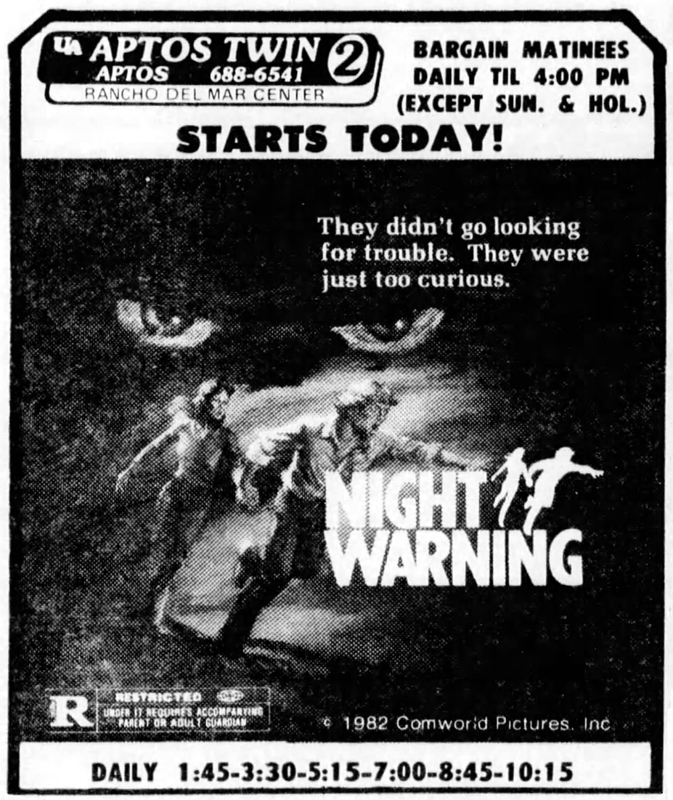
Of course, this movie was pretty much dead on arrival, thanks to a disastrous test screening and a new title, Night Warning, that says nothing about what the audience is about to see. It’s also a movie so strange that it seems to occupy its own universe, unlike any other film before or since. I can see why the general public wouldn’t enjoy it. In England, it made the infamous category 2 video nasty list.
Basically, what I’m saying is rush out, find this and watch it. Now.
This sold out the last time Ronin Flix offered it, so I’d head over to their site ASAP to grab one. It’s such a weird slice of cinema that demands to be in your collection.
DAY 5. MUMMY’S DAY: An ancient woman wrapped in linen has resurfaced with new purpose.
There are plenty of mummy films to choose from, but ever since I wrote this article on section 3 video nasties, I’ve been wanting to watch this.
Dawn of the Mummy was directed by Farouk “Frank” Agrama, who was also behind the camera for the abysmal King Kong parody, Queen Kong. He’d go on to form Harmony Gold — yes, the same people who redubbed Macross, Southern Cross and Genesis Climber Mospeda and turned them into Robotech. After that, he’d later be convicted of buying and selling film rights at inflated prices in a scandal that also brought down former Italian Prime Minister Silvio Berlusconi. Agrama would have gone to jail if he wasn’t 82 years old, but was later exonerated.
Dawn of the Mummy was shot in Egypt with a mostly Italian crew, which allows it to transcend its boring beginnings and emerge with a second half filled with utter mayhem, as these mummies aren’t just content to shamble around. No, they’re closer to zombies that must feast upon the flesh of the living.
The film begins in ancient Egypt, where youngvillagers are taken away to be the servants for Pharaoh Sefirama in the next life. As we watch his body get prepared for the next world, they’re killed with poison gas and the entrance to the tomb is sealed. Then, the high priestess places a curse on the pyramid, declaring “he who enters this tomb, after it is sealed, will die on the dawn of the mummy”.
By the way, if you watch movies with me, please know that any time the title of the film is said within the dialogue, I scream and yell as if I’m Pee-Wee Herman and you just said the secret word.
We then fast forward to the present, where the high priestess — now an ancient crone — chases off some grave robbers. They’re persistent, however, even in the fact of poison gas, but we soon discover that they’ve met their demise when a fashion shoot in the desert ends up with a model tripping over one of their severed heads. Yep — if you’re expecting a bloodless mummy affair, you picked the wrong scuzzy movie to enjoy.
One of the grave robbers, Rick, has survived. The film then goes into he and his henchmen following the fashion shoot into the cursed pyramid. Yes, you may have always wondered, “How would the pharaohs react to disco and vogueing?” This is the movie that strives to answer that question.
The photographers being their lighting into the pharaoh’s burial chamber, which behins to wake the slumbering monarch. Then someone spills a bowl filled with the mummy’s organs and burns her hands, thanks to the blood of the mummy. That sends a torrent of zombie-like mummies into the streets. Numerous explosions later, our heroes — such as they are, they’re all pretty much morons — celebrate even through Pharaoh Sefirama is still alive.
This movie was remade in 2015 as Prisoners of the Sun, with Joss Ackland and John Rhys-Davies. It’s directed by Roger Christian, who of course brought us Battlefield Earth.
Anchor Bay released this years ago, but it’s currently out of print. If you want to see it, it’s on Amazon Prime. It’s nowhere near as good as the poster makes it look, but it’s certainly different than most mummy films. It’s a movie so messy and scummy that you feel like you may very well be covered in the dusty, mucky and grue of the tombs that it explores.
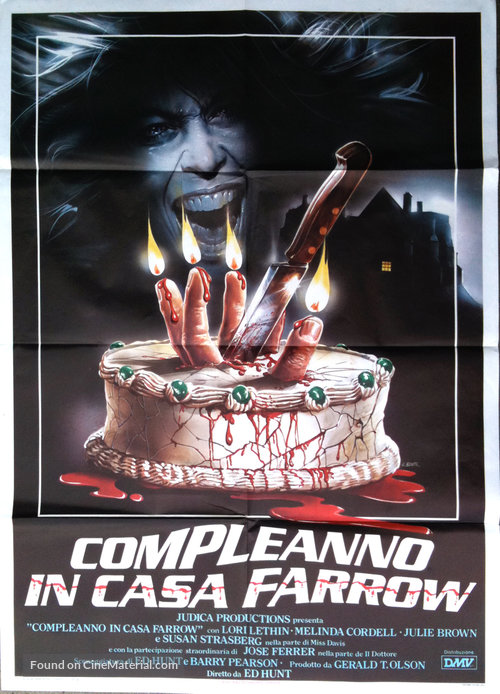
Director Ed Hunt brought us The Brain and Starship Invasions. But as the slasher boom continued, he combined The Bad Seed with the multiple murders that audiences were demanding. Jose Ferrer is along for the ride as a doctor and to add some Old Hollywood star power to the proceedings.
June 9, 1970. Southern California’s Meadowvale General Hospital sees two boys and a girl born during a solar eclipse. Certainly, this can’t be good.
Ten years later, a series of murders has been happening in town. Sheriff Brody comes to his daughter Debbie’s class and asks if any kids have seen a shovel or jump rope, but no one speaks up. Then we meet Debbie’s friends Curtis and Steven, who invite their teacher Ms. Davis (Susan Strasberg, the daughter of famous acting coach Lee and the originator of the main role in The Diary of Anne Frank; she’s also in Sweet Sixteen) to their birthday party.
The kids waste no time killing the lawman, trying to get him to trip on a skateboard before beating him with a baseball bat. Then, as they notice that a kid name Timmy is watching, they lure him to a junkyard and try to trap him in a fridge.
While he escapes, the kids go bonkers from here on out. Curtis shoots their teacher with the dead cop’s handgun. Then they graduate to using cars and vans as weapons.
How would you explain all of this to your kids? Timmy’s mom Joyce (Lori Lethin, The Prey, Return to Horror High) explains to him that Saturn was blocked when the three kids were born, which is the normal planet that controls how people treat one another.
Figuring that she’s figured out their scheme, the kids make Joyce look insane. And even worse, they kill Debbie’s older sister once she catches wise, too. This is where I should mention that Julie Brown — yes, the Earth Girls Are Easy Julie Brown — plays Beverly and she dances nude in a scene that was always in Celebrity Skin back before we had a thing called the internet.
I kind of love that Debbie is very much the Rhoda Penmark of this movie, always getting the boys to do her bidding and continually blaming them for everything. Even when these kids are caught, you get the feeling that they’re never going to learn how to behave. They’re going to become even worse murderers or go into politics.
Joe Penny from Riptide is also in this, as is Billy Jayne — who in addition to being in The Beastmaster, Superstition and Cujo is the half-brother of Scott “Bad Ronald” Jacoby — and Cyril O’Reilly, Tim from the Porky’s movies.
You can watch this for free from Tubi. Or grab the Arrow Video blu ray release.
This movie is based on Two Halves in Hell, a 1962 Hungarian film directed and co-written by Zoltan Fabri also known as The Last Goal. Based on a story about a soccer match — yes, football in the rest of the world — between German soldiers and Ukranian POW’s during World War II, it’s also the inspiration for The Longest Yard. The major difference is that the Nazis kill all of the good guys in Fabri’s version of this story.
In truth, the so-called Death Match — in which FC Dynamo Kyiv defeated German soldiers — probably never happened. The team did actually play several matches against German teams and won all of them before they were sent to prison camps where at least four were killed long after the games were played.
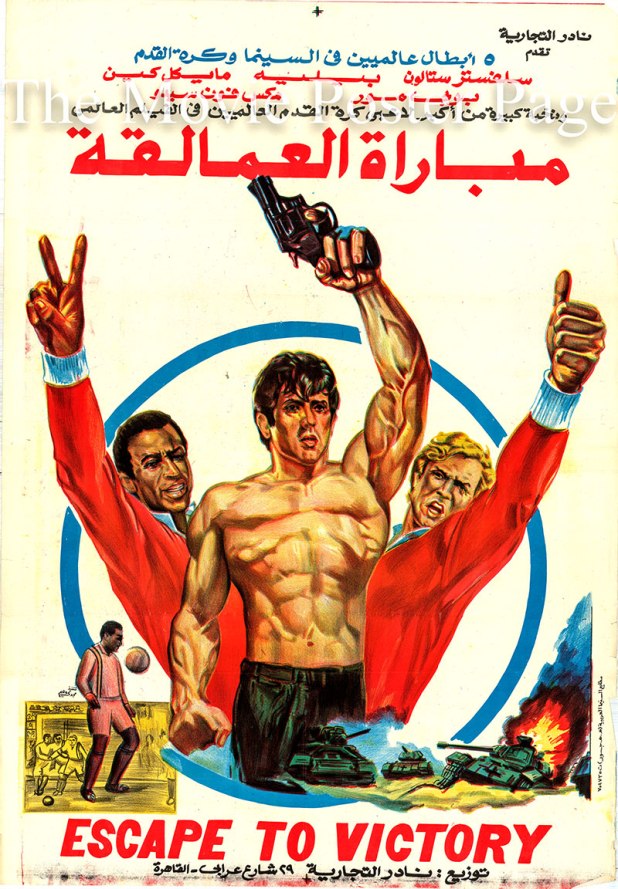
Escape to Victory, as this movie is also known, features plenty of major soccer stars of ist era, including Bobby Moore, Osvaldo Ardiles, Kazimierz Deyna, Paul Van Himst, Mike Summerbee, Hallvar Thoresen, Werner Roth and perhaps the best player of all time, Pele.
A team of Allied POW’s — who are coached by English Captain and former West Ham United star John Colby (Michael Caine) agree to play an exhibition match against a German team. However, they soon learn that this is all a publicity stunt.
Meanwhile, Robert Hatch (Sylvester Stallone), an American who served with the Canadian Army, nags Colby into joining the team, which is a cover for an escape attempt. However, the coach worries that this will get his team killed.
Hatch escapes to Paris and facilitates an escape plan with the French resistance and allows himself to be recaptured so that he can send messages from British High Command to officers who are inside the camp. To get Hatch on the team, Colby has to break his goalkeeper’s arm and then trains the American on how to play.
At halftime, the team is down 4-1 thanks to bad officiating, despite the star power of Luis Fernandez (Pele), Carlos Rey (Osvaldo Ardiles) and Terry Brady (Bobby Moore). Hatch shows that he can play goal and the team rallies back to deny a German win and escape anyway as the crowd shouts victory.
George Mikell continues his multiple roles as a German soldier (he also plays one in The Guns of Navarone and The Great Escape) and he’s joined by Max von Sydow as Major Karl von Steiner. It’s all directed by John Huston, whose career goes from the highs of The Maltese Falcon to the lows of acting in films like The VIsitor (which I love, but…man, night and day).
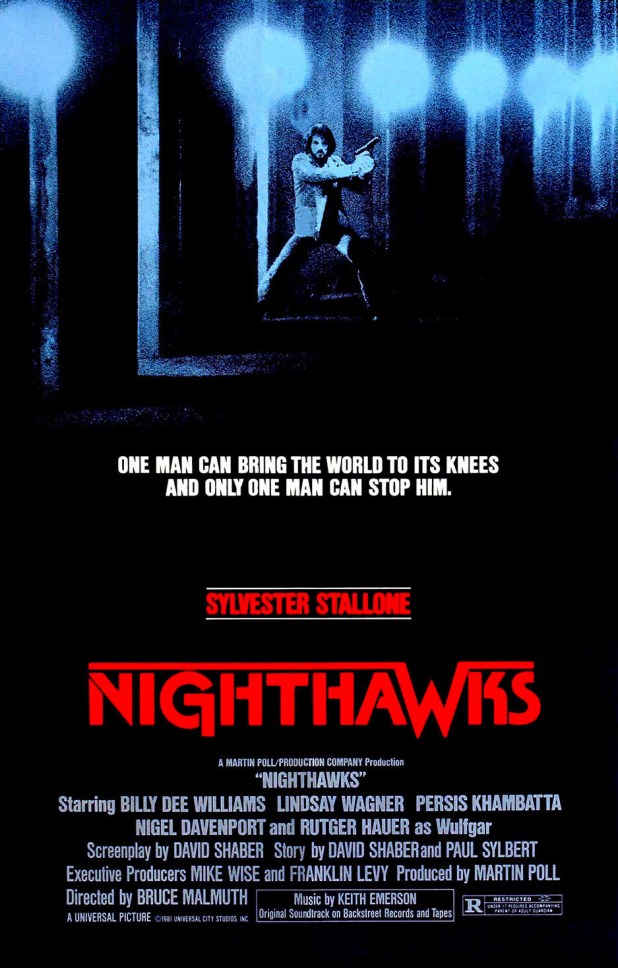
Sylvester Stallone started soccer training while filming Nighthawks under England’s World Cup-winning goalkeeper, Gordon Banks. After a dislocated shoulder and breaking one of his ribs, Stallone said that soccer been harder than fighting in the Rocky movies. Apocryphically, it’s said that he wanted to score the winning goal at the end of the film and it had to be explained that goalies don’t get to do that, so the penalty kick scene was added in.
Maybe Sly was right! Since this movie was made, goalkeepers have abandoned the net and gone forward for a last-minute set-piece such as a corner, adding to the team’s numbers in the area near the goal. As a yinzer, I can only assume that this is like pulling the goalie in hockey. Manchester United Peter Schmeichel actually scored a goal in 1997 under these conditions.
Bruce Malmuth played the ring announcer in The Karate Kid, but he was also a director with this movie, Hard to Kill and The Man Who Wasn’t There on his resume. He replaced Garl Nelson (Freaky Friday, The Black Hole), who was fired within the first week.
The story was originally planned as The French Connection III by screenwriter David Shaber (The Warriors) with Gene Hackman teaming up with Richard Pryor, before being reworked.
Because of post-production issues, the film was heavily re-edited and was released a year after it was finished. Contrary to stories that Stallone hurt the film by being so hands on, Lindsay Wagner told Crave Online: “We started with one director, and all of the sudden there was some problems, and Sylvester ended up having to take over the film and he ended up directing it. So just spontaneously, he just jumped into that role, and after [that] directed [it]. And, it was incredible watching him and his multi-talented self whip that film into shape.”
Co-star Rutger Hauer had to deal with the death of his mother and his best friend during production, as well as being burned and his back being strained in his death scene. When he learned that the cable was pulled too quickly by order of Stallone, the two had a rocky relationship on set. However, Stallone had nothing but praise for the actor: “Rutger Hauer’s performance held it together — he was an excellent villain.”
Hauer plays Heymar “Wulfgar” Reinhardt, a terrorist who has decided to take his war on society to New York City, along with his partner Shakka (Persis Khambatta, MegaForce).
Opposing him is the NYC Anti-Terrorist Action Command, made up of Detective Sergeant Deke DaSilva (Stallone) and Detective Sergeant Matthew Fox (Billy Dee Williams), led by Detective Inspector Peter Hartman (Nigel Davenport, Phase IV). Hartman doesn’t believe that American police can be ruthless enough to battle Wulfgar, who doesn’t care if innocents are killed in the crossfire.
Between gun battles in a disco, knife murders at the Museum of Modern Art and a thrilling cable car hostage sequence, DaSilva attempts to connect to his wife Iris (Wagner). Joe Spinell also shows up as Lieutenant Munafo. This would be the last film he’d work on with Stallone.
The beginning and end of the film bookend this, as Stallone is in drag, getting the jump on three muggers, then is dressed as his wife when Wulgar attempts to kill her. He turns and blows the villain out a window, then sits next to his dead body on the cold streets of New York City.
Stallone would later tell Ain’t It Cool News that Nighthawks “was a very difficult film to make namely because no one believed that urban terrorism would ever happen in New York, and thus felt that the story was far fetched. Nighthawks was an even better film before the studio lost faith in it and cut it to pieces. What was in the missing scenes was extraordinary acting by Rutger Hauer, Lindsay Wagner and the finale was a blood fest that rivaled the finale of Taxi Driver. But it was a blood fest with a purpose.”
I love the Keith Emerson score. He also lent his talents to movies like The Church, Murder Rock and Inferno when he wasn’t being the greatest keyboardist in prog rock history. When asked about the score, he minced no words: “Universal got some old dyke as music editor that had worked on Jaws. She was a minimalist in maximalist clothing and immediately set about stripping everything down apart from my underwear in order for my entire score to reach the big screen as half the man I might have been. Sly, upset about Raging Bull, was already working on another Rocky sequel, and couldn’t be bothered.”
Gary Graver was many things — a film director, editor, screenwriter, cinematographer and as Robert McCallum, the director and cinematographer of 135 adult movies. He’s in the Adult Video News Hall of Fame for his work, which includes Amanda By Night, Coed Fever, Suzie Superstar and Unthinkable, which won the AVN Award as Best All-Sex Video of 1985.
But what he’s best remembered for today is his work as Orson Welles’ final cinematographer, spending most of his life working on the master’s long unfinished film The Other Side of the Wind, the story of which was told in They’ll Love Me When I’m Dead.
In 1970, Graver made an unannounced pitch to work with Welles, who told Graver that only one other person had ever pitched him in that way — the legendary Gregg Toland who he worked with on Citizen Kane. To quote Variety, “From that day forward, Orson Welles was the central figure in Gary Graver’s life: more important than his wife, his children, his bank account, and his health. For the rest of Orson’s life (and his own) Graver belonged to the great director.”
In fact, Welles even edited several of Graver’s adult work — so that Graver could get back to the business of working on his films — including a scene in the movie 3 A.M. which shows all of his genius, albeit in filthy lesbian romp.
Graver’s career is all over the place. Sure, he worked on movies that the arthouse could swoon over like John Cassavetes’s A Woman Under the Influence and Welles’ F for Fake, but he also has grindhouse pleasing fare on his resume like The Toolbox Murders, Trick or Treats, Mortuary, They’re Playing with Fire and Satan’s Sadists.
Originally, this movie was going to be a serious drama entitled The Boys, but the producers demanded that Graver re-edit it into a comedy. Those producers were Film Ventures International, the people who brought you Beyond the Door, Grizzly, Day of the Animals, The Dark, The Visitor, The Incubus, Pieces, Great White and so many more amazing films. They also released Antropophagusas The Grim Reaper and Bava’s Shock as Behind the Door II. Seriously, the list of films that they released is absolutely incredible and I haven’t even got to stuff like Stunt Rock and The Force Beyond.
By 1984, the company was almost bankrupt due to Universal suing them over the similarity of Great Whiteto Jaws and the poor box office performance of Mutant. Montoro responded by taking a million dollars from the company’s bank account and vanishing, never to be seen or heard from again.
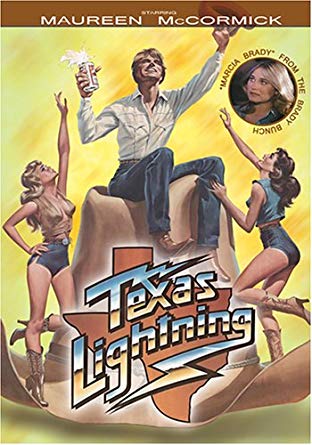
I told you all that to tell you this, the story of Texas Lightning, one of the most confusing movies I’ve ever seen.
Karl Stover (Cameron Mitchell!) is a macho truck driver who feels like his son Buddy is too soft, so he takes him on the road. The fact that his son is played by his real life child Cameron Jr. only adds to the gravitas of this movie. Also — you’ve never lived until you’ve seen cowboy Cameron in a shiny gold shirt.
Buddy soon falls in love with the first girl he meets, a barmaid named Fay, played by Maureen McCormick from The Brady Bunch. This isn’t her first redneck go-round, as she played one of the Hammer sisters in Moonshine County Express opposite John Saxon as a kung fu fight stock car driver.
Keep in mind when you’re watching this movie that none of the painted characters on the poster are actually in this film. This is probably the best movie I’ve seen where Cameron Mitchell punches the hell out of a truck stop bathroom while trying to explain the facts of life to his son.
Seriously — if you watch this hoping for some trucking and womanizing, you’re left with a pretty downbeat drama, despite Graver’s re-editing efforts. I assume this probably ran second or third in drive-ins, so nobody complained.
Mitchell Jr. ends up going back to his hotel with the barmaid, who cons him out of money for her sister’s operation before they start making out. This gives his father’s friends the license to smash down the door and assault her, which leads to the son to want revenge. Somehow, this movie has a happy ending montage and was still intended as a comedy. How can it be funny when we have Mitchell holding and hugging and crying over his son while a bunch of cowboy hat-wearing, sweat stains having gang team up on Marcia Brady? Your guess is as good as mine.
This was produced by Jim Sotos, who directed Sweet Sixteen and Forced Entry, which is also known as The Last Victim. It’s an R-rated remake of Shaun Costello’s adult film of the same name, substituting Tanya Roberts and Nancy Allen for Laura Cannon, Ruby Runhouse and Nina Fawcett. The latter two were two transient hippies who let their loft be used for filming as long as they could be in the film. They ended up so high on mescaline that their scene took five hours to shoot. Of all Harry Reems movies, it’s the only one that he claims to regret making.
“Shoot, why didn’t they just pud it all in one gosh dang movin’ pickture called ‘Bite My Grand Theft Auto Dust, Smokey’?” — Cletus
“Shoot, Hoke. I thought you said this were’s a sequel to Smokey and the Bandit,” says Cletus with a baseball cap smack to the head of Hoke. “There ain’t no Burt Reynolds in this!” Then Cletus feels a movement in the those demin-stained loins. “Oh, now wait jusda gosh-dang minute. Now who be that little darlin’ in the yellow daisy-duke overalls? She’s purty. That’s be makin’ up for Burt Reynolds not bein’ in it.”
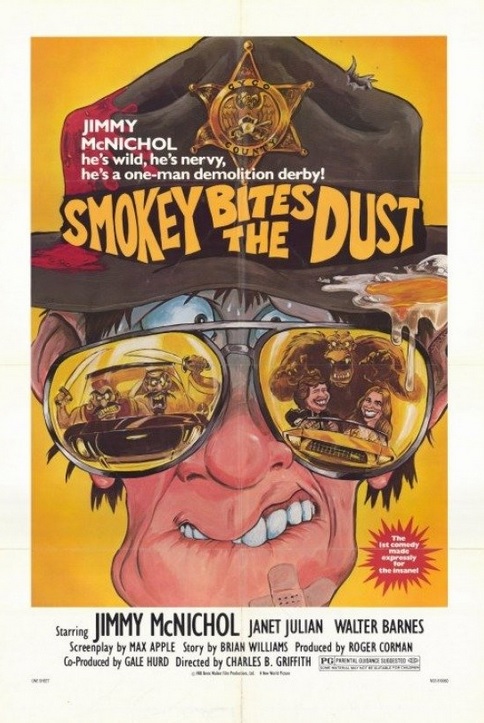
And that’s the plot of Smokey Bites the Dust: Janet Julian in that yellow jumper.
Looks like a Boss Hog and Daisy Duke to me.
And it’s the same exact plot as the Halloween rip-off, Humongous (1982), the Iceman rip-off, Ghost Warrior (1984), and the Rambo rip-off, Choke Canyon (1986): Janet Julian. And they all suck celluloid donkey ass. And the only reason to watch any of them, class . . .
“Janet Julian, Mr. Francis.”
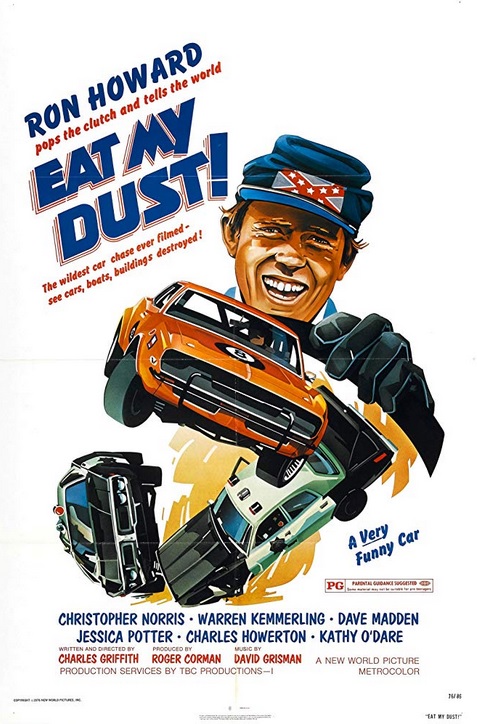
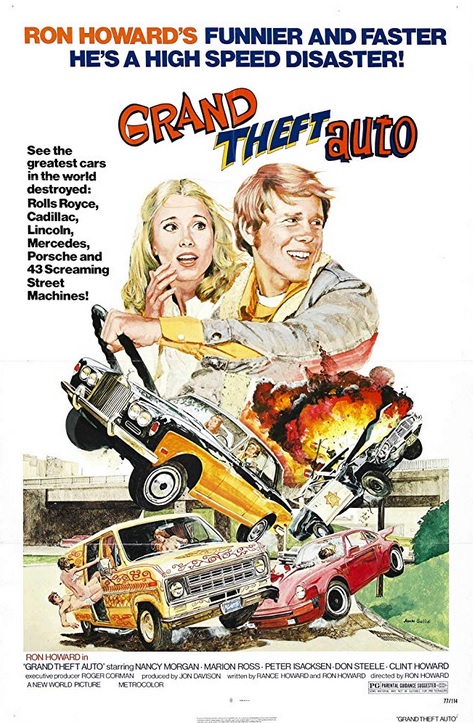
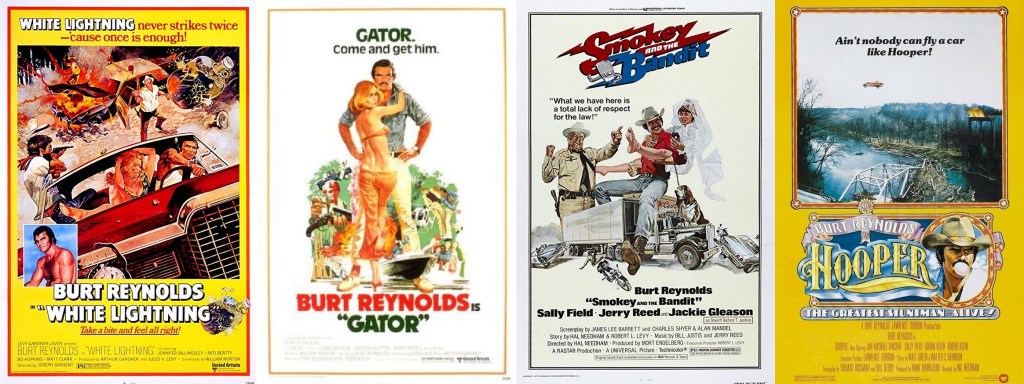
As for the “plots” to Eat My Dust and Grand Theft Auto: It’s the same ol’ Smokey and the Bandit car chases and car crashes tomfoolery caused by another bumbling Sheriff Buford T. Justice-clone chasing another Bandit-clone—both owing their existence to Burt Reynolds’ White Lightning—but without the desperately needed Janet Julian fix. Yeah, Christopher Norris in Eat My Dust is cute and Nancy Morgan in Grand Theft Auto is okay. But they’re all the same Sally “Frog” Field character from Smokey and the Bandit and, again, class . . .
“They’re not Janet Julian in those yellow daisy-duke overalls, Mr. Francis.”
Look, the hicksploitation plot equation is real simple, Bocephus: Ron Howard’s Hoover Neibold in Eat My Dust x his Sam Freedman in Grand Theft Auto ÷ Jimmy McNichol’s Roscoe Wilton in Smokey Bites the Dust = Burt Reynolds’s Bo “Bandit” Darville in Smokey and the Bandit. You got that, son?
Yeah, I know that William Forsythe (Stone Cold), one the best—if not the best—“heavies” in the business, makes an early film appearance as the lovesick football player in pining for Janet Julian’s Peggy Sue Turner. But Big Bad Bill is not yet into his full bad assery-mode that we know and love—and there’s not enough of Bill and way too much teen-idol “Bandit” tomfoolery with Jimmy McNichol getting in the way. Thank God, Janet is there in those, class . . .
“Yellow daisy-duke overalls, Mr. Francis.”
While B-Movie novices may have been buffaloed into thinking they were seeing a sequel to Smokey and the Bandit (a skill in which Roger Corman excelled), Smokey Bites the Dust isn’t a sequel—at least not in the character or plot development departments—to Corman’s Eat My Dust, as commonly reported.
Ron Howard, then hot from his starring role as Richie Cunningham on TV’s Happy Days, was approached by Corman to star in Eat My Dust. Howard wanted to move into directing. So they made a deal: Howard starred in Eat My Dust and Corman financed Howard’s directing debut with Grand Theft Auto—both films stealing the White Lightning blueprints and quickly produced to cash in and beat Smokey and the Bandit into theatres. And they both cleaned up at the box office.
“Shoot, Cletus. You’s sure we ain’t bin seein’ this movie before? All these car chases and crashes sure du-be lookin’ fermilar,” head scratches Hoke with an oil can spout.
“Gud God, Hoke. Yer sures is dumb. Don’t ya know ya-be watchin’ a film produced by the king of stock footage recycling?” baseball cap smacks Cletus.
In the wake of Star Wars (?), Corman came up with an idea for a “sequel” to Eat My Dust called Car Wars—based around the stunt footage from Corman’s five previous “hicksploitation” productions: Eat My Dust, Moving Violations (starring Kay Lenz), Fighting Mad (starring Peter Fonda) (both 1976), Thunder and Lightning (starring David Carradine), and Grand Theft Auto (both 1977). In fact, Corman had Allan Arkush and Joe Dante use the same celluloid bricklaying concept to create Hollywood Boulevard. (1976). And how many times have we seen the special effects footage from Corman’s Battle Beyond the Stars?
Of course director Charles B. Griffith had the nerve to inject a plot and character development into Smokey Bites the Dust—which took away from the car chases and crashes—so Corman cut out all that character and plot crap getting in the way. And that’s how we ended up with a plot that revolves around, everyone . . .
“Janet Julian in those yellow daisy-duke overalls, Mr. Francis.”
As for the hicktastic Sheriff Buford T. Justice-clones of Bite My Grand Theft Auto Dust, Smokey:
Charles Howerton, who stars as Sheriff Sherman “Sherm” Bleed in Eat My Dust, dubbed voices for the Italian Gialli Confessions of a Police Captain, Four Flies on Grey Velvet, and What Have You Done to Solange?, and is best known to trash cinema connoisseurs for his work in 1975’s Nazi-blaxploitation hybrid, The Black Gestapo. In addition to Charles B. Griffith’s Jaws rip, Up from the Depths, Howerton played another redneck sheriff in another hicksploitationer, Joyride to Nowhere (1977).
Barry Cahill plays a pseudo-sheriff as Bigby Powers, the corrupt Governor-father of Nancy Morgan in Grand Theft Auto. He also appeared in Daddy’s Gone A-Hunting (1969), Coffy, and The Stone Killer (both 1973), and had a fruitful career on American soap operas.
In addition to his role as Sheriff Hugh Turner in Smokey Bites the Dust, former NFL Philadelphia Eagle guard-turned-actor Walter Lee Barnes became a stock player in Clint Eastwood’s oeuvre, most notably as Tank Murdock in Every Which Way but Loose, along with roles in Bronco Billy and High Plains Drifter. In addition to working alongside John Wayne in Cahill U.S Marshall, trash cinema lovers may remember Barnes in Pigs (1972; aka Daddy’s Deadly Darling), The Christian Licorice Store (1971), and Day of the Animals (1977).
Class dismissed. Study your films. Work on your Janet Julian dissertations. See you on Monday! Have a good weekend!
And thank you, Burt. For without you: we would have NEVER gotten Janet Julian in that yellow jumper. God bless your redneck heart.
An update from the “What Makes B&S About Movies So Cool: Our Readers” Department: This little piece ‘o film trivia—that you won’t find on a Trivial Pursuit card—slipped by us. Doh! And we pride ourselves on our oddball “Amaze your friends with obscure film trivia” OCD.
So, it turns out Walter Lee Barnes played a variation of his Sheriff Hugh Turner, here, in the original version of Disney’s Escape to Witch Mountain (1975) as Sheriff Purdey: a sheriff bribed by the evil Aristotle Bolt (Ray Milland). We did two takes on the film, first in December 2019, then in July 2021. How did we miss this?
Seriously, a connection—a just beyond an actor’s resume—between a Corman and Disney film? Who knew? Our awesome, uplifting readers, that’s who. In fact, that reader, Phantom 309, came in with the assist on another Smokey-inspired hicksploitation romp, Double Nickels (1977). You rock, Phantom! Any fan of the classic Plymouth Satellite is okay in our book!
About the Author: You can read the music and film reviews of R.D Francis on Medium and learn more about his work on Facebook. He also writes for B&S Movies.





 B&S About Movies
You must be logged in to post a comment.