EDITOR’S NOTE: Friday the 13th was on USA Up All Night on August 13, 1993 and May 13, 1994.
After the success of John Carpenter’s Halloween, every studio wanted a piece of the horror pie, which to this point had been exploitation fodder. Paramount Pictures was first. Sure, critics salvaged the film, but after $40 million in profit, no one really cared.
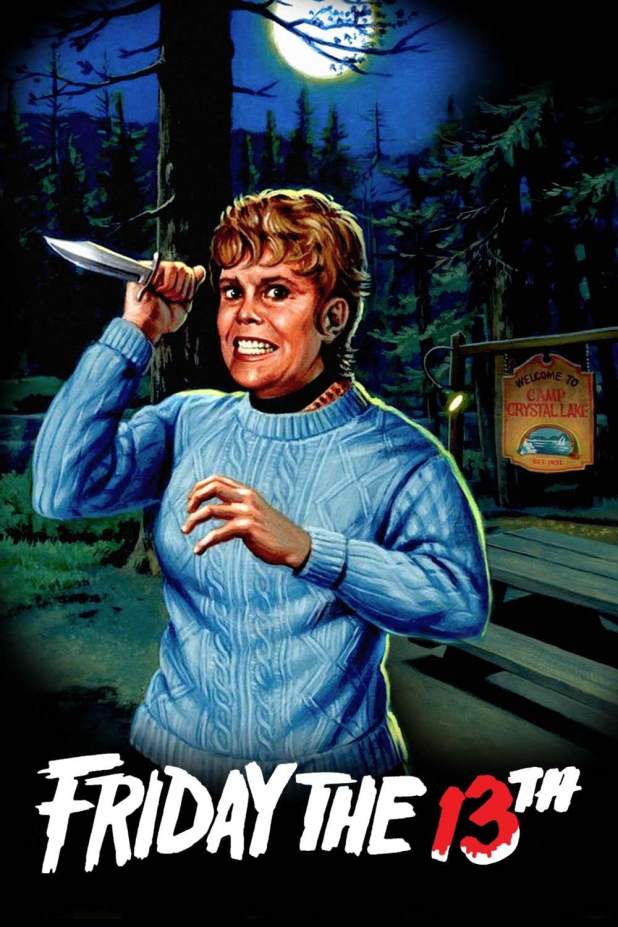
Produced and directed by Sean S. Cunningham (Last House on the Left), this movie was envisioned as a roller coaster ride. The script came from Victor Miller, a soap opera scribe. And spoilers — but this movie doesn’t even really have Jason in it!
The movie starts in the summer of 1958 at Camp Crystal Lake, where two counselors sneak off and have sex before being killed. This sets up one of the many rules of slasher films: never fuck in the woods.
The camp closes for 21 years, but on Friday, June 13, 1979, that’s all about to change. That said, no one in the town wants it to happen. When Annie Phillips arrives in town, everyone treats her strangely or acts like Crazy Ralph (Walt Gorney, who shows up in the next film and was the narrator for Friday the 13th Part VII: The New Blood). She lasts for about five minutes, as she gets killed after her third hitchhike of the day. I’d say this is more of a warning against hitching in the late 1970s than I would serial killers in the woods.
The other counselors — Jack (Kevin Bacon!), Ned, Bill (Harry Crosby III, son of Bing), Marcie, Alice and Brenda (Laurie Bartram, The House of Seven Corpses) — and owner Steve Christy all show up to get the camp ready. This is where you’ll notice just how different fashion is. Becca and I have seen this live several times in a theater now and everyone laughs as soon as Steve shows up in his short shorts and bandana.
Ned is killed pretty quickly, then Jack is killed with an arrow and Marcie takes an axe to the face. Brenda is murdered as she responds to the voice of a child. Steve gets killed on the way to camp. Before you know it, Alice and Bill are the only ones left, but Bill lasts pretty much seconds. Then we have another future slasher trope: every body is discovered, hung like trophies.
Now, we have our Final Girl: Alice, who ends up meeting Mrs. Vorhees, who tells the tale of how her son Jason drowned and the horrible counselors who allowed it to happen. Much like the giallo/pre-slasher film Torso, the movie now focuses on the battle between Alice and the real killer. Alice ends up beheading her and sleeping in a canoe. As the police arrive, she has a dream that Jason rises from the water to kill her. This scene wasn’t in the script, but special effects king Tom Savini thought a Carrie-like ending would be more powerful.
Another way that the film pays sort of homage to Italian filmmaking is in the snake scene. It was another Savini idea after an experience he had in his own cabin during filming. The snake in the scene? Totally real, including its on-screen death — someone alert Bruno Mattei!
Some trivia: the film was shot just outside Lou Reed’s farm. The rock star performed for the cast and even hung out with them! Sweet Jason?
To me, the film works because of how great Betsy Palmer is as Jason’s mom. It’s a fine film, but nowhere near the excesses that the series would grow into. This was also the start of critics really hating on slasher films. Gene Siskel was so upset about Betsy Palmer being in the film that he published her address in his column and encouraged people to write her and protest. Of course, he published the wrong address.
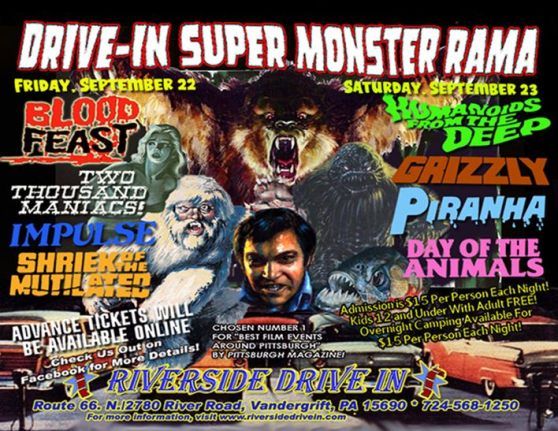
EDITOR’S NOTE: This weekend is the Drive-In Super Monster-Rama! Get more info at the official Drive-In Super Monster-Rama Facebook page and get your tickets at the Riverside Drive-In’s webpage.
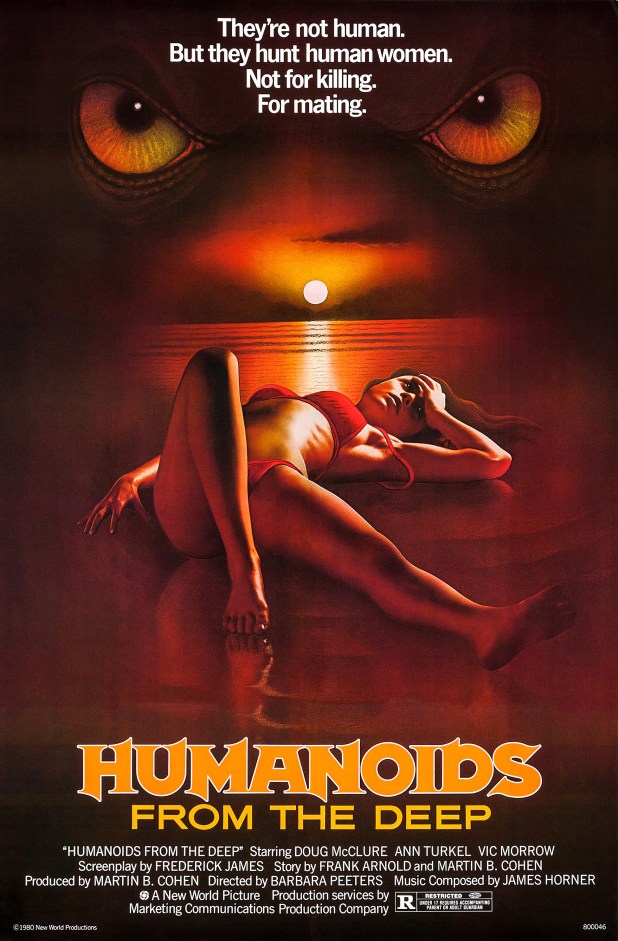
Did Roger Corman sit in a room screaming, “Make me more amphibian monster movies NOW!” into the telephone? Because this week, that’s the feeling that I’m getting. This time, Barbara Peeters got the call (Joe Dante turned this one down), although the final film was nothing like she wanted it to be and she tried — and failed — to get her name removed from the credits.
Fishermen catch what looks like a monster. Then, the son of one of them is dragged under the waves by an unseen beast. Another fisherman fires a flare gun that sets the whole boat on fire, killing everyone. Pre-credits, this movie is already meaner and better than most of what we’ve watched this week.
Jim Hill (Doug McClure, TV’s The Virginian) and his wife Carol (Cindy Weintraub, The Prowler) see the boat blow up and then their dog gets eaten (and his remains thrown up on their porch). So yeah. Things are off to quite the start.
Meanwhile, Jerry and Peggy (Lynn Schiller, Without Warning) are swimming and fooling around, but Jerry ends up torn apart and a fishman rapes the girl, causing the director to want to leave the picture. Seriously — they kept her name on the film. Time’s up, Roger Corman.
That scene is repeated with Billy (future ventriloquist David Strassman) and Becky, with yet another fish on female rape. All manner of folks are attacked, but Peggy somehow survives.
Meanwhile, Canco is opening their new canning operation in town. It turns out that the monsters that are fucking everyone to death are the result of Canco using HGH on salmon that were in turn eaten by larger fish who then turned into humanoids. From the deep? Yes. Humanoids from the Deep.
Luckily, Jim and Dr. Susan Drake are on the case. Their big plan? At the town’s fish fest, when the beasts attack, they dump gasoline in the lake and set it on fire. So not only is there no safe zone for women, fuck the environment, too. While all this is going on, Carol is attacked by two monsters but survives. Oh yeah! Vic Morrow is in this mess, too. And if you think Peggy is going to give birth to a fish baby, then you haven’t been watching this film.
Actress Ann Turkel chose to do this film — originally titled Beneath the Darkness — because: “It was an intelligent suspenseful science-fiction story with a basis in fact and no sex.” She was enraged as well at what the final film ended up being.
Corman remade this film for Showtime in 1996, with the sex and violence scaled down. That said, he of course reused the Salmon Festival footage for the remake. Why actually shoot something new?
Well, if you’re looking for a grimy, fishy film, this is it.
Won’t be at the drive-in? You can watch it on Tubi.
EDITOR’S NOTE: Pinball Summer aired on USA Up All Night but I can’t find the date!
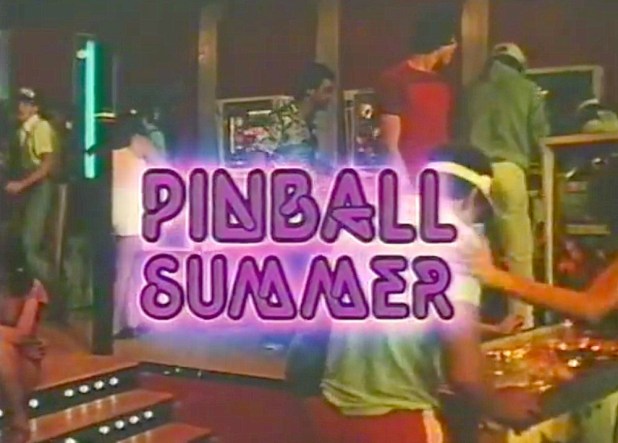
Also known as Pick-Up Summer and Flipper Girls in Germany, this Canadian film comes after the Crown International beach movies and before Porky’s. Most of the action revolves around a place called Pete’s, an arcade that is hosting a pinball competition, which also has a Miss Pinball pageant, which I really hope was a thing at some point.
Speaking of movies leading to something more, director George Mihalka and cinematographer Rodney Gibbons would make My Bloody Valentine* after this, a movie that is much better remembered than this teen summer comedy that revolves around disco, burger joints, amusement parks and hijinks between a biker gang and our heroes over the pinball trophy.
Film Ventures International bought this for America and changed the name, thinking pinball was dead. It did pretty well and people didn’t even notice that it was made in Quebec and not California. It’s a pretty innocent movie when it comes to teen comedies.
*Helene Udy, who played Sylvia in that classic slasher, Thomas Kovacs, who played Mike, and Carl Malotte, who played Dave, are all in Pinball Summer as well.
EDITOR’S NOTE: Clan of the White Lotus was on USA Up All Night on June 13, 1992.
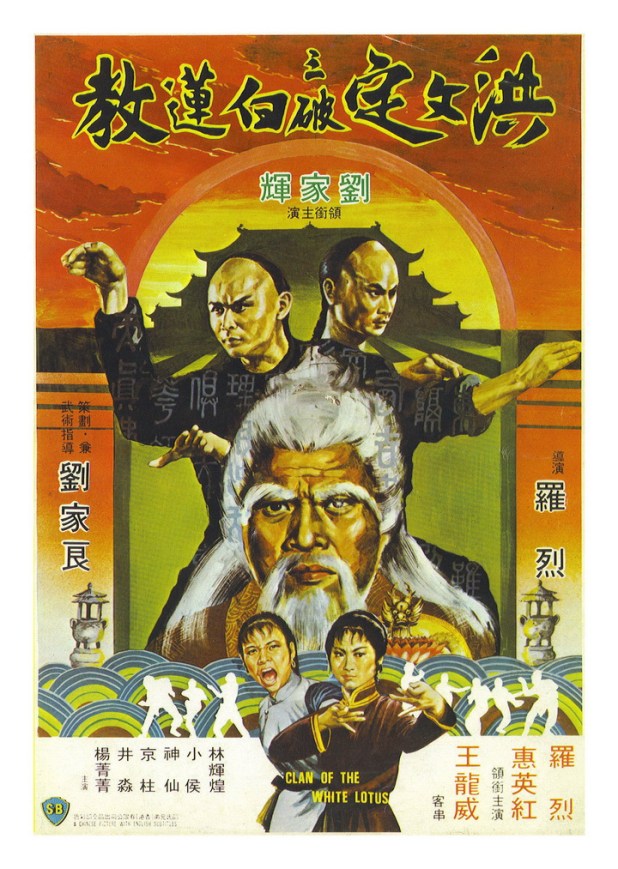
It kind of blows my mind when a Shaw Brothers movie finds its way to USA Up All Night. Released as Fists of the White Lotus in the U.S., this is the sequel to Executioners from Shaolin (AKA Shaolin Executioners and Executioners of Death) and Abbot of Shaolin (AKA Shaolin Abbot and Slice of Death).
A white eyebrowed priest named Pai Mei battles brothers Hung Wei Ting (Gordon Liu) and Wu Ah Biu (King Lee King-Chu) and the fight costs him his life. However, Pai Met also had a brother, the monstrous White Lotus (Lo Lieh, who directed this movie) who shows up and murders Wu Ah Biu. Hung Wei Ting must study new techniques and learn how to fight a man who is stronger than anyone else in the world.
Perhaps the Tiger and Crane styles and more male-oriented martial arts can’t function against White Lotus. Hung Wei Ting is inspired by his sister-in-law Mei Ha (Kara Hui) to study her style, which she calls Embroidery Fist.
Now, two men who have lost their brothers to one another must finally face off in combat. This fight also involves acupuncture, which is almost the most awesome part of the Lau Kar Leung choreography but then I forgot that this has more nut punches than twp episodes of America’s Funniest Home Videos.
EDITOR’S NOTE: Thanks to Matthew Hale on Letterboxd, I’ve learned that there are alternate versions of this Mill Creek box set. For the sake of completeness and my obsessive compulsive disorder, here’s this missing movie.
Director Boris Szulzinger is best-known for the Tony Hedra-written science fiction cartoon for adults The Big Bang and Tarzan, Shame of the Jungle, the first foreign animated movie to be rated X in the United States.
A comedic retelling of the myth of Elizabeth Bathory, here known as Mama Dracula and played by Louise Fletcher. This is also written by Hedra, along with Szulzinger, Marc-Henri Wajnberg and Pierre Sterckx. Hedra was probably best known for his work with the National Lampoon, a series of parody magazines (Not the New York Times, Playboy: the Parody, The Irrational Inquirer and Not the Bible), being the editor-in-chief of Spy Magazine and co-creating, co-writing and co-producing Spitting Image. He was also Spinal Tap’s manager Ian Faith. The sad part of his legacy is that he was accused of molestation by his daughter Jessica. That said, the article about it that was published by The New York Times had no proof and was disputed by several people (and supported perhaps by just as many). It’s a stain on his career and life.
Back to the movie.
Professor Van Bloed (Jimmy Schuman) is brought to Transylvania as part of a special conference on blood research hosted by Countess Dracula. She also has twins who run a fashion boutique called Vamp. But the problem that Mama Dracula is having is that there aren’t enough virgin women to keep on bathing in their blood. She wants the scientist to create something to help her. He also falls for a local, Nancy Hawaii, who is played by Maria Schneider, who had survived the PTSD of making Last Tango In Paris, drug abuse and a suicide attempt to finally find some level of happiness by the early 80s, if being in movies with Klaus Kinski can be considered joy.
This movie has a bad reputation, one of it being barely watchable. I can confirm this yet I am amazed that somehow both Fletcher — an Oscar winner! — and Schneider — a sex symbol on the comeback after walking out of her last big role in Caligula and probably that was the right call — are in it.
EDITOR’S NOTE: Thanks to Matthew Hale on Letterboxd, I’ve learned that there are alternate versions of this Mill Creek box set. For the sake of completeness and my obsessive compulsive disorder, here’s this missing movie.
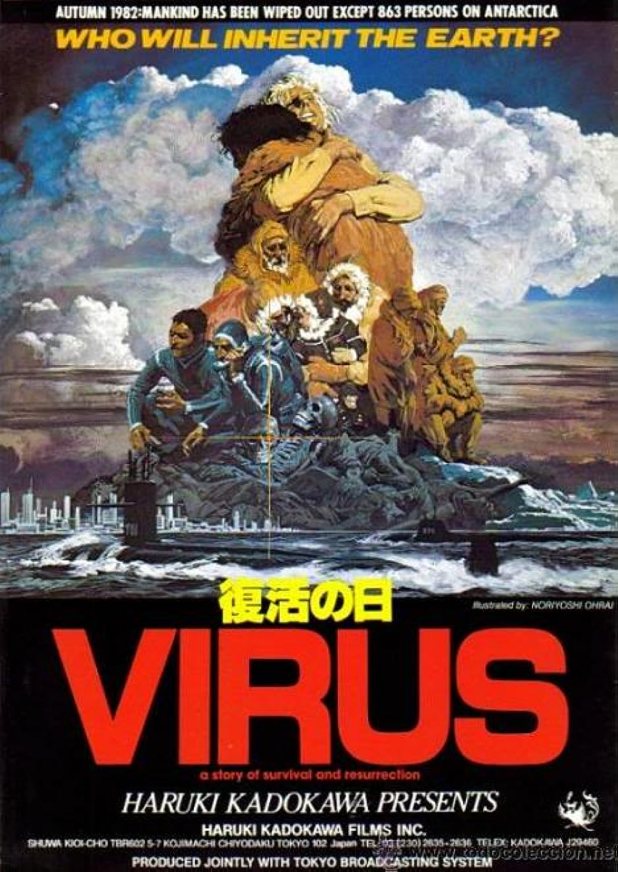
If you’re depressed and home alone with COVID-19, I advise you in no way should you watch the 1980 Japanese movie Fukkatsu no Hi (Day of Resurrection). Directed by Kinji Fukasaku (Battles Without Honor or Humanity, Message from Space, Battle Royale) and taken from the book by Sakyo Komatsu. Two of that writer’s other books, Japan Sinks and Sayonara Jupiter became the movies Submersion of Japan and Bye Bye Jupiter.
Fukasaku took a Japan that had already dealt with the loss of World War II and being the only country to ever be nuked — twice — and created post-apocalyptic disaster films that allowed them to see the rest of the world deal with terrors like they did. It’s exploitation but in some ways, it also had to feel cathartic.
As I sniffle on the couch today, the victim of a plague in its who knows how many mutations, I don’t feel all that good about watching a movie about how a plague destroys humanity.
In 1982, East German scientist Dr. Krause and a group of Americans exchange MM88, a deadly virus that amplifies any virus or bacteria that it meets. It had been stolen from the U.S. and as it is being returned, the place crashes and causes a pandemic called the Italian Flu. This in no way feels like our life for the past few years.
Seven months is all it takes for the world to end. As President Richardson (Glenn Ford) and Senator Barkley (Robert Vaughn) die, they realize that the only way America can live is to move its authority to the sub-zero Palmer Station in Antarctica, a place where the cold has kept the virus from infecting the scientists from many countries who live there.
In a few years, Palmer Station becomes a melting pot of sorts where women consensually sleep with as many men as possible to repopulate the Earth. The only problem is that the Automated Reaction System designed by General Garland (Henry Silva) is set to nuke anyone that attacks the U.S., even if it’s an earthquake, so their little hidden paradise is about to be blown into space. That said, it seems as if a cure for the virus has been found.
The women and children and several hundred of the men are sent to safety aboard an icebreaker while Dr. Yoshizumi (Masao Kusakari) and Major Carter (Bo Svenson) take a sub to shut down the ARS after taking the experimental vaccine. In Washington, D.C., Carter dies in the rubble of a bunker where the missile system is. Yoshizumi contacts the Nereid and tells them to try to save themselves. He does say that the vaccine seems to have worked, “If that still matters.” “At this point in time, life still matters,” the captain replies.
The bombs hit and this is where the movie has different versions. In America, the screen goes to black and then credits. But in Japan, well, they still have hope. Yoshizumi survives the blast and walks back to Antarctica, taking years to get there, but finding the survivors and true love. He then says, “Life is wonderful.”
As every disaster movie should, this has a huge cast. More than those we named, there’s also Sonny Chiba, Kensaku Morita, Toshiyuki Nagashima, George Kennedy as the leader of Palmer Station, Chuck Connors, Olivia Hussey, Isao Natsuyagi, Edward James Olmos, Stuart Gillard and more.
Producer Haruki Kadokawa was the heir to a publishing empire. He entered the film business in the mid 70s with some high-profile features and thought that this movie would break his company into the international film marketplace. That’s why so many American stars are in it and it was called Virus. It was a huge flop and only played limited dates before being sold directly to cable. It was the most expensive Japanese film at the time it was made (a record that Fukasaku may have already had with Message from Space).
My favorite part in the entire movie is when Japan is falling into sickness and naked people are still in a disco, dancing and throwing up. That’s how you do the end of it all. I would have loved another movie that has the four-year walk that Yoshizumi takes from America to Antarctica.
The director’s cut on Tubi is massive and comes in at two hours and thirty-six depressing minutes. Every moment, I wonder if my throat will close and this virus will end me, and then I remember that it’s supposedly weaker now and I’m on meds, but man, MM88 is rough.
If this is my epitaph, let it be known that it was Guns ‘n Roses that finally killed me.
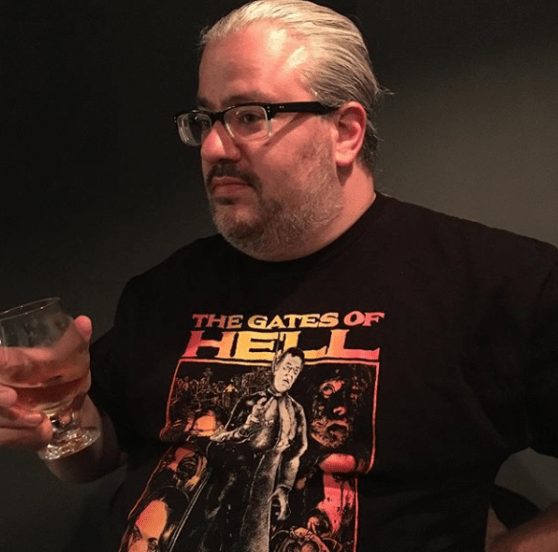
If you ever meet me in person, there’s a 90% chance I’ll be wearing a t-shirt of this movie. Therefore, I find it near impossible to be objective about this film. I love it too much. I can only share my adoration with you, dear reader.
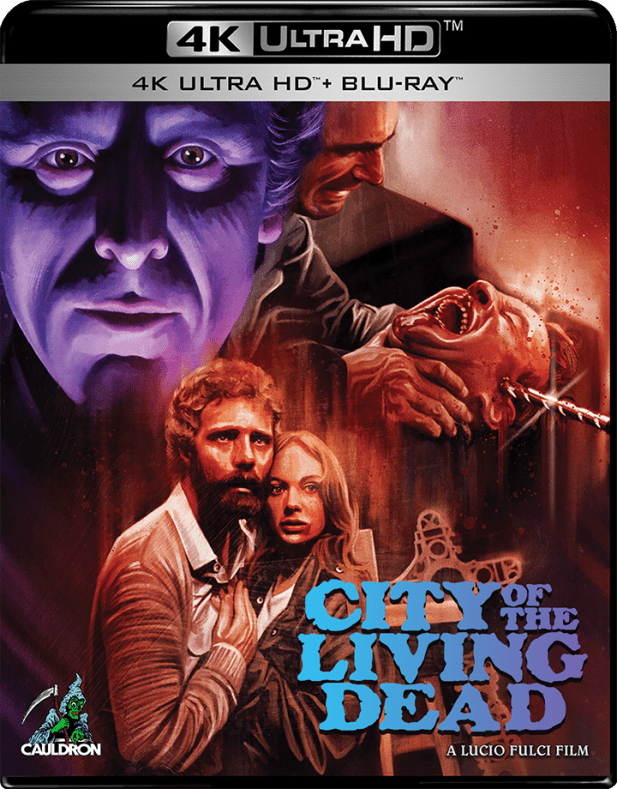
Alternatively known as Paura Nella Città dei Morti Viventi (Fear in the City of the Walking Dead), Twilight of the Dead, The Gates of Hell and Ein Zombie hing am Glockenseil (A Zombie Hung on the Bell Rope), this is the first unofficial chapter in what has become known as Lucio Fulci’s Gates of Hell trilogy, along with The Beyond and The House by the Cemetery.
It all begins with a seance in the apartment of a medium, where Mary Woodhouse (Fulci heroine supreme Catriona MacColl, who appears in all three of the Gates of Hell movies) has a vision of Father Thomas as he commits suicide and opens the gates to the City of the Living Dead. That priest must be destroyed by All Saints Day or the dead will walk the Earth.
The images that she sees send her into a coma, which everyone else believes is her death. She’s buried as the police and journalist Peter Bell (Christopher George, Pieces) investigate her murder. As Peter visits her grave the next day, he hears her screams as the gravediggers discuss porn where a guy has sex so much that he dies (one of those guys is pornstar Michael Gaunt, who was in Barbara Broadcast and the other is an uncredited Perry Pirkanen from Cannibal Holocaust and Cannibal Ferox).
Peter uses a pickaxe (!) to smash his way into the grave, nearly killing her as he saves her life. This scene has been ripped off twice that I know of, once informing the scenes of the Bride in the coffin in Tarantino’s Kill Bill (also look for a scene that takes Rose’s tears of blood later in that movie) and in this year’s abysmal The Nun. Neither of these have the frightening power that Fulci pulls of in this scene or the painful closure at the end, where Mary screams and pants in the open air, her eyes filled with pure terror.
Once Mary recovers, she and Peter visit the medium who reveals the answers behind her visions. As that’s all going on, a weirdo kid named Bob (Anyone named Bob is a Fulci movie is one to be feared) finds a sex doll that somehow inflates itself before being scared off by a rotting fetus. And at Junie’s Lounge, a discussion of how weird Bob is leads to the mirror behind the bar shattering. As they say, strange things are afoot and this is just the start of Fulci’s descent into surrealism.
While all this is going on, psychologist Gerry (Carlo De Mejo, Manhattan Baby) is consulting Sandra (Janet Agren, Night of the Sharks, Hands of Steel) about life and how she used to want to marry her father before he ran out on her family. Just then, his girlfriend Emily arrives and tells him that she’s on the way to try to help Bob. When she finds him, he’s crying on the floor and shoves her away, just as Father Thomas appears and smothers her to death with a hand full of maggots.
Obviously, if you think anything is going to make sense in this movie from here on out, you aren’t ready for this era Fulci. There are no filters left, just a demented Italian madman let loose in America with tons of fake blood, guts and film to burn.
One of my favorite scenes in the film is when Rose and Tommy (a young Michele Soavi ) are making out in his car and she thinks she hears a noise. It’s a total slasher moment that any other director would handle in a rote way. Instead, Fulci has the couple turn on the headlights and there is no joke or defusion of the tension. Instead, we see the priest hanging by the neck in front of them as Rose’s eyeballs bleed and she throws up her intestines (Daniela Doria is pretty much decimated by Fulci in every movie she did for him, including being knifed through the back of the head in the opening of The House by the Cemetery, has her chest and face sliced up brutally in The New York Ripper and asphyxiated in The Black Cat. I have no idea what he ever did to her, but you can read a great interview with her here. And yes, she did this scene by throwing up tripe and fake blood.). Then, Tommy’s head is ripped open.
Everyone suspects that Bob is behind the many disappearances in Dunwich, which totally isn’t going to keep Peter and Mary from heading there.
We’ve fully descended into Fulci world at this point. Bob is seeing visions of Father Thomas, a mortician gets bitten by a corpse when he tries to steal her jewelry, Emily’s zombie visits her little brother John-John, the same corpse that bit the mortician shows up in Sandra’s kitchen and broken glasses fly all over her house, spraying the room with blood. Meanwhile, Bob’s just trying to hide out and smoke a joint with Mr. Ross’s teenage daughter when the man comes in, nearly insane, and kills him with a drill press.
Yep. In any other movie, they’d tease death by drill or show you the moment before impact. Fulci revels in this scene and makes it last. Yes, that drill is going inside Bob’s head. And it’s coming out the other side, too.
Peter and Mary make their way to Dunwich, where they meet up with Gerry and Sandra. While they’re talking, a storm of maggots — oh that Fulci! — rains down on them. To top it off, Gerry gets a call that his dead girlfriend has risen from the grave and killed John-John’s parents. Sandra offers to take the kid to her apartment, but Emily is there and rips her scalp off before they save the boy just in time for a state of emergency to be declared.
Remember that bar at the beginning? Zombies invade it and kill everyone just as All Saints Day begins. Peter, Gerry and Mary (not Peter, Paul and Mary) go into the family tomb of Father Thomas, filled with skeletons, cobwebs and fog. Just to prove that this is 100% a Lucio Fulci film, Peter, who we’ve been led to believe is the main male hero, is killed when a zombie rips his brains out. Mary and Gerry battle Sandra and an army of zombies until they encounter the sinister priest, who makes Mary’s eyes bleed.
Before she can throw up her innards, Gerry stabs him with a cross and his guts fall out as he and the rest of the zombies go up in flames and become dust, with the Gates of Hell closed.
Mary and Gerry exit from the tomb to discover John-John and the police, but she soon screams as he comes near her and the film shatters to blackness. Wait — what just happened?
There are a ton of stories about the true ending of this movie. Some say John-John was supposed to be a zombie and the negative of the original recording was destroyed by a lab. I’ve also heard that the editor spilled coffee on the footage, forcing Fulci to improvise. And then some stories claim Fulci changed his mind about the end after the shooting was complete and just went with this. Interestingly, the Danish version of the film ends with a dark move across the graveyard and this text: “The soul that pines for eternity shall outspan death, you dweller of the twilight void come Dunwich.”
Trivia note: The movie Uncle Sam ends exactly the same way with the only exception being a title card that says, “For Lucio.”
Who knows how it ends! Who knows what the hell is going on for long stretches of this movie! It doesn’t matter! As Fulci would say, this is an absolute movie of images, a triumph of style (and gore) over substance.
The first time I saw this film was a third generation — or worse — dub on Hart Fischer’s American Horrors ROKU channel. As much as I love having 4K versions of things on blu ray, this is just about a movie made for the fuzzy quality of an old VHS tape. And yet here I am discussing the 4K release!
Obviously, this was written by Dardano Sacchetti, who was behind so many of Fulci’s scripts, like Zombi, Manhattan Baby and Conquest, as well as so many other awesome movies like Thunder and Demons.
This disc is filled with extras, including new audio commentary with film historian Samm Deighan, archival audio commentary with film historians Troy Howarth and Nathaniel Thompson — which is what I listened to on my first spin through this disc and as you can imagine from these talents, it’s absolutely packed with information, including the deep cut credits and the differences between the Italian and English dubs — as well as two other archival commentaries by actress Catriona MacColl moderated by Jay Slater and actor Giovanni Lombardo Radice moderated by Calum Waddell. There are also interviews with Massimo Antonello Geleng and Radice; Q&A sessions with Venantino Venantini and Ruggero Deodato, Carlo De Mejo, MacColl and Fabio Frizzi; a featurette on The Meat Munching Movies of Gino De Rossi and A Trip Through Bonaventure Cemetery; a Catriona Maccoll video intro from 2001; an image gallery; even more archival extras and surprises — as promised and I know there are Easter Eggs but I haven’t found any — all with a double-sided wrap with artwork by Matthew Therrien.
ABOUT THE AUTHOR: Jennifer Upton is an American (non-werewolf) writer/editor in London. She currently works as a freelance ghostwriter of personal memoirs and writes for several blogs on topics as diverse as film history, punk rock, women’s issues, and international politics. For links to her work, please visit https://www.jennuptonwriter.com or send her a Tweet @Jennxldn
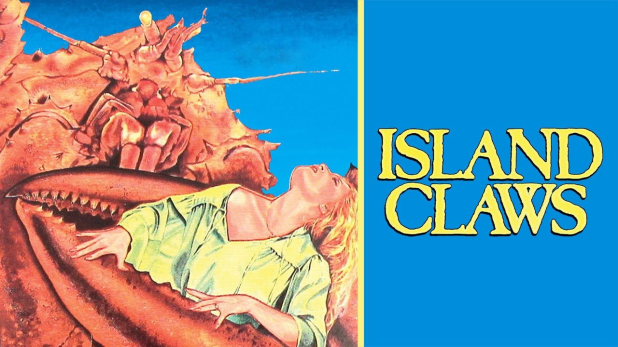
Island Claws was made in the post-Jaws era – a time when killer animal movies were all the rage – but features a storyline, characters, and giant creature right out of ‘50s sci-fi films like Tarantula or The Deadly Mantis.
The movie opens with lots of lingering shots of hundreds of crabs wading in the ocean against a backdrop of sunshine and easy listening jazz. Right away, I was hooked.
The island’s residents are absolutely the kind of people I’d like to drink with. We have the Irish Moody (Robert Lansing doing a decent accent), the young, handsome Pete (Steve Hanks), and a bunch of fishermen who basically hang out at Moody’s bar run by the lovely Rosie (Nita Talbot),
Jan Raines (Jo McDonnel) is a young, plucky photojournalist, sent to the National Marine Biology Institute conducting experiments on crabs using growth hormones to help solve world hunger. There she meets Pete and the two begin dating.
Because Jan’s father Frank (Dick Callinan) is the owner of the adjacent nuclear power station that has recently experienced a significant spill, Moody is skeptical of Jan. Moody had a long-time friendship with Jan’s father as well, but Moody is not telling Pete that Frank was the one who killed Jan’s parents by drinking and driving.
While all this is happening, people are now being attacked and killed by (normal-sized) crabs everywhere and Pete discovers a giant shell, foreshadowing what’s to come. One guy dies in a fire in his makeshift school bus home. Many residents attribute this to a boatload of Haitian immigrants who entered the country illegally. They take up pitchforks, but Moody calms them down. Then, the big crab shows up and all hell breaks loose.
Robert Lansing really brings it home in this movie. Especially in the scene where he finds his beloved old dog at death’s door after having been attacked (offscreen) by the crabs.
I love that an older actor like Lansing gets to ride the monster’s giant claw in this film like a horse. John Agar should have done that in Tarantula, but I don’t think that movie had the budget that this one did.
Made on the old Salty the Seal sets in Key Biscayne, the giant crab, built by Glen Robinson, cost a million bucks to create. It really does look good for its time, although it didn’t function as expected, necessitating a lot of dark medium shots and close-ups. The eye movements are especially cool.
First-time Director Hernan Cardenas, who never made another movie, does a pretty good job overall. It’s a bit of a slow burn, with a pace like a Made-for-TV-Movie of the same era but it doesn’t make it any less enjoyable. The Scorpion Releasing Blu-ray print is beautiful, but if you can’t track that down, you can watch an old grainy VHS rip on YouTube.
And here’s that jazzy soundtrack I referred to in the opening paragraph for your listening pleasure:
EDITOR’S NOTE: The Awakening was on the CBS Late Movie on October 31, 1986 and February 25, 1987.
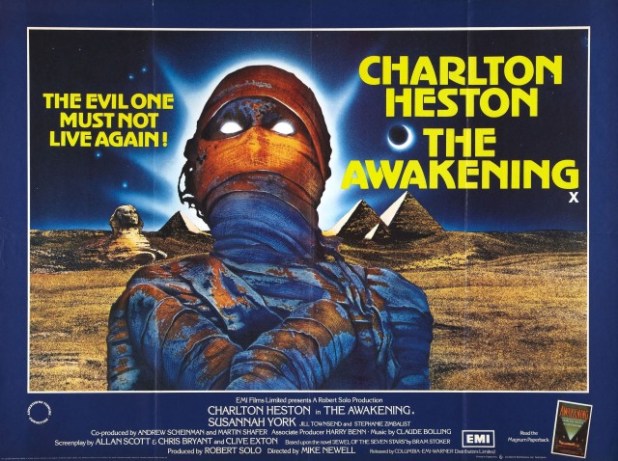
Based on Bram Stoker’s The Jewel of Seven Stars — which was also filmed as an episode of Mystery and Imagination as “The Curse of the Mummy,” Hammer’s Blood from the Mummy’s Tomb and the 90s movie Bram Stoker’s The Mummy — this movie places Matthew Corbeck (Charlton Heston), his pregnant wife Anne (Jill Townsend) and his assistant Jane Turner (Susannah York) in Egypt searching for the tomb of Queen Kara. One could argue that the most exploring Matthew is doing is between the thighs of Jane, but there you go.
When you see a sign that says “Do Not Approach the Nameless One Lest Your Soul Be Withered,” you may want to turn back. Nope, Matthew goes in hard — again, much like with his assistant — while his wife goes into labor. She’s dropped off at a hospital so he can get back to digging and their stillborn child comes back to life once he unearths and opens a sarcophagus.
Eighteen years later and that daughter, Margaret (Stephanie Zimbalist) is looking for her father, who is now married to Jane and still obsessed with the mummy that he found. It’s being destroyed by bacteria, so he gets it sent to England so that he can save it. Of course, the mummy queen wants to be reincarnated inside his daughter, who starts to believe that she really is Queen Kara.
Directed by Mike Newell (who went on to direct Four Weddings and a Funeral and Donnie Brasco) and written by Clive Exton, Chris Bryant and Allan Scott, The Awakening is a big dumb mess, but I kind of like that sometimes. It was recut by Monte Hellman after Newell lost final cut.
The best thing I can say is that this was shot in Egypt with actual locations.
EDITOR’S NOTE: The Ivory Ape was on the CBS Late Movie on May 25, 1984 and May 10 and July 24, 1985.
Rankin/Bass had some experience working with Japanese filmmakers after making King Kong Escapes, the Desi Arnaz Jr. feature Marco, Rudolph and Frosty’s Christmas in July, Willy McBean and His Magic Machine, The Bushido Blade (which has Mako, Sonny Chiba, James Earl Jones, Richard Boone and Laura Gemser all in the same movie), The Bermuda Depths and The Last Dinosaur there.
The last two movies we mentioned and this one were made with Tsuburaya Productions, the company that brought us Ultraman.
While this debuted on ABC on April 18, 1980, an extended version would later play theaters in Japan.
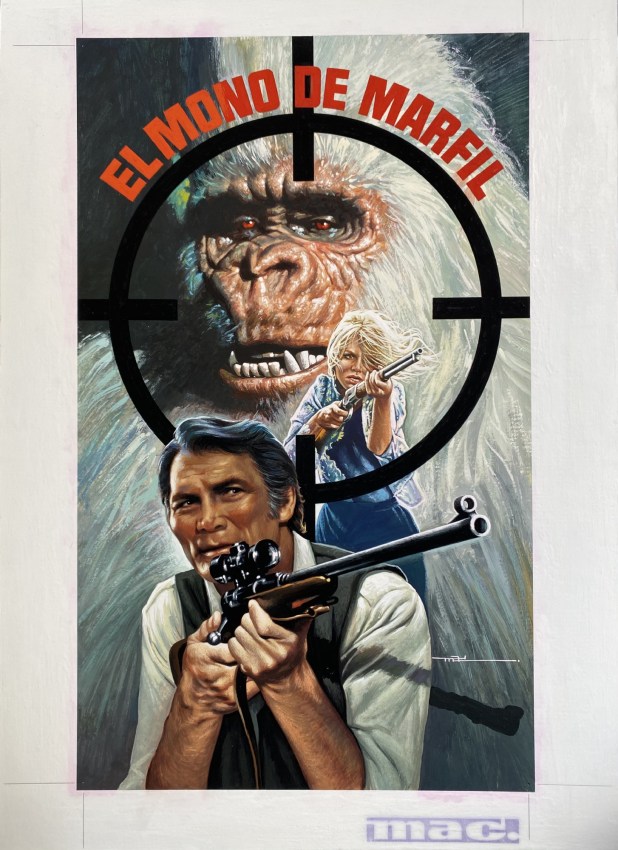
A rare albino gorilla has escaped somewhere in Bermuda, and the hunter who caught it once before (Jack Palance!) is set to destroy it. Can Steven Keats (Bronson’s son-in-law in Death Wish) and Céline Lomez (originally going to play Linda Thorson’s part in Curtains) stop him in time?
Kotani’s work, including The Bushido Blade, is a fascinating blend of Western and Eastern elements. The film, which stars Richard Boone leading sailors versus samurais under the command of Toshirô Mifune, is a unique exploration of cultural dynamics. If that’s not enough to pique your interest, the fact that Laura Gemser is in it might. Kotani’s diverse filmography also includesPinku redi no katsudoshashin, a feature-length movie about Mie and Keiko Masuda, two idol singers whose Japanese success was imported to the shores of the U.S. Their song “Kiss in the Dark” reached #37 in America, making them the first Japanese act to chart here since Kyu Sakamoto’s “Sukiyaki” in 1961. Sadly, their Sid and Marty Krofft developed series – The Pink Lady and Jeff – only lasted six weeks on NBC during Fred Silverman’s disastrous year of 1980, which also unleashed the Supertrain on an uncaring television audience. Kotani’s other works include The Last Dinosaur and The Bermuda Depths.
There’s something about the 70s TV movies from Rankin/Bass that’s truly unique. Each one carries a certain level of darkness and palpable sadness, making them the perfect choice for a snowy day in 1981 when all you wanted to do was stay under the covers. They still possess that same strange magic today, evoking a sense of nostalgia and appreciation for the historical significance of these films.





 B&S About Movies
You must be logged in to post a comment.