1 hour and 45 minutes of absolute malarky. Yes, Wheeler Dixon and Sidney Paul are back, making another video that could be interchangeable with the others they made, but I don’t care. I’ve watched them all.
While they also dropped UFO: Top Secret and Attack from Outer Space the same year, this one leans much harder into the science of space travel. It features an extensive, purely theoretical sequence about a manned mission to Mars, detailing the terrifying risks of retro-rocket failure and the math required to keep a tiny ship from being swallowed by the sun’s gravity. There’s also a surprisingly detailed look at the then-new Space Shuttle program, framed as the practical future of reusable space travel.
The film spends a significant amount of time showcasing archival footage from the U.S. Air Force, including the 1959 Corpus Christi sighting and the famous Tremonton Film of 1952, which depicts a cluster of five glowing discs moving at speeds estimated at over 3,000 mph. Each of these is called out by case number, like Project Blue Book, which we have at hand whenever we watch 70s alien documentaries.
This time around, there’s less about aliens wanting to eat us and more fuzzed-out space rock. Sure, there’s plenty of rambling, but I just love the feedback and rocking breakdowns in these songs. And man, that rambling. The narrator suggests that life might not be limited to little green men but could exist as crystalline formations or even as entities that live within the sun’s solid, cool core.
One of the most convincing clips they show is a 1967 snippet from a Western movie set in Camarillo, California (there are also rumors that you can see a UFO during Rio Grande). While filming a close-up of an actor, a humming, white dot drifts across the background, performing erratic maneuvers that the crew can’t explain.
Yet, unlike the rest of their movies, this has a rare moment of skepticism when it’s pointed out that some famous saucer photos bear a striking resemblance to the underside of a standard infrared chicken brooder.
I’m sad that I only have a few Wheeler Dixon and Sidney Paul paranormal docs left, but instead of being upset that it’s over, I will be happy that I had the experience.
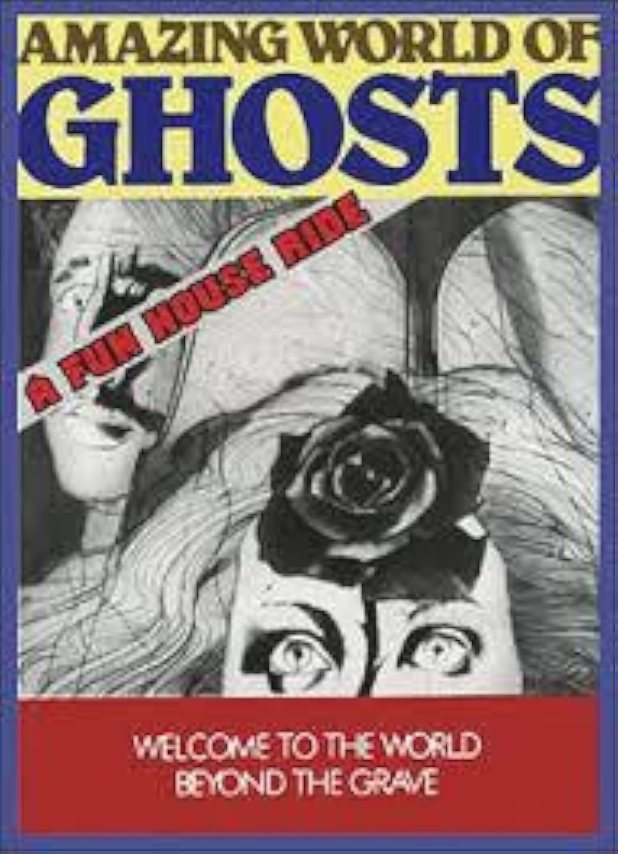
The film begins with a classic Dixon/Paul flourish: A young boy walking down a city street at night. The narration immediately pivots to the jugular: Will he be attacked by a ghost? Will he, as all Dixon/Paul films eventually ask, be eaten by an alien? What walking horror from the realms of nightmares will bring him the endless embrace of death? It’s a lot of pressure for a kid just trying to get home, but the film insists that the lights of the city are not a comfort that can dispel the aura of gloom.
The narration also informs us that photos of ghosts are hard to come by, so this starts to ramble into UFOs and Bigfoot. It’s not what I signed up for, but here I am, fully buckled in. In the same way this film cannibalizes a hundred stock photos and library films, music supervisor Jim Cookman dives into a sonic fever dream. We get fuzzy blues rock, synth dibble-dabbles, somber piano plinking and sound effects that sound like they were rejected from a sub-Outer Limits TV show.
This has it all and by all, I mean ectoplasm coming out of the mouths of 1920s Spiritualists (which the film tells us is a very dangerous procedure), the red eye of Jupiter, the Abdominable Snowman, ghost towns created by Manifest Destiny, so many goats, a ghost pony that haunts an English churchyard and moments where the stock footage, voiceover and music don’t line up, but I kind of love these films for that. So many people refer to them with terms like bad, boring, inept and incoherent.
That’s so wrong. Where else would we learn about a train haunted by a phantom so horrible that passengers were routinely beheaded? Who would let this train keep operating? Or the claim that earthquake survivors work tirelessly to limit “ghost activity” after a disaster? Did you even comprehend that? I didn’t. This leaves me, as all of Wheeler Dixon’s work does, with a thousand questions and zero answers.
I also adore that someone on IMDb presented the following factual errors:
Rasputin was not “killed by the Palace Guard” as the narration states, but rather by Prince Felix Yusupov. The prince shot Rasputin in the yard of the Yusupov palace and not in “an abandoned wing of the palace” as the film states.
H.G. Wells and Orson Welles were not contemporaries and did no collaborative work.
Mary, Queen of Scots, was not known as “Bloody Mary.” That was Mary I of England.
A frame from the Patterson-Gimlin film, shot in Northern California and purportedly showing Bigfoot, is shown in black-and-white and described by the narrator as a photo of Bigfoot “striding across the icy tundra of the Himalayan mountains.”
Keep in mind, this is a movie that asks whether UFOs are flown by ghosts or whether ghosts are really the living dead from outer space. Facts are in short supply.
Bonus points for the appearance of the Mesopotamian demon Pazuzu, who is apparently responsible for destroying crops with desert winds.
Wheeler Dixon and Sidney Paul made so many of these movies, and you may get confused because they all seem so similar. Yet you must go down this corridor and expose yourself to each of their films.
What connects these films? The fact that they continually remind us that aliens want to eat us. How do they know this? They’re so sure of it. They even say that alien civilizations might view Earth as “nothing but a slaughterhouse, an alien food breeding ground.” Paul calmly asks frightening queries, like “What will save us then?” and “Are we being watched by creatures from outer space?”
This movie is washed out; it has wild folk music mixed with library sound effects, and a rambling narration that seems to ask you questions every few moments, and I always find myself having a conversation with it. Yet this is the kind of thing that totally speaks to me, a nearly lost film that has never come out on DVD, even, one that’s hiding on YouTube and feels way stranger than any of the Ancient Aliens shows that litter cable.
There are a hundred or more ideas in here. If one of them were true, it would destroy your mind. Do aliens live inside the sun? Are ancient cave drawings and burial tombs in Greece and Peru blueprints for fuel thrust systems and a pressurization chamber? And, as always, when are extraterrestrials going to treat Earth as if it were Golden Corral?
It exists in a strange limbo, too psychedelic to be a serious documentary and too earnest to be pure fiction. Because this film relies heavily on public-domain NASA footage, military archives, and stock science clips, it feels like a dream of 20th-century progress reinterpreted through a lens of impending doom.
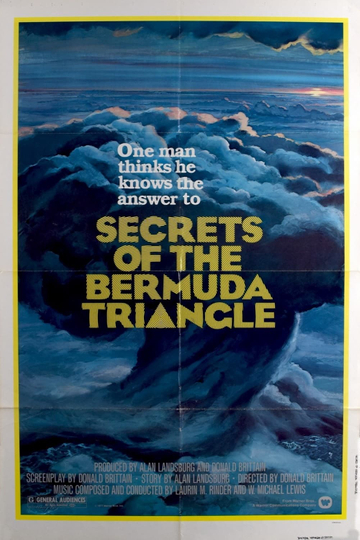
Part documentary. Part dramatization. All bullshit. I say that with love. This is yet another movie of a time and place where we got obsessed over things like the Bermuda Triangle, something we could care less about today for some reason.
Director Donald Brittain mainly made documentaries and shorts, this being the lone paranormal film he worked on. He was joined by co-director Laurin Render (who also composed the music with W. Michael Lewis, who did the music for Enter the Ninja, The Killing of America, In Search Of and Blood Beach, where he wrote the club music) and writer Alan Landsburg, who created In Search Of and wrote the books that Manbeast! Myth or Monster? and The Outer Space Connection were based on.
Planes will be lost, as will the rescue ships went after them. Such is the power of the brutal Bermuda Triangle. What if it also informed us of high-profile cases such as Flight 19, the disappearance of the USS Eagle and other unexplained disappearances, as well as reports of mysterious personality changes and strange weather patterns?
Here’s one mustery I can solve: it’s cinematographer was Brianne Murphy, who also directed the movie Blood Sabbath. Her career found her doing a bit of everything, whether that meant beinga production assistant on The Gay Deceivers, a dialogue director on The Incredible Petrified World, shooting stills on the Cheech and Chong movie Nice Dreams, working in the costume department for Teenage Zombies, being a DP on In the Heat of the Night and Highway to Heaven and directing six episodes of Acapulco H.E.A.T.and the Ami Dolenz movie To Die, To Sleep. She was also the first woman to be invited into the American Society of Cinematographers.
She worked with J. Barry Herron on this and man, his career went everywhere from shooting aerial photography on Chatterbox(what did that movie need that for?) and Tarantulas: The Deadly Cargo to underwater work on The Love Boat, Strange Brew, Big Trouble In Little China and Friday the 13th Part VI: Jason Lives and being the DP or cinematorapher on The Young Graduates, In Search of Ancient Mysteries and Orca. He even directed two episodes of Airwolf and wrote one of Acapulco H.E.A.T.
Anyways, back to the BS. The idea of a time dimension or parallel world was popularized by pilot Bruce Gernon in 1970. He claimed to have flown through a tunnel-shaped”cloud (which he called Electronic Fog) and emerged miles ahead of where he should have been, having traveled through what he believed was a time hole. This story fueled the theory that the Bermuda Triangle isn’t a graveyard, but a gateway.
Some legends suggest that the pilots of the famous Lost Patrol of Flight 19 didn’t crash but were transported. There is a long-standing legend that ham radio operators in Florida intermittently eeceived the final transmissions of Flight 19 decades after they vanished, with some versions of the story claiming the voices sounded calm and elsewhere. That was further legitimzed by the fact that this is how Close Encounters of the Third Kind ends. There are also many accounts of ghostly radio transmissions from ships like the SS Cotopaxi or the Cyclops, where listeners claimed to hear voices long after the ships disappeared.
There’s also the Raifuku Maru, which was the 1925 disappearance of the Japanese freighter, which left one final message: “Danger like dagger now… come quick!”
So yeah. Maybe no one cares because scientists claim they figured it all out. Geologists and oceanographers generally point to more grounded explanations for the disappearances, like methane hydrates, which are large pockets of gas rising from the ocean floor that could theoretically sink a ship by rapidly reducing water density. The Gulf Stream is also pretty dangerous, as it’s an extremely fast and turbulent current that can quickly erase any evidence of a crash or sinking. Or Hexagonal Clouds in the triangle could drop high-velocity air bombs that create 170 mph winds.
But totally aliens, you know?
The film serves as a feature-length spiritual successor to the Leonard Nimoy-hosted series In Search Of. Produced by Alan Landsburg, it utilizes the same formula: ominous narration, grainy reenactments, and a synth-heavy score that makes even a calm ocean look terrifying.
If there was a Mount Rushmore for the 1970s In Search Of aesthetic, Richard Martin would be carved right into the granite alongside Leonard Nimoy and Sunn Classic Pictures. Following his deep dives into the Bermuda Triangle and Bigfoot, Martin took his cameras beneath the waves for The Lost City of Atlantis, a paranormal documentary that, today, would air on basic cable but, back in the day, you’d have to go to a theater or drive-in to see. Or you could wait and see it on a rainy Saturday afternoon on a UHF station. Today, just turn on YouTube.
Before the internet ruined everything with things like facts and sourced data, we had the glorious era of the theatrical documentary. These were movies that promised to solve the mysteries of the universe for the price of a matinee ticket and in return, you got a deep, authoritative voice telling you that everything you know is a lie and that Greek philosophers were actually talking about a high-tech continent that sank because they played God with crystal energy.
Come with us to Bimini Road in the Bahamas. We’re going to spend a lot of time underwater looking at limestone blocks and we’ll be told that they aren’t natural formations but rather the paved highways of a sunken empire. It’s the kind of photography that looks incredible on a big screen, but, when viewed today on a grainy YouTube upload, looks mostly like some very confused divers poked at some rocks while a synthesizer soundtrack tried to convince you that the fabled land of Mu was behind one of these reefs.
You can’t talk about Atlantis without bringing in the Sleeping Prophet Edgar Cayce. The film leans heavily into Cayce’s predictions that Atlantis would rise again in the late 60s. Sure, it didn’t happen. Or, did it? The movie tells us that we just aren’t looking hard enough. It’s a wonderful bit of narrative gymnastics that connects the pyramids of Egypt, the Mayan ruins, nd the deep ocean floor into one giant, cosmic conspiracy.
What makes this film so watchable today isn’t the science; it’s the vibe. It’s the grainy 16mm footage of experts with massive sideburns and turtlenecks sitting in wood-paneled offices, talking about things to come that never did.
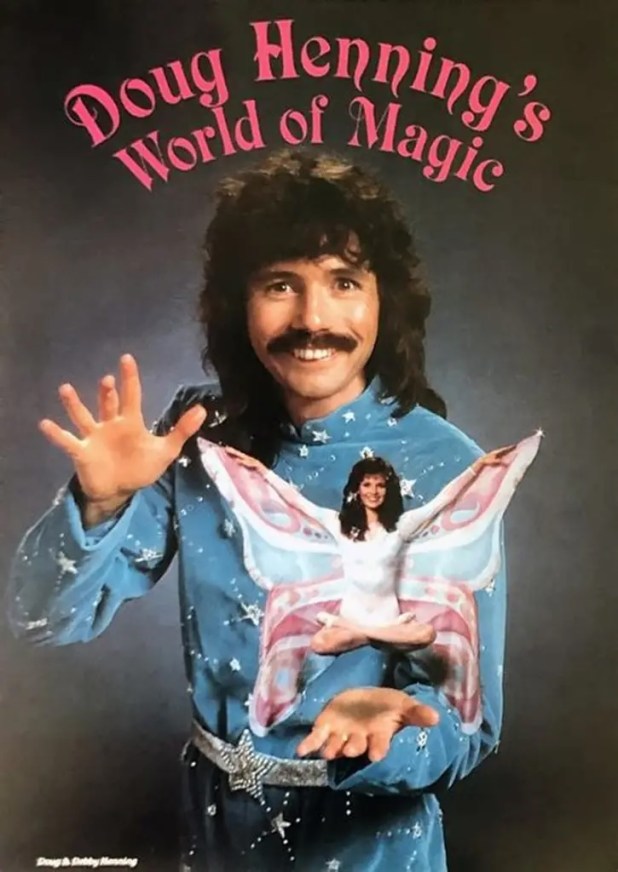
The fourth in a series of seven annual prime-time television specials that aired between 1975 and 1982, starring famous magician Doug Henning; this time, Brooke Shields appears, and Tom Bosley, for some reason, plays heel.
Oh, Doug Henning. The 70s, really. Starting as The Astounding Hendoo in Winnipeg, he won a government grant with the idea that his work was “magic plus theatre equals art.” The live theatrical show that would result, Spellbound, was written by David Cronenberg, directed by Henning’s college friend Ivan Reitman and had music by Howard Shore. His career went beyond magic, as he created looks for the Jacksons Victory Tour, had his own line of stuffed animals called Wonder Whims, co-wrote a b0ok about Harry Houdini, married relationship consultant Barbara De Angelis (who was married five times and one time to Men Are from Mars, Women Are from Venus author John Gray), moved to India in order to devote his time to Transcendental Meditation, almost started a TM theme park named Maharishi Veda Land in Florida, was the senior vice president of the Natural Law Party of Canada and a Natural Law Party candidate in the United Kingdom’s general election. Sadly, he died of liver cancer at the age of 52. Nothed crumudgeon James Randi said that Henning “abandoned regular medical treatment for liver cancer, continued to pursue his diet of nuts and berries, and died of the disease.”
In his act, he always said the same thing: “Anything the mind can conceive is possible. Nothing is impossible. All you have to do is look within, and you can realize your fondest dreams. I would like to wish each one of you all of life’s wonders and a joyful age of enlightenment.”
He was everywhere in the 70s. It’s hard to overstate how much Doug Henning’s psychedelic, “rainbow-and-denim” aesthetic defined the 1970s. He managed to pivot magic away from the stuffy, tuxedo-clad Victorian era and into the age of Aquarius.
Director Walter C. Miller was the man when it came to making award shows and specials. Buz Kohan, who wrote this, worked on similar stuff.
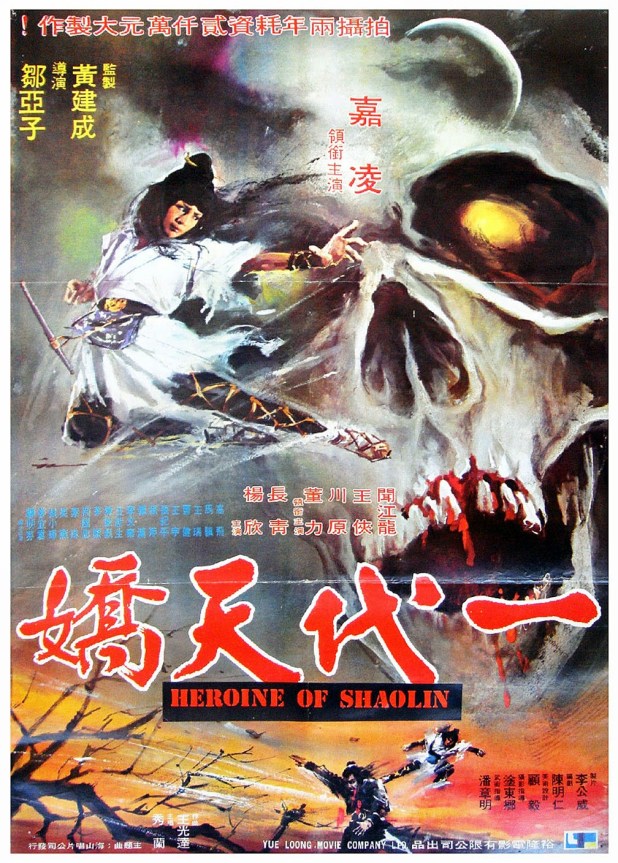
Hsiang Ying (Chia Ling) has been betrayed by her master, who tells her that he killed her father before tossing her off a cliff and when she survives that and a battle with wolves, he locks her inside a cage. She’s saved by Ku (Chiang-Lung Wen) but it turns out that the real killer is his uncle, a maniac who has two skulls that sit on his shoulders and, when called upon, can fly around and bite people.
Now known as the Heartless Woman, she goes on episodic adventures that have her battling ripoffs of other martial arts movies, such as a one armed boxer (Phillip Ko!) and a monkey king. Like many kung fu films from Taiwan, the budget is low and the imagination is high. I wish it spent all the time with its heroine instead of going into comedy, but I still had a blast watching it. Seriously, the final bad guy may have the most amazing weaponry ever.
Also known as Revengful Swordswoman, this was released by 21st Century.
You can watch this on Tubi. You can also get it on blu ray from Gold Ninja Video.
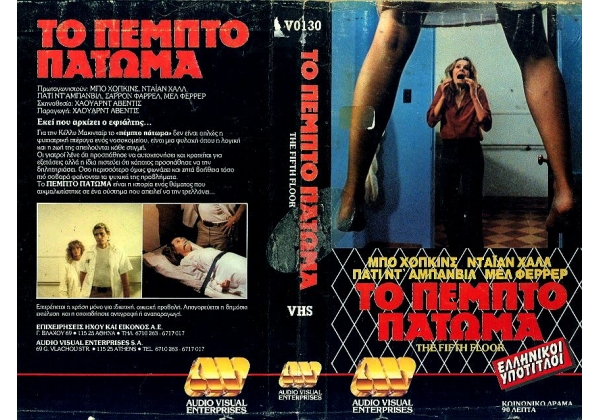
Growing up, the Saint Francis Hospital would always send people with mental issues to the fifth floor. I’ve had certain family members who would have semi-regular vacations to the fifth floor. It got to the point that whenever someone would discuss whether or not someone was acting strangely, they’d say, “Well, they’re on the fifth floor.”
This was going to be part of slasher month, except that it’s in no way a slasher. Of course, the poster work and other marketing makes it seem that way. It’s not. It’s much stranger.
Kelly McIntyre (Dianne Hull, cryonics enthusiast and an actress in Christmas Evil) is a disco dancer who gets dosed, probably by her boyfriend. This brings her to the fifth floor fo Cedar Springs Hospital, where her boyfriend refuses to help her, accusing her of being suicidal.
Kelly’s attractive, which means that she soon becomes the target of Carl the orderly. He’s played by Bo Hopkins, who I have had the fortune of watching several films with him in them of late. Here he’s out of control, a non-stop erection determined to ruin everyone’s life.
This movie is packed with faces you’ll remember, like Don Johnson’s ex-girlfriend and Warhol movie star Patti D’Arbanville, Cathey Paine (Helter Skelter), horror icons Michael Berryman and Robert Englund, Sharon Farrell (It’s Alive), Anthony James (the chauffeur from Burnt Offerings), Julie Adams Dennis Hopper’s The Last Movie and The Creature From the Black Lagoon), Mel Ferrer, John David Carson (Creature from Black Lake), Earl Boen (the only actor other than Arnold Schwarzenegger to appear in the first three Terminator films), Alice Nunn (Large Marge!), rock and roll photographer Chuck Boyd (who is also in the sexploitation film Dr. Minx and The Specialist, both from the same director of this movie), Machine Gun Kelly (who was the announcer in UHF), disco singer Patti Brooks (whose song “After Dark” was on the soundtrack of Thank God It’s Friday! and recorded two duets with Dan Aykroyd for Dr. Detroit), Milt Kogan (Barney Miller), 1961 Miss Universe Marlene Schmidt (who is in nearly every movie this director did) and Tracey Walter. Yes, Bob the Goon from Batman.
This star-studded journey into mental illness comes straight out of the mind of Howard Avedis, who brought us all manner of literally insane movies like Mortuary and They’re Playing with Fire, two movies that I recommend highly. He knows how to take a salacious topic and make it even smuttier, which I always adore. Well done, Howard (or Hikmet).
It might seem like a TV movie for a bit, then there’s full frontal nudity and you’ll feel safe, like a warm straitjacket has been put on you, allowing you to just lie back and enjoy the magical exploitation within.
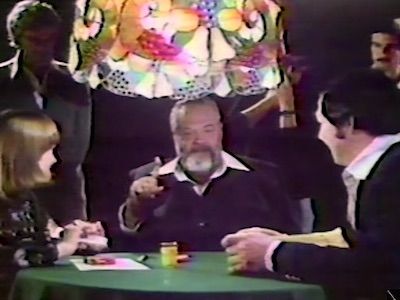
As a kid, Orson Welles was, to me, someone who showed up on talk shows. I had no idea why he was famous, that he was a genius, that Hollywood had taken him down, and he kept on making movies.
This show would have made me think he was a magician.
Originally airing on Showtime in 1978, this was conceived by Abb Dickson. A former President of IBM, he also had tons of Houdini’s original props. The son of a funeral home owner father and a personal secretary to Presidents Roosevelt and Truman mother, Dickson loved the trick The Disembodied Princess, which he first saw Orson Welles perform with his then-wife, Rita Hayworth, on a USO show. When Welles was making a TV special—unfinished—The Magic Show, he reached out to Dickson to get his Disembodied Princess prop. This led to a friendship that would last the rest of Welles’ life. There was one rule: “… the parameters of Welles’ friendship with Dickson included the unspoken rule that they were never to discuss his film career or, indeed, movies in general. It seems obvious that one of the reasons Welles surrounded himself with so many magicians late in his life is because their company provided a respite from the struggles he encountered in trying to put together film projects.”
I wish The Magic Show would be finished, as it has Welles performing a bullet trick that killed its original magician, and Welles does it alongside Angie Dickinson. You can learn more in this article. You can watch some of it here:
As for Dickson, he also shows up in two Andy Sidaris movies, Malibu Express and Picasso Trigger. When it came to this show — you know, the one I started writing about several hundred words back there — the producers wanted a star to introduce it. Dickson said, “Well, how about Orson Welles?” He said, “You couldn’t get Orson Welles to do this!” I said, “Give me your phone.” I picked up the phone, I called Orson, I said, “Look, I’ve written this Magic Castle special…” Joe Butt is standing there with his mouth open. I said, “I need for you to do the introduction and the in-and-out. It will probably be one day of shooting, at the most two, and I’ve only got, I think, $25,000. Will you shoot this?” And he said, “Sure! But I get the extra film.” I said, “Okay, great.” I hung up the phone and said, “Okay, we got him.” Joe Butt was truly amazed.”
In the Senses of Cinema article I’ve referenced, the main reason Orson did this was to get tails of film to make his own movies.
Disckson said, “One of Orson’s jobs – as he said – was making nickel and dime money doing all these commercials and little things so he could get the tail footage from the films. In other words, if you’re going to shoot a commercial and you order 500 feet of stock, he could do it in 100 feet. Then he would have 400 feet to deal with on his own.”
This special, directed by Tom Trbovich (who also directed the “We Are the World” video and Playboy’s Roller Disco & Pajama Party), features the following magicians:
Kuda Bux: Also known as Professor K.B. Duke, he was known for fire walking and the trick he does here: seeing with his eyes covered with paste and wrapped with cloth. Sadly, he eventually lost his eyesight to glaucoma.
Albert Goshman: A bagel baker from Brooklyn, he eventually became one of the world’s foremost makers of foam balls for magic. His coins-in-the-purse routine in this is incredible.
Peter Pit: This Dutch magician was a consultant to Siegfried and Roy and the booker of talent at the Magic Castle.
Ger Copper: The founder of the Dutch School of Magic.
Jay Marshall: The Dean of American Magicians and the first person to open for Frank Sinatra in Vegas.
As for The Magic Castle itself, it’s a performance venue, restaurant and clubhouse for the Academy of Magical Arts for magicians and magic enthusiasts. Today, we may think of magic as silly, but as a kid, I dreamed of going there. Specials like this and TV movies like A Night at the Magic Castle are why. 70s TV culture was a different, less cynical thing for me, a place where I’d love to get to meet Dai Vernon and explore the secret areas of the Magic Castle.
21. TWINNERS CIRCLE: Scientists rejoice! Human cloning has been achieved.
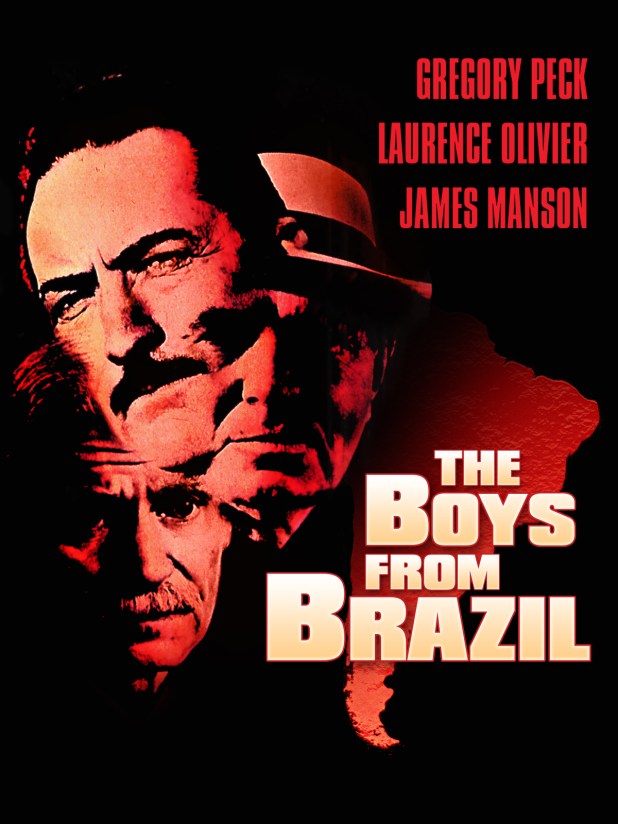
Barry Kohler (Steve Guttenberg) died so that Ezra Lieberman (Laurence Olivier) could learn that Dr. Josef Mengele (Gregory Peck) lives and plans on killing 94 civil servants near retirement. Despite being exhausted by the world, Ezra forms a team with his sister Esther (Lilli Palmer), journalist Sidney Beynon (Denholm Elliot) and vigilante David Bennett (John Rubinstein) to stop the murders.
Directed by Franklin J. Schaffner (Planet of the Apes) and written by Heywood Gould (Rolling Thunder) from the book by Ira Levin, this is about the children — clones! — of Adolf Hitler, who have been placed all over the world.
Two years before this, Olivier would play a Nazi in Marathon Man. Here, he seems way more kindly than the character is in the book that inspired it.
Oddly, this is a movie that my wife’s family watched and quoted all of the time. Maybe they just like watching dogs maul evil German doctors. Who can say? Even today, long after this was made, just saying the title of the movie suggests a vast conspiracy.
Ira Levin had to be the richest man ever. Just look at the movies of his books: A Kiss Before Dying, Critic’s Choice, Rosemary’s Baby, The Stepford Wives, Deathtrap, Sliver and more. Several were filmed more than once and had sequels.



 B&S About Movies
You must be logged in to post a comment.