The Mighty Peking Man (1977)

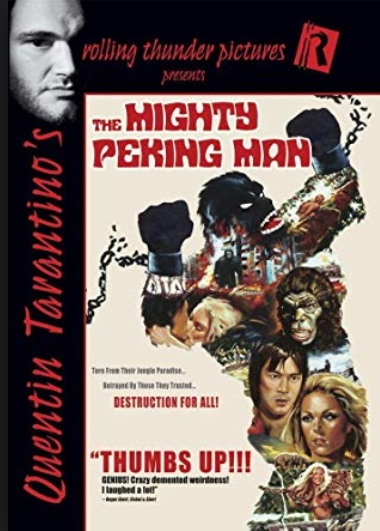
The Mighty Peking Man is a 1977 monster film whose Mandarin title, Xingxing Wang, translates as “Gorilla King” in English (let’s forget the dopey U.S. title of Goliathon). Yep, you guessed it: made to cash in on the 1976 King Kong remake. While Quentin Tarantino’s Rolling Thunder imprint reissued the film in 1998, MPM initially rolled out as a second-biller on the U.S. Drive-In circuit in 1980. It’s the same old story—only told with tongue firmly planted in cheek—featuring greedy explorers who exploit a very large Himalayan Yeti—with a twist: Peking Man raised a beautiful, Tarzaneque woman orphaned in a plane crash who pals around the jungle with a pet leopard. The climax: The Peking Man takes a header off Hong Kong’s Jardine Tower in a hail of helicopter gunfire and jet bombers.

And that Roger Ebert “Thumbs Up!” on the VHS sleeve ain’t no scam: it’s the real deal, as he sites MPM as his “favorite Hong Kong monster film.” And mine too, Rog. Mine, too, as it’s a very well made film. And it should be, as The Mighty Peking Man had a budget of six million Hong Kong dollars under the Shaw Bros. studio (Corpse Mania). The film took over a year to complete—and that time and care shows, in spades—and it was shot in Mysore, India.

While I love it equally, the Shaw Bros. didn’t fair as well with their Hammer Studios co-production of their martial arts vamps going against Peter Cushing’s vamp hunter in The Legend of the Seven Golden Vampires. Their other co-production—the lesser known Shatter—was intended as a weekly TV series, but ended up being a theatrical film dovetailed into the U.S. martial arts drive-in craze of the mid-70s. Oh, and Roger Ebert enjoyed The Mighty Peking Man so much that he re-watched—22 years later and upped on his two and a half star review, for—the Shaw’s 1975 release, Infra-Man. That’s the power of the Q: you gotta love it. And when it comes to Hong Kong cinema, none meets the power of the Shaw Bros.: you gotta love it. As you will this film. Pure awesome.
In a production twist only a B&S Movies reader can love: Koichi Kawaktia, MPM’s assistant director, later worked on Yonggary, the 1999 South Korean remake by Hyung-rae Shims of Yongary, Monster from the Deep (1967). Yonggary ’99’s co-scripter is Marty Poole, who wrote the 1997 Richard Lynch-fronted Rollerball homage, Ground Rules (oh, you gotta watch that film!!).

There’s a lot of online opportunities to watch The Mighty Peking Man, but you know us: we always try to find you the freebie. So watch it on You Tube. It’s campy, it’s whacked, it’s funny and entertaining. Strap on the popcorn bucket and snap the caps off the Dr. Pepper sixer and roll it. It’s the perfect “must watch” of this week’s “Hong Kong Week” tribute of reviews to pencil into your schedule.

Don’t forget that you can learn more about the Q’s Rolling Thunder imprint with our “Exploring: The 8 Films of Quentin Tarantino’s Rolling Thunder Pictures” featurette.


Reissue Update: Here we go with another Delirium, UFO: Target Earth, and Calamity of Snakes surprise, again! In this case we were simple scratching a movie off of our above noted Quentin feature . . . or was it our “Planet of the Apes” tribute week . . . no, wait, it was for our “Kaiju Day Marathon” . . . and months later, a DVD restore was announced for release in December 2021. (Duh, it was for our “Hong Kong Week” of films. Hey, gotta work in the links.)

Yes! A reissue of The Might Peking Man is now available as part of Arrow Video’s “Shaw Scope” box set, in this case, Volume One. You don’t want the box set and you’d rather stream it? No worries. It’s also available on the Arrow Player service.
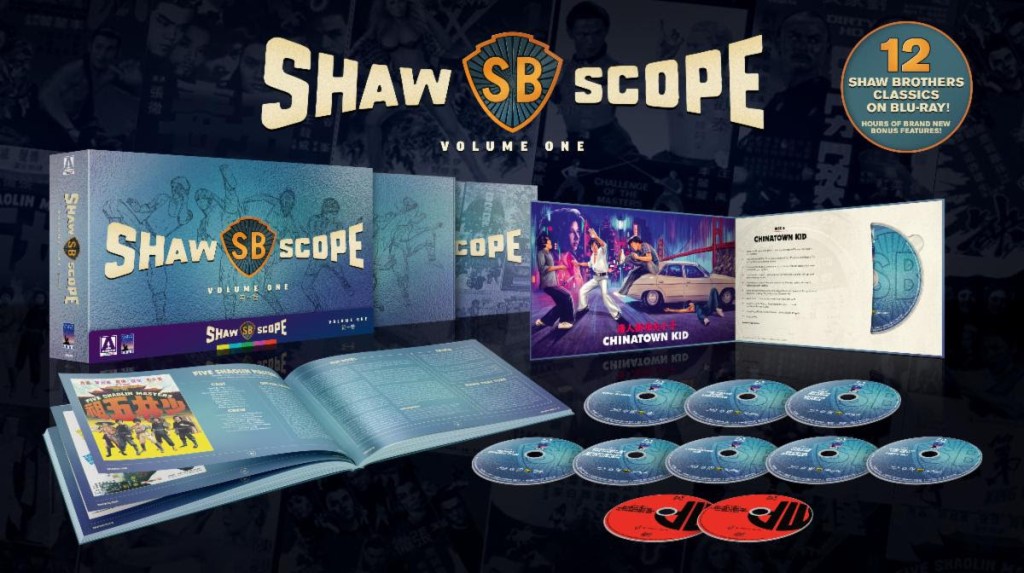
This new Arrow version of The Mighty Peking Man features the film in both uncompressed Mandarin and English original-mono audio, as well as newly translated English subtitles for the Mandarin audio, plus English hard-of-hearing subtitles for the English dub.

The new features also include: A new commentary track by Travis Crawford, a new interview with suit designer Keizo Murase, a 2003 iInterview with director Ho Meng-hua, a 2004 interview with star Ku Feng, a behind-the-scenes vignette of Super 8 footage from the archives of Keizo Murase, an un-restored standard-definition version of the film, alternate opening credits from the U.S.-version of The Mighty Peking Man, known as Goliathon, trailers from the Hong Kong and U.S., German and Dutch versions, as well as the U.S. TV commercial (Oh, boy, I remember seeing that on TV!), and a stills-image gallery.

You can purchase the Shaw sets from MVD.

Streaming online: You can also stream The Might Peking Man by visiting ARROW to start your 30-day free trial. Subscriptions are available for $4.99 monthly or $49.99 yearly. The ARROW Player is available in the U.S. and Canada, the U.K. and Ireland on the following Apps/devices: Roku (all Roku sticks, boxes, devices, etc.), Apple TV and iOS devices, Android TV and mobile devices, Fire TV (all Amazon Fire TV Sticks, boxes, etc.), and on all web browsers at at Arrow Player.com.

About the Author: You can read the music and film reviews of R.D Francis on Medium and learn more about his work on Facebook. He also writes for B&S Movies.
The Last Dinosaur (1977)

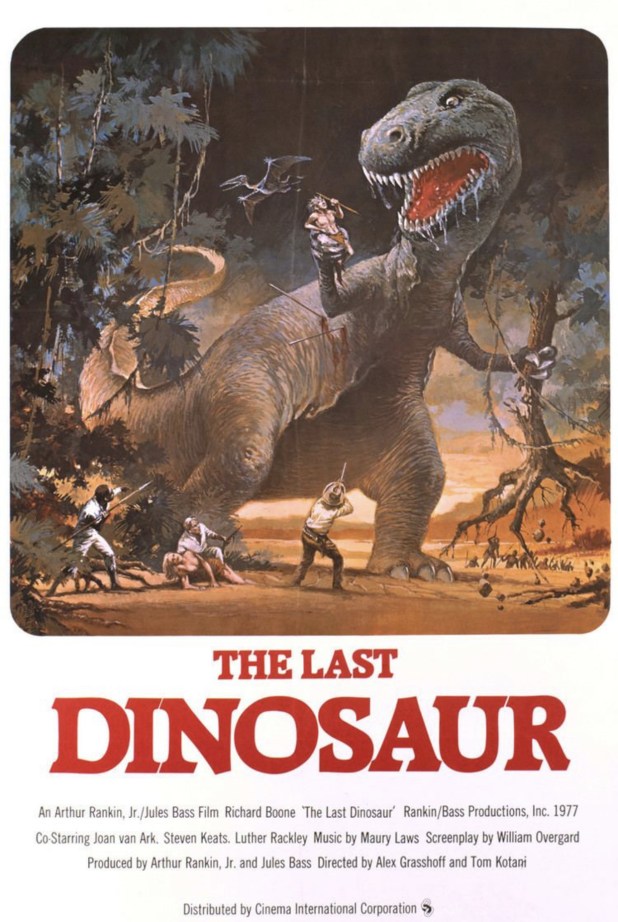
Also known as Polar Probe Ship: Polar Borer, this film was a co-production of Rankin/Bass and Tsuburaya Productions. It was directed by Tsununobu “Tom” Kotani and Alex Grasshoff, who also made The Wave, a TV movie we watched repeatedly in high school classes.

This movie was intended for theatrical release, but failed to find a distributor. That meant it ended up on ABC, with a 92-minute edit airing on February 11, 1977. In other countries, it played as a 106-minute film (it was a double feature with Sorcerer in the UK!).

Oil company owner and big-game hunter Maston Thrust (Richard Boone) — what a combination for a heel, right? — is using a laser drill to find oil under the polar ice caps when a T. Rex is discovered living in a valley that is heated by a volcano. The first crew that explores the area dies, other than geologist Chuck Wade (Steven Keats, who also appears in another Rankin/Bass and Tsuburaya film, The Ivory Ape), so a new crew is sent in.

Thrust himself leads it, along with Maasai tracker Bunta (NBA and ABA player Luther Rackley), Dr. Kawamoto (Tetsu Nakamura in his last role), Chuck and Frankie Banks (Joan Van Ark), a Pulitzer Prize-winning photographer who gets on the trip by sleeping with Thrust. Yes, that really happens. Also, it was 1977.

The laser borer gets destroyed fairly early and all modern conveniences fail in the face of multiple dinosaurs, all portrayed with man-in-a-suit techniques, which I absolutely loved. The entire crew is nearly killed by numerous kaiju attacks. Also, there are cave people and one of them, named Hazel, ends up washing Joan Van Ark’s hair.

If you love the T. Rex costume here, well you’ll be excited to know that it was reused as Dinosaur Satan Gottes for the simply baffling Japanese anime/live action mashup Dinosaur War Izenborg, which you can find in the U.S. as Attack of the Super Monsters.

Perhaps the best thing about this movie is its theme song, “He’s The Last Dinosaur.” It’s worth getting through the whole film just to hear it.

Dynasty (1977)

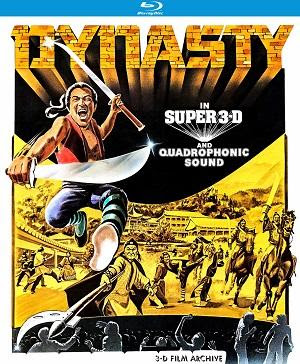
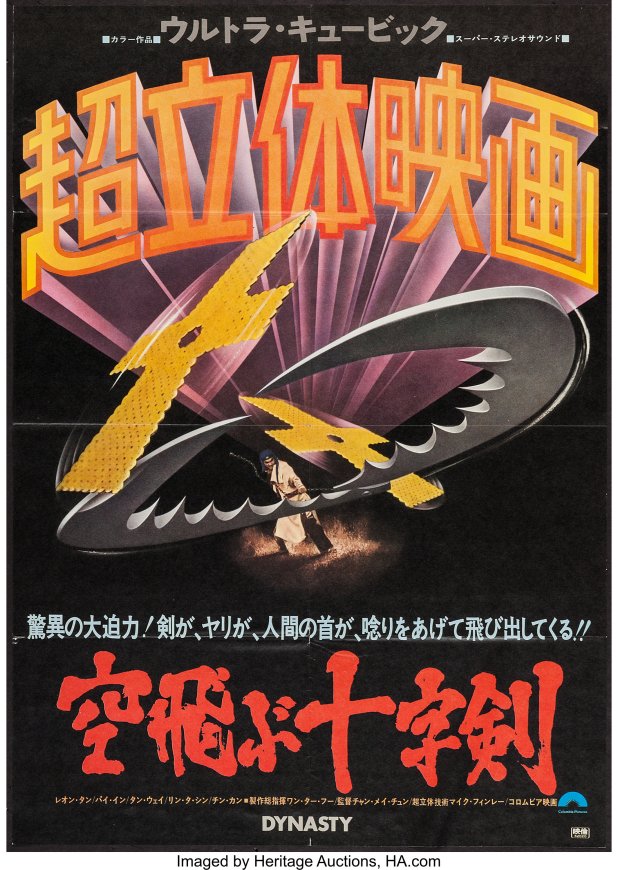
Qian Dao Wan li Zhu AKA Super Dragon AKA Dynasty was the first Hong Kong/Taiwan 3D film, as well as using the Sensurround 8-track stereophonic sound system. That way, the things you’ve come to expect from martial arts films — punches, kicks, swords and flying guillotines — mix up with things you will in no way expect — flying heads, crushed skulls, metal umbrellas as weapons and even a man battling with his amputated knubs — while flying directly at your face.

The prince of the Emperor is accused of treason against the throne by an evil eunuch and his sword-wielding henchman and must fight for his life, which is all the set-up you need for 94 non-stop minutes of fighting. It’s not the best martial arts you’ve ever seen, but it is one of the few that made it into the third dimension.

Director Mei-Chun Chang*also made Young Dragons: Kung Fu Kids and understand that we want to see 3D bust our eyeballs. And serving as the 3D advisor on this? Michael Findlay. Yeah, the very same.

Kino Lorber has released a special edition blu ray of this film, working alongside the 3-D Film Archive to create something that be viewed with either BD3D polarized or traditional red and blue glasses (it comes with one pair). That’s because this blu ray was made with Adaptive Multi-Band Anaglyphic Encoding, which they claim is a vast improvement over any previously used process for red/cyan 3D imaging. I’ll be honest, in my trial of this, it worked perfectly.

The disk also features a restored comic book, some 3D slideshows and a 3D music video.

Here’s to Kino Lorber — you can get this blu ray from them — is planning on releasing more in your face action. This is one of my favorite blu ray releases of the year and is begging to be in your collection.

*Chang also directed another 3D martial arts film, Revenge of the Shogun Women.

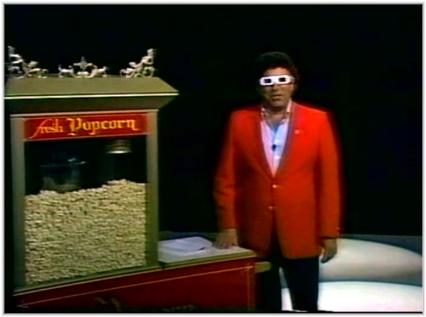
PS – This movie played on TV stations across the country with giveaway 3D glasses. In Pittsburgh, it played on Chilly Billy’s Chiller Theater, which got to use the Money Movie set for the evening.

SON OF KAIJU DAY MARATHON: Legend of Dinosaurs & Monster Birds (1977)

Toei president Shigeru Okada attended several film festivals and trade fairs in America and as he saw the way the film business was shifting toward blockbusters like Jaws, he felt that Japan should follow that trend. After all, who knew monster movies better than them?

Filming started the very same month that Jaws was released overseas. At the same time, everyone had grown obsessed with the Loch Ness Monster. Therefore, this was the perfect movie for Toei to appeal to not just the Japanese movie audience, but one across the world.

The film takes inspiration from the aforementioned shark movie, having attacks on boaters and swimmers and a build of the tension until the monster is unleashed. There’s even a gory scene where a headless horse is found hidden in a tree.

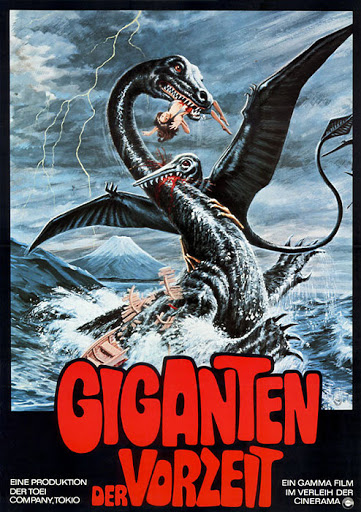
It turns out that not one but two kaiju are on the loose: a plesiosaurus and a rhamphorhynchus. They eventually battle and then fall into an erupting Mount Fuji.

Oddly enough, there are neither dinosaurs nor monster birds in a movie named Legend of Dinosaurs & Monster Birds. The plesiosaurus is a member of the sauropterygia and only a distant relation of dinosaurs while the rhamphorhynchus is a pterosaur, which is not a bird.

Perhaps even more strangely, this movie was a big deal in Russia and was, at one time, the 19th highest-grossing foreign film of all time in the USSR.

You can watch this on YouTube.

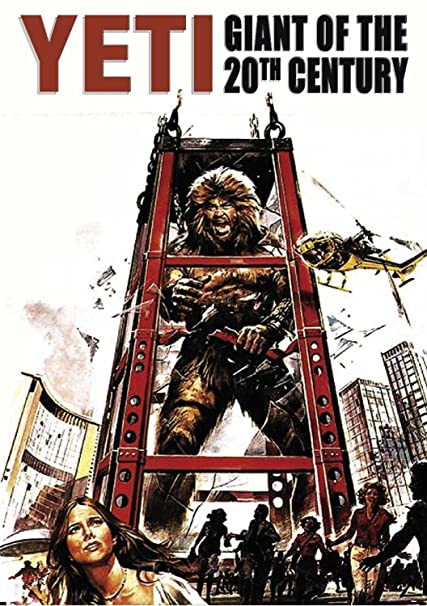
SON OF KAIJU DAY MARATHON: Yeti: Giant of the 20th Century (1977)

Somewhere deep in the middle of the Canadian mountains, Professor Wassermann (played by John Stacy and voiced by Gregory Snegoff, who was Scott Bernard on Robotech and Golgo 13 in the translated American version of his cartoon) is looking for a giant iceberg that has a yeti (Mimmo Crao, the only actor that I know that is in a Jesus movie — Jesus of Nazareth — and an Edwige Fenech sex comedy — Sex With a Smile — and this monster movie).

Morgan Hunnicut (Eddie Faye, who is really Edoardo Faieta from Plot of Fear, and also voice by Snegoff) owns a multination oil company that funds the expedition to study him but he really wants the yeti to exploit. He’s also brought along his orphaned grandchildren for some reason — what, a Fortune Six company doesn’t have daycare for their CEOs? — named Jane (Phoenix Grant*, AKA Antonella Interlenghi, Emily from City of the Living Dead) and Herbie (Jim Sullivan), who had been mute since the death of his parents and only communicates with his dog Indio.

There’s an astounding scene where the Yeti is fitted into what is basically a giant telephone booth and airlifted by helicopter to a height of 10,000 feet because the air up there is what he’s used to and it’ll be easier to thaw him out up there. This is bonkers Italian cinema science at its finest, dear reader.

The paparazzi wants to see more of the yeti and surrounds everyone, freaking him out as if he were in a Dino De Laurentiis movie from 1976 and sending him running with Jane, Emily and Indio in his hand. He gets so excited by Jane rubbing against his paw  — and I’m not making this up — that he gets erect nipples. Later, as he combs her hair with a giant fishbone — again, not making anything up — they are found by the professor who claims that she has been adopted as his wife and Herbie as his son. Cliff Chandler (Tony Kendall**, AKA Luciano Stella, AKA Kommisar X!) is one of the company men who comes to their rescue and he comments that she’ll have to put out soon for the ape man.

Speaking of putting out, the Yeti has been marked much like Kong was in the wake of Dino’s remake. You can find Yeti shirts that say “Kiss Me Yeti” — a phrase that makes no sense — and a disco song and a commercial for the gas stations that ask you to put a Yeti instead of a tiger in your tank.

Then things get bad when the new leader of Hunnicut turns out to be the evil Cliff. He decides to kill anyone connected with the big lug.

How bad do things get?

The kind of bad where autistic children are threatened, Yetis break free over the Niagra Falls, where old kindly professors are killed by Aldo Canti, who was once Angel the acrobat from Return of Sabata and even cute dogs get stabbed.

Somehow, however, Indoo shrugs off this 1d4 slashing damage and survives to come running across the field like Wuthering Heights at the end as the Yeti goes back home to the frozen Canadian tundra, leaving behind nothing but death, destruction and flipped over toy vehicles with dead industrialists trapped inside.

Oh yeah and Dr. Butcher himself, Donald O’Brien, is in this!

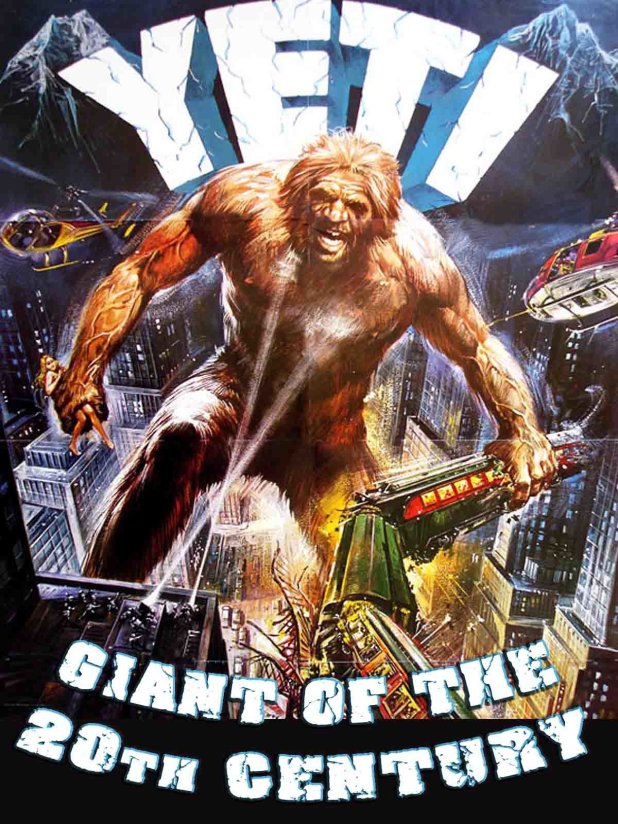
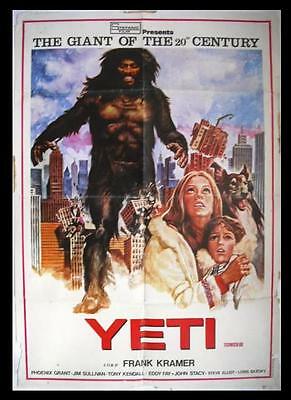
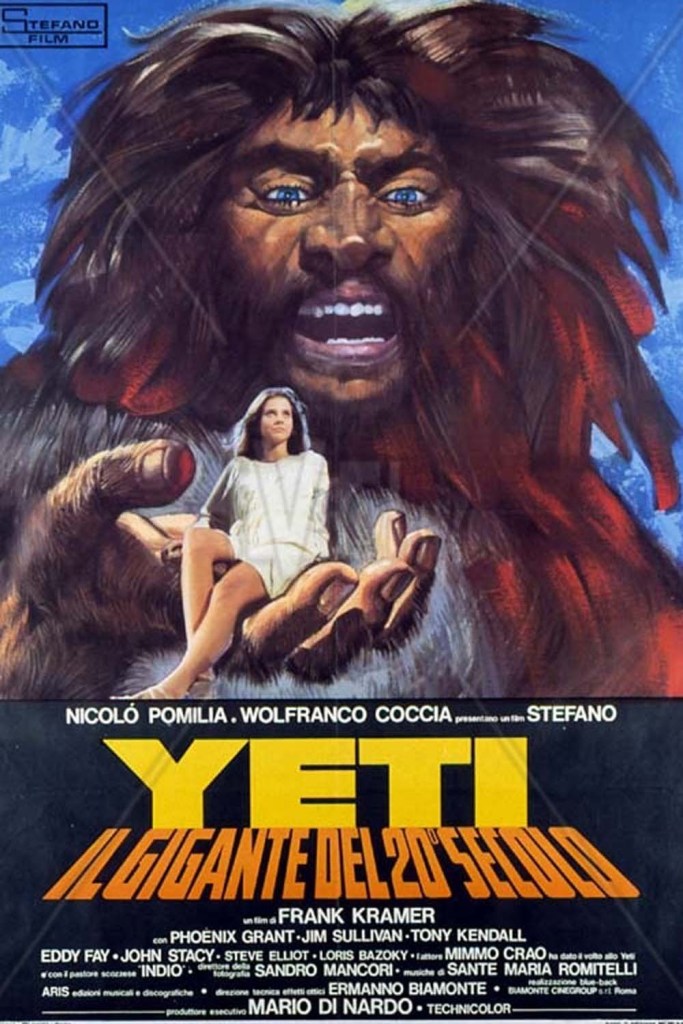
A lot of folks hate on this movie and for really poor reasons. This is the very best kind of trash, a movie blessed with great poster art and the worst in special effects. These people are morons that don’t understand the wonder of a film that has high budget dreams and bottom basement budget realities.

Writer Mario di Nardo also wrote another astonishing film, the revenge picture by way of slasher grossout Ricco AKA Cauldron of Death and one of the best giallo films ever, The Fifth Cord, as well as Five Dolls for an August Moon. He was joined by Marcello Coscia on the screenplay, who also wrote Mission Bloody MaryA Quiet Place to KillWhen Women Lost Their TailsThe Living Dead at the Manchester Morgue and Tex and the Lords of the Deep. There was some talent here, at least in the script.

Director Gianfranco Parolini went from writing peblum films to the scripts for all three Sabata movies and God’s Gun. His directing resume has some decent stuff on it as well, including several of the Kommisar X films, If You Meet Sartana…Pray for Your Death and The Fury of Hercules. He also produced this film. Again, he had a record of producing solid work, but I think they shot too high and paid the price.

And by paid the price, I mean made a movie that completely entertained me for its entire running time.

*According to Wikipedia, Jessica Harper (yes, from Suspiria) is the voice of Jane. This seems way too good to be true.

**Kendall and O’Brien are dubbed by Ted Rusoff, the son of screenwriter Lou Rusoff and nephew to B-movie titan Samuel Z. Arkoff. He relocated to Italy to dub movies — where he met and married Carolyn De Fonseca — and you can hear his voice in movies like Voyage Into Space, Deep Red and The Strange Vice of Mrs. Wardh.

You can watch this on Tubi.

KAIJU DAY MARATHON: Cozzila (1977)

EDITOR’S NOTE: We originally ran this piece on March 30, 2020, but any discussion of our Godzilla vs. Kong excitement has to feature something about this little-known Italian version of the original Godzilla, which was made by Luigi Cozzi.

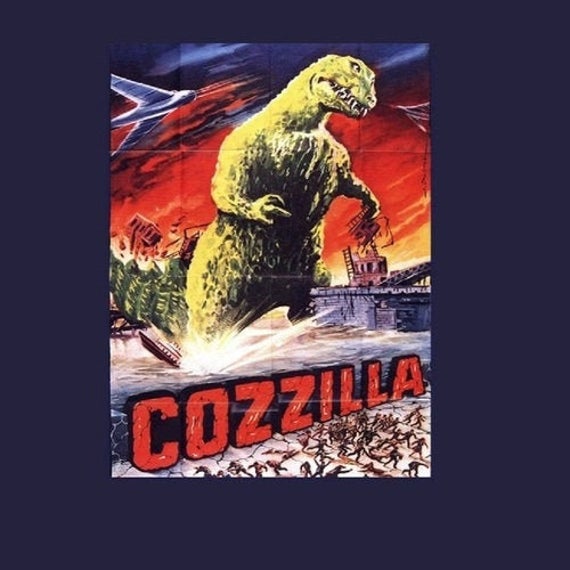
All the way back in 1979, the first issue of Fangoria came out with a psychedelic cover of Godzilla. I always wondered where this image came from and now I know — the strange and alluring 1977 Luigi Cozzi led version of the original film.

Yes, Italian filmmaker Luigi Cozzi (StarcrashContaminationPaganini Horror) created this colorized version of the original Godzilla, complete with a soundtrack that used a magnetic tape process similar to Sensurround.

Due to the success of the 1976 remake of King Kong, Cozzi attempted to cash in on the film’s success by re-releasing Gorgo, but it costs too much. Toho gave him a good price, but were only able to provide negatives for the 1956 American version of the film. Cozzi’s distributors refused to release the film, after discovering it in black-and-white.

At this point, Cozzi got the approval from Toho to colorize the film, provided they get the new negative when he was done. He had final approval over the stock footage, music, and choice of coloring.

To pad the film’s running time to 90 minutes, Cozzi added stock footage, saying “The decision to insert extra footage was because the original picture was 1 hour and 20 minutes. This was normal length in the fifties but in the mid seventies a picture to be shown theatrically had to be at least 1 hour and 30 minutes long. So we were forced to add material to it in order to reach that length. Its final length was 1 hour and 45 minutes.”

Cozzi wanted to give an old film an “up-to-date and more violent look,” so the director added real footage of death and destruction from war-time and Hiroshima stock footage, as well as scenes from The Train, The Day the Earth Caught Fire, The Beast from 20,000 Fathoms and Godzilla Raids Again

To make the movie even bigger, Cozzi added Sensurround effects that would be blasted from giant loudspeakers specially placed in each theater. Composer Vince Tempera wrote the film’s additional score on electric piano, with synth music being used to give the film a more modern feel.

Image from SciFi Japan

Then, the film was colorized by Armando Valcauda frame-by-frame using stop motion gel photography, a process that took three months. The effect isn’t really seeing the movie in color, as later colorization efforts would accomplish, but pretty much providing a tripped out version of the film that is constantly being splashed with neon colors.

So what was Spectrorama ’70? Cozzi told SciFi Japan, “Spectrorama 70” is just a name I did invent to help advertising. It refers to colorization but also gives a feeling of 70mm which at that time was typical of every big budget Hollywood blockbuster. This invented name, in the style of William Castle, helped to give a “bigger” look at my Godzilla theatrical re-release advertising materials.”

This is one of the hardest kaiju films to find and one that’s probably one of the weirdest and most interesting. There’s really nothing like this movie and you can say that about just about every film that Cozzi created.

You can download this on the Internet Archive.

The Unknown Force (1977)

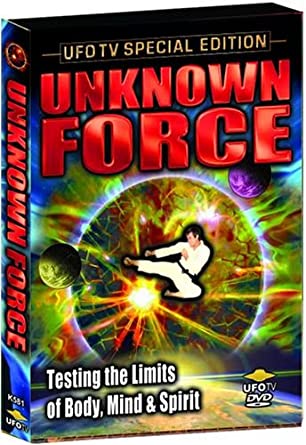
Dick Croy made four movies all about the unknown, including World Beyond DeathThe Miracle HealersAge of the Psychics and this film, which has Jack Palance as the voice that tells you all about the secret powers that karate fighters and healers all possess.

Keep in mind that this has nothing to do with 1978’s The Force Beyond, which found Willaim Sachs getting Emperor Rosko to say serious things over increasingly goofy happenings.

The sell copy for this claims that it’s all about “the fascinating story of the scientists who are developing the technology to measure these imperceptible energies and the exploration of an untapped energy force available to all of human kind which would revolutionize and improve the quality of life throughout the world.” You may detect the subtle hint of male cow feces throughout.

Nonetheless, they also claim that this movie has “stunning extrasensory evidence that can no longer be denied.” So who am I to be a naysayer?

B-Movie Blast: End of the World (1977)

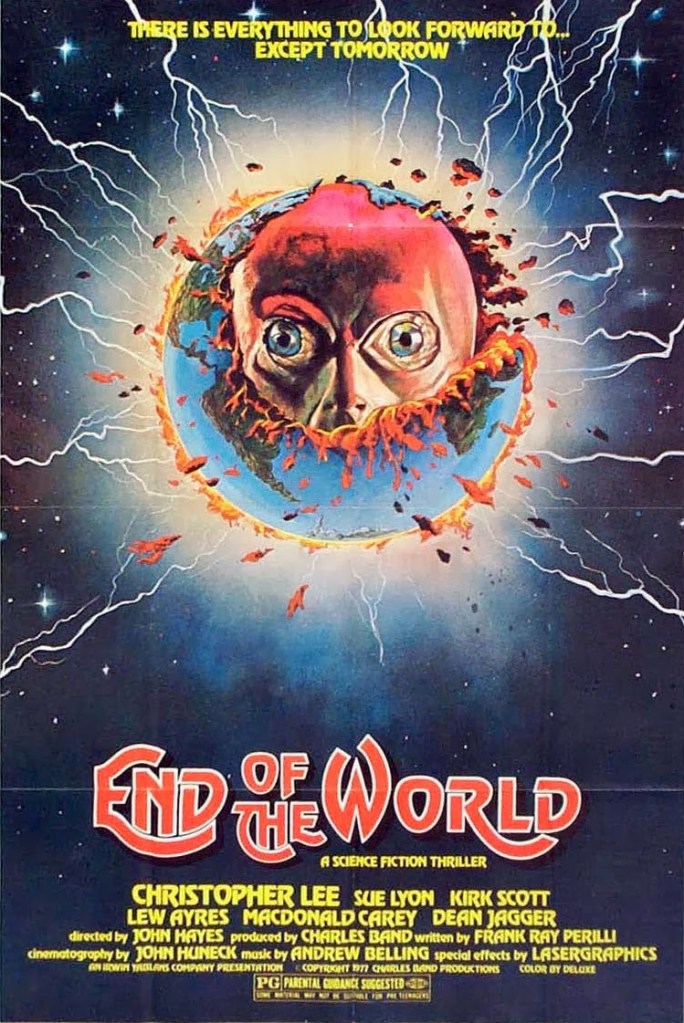
We reviewed this drive-in oddity way back on October 25, 2018, just because. Well, wouldn’t you know it: Mill Creek’s included it on their B-Movie Blast set. And it got assigned to me to do another take. Ugh. “Keep the site ‘fresh,'” Sam’s says. Whatever, boss.

When Sam reviewed this back in 2018, he mentioned how Bill Van Ryn from Groovy Doom and Drive-In Asylum always jokes about movies where nothing happens as being his “favorite movies.” No truer words spoken, William, for ye are B-movie wise. Nothing happens, here. Zero. Nada. Zippity-do-da. And we love End of the World for the fact that the filmmakers behind it were in the editing suite and said, “print, that’s a wrap.”

Yeah, sure, John Hayes, the director behind the very cool Dream No Evil and Grave of the Vampire (both with the great Michael Pataki starring), as well as Garden of the Dead (bad, but I liked it), gave us this Star Wars dropping.

And Frank Ray Perilli? Well, when the guy who pens Mansion of the Doomed and Dracula’s Dog . . . then follows this alien romp with another alien romp for Charles Band, the romper stomper that is Laserblast . . . well, why are we so shocked at this film’s insanity? Oh, and Cinderella. Perilli has the lower-abdominals to adult-up the classic children’s tale. And he had the muscles to squeeze out a film that not only serves to insult the Catholic Church, but E.T.s the galaxy over.

And this review isn’t over. Not yet.

Watch the trailer.

Christopher Lee, who stars here, is, rightfully embarrassed by this movie. And we are embarrassed for him. As well for his work in Starship Invasions — a film that is inventive, to say the least, but was unable to live up to its whacked premise of underwater alien pyramid bases, due to its non-budget. Did Ed Hunt dupe Sir Lee into that movie? Who knows?

But Lee was duped into End of the World with the hook that José Ferrer, Dean Jagger, John Carradine, Lew Ayers, and MacDonald Carey would star. Lee knew them and their work. So, sure. Why not, so goes the story. Lee commits to the project.

Well, Ferrer and Carradine aren’t here. Bur Ayers and Jagger are. So is ol’ daytime soap actor Mac. But their collective roles are one-day shoot-’em throw away scenes. And we have Sue Lyon (Crash!) and Kirk Scott (Starflight: The Plane That Couldn’t Land; “Big Bud Dean” in Heathers) as our leads. And outside of Lyon and Scott, the rest are wooden. Yeah, even Ayers and Jagger. Well, Lyon and Scott are driftin’ the wood, too, as they show us why they never rose above junk like this and only booked bit parts in anything rising to the level of being a decent watch — such as Heathers.

Anyway . . . the plotting of this Star Wars dropping . . . Jesus H. you-know-who and a bag o’ chips.

So, Irwin and Frank Yablans of Compass International, who unloaded the VHS crap on us Crown International-style, along with Charles Band . . . yes, he of Empire and Full Moon Pictures fame . . . duped Christopher Lee into this galactic craptastica. You know Band’s work, but you may not know the Yablans Brothers were also behind the first Halloween (Irwin’s “idea” as The Babysitter Murders that takes place during Halloween). But Brother Yablans also unleashed Nocturna: Granddaughter of Dracula. Then came up with the idea of an alien priest overseeing a convent of alien nuns.

So . . .

Sir Lee is a catholic priest . . . but he’s an alien.

Nuns operate a supercomputer. They’re aliens.

Lee’s is Father Pergardo, but he’s being called back — or is it “replaced” by the alien Zindar. But he doesn’t want to “go back.” But he “is” Zindar and doesn’t know it. Or something.

Kirk Scott is Professor Andrew Boran. He tinkers in his lab and discovers a coming natural disaster by way of an alien radio signal. Or something.

He and his wife, Sylvia (Sue Lyon), intercept the signals and triangulate them back to a convent . . . where alien nuns run said supercomputer.

The Professor and his squeeze are useless heroes.

The night photography is so dark, it’s to the point of blindness.

Aliens by E.S.P can blow up pay phones, diner coffee machines, and car engines.

The aliens can’t get back unless the Professor gives them some crystal do-dad to fix their Phantasm-doorway back home.

NASA labs have shit security one can easily break into to steal what the aliens need.

The Earth is destroyed because its “diseases” are leaking over into the universe.

Cue the stock footage purchased from Roger Corman.

Blow up the glitter-filled Christmas ornament painted to look like Earth.

The end. Seriously, the real THE END . . . the earth is destroyed!!!

Yes. This TV ad, seen below — in my teen I-must-see-ANYTHING-Star Wars-ish years — got me into the duplex. So, I, like Sir Lee, was duped. But wow . . . when you pair this with Starship Invasions . . . what a double feature! And you can enjoy it . . . and see how it all ends . . . on You Tube. In addition to its inclusion on the B-Movie Blast film pack, you can also watch it as part of their Nightmare Worlds box set.

* Nightmare World image courtesy of JohnGrit/Unisquare.

About the Author: You can learn more about the writings of R.D Francis on Facebook. He also writes for B&S About Movies.

L’occhio Dietro La Parete (1977)

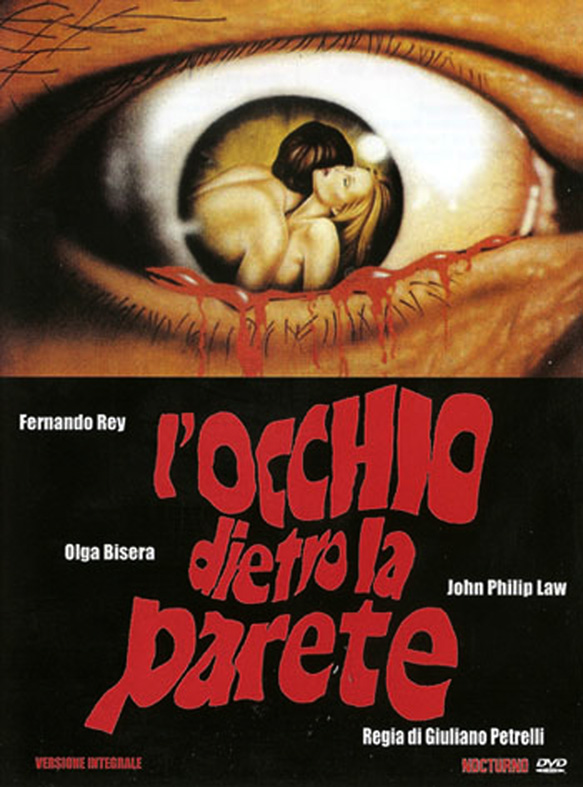
Eyes Behind the Wall tells the story of Ivano (Fernado Rey, The French Connection), a wheelchair-bound man who has an apartment filled with audio-visual equipment that allows him to spy on Arturo (John Phillip Law, Danger: Diabolik) and his various sexual conquests. He also gets off making his wife Olga (Olga Bisera, The Spy Who Loved Me and obviously a confidant woman, as she was the partner of Luciano Martino — who had been married to Edwige Fenech and Wandisa Guida — from 2004 until his death in 2013) watch these shenanigans. But now, he wants her to seduce him and be part of the action. And that’s where things get…giallo.

There’s also an astounding disco sequence with Bava-esque lighting, public nudity and a song called “Disco Boogie” that made me lose my mind. There’s nothing quite like a disco scene butting its way in to a movie that has nothing to do with dancing and these scenes are always quite welcome. I mean, everyone in this scene is going for it in a way that I never could on the dance floor.

Giuliano Petrelli was usually an actor — he’s in Massacre in Rome and The Italian Connection — and this was his one and done as a writer and director. It’s a shame, because this definitely has some great moments and was way better than I thought that it was going to be. It’s an adjacent giallo, I guess, as it’s more Rear Window than The Bird With the Crystal Plumage. And I did not expect that post-disco scene coming where  Arturo’s black friend (Jho Jhenkins, The Perfume of the Lady In Black) takes him from behind on the floor while Ivano gleefully watches and Olivia runs screaming to her bedroom.

Seeing as how the movie starts with Arturo assaulting and murdering a young girl on a train, these things certainly can’t end well for anyone. And what’s with the butler, who seemingly worships Olga, picking up her body hair and underwear in an almost state of religious ecstasy?

This is an adjacent giallo that could fit into the sex thrillers of the late 80’s and 90’s, except that it doesn’t have any negative attitude toward sexual behaviors, from normal to, well by the end of the movie you learn more, totally aberrant. Nor does it shy away from male nudity, so it’s totally the least closed minded pervy 1977 Italian movie you’re ever goign to see. And hey — that Pippo Caruso (Primitive LoveEscape from Women’s Prison) soundtrack is all over the place, from that aforementioned disco number to the strange ambient music that Arturo listens to and the score that drives this film.

The end of this movie will either make total sense to you, gross you out or all of the above. Here’s to 70’s movies that end on the flaming wreckage of their main characters.

You can watch this on YouTube.

House (1977)

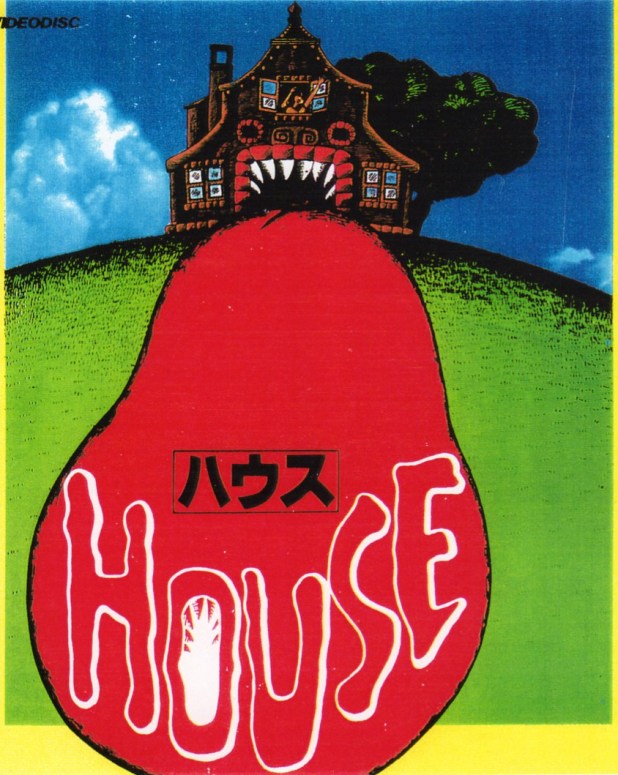
Nobuhiko Obayashi died this year, but left behind a career that began as an experimental filmmaker and somehow moved into mainstream success and around 3,000 commercials. At least in the U.S., he’s best known for this movie, which got its start when Toho asked Obayashi to make a movie like Jaws. His daughter Chigumi gave him several ideas that he worked into a script with Chiho Katsura. For two years, no director wanted to make the movie*, so eventually, Obayashi made it himself with a cast of nearly all amateur actresses**. So much of what ended up on the screen was influenced by Hiroshima, where the director grew up and saw every one of his childhood friends die in an atomic blast.

This is truly a haunted house tale told by and for children. Obayashi even wanted the special effects to look unrealistic, as if made by a child. So let that inform the story of Gorgeous, who has been planning a summer vacation with her father, who has been Italy scoring film music***.

Instead, she learns that she has a new stepmother and makes the decision to visit her aunt, along with her friends Prof, Melody, Kung Fu, Mac, Sweet and Fantasy, all of who have names that completely explain who they are.

From there on out, honestly, you’re on your own. House is a movie that should be experienced instead of read about, because this is the kind of movie where pianos can eat children, where watermelons become human heads and heroines can burst into flames within happy endings.

Man, according to the IMDB trivia section, Obayashi proposed a story for what would have been the 16th Godzilla film, which would have used the same crew as House. In this story, a girl named Momo finds the dead body of Godzilla, who is really a pregnant female alien named Rozan who died from diabetes, and then she becomes a spaceship to take children to her home planet to bring Godzilla back. There was, of course, a female monster who shot flames out of her breasts.

*Obayashi would later say that a producer told him that Toho was tired of losing money on comprehensible films, so they decided to let him make something that was incomprehensible.

**Most of those actresses had worked on his commercials, other than Yoko Minamida who played the Auntie. Also, Obayashi was a smart guy, because he made a series of movie tie-ins before the movie was even made, promoting the script so that Toho saw that it would be a success. He published a commercially-successful manga, radio drama and soundtrack album with the band Godiego before Toho finally said that he could make the movie himself.

***How weird would it be if her dad was scoring Suspiria, a movie that House shares the idea of childhood against horror, some level of nonlinear storytelling and primary colors with?