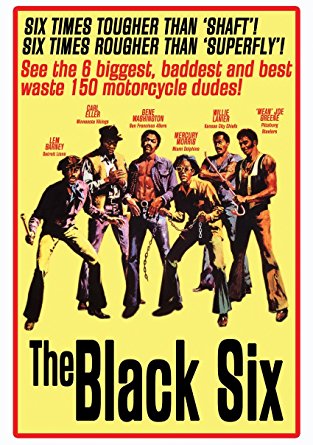
Matt Cimber has pretty much lived a life — he was married to Jayne Mansfield, he created the Gorgeous Ladies of Wrestling and he directed movies like Butterfly, The Witch Who Came from the Sea and Hundra amongst others. And in 1973, he was able to convince six currently playing NFL stars to appear in a black version of the biker film. The results? Amazing.
The Black Six is made up of six All-Pro NFL stars:
Gene Washington, San Francisco 49ers (who also was in Cimber’s Lady Cocoa and Airport ’75)
Willie Lanier, Kansas City Chiefs (who is in the NFL Hall of Fame and was named to the NFL 75th Anniversary All-Time Team)
Carl Eller, Minnesota Vikings (an NFL Hall of Famer who went on to found substance abuse clinics)
Mercury Morris, Miami Dolphins (a Pittsburgh native who was drafted to West Texas State, the alma mater of tons of pro wrestlers, including Tully Blanchard, Stan Hansen, Ted DiBiase, Dusty Rhodes and both Funk brothers to name but a few)
Lem Barney, Detroit Lions (an NFL Hall of Famer who sang backup on Marvin Gaye’s “What’s Going On” and played himself in Paper Lion)
Joe Greene, Pittsburgh Steelers (one of my hometown heroes, Greene is probably one of the greatest — if not the greatest — Steelers ever. He appeared in a famous Coke commercial, as well as Fighting Back: The Rocky Bleier Story and Smokey and the Bandit II and is also an NFL Hall of Famer)
Washington already had some acting experience, so he stars as Bubba Daniels, a Vietnam War vet who returns home to find that his brother has been killed by a white supremacist biker gang. Their leader, Thor, is played by Ben Davidson, an avid real-life biker who played for the Oakland Raiders. You can also see him in M*A*S*H*, Conan the Barbarian and as Porter the Bouncer in Behind the Green Door.
Bubba and his gang — the Black Six — decide to avenge that death, which leads to battles with racist townies, uncaring police and Thor’s gang. The final battle ends with Thor blowing up his own bike to kill them all or so it would seem. According to Mercury Morris’ book Against the Grain, the players protested that ending — guess they didn’t realize that nearly every biker movie ends with the heroes getting killed — so that’s why the movie ends with the title card that says “Honky, look out…Hassle a brother, and the Black 6 will return!”
It’s all pretty depressing stuff, to be honest. But you can say that for nearly all biker and blaxploitation cinema. It’s still amazing to be that at one point, the NFL didn’t have the control that it does today and that six of its biggest stars could go off and make a movie together.
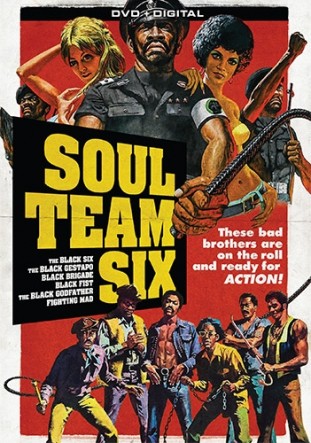
You can get The Black Six on Mill Creek’s new Soul Team Six DVD collection, along with five other films.
DISCLAIMER: Mill Creek sent us this set, but we were planning on buying it anyway. It has no bearing on this review.
Originally airing on January 24, 1973, Go Ask Alice is an adaptation of the 1971 book. The film, much like the book, delves into the personal struggles of a troubled teenager, a theme that resonates with many of us. While the book is more of a diary and is written by Anonymous, most people believe that therapist and author Beatrice Sparks wrote it. She’d go on to write several similar books that were also supposed to be the actual diaries of troubled teenagers.
Jamie Smith Jackson portrays Alice, a teenager striving to blend in at her new school, as she confides in her diary. Her quest for acceptance leads her to experiment with LSD at parties, plunging her into a world of substance abuse and family discord. The portrayal of her parents, played by William Shatner and Julie Adams, reflects the societal attitudes towards youth in the 1970s.
Mackenzie Phillips — who would later have drug problems of her own — shows up, and Andy Griffith (the film’s best part), Robert Carradine and Ruth Roman (from The Baby!) all make appearances. Their performances, especially those of Andy Griffith, add depth and intrigue to the film. It’s pretty schmaltzy in parts, but it’s a preachy 1973 TV movie. You kind of expect those kinds of things.
Bonus: You can listen to Becca and I discuss this on our podcast.
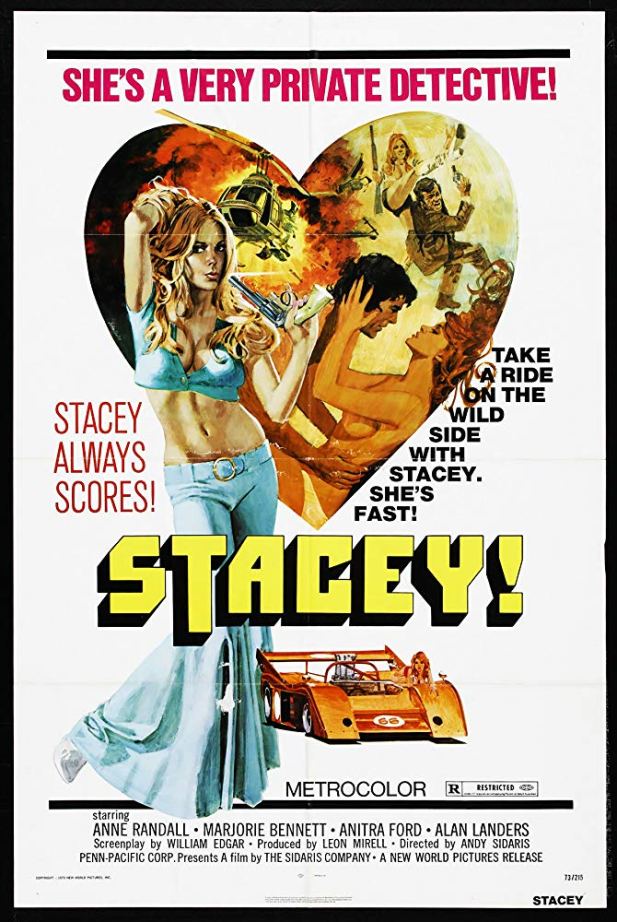
Before he made Stacey, Andy Sidaris was known as a pioneer in the world of sports television, directing thousands of hours worth of football, basketball, Olympic games and special events for ABC’s Wide World of Sports. He eventually won seven Emmy Awards, but is perhaps best known for his invention of the “honey shot,” where he’d zoom in on the cleavage of female audience members and cheerleaders.
After helping make Monday Night Football into a ratings powerhouse and working on shows like Kojak and Gemini Man, Sidaris moved into making his own movies by partnering with Roger Corman, raising half the funds for his debut film, Stacey. This is not truly his first film, as that would be The Racing Scene, a documentary about actor James Garner’s racing team.
Stacey Hanson (Anne Randall, May 1967 Playboy Playmate of the Month) has two jobs: private eye and race car driver. Wealthy older woman Florence Chambers hires her to determine whether or not her three family members are worthy of being in her will: the secretly gay John, his adulterous wife Tish (Anitra Ford from Messiah of Evil!) and Pamela (Cristina Raines from The Sentinel!), who is in a Manson-esque cult.
Meanwhile, houseboy Frank, who has been sleeping with and blackmailing everyone in the family, has been killed and no one is safe. This is the movie that I learned that none of Sidaris’ heroes and heroines knows how to shoot a gun, yet the villains are easily able to shoot everyone around them resulting in spectacular crimson geysers of gore.
If this all seems rather close to a later Sidaris film, Malibu Express, that’s because other than a few characters, they’re largely the same film. The sad fact that I can logically discuss Andy Sidaris films and know enough facts about them that I can drop at will either makes me feel like I’m doing the right thing or ponder where it all went wrong. There’s a thin line between madness and genius. The films of Andy Sidaris make me confront that head on.
Whereas the later films of Sidaris postulate a shared universe of L.E.T.H.A.L. Ladies and various drug dealing enemies that eventually become friends, this is a self-contained affair. But as he’d move on from doing TV — he was still working on shows like The Hardy Boys/Nancy Drew Mysteries and ABC’s Monday Night Football — Andy was ready to embrace the world of film completely. Yet one thing never changed: Sidaris loved showing off gorgeous women, but don’t write off his films as simple exploitation. His women are always capable, empowered and intelligent.
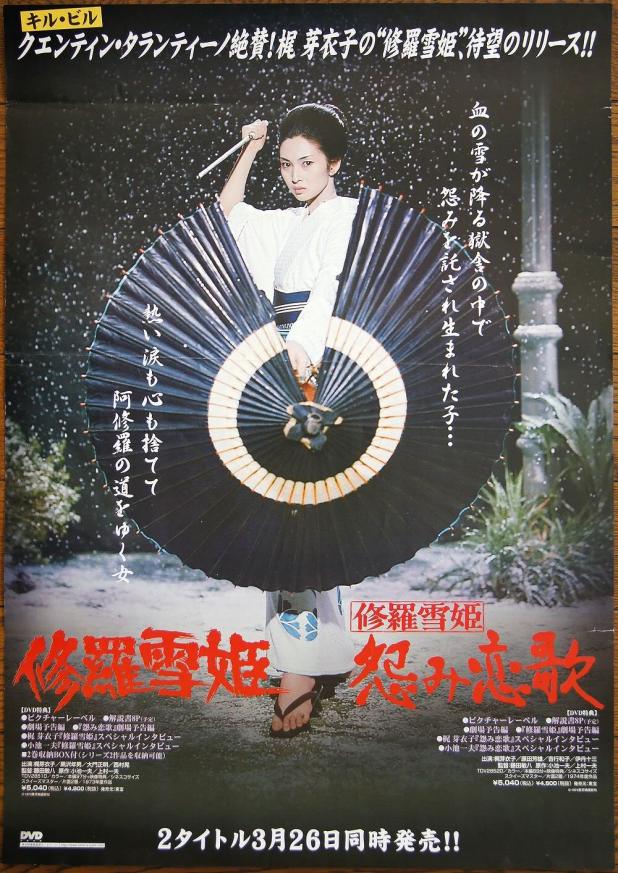
Meiko Kaji is truly the goddess of women’s revenge films. Where Christina Lindberg showed promise and poise as she destroyed everyone in her path in They Call Her One Eye, Meiko showed her power in all of the Female Prisoner Scorpion films and then two Lady Snowblood films. In fact, to get his cast ready for what Kill BIll was all about, supposedly Quentin Tarantino made them watch these films.
You can see the inspiration for those two films directly in the way that Lady Snowblood hops time and space, showing you the story of its heroine’s life in a nonlinear fashion.
A woman named Sayo has lost everything. Her husband and son were murdered and then the convicts assaulted her. After stabbing one of them to death, she was imprisoned for life. Unable to escape to get the vengeance that she claims it would take seven lifetimes to fulfill, she seduces multiple prison guards, with her child born in prison and trained for a life of revenge. She is a child of the netherworld and as such, must be trained for a violent life.
Now named Yuki for the snow in which she was born, the young warrior trains under the warrior priest Dokai to become a living instrument of her mother’s hatred.
Yuki learns the names of the three men she must find and goes after them one by one. She has no remorse, even after learning that one of them, Takemura Banzo, saw his life fall apart after what he did to her mother. He’s a drunk, a cheater at gambling and his daughter has turned to selling herself. Yuki gets him pardoned at the gambling den and then reveals her identity to him on a beach before killing him.
She’s also been led to believe that her final target, Tsukamoto Gishiro, had died in a shipwreck just as she began looking for him. She becomes involved with a reporter named Ashio whose story draws out the man who personally murdered her father, Kitahama Okono.
Through all manner of twists and turns, we learn that Ashio’s father is really Gishiro, who had faked his death when he learned that Yuki was on his trail. She will stop at nothing to have her revenge, feelings and her life be damned.
While this movie is based on Kazuo Koike’s Lady Snowblood manga, the role of Yukio was written specifically for Meiko Kaji. Both this film and its sequel were directed by Toshiya Fujita, who was also behind Stray Cat Rock: Wild Jumbo and Street Cat Rock: Beat ’71.
There are literally geysers of blood in this movie, a dark rumination on revenge. It is near-poetic, an odyssey into the depths that pain can cut across multiple lives.
The fourth and final of the first Female Prisoner Scorpion series, this movie has Meiko Kaji coming back to portray Nami Matsushima — the Scorpion — one more time. However, director Shunya Ito was replaced by Yasuharu Hasebe, who worked with Meiko on the Stray Cat Rock series. Scorpion remains on the run after the last film, starting things off the same way, with a lone voice screaming her name.
This time, our heroine is found by the police — including her new nemesis Hirose — in a wedding chapel. Despite handcuffing her, she’s able to escape and makes her way to find Kudo, a political radical who now works in a sex show club. He’s covered by scars from multiple run-ins with the police, so he has no problem keeping Scorpion hidden.
However, one of the girls in the club, upset that Kudo had rebuffed her advances, finds the detective’s handcuffs in Kudo’s room and calls the police. They show up and beat Kudo until he finally gives in and sells out the Scorpion. Yep, she falls in love with him, even gives her body to him willingly unlike every other time in this series and he still lets the cops know where she is. He even leads them to her. Bad move, Kudo.
Soon, Nami is back in prison and sentenced to death. Despite a guard who reaches out to her and asks her to open her heart and ask for forgiveness, Scorpion finally reappears. That’s my main issue with this film. Despite opening with an awesome sequence of Scorpion in her trademark trenchcoat and black hat, the rest of the movie is all about Nami reacting and running instead of being the master manipulator that we know that she can be. That said, by the end of the film, she comes back to who she should be all along, escaping the prison with the help of the warden, murdering the detective who won’t give up on capturing her and then returning to find Kudo, getting her revenge. She tells him that she didn’t stab him. Instead, it was Nami, the woman who fell in love with him. Now, she is only the Scorpion.
This is the final film that Meiko Kaji would play Scorpion, but in 1976, Yutaka Kohira would direct New Female Prisoner Scorpion: #701. He followed that up with New Female Prisoner Scorpion: Special Cellblock X. Evil Dead Trap director Toshiharu Ikeda also presented Scorpion Woman Prisoner: Death Threatin 1991, a new version of the story.
You can watch this on Shudder. Or you can grab the Arrow Video box set at Diabolik DVD.
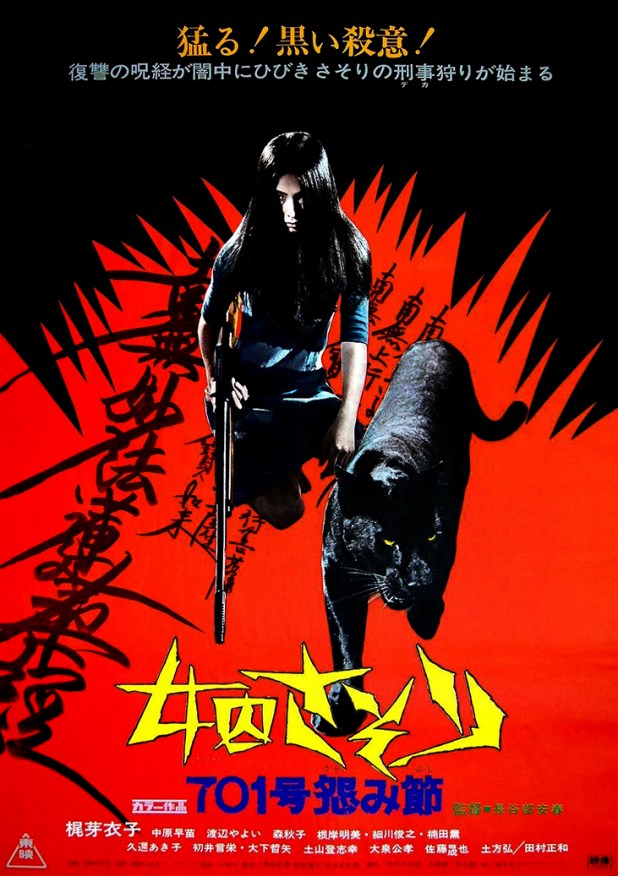
After the poetically beautiful ending of the second film in the Female Convict Scorpion series, Female Prisoner Scorpion: Jailhouse 41, this film starts with sheer violence. Matsu the Scorpion (Meiko Kaji) is wanted, with her face on every wall in the city, after leading a jailbreak. As she sits silently by herself as every newspaper around her shows that she is a dangerous fugitive, Detective Kondo and his partner notice her.
As they go to grab her, she pulls out her knife but she’s handcuffed to Kondo. However, the Scorpion will not be denied and she rushes out of the train car as the doors close. She hacks off the detective’s arm and runs through the streets, spraying the lawman’s blood everywhere.
Scorpion is back and woe to anyone that gets in her way.
There is one person willing to help Scorpion: Yuki, a prostitute who is abused on the streets and at home by her mentally deficient older brother. When they first meet, Scorpion is still stuck to that bloody arm, which later shows up in the mouth of a dog in a striking sequence.
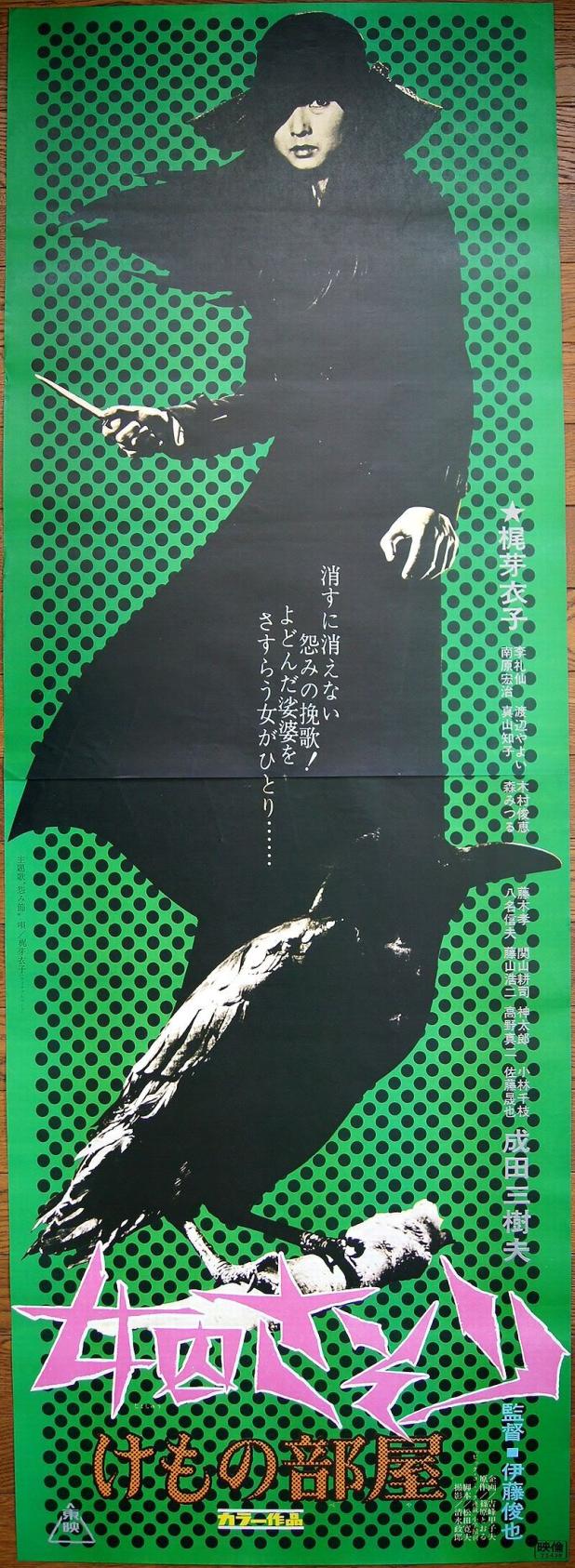
Soon, she becomes Yuki’s defender in a world that is ready to take everything from her. All Matsu wants to do is be a seamstress and fade away, but her attack against a Yakuza member leads to her former prison mate Katsu recognizing her. This is where the series takes a turn for cartoonish, as his boss lady’s makeup, demeanor and dress suggest that she’s some demented Disney villainess, complete with an army of evil animals. She throws Matsu into a cage of deadly ravens, but she soon escapes and starts destroying Katsu’s gang, which brings back the one-armed Kondo, who wants personal and not just professional revenge.
This film deals with issues of motherhood and abortion, as both Yuki and another prostitute must both terminate their pregnancies. However, as the second woman dies as a result of her back alley surgery, her hand drops a blade into Scorpion’s hand. Director Shunya Ito cites Luis Bunuel as one of his favorite directors. Therefore, the recurring images of blades being pulled across the eyes in this series are homages to Un Chien Andalou. Whereas in the previous film, the old woman who faded into the leaves gave Scorpion all of her powers, here the dead prostitute’s gift of the blade unleashes the first tears we’ve seen our heroine shed. She is now more than just the destroyer of worlds. She is death incarnate, the black angel, the final defender of women who have lost everything.
In what he saw as the final film of the series — Kaji would return for one more — Shunya Ito wanted to create a world where all of the demon ghost stories of old Japan became true, such as the tale of Tsuna Watanabe cutting off a demon’s arm and the brother and sister in a forgotten village, whose incest was the only way they could support one another.
There’s a proto-Goodfellas sequence here where we follow Scorpion as she kills off everyone on her list, one by one, just as the camera follows the victims of Jimmy Conway to cover up the Lufthansa heist. Bodies are left in the streets, in movie theaters, in car washes and in one striking sequence, Scorpion slashes a man in front of an entire wall of wanted posters bearing her name. The kills come quickly and brutally, with no need to set up time or place. We are in the poetic world of art now and her art is death. She even appears from mirrors, saying that she has been possessed by the spirit of the dead girl before unleashing a raven that attacks a man and sends him flying through a glass window.
Scorpion then runs from the police, across rooftops and dodging searchlights before being cornered by an army of officers. She takes to the sewers, as man after man is sent down, each dying by her hand. As Scorpion goes deeper into these watery passages, the camerawork becomes more claustrophobic.
All these men with their toys, like bulletproof vests, SCUBA gear, boats and submachine guns. And all our heroine has is her knife.
Yuki finally runs to the streets, after her brother takes her one more time, and the rains wash the sewers, ruining the hiding place. Scorpion won’t give up. She can’t. Yuki feeds her friend but is discovered by the detective, who abuses her with a roomful of men in full armor who beat her with wooden swords and threatens to keep her so that her brother will starve.
The end of this movie is beyond perfect. After setting the sewers ablaze and Kondo laughing like a maniac — this movie has a Die Hard fireball 16 years before that movie came out — everyone’s life moves on as if Scorpion were dead. Or is she? We see Yuki bruised and back in her brother’s arms before the blazing waters of the underground are broken by Scorpion rising from the water like some sort of ghost.
As a result of her dealings with Detective Kondo, Katsu is in jail, her face pale but no longer sporting her distinctive makeup. Yet you can tell that she’s in power, even behind bars.
Then a new prisoner shows up for a short three-month sentence. Katsu becomes convinced that this woman is Scorpion. Even when Kondo comes to the prison to either clean up loose ends or question Katsu further, he shows up at her cell just as she’s convinced that Scorpion is about to kill her. She ends up killing the detective as a woman mops the floor. As Kondo struggles and demands she sound an alarm, the woman looks up and it’s Scorpion. She locks eyes with him as he dies.
Finally, all of the wanted posters are ablaze as Scorpion’s theme plays one last time. We end on her face. She should be happy now that her mission of vengeance is over and she can rest. But no — all we get are her eyes staring at us.
I can’t even explain how life changing this movie is. Rush to find it, watch it and be changed by it.
You can watch this on Shudder or go all in and buy the Arrow Video box set at Diabolik DVD.
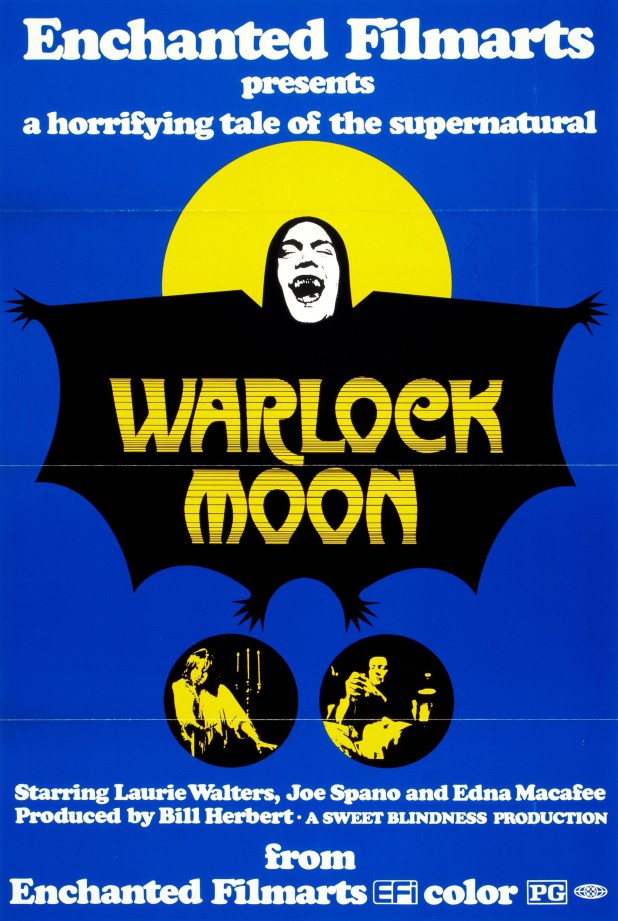
I always try to think about what movies I’d show together if I did a theme night at a theater. Warlock Moon is the kind of 1970’s weirdness that would pair well with 1972’s Terror House, a cannibal comedy that predates The Texas Chainsaw Massacre for its depiction of a family that eats human beings together.
You may know Laurie Walters from Eight Is Enough, but around here, she’s a bit more celebrated for being in the 1972 made-for-TV movie The People, which also has Kim Darby and an incredulous William Shatner, shocked that kids can fly. Here, she plays Jenny Macallister, a college student who follows John Devers, a journalist played by Joe Spano (who is probably known to TV lovers as Lt. Henry Goldblume on Hill Street Blues and FBI Special Agent Tobias C. Fornell on NCIS), to a strange house in the countryside that seems to appear and disappear.
Shot under the title Devil’s Feast, this movie was lensed at the Soda Spring Spa, which was originally the Arroyo Del Valle Sanatorium, a treatment center for tuberculosis, which had been vacant for an entire decade before the movie was filmed.
Interestingly enough, on the Media Blasters DVD, Joe Bob Briggs claims that Tobe Hooper caught wind of the movie while he was finalizing The Texas Chainsaw Massacre and he made a special trip to California fearing that the movies were too similar. They may be story-wise, but the tone is wildly different.
This is the kind of movie where not much happens until the last few minutes, as it all feels trapped in a hazy ’70s drug world. That’s not a bad thing, but it’s also not the kind of pace that most people today are able to get into. For those that love it, this is exactly what you’re looking for. For example, this is the kind of movie that Rob Zombie has tried to make around ten times.
You can buy the Code Red release of this movie at Ronin Flix.
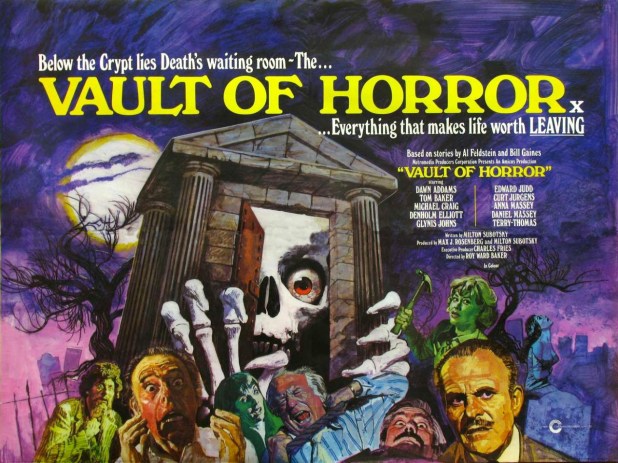
After Tales from the Crypt, where else can you go? The Haunt of Fear? How about The Vault of Horror? Roy Ward Baker was also the director of Asylum, Scars of Dracula and The Legend of the Seven Golden Vampires, so that makes him absolutely perfect for this one. Strangely, none of these stories appeared in The Vault of Horror comic book. They all come from Tales from the Crypt and Shock SuspenStories.
Five strangers ride an elevator to the basement of an office building where they reach a mysterious basement room that looks like a gentlemen’s club. There’s no exit, so they get drinks and each man shares the nightmare they’ve been dreading every night.
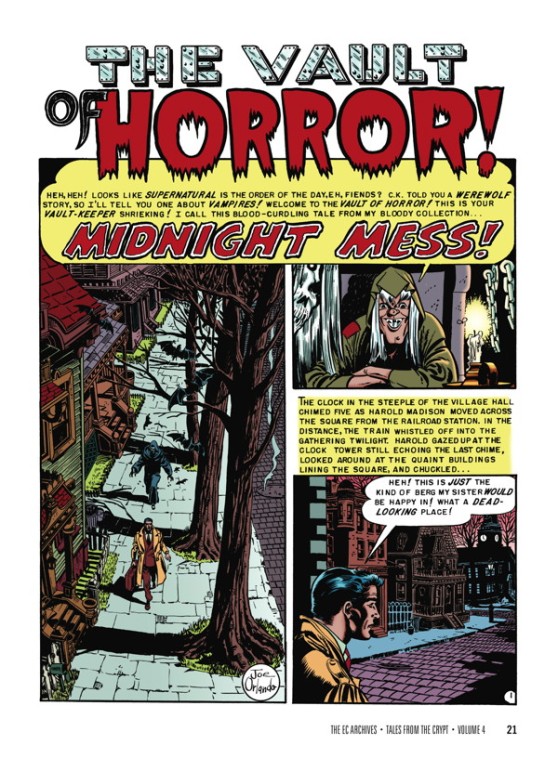
Midnight Mess originally appeared in Tales from the Crypt #35. Harold Rodgers (Daniel Massey) and his sister Donna (real-life siblings Daniel and Anna Massey) reunited in a strange village where brother kills sister over the family’s estate. But later, as he dines out, he realizes that this is a town of vampires and his sister isn’t as deceased as he believed. The last frame of this scene is absolutely perfect!
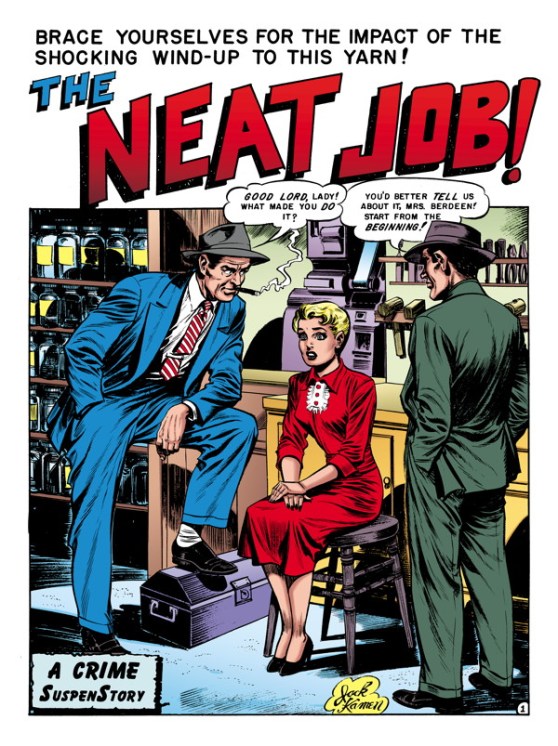
The Neat Job comes from Shock SuspenStories #1 and concerns Terry-Thomas being an old bachelor with OCD who finally marries his trophy wife, Eleanor (Glynis Johns, who was much later in life the grandmother in While You Were Sleeping). His constant prissy orders and need for perfection drive her crazy and she puts all of his organs into nicely labelled jars. Becca has threatened to do this to me so many times that I changed my Driver’s License so that she gets my organs instead of someone else.
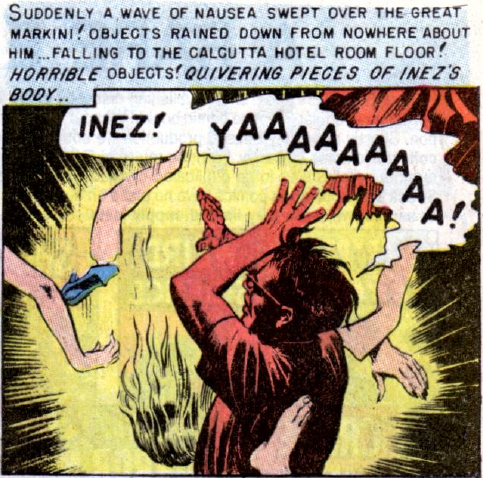
This Trick’ll Kill You first appeared in Tales from the Crypt #33. Sebastian (Curt Jürgens, The Mephisto Waltz) is a magician on vacation in India looking for new tricks for himself and his wife Inez (Dawn Addams, The Countess from The Vampire Lovers). He’s also ready to steal and kill to get ahead. The conclusion to this one isn’t quite as gory as the comic story but is much creepier as blood just comes out the ceiling, hinting that something really brutal has just happened.
Bargain in Death comes from Tales from the Crypt #28 and is all about an insurance scam and graverobbers, as well as double crosses and outright murder.
Drawn and Quartered was in Tales from the Crypt #26 and is the final story. A painter living in Haiti — played by Tom Baker! — discovers that he may be poor, but his paintings are selling for top dollar thanks to art dealers Diltant (Denholm Elliott) and Gaskill (John Witty) after art critic Fenton Breedley (Terence Alexander) makes his work the talk of the art scene. It turns out they all conspired to keep him hungry while they benefitted from his work, so he gets voodoo power in his painting hand and paints the three men, then destroys them. For some reason, he also painted himself and when that canvas gets covered with paint thinner, things get ugly.
Finally, all of the men walk into a graveyard and disappear, while Sebastian the magician stays behind in the room before he goes away, too.
This is the only Amicus portmanteau without Peter Cushing, who was filming And Now the Screaming Starts! while this film was in production. This is Amicus at the height of their powers, however, and this is a film worth owning. You can get it — and Tales from the Crypt — as a two blu ray set from Shout! Factory.
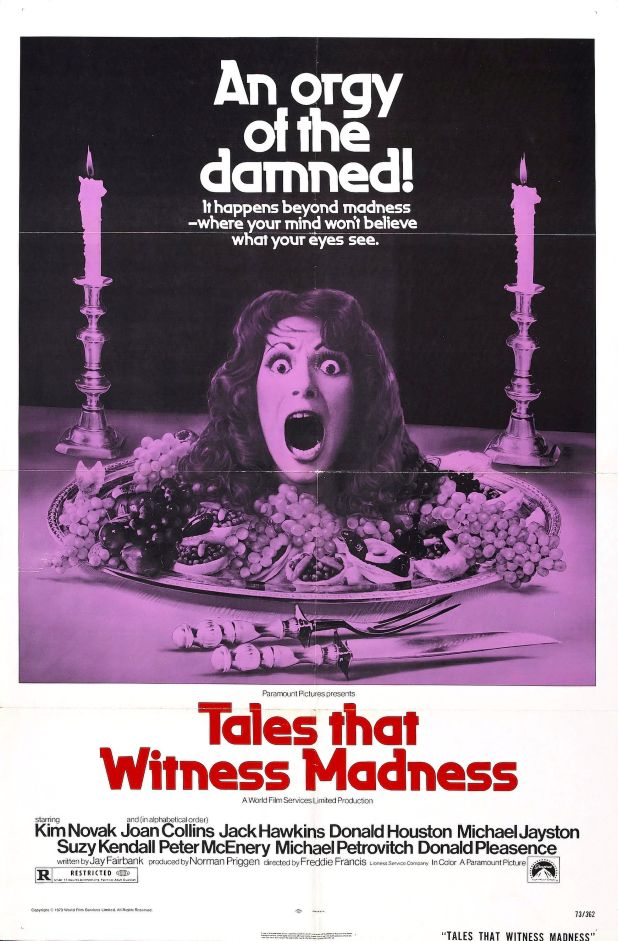
This movie may look like an Amicus movie, but make no mistake. It isn’t. But I can’t blame anyone that thinks that it is, thanks to its cast and director, Freddie Francis. Its wraparound story is all mental hospital, where Dr. Tremayne (Donald Pleasence) tells Dr. Nicholas (Jack Hawkins, Theater of Blood) about four very special cases and how he solved them.
In the first story, Mr. Tiger, a young boy imagines a new best friend, a talking tiger. His parents argue constantly, so he uses that friend to try and escape.
The second tale — that witnesses madness — is Penny Farthing. Here, an antique store owner Timothy inherits an odd portrait and a penny farther bicycle from his aunt and uncle. Soon, he travels through time and romancing an earlier love interest of his uncle who looks exactly like his girlfriend in our time. That’s because they’re both played by Suzy Kendall (The Bird with the Crystal Plumage).
Mel, the third part of this film, concerns found object art that a man falls in love with, ignoring his wife Bella (Joan Collins!). Obviously, this man is a complete moron.
Finally, Luau is about a literary agent (Kim Novak, Vertigo) whose daughter is menaced by an author and his associate who plan on serving her daughter for dinner as an “earth pig.” Novak replaced Rita Heyworth, who was originally going to be in this part of the film.
Finally, the story is wrapped up when Dr. Nicholas tries to lock up Dr. Tremayne for being as insane as his patients. He’s soon eaten by the invisible tiger from earlier. Yep. That really happens.
Sadly, Jack Hawkins died soon after this movie wrapped due to complications from a surgery that was to give him an experimental voicebox. His dialogue is dubbed here by Charles Grey, the narrator of The Rocky Horror Picture Show.
There are a few fun moments here, but if you haven’t enjoyed a British portmanteau horror before, this probably isn’t the one to start with.
The beauty of a Mill Creek box set is that amidst the dross, there are films of incredible power. Sure, you’ll suffer through old television shows, barely incomprehensible Spanish horror and video store era throwaway junk, but then you’ll be rewarded with a film like this. Messiah of Evil isn’t just a legendary once lost film returned to power. It’s a work of art that feels like it came from beyond the wall of sleep, the place where the Ancient Ones wait to come back and reclaim their rightful and most horrible power.
You can watch Messiah of Evil on several levels. On the most basic of levels, it’s a film about Arietty (the never before or since more lovely Marianna Hill) attempting to find her artist father in the cursed town of Point Dume, California.
It’s also a zombie movie of sorts, made in the wake of Night of the Living Dead, where an entire town slowly becomes the living dead. As they bleed from the eyes and lose all sensation, to begin to crave meat from any source, be it an entire grocery store’s meat department, mice or human flesh. Once they give in to their transformation, they light fires on the shore, as their ritual of The Waiting anticipates the Dark Stranger’s return to glory, leading them toward taking over the rest of reality.
Or is it about the final days of the class struggle that started in the 60s? The zombies nearly all wear suits while their targets, like collector of legends Thom (Michael Greer, who would go on to provide the voice for Bette Davis after she quit the film Wicked Stepmother) and his two lovers, Toni (Joy Bang, who worked with talents like Roger Vadim, Norman Mailer and Woody Allen before Messiah) and Laura (The Price isRight model Anitra Ford), are free love visions of style. Yet the Dark Stranger cuts through class, even turning cop upon cop near the climax.
Parts of the film were never fully realized, but that doesn’t matter. Some critics complain that major plot points and the lead characters’ motivations are never fully explained. Even the most normal people in this film act like the strangest characters in others. At no point does it feel like we’re watching a movie set in our reality. This is a transmission from another place where our surrealism is their everyday.
Messiah of Evil was created in an environment that will never exist again — the New Hollywood that starts with traditional studios panicking as their blockbusters and musicals would stall at the box office, while films like Easy Rider succeeded. Suddenly, deeply personal films would be made within the studio or even exploitation systems. Indeed, the previously mentioned Night of the Living Dead is packed with politics and social commentary, things only hinted at in past horror and science fiction films. This trend would die with the return of the blockbuster, with Jaws and Star Wars. In a moment of true irony, the creators of this film — the husband-and-wife team of Willard Huyck and Gloria Katz — would go on to direct Howard the Duck and write American Grafitti andIndiana Jones and the Temple of Doom for Goerge Lucas.
This is a movie where the heroine finds herself in the throes of undead transformation, throwing up mouthfuls of insects while the shade of her father begs her to not tell the world what she knows before he attacks her. After murdering everyone else in their path, the dead things of Point Dume don’t kill her. No, they resign her to an even more horrible fate: she must spread the legend further so that once the Dark Stranger arrives, more of reality is receptive to his grasp. She ends the film in a mental institution, knowing that one day soon, the end of everything we hold dear will arrive.
I love that the Chilling Classics set was sold in K-Marts and WalMarts, places where normal people would find this asynchronous transmission from another place and time and wonder what the hell they were watching. Much like the infection of Point Dume, it finds the right people. It discovers the best way to transmit its message to those most willing to spread its legend. It survives, no matter what, despite not being finished, despite age, despite being lost.
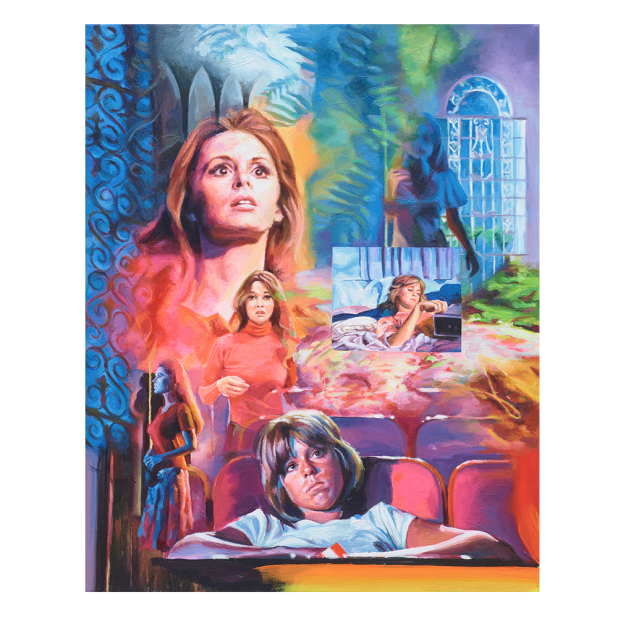
The absolutely amazing art for this article is by Francine Spiegel and can be purchased at Exhibition A. And we love this movie so much, we reviewed it two more times: Doc from Camera Viscera reviewed it as part of our Mill Creek “Chilling Classics Month” HERE and we discussed it as part of our 2017 podcasting schedule HERE, and you can listen to Bill from Groovy Doom and Drive-In Asylum discuss this movie with Becca below.
You can also listen to the commentary track that Bill and Sam did for this movie here:




 B&S About Movies
You must be logged in to post a comment.