April Ghouls Drive-In Monster-Rama 2024 Primer: Messiah of Evil (1973)

April Ghouls Drive-In Monster-Rama is back at The Riverside Drive-In Theatre in Vandergrift, PA on April 26 and 27, 2024. Admission is still only $15 per person each night (children 12 and under free with adult) and overnight camping is available (breakfast included) for an additional $15 per person. You can buy tickets at the show but get there early and learn more here.

The features for Friday, April 26 are The Return of the Living Dead, the new Blue Underground 4K print of Deathdream, Messiah of Evil and The Children.

Saturday, April 27 has Killer Klowns from Outer SpaceEscape from New York, Starcrash and Galaxy of Terror.

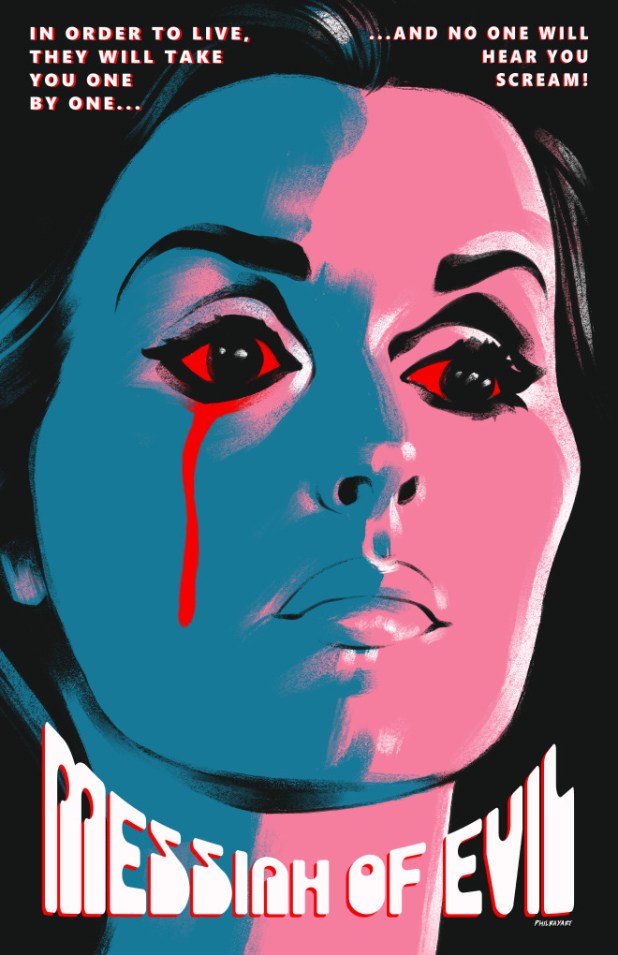
Once abandoned to the wilds of public domain DVD sets, Messiah of Evil was for a time the gold amongst the dross, a film of incredible power. Hidden amongst old television shows, near-unwatchable transfers of Spanish horror and video store-era throwaways, it held a haunting power. Did I see that? Is this movie real? Can I explain it to anyone who hasn’t seen it?

Today, Messiah of Evil isn’t just a legendary once-lost film returned to power. It’s a work of art that feels like it came from beyond the wall of sleep, the place where the Ancient Ones slumber until time untold to come back and reclaim their rightful and most horrible power.

You can watch Messiah of Evil on several levels. On the most basic, it’s a film about Arietty (the never before or since more lovely Marianna Hill) attempting to find her lost artist father in the cursed town of Point Dume, California.

It’s also a zombie movie of sorts, made in the wake of Night of the Living Dead yet uninfluenced by it, where an entire town slowly becomes something like the living dead. As they bleed from the eyes and lose all sensation, they begin to crave meat from any source, be it an entire grocery store’s meat department, mice or human flesh. Once they give in to their transformation, they light fires on the shore, as their ritual of The Waiting anticipates the Dark Stranger’s return to glory, leading them toward taking over the rest of reality.

Or maybe it’s about something else. Is it about the final days of the class struggle that started in the 60s? The zombies nearly all wear suits while their targets, like collector of legends Thom (Michael Greer, who would go on to provide the voice for Bette Davis after she quit the film Wicked Stepmother) and his two lovers, Toni (Joy Bang, who worked with talents like Roger Vadim, Norman Mailer and Woody Allen before Messiah) and Laura (The Price is Right model Anitra Ford), are free love visions of style and sophistication. Yet the Dark Stranger cuts through class, even turning cop upon cop near the climax.

Parts of the film were never fully realized, but that doesn’t matter. Some critics complain that major plot points and the lead characters’ motivations are never fully explained. Even the most normal people in this film act like the strangest characters in others. At no point does it feel like we’re watching a movie set in our reality.

I don’t want that.

This is what I want. A transmission from another place where our surrealism is their everyday.

Messiah of Evil was created in an environment that will never exist again — the New Hollywood that starts with traditional studios panicking as their blockbusters and musicals would stall at the box office, while films like Easy Rider succeeded. Suddenly, deeply personal films would be made within the studio or even exploitation systems. Indeed, the previously mentioned Night of the Living Dead is packed with politics and social commentary, things only hinted at in past horror and science fiction films. This trend would die with Jaws and Star Wars. Yet at this point, as this film’s commentary track by Kim Newman and Stephen Thrower reminds us, even the creators of the blockbusters that changed entertainment forever, all the way back then, all wanted to be artists. And in a moment of true irony, the creators of this film — the husband-and-wife team of Willard Huyck and Gloria Katz — would go on to direct Howard the Duck and write American Graffiti and Indiana Jones and the Temple of Doom for Goerge Lucas.

This is a movie where the heroine finds herself in the throes of undead transformation, throwing up mouthfuls of insects while the shade of her father begs her to not tell the world what she knows before he attacks her. After murdering everyone else in their path, the dead things of Point Dume don’t kill her. No, they resign her to an even more horrible fate: she must spread the legend further so that once the Dark Stranger arrives, more of reality is receptive to his grasp. She ends the film in a mental institution, knowing that one day soon, the end of everything we hold dear will arrive.

I love that this movie once appeared in DVD bundles easily available in K-Marts and WalMarts, places where normal people would find this asynchronous transmission from another place and time and wonder what the hell they were watching. Much like the infection of Point Dume or Arietty spreading the infection into other towns, it found the right people. It always discovers the best way to transmit its message to those most willing to spread its legend. It survives, no matter what, despite not being finished, despite age, despite being lost for so long.

How wonderful it is to have what was once occult brought into the light and yet it loses nothing of its infernal power. In fact, it retains its power now, all the furtive watches and evangelists that loved this movie and spread that message.

BONUS: Listen to the commentary track that I did with Bill Van Ryn from Drive-In Asylum here:

RE/SEARCH Incredibly Strange Films: The Baby (1973)

I love having people over to our house to watch movies. However, some folks don’t get to watch the really strange films in our collection. They have to make it through a test to see if they can hang. I’ve had the misfortune of trying to explain Beyond the Valley of the Dolls to people and get angry, then sad, then angry again when they just don’t get it. If you make it through my cinematic ring of fire, the journey through excess and madness and horror, then and only then are you greeted by the final challenge: 1973’s epic freakout The Baby.

This isn’t a movie that I’ve known about forever. Quite to the contrary — I discovered it two years ago when the trailer played during one of the all-night drive-in events at the Riverside Drive-In. The blast of strangeness in that trailer was enough to get Becca and I repeating the dialogue for weeks: “What have you done with my Baby?”

Luckily, Bill from Groovy Doom/Drive-In Asylum had a copy that he was only too happy to bring to our house. Too often these days, we’re greeted with too much hype for movies, with statements like, “If you don’t love this movie, you don’t understand cinema!” and “This movie shook me to my very core!” Well, I can honestly say that The Baby has destroyed my mind in a way that no film made before or since ever has.

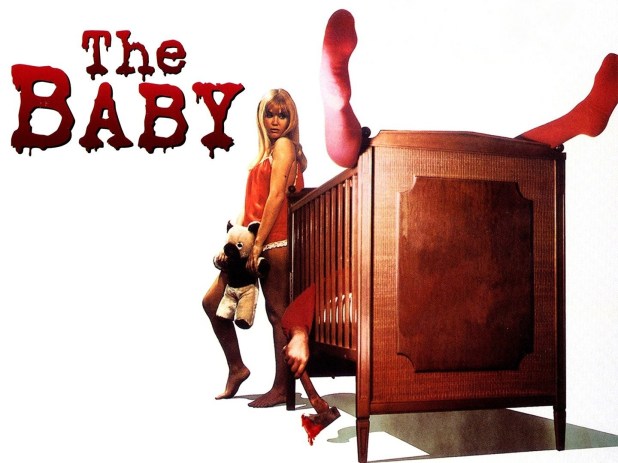
Ann Gentry (Anjanette Comer, The Loved One) is a social worker who has just been assigned to the incredibly strange Wadsworth family. There’s Mrs. Wadsworth (Ruth Roman, who not only starred in Strangers on a Train, but survived the sinking of the Andrea Doria), the strong-willed mother. Her daughters Alba (Susanne Zenor, who was the original Samantha in the pilot of TV’s Three’s Company before Suzanne Somers took over the role), who teaches tennis, and Germaine (the transcendent Marianna Hill, Messiah of EvilSchizoidBlood Beach), who occasionally acts in TV commercials when she’s not looking like a maniac. And finally, there’s Baby (David Manzy), a twentysomething man who doesn’t walk or talk and who has been raised as an infantilized adult.

You just read that right. This is a movie about a grown-up baby that sits in a crib and cries, but not just as cries. The original track containing baby sounds that  Manzy worked so hard to craft during the filming was lost, so the voice of an actual baby was used. It’s disconcerting to say the very least. Add in that the actor completely shaved his body for the role and you have the foundations for a movie that’s more than a little left of center.

Ann is driven to improve the lives of her cases, but Baby is a special case. Perhaps too special to Ann, as she’s recently recovering from a severe auto accident that had a serious effect on her husband. The Wadsworth family totally depends on Baby for most of their income and as a result, won’t allow him to grow into an adult. And it seems like Ann could change all that, as she discovers that Baby’s current state is the result of neglect.

“Baby doesn’t talk. Baby doesn’t walk.” Baby also isn’t allowed to do things by himself, either being beaten, cattle prodded or restrained when he does anything against the rules. Even when Ann shows the family that Baby has the capacity for growth, she’s instantly rebuffed.

If all of the above was all that this movie would be about, it would still rank amongst the oddest ever made. But it gets much stranger. You see, nearly every woman who meets Baby wants to possess him. And some often want to have sex with him, like the sitter who gets into his crib and allows him to nurse from her. The Wadsworths come back home to this scene and proceed to annihilate the young girl and beat Baby into further submission. And even Baby’s sisters may love him a little more than siblings should.

Finally, the simmering discord between Ann and Baby’s family comes to a head on the night of Baby’s birthday party — which is the strangest one committed to film since perhaps Jessabelle the cat’s celebration in The Sentinel. That said, any party that has Michael Pataki as a guest is one that I want to be at!

After escaping the murderous intent of the Wadsworths, Ann finally succeeds in taking Baby away. Rather than turning him over to an institution, she keeps him at her house and then sends his family photos of their manchild doing adult things like standing up straight.

This sends the Wadsworth clan into a murderous tailspin, as they head for Ann’s house with killing in mind. However, she and her mother-in-law aren’t willing to give up their new guest without a fight.

Even though this film was made over forty years ago, I’m not giving you the ending here. I want you to see it for yourself with no preparation whatsoever.

Now, after reading all of the above, you have to be thinking — surely The Baby is an unrated affair or at worst it got an R, right? Nope. This is a PG movie. The 1970’s did not care at all about children, blasting them with both barrels of bonkers with movies like this, The Little Girl Who Lives Down the Lane and It’s Alive all getting just a simple Parental Guidance suggested label.

Here’s the next surprise: The Baby wasn’t an underground film. Nope, it was a mainstream release directed by Ted Post, who directed numerous TV series like Gunsmoke, The Twilight Zone and 178 episodes of Peyton Place, as well as Hang ‘Em HighMagnum ForceBeneath the Planet of the Apes and the TV movies Do Not Fold, Spindle, or Mutilate and Cagney and Lacey, which led to the series. The dark nature of this film kept Post away for a year before writer Abe Polsky was able to talk him into getting behind the lens.

The Severin blu ray of this film was a great package, complete with informative interviews with Post and Manzy. Arrow Video is releasing a new version this week with even more extras, including newly commissioned artwork by The Twins of Evil, deep commentary by Travis Crawford, interviews with Marianna Hill and one of the set painters and a discussion with film professor Rebekah McKendry on the influence of the film. It’s a great package that truly does this movie justice.

Back to the hype engine that sours so many on so many movies. Often, you’ll read things about how movies have permanently changed lives and scoff. I’m telling you that the way that I view movies and live has been forever altered by this movie. It’s hard for me to find another film that can match it for sheer audacity and bizarre subject matter. However, no words that I write can do it justice. You must watch it for yourself and be changed by the act of viewing it.

You can watch this movie on Tubi.

BONUS! Here’s the podcast where we discuss The Baby in detail with Bill!


RE/SEARCH Incredibly Strange Films: Love Me Deadly (1973)

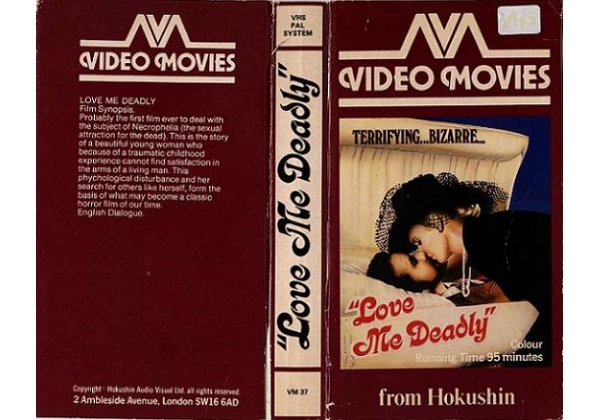
Lindsay Finch (Mary Charlotte Wilcox, The Beast of the Yellow Night and Psychic Killer) loves to go to funerals, where she mourns and then kisses the dead men passionately after everyone else leaves. Throw in a theme song that sounds like it comes out of James Bond while we see flashbacks of her relationship with her dead father and visiting his grave and pigtails and I’m all in.

She has swinging hippie parties at her pad and her friend Wade (Christopher Stone, the late husband of Dee Wallace who appeared with her in Cujo and The Howling)  tries to get with her. Just when it seems she’s giving in to his makeout moves, she screams at him to stop and he calls her a bitch, because this is 1973. She dreams of her father in yellow hued flashbacks and hugs a stuffed animal.

Later, she goes through the funeral notices to find the services for young men. We then meet Fred McSweeney, a mortician, as he picks up a male prostitute. That job is just a cover for his true love — a Satanic coven that meets at night, inside the mortuary, where they have orgies with dead bodies. McSweeney takes the young man to his workplace where he pumps the manwhore full of embalming fluid while he’s still alive, all while Lindsay goes to another funeral where she tries to make out with Bobby. She’s surprised by Alex (Lyle Waggoner, TV’s The Carol Burnett Show and Wonder Woman, as well as the honor of being the first nude centerfold in Playgirl and the appointed mayor of Encino, California), the man’s brother.

Speaking of that embalming scene, it goes on and on and on, with the young man screaming, “I’m blind!” over and over. It’s nearly campy instead of frightening. To say this film has an issue with tone is an understatement.

Lindsay sneaks out to Bobby’s funeral, where she starts to associate Alex with her father. He’s a rich gallery owner and they begin a romance — one she refuses to consummate, even after they are eventually married. Every time she sees him, we get yellow hued flashbacks with a music box soundtrack of her playing with her father. But more about that in a little, OK?

McSweeney speaks to Lindsay after he catches her at a funeral, telling her that he has a group that she should join. Yet she tries to remain normal, even going on a date with  Wade that fails. That’s when she decides to see what McSweeney’s group is all about.

She walks into an orgy with the dead, which freaks her out enough to go back home. Then she and Alex fall in love with no dialogue, just a montage. It’s a strange part of an incredibly strange film, with this happy go lucky relationship coming out of nowhere in a film otherwise about sex with dead people.

Lindsay keeps talking to the cult and ends up getting a dead body of her very own. But Wade follows her and is killed by McSweeney. She screams in horror. This scene wasn’t n the original script, nor was the Satanic group in the one that follows, but were used to pad out the film and add more horror elements so that it would potentially play drive-ins better.

Again — tone being all over the place — we’re treated to a nude cult disrobing Wade’s corpse and having their way with it before Lindsay awakes screaming. But the marriage isn’t working out well, with Alex following her all over town and their maid — complete with the most stereotypical Irish accent ever — telling him that his wife spends her days at her father’s grave, wearing pigtails and dressed like a little girl. You should see the look on Alex’s face when he catches her as she yells, “This is not your place, go away!”

Alex tries to get Lindsay to go on a holiday to visit his mother, but he discovers a registered letter from McSweeney to his wife for a meeting at 10 PM. He follows her to the mortuary where he discovers his wife surrounded by nude devil worshippers as she makes love to a dead body. She looks frightened and then McSweeney murders Alex, which calms her.

McSweeney drugs her as she lies in her bed, then brings in her husband, now embalmed so he can last forever, finally a man who she can be attracted to: the combination of her father — who we see in flashback being shot accidentally by her — and the man she fell in love with. The editing here — combined with dissonant instruments and a remix of the title theme — is crazy, like this film has suddenly become Beyond the Valley of the Dolls.

We see intercut shots of Lindsay getting under the covers with her dead husband and her getting in the coffin with her father as everything goes sepia tone and the theme song returns.

Love Me Deadly isn’t for everyone. It’s one of those films that I hesitate to recommend to normal folks. But it is the kind of movie I text people about in the middle of the night.

Code Red has released this film on DVD, but it’s still rather hard to find. It’s up on YouTube, where I found it. It’s…well, it’s something. If you enjoyed The Baby, well, then you’re on the right wavelength of this one.

You can watch this on Tubi.

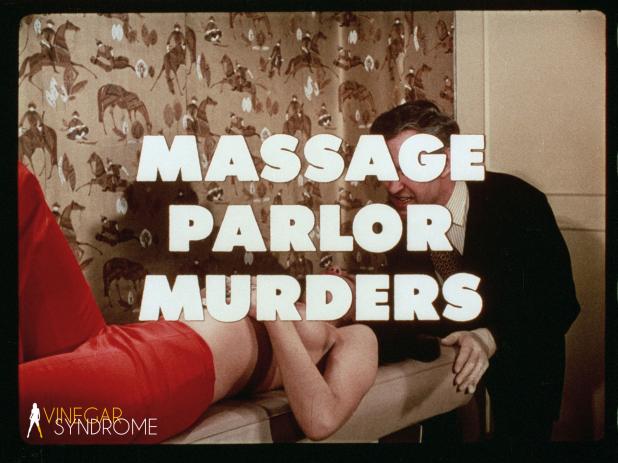
FVI WEEK: Massage Parlor Murders! (1973)

I think more movies should have exclamation marks in their titles. I also believe that more movies should have Brother Theodore in them, so hey — Message Parlor Murders! is two for two.

Detective Rizotti and O’Mara are hunting the killer of numerous massage parlor workers — one of them, Rosie, often gave Rizotti the rub down — and now O’Mara is getting close to Rosie’s roommate Gwen (Sandra Peabody, The Last House on the LeftLegacy of SatanTeenage Hitchhikers). Of course, she’s the kind of girl who only appears in movies, someone who doesn’t rub nor tug, but instead acts like an analyst for her clients. Maybe their co-pays didn’t cover therapy or we hadn’t yet worked out the mental health side of care in 1973, but going to a massage girl at the Lust Lounge for psychotherapy seems like not the best idea I’ve heard today.

Maybe the killer is a man they call Mr. Creepy. It could also be someone trying to work out the seven deadly sins 22 years before Kevin Spacey. That theory seems to work, but hey, the seventies were a downer time and perhaps not everyone makes it out of this alive.

Somehow, this was also released as Massage Parlor Hookers! with the horror parts cut out. How long was that movie, 22 minutes?

You can and should order this from Vinegar Syndrome.

FVI WEEK: Family Killer (1973)

NOTE: I have this in my notes as an early Cannon movie, but some lists online have it being distributed by Film Ventures International. I can’t even find a poster! Anyone have any ideas on this?

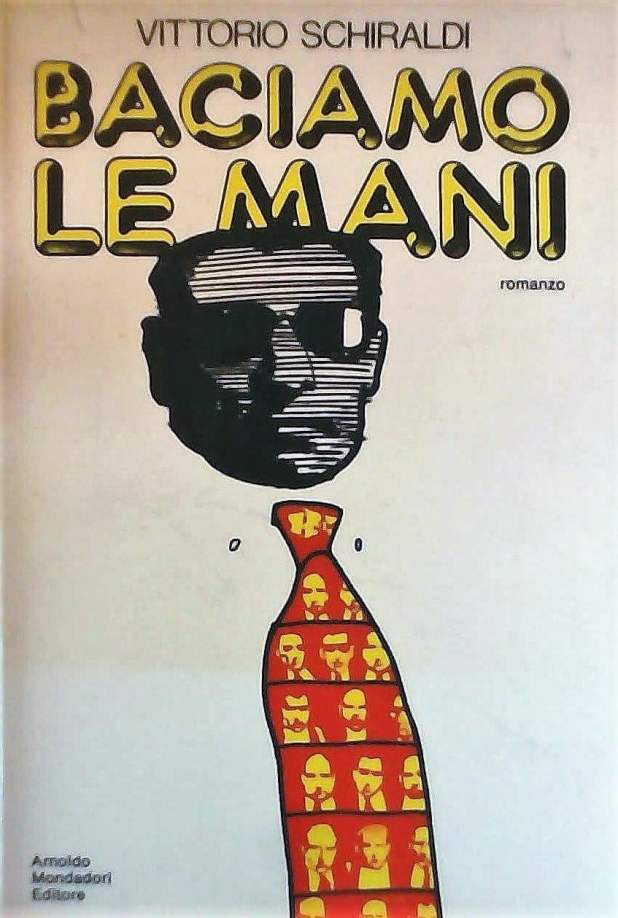
Directed and written by Vittorio Schiraldi (who also wrote Watch Me When I Kill), this was based on a novel that Schiraldi wrote.

Stefano (Joshua Sinclair), the son of Don Angelino Ferrante (Arthur Kennedy) has been shot in the back by the brutal Gaspare Ardizzone (John Saxon) — who is the start of a more violent and ruthless breed of criminal — for refusing to sell him land. Ferrante sends for a killer from America hoping for revenge.

The death of Stefano leaves behind a widow, Mariuccia (Agostina Belli), who is both protected and impregnated by a bodyguard named Massimo (Pino Colizzi). Meanwhile, Ardizzone goes to America and starts wiping out the New York bosses too and Don Ferrante still refuses to put a hit on him. Will his family and way of life survive?

Pretty much The Godfather with a different cast and some subtle changes, Family Killer still boasts an amazing Saxon performance as a total psychopath.

FVI WEEK: The Legend of Blood Castle (1973)

Also known as Blood CeremonyThe Female ButcherThe Bloody Countess and Ceremonia Sangrienta, this Jorge Grau-directed (The Living Dead at Manchester Morgue) Eurohorror film is a real classic.

The people of 19th century Europe aren’t ready to let go of their fear of vampires just yet, so they head out into the night and conduct trials over the graves over those who have recently died and are rumored to the undead.

As for Countess Erzebeth Bathory (Lucia Bosè, Fellini’s Satyricon), all she cares about is her quickly fading beauty and her husband’s lack of attention. But there are methods to bring her looks back and him back to bed which involve the dark practices of the ancestor she shares a name with. Blood is the secret and shockingly, her husband is only too willing to get it for her.

Where you’d expect a film awash in blood and gore, this is a movie more about how women deal with aging and men that only see beauty in youth. And yes, there’s still plenty of bloodbathing along the way.

Ewa Aulin (CandyDeath Laid an Egg) is also in this. Sadly, Aulin didn’t enjoy acting and was done by the age of 23.

FVI WEEK: Rico (1973)

I get it. This movie isn’t a giallo. But what is it, really? It was sold under so many titles, from the more horror-centric Cauldron of Death (complete with completely insane poster) to the more crime-oriented Gangland, the great Italian title Un Tipo Con una Faccia Strana ti Cerca per Ucciderti (A Guy With a Strange Face Is Looking for You to Kill You), The Dirty MobMean Machine and even O Exolothreftis (The Terminator) in Greece.

It was written by Jose Gutierrez Maesso, who wrote Django and was an uncredited writer for the magical Pensione Paura. He’s joined by Santiago Moncada, who wrote A Bell from HellHatchet for the Honeymoon and The Corruption of Chris Miller, along with Mario di Nardo (The Fifth CordFive Dolls for an August Moon). Directing all of this mayhem is Tulio Demichelli, who made the utterly insane Assignment Terror, as well as The Two Faces of Fear Espionage in Lisbon and the well-named There Is Someone Behind the Door.

Make no mistake — this is a movie awash with exploitation, gore, aberrant behavior and no real heroes. In short, it’s exactly the kind of movie you come to this site to read about.

Rico Aversi (Chris Mitchum) has just got out of jail, two years after Don Vito (Arthur Kennedy, the inspector from The Living Dead at Manchester Morgue) killed his father. Everyone wants Rico — notice that his named is spelled completely unlike the title of the movie — to kill the boss off, but Rico just wants to enjoy life outside of prison.

Malisa Longo (Cat in the Brain) plays his girlfriend — and who used to love Rico’s woman — and she enjoys sleeping with the hired help, which gets one unlucky member of the workstaff castrated in shocking detail. Then, his John Thomas gets shoved in his mouth and he’s dipped into acid and turned into soap. This movie is not interested in being unoffensive. Plus, you get Paola Senatore (Eaten Alive!) as Rico’s sister, whose death sets him finally on the path to revenge.

Robert Mitchum is one of my favorite actors ever, so it kind of pains me to admit this his son kind of slumbers through this leading role. But then again, everyone else in this movie is going to seem boring next to Barbara Bouchet, who pretty much sets the screen on fire, dances on the flames and sets it ablaze all over again in this movie. Anyone could show some leg to get the attention of some criminals. Bouchet goes all in, dancing nude on the roof of a car, covered in fog, giving her all no matter how grimy this scumfest gets. Without her, this movie would be passable. With her, it’s transcendent.

So yeah. It’s not a giallo. But man, if you’re coming in looking for bad behavior, gorgeous women and great clothes, it has all of that covered.

FVI WEEK: Stranded In Space (1973)

Another of the movies that Film Ventures International redid for TV, this uses footage from Prisoners of the Lost Universe as its opening credits and renamed The Stranger to become Stranded In Space.

Astronaut Neil Stryker (Glenn Corbett) is the only survivor of his mission. He is held in quarantine for such a length that he starts to suspect the government. It turns out that Dr. Revere (Tim O’Connor) and a operative by the name of Benedict (Cameron Mitchell) are pumping him full of drugs and interrogating him. It turns out that Stryker has landed on another version of our world named Terra and is being studied.

On this other world, a war destroyed most of the population and those that remain follow the Perfect Order, a one world government that keeps individual thought out of peoples’ minds. With the help of Dr. Bettina Cooke (Sharon Acker) and Professor Dylan MacAuley (Lew Ayres), Stryker is trying to get on a spaceship and fly it back to our reality.

This aired as the NBC Monday Night Movie on February 26, 1973.

You can watch this on YouTube.

Una vita lunga un giorno (1973)

I read a great article, “A Genealogy of Italian Popular Cinema: the Filone,” on Offscreen in which Donato Totaro explained that the filone is not easily categorized. We can see the term to mean not just a genre, but if you will, a body of water that flows into other streams. To quote the article, “…the filone is more flexible than genre or subgenre, taking in the idea of cycles, trends, currents, and traditions.”

It also breaks down the main years of the Giallo as 1962-1982 and the Poliziottesco as 1968-1978. Of course, movies in these filone were made after — if not before — and there are different versions of both.

This is all to explain that 1973’s Long Lasting Days fits into the time periods of both of the above genre and can have a little of both, a combo plate, if you will.

Andrea Rispoli (Mino Reitano, whose bands with his family, Benjamin & His Brothers, played the Star-Club in Hamburg with The Beatles) has fallen in love with a woman he’s met at the boarding house where they both live named Anna Andersson (Ewa Aulin, Miss Teen Sweden 1965 and Miss Teen International 1966, who turned that early fame into an acting career which found her appearing in Col cuore in golaLa morte ha fatto l’uovoThe Legend of Blood CastleDeath Smiles on a Murderer and the movie she made with her husband John Shadow, Microscopic Liquid Subway to Oblivion; this is the last movie she made before going to college and becoming a school teacher). She has a heart condition that could end her life at any time — and learns this after being assaulted and surviving by jumping through a glass window in case you wondered if this was an Italian movie — so Andrea decides to put his life on the line by allowing a group of rich people — led by Philippe (Philippe Leroy) and his wife (Eva Czemerys) — to hunt him. If he survives, he will make enough money to potentially save Anna.

Directed and written by Ferdinando Baldi (Texas AdiosComing at Ya!), this pits a poor man enraptured by love against a group of bored rich society types who want to hunt the wold’s most dangerous game. They will be allowed to attack Andrea five times as he tries to get through the entire city, using a knife, a rifle, a vehicle, fire and brass knuckles which hang over a dance floor at a wild party that can only exist in Italian exploitation movies.

For someone known as a singer, Mino Reitano is pretty good in this, a man forced to abandon his dispassionate sailor ways to be in love and care for someone. Does he become too trusting too fast? That’s for you to find out.

You can watch this on YouTube.

Tarot (1973)

I’m going to get it out of my system so this entire article isn’t about me gushing about Sue Lyon, but I am not made of stone. With only two previous acting roles, she was cast in the lead of Stanley Kubrick’s Lolita at just 14 years old. The book’s writer, Vladmir Nabokov, who also wrote the screenplay and said that she was the “perfect nymphet.” Compounding his cringe was that he wanted the 12-year-old Catherine Demongeot to play the role. Man, dudes were weird about this movie — Otto Preminger would not permit Jill Haworth to take the lead nor would Walt Disney let Hayley Mills, even not allowing her to see the movie — and I would like to think things are different, but no, they aren’t.

Now back to me waxing on and on about Sue Lyon.

After winning the Golden Globe Award for Most Promising Newcomer—Female and releasing a single on MGM — “Lolita Ya Ya” which was written by Nelson Riddle — Lyon would later say that her life fell apart early: “My destruction as a person dates from that movie. Lolita exposed me to temptations no girl of that age should undergo. I defy any pretty girl who is rocketed to stardom at 14 in a sex nymphet role to stay on a level path thereafter.”

She signed a seven-year professional services contract to Kubrick, producer James B. Harris and production company Seven Arts Productions, making The Night of the Iguana7 WomenThe Flim-Flam Man and Tony Rome before being released from her deal. She went to Italy in 1970 to make Four Rode Out and Evel Knievel before two of her marriages — the first to African American football player Roland Harrison in 1971 just four years after interracial marriage was passed by the Supreme Court and another in 1973 to imprisoned murderer Cotton Adamson — ruined her box office appeal, at least to people in the U.S.

At this point, she started making Spanish genre movies like this and Murder in a Blue World, a wild ripoff of A Clockwork Orange starring a Kubrick ingenue. She also made the TV movie Smash-Up on Interstate 5 and Charles Band films such as Crash! and End of the World as well as the baffling The Astral Factor and the last movie she’d make, Alligator.

In this film, Lyon draws on her sex appeal as she plays Angela, a woman who has married a rich older blind man named Arthur (Fernando Rey) for his money. It’s a pretty good deal because she gets a life of luxury and also gets to take advantage of the attractive young hired help in Marc (Christian Hay), who actually set the whole thing up.

You know who isn’t happy with this motorcycle-riding, tarot-dealing blonde American taking her man Marc? One of the other servants, Natalie (Gloria Grahame, Mansion of the Doomed).

Also known as Autopsy — no, not that Autopsy — as well as Game of Murder, Angela and The Magician, this was directed by José María Forqué (he also wrote Un omicidio perfetto a termine di legge and directed It’s Nothing Mama, Just a Game), who wrote the story with James M. Fox (Stoney) and Rafael Azcona.

Lest you think that this is all high class, inserts with Claudine Beccarie were added to the French version. And hey, when else can you see a classic film noir actress like Grahame act in a quasi-giallo with Anne Libert, the Queen of the Night from A Virgin Among the Living Dead?