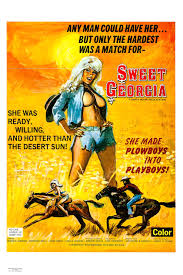
Sweet Georgia (1972)

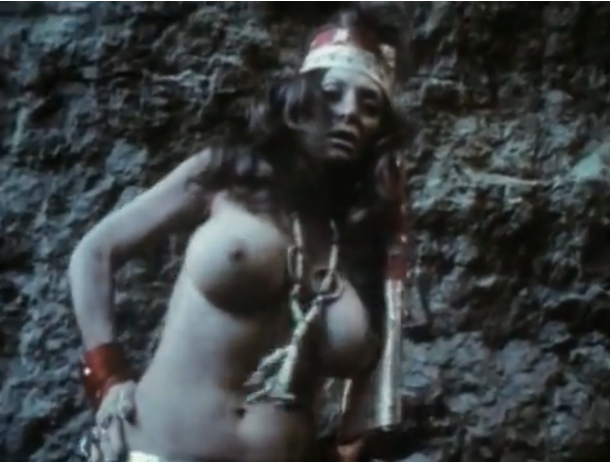
Marsha Jordan (Count YorgaThe Toy Box) is Sweet Georgia, the sexed up wife of rancher Big T (Gene Drew, Truck Stop WomenBobbie Jo and the Outlaw), an abusive drunk who she denies carnal pleasure, instead finding it in the arms of ranchhand Cal and even the arms of her stepdaughter Virginia (Barbara Mills, who also used the stage names Leona Tyler and Barbara Caron for movies like Executive Wives and Fire In Her Bed).

The final straw is when Georgia sleeps with the slow switted Leroy, which leads to her getting trampled by a horse and the farmhand getting stabbed with a pitchform before Cal and Virginia cattle prod the oyster ditch, so to speak. Then, of course, Cal is killed by Big T and we cut to Virginia enjoying herself in a room that is so red lit that it must have been in Mario Bava’s house. In case you think that the once virginal Virginia isn’t going to dance the forbidden polka with her old man, then you haven’t seen a Harry Novak film. Is there a square up reel? Of course there is.

This is another Harry Novak affair. Yes, the producer of such stalwart offerings as Suburban PagansCountry CuzzinsWham! Bam! Thank You, Spaceman!; The Child and   Tanya, perhaps the only sexploitation comedy romp about Patty Hearst. If you think I’m not hunting down that last one right now, you don’t know me all that well.

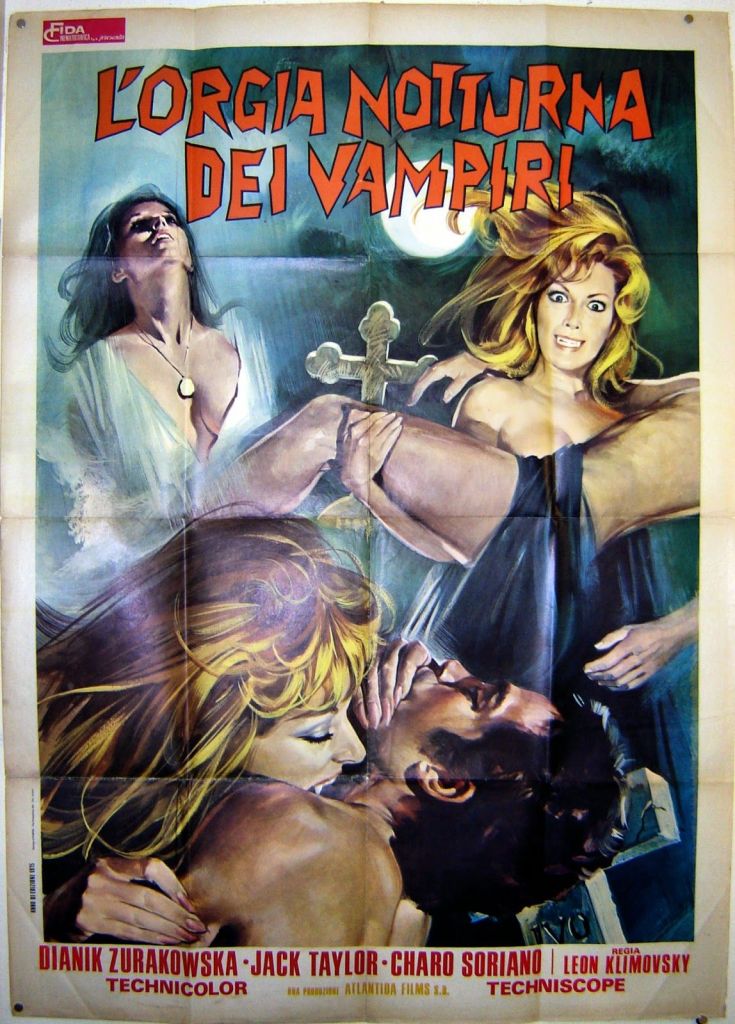
Should you watch this? Honestly, other than the song that plays throughout the film, there’s not much I can recommend. You’d probaby get more out of it just looking at the poster for an hour.

Daughters of Satan (1972)

John Hollingsworth Morse was a noted film and television director responsible for an eclectic variety of U.S. television series from the 1950s through 1980s, starting with the Star Wars precursor, Rock Jones: Space Ranger, and the still-in-runs Adam-12, The Dukes of Hazzard, and McHale’s Navy. Whenever you watch old World War II film clips—especially the Battle of Normandy—chances are Morse was on the film crew that captured those images.

It was during his time working in U.S. television that Morse met a young actor who recently broke into the business and had a few small roles in a few films and since forgotten U.S. television series. And he saw something special in that actor.

By the late ‘60s, screenwriter John C. Higgins was in the business almost 40 years and ready to retire. He quickly became a go-to talent in the film noir and murder mystery genre (precursors to Italian Giallo), most notably the Spencer Tracy vehicle Murder Man (1935) and The Black Sheep (1956), starring noted Sherlock Holmes actor, Basil Rathbone. Moving into science fiction, Higgins worked on the reimaging-rewrites of Daniel Defoe’s 1719 classic literary tale as Robinson Crusoe on Mars (1964), and an early, shot-in-Philippines Burt Reynolds action film, Impasse (1969).

So, you’ve been cast in your first leading-man role crafted by two respected filmmakers backed by one of the biggest film studios in the world—responsible for The Defiant Ones, High Noon, and 12 Angry Men—United Artists. This film is going to be a box-office smash. Your film is going to be a bigger hit than the film it’s emulating, one that reignited the horror genre: Roman Polanski’s Rosemary’s Baby (1969). You’ll even predate The Exorcist and The Omen. . . .

Not when you’ve stepped into The Twilight Zone. In the plot-twisty Rod Sterling universe, the studio is unimpressed with the lackluster end result of the film.

“What in the hell is this crap?” chomps the film executive on his cigar. “I wanted Rosemary Baby and I got Ed Wood with an oil painting,” storms the executive out of the theatre with Louise, his gum-snapping “secretary” in hip-sashaying pursuit. “I’m going to lunch. And put all of my calls on hold for the rest of the day.”

“Yes, Mr. Weinstein,” high-pitches Louise.

“Kid, you’ve got a lot of nerve pulling that crap, making jokes about me,” Mr. Weinstein snaps at this burgeoning screenwriter. “Your never-was writing career is finished.”

“Gulp,” goes my throat.

“So, Mr. Weinstein, what about—.”

“Thank god we shot on the cheap for slave wages in the Philippines,” the executive grumbles to himself. “Just have them dump it into the Drive-Ins, Louise.”

And with the stroke of a pen, the studio works up some garish artwork and dumps the film into the American Drive-In circuit on a double-bill with another shot-in-Philippines masterpiece: Superbeast (1972).

“What the hell?” shouts Tom Selleck at the first sight of the poster. “This isn’t what . . . the script was . . . but I. . . .”

I know Tom, ain’t it a kick in the head?

What was intended as a Tom Selleck-starring vehicle instead becomes a showcase for Vic Dias, the requisite evil-jolly fat man of Filipino cinema who starred in over 100 films, most notably: the female-in-prison flicks The Big Bird Cage (1972) and Black Mama, White Mama (1973). So with Daughters of Satan and Superbeast, Vic got his first unintended double billing.

So, while Magnum’s future partner and spin-off sidekick, Gerald MacRaney, aped Norman Bates in his first leading-man role in Night of Bloody Horror, ‘ol Tom found himself in what is best described as an extended episode of The Twilight Zone. And to keep things interesting: the filmmakers stunk-up the joint with red herrings by ripping off an Amicus Studio picture, which were rip-offs of Hammer Gothic-mystery tales. And to annoy us: they’ve added a screeching déjà vu soundtrack. Oh, no. This is Night of Bloody Horror all over again; they stole the soundtrack from another sci-fi/horror film. And to really piss us off: they made their pseudo-Spanish Giallo picture in Manila because they were too cheap to shoot in Madrid and let the maestro, Paul Naschy, shoot it.

“Bla, bla, bla. I’m going to the IMDb for a synopsis,” you scoff.

Tom Selleck stars as James Robertson, a Manila-based antiquities dealer who specializes in unusual and unique art works and can’t explain his fascination with an old, gory oil painting depicting a trio of witches being burned at the stake.

“So, can I see the ‘ancient tapestry’ that you think you have?” smarmy Tom says to piss off the curator of Treasures of the Orient and release the curse.

“Oh, most honorable Magnum, let me show you this painting.” 

“What? You’re joking. This is a really shitty knock off of Spanish colonial-era art . . . but that one witch looks like my wife, Chris, who looks like Barra Grant who appeared on episodes of TV’s Gunsmoke and Barnaby Jones,” ponders Tom.

So what do you do, Tom? Get the hell out of the creepy shop and hop the first plane out of Manila?

Yeah, right.

These people are more clueless than the cast of a Paul Naschy movie.

So Chris stops wearing the crucifix Tom gave her for her birthday and, if she’s smart, she’s contemplating divorce because, well, Tom’s “eye” for art obviously ain’t paying the bills. I mean, what’s with the Marsha Brady wardrobe fashioned from of ugly curtains and wallpaper? No wonder Chris is stressed and hallucinating wispy, disembodied voices calling “Damien” to her in bed.

No, wait. That’s The Omen, and it wasn’t even made yet. That’s right; these ghosts are calling out “Christina” to her. So Tom takes down the painting and . . . yeah, right.

“Why are you being so bitchy, more than usual, Chris?” scowls Tom. “And why did you stop wearing the crucifix?”

“Your mother sucks cock in hell,” spews Chris.

“Wow, should I go to the drugstore and get you something for your PMS?” whimpers Tom, wiping away the pea soup from his face. “And sweetie, quit auditioning for that role in The Exorcist. I love you, but it’s not going to happen. You’re not as good Anissa Jones from Family Affair and she didn’t get it. And this film ain’t that good, either.”

“. . . Hey, what’s that fish smell? Tom’s face scrunches. “Who are all these random strangers that suddenly seem to know me? Why are they chasing me in the streets? Who killed the shop keeper that sold me the painting? Who killed my shrink that was well-versed in Filipino folk lore?”

Screenwriters call them “red herrings,” Tom. It has something to do with the painting. Get rid of it.

“Hey, that new friend of my wife’s, she looks like Tani Guthrie from TV’s Adam 12, Cannon, Dragnet, and Emergency who also got kidnapped by a demon-slave cult in The Thirsty Dead that shot down the street from our set—and she looks like one of the witches in the painting.”

Tom, buddy. She is of the witches. Get rid of the painting. Screw Chris. Take it out back and burn the damned thing. Save yourself. She’s not “Chris.”

“No, I like it. It’s kitschy. The fact that the painting’s images mystically change and it seems as if the invisible hand of Satan is ‘painting’ it doesn’t bother me.”

“Tom, your wife, who’s not a dog person, befriended a random dog; the dog hates you—and the very same dog that was in the painting disappeared from the painting,” I yell at the TV. “You’re a friggin’ idiot, Magnum!”

Did Paul Naschy write this movie? Someone call Alaric de Marnac and “morning star” Tom out of his misery.

So, for those of you keeping track: we got two pissed off witches in the revenge-queue. We got the dog. We need one more witch to complete the painting. I wonder who the executioner will be. . . .

“Hey, how come the new housekeeper my wife just hired looks like one of the women in the painting?” says the deserves-a-Gerald MacRaney-cranium-chop victim.

Oh, look she’s brandishing the ostentatious ceremonial dagger—the same prop from the very promising Amando de Ossorio-boob-fest-sacrifice-over-a-bed-of-spikes prologue.

You’re hired. No windows required. Start in the bathrooms.

Then Tom goes outside to check on some strange noises—only to be attacked. Or was he? Oh, shit. It’s that dues ex machina, dream-within-dream-enigma-wrapped-in-a-riddle screenwriter crap again. Hey, be thankful Tom didn’t have a cheap Gerald MacRaney, swirly-spiral optical-effect backdrop to show us he’s going off the deep end. What? No Paul Naschy-cum-George Romero out-of-left-field zombies just for the hell of it?

Come on, Magnum. Get your shit together. Do we need to call Michael Knight to program it into KITT and solve this case? I mean, come on, dude. Look at that painting over there. You’re a dead ringer for the infamous Spanish Inquisition witch hunter, Sir Diego Roberson. Don’t you remember that he gave the ‘ol “Alaric de Marnac”-curse to you and your descendants before you struck the match?

And that, boys and girls, is the story of the painting of the three witches from the infamous 16th century Duarte Coven, who, along with their dog, Nicodemus, the Hound of Hell, were burned at the stake in 1592 in Spain. Why were we in Manila in South East Asia: again, because it was cheaper than shooting in Spain.

“And what’s the moral of the story?” Gabe Kaplan asks the Sweathogs.

“What? Where?” Big Surprise. Bud from Urban Cowboy is stumped. The true sign of an idiot: dump Madolyn Smith for Sissy.

“Ooh! Ooh! Mr. Kotter!” calls out Horseshack, “The moral of the story is that stupid Americans shouldn’t be moving into creepy houses in Manila like some half-assed American-not-yet-made-remake of a J-Horror film shot in an Asian-less Japan with blue eyed-blonde hair American TV actresses.”

“Wow, there, Mr. Kaw-ter. Life sure was rough for future ‘80s TV detectives,” says Freddy “Boom Boom” Washington.

Indeed.

Case solved and class dismissed. Now get the hell out of here and go bother Mr. Woodman. I have more narcissistic articles that I must attend.

About the Author: You can read the music and film reviews of R.D Francis on Medium and learn more about his work on Facebook. He also writes for B&S Movies.

The Other (1972)

Robert Mulligan is a strange choice to direct a horror movie. He was more well-known for dramas like Summer of ’42Same Time, Next Year and To Kill A Mockinbird. This adaption of the Tom Tryon book was also scripted by the author, who was once an actor before suffering the abuse of Otto Preminger.

This is a movie that I’ve been wanting to see since reading about it in Paperbacks From Hell (writer Grady Hendrix — who created that book with Will Errickson — also wrote this great article all about Tryon), as Tryon is really the forgotten horror writer of the 1970’s.

In the summer of 1935, identical twins Holland and Niles Perry live on their family farm, but all is not well. Their father died in an accident in the apple cellar last year and their mother remains so sad that she rarely leaves her room. While the rest of the family goes about their daily lives, Niles grows closer to Ada (Uta Hagen, who may have only appeared in five films, but was an incredibly influential acting teacher and Broadway star), his Russian grandmother, who has introduced him to the great game, the Perry family’s secret gift of being able to project their mind into other beings.

The twins are pretty mischeivous, as they still play in the apple cellar where their father died. One day, they’re caught there by their cousin Rusell, who also sees that Niles is wearing the ring that was to be buried with his rather. Holland, the older of the two twins, says that the ring passes on to the oldest son, who can do whatever he wants with it. He wants his brother to have it.

Their father’s brother George locks up the cellar, but Holland knows how to sneak in. And to get revenge for Russell’s snitching, he hides a pitchfork inside a haystack. The young boy jumps into it and is killed to the horror of Niles, who must now keep his brother’s secret. This behavior only gets worse when Holland causes a neighbor (Portia Nelson, one of Tryon’s lifelong friends) to have a heart attack after he menaces her with a rat.

The twins’ mother finally learns what is happening and finds the ring inside a tobacco tin, along with a human finger. She demands that Niles tell her how he got it. He says that Holland gave it to him and the evil brother charhes his mother, knocking her down the stairs, rendering her paralyzed.

After the neighbor’s body is found, Ada finds Holland’s harmonica and asks Niles what happened. He lets her know that his brother has been evil all summer. Here’s where the twist comes in — Holland has been dead since he fell down a well on their birthday last March. Right before he died, Niles used the great game to talk to his dead brother, who commanded him to open his coffin, cut off his finger and take the ring.

The old woman now realizes that Niles has kept his brother alive in his mind and has been responsible for everything bad that has happened. Yet she is unable to turn on him and keeps his secret, as long as he never plays the game again.

The only problem is that Niles can’t be stopped. When his sister gives birth to a baby girl (look for a young John Ritter as their father) the Holland side of his personality steals the baby as he is fascinated by the Lindbergh kidnapping. The child is discovered drowned and a mentally challenged farmhand is arrested for the murder. But Ada knows better. She demands that Niles — alone in the apple cellar — screaming for Holland to tell him where the baby — who he loved — went. Ada pours kerosene into the cellar to kill the boy and throws herself into the fire.

Months later, we learn that Niles escaped, as Holland had cut the padlock to the door. With his beloved grandmother dead and his mother basically a vegetable, no one will ever know his secret. Niles is called down to lunch and life goes on.

This is how the theatrical cut ends, but the CBS 1970’s TV version, perhaps wanting the child to pay for his crimes, ends with Niles saying, “Holland, the game’s over. We can’t play the game anymore. But when the sheriff comes, I’ll ask him if we can play it in our new home.” The voiceover is dubbed by a different actor. However, every broadcast and release of the film cut out this voiceover in favor of the original theatrical ending.

Tryon hated this adaption, blaming everyone, incuding himself. “Oh, no. That broke my heart. Jesus. That was very sad,” he said of the finished film. “That picture was ruined in the cutting and the casting…God knows, it was badly cut and faultily directed. Perhaps the whole thing was the rotten screenplay, I don’t know.”

Despite a mild performance at the box office, the film ran on TV throughout the 1970’s. Roger Ebert was a major fan, saying that the film “has been criticized in some quarters because Mulligan made it too beautiful, they say, and too nostalgic. Not at all. His colors are rich and deep and dark, chocolatey browns and bloody reds; they aren’t beautiful but perverse and menacing. And the farm isn’t seen with a warm nostalgia, but with a remembrance that it is haunted.”

I looked for this film for nearly a year until Shudder played it last month, but it’s already gone from the service, back into the mists from whence it came.

Terror House (1972)

Whatever you call it — Terror House, Terror at Red Wolf Inn or Folks at Red Wolf Inn — this 1972 horror comedy is one strange film. It makes a nice double or triple feature companion for a few other movies from the early 70’s like The Baby and Messiah of Evil. They’re horror, sure, but they also all feel like they’ve come from some other planet, somewhere beyond the walls of our normal plane of existence.

Regina (Linda Gillen) is a young college student with no money, friends or plans as the rest of her class leaves for spring break. That said — her luck is about to change, as she gets a letter informing her that she’s won a free vacation to the Red Wolf Inn.

She even has a plane ready for her and a handsome young man named Baby John Smith to pick her up when she arrives. Their ride to the inn is wild, as he races the police, but instead of reacting with fear, she enjoys the ride.

Once they arrive, Regina meets the owners of the inn, Henry (Arthur Space, who played veterinarian Doc Weaver on TV’s Lassie) and Evelyn (Mary Jackson, Sister Felice in Airport and Emily Baldwin on TV’s The Waltons), who are also Baby John’s grandparents. Plus, there are two other contest winners, Pamela (Janet Wood, Angels Hard as They Come) and Edwina (Margaret Avery, who years later woud be nominated for a Best Supporting Actress Oscar for her work as Shug Avery in The Color Purple; she’s also in the made for TV movie Something Evil that Steven Spielberg directed before Jaws).

That night, everyone sits down to an extravagant meal where they’re encouraged to indulge themselves. The next morning, Pamela has gone, but her dress has stayed behind.

Baby John and Regina’s feelings for one another are noticed by everyone in the house. This leads to my favorite scene in the movie, where they share a moment on the beach, flirting with one another before they embrace and kiss. Then, Baby John catches a small shark and loses his mind, smashing it over and over again before punching it, all the while screaming “Shark!” before confessing that he loves Regina. It’s incredibly disconcerting, like the way that beings from another dimension would act thinking that they were fitting in with humanity.

Before you know it, it’s time for another party, this time celebrating Edwina’s last night. After everyone goes to bed, the Smiths go to her room, knock her out with chloroform and then slices her to ribbons inside the refrigerated meat locker. After Regina worries that Edwina left without saying goodbye, she tries to run away, but even the police are members of the Smith family.

A prisoner inside the Red Wolf Inn, she soon discovers that she’s been eating human flesh the entire time there. She tries to run one more time, but is caught and finally admits that she’s in love with Baby John. Despite the fact that she believes that his grandparents want to kill and eat her, she thinks that they’ll come to accept her. There’s a test later that night where they try to get her to eat human flesh, now that she knows what she’s been devouring, but she runs away.

Baby John is smitten, but will he save the woman he’s fallen for? Will he eventually eat her too? Or is there an even stranger ending poised to blow your mind?

If you want to know every single thing there is to know about this film, I heartily recommend the zine Drive-in Asylum. In issue eight, there’s an interview with Linda Gillen that goes in-depth into every facet of the film and its production, as well as a great article by Terry Thome that dissects the film’s mixture of romance, horror and comedy. In fact, if you check out the Drive-In Asylum etsy store, you’ll find everything from signed VHS copies of the film, promotional photos and even a cookbook inspired by the film! I’m proud to say that I illustrated this unique souvenir of this film, which as a real honor (and I even have one signed by Linda).

BONUS: We spent two full episodes of our podcast discussing this movie with Bill from Drive-In Asylum, which will give you even more insight into the sheer craziness at the heart of this film.

Space Is the Place (1972)

For years, very little was known about Sun Ra’s early life, and he contributed to that with evasive, contradictory or even nonsensical answers to questions of his origin.

Sure, he may have been born Herman Poole Blount in Alabama, named for the popular vaudeville stage magician Black Herman, who had deeply impressed his mother, but he didn’t become Sun Ra at birth.

He already had some powers and skills, such as being able to transcribe big band songs from memory after only hearing them once. But the real Sun Ra was born sometime between 1936 and 1940. Or at the very least, before 1952. That’s when Herman had a vision.

.His biographer, John F. Szwed, said that Sun Ra was “both prophesizing his future and explaining his past with a single act of personal mythology,” a moment where the musician claimed that he was visited by space brothers: “My whole body changed into something else. I could see through myself. And I went up… I wasn’t in human form… I landed on a planet that I identified as Saturn… they teleported me and I was down on [a] stage with them. They wanted to talk with me. They had one little antenna on each ear. A little antenna over each eye. They talked to me. They told me to stop [attending college] because there was going to be great trouble in schools… the world was going into complete chaos… I would speak [through music], and the world would listen. That’s what they told me.”

This experience led to Sun Ra leaving college, giving up sleep to devote himself to music and the study of the Bible. However, in 1942, he was drafted and was rejected as a conscientious objector. He was approved for alternate service at a Civilian Public Service camp but never showed up. When taken to court, he debated the judge on matters of the law and Bible. The judge listened to him and threatened to draft him to the military. Ra responded that if this happened, he would kill the first high-ranking military official he met. Sentenced to jail, the judge said, “I’ve never seen a (ethnic slur) like you before.” Ra answered, “No, and you never will again.”

After some time in an Alabama jail, Ra then went to that work camp, where he did forestry work by day and played piano at night. He was finally classified 4-F due to his chronic hernia and he returned home. After the death of his great-aunt Ida, who he provided for, he left home for Chicago.

Surrounded by ancient Egyptian-styled buildings and monuments, as well as the cities activism, Ra began to believe that the accomplishments and history of black people had been co-opted, suppressed and denied by the white man. In 1952, much like how Nation of Islam members removed their slave names, he legally changed his to Le Sony’r Ra.

Chicago is also where Ra met Alton Abraham, who shared his interests but also balanced his shortcomings (Ra was notoriously withdrawn and bad at business). Together, they expanded his Arkestra of musicians and published pamphlets that they distributed on the streets.

Sun Ra and his Arkestra would live communally, traveling to New York City and Philadelphia. He’d call compulsory band practice at any hour of the day or night. Their residences would gain famous fans like Thelonious Monk and Dizzy Gillespie. And their Philly neighbors would soon love having them around, as they were drug-free, friendly with the kids and very friendly, if a bit loud.

Soon, the Arkestra was touring the world with up to thirty dancers, singers, fire eaters and a light show that would often leave hippies confused, as they were used to bands just playing and not having a stage show. Ra was also appointed as artist-in-residence at University of California, Berkeley, teaching a course called The Black Man In the Cosmos.

This class sounds amazing. There was a half an hour of lecture time; reading lists that included Madame Blavatsky, Henry Dumas, the Tibetan Book of the Dead, Alexander Hislop’s The Two Babylons, African American folklore and Egyptology; and then a half hour performance of the Arkestra.

This brings us to 1972, when San Francisco public TV station KQED producer John Coney, producer Jim Newman, and screenwriter Joshua Smith came together with Sun Ra to produce an 85-minute feature film that would bring his philosophy to the masses.

What is that message? In short — and this article is scant space to really get into Ra’s full message — he sought to “elevate humanity beyond their current earthbound state, tied to outmoded conceptions of life and death when the potential future of immortality awaits them.”

Sun Ra used a mixture of the Freemasonry (he had studied at a Masonic Lodge as a child, the only place that allowed black men to read books), Ancient Egyptian Mysticism, the Kabbalah, Rosicrucianism, channeling, numerology, black nationalism, Gnosticism and more. Ra even argued that the monotheistic God of organized religion was not the Creator or ultimate God, but a lesser evil being out to enslaved mankind. He was also not a fan of the Bible, as it had been used to endorse slavery.

He was a master of reworking phrases and names, often changing Biblical passages to suit his ends or change the real names of Arkestra members. He’d often use Zen koans or nonsense statements that suddenly took on entirely new meanings when looked back on days later. Often, they would cause people to make paradigm shifts in how they looked at the world.

While closely identified with Afrofuturism, Sun Ra felt that he wasn’t close to any one race. Eventually, he came to believe that some outside force was manipulating both blacks and whites to hate one another.

Space is the Place emerged from Dilexi, an experimental art series of films produced by the aforementioned Newman and director by Coney. After filming some performances of the Arkestra, they created a story with Smith that tied it all together.

Sun Ra has been lost in space since June 1969, but he finds a new planet that he wants to colonize with African Americans. His music will lead them there. His mission starts by traveling back in time to the Chicago of his past, where he and the Overseer will play a game of cards for the fate of the human race.

Who is this Overseer? Is he the evil inside the black community? He appears to be a community leader and a man of great charity who seems to mean well, but he’s been overtaken by the status quo of white capitalism.

There’s also a theory that Sun Ra saw his teachings went directly against the Black Panthers, believing that “only the band’s use of technology and music will liberate the people by changing consciousness.”

In present time, Ra opens an Outer Space Employment Agency to recruit people ready to move to his new planet. The only trouble is that many are suspicious of Sun Ra, thinking he’s a gimmick or selling out to the Overseer. He’s even kidnapped by three white NASA scientists who want his space travel secrets before he’s saved by three teenagers just in time to play a major concert.

During the show, the scientists return and attempt to murder Ra, but a teenager takes a bullet for him. Ra, the teens and then black people all over the city begin to beam up to Ra’s ship. Sun Ra has defeated the Overseer and even taken his henchman Jimmy Fey’s blackness with him, leaving Earth behind to die.

The sheer otherworldliness of this film is only increased when you realize that it shared sets with The Mitchell Brothers’ Beyond the Green Door. I guess as Sun Ra sought to open peoples’ minds, that movie was blowing another set of people’s minds by featuring Johnnie Keyes coupling with Marilyn Chambers.

Of all the movies I’ve covered for this week of musicals, Space Is the Place is perhaps the strangest I’ve watched. Sun Ra wasn’t from Alabama. He had to really be from Saturn. There’s no other way that this makes sense otherwise. Sun Ra didn’t seek to conquer, instead to inspire humanity to transcend this insignificant physical life and aspire to greatness in the stars.

“In some far off place, many light years in space, I’ll wait for you. Where human feet have never trod, where human eyes have never seen. I’ll build a world of abstract dreams and wait for you.” – Sun Ra

Private Parts (1972)

Paul Bartel is a bonafide hero here at B & S About Movies. From his cameos in movies like Gremlins 2: The New Batch and Chopping Mall to the films he directed like Death Race 2000 and Eating Raoul, every time he turns out on the screen it makes us happy.

Cheryl and her roommate get in a fight, so instead of going back home, she decides to move into her aunt’s run down hotel in downtown Los Angeles. Suffice to say that shenanigans ensue.

Aunt Martha is a strange lady, played by Lucille Benson, who was on TV’s Bosom Buddies and played Mrs. Elrod in Halloween 2, as well as time on Broadway. She’s obsessed with funerals and given to moralizing. Her hotel is packed with maniacs and there are also a series of murders going on, with Cheryl as the best chance to be the next victim.

Get this — the role of Aunt Martha was originally written for Mary Astor (The Maltese FalconHush…Hush, Sweet Charlotte)!

Cheryl wants to be a woman and experience her sexuality, which leads her into George’s orbit. He’s a photographer who longs for love, but also sleeps with a water inflated doll that he often injects with human blood and covers with a photo of Cheryl’s face. He’s somehow not the strangest person in the hotel. And oh yeah, to add to the whiff of perversion in the air, he’s her cousin.

Stanley Livingston, Chip Douglas from TV’s My Three Sons, also is in this movie, playing Jeff, another tenant. He would be a better mate for Cheryl, but she’s already too deep. And it’s pretty crazy to see Laurie Main, who hosted and narrated Disney’s Welcome to Pooh Corner, as a gay priest. That said, he also shows up in some other strange places, like Larry Cohen’s Wicked Stepmother and as the narrator of Cheech & Chong’s The Corsican Brothers.

There was also a model named Alice that once lived in Cheryl’s room that nobody wants to talk about. And a whole bunch of keys that open other rooms so that our voyeuristic heroine can spy on all of them.

Private Parts began with the working title Blood Relations, but its new title was rough on the film, as some newspapers wouldn’t promote it with that name, some even calling it Private Arts. Some ads even said that the title was too shocking to print and asked people to call the theater to learn the name of the film!

It really was shot in a skid row hotel, the King Edwards Hotel in downtown L.A and all of the people in it were based on people that writers Philip Kearney and Les Rendelstein met in LA in the 1960s. It’s still around, having been purchased in 2018 with plans to convert it into low-cost single-occupancy transitional housing.

This is a movie that fits in well with other blasts of 70’s odd like The Baby. Like that movie, Private Parts may not explicitly have sex and violence, but it just feels off and as if it came from another universe that might appear to be ours, but has scum and strangeness in every corner.

Leonard Maltin said this about Private Parts: “If Andy Warhol’s Chelsea Girls had co-directed by Alfred Hitchcock and John Waters, it would come close to this directorial debut by Paul Bartel.” That sums this up quite well.

The Satanic nature of this film ties in well with Anton LaVey’s 1988 Pentagonal Revisionism. George’s preference for his doll ties in well with the Church’s realization of the need for the development and production of artificial human companions, which LaVey referred to as “the forbidden industry.”

Dr. Phibes Rises Again (1972)

The fact that this movie exists gives me hope. There are moments when life gets me down, when I wonder about my place in this world and if humanity is essentially horrible. Then I remember that great films like this exist and it makes me feel a lot better. You should do the same thing if you’re ever in an existential crisis.

Dr. Phibes is back, three years after he laid down in the darkness next to the corpse of his beloved wife. Now, however, he has learned that the secret of eternal life — held by a centuries-old man — are in Egypt. I don’t care why he’s back. I’d watch Dr. Phibes go grocery shopping!

Dr. Anton Phibes (Vincent Price) has in suspended animation in a sarcophagus alongside his wife Victoria Regina Phibes (Caroline Munro). When the moon aligns with the planets in a way not seen for two millennia, he returns, summoning the silent Vulnavia (thus confirming to me, at least, that she’s really one of his robots as she died in the last film; furthermore, she’s played by Valli Kemp, who took over for the pregnant Virginia North) to his side.

Phibes plans on taking his wife’s body with him to Egypt, where the River of Life promises her resurrection. As he emerges from his tomb, his house has been demolished and the safe that contained the map to the river lies empty. That’s because the map has been stolen by Darius Biederbeck, a man who is hundreds of years old thanks to a special elixir. He may also be every bit Phibes’ equal.

Darius is played by Robert Quarry, who American International Pictures was grooming to be Price’s replacement. There were tensions between the two on set, including a moment where Quarry was singing in his dressing room and challenged Price by saying, “You didn’t know I could sing did you?” Ever the wit, Vincent Price replied, “Well, I knew you couldn’t act.” Quarry would had already played Count Yorga in two films for AIP and would go on to be in The Deathmaster, where he played hippie vampire Khorda, but the AIP style had already fallen out of style. He’s also in tons of Fred Olen Ray films, like Evil Toons where he’s the uncredited voice of the demon.

Biederbeck wants eternal life for himself and his lover Diana (Fiona Lewis, Tintorera…Tiger Shark). Phibes and Vulnavia are on his trail, immediately entering his home, murdering his butler and stealing back the map. Everyone connected with Biederbeck comes to an ill end — Phibes places one inside a giant bottle and throws him overboard. That murder brings Inspector Trout back on the case, as he instantly recognizes that only one man could do something like that.

The rest of the film’s murders are based on Egyptian mythology versus Biblical plagues. Hawks and scorpions become his weapons, along with gusts of wind and bursts of sand. Phibes has also brought an army of clockwork men with him the desert to do his bidding.

Phibes finally exchanges Diana’s life for the key to the River of Life. As he floats the coffin containing his wife down the water, he beckons Vulnavia to join them. As his lover tries to comfort him, Biederbeck begs Phibes to take him with them. He begins to rapidly age and dies as Phibes loudly sings “Over the Rainbow,” which might be the best ending of any movie ever made.

There were plans for a whole bunch more of these films and the fact that they were never made saddens me to this day. I’ve heard that a third film would Phibes fighting Nazis. I’ve also heard that it’d be about the key to Olympus. Or Phibes going up against  Dr. Vesalius’ son. Or Victoria Phibes herself coming back, just as sinister as her husband. There have been titles thrown around like Phibes Resurrectus, The Seven Fates of Dr. Phibes and The Brides of Dr. Phibes. There was even thought of Count Yorga facing off with Dr. Phibes, a fact which delights me to no end.

There was also a pitch for a TV series and what looked like an animated version, with Jack Kirby himself providing the pitch artwork!

Other ideas included Dr. Phibes in the Holy LandThe Son of Dr. Phibes (which would have pitted the doctor and his son against ecological terrorists), Phibes Resurrectus (which would have David Carradine as Phibes battling against Paul Williams, Orson Welles, Roddy McDowall, John Carradine and Donald Pleasence. The mind boggles at the thought, let me tell you!), a 1981 Dr. Phibes film where the WormwooInstitutete would have destroyed his wife’s body and then their strange members, including transvestite twins obsessed with economics and nuclear weaponry, fail to match wits with Phibes) and finally, Phibes was almost a role for Peter Sellers in a Pink Panther film where hed also play Clouseau and Fu Manchu. You can learn more about these at the Vincent Price Exhibit site.

There was also a story in 2013 that Johnny Depp was going to star in a Tim Burton directed remake. That obviously didn’t happen.

So much of this film fits into the same Satanic themes as the original. However, you can add in a few new wrinkles. One of the Eleven Satanic Rules of the Earth states “When walking in open territory, bother no one. If someone bothers you, ask him to stop. If he does not stop, destroy him.” All Phibes wished to do was take his wife to Egypt and bring her back to life. Once Biederbeck stole from him, his fate was sealed.

Marjoe (1972)

Hugh Marjoe Ross Gortner first became known — way back in the late 1940’s — as the youngest person to be ordained as a preacher. Just four years old, he possessed an innate ability to speak sermons and lead revival meetings. By the time he was sixteen, the Gortner family had taken around three million dollars from the faithful, money that Marjoe’s father would run away with. From then on, Marjoe was a beatnik until he needed money in his early 20’s and went back to preaching, basing his style on being a rock star like Mick Jagger.

He became famous for a different reason when he starred in this film, a behind-the-scenes documentary about Pentecostal preaching made just as Marjoe planned on leaving the faith for an acting career.

While this won the 1972 Academy Award for Best Documentary Film, it was a lost film for several years. That’s because due to the fears of bad reactions to the film in the Bible Belt, it was not shown widely in theaters any farther south than Des Moines, Iowa.

https://www.dailymotion.com/video/x58m473

The film finds Marjoe in what he claims are his final months of touring the tent revival circuit. That’s why he offered the documentary film crew full and unrestricted access to his 1971 tour. The crew includes Howard Smith, who also directed the documentary Gizmo!, appears as a TV commentator in the original Dawn of the Dead and was also a famous DJ who conducted long-format interviews with stars like John Lennon and Yoko Ono, Lou Reed, Eric Clapton and Jim Morrison; his co-director was Sarah Kernochan, who would go on to write 9 1/2 Weeks and What Lies Beneath.

The film juxtaposes Gortner preaching, praying and even healing people in Los Angeles, Fort Worth, Detroit, and Anaheim while revealing to the crew backstage that he is a non-believer, while also showing them the tricks of the evangelist trade. Even more damning are the moments where preachers pull bills out of buckets, fold them and make huge stacks of the money they’ve taken from those that only want to be saved.

In an interview with Vice, Kernochan said, “I didn’t warm to Marjoe. He was difficult to work with, very paranoid, and mistrustful, and tense. I’m not sure we were very good at relaxing him; maybe nobody could. I was concerned about him being likable. There was no point in making a film about someone who you never heard of that was portrayed as despicable. But when I saw the scrapbook, I realized that as long as people knew about his childhood, they would forgive him for anything because of what was done to him.”

She also added that one of the great ironies of the film was that one of the camera operators, Richard Pearce, objected to how the movie made many of the worshippers look dumb. How is that ironic? Well, he went on to direct Leap of Faith with Steve Martin. She said, “After putting the film down for making religious people look stupid, he ripped off some things…I thought that was really hypocritical.”

There’s also a scene that she said was cut from the film, where an artist asked Marjoe if he was being used by Jesus Christ, even if he didn’t believe in Him. The question disarmed him and twisted his already conflicted feelings.

Did they find any positive religious figures in all the time they filmed? Kernochan confessed, “I wish we had found a preacher that I felt was genuine, but we just never found one. They must be out there. But we didn’t go out of our way to find crooks.”

Even the release of the film only benefitted Marjoe, leading to a career as a rock star and releasing one album called Bad, But Not Evil, as well as being a correspondent for Oui magazine and starting his acting career. He appeared in the pilot for TV’s Kojak, as well as Earthquake, The Food of the Gods and Starcrash.

After appearing on Speak Up, America!, an 80’s reality show and Circus of the Stars, Gortner worked for charity organizations until he retired in 2010. He was married to Candy Clark (Q, the remake of The BlobCat’s Eye and Buffy’s mom in the original Buffy the Vampire Slayer) for about a year in the late 70’s.

In the Nine Satanic Statements, LaVey put forth: “Satan represents undefiled wisdom instead of hypocritical self-deceit!” You can argue that the people at these revivals didn’t know they were being lied to. Or perhaps the lie allows the psychosomatic mind to heal pain. Regardless, Marjoe and the men in this movie are profiting from them. 

That said, Stupidity is at the top of the list of the Nine Satanic Sins. “It’s too bad that stupidity isn’t painful. Ignorance is one thing, but our society thrives increasingly on stupidity. It depends on people going along with whatever they are told. The media promotes a cultivated stupidity as a posture that is not only acceptable but laudable. Satanists must learn to see through the tricks and cannot afford to be stupid.”

I think it’s intriguing that right on the Church’s Bunco Sheet, they encourage members to “develop the cold-reading abilities of a Carney, rather than the naïveté of the mark.” Their biggest warning about getting involved with other groups outrightly states: “When someone claims to have a direct line of communication with Satan, watch out. Selling that kind of mysticism is exactly how Christianity has kept people enslaved in ignorance for centuries. It’s one of the things we’re fighting against.”

You can watch this movie on Tubi or Vudu for free.

Who Saw Her Die? (1972)

If you see one movie where a father has sex instead of watching his daughter and spends the rest of the movie hunting her killing through the canals of Venice, you should probably watch Don’t Look Now. In fact, you may not even realize there’s another movie with the same plot. Actually, there is and to be honest, it’s really good. And believe it or not, this movie came out a year before Roeg’s. I’ve also heard this film compared to 1978’s The Bloodstained Shadow.

While at a French ski resort, a young girl wanders off and is murdered by a woman in a black veil, who then buries her body in the snow. Years later, the same thing happens in Venice, as Roberta (Nicoletta Elmi, DemonsA Bay of BloodFootprints on the Moon, The Night Child, Deep Red — when you needed a child actor in Italian horror films, she was the one you hired) is abducted and found drowned in the waters of that famous Italy town.

Now, her divorced parents — sculptor Franco (former James Bond George Lazenby) and Elizabeth (Anita Strindberg, The Antichrist) — must work together to discover who killed their daughter. That journey will take them into a world of darkness, sexual depravity and murder. And anyone that learns too much pays for those secrets with death.

The ending of this movie is astounding, with the killer set ablaze — to the apparent delight of Elizabeth — before they are launched out a window. And not to make a horrible pun, but it’s nearly a broken record to say that Morricone’s soundtrack may be the best part of this movie.

Director Aldo Lado is also responsible for Short Night of Glass Dolls and The Humanoid, two other movies well worth your time.

You can watch this movie on Amazon Prime.

Seven Blood Stained Orchids (1972)

Umberto Lenzi made the first Italian cannibal film, The Man from Deep River and followed that up with Eaten Alive! and Cannibal Ferox. When he followed a trend, his movies always stand out. Zombies? Lenzi’s Nightmare City outgrosses and out-insanes them all. Horror? He made the utterly bizarre Ghosthouse, which was shot in the same house as The House by the Cemetery. Sword and sorcery? Lenzi made Iron Master, another out there film with George Eastman wearing a lionhead and murdering people left and right.

And when it comes to giallo, Lenzi broke the mold and brought out films like EyeballSpasmo, OrgasmoSo Sweet…So PerverseA Quiet Place to Kill and this movie.

This film comes after Lenzi had tired of the giallo and started to move toward more poliziotteschi or Euro-Crime films.

A serial killer is on the loose and he’s only murdering women. One of the potential victims is Giulia, the newly married bride of Mario (Antonio Sabato), on the night of their honeymoon. The killer escapes and the police accuse Mario of being the killer.

To protect his wife, the police decide to act like she’s died. Meanwhile, Mario sets out to prove that he isn’t the killer and attempts to solve the Puzzle of the Silver Half Moons.

Lenzi isn’t afraid to push the violence in this one. The black gloved killer stabs a woman in her bed, bashes in another’s head, strangles another, drowns one more and even uses a power drill in a scene that features nearly neon red blood.

This is more a combination of German-style krimi film with the giallo, but it’s still pretty fun. A good part of that fun comes from the actresses here, like Marisa Mell (Danger: Diabolik‘s Eva Kant) and Uschi Glas, a German actress with the nickname of Schatzchen, or baby, from her first film Zur Sache, Schatzchen or Go for It, Baby.

Lenzi isn’t celebrated in the same way as Argento and Bava, but I’m always entertained by his films. This one was no different.

You can grab this one on blu ray from Kino Lorber.