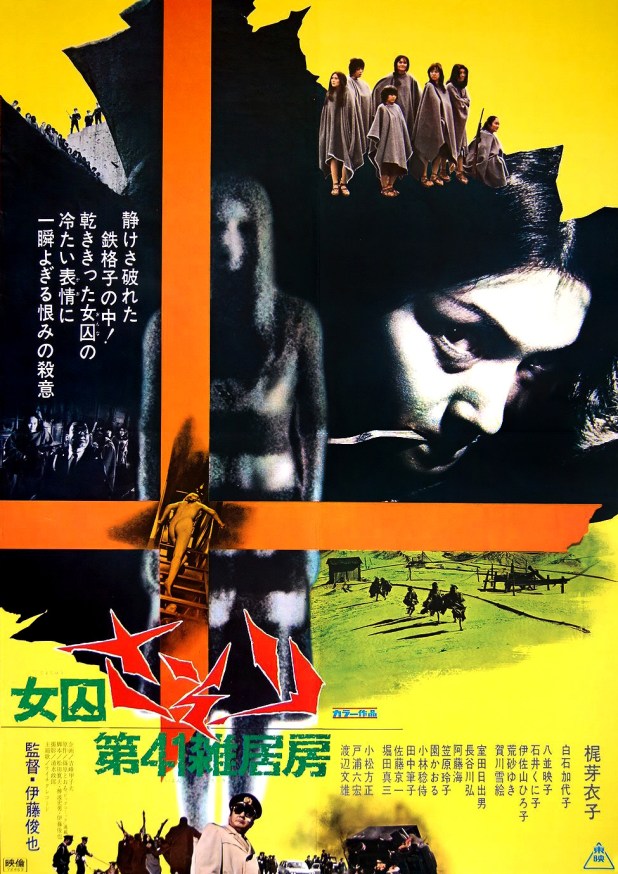
Female Convict Scorpion: Jailhouse 41 (1972)

“You’re a beautiful flower” – his words flatter you today

But once you’re in full bloom, he’ll just toss you away.

Foolish, foolish, foolish woman’s song.

Her song of vengeance.

“Sorrow is my fate.”

So you’ve given up on men.

Show him your tears and he’ll bring you grief again.

Tearful, tearful, tearful woman’s song.

Her song of vengeance.

A bright red rose has thorns that you might not see.

I don’t want to pierce you, but how else will I get free?

Burning, burning, burning woman’s song.

Her song of vengeance. 

With these words, we have returned to the world of Female Prisoner #701 Scorpion. When we first see our heroine, Nami Matsushima (Meiko Kaji, truly the queen of all revenge movies), she is bound and stuck in solitary confinement, but her eye stares directly at us, the viewer. It is not a look of sadness or fear. It is a look that this jail is temporary, as are all things, and as we hear the scraping of metal against concrete, we notice the spoon between her teeth being turned into a shiv.

Inspector Goda, the warden of the prison that Matsushima, or Matsu the Scorpion, walked back into in the last film is due to be promoted to a higher position. As another inspector comes to the jail, he brings Matsu out of confinement so that she may be inspected. Of course, this is when our heroine attacks, scratching his face and inciting a riot.

The punishment? Four guards are sent to brutally assault Matsu and then she and six other inmates are sent to a labor camp. On the way, the six women beat Matsu mercilessly. The guards are told that she may be dead, so when they stop the van, they’re shocked. She’s still alive and the women murder the guards and blow the van up.

As the women escape, they reveal their crimes to one another. Oba discovered that her husband was unfaithful, so she drowned their son and stabbed herself, which led to her killing their unborn child.

Then, an old woman with a dagger shows up and the further crimes of the gang are shown as the old woman gives Scorpion her blade before dying and turning into leaves that blow away in the wind! I love that the Scorpion films can seemingly be based in reality in one moment and then become strange art films with no warning at all.

After stealing clothes and hiding in an abandoned home, the prisoners wait for nightfall. One of them, Haru, finds her own home and son, but is found by two of the jailers. They offer her freedom if she reveals where the others are. Matsu kills one of the guards, but one of the convicts is also killed and the other guard makes his way back to Inspector Goda.

A tour bus passes through the same area and everyone is warned that the convicts are on the loose. That doesn’t make three of the men on the bus any less leering and lecherous. They end up finding one of the convicts, who they assault and throw into the river for dead. The other girls find her body and attack the bus, holding everyone hostage while taking their revenge on the three men.

As they approach a police checkpoint, the de facto gang leader Oba throws Scorpion out of the bus. The roadblock also has Haru’s son on it, so she runs toward him and is killed by a sniper. Oba and the convicts kill the bus driver and plow through the roadblock. However, the police soon corner them and Goda sends Scorpion to learn of the hostages’ status.

She lies and states that everyone is dead, so the police attack. The women throw the three evil men outside, who are all killed by police bullets. Everyone except Oba is killed. As the police capture both her and Scorpion, they plan to kill our heroine on the way back to the prison. Oba saves her and gives up her life, finally freeing Scorpion.

Inspector Goda has been promoted and is now in the city, where Scorpion finally tracks him down. She repeatedly stabs him and her dagger is passed to the ghosts of all the convicts, who pass it back and forth as they run wild through the streets.

Made just months after the original, this film posits that Scorpion spent an entire year in solitary confinement, just waiting for her revenge. Well, she gets it. She might have to go through hell, but she gets it.

Meiko Kaji is, of course, beyond amazing in this film. She made 26 movies between 1970 and 1972, which is some feat of endurance that I don’t see many capable of doing these days. In each of these, she often faced excruciating scenes of torture and emotional pain, yet she never loses her dignity nor willingness to come back and decimate all in her path. In 1973, she’d make two more Scorpion films and Lady Snowblood, so it wasn’t like she was about to slow down any time soon.

I love that despite the antics of the gang of women, Scorpion remains separate from them. Her goal throughout is her own solitary revenge and whatever it takes to get it.

The final scenes, where we go from Scorpion staying with Oba as she dies in a garbage dump to her finally tracking down Doga in the city are beyond amazing. Her vengeance is such that even the screen can’t contain it, as she slices through the fourth wall and splits it asunder. The once powerful man has become weakness in Scorpion’s arms, as she has assumed her true form, the black-clad destroyer of worlds, as she repeatedly stabs him without expression. Only when his false eye falls out and we see inside it do we get to watch her laugh and smile as she leads the women’s spirits out of death and through the streets. It brought tears of joy to my eyes. Such a pure moment of cinema!

You can watch this on Shudder or order the beyond impeccable Arrow Video box set at Diabolik DVD.
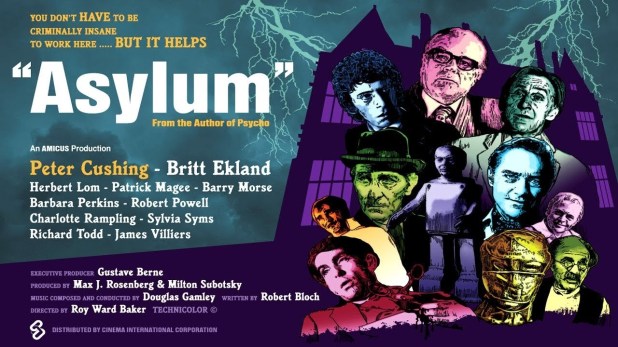
Asylum (1972)

My real job is to write copy for marketing. I’ve been at it for over twenty years, and no matter how many great taglines I see in commercials, nothing moves me more than the copy that has sold my favorite movies. The words that sell Asylum are very special to me:

“Come to the Asylum…to get killed!”

The best lines make you say, “And then?” Or even better, “Why?” Why would I come to the Asylum? Why would I want to get killed? I need to know more. I need to watch this movie.

Asylum is a movie of pedigree. It comes from Amicus, the studio that made portmanteau horror their toast and baked beans. It’s written by Psycho author Robert Bloch, who based the script on several short stories. And it’s directed by Roy Ward Baker, whose films Quatermass and the Pit, The Vampire Lovers and The Vault of Horror belong in every media collection.

You know the narrative structure if you’ve seen an Amicus anthology film. Generally, unrelated people come together, tell their stories and realize that they’re either dead, in hell, or dead and in hell. Then, the narrator points to the camera and says something to the effect of “You’re next!”

Asylum breaks the mold by presenting its tales within a secluded home for the incurably insane. Dr. Martin arrives to interview for a position when he’s met by Dr. Lionel Rutherford, who is in a wheelchair thanks to an attack by inmate Dr. Starr, who was once the head of the place! If Dr. Martin can deduce exactly who Starr is from a series of patients, the job is his.

The first tale, “Frozen Fear,” is a very by-the-numbers EC Comics affair, with butcher paper-wrapped body parts suddenly finding a life of their own.

Yet, “The Weird Tailor” is when Asylum picks up speed and runs toward brilliance. A tailor, on the cusp of losing his shop, accepts a strange job from an even stranger man, played by Peter Cushing. There’s a feeling I get when Peter Wilton Cushing, OBE, appears on screen. It’s a return to childhood, remembering afternoons and late evenings watching endless Hammer movies with no adult cares and that moment of excitement when I recognized him in Star Wars. Here, as a man who has lost his son — Cushing was no stranger to loss, never getting over the death of his wife — he implores the tailor to create a suit for him, one with instructions that must be followed without question. The denouement of this episode still gets me every single time. This is pre-CGI practical magic creating sorcery on celluloid, an utter moment of strange beauty mixed with otherworldly dread.

The ending of “Lucy Comes to Stay” can be defined in the first few moments, but when you have Britt Ekland and Charlotte Rampling on screen together, something so trivial as an easy-to-divine twist is simple to get over.

“Mannikins of Horror” is a masterclass in unexpected twists. Soul transference and eerie toys converge to create a nightmare within the asylum’s four walls. And just when you think you’ve seen it all, the reveal of Dr. Starr will leave even the most seasoned fright fans stunned. Remember – nobody gets out of the Asylum unscathed. The unexpected twists in this tale will keep you guessing and gasping until the very end.

Despite owning thousands of DVDs and Blu-rays, Asylum always finds its way into our home’s player at least once a month. Why? Because it never loses its unique edge. How many films do you know that feature small robots filled with noodle-like guts stabbing doctors with scalpels, while glowing suit-wearing mannequins stalk the screen? And how many manage to combine these frightening moments with an ongoing theme of mankind’s tenuous grasp on sanity and identity? Asylum is a rare gem that accomplishes both, and it’s a film you won’t want to miss.

NOTE: This article originally ran on Horror and Sons.

BONUS: You can listen to the podcast we made about this film!

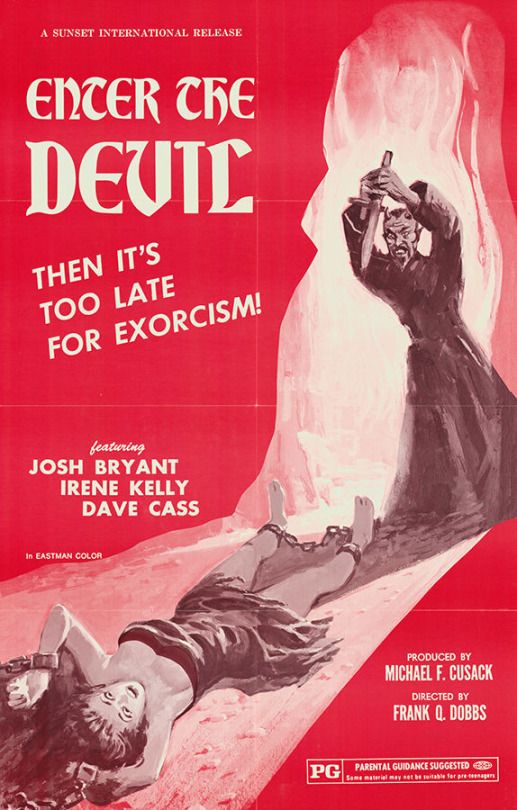
Enter the Devil (1972)

This regional oddity was written and directed by Houston native Frank Q. Dobbs. It has nothing to do with the other film that uses this title, which is better known as The Eerie Midnight Horror Show. Instead, it’s all about a woman who is doing a reference book on cults of the world, which leads her to the dust bowl of the American Southwest, a place where extremist Christians sacrifice human beings.

https://www.dailymotion.com/video/x54w6nj

Of course, it takes 40 minutes of languid screentime before the heroine shows up in Terlingua, Texas. But until then, there’s plenty of beer drinking, innuendo and red robed cultists, who are known as The Penitentes, a centuries-old fraternal — and fanatical — brotherhood.

The pace seems so slow that when things actually start happening, it’s really shocking. Nothing happens in this film at an expected pace and nothing is cliche. It’s all unexpected.

This was lost for a long time before Something Weird released one of the most scratched up prints ever.  Luckily, Massacre Video has cleaned this all up and released a proper version that you can get from Diabolik DVD.

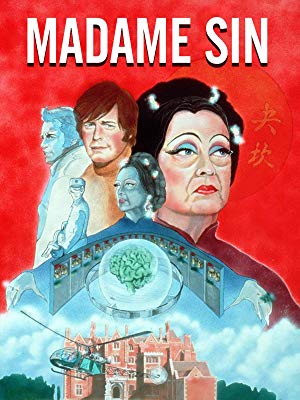
LOST TV WEEK: Madame Sin (1972)

Originally broadcast on January 15, 1972, this film emerged at the tail end of the superspy craze to present a truly insane idea for a weekly series that was never to be: Bette Davis as a villainous vixen who commands an army beneath the Scottish highlands to do her bidding. Imagine if Dr. Evil were the lead in his own show and you have a vague idea of how completely bonkers this movie is.

Arming her men with sonic weaponry and possessing the ability to implant memories that make people do whatever she wants, what the titular vaguely Asian spiderlady wants is to get her very own nuclear submarine.

Helping and hindering her in this plan is Anthony Lawrence (Robert Wagner), whose father was a past lover/adversary of Madame Sin. She’s helped by Malcolm De Vere (Denholm Elliot) and a huge army of sycophants, including numerous women who dress like nuns.

If it seems like I am describing a dream I had that is my best film idea ever, this is close. Imagine if Bette Davis were a villainess on The Avengers, but one that — spoiler warning — wipes out every single person who faces her and even dares to imagine kicking the British Royal Family out of Buckingham Palace.

While intended to be an ABC in the U.S. and ITC in the U.K. co-production, this film sadly wasn’t picked up. It’d be hard to see this level of quality continued week in, week out, such as shooting everything at Pinewood Studios.

Madame Sin was directed by David Greene, who was also behind the film version of Godspell and big TV event movies like Roots and Rich Man, Poor Man. One of its writers, Barry Shear, was the director of Wild in the Streets.

Ah the 1970’s, when spy movies like this would just show up as Movies of the Week and then disappear into the ether, only to remain in our subconsciousness or perhaps a replay on the CBS Late Movie.

You can get this from Shout! Factory.


CHILLING CLASSICS MONTH: Track of the Moon Beast (1972)

This entry was written by Bill Van Ryn, who is the creative force behind the website Groovy Doom and the zine Drive-In Asylum. Somehow, he’s tackled nearly every yeti related film on this box set. Thanks, Bill!

Filmed in 1972, Track of the Moon Beast never received any significant theatrical distribution. It sat shelved for years after completion, and IMDB claims it premiered June 1, 1976, but I’ll be damned if I can find an ad for any theatrical engagements in any newspaper archive.  The first appearances I can document are when it came to TV in 1978, and after that it was a frequent item on local stations desperate to fill their late night slots. Even though the film takes place in the early 1970s (a fact that the fashion and decor will never let you forget), the plot for this is straight out of classic 1950s science fiction.

A young man named Paul (Chase Cordell) is struck by a tiny shard from a falling meteorite from the moon. The shard has embedded itself in his head, and for some reason this causes him to transform into a rampaging lizard monster whenever the moon rises.  He happens to be friends with a local professor who connects this bizarre turn of events with an ancient Native American legend, although nobody can stop Paul’s deadly transformations.

Track of the Moon Beast boasts an interesting creature design by Rick Baker and Joe Blasco, about on the level with Baker’s monster suit work for 1971’s Octaman. It’s a throwback ‘man in a suit’ monster movie, and the majority of the film is just total camp. Even its most ridiculous moments are played with a serious tone, and the experience of watching the limited actors devour the absurd script makes it an easy target for riff trackers, both professional and amateur.

There is one scene in the film that I found extremely effective: after Paul transforms for the first time, we see an older man and his wife who are in the middle of a fight. The wife is angry and has locked the drunken man outside, threatening to go to bed and leave him out there all night. They are ridiculous caricatures, and we know he’s going to be attacked by the Moon Beast, but the film presents it in an unexpected way, focusing on the wife’s stunned look of horror as she hears the sounds of it attacking and killing her husband just outside their front door.  The camera pans from her frozen face to a large pool of blood that has started to seep under the door, and for a few moments the film actually seems capable of something.

Although it never lives up to that moment again, Track of the Moon Beast probably would have ended up with a better reputation if it had just been a little more lighthearted. The nihilistic aspects of the story are a real bummer, made even worse by the fact that there is actually some real chemistry between Chase Cordell and Leigh Drake, who plays Paul’s girlfriend Kathy.  It’s almost by accident, but they do seem very natural together, and Kathy of course is about to find out the cruel truth that every girl who ever dated a werewolf could have told her: there’s no future when you fall in love with a man who transforms under the moon. There’s a scene where Paul and Kathy overhear a doctor in an adjacent room casually discussing the fact that Paul’s condition is hopeless and he is doomed to die. Although the film veers off into a ludicrous climax at this point, it’s hard to shake the fact that a man is given a medical death sentence on screen and runs off into the desert with intentions of suicide. The fact that he turns into a man-lizard and disappears in a supposed shower of cosmic rays might make you smile, but you’ll either be asleep or seriously bummed out when it’s all over. I couldn’t blame you either way.

Don’t have the Chilling Classics box set? You can watch this for free with an Amazon Prime subscription.

CHILLING CLASSICS MONTH: Silent Night, Bloody Night (1972)

Hey guys! Paul Andolina is in charge for this review. I met Paul at a wrestling show and we discovered a mutual love of film. Check out his writing at Wrestling with Film.

I love holiday themed horror movies. I probably spend too much time scouring the internet and books to look for more films with a holiday bent to add to my watchlist. Just this October I participated in a friendly movie watching competition. Its theme was holiday-centric horror. When I picked up Chilling Classics I had completely glanced over the fact it contained the film Silent Night, Bloody Night. I already owned it separately on DVD. I finally got around to watching it for this review and I was not expecting what I got. In the end, I was pleasantly surprised.

Silent Night, Bloody Night is a horror thriller released in 1972. It was directed and partly written by Theodore Gershuny. You may be familiar with his work unknowingly as he worked on both anthology television series, Tales from the Darkside and Monsters as both director and writer. Silent, Night Deadly Night is about the Butler house, a one-time asylum with an interesting past. Wilfred Butler the man who restored the house to its current state dies when he set himself on fire on Christmas of 1950. His only surviving relative, his grandson, Jeffrey Butler, is selling the house. He’s in town to settle affairs but his lawyer and other people go missing. What is it about this house? Why does Jeffrey want to sell it and why do the townsfolk seem so eager to acquire it all costs?

The film stars James Patterson, a Derry, Pennsylvania native, as Jeffrey Butler. He died during post-production of the film and his lines were apparently dubbed by someone else. It also stars the director’s then-wife Mary Woronov as Diane Adams, the mayor’s daughter. It largely centers around these two characters. Someone is calling the townsfolk and in whispered tones is asking them to come to the Butler house. The calls sort of reminded me of those placed by Billy in 1974’s Black Christmas. However, the caller is able to convey a creepiness without the crassness of the calls in Black Christmas. There is something deeply unsettling about the hush toned calls from the mystery caller, who says she is Marianne. The movie is deliberately paced and has substantial payoffs both in terms of plot and the kills depicted. Even though there are only two or three kills depicted outright, there is one that will catch you off guard and change the tone of the film drastically. 

The movie takes place around Christmas but it isn’t played up much, apart from some Christmas tunes on the radio, some decorations, and sparse snow. It still has the dreariness one would want in a holiday horror flick and would go well with some spiked eggnog or whiskey laden hot chocolate on a snowy day. There is a particularly interesting use of the church hymn In the Garden as well. It is a recurring theme throughout the movie’s soundtrack and adds an extra dose of oddness to the proceedings. If you enjoy low budget films or holiday centered horror or just enjoy proto-slasher films you’ll find much to enjoy in Silent Night, Bloody Night. I should also point out that not only is this Cannon’s first released film it is also co-produced by Lloyd Kaufman of Troma. I hope you consider watching this film during the upcoming holiday season but must warn that most cuts of the film released on DVD are not the best looking prints.

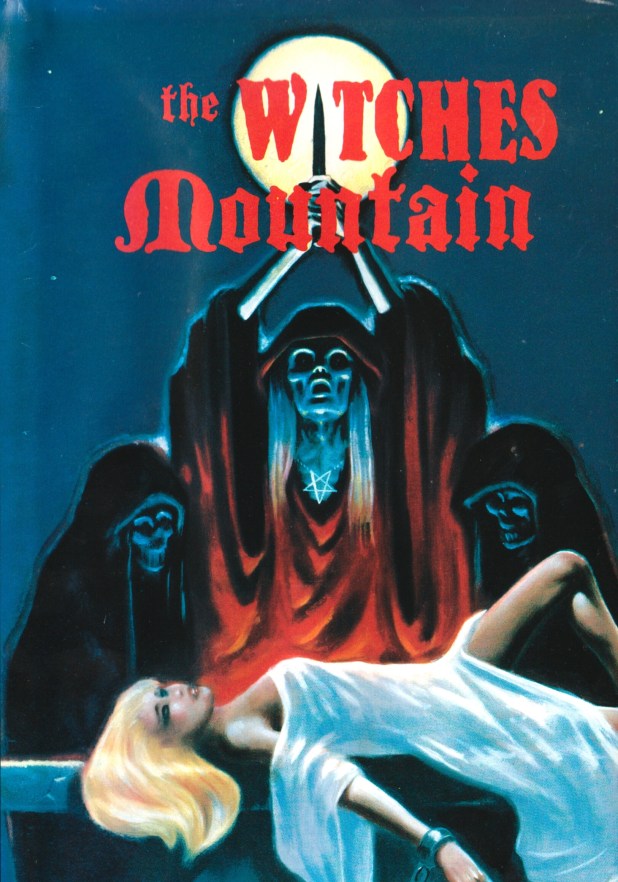
CHILLING CLASSICS MONTH: The Witches Mountain (1972)

Known in Spain as El Monte de las Brujas, this 1972 effort comes to us from director Raúl Artigot, who was the cinematographer on The Ghost Galleon (released in the U.S. as Horror of the Zombies) and The Erotic Rites of Frankenstein.

The opening of this movie is Cathy’s Curse level insanity: Carla walks around her house and finds a knife stuck in a wig, a voodoo doll and finally, a bloody cat in her bed. That’s when a little girl appears and tells her that she took care of the stupid cat before running away to look for another animal. Carla follows her to the garage, throws gasoline all over the place and sets everything — including the little girl — on fire.

That’s just the start of this movie. The next scene has nothing to do with any of that, as photojournalist Mario (Cihangir Gaffari, Jess Franco’s The Demons) breaks up with Carla and decides to not go on vacation with her, instead calling his office and begging for an assignment. Soon, he’s on his way to the Pyrenees Mountains in northern Spain. Soon, he meets freelance writer Delia (Patty Shepard, who not only appeared in numerous Paul Naschy movies like La Noche de Walpurgis (The Werewolf vs. The Vampire Woman) and Los Monstruos del Terror (Assignment: Terror) as well as Hannah, Queen of the Vampires and Slugs), who joins him on his trip.

They decide to stop at an ancient hotel that’s staffed by a man who sounds like every bad Igor impression. And then they learn of a mountain that’s haunted by a coven of witches, so they decide to go check it out.

Keep in mind that the beginning of this movie has nothing to do with things until the end, that Mario is a horrible hero and that you will hear chanting ala The Exorcist and The Omen for the entire running time of this movie. Do you want a shock ending, too? Of course, we can get that for you!

Avco Embassy included this movie as part of their Nightmare Theater package that was syndicated for television in 1975. The others are Marta, Death Smiles on a Murderer, A Bell from HellManiac MansionNight of the SorcerersFury of the Wolfman, Hatchet for the HoneymooonHorror Rises from the TombDear Dead DelilahDoomwatchMummy’s Revenge and The Witch.

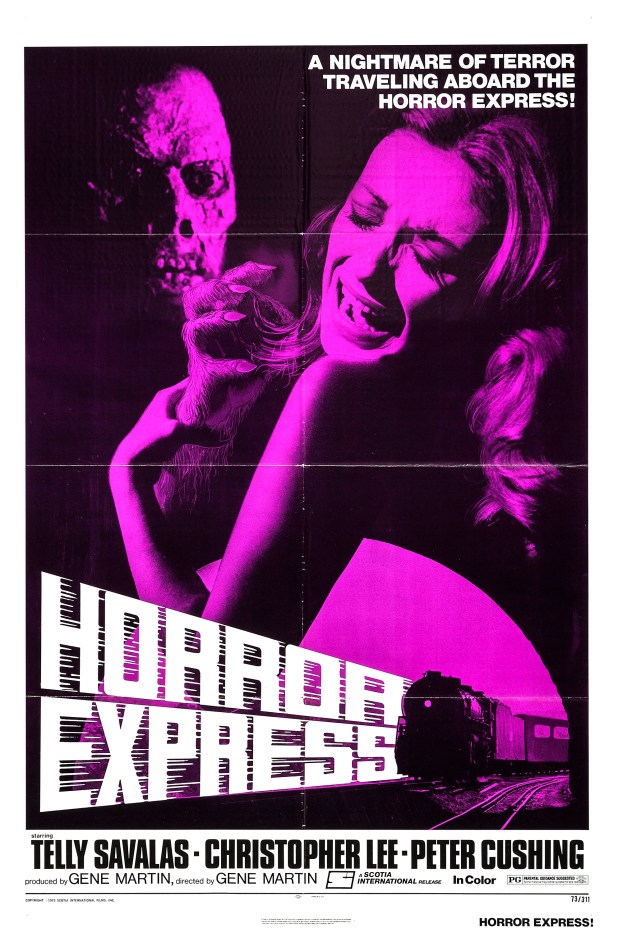
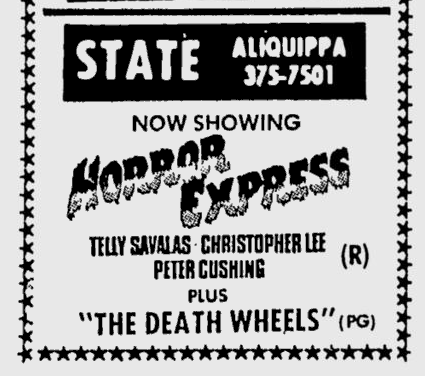
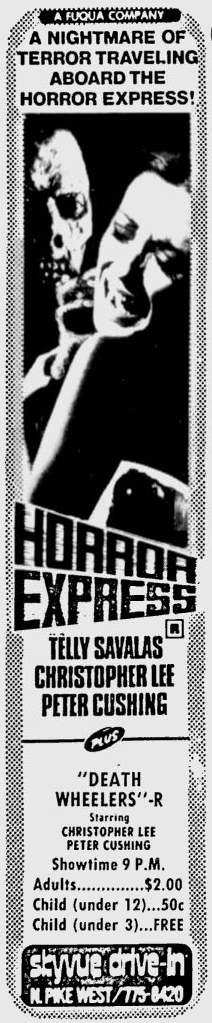
CHILLING CLASSICS MONTH: Horror Express (1972)

This entry was written by Bill Van Ryn, who creates both Groovy Doom and Drive-In Asylum. You should order every issue, because Bill puts together a zine that makes you fall in love with movies more and more with every page.

There was something great about growing up in the 70s as a monster kid. With VHS still a distant promise waiting over the horizon, TV was the only way you could access movies once they passed through your local theaters–and if you were a kid, seeing them theatrically usually meant pleading your case with an adult who was totally disinterested. TV was the last stand. Fortunately, local stations desperate for programming often filled their lineup with syndicated packages of older films. Horror movies often turned up as time-fillers on local TV, usually in late night slots meant for insomniacs and people who worked graveyard shift.  What this meant for us monster kids was, we scoured the TV Guide looking for movies noted “THRILLER”, and then you had to make a decision about whether or not it was worth staying up until 3am to watch.

1972’s Horror Express was one of those flicks that I *never* missed, no matter what. Not only does it star Christopher Lee and Peter Cushing, Telly Savalas shows up about halfway through the film as a Russian cossack (!), and it’s got a series of simple but gruesome attack scenes that were some of the goriest things I’d seen up until that point. The story is set in the early 1900s, and Lee plays an anthropologist who discovers a hairy ape-like fossil in the Himalayas. Believing it to be the missing link, he crates it and hurriedly books passage on the Trans-Siberian Express in order to return to England with it as quickly as possible. Cushing is a colleague of his who is also on board, and immediately senses that Lee is up to something noteworthy. Unbeknownst to anyone, the creature is actually the last vessel of an extraterrestrial intelligence that has the ability to lock eyes with its victims and drain their brains of all information contained therein. It gets out of the crate and starts absorbing people. Its victims die gruesomely in the process, bleeding profusely from the eyes, which turn white like a boiled fish. This alien presence can also transfer itself to another host in this way, allowing it to jump from body to body if necessary.

Horror Express is a British/Spanish coproduction directed by Eugenio Martin, who had just made the movie Pancho Villa starring Telly Savalas. Martin used the same train set from that previous film, and each different “car” of the train was actually the same set redressed for each new part of the train. That meant that the entire film had to be shot out of order, with every scene taking place in the corresponding car being completed before the set was taken down and redressed. The movie was shot silent, with the entire soundtrack dubbed in later, although Lee, Cushing, and Savalas all did their own dubbing, so their familiar voices are all present.

Most importantly, the story is engaging and clever, with the mystery of the creature being slowly unraveled by the protagonists using clues left behind. One of the more outlandish moments has Cushing obtaining the eyeball of the now dead fossil and extracting fluid from it — fluid that somehow contains actual images that the host observed, now visible under a microscope! This is how they determine that it was from outer space and had been on Earth since prehistoric times. Hey, it’s as good an explanation as anything, right?

Although not a Hammer production, this movie definitely feels like one, especially since we have Lee and Cushing together in the same film. It was perfect for late night television, and it was hard for me to forget those bleeding white eyeballs after I saw this movie. You’ve probably already noticed the similarities to the story Who Goes There? by John W. Campbell, the basis for “The Thing”, and I always loved the way this movie sets up the hairy fossil as if it’s the villain. Eventually you realize that whatever the fossil was, it was just a shell, another victim of the real monster. Although we’re talking about the Chilling Classics public domain version of Horror Express, there exists a fabulous blu ray transfer from Severin Films, definitely worthy of your hard earned dollars.


CHILLING CLASSICS MONTH: Maniac Mansion (1972)

I love Mill Creek multipacks. Sure, the quality is abysmal at times. Often, you get the same films on multiple sets. And you get bad dubs. But let’s face it — often you can find these sets used for $5 or less and you get up to 50 amazing films. That inspired me to spend the month of November gathering some of my favorite writers and fans of the site to tackle the Chilling Classics box set.

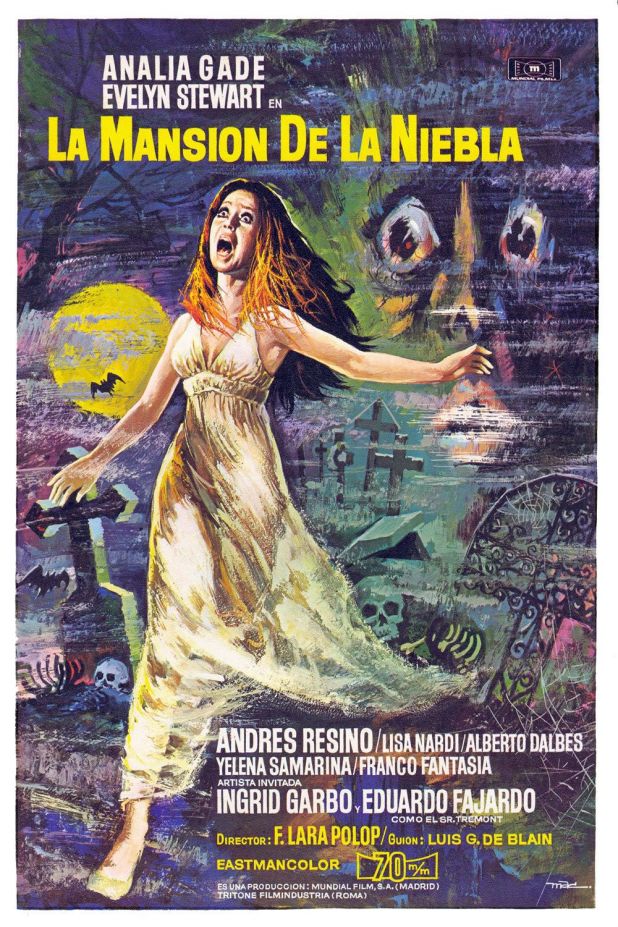
Originally released as La Mansion de la Niebla (The Mansion in the Fog) and also known as Murder Mansion, this Spanish/Italian film fuses old school haunted house horror with the then new school form of the giallo.

The plot concerns a variety of people drawn to a house in the fog, so the original title was pretty much correct. There are plenty of European stars to enjoy, like Ida Galli, who also uses the name Evelyn Stewart and appeared in Fulci’s The Psychic as well as The Sweet Body of Deborah. And hey, there’s Analía Gadé from The Fox with the Velvet Tail. Hello, George Rigaud, from All the Colors of the Dark and The Case of the Bloody Iris! They’re all here in a movie that seems to make little or no sense and then gets even more bonkers as time goes on.

This was one of the 13 titles included in Avco Embassy’s Nightmare Theater package syndicated in 1975 (the others were MartaDeath Smiles on a MurdererNight of the SorcerersFury of the Wolfman, Hatchet for the HoneymoonHorror Rises from the TombDear Dead Delilah, DoomwatchBell from HellWitches MountainMummy’s Revenge and The Witch). How did these movies play on regular TV?

There’s a history of vampires in the house, the previous owner was a witch and hey — this is starting to feel like an adult version of Scooby Doo with better-looking ladies. That’s not a bad thing. But if you’ve never watched a badly dubbed giallo-esque film before, don’t expect any of this to make a lick of sense.

Don’t want to buy the whole box set? This is playing for free on Amazon Prime.

Frankenstein ’80 (1972)

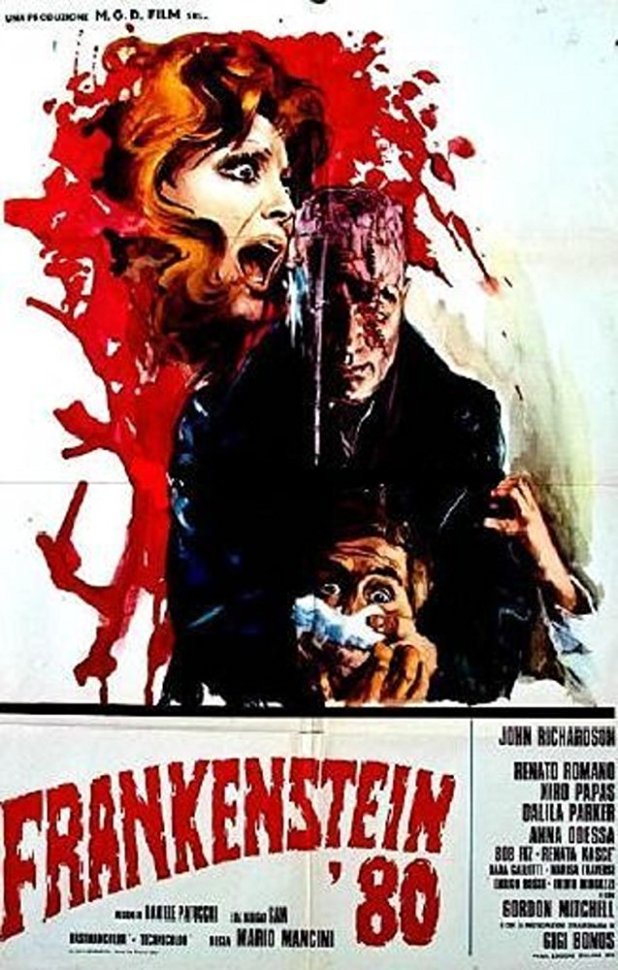
Dr. Otto Frankenstein works in his lab all day and to the normal daytime world, he seems like an ordinary doctor. But at night, he works on perfecting his own form of life, Mosiac, putting together this inhuman human from several dead bodies. Then, once completed, Mosiac repays him by killing him and we still have an hour left.

Directed by Mario Mancini (who was the cinematographer for Frankenstein’s Castle of Freaks and The Girl in Room 2A), this is a film featuring real surgical footage, nonsensical dialogue and a total lack of plot. Suffice to say I loved it.

Mosiac spends the rest of the movie replacing his constantly failing organs, which means that he must murder and murder and murder some more. Have you ever wondered, “What if someone used a giant leg bone to kill someone?” this would be the movie that answers your inquest.

Also, in whatever nameless city in some unknown country that this is supposed to be set in, possibly Germany, the women in the night have no issues with a gigantic monster in a leather Nazi-esque outfit picking them up with merely a few grunts. No money discussion — he kills them way before they tell him how much a half and half costs.

This movie was inspired by Italian horror, sex and gore comics, like Oltretomba. If you’re offended by the blood and guts and books of this film, consider this a stern warning: avoid these comics at all costs. They take it even further. And then further. And then some.

There’s a new blu ray of this that’s been released — the film is in public domain — that finally fixes the rough prints that are out there right now. It’s nearly impossible to find, but that doesn’t mean I’m going to stop looking. For all the foibles of this film, it has a certain something.

As a bonus, here’s some artwork that I did of the film.