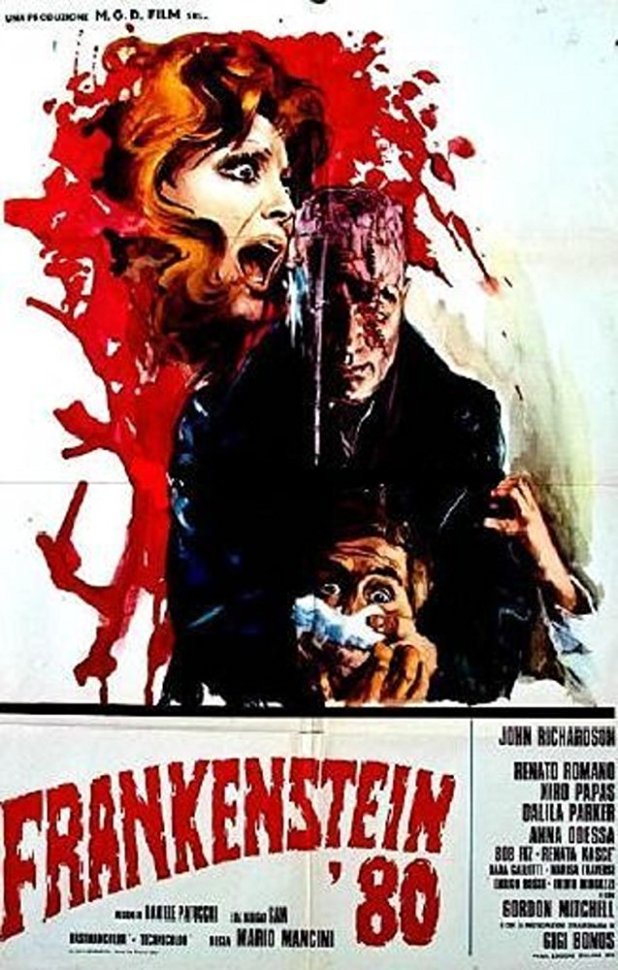
Frankenstein ’80 (1972)

Dr. Otto Frankenstein works in his lab all day and to the normal daytime world, he seems like an ordinary doctor. But at night, he works on perfecting his own form of life, Mosiac, putting together this inhuman human from several dead bodies. Then, once completed, Mosiac repays him by killing him and we still have an hour left.

Directed by Mario Mancini (who was the cinematographer for Frankenstein’s Castle of Freaks and The Girl in Room 2A), this is a film featuring real surgical footage, nonsensical dialogue and a total lack of plot. Suffice to say I loved it.

Mosiac spends the rest of the movie replacing his constantly failing organs, which means that he must murder and murder and murder some more. Have you ever wondered, “What if someone used a giant leg bone to kill someone?” this would be the movie that answers your inquest.

Also, in whatever nameless city in some unknown country that this is supposed to be set in, possibly Germany, the women in the night have no issues with a gigantic monster in a leather Nazi-esque outfit picking them up with merely a few grunts. No money discussion — he kills them way before they tell him how much a half and half costs.

This movie was inspired by Italian horror, sex and gore comics, like Oltretomba. If you’re offended by the blood and guts and books of this film, consider this a stern warning: avoid these comics at all costs. They take it even further. And then further. And then some.

There’s a new blu ray of this that’s been released — the film is in public domain — that finally fixes the rough prints that are out there right now. It’s nearly impossible to find, but that doesn’t mean I’m going to stop looking. For all the foibles of this film, it has a certain something.

As a bonus, here’s some artwork that I did of the film.

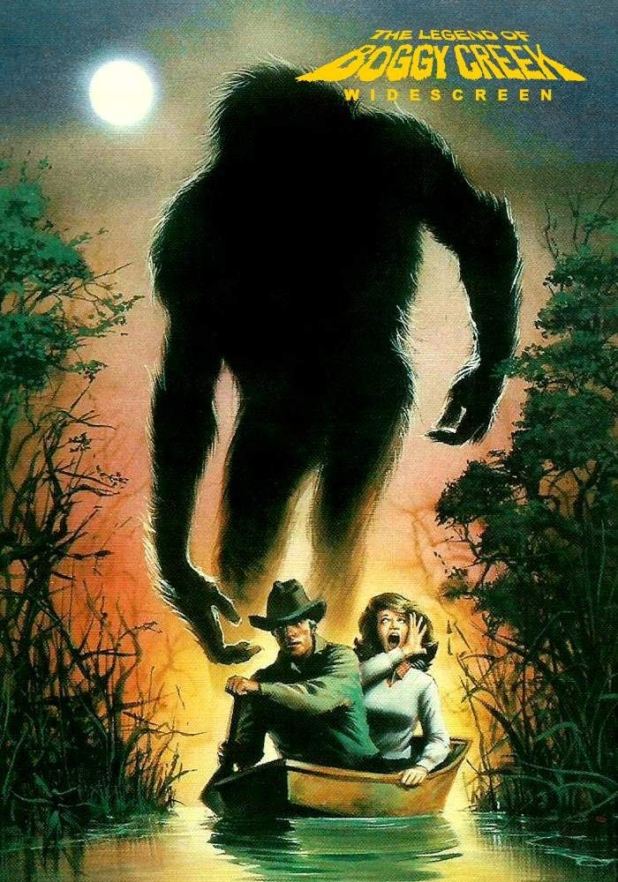
BIGFOOT WEEK: The Legend of Boggy Creek (1972)

The Legend of Boggy Creek is my favorite kind of movie. It’s at once a narrative story and a documentary so that there will be times that you have no idea whether you’re learning the unvarnished truth or being spun a tale. It’s kind of like that movie in Orson Welles’ F for Fake where he tells you that his promise to be truthful ended several minutes ago, except that it lasts for an entire movie and there are no promises whatsoever.

This journey to discover the Fouke Monster tells its story with staged interviews with Arkansas locals while also presenting reenactments of their tales. It comes straight from the fevered imagination of Charles B. Pierce. Once an advertising salesman from Texarkana, he borrowed over $100,000 from local trucking company Ledwell & Son Enterprises, used a movie camera he built himself and relied on an all-local cast that he discovered one by one at a gas station to create this opus.

While Pierce didn’t believe in the local legends himself, he was impressed by the “authenticity and down-to-earth qualities” that the locals brought to their tall tales. He turned to another ad man, Earl eE. Smith, to work their stories into a narrative and shot the film in Fouke, Texarkana and Shreveport.

Unable to find a theater willing to show his film, Pierce bought his own and cleaned it up himself called the Perot Theatre. Within three weeks, lines stretched around the block and Pierce was up $55,000 before selling international and TV rights to AIP.

The Fouke Monster is a skunk ape, a Sasquatch creature that the residents of Fouke have seen since the 1940’s. It has reddish-brown fur, a horrifying smell and three toes.

Locals regale us with stories, such as the time the Fouke monster carried off two 200 pound pigs. Or the time it scared a kitten to death. Or the time when hunters had the beast cornered, but their dogs refused to follow it any closer.

Finally, actual newspaper stories are cited in regards to the beast attacking a family and injuring one of them. The creature was never captured and is said to still stalk the swamps of southern Arkansas to this day. This is a real auteur work, with Pierce not only directing and producing but also interviewing the locals and singing the theme song.

This is my favorite era of cryptozoology when regional legends of the past contended with Cold War mania to create creatures that broke from their dimensions — like some pop culture Ancient Ones — to invade our popular consciousness. If only Pierce had grown up near Point Pleasant, WV, he would have made this movie about mothman!

Pierce would continue to make films about and for his unique Texarcana audiences, such as Bootleggers, the Western films Winterhawk and Winds of Autumn, and 1976’s transcendent The Town That Dreaded Sundown. He’d go on to be an in-demand set decorator, the writer of the Dirty Harry film Sudden Impact (he may have originated the line “Go ahead. Make my day.”) and directed other films like The Evictors and the nowhere near as good sequel to this film.

You can watch this on Shudder with and without Joe Bob Briggs commentary.

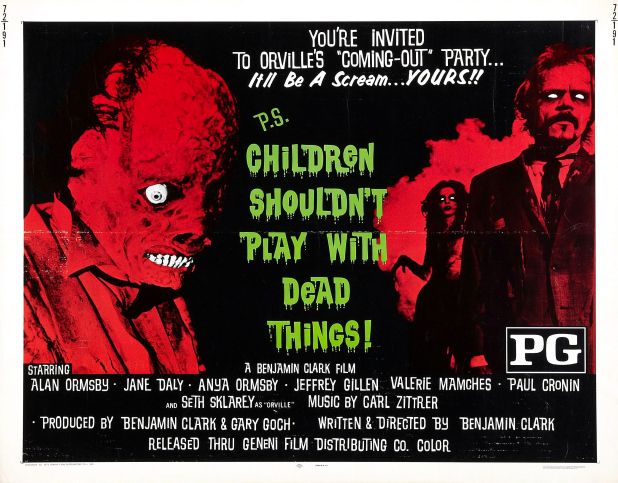
Children Shouldn’t Play with Dead Things (1972)

The same Bob Clark that did Porky’s did A Christmas Story and also made Black Christmas and Deathdream. He even produced the film Moonrunners, which inspired TV’s The Dukes of Hazzard. He also made Turk 182! (if you had HBO back in the day, you saw it), Rhinestone and the Baby Geniuses series. Yep. Bob Clark pretty much did it all. And here’s one more completely great thing he created.

Alan (Alan Ormsby, who would go on to write DeathdreamDerangedMy Bodyguard and direct Popcorn) leads a group of actors who have all gone to an island together for a night of shenanigans. Sure, the island is a cemetery for criminals. And of course, he’s going to do a seance to raise the dead. And while the whole thing is a joke, Alan is genuinely upset that the dead aren’t walking the swamp.

They do find a corpse — Orville — and Alan uses it to continually harass his actors. And the ritual really did work, as the dead begin killing everyone off one by one.

The shift from comedy to drama to horror in this film is startling. The cast is amateur, but the terror feels real. The dread and doom at the end, as the zombies board a boat as the lights of Miami are in the background and atonal music plays are as perfect as film can be.

Clark shot this movie at the same time as Deathdream, using some of the same cast. A surprising moment in the film is that while there are two gay men — and they stereotypically lisp — they play an integral role in the film. That’s pretty woke for 1972.

Stick with the slowness at the start of this film. It will pay off by the end. I give you my promise. You can check this out on Amazon Prime.

Eye in the Labyrinth (1972)

The middle of the night is dangerous business. You can awaken from a dream where your psychiatrist boyfriend is murdered only to find that he has disappeared. Then your life will seem like a waking nightmare, but only if you’re Julie, the heroine of Eye of the Labyrinth.

Known for her appearance in a two-part episode of The Saint that was turned into the theatrical release Vendetta for the Saint, Marquis de Sade: Justine and The Shoes of the Fisherman, Rosemary Dexter plays Julie, whose search for Luca (Horst Frank, who also appeared with her in Marquis de Sade: Justine) takes her to a small seaside town. From the moment she knows he’s been missing, people have been harassing her as to his whereabouts. Everything simply feels off.

When she gets there, she meets Frank (Adolfo Celi, Danger: DiabolikThunderball), who tells her that her boyfriend had been in town. Then there’s Gerda (Alida Valli, Miss Tanner from Suspiria), whose house is full of artists with some level of ill repute, including a young Sybil Danning as Toni.

However, Julia keeps meeting people over and over who refuse to believe that they know her, which lends the film even more of a dreamlike quality. Is there a crime syndicate involved in every moment of her life? Is she in constant danger? Or has she simply gone insane? I’m not going to answer this all for you. You should drink it all in yourself.

This is a rare film financed by the city of Monaco (along with some German investments and stars). Mario Caiano (Nightmare Castle) was the director and he keeps things both mysterious and driving. There’s also a great soundtrack by Roberto Nicolosi, who scored Black Sabbath and Black Sunday. It’s a loungy, jazzy affair that adds verve to the proceedings.

Code Red released this film on blu-ray, the first time it was released in the U.S. It’s worth tracking down, as it fits in well with plenty of the great giallo released in 1972 (The Case of the Bloody IrisDon’t Torture a Duckling, All the Colors of the DarkThe Red Queen Kills Seven Times), which was a banner year for black gloved killers and psychosexual drama.

BIKER WEEK: The Pink Angels (1972)

I have no idea who this movie is for. I would imagine that gay folks would either find it camp or be offended by its horrible stereotypes. Then, I think that bikers would also be upset by the fact that it sends up their culture and points out the homoeroticism at its core. And then, I think that anyone looking for a comedy will be put off by the ending. Even worse, anyone who loves good filmmaking will wonder why they’ve suffered through the endless takes and torturous plot.

But fuck, that’s a great trailer. It has everything good about this movie, including some quotable lines. That’s what a great grindhouse or drive-in trailer is all about: action, baby!

Director Larry G. Brown only created two other films: An Eye from an Eye, a 1973 movie where a children’s television show host stalks and murders abusive parents, and 1986’s Silent but Deadly, which has a poster of a dog farting.

Producer Gary Razdat even posted this on IMDB about the film: “In the genre of cinema verite, I thought that the film was a pure attempt to make a movie and see if it could get distributed…I know that for sure as I am the one that produced the movie. It started out with the best of intentions and the money came and went…the best part was that we actually got it distributed and on the film circuit…The characters were picked from the USC school of film as were a couple of the women, one of which was an actual ‘hooker’ that just wanted to be in the film. It was a real effort to complete the film since the director was insane and had forgotten to film an ending – which we had to re-shoot after everything was wrapped…quite a story, eh?”

Hey — is that Michael Pataki and Dan Haggarty as bikers? Yep. Sure is. They’re straight bikers who the Pink Angels ply with prostitutes. Yet when they wake up, they’ve been made up with hair accessories and makeup by our heroes. Oh, you guys. This scene probably only exists so we can get some female nudity and moviegoers could feel a bit more manly after seeing so much man lust. It’s also when one of the better scenes happens, as the future Grizzly Adams jumps on the black prostitute, who proclaims, “Black is not only beautiful, it’s good.”

There’s also a general who is trying to capture the Pink Angels for some reason. And he gets them in the end, as the film jump cuts to an ending with our heroes, the folks we laughed, love and fought with for over 80 minutes or so lynched in the front yard. I guess after Easy Rider every biker movie had to end on a downer note. That said, this is a real downer.

My advice? Just watch the trailer. You’ll be better off.

Unholy Rollers (1972)

There was a time that roller derby was one of the most popular sports on UHF TV, vying with pro wrestling for ratings and attendance. And much like its cousins in the squared circle, it had predetermined finishes and storylines. Don’t blame me for breaking kayfabe — Unholy Rollers does this right off the bat, explaining how everything has to go according to the game plan and how fights and falls really work!

Karen (Claudia Jennings, Truck Stop Women‘Gator Bait) wants a better life than working in a canning factory, but has no idea how to do so until she discovers the glamourous and oh so dangerous world of roller derby (there was a rival film that followed a similar storyline, Kansas City Bomber starring Racquel Welch).

Unlike any other rags to riches story you’ve ever watched, Karen might be the hero, but she’s a horrible person. She uses and abuses everyone in her way. And the fact that she becomes a star by going against the script goes to her head, leading to her never listening to anyone.

Along the way, Karen battles her team’s star, Mickey Martinez (Betty Anne Rees, Sugar Hill), a tough, muscular lesbian who comes on to her. This leads to the entire team stripping Karen in a bar and her having an affair with the team captain, Nick. That affair starts with her riding on his motorcycle, shooting his gun at LA landmarks and then kicking his ass on the track and then getting ass on said track.

And the ending! Karen knows she’s on the way out, so she flips out on everyone. Her opponents, her team, the audience, cars in the parking lot and even raises her fist to the police as the credits roll.

This is a grimy, tough little movie with plenty of fun to be had. Roberta Collins (Death Race 2000Eaten Alive) is in it and so is Joe E. Tata (Nat from the Beverly Hills, 90210 Peach Pit). It’s directed by Vernon Zimmerman, who also wrote Teen Witch and directed Fade to Black. And its editor? Martin Scorsese!

If you’re looking to see it for yourself, Shout Factory has put it out on one of their multiple movie releases. Roller derby has come a long way — with leagues and teams across the country playing actual athletic contests. But if you’re ready to see the exploitation version of where it came from…Unholy Rollers has you covered.

Haunts of the Very Rich (1972)

1972. TV movies. Celebrities. The occult. Oh man, when I add up all the elements of the stew that makes up Haunts of the Very Rich and the broth tastes succulent!

Director by Paul Wendkos, who also was behind the supernaturally tinged The Brotherhood of the Bell, Good Against Evil and The Mephisto Waltz, not to mention the 1985 remake of The Bad Seed, the legendary 1975 TV movie The Legend of Lizzie Borden and the Gidget film series (whew!), this is a tasty slab of cathode ray goodness.

Predating Lost by 32 years, the film begins on an airplane where we learn that our cast of characters has all been lured to the Portals of Eden tropical resort for many different reasons. When they arrive, their host Seacrist (Moses Gunn, Detective Turner in Amityville II: The Possession) helps them enjoy paradise. A snake might show up, of course, but no one should be all that worried.

However, a storm breaks out that night and the staff goes away, the food goes bad and the mood goes sour. David and Ellen (Llyod Bridges and Cloris Leachman) think everyone is already dead and in hell. Al (Ed Asner) refuses to believe in anything. Annette (Anne Francis) goes from manic state to manic state before trying to kill herself. Lyle and Laurie (Tony Bill and Donna Mills) just stay in the background. And the priest (Robert Reed)? He abandons everyone for a peyote ceremony with a tribe of natives that bury birth defected children alive.

Originally airing on September 20, 1972, this film is very much of its time. It was shot on the grounds of the Vizcaya Museum and Gardens, which was the winter home of International Harvester vice president James Deering. You can also see this house in the films Ace Ventura: Pet Detective, Airport ’77 and Iron Man 3.

If you enjoyed Fantasy Island but always wondered, “What if this show fucked with people instead of rewarded them?” then this is the movie for you. The double rug pull at the end surprised even me. And the acting is great. You know how you always heard how trapped Robert Reed felt on The Brady Bunch and how he yearned to be a real actor? Watch his final speech in this film and you’ll realize that he was probably right.

This has never been released on DVD, but aired a lot in the 1970’s and was released on VHS. That said, YouTube — and the TV TERRORLAND channel — are your friend. Check it out and let me know what you think.

The Victim (1972)

If you ever wonder why I love my wife so much, I watched this movie, and she walked into the room, sat on the couch and excitedly remarked, “That’s Eileen Heckart!” Yes, Becca loves The Bad Seed, a classic psychological thriller where Heckart’s performance as the mother of a sociopathic child is unforgettable. And she isn’t shy about it.

Director Herschel Daugherty’s directorial efforts run the gamut of TV classics, from Star Trek to Alfred Hitchcock PresentsThriller and The Six Million Dollar Man. He was even the dialogue director for Mildred Pierce!

Kate Wainwright (Elizabeth Montogomery, who you may know from Bewitched, but around here we celebrate her for her role in The Legend of Lizzie Borden) is coming to visit her sister, but unbeknownst to her, her sister is already dead. She has to deal with the increasingly crazy attention of her sister’s maid, Mrs. Hawkes (Heckart), power outages, and an increasingly frightening storm. We soon learn that her sister already fired the maid and plans to divorce her husband, Ben.

While the film opens with the murder of the sister, the identity of the killer remains a mystery. As we witness Kate’s growing fear, Montgomery’s performance is nothing short of superb, keeping us on the edge of our seats.

The McKnight Malmar story this was based on was first filmed for a 1962 episode of Boris Karloff’s Thriller, ‘The Storm,’ also directed by Herschel Daugherty. The Victim was rewritten by Merwin Gerard and doesn’t stick as close to the original story, but it retains the core elements of the original, including the intense psychological suspense and the theme of a woman in peril.

The ending of this movie is bound to stir up some strong emotions. It might leave you feeling frustrated, or you might find it enjoyable, as it maintains a consistent level of suspense and creepiness throughout.

Death Walks at Midnight (1972)

Nieves Navarro is a true queen of giallo, appearing in All the Colors of the Dark, Forbidden Photos of a Lady Above Suspicion, So Sweet, So Dead and Death Walks on High Heels. Here, she makes her second film with her husband, Luciano Ercoli.

In this one, she plays a fashion model named Valentina who agrees to help her journalist beau study LSD. But while she’s dosed and in the middle of a photo shoot, she watches a man brutally murder a woman with a spiked gauntlet. He thinks she’s just hallucinating and publishes her account, but she believes it’s real. And when the killer starts stalking her, she really starts to worry.

The entire opening of the film is one big acid freakout and everything that follows is the bad trip, the comedown and reality brutally intruding into drugged out bliss. This is a film packed with brutal violence and plenty of gore, but it makes sense. The movie demands it.

The end, when everything is wrapped up by the killer (killers?) is pretty great, as the many red herrings are discussed and the entire plot is finally explained to us. If everything before felt like a nightmare, this is bracingly cold water directly to the face.

Even better, Navarro portrays a heroine who doesn’t faint at the first sign of danger. She deals with the ineffectual police and indifference of her boyfriend with aplomb.

And yes — this film is packed with bonkers crazy fashion — a metal/glass silver wig and a strange sculpted wall feature prominently — so if that’s why you love giallo, you’ll be quite happy here. Me? I loved every minute.

If you want to watch it, it’s on Shudder.

What Have You Done to Solange? (1972)

London. The 70’s. Professor of Italian Enrico Rosseni (Fabio Testi, The Four of the Apocalypse) is on his boat, making out with Elizabeth (Cristina Galbó, The Living Dead at Manchester MorgueThe House that Screamed) and trying to get her to go further than she has before. Right when it seems like he’s going to finally conquer her, she looks up to see a woman being stabbed on the shore.

After angrily rowing to the shore, Rosseni and Elizabeth find no evidence of a crime. He accuses her of being too religious, like all the girls at the school her uncle sent her to. The next morning, while he dresses and argues with his wife Helga, he hears about a horrid murder on the banks of the Thames river. He drives to where he and Elizabeth were and finds tons of cops. And there are even more at the school where he works!

The victim was one of Elizabeth’s friends, so she wants to tell the police what they know. However, he doesn’t want the affair exposed. However, his pen has been found near the body and he shows up in the crime scene photographs in the newspaper.

More murders. More clues in Elizabeth’s mind. More priests doing evil things. More anger from Helga. More of Rosseni trying to solve the crime. And all he has is one clue: Who is Solange and what was done to her?

The movie takes a turn when Elizabeth is killed inside the apartment that Rosseni has rented for the two of them to continue their affair. And at that point, Helga starts being much nicer to our hero. As their relationship improves, her makeup grows softer, her clothing gets more fashionable and her hair comes down. How strange to find a giallo about a relationship coming back together as the result of murder!

What happened to Solange (Camille KeatonI Spit on Your Grave)? She was given an abortion that all of the murdered girls were there for. In a kitchen, no less. And all of those girls were involved in doing drugs and dating older men.

So what do the cops do? Oh, just set up a sting operation with all of the surviving girls. And of course, Solange just happens to show up, walking through the park. Here’s the second of course — the cops bungle everything and the killer takes Brenda, asking her the story of Solange, as he did every other victim.

This is one well put together film, thanks to Massimo Dallamano, who was the cameraman for Sergio Leone’s A Fistful of Dollars and For a Few Dollars More. Joe D’Amoto was the cinematographer and added plenty to the film. And you can’t deny the power of having an Ennio Morricone score!

This film is an interesting combination of the German krimi film and the Italian giallo and gave way to Dallamono’s Schoolgirls in Peril trilogy, which includes What Have They Done to Your Daughters? and Rings of Fear.

I always love seeing what titles films get released and re-released under. What Have You Done to Solange has so many, including an attempt to sell it as a teen comedy entitled The Rah-Rah Girls! You can learn more at the amazing Temple of Schlock site. And for an awesome police report of the events of the film, head to The Giallo Files.

So who was the killer? No spoilers here. You’re just going to have to watch this on Shudder.