LARRY COHEN WEEK: Bone (1972)

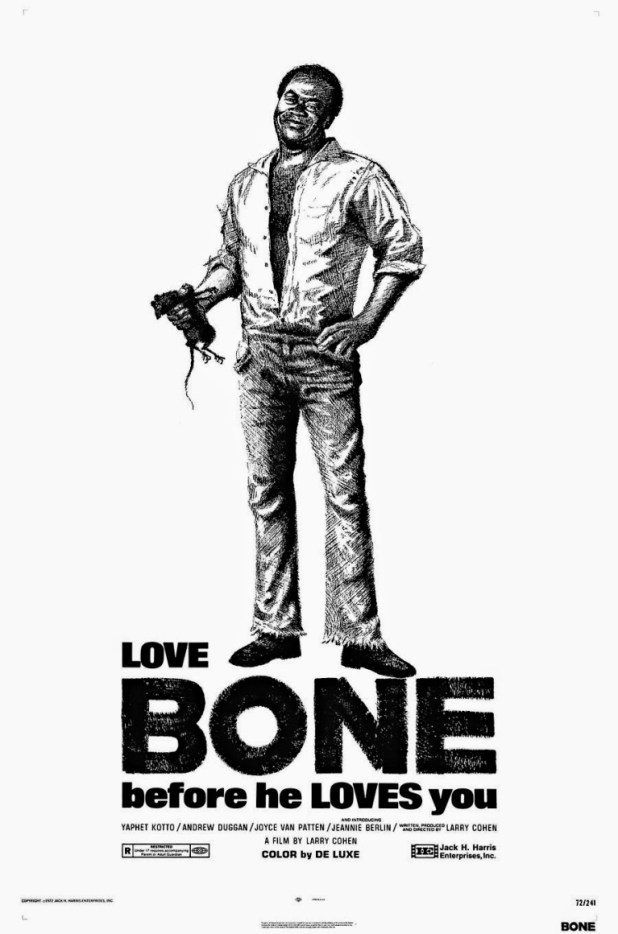
The basic story of Bone is simple: a rich couple deals with a home invasion. But this movie has Larry Cohen at the helm, so it’s going to be anything but basic. The man who is there to take them for everything soon learns that the couple is anything but rich. And they’re anything but happy.

Bernadette (Joyce Van Patten, St. Elmo’s FireGrown Ups) and Bill (Andrew Duggan, In Like FlintIt Lives Again) are a seemingly rich Beverly Hills couple. Bill’s a used car salesman who feels that he’s the only one working hard, symbolized by his wife refusing to even getting up to answer the phone while he cleans the pool. Then, a rat gets stuck in the drain. That’s what brings Bone (Yaphet Kotto, AlienLive and Let Die) into their lives.

Mistaking him for an exterminator, they ask him to pull the rat out. He does and instead of hiding it from them, he confronts them with it. He then takes them hostage as he goes through their home looking for money.

It turns out that the couple has little in liquid assets and is deeply in debt. Their son may be in Vietnam or he may be in jail. And it turns out Bill has a secret bank account that Bernadette knows nothing about. Bone commands him to clean out that account and bring him the money in an hour or he’ll rape and kill his wife.

Bill ends up taking his time as he realizes how little he loves his wife. He drinks with a lady (Brett Sommers from TV’s Match Game) that explains how her husband died from too many dental x-rays. Soon, he’s been seduced by a young girl (Elaine May’s daughter Jeannie Berlin, The Heartbreak KidInherent Vice) who steals from the system, attracted to her offbeat ways and youthful spirit.

He comes home without the money. But meanwhile, after learning how to make eggs — she doesn’t cook anymore — Bernadette and Bone have gotten drunk and ended up on the couch together. He explains to her how raping white women and the black mystique used to take him so far, but today, black and white love is commonplace. What started as him continually saying he was going to rape her has turned and she begins to seduce him, kissing him and “doing all the work.” He talks about how black men have troubles now making love and she tells him that it’s not just black men.

After they bond, Bernadette tries to convince Bone to help her murder Bill for his insurance. They ride the bus to the end of the line, then chase Bill to the beach. He tries to win them over with a used car pitch to keep him alive, Bernadette smothers and kills him. Bone realizes that he wants nothing to do with this life and leaves.

On Cohen’s website, the characters in this film are broken down by how they relate to the world: Bill is The Establishment who may be open to change. Bernadette is liberation and feminism that has been held down. The X-Ray Lady is the real Establishment, the old guard ready to die off. The Girl is the hippy love generation already giving way to the darkness of the 70’s. Then there’s Bone — facing racism but willing to play with it to get what he wants, as he says, “I’m just a big bad buck, ready to do what’s expected of him.” He even talks about how he’s held onto the past, enjoying his part of the world of racism because it was easier and there was a role. Now, in this new world, he doesn’t know who to be.

The character work in this film is superb. Witness the scene where the girl explains to Bill how she was raped as a child and that’s why she’s attracted to old men like him. Even when he tries to connect with her by telling her about the Street & Smith pulps he bought as a kid, she still tries to connect him to the rapist who took her virginity as she begins to make love to him.

If I didn’t say it yet, Yaphet Kotto is fucking amazing in this movie. His performance is quite literally a tour de force. He’s always great in everything he’s in, but in this film, he’s transcendent. I also love that he borrowed Cohen’s red sweater for a scene late in the movie and never returned it.

Amazingly, this was Cohen’s first film. It’s assured and poised, straddling the line between art film and exploitation.

You can watch it on Brown Sugar or Amazon Prime. I’d advise you to do so at your next convenience.

Feedshark

SON OF MADE FOR TV MOVIES WEEK: Something Evil (1972)

Steven Spielberg directed this Robert Clouse (the director of Enter the Dragon) written TV movie that originally aired on January 21, 1972. In fact, Spielberg even appears briefly in the film speaking to Carl Gottlieb (who would go on to co-write Jaws) at a party.

Marjorie (Sandy Dennis, God Told Me To) and Paul Worden (Darren McGavin, Carl Kolchak forever) have just moved to a Pennsylvania farmhouse with their children, Stevie (Johnny Whitaker, Jody from Family Affair) and Laurie. There are symbols all over the house, which no one seems to have any issues with.

Is there weirdness at the farm? You know there is. Their neighbor, Gehrmann, (Jeff Corey, Battle Beyond the Stars) kills chickens right in front of the kids. Marjorie keeps hearing the sound of crying children. Then there’s Harry (Ralph Bellamy, Coming to AmericaPretty Woman), a local who believes in demons and says that the house is protected from them because of all the symbols.

Marjorie is convinced that the devil wants her and even slaps her son, which leads to her leaving the family, as she can’t even trust herself. But what if the devil was after her kids and not her? Hmm?

Spielberg would escape TV movies after this. It’s a low budget affair, but his style as a director transforms the material. It’s unsettling, filled with doom and gloom and dread. The 70’s really seem like a dismal time to be alive if we only go by TV movies, huh?

SON OF MADE FOR TV MOVIES WEEK: Crawlspace (1972)

Based on the novel by Herbert Lieberman, Crawlspace is what happens when Albert (Arthur Kennedy, The Sentinel, The Living Dead at Manchester Morgue) and Alice (Teresa Wright, Best Supporting Actress for the film Mrs. Miniver, as well as The Little Foxes and The Pride of the Yankees) Graves take in Richard Atlee as their adopted son.

Well, let’s hold on a second. The Graves have moved to a small town to help Albert recuperate from his heart attack. And when their furnace goes, the repair company sends Richard to fix it. They invite him over for dinner and the furnace goes bad a few days later. When the new repairman shows up, he tells them that Richard disappeared.

Strange sounds come from the crawlspace. Turns out Richard has been living there. And even when the Graves adopt him and try to care for him, he refuses to sleep anywhere but the crawlspace.

Even after Sherriff Birge warns the couple about the boy, they keep him in their home. But then, Richard starts acting out. His violent outbursts toward the Graves and the entire town (particularly a general store) increase in intensity and menace.

Directed by John Newland and Buzz Kulik (who also did Bad Ronald), this February 11, 1972 TV movie is slow, haunted and pretty effective. You can see why the couple wanted Richard in their lives, as he becomes the only topic of their conversations. And as he begins to fix things around the house, he becomes oddly necessary.

“What the hell are we doing with a boy in the hole in our cellar?” You’ll wonder this same question! This is a real actor movie, with Arthur Kennedy really shining here, his anger toward what he perceives as Richard’s rudeness balanced by Teresa Wright’s need for someone to care for. The scene where she asks if she should add Richard’s name to Christmas cards is heartbreaking.

The police finally give up on trying to convince Albert and Alice to give up Richard and refuse their calls when a gang of boys he’s feuding with attack their house. Despite pleas for Richard to leave, despite offering him money, despite all attempt at sanity, Richard will not leave.

An attack from the gang of boys leads to Richard killing one of the men and Albert covers for Richard one last time. Alice loses her civility and screams that she wants Richard to leave. He attacks her, leading to Richard shooting him and dying for a stress-related heart attack. Only Alice is left behind in the crawlspace.

Crawlspace is filled with sadness. A couple that could never find a child. A man who can never find his place in the world. And even in the brief moments of happiness they find together, there is always the chance that it could fall apart at any moment. You can see the ending before the characters do, but that doesn’t lessen its impact.

SON OF MADE FOR TV MOVIES WEEK: She Waits (1972)

Laura Wilson (Patty Duke, Valley of the DollsThe Swarm) and Mark (David McCallum, Illya Kuryakin on The Man from U.N.C.L.E. and better known to today’s TV audience as Dr. Donald Mallard on N.C.I.S.) haven’t been married long. On their first trip to meet his mother (Dorothy McGuire, The Greatest Story Ever Told), she learns that maybe this marriage wasn’t the best of ideas. Mom has been ready to go nutzoid ever since Mark’s first wife, Elaine, died, and she’s convinced that her ghost is inside her home.

Everywhere Laura goes, she starts hearing Elaine’s favorite song and even her voice. Is she trying to possess her? Or is she just being ridiculous, as the family doctor suggests? The movie never fully embraces the supernatural. It’s more about Mark shutting himself off and not dealing with the past.

The family maid thinks that Mark’s mother is getting worse and worse, with Laura in danger of the very same insanity. And what’s the deal with Mark’s friend David (James T. Callahan, the dad from Charles in Charge)? And can you talk a ghost out of possessing someone just by talking to them?

Director Delbert Mann (Marty) weaves a competent story, penned by Art Wallace, the main writer for TV’s Dark Shadows. It’s a tale that fits snugly into the 1970s, a time when possession, Satan, and the ghosts of murdered wives lurked around every corner. The film’s slow pace is a deliberate nod to the conventions of TV movie horror, inviting you to revel in the nostalgia of a bygone era.

BAVA WEEK: Baron Blood (1972)

There’s an urban legend called The Well to Hell, which claims that you can hear Hell through a hole in the earth, and there have even been audio recordings posted as proof. Those recordings have been revealed to be the soundtrack to this film. That should tell you what you’re getting into.

Peter Kleist arrives from America to take a break and study his family’s history. His uncle Karl allows him to stay at his large mansion and refuses to discuss their ancestor, Baron Otto Bon Kleist, better known as Baron Blood for the torture and murder he inflicted on the village. His foremost crime was burning a witch named Elizabeth Holly at the stake as she cursed him to rise from the dead again and again, knowing no rest, so that she could take her revenge on him over and over again. The Baron’s castle is being remodeled for tourists, so Peter asks his uncle to take him there.

At the castle, Peter meets Eva (Elke Sommer, Lisa and the Devil), who works with Dortmund, a businessman who is fixing the castle. She is there to ensure that Blood’s castle retains its original beauty. Eva comes to Karl’s house for a meal, where we learn that Baron Blood has been seen in the woods near the castle. And Peter has found an ancient spell that will awaken the spirit of the Baron. Karl warns him of dabbling in the occult, and seeing as we’re only a few minutes into the movie, we know he won’t listen.

Of course Peter and Eva go to the bell tower and read the spell at midnight. The bell tolls two, not twelve, symbolic of the time of day that Blood’s victims rose and killed him. Eva begs Peter to reverse the spell, but a gust of wind blows the spell into a fireplace as the Baron emerges from his grave.

The Baron is born with the same wounds he died from, wounds even a doctor cannot heal. He then goes on a killing spree, starting with the doctor and a gravedigger, then hanging Dortmund and smooshing the castle’s caretaker inside a spiked coffin.

The next day, Alfred Becker (Joseph Cotton, The Abominable Dr. Phibes), a disabled millionaire in a wheelchair, purchases the castle. He seems decent, so Eva stays on long enough to have the Baron attack her again. She quits her job and moves to the city, only for the black-clad Baron to follow her, chasing her through the foggy streets in a pure Bava scene. She escapes to Karl’s home and luckily, he finally believes that the Baron is still alive.

A local medium helps them bring back Elizabeth Holly, who gives them a magic amulet and the knowledge that only they can destroy the Baron because Peter and Eva brought him back. The moment they leave, the Baron kills the psychic.

The Baron also chases Karl’s young daughter. She then realizes that the Baron and Becker are the same man, as their eyes burn like fire. When they confront the man who uses a wheelchair with this revelation, he denies it and shows them his castle, which now has dummies impaled on stakes as decorations. As they debate what to do next, he rises from his wheelchair and knocks all of them out, taking them to his torture chamber.

Eva learns that when her Blood and the amulet unite, the Baron’s victims all return from the dead. They rise and tear him apart limb by limb as Peter, Eva and Karl escape. As the film ends, we hear Elizabeth Holly’s laughter.

Critically, this is not considered one of Bava’s best. However, I found plenty to like, including the Baron’s quite frightening design. And how can any movie that features Elke Sommer running through the fog be bad?

CHRISTMAS CINEMA: Tales from the Crypt (1972)

To finish out this season of movies, allow me to give you the gift of my favorite film ever. There’s nothing better than a portmanteau and there was no studio better at making them than Amicus. This is a monument to that studio, their main director Freddie Francis and British horror royalty Peter Cushing all in one film. And with one of the stories centered on Christmas, it’s perfect to watch right now.

Five people are part of a tour of old catacombs, yet get separated from everyone else. They find themselves in the company of the Crypt Keeper (Ralph Richardson, Whoever Slew Auntie Roo?), who looks nothing like the character from the E.C. Comics or the later HBO series. He begins to tell each of them how they came to be in his chambers.

…And All Through the House (based on Vault of Horror #35)

Joanne Clayton (Joan Collins, Empire of the AntsI Don’t Want to Be Born) has murdered her husband on Christmas Eve. Yet even as she hides the body — scrubbing impossibly crimson blood from her immaculate white fur carpet — a killer dressed as Santa Claus is stalking her. If she calls the police, they’ll discover her crime. If she doesn’t, she’s dead.

Her daughter (Chloe Franks, who is wonderful in another Amicus anthology, The House That Dripped Blood, which we covered on one of our first podcasts) thinks that the killer is Santa and lets him in. Not the best of ideas, as he’s soon chasing Joanna all over the house.

Reflection of Death (based on Tales from the Crypt #23)

Carl Maitland (Ian Hendry, Theater of Blood) has left his family to be with his lover, Susan. That said, as they drive away, they are in an accident and no one will stop to help him after he awakens. His wife is already with another man. Susan is blind and claims he died two years ago. And by the time he figures out the truth, it’s too late.

Poetic Justice (The Haunt of Fear #12)

Edward and James Elliott hate their neighbor Arthur Grimsdyke (Peter Cushing is absolutely perfect in this role and if you don’t know who he is, I recommend that you shut down your computer and weep), who has plenty of dogs and loves to entertain the neighborhood’s children. They take his dogs from him, they get him fired from his job and finally convince the parents that he’s a child molester. A widower who speaks to his wife even after death, Grimsdyke can take no more after James sends his mean-spirited Valentines, signing the name of every neighbor. But one year later, Grimsdyke rises from the dead and sends Edward a very personal Valentine’s Day card with the help of his son’s still beating heart.

This part is perfect. From the scorn of the rich toward the poor to Cushing’s emotional pain (he was reeling from the death of his beloved wife Violet Helene Beck and had even tried to give himself a heart attack by repeatedly running stairs in his home, hoping to find a way back to her) and his rise from the earth, this is everything horror movies should be.

Wish You Were Here (The Haunt of Fear #22)

A retelling of The Monkey’s Paw, this story finds businessman Ralph Jason (near bankruptcy when his wife Enid finds a Chinese figure that will give three wishes. The first, for money, comes true when she gets Ralph’s insurance money after he dies in a car crash. Her second is to bring him back exactly as he was before the accident, but she learns that he had a heart attack upon seeing a skeletal motorcycle rider. Finally, she wishes for him to come back alive and to live forever, but as he’s already been embalmed, he awakens to horrifying pain. Even after she chops him up, he remains alive.

Blind Alleys (Tales from the Crypt #46)

Major William Rogers is the new director of the home for the blind, but he immediately cuts the budget. The men must now deal with the constant cold and a lack of food while he lives the high life with his German shepherd. The blind men rise up and turn the tables, putting Rogers in a maze where he is blinded, bloodied and finally murdered by his own dog.

The Crypt Keeper then reveals that this isn’t what may happen. It has already happened and he is there to send them all to Hell. He looks directly at the viewer, breaking the fourth wall and asks, “And now… who is next? Perhaps you?” This ending would be recycled for several Amicus films but gets me every single time.

The band CANT — that I sang for — recorded a song entitled “Tales from the Crypt” that was released on our 2015 demo. It’s opening lyrics, “Like a stain you can’t erase, you left without a trace. Ruining lives, burning inside, left in the cold, going blind” echo the evil of each character in the stories, while the chorus, “Strangled, crushed, torn, burning, blind — you are gonna die” reveals the ending to each story.

Like I said — I really love this movie. The track was originally called “The Strange Bruises You Find on Joan Collins’ Throat,” but it seemed too long and it felt better to tip my hat toward the movie.

Hey everyone! Merry Christmas!

You can watch this on Amazon Prime.

CHRISTMAS CINEMA: Santa and the Ice Cream Bunny (1972)

This movie was made for children. Let’s keep this in mind as we discuss it.

Sure, it was created by R. Winer to use existing Barry Mahon films — either Thumbelina or Jack and the Beanstalk — and create a framing device of Santa so that it could be released over Christmas. But what emerged was a piece of cinematic horror that can try even the bravest of souls.

In the North Pole, the elves are worried about Santa not being there. Where is he? Oh, stuck in the sand on a beach in Florida, with the reindeer flying away because of the heat. Santa sings a song about his problems, then he falls asleep.

Santa uses telepathy to reach out to children, several of whom are fistfighting. They race to help him, asking him logical questions like, “Why don’t you just get on a plane?” He says he cannot abandon his sleigh, so a pig, a sheep, a donkey, a horse and a gorilla come to help while Tom Sawyer and Huckleberry Finn watch.

This movie is drugs.

Santa tells the kids to not give up, then tells them a story, which would be one of the two stories discussed earlier. Santa then tells the kids to always believe and a girl reveals that her dog, Rebel, can do anything.

Santa gives up — even after the advice he gave the kids — and goes to sleep. But then the kids come back in a fire truck driven by the Ice Cream Bunny, a scene which ruined my already tenuous grip of sanity, leaving me lying on the couch holding my sides while my eyes cried deep tears of laughter.

Yes, Rebel the dog knows the Ice Cream Bunny, who drives Santa to the North Pole, leaving behind the sled, ruining the main conceit that Santa had brought up before, that he would never leave his sled behind. The children wonder what to do and then the sled disappears.

The conflict that has driven this movie was all a lie.

Why did we sit through all of the animals trying to pull the sled?

Why did we have to watch the movie within a movie?

Why were Tom Sawyer and Huck Finn in this film?

What the fuck did I just watch?

This movie was probably created as part of the Pirates World amusement park in Dania, Florida, which had already produced the two films within the film. But with Disney World opening in 1973, this little enterprise was doomed. Was the Ice Cream Bunny one of their characters? Because we’re led to believe that he’s well-known, but I’ve never heard of him.

This is a movie that will break you.

You think I’ve covered some insane holiday movies?

I really think this one tops it all.

Did I mention that when the Ice Cream Bunny comes to rescue Santa that he almost runs over Rebel the dog? I mean, this genius dog that was able to summon a magic bunny runs in front of a moving vehicle to drink out of a muddy pool of water, nearly being run down by a fire truck driven by a man in a rabbit suit that surely can’t see him! Look for the jump cut where Rebel is back and moved to safety!

And Pirates World is even crazier when you learn that Led Zeppelin, Black Sabbath, Alice Cooper and David Bowie all played the theme park! You can see footage of Iron Butterfly playing the park in the movie Musical Mutiny.

The director Barry Mahon, who created the films for the park, lived an insane life that inspired the film The Great Escape. During World War II, Mahon Mahon escaped Stalag Luft III only to be captured on the Czechoslovakian border. He escaped again, was recaptured again, and was finally saved by Patton’s 3rd Army in 1945.

So what did he do when he got back to the USA? He became Errol Flynn’s personal pilot and manager. His directorial credits alternate between children’s fare, like Santa’s Christmas Elf Named Calvin and The Wonderful Land of Oz, and nudie cuties like Fanny Hill Meets Dr. EroticoThe Diary of Knockers McCalla and The Beast That Killed Women. He also directed 1961’s Red Scare shocker Rocket Attack U.S.A.

No one is really sure who R. Winer is, but some think he was Richard Winer, a cinematographer and director whose entire IMDB page is devoted to films he either created or appeared in that were all about the Bermuda Triangle and UFOs. Of course.

This is the kind of film David Lynch dreams that he could make. Alejandro Jodorowsky lives in abject terror of its unholy power. You should have to wear some kind of protective brain plate when you watch this.

I can’t keep this to myself. If you want to subject yourself to the assault that is this film, here it is. Don’t say I didn’t warn you.

You can also watch this on Amazon Prime.

CHRISTMAS CINEMA: Silent Night, Bloody Night (1972)

Christmas Eve, 1950: Wilfred Butler runs from his home, on fire, and supposedly dies in the snow.

Christmas Eve, 1970: John Carter (Patrick O’Neal, The Stepford Wives, The Stuff) and his assistant Ingrid arrive in a small Massachusetts town. He meets with the town’s mayor, sheriff and major citizens like Tess Howard and Charlie Towman (John Carradine!), who may have lost his voice to a tracheotomy but not his need to smoke, about selling the Butler mansion as soon as possible. While staying overnight with Ingrid, who is also his mistress, they are both killed by an axe. The killer calls the police and says that they are Marianne.

Tess, the town’s telephone operator, hears the call and drives to the mansion, where she is greeted by Marianne Butler before she is hit in the head with a candle holder. Meanwhile, Sheriff Mason finds that Wilfred’s grave is empty. He is killed and thrown into the empty hole.

Mayor Adams is asked to go to the Butler mansion but leaves his daughter, Diane (Mary Woronov, Death Race 2000Chelsea Girls) at home. She meets up with a man who claims to be Jeffrey Butler, who has taken the sheriff’s abandoned car. Together, they search for the lawman but can’t find him.

After taking Towman to the mansion, Jeffrey goes back to get Diane. On their way to the mansion, Towman stumbles blindly in front of them and is hit and killed. His eyes had been stabbed out and Diane grows worried about Jeffrey.

Well, fuck me, this movie is also about incest! A diary found at the house reveals that Jeffrey is the son of Wilfred and his daughter, Marianne. Afterward, Wilfred turned the house into an asylum and admitted his own daughter. However, on Christmas Eve 1935, he turned all of the inmates loose. They killed every doctor as well as his daughter. Of note here is that many of the inmates in the flashback are played by former stars of Warhol’s factory, like Ondine, Tally Brown, Kristen Steen and Lewis Love, as well as Flaming Creatures auteur Jack Smith, artist George Trakas and his wife at the time, Susan Rothenberg. Warhol superstar Candy Darling also shows up in the film as a party guest.

Well, it turns out that some of the inmates of the insane asylum ended up being important parts of the town — that’s right, all of the important people John met with in the beginning!

Mayor Adams arrives at the mansion and he and Jeffrey face off, guns drawn, each believing the other is the killer. They kill one another as Marianne shows up, but she is really Wilfred, who is alive. He went after the inmates for their role in the death of his daughter and used his grandson/son/secret shame Jeffrey as a patsy. Diane gets the gun and kills the old man. One year later, the mansion is demolished as she watches.

Director Theodore Gershuny worked on plenty of episodes of Monsters and Tales from the Darkside after this film. He was also married to Woronov. The original title for the film was Night Of The Dark Full Moon and it was also nearly called Zora, which makes little to no sense.

There are some really interesting techniques here, especially in the flashback sequences, which feel like tinted photographs come to life with the saddest version of “Silent Night” ever playing behind the action. I love how experimental and dark these sequences look — they remind me a little of the film Begotten.

This is a dark film for your holiday viewing, so if you want to chase away the family for awhile, this is the one to do it.

CHRISTMAS CINEMA: Home for the Holidays (1972)

Originally airing on November 28, 1972, this ABC-TV movie was produced by Aaron Spelling and debuted on VHS in 1986. It’s packed with future talent and is at the center of what we love most here: TV movies, Christmas movies and horror.

Benjamin Morgan (Walter Brennan, Rio Bravo) is rich and dying and suspects his wife, Elizabeth (Julie Harris, one of America’s most famous stage actresses), of poisoning him. He sends his oldest daughter, Alex (Eleanor Parker, Eye of the Cat) to find her three sisters and bring them home — the first time they’ve been back since their mother’s suicide.

The three sisters are Freddie (Jessica Walter, Arrested Development), Joanna (Jill Haworth, The Brides of Dracula) and Christine (Sally Field, Steel Magnolias). Their father tells them that they must kill their stepmother before she kills them. At dinner that night, Joanna harangues her stepmother with questions about how her first husband died, while Freddie screams in her room about how their father’s affairs led to their mother killing herself.

This is obviously the holiday get-together everyone hoped for.

Soon after, Joanna tries to leave but is killed by a pitchfork-wielding person in a yellow raincoat. That same killer also drowns Freddie in the bathtub while Elizabeth keeps offering everyone warmed milk and honey. Soon, the phone line gets cut and everyone is trapped with a killer. But who is it?

There are plenty of twists and turns here, as the love between a father and daughter and the love between husband and wife is contested. It’s bloodless, as it’s a TV movie, but it’s also pretty dark, because the 1970’s were the end of the world and the movies made then reflected it. You also get a cast packed with Oscar winners and nominees, all acting within basically one or two rooms, so there’s plenty of emotion and suspense.

Looking for a copy? You can always head to iOffer, where I recommend the seller rareblood. Or if you feel like looking through used videos or Walmart bins, Echo Bridge Home Entertainment released the film on DVD in 2013 as part of their 8-Movie Midnight Horror Collection on a disk called 8 Midnight Horror Movies “It Will Leave You In Stitches.”

Necromancy (1972)

If you go to a town named Lilith to live, you should not be surprised that the town is run by devil worshippers. If Orson Welles comes to you in a robe and his name is Mr. Cato, you should not be shocked to learn that he wants to use you to raise his son from the grave. What is surprising is that for a movie promising rituals and raising the dead, Necromancy isn’t all that exciting.

Directed by Bert I. Gordon (War of the Colossal BeastPicture Mommy Dead), the master of rear projection, this film is all about Lori Brandon (Pamela Franklin, The Legend of Hell HouseAnd Soon the Darkness), a woman who has recently lost a child. She moves with her husband, Richard (Michael Ontkean, Sheriff Harry S. Truman from Twin Peaks) to the aforementioned town of Lilith to start over again.

On the way there, they get in an accident and kill a woman, but it’s totally glossed over because this is 1972. Life was cheap. At least Lori gets a baby doll out of this accident.

There used to be a sign in my hometown that said, “What Ellwood City makes, makes Ellwood City.” The town of Lilith makes one thing: the world’s finest occult paraphernalia. There’s one great scene here with Lori sees her image inside a tarot card, a really evocative scene thrown away in a film that is otherwise less than memorable.

If you’ve seen Rosemary’s Baby, you know exactly how this is all gonna turn out. If you are the star of a 1970’s horror movie — especially if you are Donald Sutherland — expect to die. Horribly.

Much like the devil, Necromancy goes by many names, such as The WitchingA Life for a Life, Horror-AttackRosemary’s Disciples and The Toy Factory. When Paragon Video re-released it on VHS in 1982, they chopped out tons of story and dialogue to insert scenes of nude witches like Brinke Stevens and even more Satanic rituals.

As much as I love Orson Welles — we’ll have a whole month of his films at some point, I’m certain — this is not his finest hour. He has some fine speeches, but the material is Mrs. Paul’s level. Beneath him.