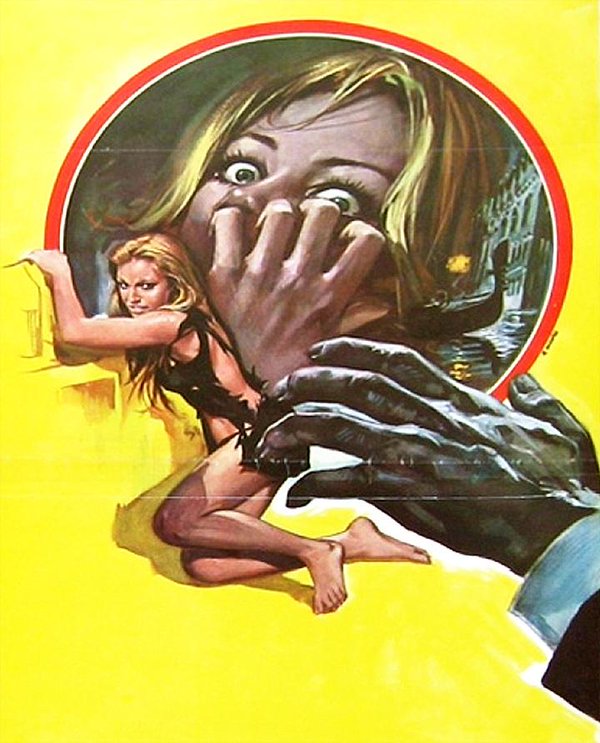
Amuck! is a great title, but this is a movie that has a ton of great other titles –Alla ricerca del piacere (In Pursuit of Pleasure), Maniac Mansion, Leather and Whips and Hot Bed of Sex were also used and the working titles were Replica de un delitto (Repetition of a Crime) and Il passo dell’assassino (Footsteps of the Killer). No matter what name you give it, this is one dark little film.
Along with his wife Eleanora (Rosalba Neri, Lady Frankenstein), the writer lives in comfort on his own island. Their past secretary, Sally, disappeared without a trace. However, Richard and Eleanora don’t know Greta’s reason for joining them — the missing girl was her lover, a fact we find out via a flashback lovemaking scene that is artful, if stilted, awkward and the way that men would assume women would couple (staring at one another and attempting to kiss, then going to sleep). Indeed, it feels like the fever addled wet dream of a maniac, which pretty much sums up what giallo can be at times.
The more Greta gets close, the more sex, drugs and violence is unearthed. The Stuarts often hold sex parties in their palatial home. Oh yeah — Eleanora has ESP, seeing Greta’s death, screaming about it while in a fit of prophecy.
Indeed, death begins to follow our heroine. The next day, a hunting trip turns into a brush with quicksand, that most evil of all movie doom.
Richard reveals that Eleanora fascinates him because of her duplicitous nature and he is falling in love with Greta because of how honest she is. He then reveals the accident that claimed Sally’s life in a flashback: Eleanora watches Rocco through her hunting scope before inviting him to a rendezvous with her and Sally. They both dance for him in a series of druggy jump cuts — perhaps the film’s most assured scene. After making love to Eleanora, the fisherman kisses Sally tenderly before losing control, which is shown by how the film speeds up, like the Keystone Kops. He ends up choking Sally to death while Eleanora watches, powerless to stop him.
Richard and Greta end up making love later that night during a storm. Eleanora watches through the doorway before looking directly at the camera, as if she is sad yet not surprised.
The very next evening, after Richard leaves town, Eleanora sets up the same threeway with Rocco (who she calls the perfect male, yet he seems like a leering idiot). Greta tries to leave, only to find the dead body of the butler in the hallway. Richard shows up, telling her that this has all been a game. They’ve found Sally’s body and now, they need to get rid of her. He tells her that it’s all over now and she must die, describing how Rocco will murder her in calm tones.
However, Rocco remembers an act of kindness that Greta had performed for him. Eleanora attacks him, slapping the shit out of him before he tosses her into a wall, killing her, and stabbing Richard.
Greta leaves, learning that Rocco is getting the help he needs. Yet the film ends on a weird note, as a policeman tells Greta that the woman in the lagoon wasn’t even Sally. FIN.
Director Silvio Amadio crafts a film that takes some time to get going and has flashes of mood, but may not rank amongst the best in giallo. That said, he has an attractive cast to work with, an interesting story and there’s a well shot sequence of a boatman taking a dead body down a river that aspires to art.
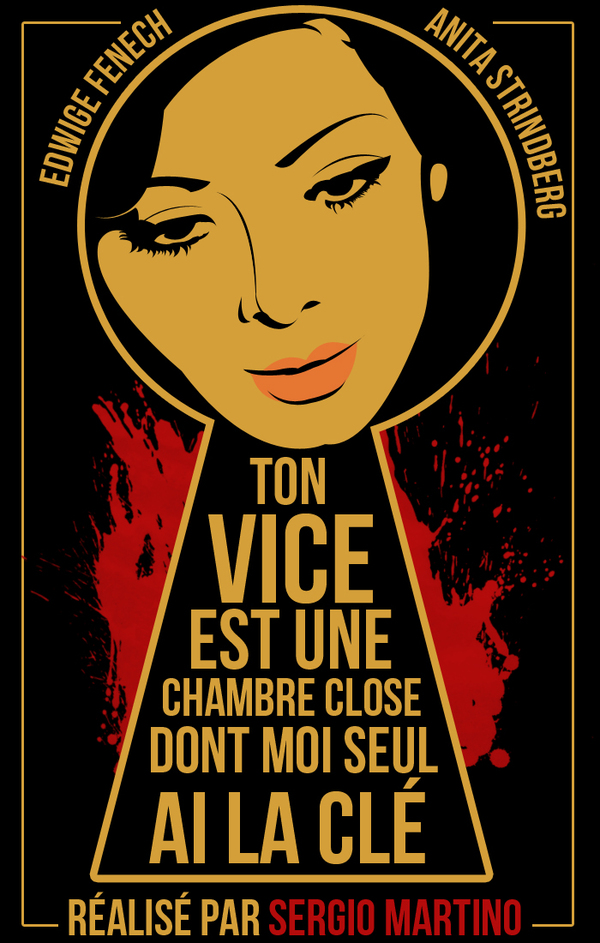
Has a movie ever had a better title? Nope. Sergio Martino’s fourth entry into the giallo genre, following The Strange Vice of Mrs. Wardh,The Case of the Scorpion’s Tail and the previously reviewed All the Colors of the Dark, it refers to the note that the killer leaves to Edwige Fenech’s character in Mrs. Wardh. And the title is way better than the alternate ones this film has — Gently Before She Dies,Eye of the Black Cat and Excite Me!
Martino wastes no time at all getting into the crazy in this one — Oliviero Rouvigny (Luigi Pistilli from A Bay of Blood, Iguana with the Tongue of Fire, Death Rides a Horse) is a dark, sinister man, a failed writer and alcoholic who lives in a mansion that’s falling apart (If this all feels like a modernized version of a Poe story like The Fall of the House of Usher, it’s no accident. There’s even an acknowledgment that the film is inspired by The Black Cat in the opening credits.). His wife, Irina (Anita Strindberg from A Lizard in a Woman’s Skin and Who Saw Her Die?), suffers his abuses, but never more so than when he gathers hippies together for confrontational parties. He makes everyone pour all of their wine into a bowl and forces her to drink it, then humiliates their black servant Brenda until one of the party goers starts singing and everyone joins in, then gets naked. This scene is beyond strange and must be experienced. Luckily, I found the link for you, but trust me — it’s NSFW.
The only person that Oliviero seems to love is Satan, the cat that belonged to his dead mother. A black cat that talks throughout every scene he’s in, his constant meows led to my cats communicating with the TV. God only knows what a 1970’s giallo cat said, but it seems like his words spoke directly to their hearts.
One of Oliviero’s mistresses is found dead near the house, but he hides her body. The police suspect him, as does his wife. Adding to the tension is the fact that Irina hates Satan, who only seems to care about messing with her beloved birds.
Remember that servant? Well, she’s dead now, but not before she walks around half naked in Oliviero’s mother’s dress while he watches from the other room. She barely makes it to Irina’s room before she collapses, covered in blood. Blood that Satan the cat has no problem walking through! He refuses to call the police, as he doesn’t want any more suspicion. He asks his wife to help him get rid of the body.
Oliviero’s niece Floriana (Edwige Fenech, pretty much the queen of the giallo) is in town for a visit, learning how Oliviero hasn’t been able to write one sentence over and over again for three years, stuck in writer’s block (and predating The Shining by 5 years in book form and 8 years away from Kubrick’s film). Unlike everyone else who tolerates Oliviero’s behavior or ignores it, Floriana sees right through the bullshit. The writer is used to seducing every woman he meets and she initially rebuffs him, even asking if it’s true that Oliviero used to sleep with his mother. He angrily asks if it’s true that she’s a two-bit whore. “Those would be two bits worth spending,” is her caustic reply.
Irina confides all of her pain to Floriana as the two become lovers. And another girl gets murdered — perhaps by Oliviero. Then, a dirt bike racer comes to drop off milk and hit on Floriana. Whew — I was wondering when this film would get hard to follow and start piling on the red herrings!
After being questioned by the police, Oliviero comes home to choke his wife. He stops at the last second…then we’re off to the races! The motor bike races! The milk man loses when his bike breaks down, but he’s the real winner — taking Floriana back to the abandoned house that he lives in. And oh look — there’s creepy Oliviero watching the action.
Meanwhile, Satan has gotten into the coop and chowed down on several of the birds. Irina catches him and they have quite the battle. He scratches her numerous times before she stabs him in the eye with a pair of scissors. An old woman watches and is chased away by Irina’s yelling.
She’s afraid that her husband will kill her once he learns that she killed Satan. And Oliviero keeps wondering where the cat is, especially after he buys the cat his favorite meal from the store — sheep eyes. That said — Satan might not be so dead, as we can hear his screaming and see him with a missing eye.
Floriana puts on Oliviero’s mother’s dress, asking if this is what the maid looked like before she died. Whether it’s the dress or the forbidden family love or just her beauty, he rips off her dress — at her urging, mind you — and begins making love to his niece. We cut to Idrina, caressing her pet birds, when Oliviero confronts her with scissors and questions about Satan. He almost stabs her before he ends up raping her inside the coop, while Floriana looks on. She playing them off the other, even telling Idrina that she’s slept with her husband. She also tells her that Oliviero wants to kill her, so she should kill him first.
Idrina wakes up to the sound of Satan, but can’t find him anywhere. What she does find is her husband in bed with Floriana, who is belittling him. With every sinister meow, there’s a zoom of the cat’s damaged eye. Finally, Oliviero attacks her for spying on him, slapping her around before he leaves to write. She walks the grounds of the mansion, seeing the motorcycle rider make a date with Floriana and catching sight of Satan, who runs from her. In the basement, she finds scissors and the hidden bodies of her husband’s lover and the murdered maid. In a moment of clarity — or madness — she stabs her husband while he sleeps. The sequence is breathtaking — a giallo POV shot of the murder weapon intercut with the same sentence being typed over and over interspersed with all of the abuses that Oliviero had wrought upon her. She stabs again and again before Floriana interrupts, asking her if it was easy. The sentence that the author had written again and again was him claiming that he would kill her and there was a space in the wall for her, so obviously, she had to kill him.
As for Floriana, all she wanted was the family jewels, which were hidden in the house. They seal Oliviero’s corpse within the wall while Walter watches from afar. He’s played by Ivan Rassimov, who does creeping staring dudes better than anyone else — witness his work in All the Colors of the Dark. And it turns out that he’s the real killer! He’s been typing “vendetta” over and over again. Floriana asks if Idrina was planning to kill her before she runs off into the night, then Walter appears to kiss Idrina. Turns out they were working together all along — she tells him where to find Floriana the next morning. Holy shit — Idrina reveals her whole plot, revealing how she drove her husband crazy, making him believe that he could have been a murderer! She wishes that there was an afterlife so Oliviero’s mother — who she killed! — could tell him how great her revenge was. She ends by wishing that her husband was still alive so that he could suffer for eternity.
Walter sets up an accident that takes out Floriana and her boyfriend, as their motorcycle crashes, sending blood across the white heart of a billboard and out of her lips. He tosses a match on the gasoline soaked highway, burning both of their corpses. He collects the jewelry and gives it to Idrina, who responds by shoving him off a cliff!
When she returns to the mansion, the police are there, as there were alerted to her stabbing Satan by the old woman. They come inside the house to write a statement, but hear the sound of Satan’s meows. Following the sound, they find him inside a wall — with the corpse of her husband!
Your Vice is a Locked Room and Only I Have the Key is superb. An intriguing story — only a few derailing giallo moments (like the killing of the girl in the room with the dolls and the B roll motocross scenes) — with great acting, eye-catching camerawork and some genuine surprises, it’s well worth seeking out and savoring.
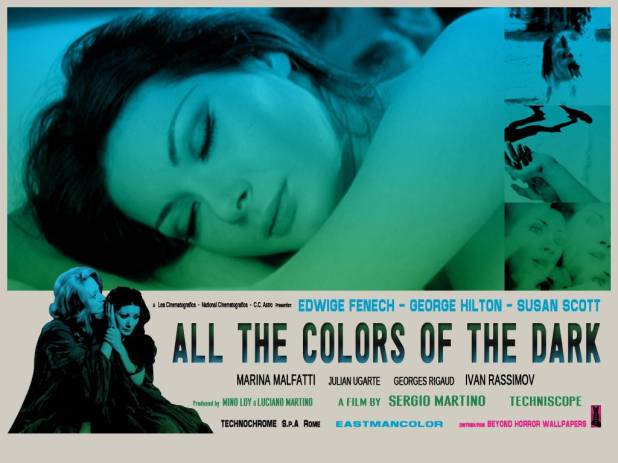
The first five and a half minutes of 1972’s All the Colors of the Dark (also known as Day of the Maniac and They’re Coming to Get You!) subvert what I call Giallo’s “graphic beauty” in intriguing ways.
An outdoor scene of a stream slowly darkens, replaced by an old crone with blackened teeth, dressed as a child and a dead pregnant woman are both made up to be anything but the gorgeous creatures we’ve come to expect from these films; even star Edwige Fenech (The Strange Vice of Mrs. Wardh, Five Dolls for an August Moon and so many more that I could go on and on about) isn’t presented in her usual role of a sex symbol. She’s covered in gore, eyes open and lifeless. As the camera zooms around the room and begins to spin, we see a road superimposed and hear a car crash. Even when Edwige’s character in this film, Jane Harrison, wakes up to shower, we’re not presented with the voyeuristic spoils that one expects from Giallo’s potent stew of the fantastique and the deadly. She stands fully clothed, the water more a caustic break with the dream world than an attempt at seducing the viewer or cleaning herself.
Again — in a genre where words possess little to no meaning — we are forced to wait five and a half minutes until the first dialogue. Richard (George Hilton, Blade of the Ripper), her husband, bemoans that he must leave but feels that he can’t. His therapy is a glass of blue pills and lovemaking that we watch from above; his penetration of her intercut with violent imagery of a knife entering flesh. Instead of the thrill we expect from this coupling, we only sense her distance from the proceedings.
As Richard leaves her behind, we get the idea of the madness within their apartment: a woman makes out on the sidewalk with a young hippy man who asks when he’ll ever see her again. Mary (Marina Malfatti, The Night Evelyn Came Out of Her Grave, The Red Queen Kills Seven Times), a mysterious blonde, glares down at him, somewhat knowingly. His wife looks lost and trapped. Without dialogue, we’ve already sensed that some Satanic conspiracy is afoot. Echoes of Rosemary’s Baby? Sure, but you could say that about every occult-themed 1970s film — the influence is too potent, a tannis root that has infected all of its progeny.
Last year, a car crash took the life of Jane’s unborn child. Her sister Barbara (Nieves Navarro, Death Walks at Midnight, Emanuelle and the Last Cannibals) has advised therapy, which Richard laughs at. As Jane waits to see the doctor, she sees a man with the bluest eyes (Ivan Rassimov from Planet of the Vampires and Django in Don’t Wait, Django…Shoot!) — eyes we’ve seen before, eyes that hint at blood and murder and madness.
Even when surrounded by people, such as on the subway, Jane is lost in her thoughts and in another world, one of inky blackness and isolation punctuated only by the cool blue eyes of the sinister man who tracks her everywhere she goes. Even the teeming masses of the city make her feel more lost; only the light of the above-ground world erases the nightmare of her stalker. That is — until he finds her in the park, where she screams for him to stop following her. The camera is detached, following her from high above, watching her run away, needing the refuge of her home. Even then, the man is still there, banging on the door, demanding to be part of her reality.
The thing is — Richard has no faith in his wife’s sanity. And even when he’s telling her sister, Barbara, how he doesn’t trust psychiatry, he’s also watching her undress in a mirror. This scene really hints that they’ve had sex in the past (perhaps the past was just five minutes ago).
Jane finally finds a kindred soul—her neighbor, Mary, whom we saw earlier in the windows. Mary tells Jane of the Sabbath, the black mass and how it helped her. She sees Jane as a lost soul who needs to be saved and agrees to take her to her church.
The blue-eyed man returns, chasing Jane past a spiraling staircase, ax in hand. The camera spins, making us dizzy as it cuts from the building to the man to Jane’s car to the man. Jane demands to be allowed to go to the Sabbath as she fears the madness that seems ready to overtake her.
As we approach the old mansion where the rite will occur, we feel more of a sense of belonging, a warmer color palette instead of the washed-out nature of the urban sprawl we’ve experienced until now. Everything is lit by a candle. Mary appears to have achieved a glow, and Jane stands in stark contrast to the beatific zombies of the assembled congregation. A taloned priest murders a dog in front of Jane’s eyes as Mary caresses her (trust me, this isn’t a Fulci realistic dog murder, although I hid my mutt Angelo’s eyes for this scene). The priest tells her that if she drinks the blood, she will be free. Hands and lips and bodies overtake her as an orgy breaks out, a bacchanal that she seems to want none of. This sex is presented as horror, as anything but pleasure, yet Jane seems ill-equipped to resist.
Immediately, we see her enjoying her husband, no longer frigid and everything back to normal, as he says. However, Jane tells her that she doesn’t feel real any longer. She walks to the bathroom, seeing multiple reflections of herself that harken back to the kaleidoscope effect we saw as the priest took her to the altar.
No matter what peace, love, and sex happen, Jane can’t escape the blue-eyed man. Even on a romantic lunch date with her husband, he’s there, outside, waiting for her. A taxi drives her back to her home, the only sanctuary against the invasion that the man presents. As she goes through her husband’s effects, she finds a book of the supernatural emblazoned with a pentagram. He claims it’s just a second-hand book and accuses her of hiding things from him.
Jane returns to the Satanic church, this time willing to give herself over and actually seeming to enjoy lovemaking for the first time in this film. Mary intones, “Now you’ll be free.” Again, the long-fingernail priest takes her while the blue-eyed man watches her, his hands covered in blood. The members of the church dance around her as Mary calls to her. The priest tells her that Mary no longer exists. She is free to go, as she brought Jane to the church. The final act is for Jane to murder her, to send her away. Jane screams that she can’t do it, but Mary tells her that they must part, that this act will free her, as she lowers herself onto the dagger that Jane clutches.
Jane awakens, fully clothed, in a field. The blue-eyed man is there, telling her, “Now you are one of us, Jane. It’s impossible to renounce us.” He offers his hand, telling her to follow him. She’s expected. He takes her to an altar that is the same design as the pendant we just saw her wear during the orgy. She demands to know where Mary is, but the only answer she gets is that she belongs to the cult and will now be protected. Mary is gone, and Jane’s sacrifice allows her to be free. They show her Mary’s body, covered in black lace, as she runs screaming.
Perhaps in retaliation for the ritual, dogs chase her through the woods, tearing at her, stopped only by the blue-eyed man who knocks her out. She awakens, clad in virginal white, surrounded by white sheets. Her husband leaves a note in lipstick on her mirror. She looks, and the symbol is on her arm, which is covered in blood. When she goes to Mary’s apartment, an old woman lives there instead.
Jane is totally lost — the ritual has brought her nothing but more madness and the blue-eyed man even closer. Her husband is away on business, her sister is on vacation, and her therapist is dismissive. Even her apartment walls, which offer security, have become a maze of fear. The colors shift to Bava-esque hues of blackness and reds as we see the blue-eyed man attack her over and over again, with constant repetition of the frame as she screams — and then there’s no one there, just the room filled with red and a broken piece of pottery embedded in her hand.
After examining Jane, the doctor leaves her with an elderly couple. Her husband can’t find her and asks Barbara to help.
Jane awakens in a white room — of course, the blue-eyed man is waiting outside the house in the gauzy early morning hours. Yet there is an ominousness about the proceedings — no one is there. A tea kettle is boiling on the stove while the old man and woman sit there, in still repose, dead at the breakfast table. She’s trapped in the room with them as she frantically calls for help. She tells her doctor that the man is there and has killed everyone. He calmly tells Richard and Barbara that he has another patient to deal with, as he doesn’t trust Richard and wants to keep him in the dark. However, he does reveal the truth to Barbara. That lack of trust goes both ways as Richard follows the doctor.
Meanwhile, the blue-eyed man finds Jane, telling her she cannot renounce them. He tells her that the knife that he holds killed her mother when she tried to deny them. And it’s the same knife that killed married. He tells her she is beyond reality and will never find it again.
Following the sound of a hound, she finds the doctor’s car in the driveway — and, of course, he’s dead, too. The blue-eyed man gives chase and finally tries to kill her, but he’s stopped at the last minute by Richard, who stabs him with a rake. He stomps on the man’s hand repeatedly, revealing the tattoo symbol he stares at.
Meanwhile, Mary arrives home to a green-hued apartment, where Richard is smoking and accusing her of being part of black magic. He sees the symbol when he watches her undress, and she tells him that she wants him, that she can make him forget her sister. She promises him untold power and that he can become anyone he wants. As she leans in for a kiss, he shoots her, tossing the envelope of a letter that he received that explains it all.
Cut to a hazy white room where Jane has been given a sedative. An inspector — the priest from the cult! — demands to see her. Richard arrives and embraces her, telling her he will take her out the main door. They speed away in a car and return to their apartment. But all is not well — Richard is killed by an unseen person, and Jane is left holding the dagger. The police that arrest her all have the symbol on their wrists and are led by the leader. The camerawork becomes tighter and claustrophobic as we see the cult descending on her.
Wait — it’s all a Wizard of Oz dream, with the police and her husband at her bedside, explaining the film’s entire plot, which ends up even more ridiculous than everything that we’ve seen up until now (which is really saying something). Turns out there was no real magic. The cult was just a drug ring. Mary was real and just a heroin addict. Her sister was behind it all because she wanted all of the money from the will of their mother’s murderer, who wanted to give 600,000 pounds to both of them.
Jane rejects this reality, saying that this cannot be true after all that she’s seen. The cop replies that he kept trying to call her, and she never answered, so he wrote it all in a letter — the letter that Richard showed Barbara after he shot her. It’s worth noting that the American version of the film ends with Jane being killed by the cult and all of the ending — nearly six minutes worth of important story and denouement — exorcised.
We return to where we were, with Richard going upstairs — just like we’ve seen before. Jane screams that she knows what will happen. The cult leader attacks him, blaming her for Barbara’s death. Richard follows him to the roof, where they fight, and the priest is thrown from the roof. Jane tells Richard that she knew the man was there; she knew that her husband had killed her sister, that it wasn’t a suicide, and that some strange force was guiding her. She asks for help, and the credits roll.
With this film, director Sergio Martino (Torso, 2019: After the Fall of New York) crafted an intriguing blend of the supernatural and the Giallo. Even the procedural elements come only after the film has descended into surrealism as if a cold glass of water splashed in the face of a viewer who needs an explanation. Magic is madness, and we can’t even trust our heroine at the end when she begs to escape the power inside her.
This film is terrific, with Edwige Fenech turning in a strong performance. You really feel the isolation and madness that surround her and empathize with her. The strong visuals and the break from the genre conventions of masked killers, gloved hands and inept police make watching this film an absolute joy. From beginning to end, it makes you question not only the reality that it presents but also the objective trustworthiness of our heroine. And while it betrays an obvious inspiration to the aforementioned Rosemary’s Baby, it is not slavish in its devotion, making a powerful statement on its own merit.
Here’s a cocktail recipe.
They’re Coming to Get You
1.5 oz. J&B
.5 oz. lemon juice
.5 oz. simple syrup
1 egg white
3 dashes Angostura bitters
Shake all ingredients in a cocktail shaker filled with ice.
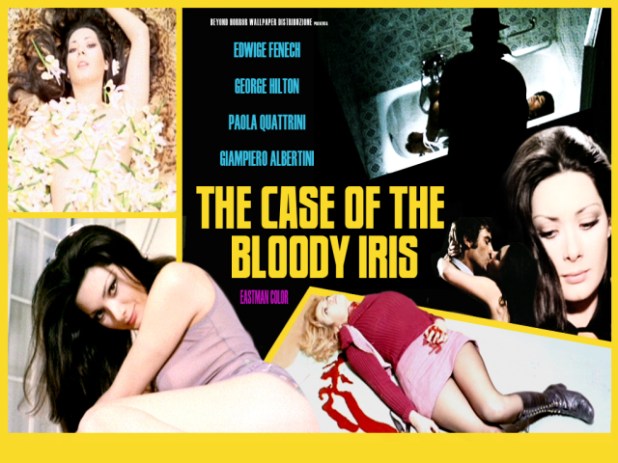
1970’s The Bird with the Crystal Plumagebecame a worldwide hit, bringing giallo to the world. But by 1972, in its native Italy, the films had already become self-aware parodies of the genre. Witness 1972’s The Case of the Bloody Iris (originally titled Why Are There Strange Drops of Blood on Jennifer’s Body?), directed by Giuliano Carnimeo (Exterminators of the Year 3000). Yes, I lied when I said I’d be watching all Sergio Martino movies. I’ll make it up to you, I promise.
We start with the hallmark of this style: a beautiful woman slashed to death by a masked killer in a public location — this time an elevator in a modern high-rise. That body is discovered by a black exotic dancer — well, she’s more of a wrestler who challenges men in the crowd to fight her on stage — who soon becomes the next victim in a bathtub drowning with a killer that references the look of the killing machine behind Bava’s Blood and Black Lace.
That leaves us with two models, Jennifer Lansbury (Edwige Fenech, Your Vice is a Locked Door and Only I Have the Key, Strip Nude for Your Killer and many more — she even had a cameo in Hostel 2) and Marilyn Ricci, who become friends with Andrea Barto, the architect of the building (George Hilton, All the Colors of the Dark) and move into the vacant room of the first victim. Nevermind that the police believe that Andrea is the killer!
Meanwhile, Jennifer’s ex-husband, Adam, used to use her for strange group sex rituals — we see a flashback of him giving her communion and initiating her into the group. He’s been stalking her, trying to get her back. Turns out he could make love to anyone he wanted and was the jealous type. “You’re not any man’s special girl because any man can take you,” he tells her. She tells him that she wants to belong to someone special. He replies by attacking her in an alley and tries to inject her with a needle. She escapes and he exclaims that she will “come crawling back on her knees.”
The cops bumble their way through the investigation, more concerned with naked women than they are with the case itself. Oh yeah — Marilyn fakes her death in the same tub the black victim died in, driving Jennifer crazy. And also — Andrea is afraid of blood. And then again there’s that nosy old Mrs. Moss who keeps showing up to find the bodies and has a subscription to Killer Man comics. And another red herring — Adam tries to kill Andrea. Whew — so much to keep track of!
Here comes another one — the murderer keeps showing up in the window of the apartment, scaring Jennifer. And then Adam shows up to attack her. Running from her apartment, she finds refuge at her neighbor Sheila Heindricks’ place. However, Sheila turns out to be a lesbian — with a violin playing dad — who wants to molest her. She runs back to her place to find a blood stained orchid and Adam’s dead body.
There is some good news. Even though the police think Andrea is the killer, Jennifer still falls in love with him. They make love while the police watch. The next day, Marilyn says hello to someone in the street and is stabbed in front of the world. She falls into Andrea’s arms, covering him in blood before dying in Jennifer’s arms. Covered in gore, the blood freaks out the architect, who runs into the streets to hide.
Wow — like I said, this film almost becomes a parody of giallo convention as it piles on things. Why does the old man play violin all night long? Why is Andrea afraid of blood? Why are the police so incredibly stupid? Oh! I forgot about Arthur, the camp gay pornographer!
Turns out that Mrs. Moss has a scarred up son that lives in her place. He attacks Jennifer when she sneaks in, then Mrs. Moss calls her a whore around 19 times in 2 sentences. When Jennifer brings the police, the son is nowhere to be found.
The killer starts luring Jennifer all over the place, from a junkyard to the basement — along with her lesbian neighbor. A blast of steam decimates the next door sister of Sappho and the lights go down, leaving our heroine trapped. Turns out Andrea has been following her since the junkyard and demands Jennifer follow him in a way that reminds her of her horrifying ex-husband.
So whodunnit? Do you really want to know? Well, it wasn’t the old lady. And it wasn’t the architect. And it wasn’t our heroine. So that leaves…the violinist! He blamed the women of the world for turning his daughter to sin, taking her from him. He also killed the old woman’s son. He dangles Jennifer over a big stairwell, but she’s saved at the last minute by Andrea. A battle ensues, leaving blood all over his face, which gives us a flashback of his father dying in a car crash, bleeding all over his face as he was a child. Luckily for all concerned, Jennifer used the reel to reel in the violinist’s apartment to record his confession.
Whew. Your head is going to spin when you watch this one, trust me. That said — if you haven’t really gotten your brain trained toward giallo, you may want to skip this. I can never really figure out what other folks are going to like! But if you enjoy murder, models and murky plots, well, this one is for you.
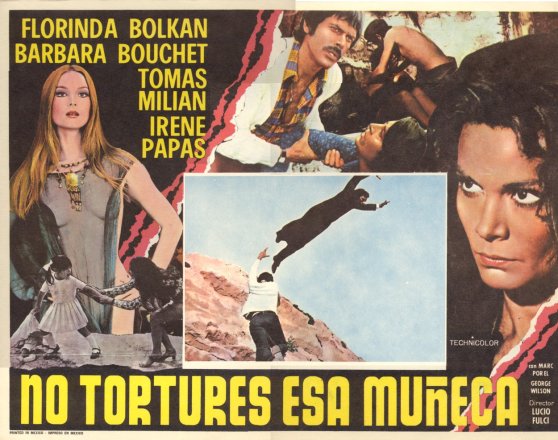
Known in Italy as Non si sevizia un paperino (Don’t Torture Paperino, because Paperino is what they call Donald Duck) and La Longue Nuit de L’Exorcisme (The Long Night of Exorcism) in France, this was what Fulci considered his best work. It’s a giallo, which if you don’t know, is an Italian movie tradition — kind of like a detective story, but often featuring POV shots from the killer’s perspective, plenty of gore, lots of sex and characters becoming drawn into a series of murders. The Bird with the Crystal Plumageis a good place to start — but this is a fine example, despite missing overt supernatural elements. It’s also the first film where Fulci would let loose with the gore — literal geysers appear in some scenes.
The film was controversial for its day, due to criticizing the Catholic Church, which led to a limited run in Europe and the film being unreleased in the US until 2000.
In the south of Italy, more specifically the small village of Accendura, Bruno, Michele, and Tonino are engaged in mischief and other activities. They do all the things you expect little Italian boys to do — smoke cigarettes, watch prostitutes have sex, abuse a pepping tom — earning the ire of La Magiara (Florinda Bolkan, also the star of Fulci’s giallo A Lizard in a Woman’s Skin), a witch who digs up the bones of an infant before conducting a ritual where she creates voodoo style dolls of the three boys, stabbing them with needles and chanting over them.
Bruno is the first to go missing, inciting a media frenzy as reporters from all over Italy find the story of the week. Andrea Martelli (Dennis Hopper’s The Last Movie, Fulci’s The Four of the Apocalypse) is one of them, but smarter than the rest. Sneaking into the police investigation, he wonders aloud why the kidnappers, who have called in a ransom, have asked for a small ransom. The peeping tom is arrested once it comes out that he buried the boy’s body — but he claims that he only did so to try and get the ransom. While he is held for questioning, the second boy, Tonino, is found dead, proving the innocence of the pervert.
Meanwhile, the final boy, Michele, meets rich girl gone bad Patrizia, (Barbara Bouchet from The Red Queen Kills Seven Times) who sunbathes in the nude and has no problem letting the young kid watch. Someone calls Michele during a rainstorm the next evening and he becomes the third victim.
This gives the reporter the chance to meet and get close to Patrizia. Turns out she’s hiding out in her rich father’s modern house after a drug scandal — MARIJUANA!!! — and the villages have already condemned her as a slut due to how she dresses. The reporter also meets the young village priest, Don Alberto Avallone, who lives with his strange mother and deaf, dumb and mentally deficient little sister.
Don Alberto is deeply affected by the boys’ deaths, as they were all pupils at his school and he attempted to keep them off the streets and playing soccer. He’s so well connected — both in town and with the Catholic Church — that he censors even the magazines on the newsstand. He remarks that he wishes that he could censor Patrizia.
One of the things you’ll notice about giallo is that the more you watch them, the more you realize that they just introduce you to character after character after character, unlike the traditional British or American detective story where everything happens for a reason.
That means it’s time to meet someone new — Francesco, an old man who lives in a cave, practices black magic and considers Magiara as his student. He refuses to cooperate with the police, so they hunt Magiara down and interrogate her. She begins to convulse, scream and froth at the mouth, happily admitting that she killed the boys because they disturbed her son’s grave. And oh yeah — that child was the son of the devil.
Even though she was nowhere near the murder scene, the villagers are convinced that she’s the killer. The police can do nothing but release her — a release that leads to her doom, as a walk through a cemetery leads to her being beaten with chains by a gang of men (several of the grieving fathers are in their number). This is where Fulci lets loose with the gore — each hit brings shards of flesh and bone and blood to the fore, ending with Magiara crawling up a cliff, begging for help as cars just pass her by.
To the shock of the villagers, the murders don’t stop. But at the latest one, Martelli has found a Donald Duck head. This makes Patrizia realize — she bought that doll for Don Albeto’s sister, after she found her walking with another headless doll.
Their theory — that the little girl is imitating her mother by pulling the heads off the dolls — is a decent one. But they’re wrong — it’s really the priest who was behind it all, killing the young boys so they can go to Heaven with clean souls. After a brutal fistfight, the priest loses his balance and falls to the rocks below. This scene would be awesome with modern effects work, but instead, Fulci must rely on a mannequin looking body — a sad sight as it’s in full close up numerous times as the body bounces off rocks and emits showers of blood.
Becca and I had the good fortune of seeing this film on the big screen at The Hollywood Theater — surrounded by around ten other people all wearing t-shirts emblazoned with their Italian horror film favorite (I demurred, not wanted to be that guy, and chose a Phantom of the Paradise design). I wouldn’t say it’s a fun film — no film stuffed with drowned and decimated children can be — but it’s well worth watching. There’s also a new Arrow Video deluxe edition that has recently come out, so you shouldn’t have to look all that hard for this movie. It’s worth it — provided that you’re not offended all that easily by attacks on church and state.
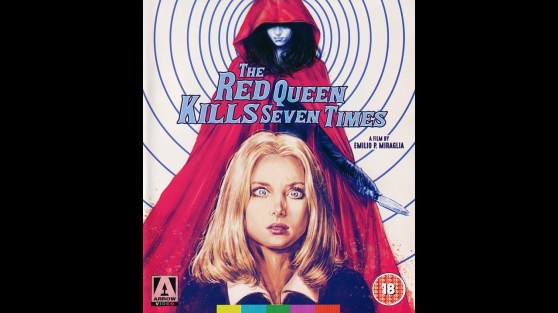
Emilio P. Miraglia followed up The Night Evelyn Came Out of Her Grave with this giallo freakout — starring the magnificent Barbara Bouchet (Don’t Torture a Duckling) — that combines gothic horror with the high fashion we’ve come to expect from early 70’s Italian horror.
A curse haunts the Wildenbrück family once every 100 years — two sisters have always become the Red and Black Queen, feuding until one of them dies. Then, the survivor is haunted by sixth deaths, with the final death — the seventh death, referenced in the title, being the surviving sister. Kitty (Bouchet) and Evelyn are the next two sisters to be so cursed, battling even in childhood, stabbing each other’s dolls with daggers.
These catfights have continued for years, ending when Kitty, now a fashion designer, accidentally takes it too far when she battles Evelyn. Third sister Franziska (Marina Malfatti, The Night Evelyn Came Out of Her Grave, All the Colors of the Dark) and her husband hide Evelyn’s body while Kitty pretends that her sister has gone to America.
All is well and good until the Red Queen rises, wearing a red cape and white mask, killing all of Kitty’s co-workers at Springes Fashions with the same dagger that was once used to slice up baby dolls. But is it really Evelyn, back from the dead (Emilio P. Miraglia sure liked Evelyn’s that rose from the dead)? Or something much more down to earth?
Miraglia only directed six films, with this being his last one. There are some moments in here that aspire toward art, like the Red Queen chasing Kitty through her dreams, ending in a long hallway run and her superimposed form attacking like a ghost. And the film flirts between the gothic castle era of Italian horror and the fashionista giallo look — all while containing plenty of deep red gore and plenty of skin, courtesy of a 20-year-old Sybil Danning (Howling II, Battle Beyond the Stars, Young Lady Chatterley 2). It’s not always art, but sometimes, it totally is. There are the requisite twists and turns of the genre, along with some really regrettable moments — like when a character goes from rapist to rescuer across two scenes and an ending where the hero and heroine both need saving.
There’s an amazing set of this that No Shame released with an actual Red Queen statue. And Arrow has, of course, put this out on Blu-Ray with Evelyn. It’s worth checking out — unless trying to add up the plot messes that a giallo brings makes you check out.
When I was a kid, I remember asking my dad what movies he thought were scary. He answered Night of the Living Dead and Gargoyles, so I was always nervous to watch this movie. It just looked strange, and in the late 1970s, it wasn’t like I could find it on demand. But the unique storytelling of Gargoyles always intrigued me.
Originally airing on CBS on November 21st, 1972, it was directed by Bill L. Norton (Baby: Secret of the Lost Legend, More American Graffiti) and written by Steven and Elinor Karpf (Devil Dog: The Hound from Hell, The Jayne Mansfield Story), Gargoyles may be uneven, but has moments of pure joy.
It’s one of the first films Stan Winston (Terminator, Aliens) worked on, providing a variety of gargoyle makeup. The look of the creatures is not just terrific, it’s downright amazing, as they don’t all look the same. The leader (Bernie Casey (Felix Leiter in Never Say Never Again, UN Washington in Revenge of the Nerds) has a perfect look that balances a regal bearing with an otherworldly aura. You can see why this won an Emmy. It’s big budget-worthy work on a shoestring budget.
Speaking of budget, the film was shot with just one camera over 18 days, which chased away the original director. Temperatures at the Carlsbad, NM location, baked the cast and crew, reaching 100 degrees or more the entire shoot. So it’s incredible that what emerged is so interesting.
The opening dialogue informs us that Satan lost the war in Heaven, with his children being the gargoyles who rise against man every six hundred years (there’s even an image from Haxan to symbolize the devil). This dialogue is by Vic Perrin (Tharg from the “Mirror, Mirror” episode of Star Trek, and the voice of Metron and Nomad), who also provides the crazy VO for the head, Gargoyle.
We join Dr. Mercer Boley (Cornell Wilde, No Blade of Grass), author of the occult, and his daughter, Diana (Jennifer Salt ofSistersand Son of Sam TV movie Out of the Darkness) as they head off to the desert — and Uncle Willie’s Museum — where they find a skeleton of a creature that Willie (Woody Chambliss of Zero Hour! and The Devil’s Rain!) claims he saw in the hills. The doctor doesn’t believe a word, but his daughter listens to his tales, only to be cut off by the sound of wings and something trying to get into the museum. Whatever it is, it sets off a fire that kills Uncle Willie.
They head to a local motel run by Mrs. Parks (Grayson Hall, who played Dr. Julia Hoffman in Dark Shadows and Carlotta Drake in Night of Dark Shadows), who is never without a drink in her hand (an acting choice by Hall that we can endorse). Two of the gargoyles try to take back the skeleton they’ve rescued from the inferno, but one is hit by a truck. It seems like the doctor sees money in the bodies of these gargoyles, alerting the group’s leader to his plan. He kidnaps Diana, showing her the eggs his people care for and explaining that they just want to live in peace with humans.
Throw in a bunch of motorcycle riders (including Scott Glenn of The Right Stuff and Silence of the Lambs), cops who can’t understand what is going on, the finest hound dogs in the area, an all-out war between humans and Gargoyles with way too much talking and you have this movie. But I can’t dislike it — it’s filled with great moments like the leader making Diana read to him about the historical account of an incubus seducing a woman and the speech he gives to the humans at the end. The closing image of a Gargoyle flying away, clutching a wounded female of his species? Amazing.
It’s worth seeking out, if only to see how horror used to be all over 1970s TV. If you grew up in that era, you have less of a chance of dismissing this movie as dumb.
At one point, network TV was the only home entertainment option. And for so many genre fans, they were rewarded with some truly amazing offerings. Sure, there are plenty of fangless horror telepics, but there are also so many more incredibly frightening and well made ones, too. We say all the time — they don’t make them like this any more — well, this is one time where that’s completely and utterly true.
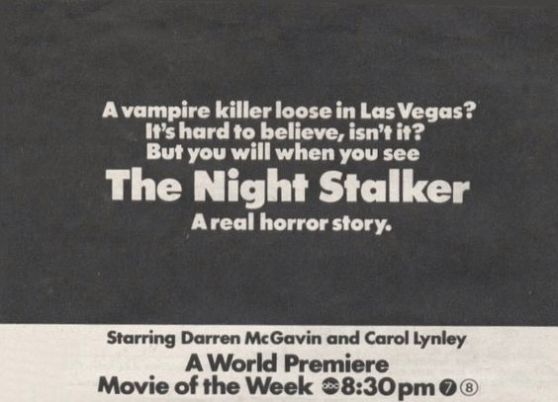
Originally airing on the ABC Network on January 11, 1972, The Night Stalker was based on an unpublished Jeff Rice novel, adapted by Richard Matheson (I Am Legend, The Incredible Shrinking Man, Corman’s The Pit and the Pendulum, The Devil Rides Out, even Jaws 3-D) and produced by Dan Curtis (Dark Shadows, Burnt Offerings, Trilogy of Terror), The Night Stalkerremained one of the highest rated TV movies for nearly a decade.
Directed by John Llewellyn Moxey (Home for the Holidays, Genesis II, No Place to Hide, The City of the Dead/Horror Hotel), this is 75 minutes of concentrated horror all with a main character that would directly connect to the fears and worries of the 70s. As part of the heroic press, a muckraker who won’t take no for an answer and who is willing to push and push and push to the point that his happiness and life are in constant danger, Carl Kolchak has been kicked out of nearly every major newspaper in every major city — more than once. He’s now a reporter in the gleaming neon world of 70s Vegas, working for (more like driving crazy) editor Tony Vincenzo.
The film opens with Kolchak listening to his own dictation of his last major story. Seems like a vampire — or something a lot like one — has been attacking women and draining them from their blood. Thanks to Kolchak’s fact checking and nose for clues, the police, sheriff’s department and DEA land on a suspect – Janos Skorzeny (Barry Atwater, who also hosted the Horro-Ritual that played before Dracula A.D. 1972), who is way older than his physical appearance suggests. Murder and chaos have followed Janos around the world, which the Vegas cops get to see for themselves when he’s shot nearly thirty times at point blank range before killing four cops and putting one in the hospital. Even though he accomplishes all of that — and outruns a police motorcycle — the forces of order refute Kolchak’s claims that they’re facing a vampire (thanks to the urging of his dancer girlfriend, Gail Foster).
Finally, the police realized that they have to listen to Carl, setting up a deal: if he’s wrong, he’ll leave Vegas forever. But if he’s right, he gets to publish his story. The pursuit of the vampire ends with Carl staking the creature while an FBI agent — finally, a credible witness — watches.
The real reason why I love The Night Stalker comes after all of this action. Kolchak is overjoyed — he finally has the story that will bring back to New York City. He proposes to his girlfriend, finally gets praise for being a great reporter from his editor and goes to see the mayor, ready to tell him to eat crow. But you can see it in Darren McGavin’s nuanced performance that the moment that Vincenzo tells him that he’s a great reporter that he knows that everything is about to unravel. This is a hard man, a man who has tumbled from the heights so many times that he is used to the fall.
Turns out the powers that be don’t want the story to get out there. They publish a false story written by Karl and charge him with the murder of Skorzeny — unless he leaves town. He tries to call Gail, but she’s been forced to leave the city for “unsavory activities.” His bags are already packed. And that’s that — we return to that empty hotel room, Kolchak explains that he spent his life savings trying to find Gail again by placing personal ads all over the country. He can’t prove his story — and everyone else involved has disappeared or is dead. Even the vampire and all of his victims have been cremated.
The success of The Night Stalker led to another movie, The Night Strangler, and a series (while it only lasted a season, it still plays on ME-TV 40 years later and four of the episodes were edited into movies for the rest of the world). Plus, this show is the spiritual father to The X-Files, a fact acknowledged when McGavin played the father of the X-Files, Arthur Dales (creator Chris Carter wanted him to play Kolchak, but he refused). Well, spiritual father to the show in the way that almost every episode of The Night Stalker was referenced by Carter’s show — but we do imitation here, don’t we?
There was a great double disk of the first two Kolchak movies that’s out of print now. But it’s worth seeking out. You’ll be impressed by how much story, character and mood can be jammed into 75 minutes.
UPDATE: You can get the Kino Lober blu ray of this at Diabolik DVD.


 B&S About Movies
You must be logged in to post a comment.