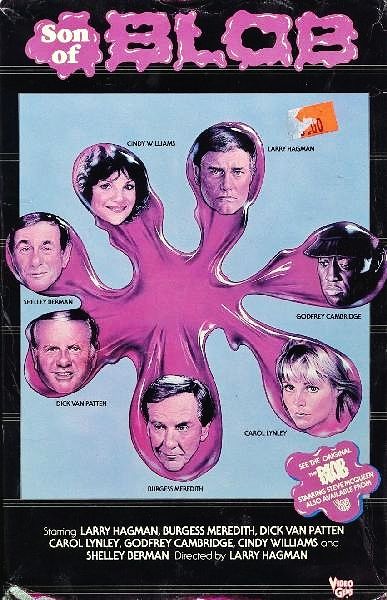
Beware! The Blob or Son of the Blob is a big idea to get your head around. While the original was presented as horror, this film pretty much leans in to how ridiculous it all is. Written by Anthony Harris and Jack Woods from a story by Richard Clair and Jack H. Harris, a lot of this was improvised on set and the script — even though it took all those people — was mostly ignored.
Harris was also the producer and Anthony was his college graduate son. They were next door neighbors with Larry Hagman — who had previously directed episodes of I Dream of Jeannie and The Good Life — who had never seen The Blob. Harris screened his print for the actor/director, who loved it and said that he could get a lot of his Hollywood friends to show up and get blobbed, as long as he could direct.
Fifteen years after the original Blob destroyed parts of Pennsylvania, Chester (Godfrey Cambridge) has brought a piece of that creature from its frozen grave in the North Pole, where he does the sensible thing and puts it in the fridge. It grows in size as it eats a fly, a kitten, then his wife Marianne (Marlene Clark) and finally, while Chester watches The Blob on TV, it eats him too just in time for Lisa (Gwynne Gilford) to watch him get claimed by the creature.
As she tries to get her boyfriend Bobby (Robert Walker Jr.). to believe what she’s seen, the red jelly eats its way through Los Angeles, claiming the lives of two hippies (Randy Stonehill and Cindy Williams) in a storm drain — were they looking for Simon? — as well as officer Sid Haig, chickens, horses, a bar, a gas station, Scoutmaster Dick Van Patten, a barber (Shelley Berman) and even some home-displaced folks (Hagman, Burgess Meredith and Del Close, who is wearing an eyepatch as his cornea was scratched by a cat previous to filming; he’d return with a similar look as Reverend Meeker in perhaps the best horror remake of all time, 1988’s The Blob).
It takes an ice rink — which was torn down shortly after filming — to stop the monster — maybe — this time. As for the bowling alley in this movie, it’s Jack Rabbit Slims from Pulp Fiction.
In the first movie, the Blob was made of silicone and dyed red. It had to be stirred throughout the movie to keep its color. This Blob was made from a red-dyed powder blended with water, as well as a big red plastic balloon, red plastic sheeting and a red drum of hard red silicone spun in front of the camera. Tim Baar and Conrad Rothmann created these effects and beyond working on second unit camera, Dean Cundey helped, years before he’d become such a force in filmmaking.
In 1982, when Hagman was on Dallas and the shooting of his character J.R. Ewing was the biggest moment in pop culture, this was re-released with the headline “The film that J.R. shot!”
EDITOR’S NOTE: This article was originally on the site on November 6, 2018 and is written by Bill Van Ryn. Now you can see it this weekend at the Drive-In Super Monster-Rama! Get more info at the official Drive-In Super Monster-Rama Facebook page and get your tickets at the Riverside Drive-In’s webpage.
There was something great about growing up in the 70s as a monster kid. With VHS still a distant promise waiting over the horizon, TV was the only way you could access movies once they passed through your local theaters–and if you were a kid, seeing them theatrically usually meant pleading your case with an adult who was totally disinterested. TV was the last stand. Fortunately, local stations desperate for programming often filled their lineup with syndicated packages of older films. Horror movies often turned up as time-fillers on local TV, usually in late night slots meant for insomniacs and people who worked graveyard shift. What this meant for us monster kids was, we scoured the TV Guide looking for movies noted “THRILLER”, and then you had to make a decision about whether or not it was worth staying up until 3am to watch.
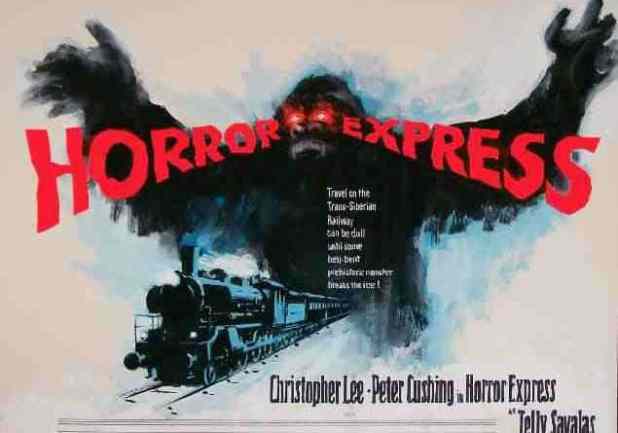
1972’s Horror Express was one of those flicks that I *never* missed, no matter what. Not only does it star Christopher Lee and Peter Cushing, Telly Savalas shows up about halfway through the film as a Russian cossack (!), and it’s got a series of simple but gruesome attack scenes that were some of the goriest things I’d seen up until that point. The story is set in the early 1900s, and Lee plays an anthropologist who discovers a hairy ape-like fossil in the Himalayas. Believing it to be the missing link, he crates it and hurriedly books passage on the Trans-Siberian Express in order to return to England with it as quickly as possible. Cushing is a colleague of his who is also on board, and immediately senses that Lee is up to something noteworthy. Unbeknownst to anyone, the creature is actually the last vessel of an extraterrestrial intelligence that has the ability to lock eyes with its victims and drain their brains of all information contained therein. It gets out of the crate and starts absorbing people. Its victims die gruesomely in the process, bleeding profusely from the eyes, which turn white like a boiled fish. This alien presence can also transfer itself to another host in this way, allowing it to jump from body to body if necessary.
Horror Express is a British/Spanish coproduction directed by Eugenio Martin, who had just made the movie Pancho Villa starring Telly Savalas. Martin used the same train set from that previous film, and each different “car” of the train was actually the same set redressed for each new part of the train. That meant that the entire film had to be shot out of order, with every scene taking place in the corresponding car being completed before the set was taken down and redressed. The movie was shot silent, with the entire soundtrack dubbed in later, although Lee, Cushing, and Savalas all did their own dubbing, so their familiar voices are all present.
Most importantly, the story is engaging and clever, with the mystery of the creature being slowly unraveled by the protagonists using clues left behind. One of the more outlandish moments has Cushing obtaining the eyeball of the now dead fossil and extracting fluid from it — fluid that somehow contains actual images that the host observed, now visible under a microscope! This is how they determine that it was from outer space and had been on Earth since prehistoric times. Hey, it’s as good an explanation as anything, right?
Although not a Hammer production, this movie definitely feels like one, especially since we have Lee and Cushing together in the same film. It was perfect for late night television, and it was hard for me to forget those bleeding white eyeballs after I saw this movie. You’ve probably already noticed the similarities to the story Who Goes There? by John W. Campbell, the basis for “The Thing”, and I always loved the way this movie sets up the hairy fossil as if it’s the villain. Eventually you realize that whatever the fossil was, it was just a shell, another victim of the real monster. Although we’re talking about the Chilling Classics public domain version of Horror Express, there exists a fabulous blu ray transfer from Severin Films, definitely worthy of your hard earned dollars.
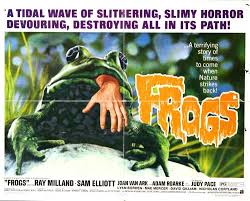
The Crockett family, led by Jason (Ray Milland), may have great power and influence, but nature in no way cares about those things. Snakes, birds, geckos, alligators, turtles, butterflies and, yes, frogs, are prepared to end their lives for daring to abuse the ecosystem with pesticides.
Wildlife shutterbug Pickett Smith (Sam Elliot) picked the wrong holiday weekend to be in their Florida mansion.
Directed by George McCowan, whose career often found himself working in episodic television, and written by Robert Hutchison and Robert Blees (Whoever Slew Auntie Roo?, Dr. Phibes Rises Again), I am sad that I will never live the life of drive-in aficionados of 1972 who got to see this with Godzilla vs. the Smog Monster.
I have no idea if the animals are turning on all of humanity — I mean, Jason’s dog remains loyal — or if it’s just this family, but I love the swampy world that this movie makes, one that makes nearly every creature in the world outside the Crockett home into a killer ready to work together and wipe out rich folks.
This also has tons of stock footage of animals which is how you make a low budget movie about a whole bunch of animals. As it was, the hotel everyone was staying in was adamant that no animals were allowed to stay in the actor’s rooms, as if that would be a thing.
EDITOR’S NOTE: As I finish out Cannon month, I’m looking into the films of 21st Century before Menahem Golan took it over.
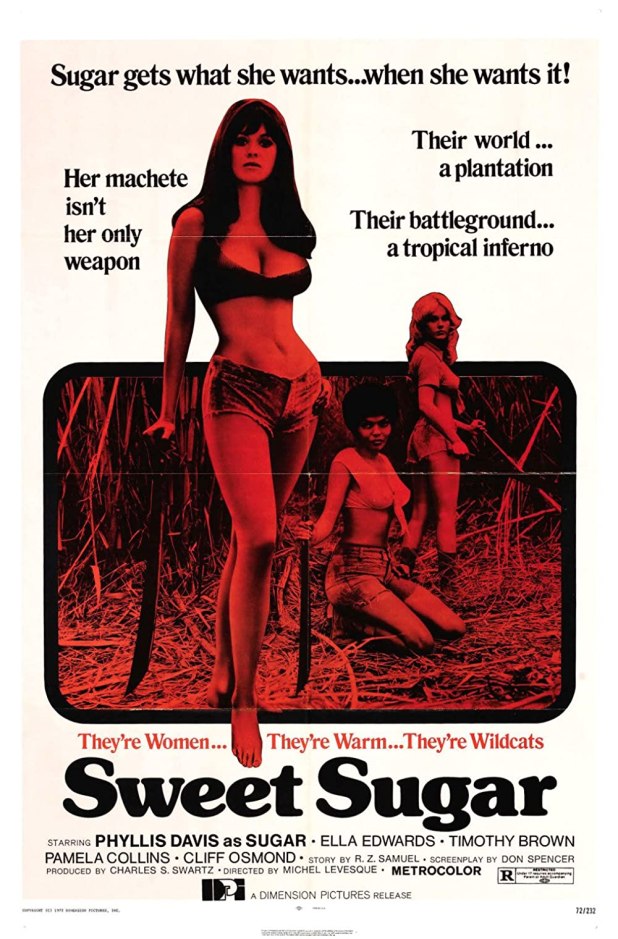
Sugar Bowman (Phyllis Davis, who was Susan Lake in Beyond the Valley of the Dolls) has taken a deal to serve two years working on Dr. John’s (Angus Duncan) sugarcane plantation rather than be in prison for a crime she didn’t commit. When she’s not out in the fields cutting crops with a machete all day, she and the other inmates get drugs tested on them by Dr. John who also is into assaulting the younger of his prisoners.
The female inmates have this scam where they are hiding Simone’s man, Mojo, but the guards catch and kill him by burning him at the stake. The women respond by setting the fields on fire and teaming up with the guards to escape. Dr. John claims to be immortal, so Simmone tests this theory by blowing up her jeep, killing both of them so Sugar can escape.
Director Michel Levesque was an art director on Russ Meyer’s Up!, Supervixens and Beneath the Valley of the Ultravixens, as well as The Incredible Melting Man, Ilsa, Harem Keeper of the OilSheiks and Savage Journey. He also did the same for Silk Stalkings, so if that show seemed kind of filthy, well, there you go. He also directed Werewolves on Wheels. It was written by Don Spencer (The Big Doll House) and R.Z. Samuel.
I can’t think of a WIP film that has orgasm-inducing drugs or voodoo, so for that, Sweet Sugar is more than worth a watch.
EDITOR’S NOTE: Cannon did not produce this movie but released it on video in Denmark on the Cannon/Mayco label.
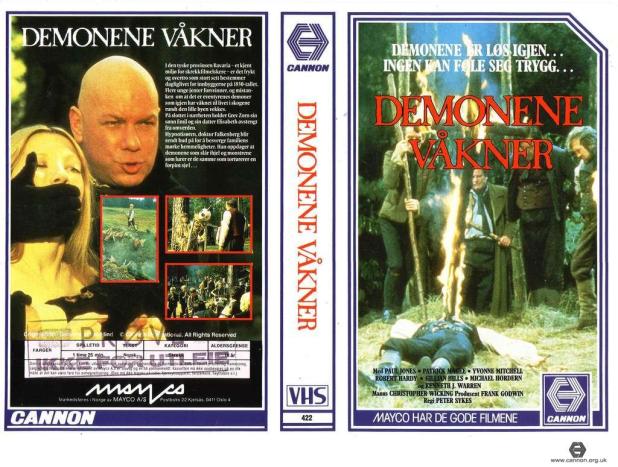
Between Venom, To the Devil a Daughter and this movie, Peter Sykes is an unappreciated creator of early 70s scummy horror. Written by Christopher Wicking (Cry of the Banshee, Scream and Scream Again), this movie combines insanity, mesmerism, religious fervor, incest, Satanic possession and just plain British weirdness to make the kind of movie that we watch on a rainy Sunday.
Baron Friedrich Zorn (Robert Hardy) keeps his children Emil (Shane Briant) and Elizabeth (Gillian Hills) locked up and away from one another, lest they make sweet sweet brother and sister love in the name of the devil. After all, his own wife had a madness like theirs that led to her suicide in front of both of them — or maybe he just wouldn’t sleep with her any longer and she got so upset at the loss of getting some of little Friedrich that she offed herself — so they both must be constantly treated to the bloodletting that takes out the evil flowing through their bodies.
Meanwhile — if that’s not enough –women s are being murdered in the woods and covered with rose petals. The townspeople think demons are to blame and by the end of the movie, they go absolutely beyond wild and try to wipe out the cause. There’s also Doctor Falkenberg (Patrick Magee) who has a carny method of curing the evil out of the Zorn progeny; he intends to get a village woman named Inge (Virginia Wetherell) to portray their dead mother in a strange roleplaying exercise while another young local named Carl (Paul Jones, who once sang for Manfred Mann) falls for Elizabeth. And oh yeah — maybe the Baron is more to blame than anyone.
Gillian Hills was a last minute replacement for Marianne Faithful, but the early 70s were not a good time for her, as she lost her son and was dealing with heroin addiction, anorexia and living on the streets. She wasn’t able to be insured for this movie.
I’m a lover of late period Hammer, as they move away from the classics and start to make their own weird little movies. Of course, they’re often filled with lots of nudity, madness and Satanic forces, so…look, I’m weak and I love what I love.
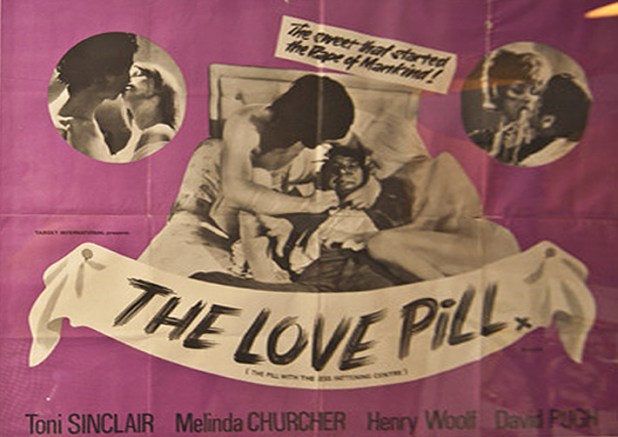
Directed by Ken Turner (who may have been more used to directing the puppets of Joe 90 and Captain Scarlet and the Mysterons) and written by Laurence Barnett (the inventor of the British game show Zodiac Game), Jesnar and hardcore filmmaker John Lindsay, The Love Pill has a man named Libido (his real name Henry Woolf is even better) developing a candy that is both a contraceptive and an aphrodisiac.
Probably the only thing worthwhile in this sex comedy which is neither funny nor sexy is the fact that the Love Pill makes women into the sexual aggressors, which mirrors one of the more frightening realizations of the sexual revolution and one men still can’t wrap their minds around: women may want sexual pleasure more than them.
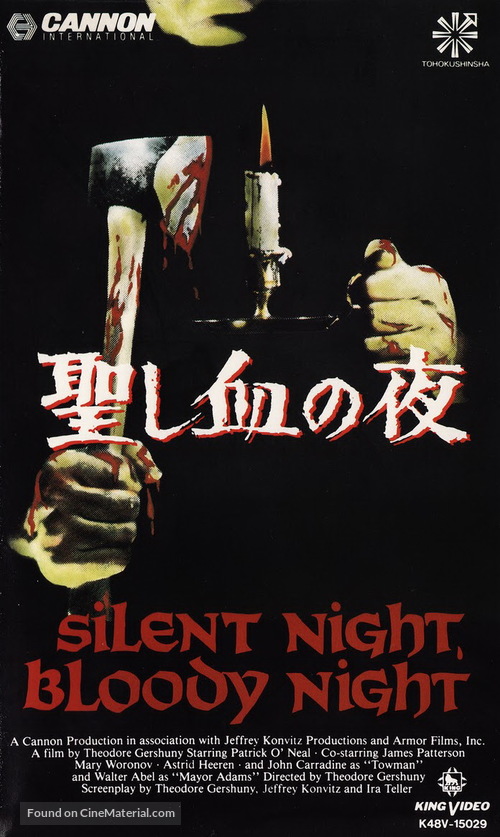
Christmas Eve, 1950: Wilfred Butler runs from his home, on fire, and supposedly dies in the snow.
Christmas Eve, 1970: John Carter (Patrick O’Neal, The Stepford Wives, The Stuff) and his assistant Ingrid arrive in a small Massachusetts town. He meets with the town’s mayor, sheriff and major citizens like Tess Howard and Charlie Towman (John Carradine!), who may have lost his voice to a tracheotomy but not his need to smoke, about selling the Butler mansion as soon as possible. While staying overnight with Ingrid, who is also his mistress, they are both killed by an axe. The killer calls the police and says that they are Marianne.
Tess, the town’s telephone operator, hears the call and drives to the mansion, where she is greeted by Marianne Butler before she is hit in the head with a candle holder. Meanwhile, Sheriff Mason finds that Wilfred’s grave is empty. He is killed and thrown into the empty hole.
Mayor Adams is asked to go to the Butler mansion but leaves his daughter, Diane (Mary Woronov, Death Race 2000, Chelsea Girls) at home. She meets up with a man who claims to be Jeffrey Butler, who has taken the sheriff’s abandoned car. Together, they search for the lawman but can’t find him.
After taking Towman to the mansion, Jeffrey goes back to get Diane. On their way to the mansion, Towman stumbles blindly in front of them and is hit and killed. His eyes had been stabbed out and Diane grows worried about Jeffrey.
Well, fuck me, this movie is also about incest! A diary found at the house reveals that Jeffrey is the son of Wilfred and his daughter, Marianne. Afterward, Wilfred turned the house into an asylum and admitted his own daughter. However, on Christmas Eve 1935, he turned all of the inmates loose. They killed every doctor as well as his daughter. Of note here is that many of the inmates in the flashback are played by former stars of Warhol’s factory, like Ondine, Tally Brown, Kristen Steen and Lewis Love, as well as Flaming Creatures auteur Jack Smith, artist George Trakas and his wife at the time, Susan Rothenberg. Warhol superstar Candy Darling also shows up in the film as a party guest.
Well, it turns out that some of the inmates of the insane asylum ended up being important parts of the town — that’s right, all of the important people John met with in the beginning!
Mayor Adams arrives at the mansion and he and Jeffrey face off, guns drawn, each believing the other is the killer. They kill one another as Marianne shows up, but she is really Wilfred, who is alive. He went after the inmates for their role in the death of his daughter and used his grandson/son/secret shame Jeffrey as a patsy. Diane gets the gun and kills the old man. One year later, the mansion is demolished as she watches.
Director Theodore Gershuny worked on plenty of episodes of Monsters and Tales from the Darkside after this film. He was also married to Woronov. The original title for the film was Night Of The Dark Full Moon and it was also nearly called Zora, which makes little to no sense.
There are some really interesting techniques here, especially in the flashback sequences, which feel like tinted photographs come to life with the saddest version of “Silent Night” ever playing behind the action. I love how experimental and dark these sequences look — they remind me a little of the film Begotten.
This is a dark film for your holiday viewing, so if you want to chase away the family for a while, this is the one to do it.
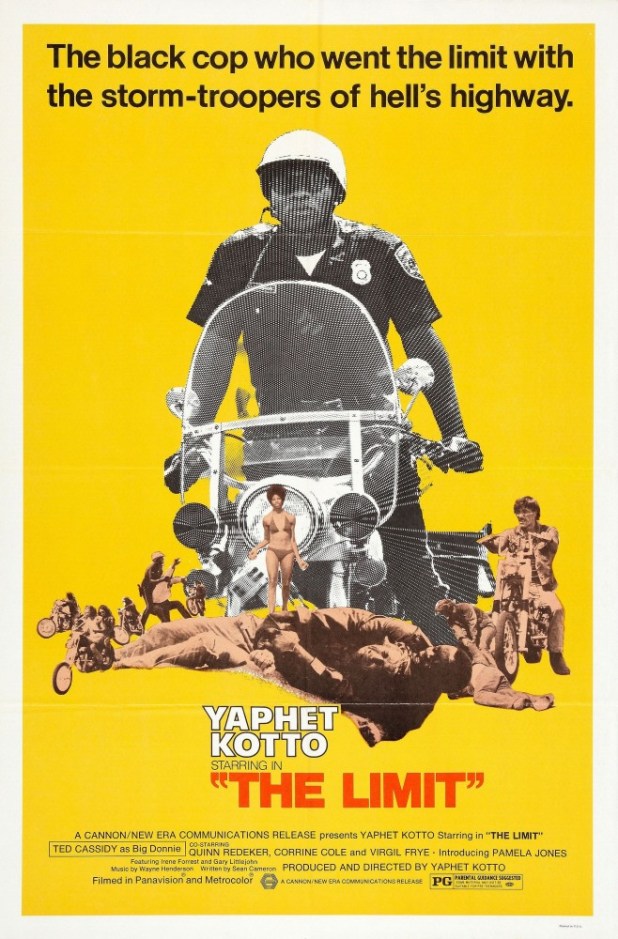
Black motorcycle police officer Mark Johnson (Yapphet Koto, who directed and co-wrote this movie with Sean Cameron) and Jeff McMillan (Quinn K. Redeker) patrols the worst neighborhoods, seeking to control the gangs like the Virgins. Yet wen Mark bonds with their leader Big Donnie (Ted Cassidy), it causes a rift in the gang with Donnie’s lieutenant Kenny (Virgil Frye).
Originally named Speed Limit:65, the film finds the gang now menacing Mark’s girlfriend Margaret (Pamela Jones) and Donnie’s pregnant partner Judy (Corinne Cole).
This movie is near-impossible to find, so if you have a copy, please let me know.
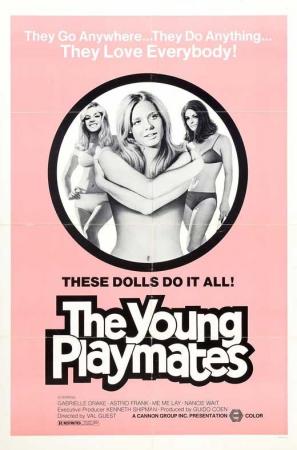
Also known as Au Pair Girls, this was filmed on the estate of George Harrison and was based on a script by producer David Grant. The original story was much more sexually explicit than what the final film ended up being thanks to director Val Guest, who disliked the pornographic ideas that Grant had.
Guest also directed The Quatermass Xperiment, Quatermass 2, The Camp On Blood Island and The Day the Earth Caught Fire before making Confessions of a Window Cleaner, Toomorrow and When Dinosaurs Ruled the Earth.
There are four au pair girls:
The Danish Randi (Gabrielle Drake, Lt. Ellis on Gary Anderson’s UFO) works for a mean businessman and when his son picks her up at the airport, she ends up sleeping with the young man before they even get up to his boss’ office.
Swedish Anita (Astrid Frank) teases Mr. Howard, the older man she’s working for, yet doesn’t realize that she’s doing it. Then she ends up getting picked up by a sheik (Ferdy Mayne) who wants to take her back to his home.
Chinese Nan (Me Me Lai, not having to deal with cannibals this time) works in a large mansion where she falls for a concert pianist and German Christa (Nancie Wait) loses her heart and virginity to a rock star.
We follow each story throughout the movie, going from girl to girl as their dramas unfold. Some of the stories are ridiculous, some are sad and all try to be sexy. It doesn’t always succeed, but it is a travelogue film too if you enjoy that.
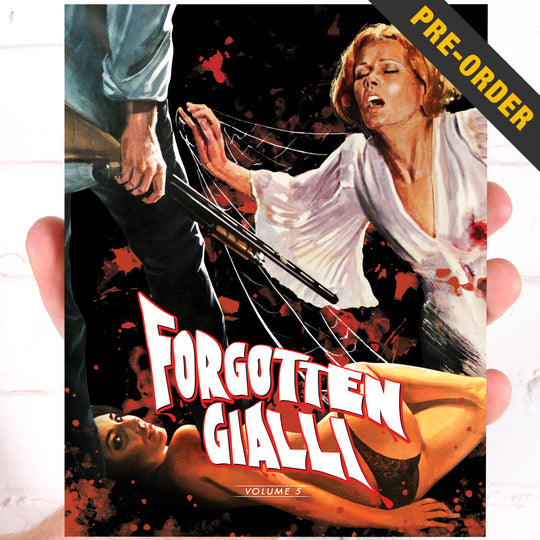
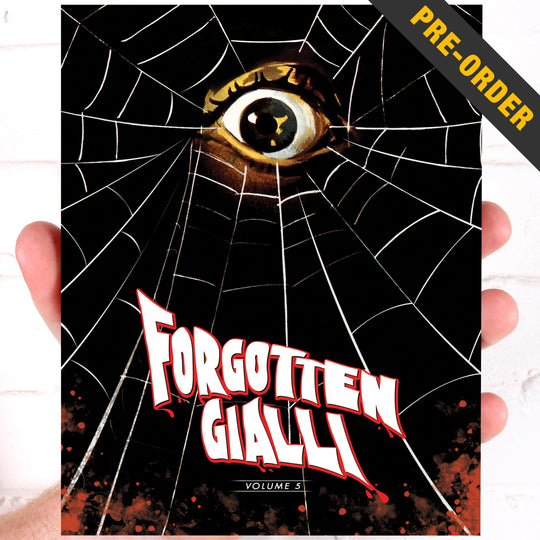
Vinegar Syndrome has a few Forgotten Gialli set out and each of these keeps adding some great movies to my collection in the best possible format with so many extras. Here’s what’s in the new one, which is now available for order.
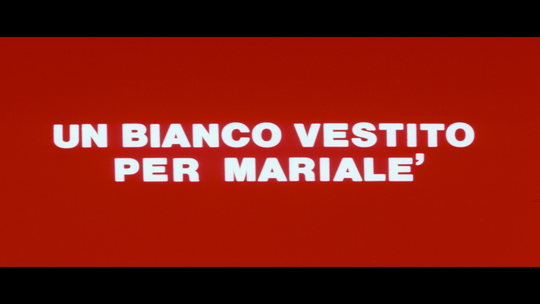
A White Dress for Marialé (1972): Going by the names Un bianco vestito per Marialé, Spirits of Death and Exorcisme Tragique (Tragic Exorcism), this giallo was directed by Romano Scavolini, who would one day make Nightmares in a Damaged Brain.
When she was quite young, Marialè (Ida Galli) watched as her father killed her mother, her lover and himself. She’s grown up a depressive recluse married to the controlling Paolo (Luigi Pistilli) who keeps her sedated. But she still has enough friends to invite over to her mansion for a costume party orgy, which goes well until this film remembers that it’s not an art film but instead a giallo and people start dying.
Let’s take a look at the guest list.
There’s her ex-lover Massimo (Ivan Rassimov) and when we see Rassimov in a giallo, he is never up to any good.
If you’re having a wild 70s sex party, always invite a love triangle. That’s how Mercedes (Pilar Velasquez), Joe (Giancarlo Bonuglia) and Sebastiano (Ezio Marano) all got to the party.
There’s also Semy (Shawn Robinson, who sang the theme for Two Males for Alexa; this is her only acting role) and her husband Gustavo (Edilio Kim).
Just about every one of them are horrible people given to attacking — for good or bad — one another, while Marialè stays in her bedroom and wears the same dress that her mother was in when she died, bullet holes over the heart, covered in blood.
A gothic and stylish film, this made me reconsider Scavolini and see him as much better than a hack who was making a slasher when that was how people made money. I wish that he’d stayed more experimental like this movie. Then again, in the book Spaghetti Nightmares, he said that was a movie “which only deserves to be forgotten.”
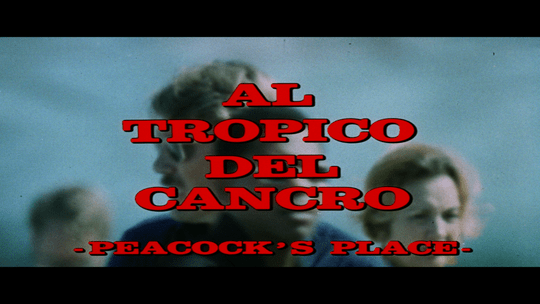
In this film, she plays Grace, the wife of Fred (Gabriele Tinti, Endgame) and their vacation has led them to Haiti and Dr. Williams (Anthony Steffen, who mostly is known for Italian westerns, but also appeared in The Night Evelyn Came Out of Her Grave, Evil Eye and An Angel for Satan), who has invented a new drug that can change the world. It’s so astounding that everyone from drug cartels to drug companies — which are really close to one another, when you really think about it — will kill for its formula.
There’s also a scene where the doctor takes our heroes to watch a voodoo ritual, all so this movie can have a bit of mondo* within it. Because it’s an Italian film, that means we’re about to watch a real bull really get killed and then lose its scrotum in gorgeous living color. The film then tops this with actual cows being slaughtered, so if you’re upset by the side of Italian cinema that doesn’t shy away from putting animal butchery right in your face, make a mark to avoid.
This movie leaves me with so many questions. What kind of doctor is Williams? He says he’s a veterinarian, then he makes a magical anti-venom drug and oh yeah, he’s also a meat packing inspector. And just what kind of wonder drug has he made? And did the filmmakers realize that the Tropic of Cancer is nowhere near Haiti?**
So yeah — most of the movie is spent wondering whether or not Grace is going to succumb to the lure of the native men***. And the best character in it is Peacock (Alfio Nicolosi, who was also in Goodbye Uncle Tom), who pretty much runs the island. Also, the murders in this go from high tech to voodoo-based death and faces getting melted right off, which is different for a giallo****.
And hey — that Piero Umiliani (Orgasmo, Baba Yaga) score is perfect!
It’s not a great giallo, but it certainly is weird, and sometimes, that’s good enough.
*One of the directors of this film, Giampaolo Lomi, was the production manager for perhaps one of the most notorious mondo films, Goodbye Uncle Tom. The other, Edoardo Mulargia, directed Escape from Hell, which was edited into the Linda Blair movie Savage Island. So with backgrounds like those, the scummy mondo nature of this film makes a bit more sense.
*Of course, we can assume that with the Henry Miller novel being such a big deal getting banned and causing controversy that the title itself seemed like a good idea to get curious folks into the theater. Better than Death In Haiti, Peacock’s Place or Inferno Under the Hot Sun.
***The flower that poisons her takes her on an insane erotic fever dream that we all get to watch and the movie is better for this scene.
****There’s just as much — if not more — male than female nudity, too.
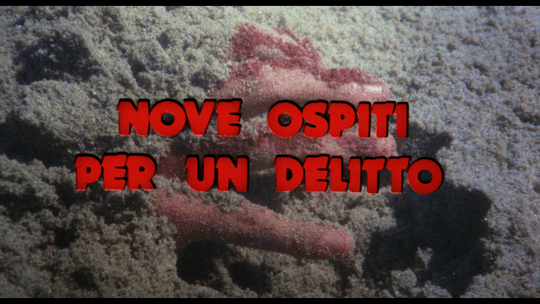
Nine Deaths for a Crime (1977): I get it — 1977 is late for the category and Ferdinando Baldi is better known for making weird westerns — like Get Mean and Blindman with Tony Anthony, not to mention two 3D movies with the very same actor, Comin’ At Ya!and Treasure of the Four Crowns — than giallo. But hey. when you’re trying to watch every one of them made, you watch them all.
Known in Italy as A Scream in theNight, in Spain as Death Comes From the Pastand Nine Guests for a Crime in other markets, this movie follows the Agatha Christie model of nine people — wow the title actually is logical — showing up on an island that has a killer stalking about.
Well, get this. There are thirteen murders in a movie with nine guests, so how about that?
A wealthy family has departed for a two-week break at their private island estate, which primarily involves plenty of balling, as The Pink Angels trailer would say. Ubaldo (Arthur Kennedy, who won a Best Supporting Actor Tony for Death of a Salesman and was nominated for five Oscars before making movies like The Humanoid, The Sentinel, Cyclone and being one of the worst cops ever in The Living Dead at Manchester Morgue) has taken his new wife Giulia (Caroline Laurente, who played three different roles in Emmanuelle2, 3 and 7) along with his sister Elizabeth (Dania Ghia, Seven Deaths in the Cat’s Eye), his sons Michele (Massimo Foschi, Holocaust 2000) and his wife Carla (Sofia Dionisio, Live Like a Cop, Die Like a Man), Walter (Venantino Venantini, Beast in Space) and his bride Patrizia (Loretta Persichetti) and Lorenzo (John Richardson, Black Sunday) and Greta (Rita Silva, Gunan, King of the Barbarians).
Michele has been doing two-person pushups with his stepmother. Walter has been threading the needle with Greta. But then Baldi goes from ripping off Bava’s Five Dolls for an August Moon — which yes, is also a Christie pastiche — into full A Bay of Blood and even the supernatural theory that Elizabeth’s dead lover Carlo is back from the dead (and the Tarot reading sequence, which gets stolen even better in Antropophagus).
This movie has reminded me that I want nothing to do with rich people or island vacations. Nothing ever works out and I’d rather stay alive and undramatic for the short period I do have left in this dimension.
This set features all three movies, newly scanned & restored in 4K from their 35mm original camera negative. You get so much more — interviews with directors Romano Scavolini, writer/director Giampaolo Lomi, actress Ida Galli and actor Massimo Foschi; audio essays by Rachael Nisbet, deleted scenes, trailers, image galleries and so much more. Order it now from Vinegar Syndrome.

 B&S About Movies
You must be logged in to post a comment.