One part mondo pseudo-doc about the Italian drug scene and one part hippy vs. organized crime caper film, Giuseppe Maria Scotese’s Acid – Delirio dei Sensi is right up my alley in two different much-loved film genres all smashed together.
While I’ve never done acid, I can tell you that I truly doubt if anyone who made this movie has either and you know, I can respect exploitation enough to be fine with that. Whereas a movie like The Trip feels inhabited by real folks who have traveled to inner worlds, this is a movie that proclaims to tell you the truth and ends up like an episode of Dragnet minus girls getting dosed and thinking they can fly. Here, they just get nude and jump in a public fountain.
That said, the eagle-eyed lovers of the kind of films this site talks about will spot Stephen Forsyth, the mannequin obsessed maniac in Mario Bava’s Hatchet for the Honeymoon and John Bartha, who was in everything from Dracula in the Provinces to Salon Kitty, Fulci’s White Fang movies and Cannibal Ferox.
However, this movie does have one person in it who has dropped in and dropped out before. Look for Humphrey Osmond, who came up with the term psychedelic.
Once, when I was a kid at the roller rink, we had to wait to get inside for a few minutes and some kids were smoking cherry flavored cigars. I was sure they were marijuana and went home in tears, telling my parents. I was a narc. A nine-year-old narc! And I blame movies like this.
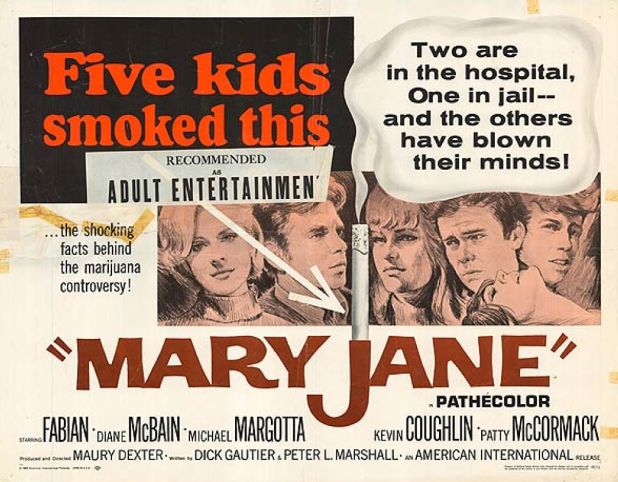
How weird is it that this warning about the dangers of drugs movies was made by American-International Pictures, the same studio that made The Trip a year before?
Maury Dexter also made The Mini-Skirt Mob, The Young Animals and Hell’s Belles for AIP, which are less preachy than this one, which at least has Fabian in it as a teacher who everyone is convinced is hooked on the pot when its really his students. Speaking of bad kids, Patty McCormack is in this. She belongs to the Maryjane club, who all have their own buttons, along with an incredibly young Teri Garr. I have to say, I do love that the kids in this aren’t sneering maniacs. They’re nomal students.
I’ve never met an art teacher who also coaches football and my dad was an art teacher, so I should know.
That said — this was written by Dexter and Peter Marshall. Yes, the same guy who hosted Hollywood Squares.
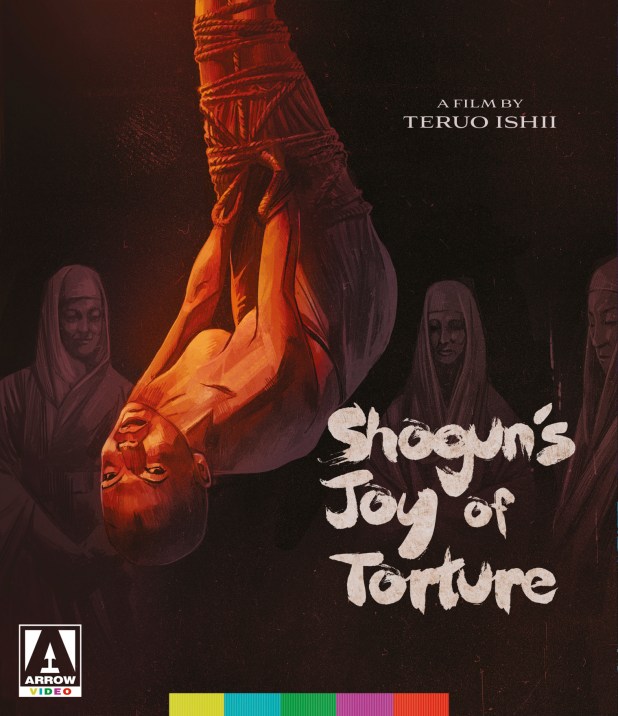
Teruo Ishii (Inferno of Torture, Invaders from Space, Horrors of Malformed Men) is mostly known for his ero-guro (erotic-grotesque) films, but his oeuvre jumps all over the place, from science fiction to sequel series, martial arts, noir and horror. Truly, anything that he could make — 83 feature films in all — he made.
From all accounts, he was a quiet, unassuming man. Well, let me tell you — if this movie is any guide, he was an absolute maniac. An anthology of three true crimes of the Tokugawa shogunate era, this is a movie that will absolutely shock you on every level.
The first story concerns a woman who will do anything to help her brother — even the unthinkable — which causes both to pay a horrifying price. The second is about a lusty monk who causes the nuns of a Buddhist temple to suffer torture for the libidinous actions that they feel compelled to enact. And finally, in the most depraved — and well made, I mean, this looks like art the way it’s filmed and presented — a sadistic torturer and a master tattoo artist discuss the way torture should be depicted within art. It’s also about Christian missionaries trying to turn the Japanese to a Western god and being duly decimated. And also artistic depictions of depravity.
The Arrow Video release of this offers a pristine looking print, as well as features of Ishii and a discussion of the history of torture in Japanese exploitation cinema.
Honestly, this movie is a hard watch. Yet there are seven sequels from Ishii and a 1976 follow-up, Shogun’s Sadism. It definitely has something to say about the nature of crime and punishment, as the final segment, though the roughest, has the most moral message. This is where I mention that this is one of many movies that speak against violence and bad morals while indulging in both. But isn’t that what exploitation films are all about?
Editor’s Note: Thanks to Dustin Fallon from Horror and Sons for this entry. He’s always been a big promoter of our site and has been instrumental when it comes to getting writers for our Mill Creek box set review projects. Dustin wrote this back on November 3, 2019, as part of our Mill Creek Pure Terror Month tribute of reviews. Well, in addition to that 50-film box set, this crazy film is also part of Mill Creek’s Gorehouse Greats 12-pack. This is a great review of seriously goofy film. No way we can re-review it any better than Dustin’s take.
They Saved Hitler’s Brain is a 1968 film directed by David Bradley, who also directed 2 well-known films starring Burt Lancaster, “Peer Gynt” and “Julius Caesar”.
You know what? Strike that last sentence.
The Madmen of Mandoras is a 1963 film from director David Bradley, who also directed 2 well-known films starring Burt Lancaster, “Peer Gynt” and “Julius Caesar”. They Saved Hitler’s Brain is really just the same damned movie, re-titled for television distribution in 1968 and featuring new footage shot specifically for its broadcast re-release.
The new footage, which is essentially an entirely new opening for the film, is a bunch of muddled nonsense that attempts to expand upon the original film’s plot, but in truth adds nothing of value or importance to the film, and actually slows down the film’s pacing. The film opens with a scientist who has been working on a secret government project to create a serum for the deadly chemical weapon known as “G-gas” (which the government fears may be used as a weapon by hostile countries) being blown to bits when he triggers a bomb connected to his car. A government agent, who looks suspiciously like Hall of Fame closer Dennis Eckersley, is assigned to the case.
The opening moments of The Madmen of Mandoras are edited into this new footage through the use of some rather abrupt and jarring transitions, with the difference in film quality immediately apparent. These scenes highlight a military briefing on the lethal “G-Gas”, where it is stated that the antidote must remain well guarded, as its falling into the wrong hands could have dire consequences for the entire world. Of course, this just means that a scientist working on the antidote is soon captured by agents of the surviving Third Reich!
They Saved Hitler’s Brain attempts to add some additional action to its runtime by meshing footage from the original film with the newly created scenes so that it appears that Eckersley and his new female partner are trying to thwart the abduction. However, both agents fail to do so and are killed for their efforts, saving viewers the nightmare of dealing with them any longer. This, in essence, wraps up the “Hilter’s Brain” portion of this review, as well as the newly created portions of the film. Now, forget they ever happened because they are total shit!
As for the real film, The Madmen of Mandoras….
Near the end of WWII, Nazi scientists discover a means of preserving the life of Adolph Hitler into perpetuity, allowing the man to continue his plans for world domination for years to come. Well, at least his severed head is preserved, severed from his body and placed into a small glass tank filled with various “life-sustaining” fluids. A decoy of the Fuhrer is left behind to deceive the Allied forces into believing that the madman had been killed and his plans for domination thwarted. The surviving officers of the Reich, with Hitler’s head in tow, flee to the fictional South American island nation of Mandoras, where they secretly plan their next steps.
Years pass and with the creation of the G-gas weapon, the Nazis have found the key to their resurgence. The only thing standing in their way is the antidote, which counters the gas’s effects, should it ever be released. As such, Nazi agents are sent to America with orders to abduct a certain Professor John Coleman, one of the scientists working on the serum. However, the government of Mandoras is not without knowledge of the Nazi’s schemes and have sent their own agent to prevent the plan from succeeding.
The Mandorian (Is that the correct terminology for the natives of this tiny fictional country?) agent fails and Coleman is taken despite his interference. Also captured are Coleman’s youngest daughter, Suzanne, and her boyfriend, David. The next intended target is Coleman’s son-in-law, Phil Day, who works for US intelligence. Granted, they weren’t intelligent enough to predict an incident such as this, or Coleman would have had some sort of security detail. The Mandorian agent prevents Phil and his wife’s abduction, but is shot and killed in the process. However, as this is a movie, the man is able to disclose the entire elaborate conspiracy to Phil before he expires.
Phil and his wife, Kathy, soon board a flight to Mandoras. Upon landing, the couple are “greeted” by the island nation’s police force, which in this case is just Creature From the Black Lagoon co-star Nestor Paiva and his seemingly slow-witted assistant. The couple are treated as “special guests” of the nation, even though no one should have known that they were visiting, and are shown to the island’s finest hotel. Okay, so it’s the only hotel.
Not long after settling into the hotel room, the Days’ are shocked to find a man sneaking into their room, despite their still being in it at the time. After a brief scuffle, the man is introduced as “Camino”, the twin brother of the Mandorian agent killed in America. Camino discloses that he, like his late brother, are working to stop the Nazi resurgence. He warns the couple that many nefarious eyes are now watching them and that danger can wait around any corner.
Essentially ignoring this warning, Phil and Kathy head out to a small local bar. There, they find Suzanne dancing away to the brass band that is playing. Suzanne informs her sister that the men that kidnapped her were quite friendly, which really doesn’t seem like the actions and behavior of a group known for their acts of genocide. Suzanne is also not aware of David’s whereabouts, but she also doesn’t seem overly concerned either. The good nature of the Nazis is proven untrue when a failed attempt on Phil’s life leaves another man dead and a dancer with a bullet in her side. After the dust has settled, Phil notices that Kathy and Suzanne are no longer in the bar. Making matters worse, Phil is arrested before he can even begin to search for the women.
Phil is escorted to the Mandoras’ presidential palace, which the Nazis have overtaken to use as their new base of operations. Phil is placed into a jail cell, where not only Kathy and Suzanne await, but Professor Coleman as well. David resurfaces, revealing himself to be a Nazi officer who has been involved in the plot for quite some time, brutally bitch-slapping Suzanne when she confronts him. However, the incarceration proves to be brief when Paiva and the nation’s president appear to release the captives, disclosing that they’ve secretly been fighting against the Nazi insurgence.
Hitler’s severed head finally makes its grand entrance, leading his forces as they prepare their bombers for a worldwide G-gas attack. This plan doesn’t get very far though, as Phil, Camino, and the rest of the men launch an all-out assault on the small, single-engine plane that is actually shown. I did mention that this was a low-budget film, right? You won’t be seeing much more than stock footage of bombers. Here, you’ll just get a Cessna.
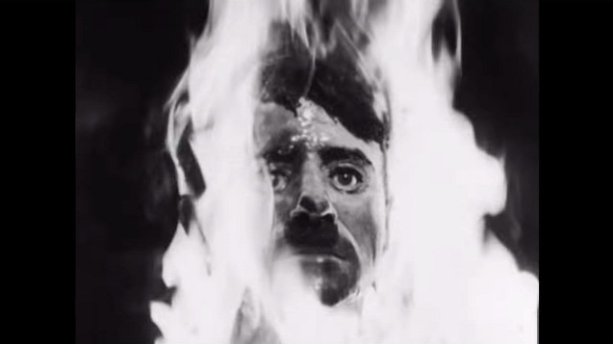
As one might expect, the heroes win, preventing the world from falling into the hands of the Third Reich. What you might not expect, especially from a film of this age, is the grisly closing image of Hitler’s disembodied head, here portrayed by a wax mold, gruesomely melted away by flames. While it is quite evident that the head is indeed wax, it’s still fairly gnarly watching the wax melt away like layers of skin and flesh from the skull-shaped creation. In fact, the scene was deemed disturbing enough to viewers that it had to be (marginally) edited down for the television re-issue.
The Madmen of Mandoras, or They Saved Hitler’s Brain, or whatever you choose to call it is a fun slice of pro-American/anti-Nazi propaganda* layered in a healthy dose of 1940’s/50’s era comics “pulp”, and sprinkled with a pinch of early 60’s pop culture sensibility. It doesn’t require a lot of thought and generally moves at a steady pace, although the footage added to the television re-release does make the first half of the film drag noticeably. The film feels more than a little dated by today’s standards, but still provides some solid entertainment for a rainy weekend afternoon or one of those nights when you’re just not sure why you are even still awake.
AUTHOR’S NOTE: Mill Creek will make you love this movie. Resistance is futile. This post originally ran in November 2019 as part of our Pure Terror month. And it came back as part of the Explosive Cinema set. So here’s Terror In the Jungle, a movie that we love, as part of the B-Movie Blast 50-film pack.
I kind of wish that I was alive in 1968 just so I could have been part of this movie. Seriously, I’ve never seen a film that so quicky changes its tone and central theme so quickly, abandoning characters that its taken time to set up for an entirely new situation. And then we get the airplane, with swinging bands playing on it and people going bonkers before it crashes? I want to live in this insane world.
After we meet all these folks — bound for Rio — we better not get too used to them. Except for little Henry Clayton Jr., who is taking his stuffed lion to live with his mother after his parents split up. There’s also Mrs. Sherman, who may or may not have killed her husband, but has a suitcase full of money and is given to insane crying jags. And there’s an exotic dancer on board as well! And some nuns, traveling with one of their dead sisters in a coffin! And then there’s a band! And a rich dude that talks about cannibals!
Everybody is having so much fun that the band plays their big hit and Marian, the exotic dancer, shows off and even the nuns enjoy it. However, the movie soon turns into sheer insanity, as the plane begins to crash. Money spills all over the plane, a nun gets pulled out of an open door and half the cast abruptly dies. Seriously, somehow this went from “Soft Lips” to dudes getting their foreheads split in half and a gory death with a birdcage. I have no idea what brought on this narrative shift.
Then, to top all this off, every single other person we met is eaten by alligators.
You read that right.
The entire cast is dead.
Everyone except Henry, who is now floating down a reptile filled river in the coffin of a dead nun.
What the actual hell is going on here?
The natives — yes, the cannibals that were discussed on the plane that call themselves the Jivaros — find Henry and thanks to his blonde hair and the magic of 1968’s worst special effects, he has a halo. The leader of the tribe declares that he is a god, except that one of them thinks he has to die. So he chases Henry into the jungle and the kid’s stuffed lion transforms into a real lion and eats the dude.
So wait — is Henry really a god?
This is a movie that starts with the declaration that “This picturd was filmed on location in the Jivaros Regions of the Amazon Jungle. Without the assistance and encouragement of the Government of Peru it would not have been possible.”
It’s also the kind of movie that randomly has Fawn Silver be Marian, the exotic dancer. If you don’t know who she is, she’s Criswell’s assistant in Ed Wood’s Orgy of the Dead.
It also has three directors — Tom De’Simone directed the plane sequence, Andrew Janzack the jungle parts and the temple close was directed by Alex Graton. That may explain the strange narrative leaps that this makes.
Let’s break down each director.
Tom De’Simone went on to become adult film director Lancer Brooks, as well as creating some of my favorite films, like Hell Night, Reform School Girls and Chatterbox. Andrew Janzack never directed another movie, but was the cinematographer for The Undertaker and His Pals.
Alex Graton would finally direct another movie eleven years later, a romantic comedy entitled Only Once In a Lifetime that has Claudio Brook — yes, the same Claudio Brook who was in Luis Buneul’s The Exterminating Angel — in it.
I love IMDB because it has comments directly from De’Simone in the review. I’ll share it below for your enjoyment:
“OK, now it’s my turn to weigh in on this disaster. I’m the director who’s credited with this fiasco but in my defense I have to explain that there were three directors on this film and we all suffered under a producer with no experience, no taste, no sense and worst of all, NO MONEY.
I was fresh out of film school working as an editor when I was introduced to him when he was looking for a director. I convinced him I could handle a feature having already won two awards at film festivals for two shorts I had done. This was the biggest mistake in my life. Once on, for a mere $50 a day, I realized what I had gotten into. He hired a bunch of non-SAG actors who actually PAID HIM to be in his movie. None had any experience in front of a camera and all the characters were his creation. I was stuck in that plane mock-up for two weeks with these desperate souls trying to create something from nothing. The script was only half written when we started and he said he would finish it when we got to the jungle. When we completed the plane interiors, including the now famous “crash” scene, the rough cut was 83 minutes long and we hadn’t even reached the jungle part of the story.
I told him we had to make some serious trims, both for time and for performances. He refused to cut anything. He was so in love with the crap we had he actually once said he believed that the actress playing the stewardess would win an Oscar for her scream scene in the fire. I knew I was doomed. We argued over and over about what I felt should be dropped, trimmed and eliminated until I had it. I walked from the production and that wonderful salary. Undaunted, he went to Peru and used the cameraman as the replacement director. Down there they wrote the second half of the script and shot it as he wrote it.
Back in LA they now had a bigger disaster, naturally. The film was way too long, badly shot, badly acted and unwatchable. He and this second director fought, as did I, and he then walked away as well. Now the producer was over a barrel. He had sunk what little money he borrowed and still believed he had a hit on his hands if he could just get it finished. He hired a third guy to come in and fix the problem. This genius hired a bunch of extras, put bad wigs on them and went to Griffith Park in LA and shot more crap that was even more laughable than what they got in Peru. After that the producer shopped around for stock footage of native ceremonies and came up with some god-awful crap from a 40’s schlock film and cut it in . . . the final disaster is what’s on screen. I’ve lived in shame my entire career because for some reason I always get the credit for making this turkey. I was one of three victims! The entire debacle was the brain child of the producer and none of us had a chance in hell to make it any better than it was doomed to be from the start.
And that’s the truth.”
In case you haven’t realized it yet, I love this movie. Like, beyond love. I’m going to bother everyone I know to tell them just how great it is and then laugh when they look at me and wonder why I enjoy this blast of craziness so much. Beware!
Editor’s Note: This review originally ran on August 3, 2020, a part of our reviews for Mill Creek’s Savage Cinema 12-Movie collection. We’re bringing it back as part of Mill Creek’s B-Movie Blast 50-Film pack.
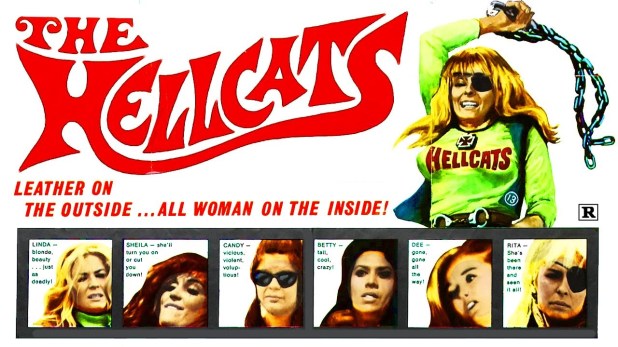
The Mill Creek Savage Cinema set features an image from this film’s poster on its cover. Seeing as how this was also known as Biker Babes, it’s probably the most suggestive — and therefore best possible selling — film to feature.
The Hellcats bury Big Daddy, who was killed by their mob contact Mr. Adrian (Robert F. Slatzer, who directed this as well as Bigfoot) when he learned that the crook was also a snitch for Detective Dave Chapman. All of these relationships are symbolized in the start of the film — the biker gang is putting their boss in the ground while the cops and the crooks watch from a distance.
Adrian decides to kill off Chapman when he’s on a date with his fiancee Linda (Dee Duffy, who was a Slaygirl and Miss June in the Matt Helm movies The Ambushers and Murderer’s Row). Dave’s brother Monte (Ross Hagen, who was also in The Sidehackers) comes back from the war to learn about what happened. He and Linda decide to act like a biker couple and get revenge.
He does so by getting drawn and quartered longer than the leader of the gang, Snake (Sonny West, a member of Elvis’ Memphis Mafia). This earns him the right to have sex with Sheila (one and done actress Sharyn Kinzie) and brings our protagonists into the gang’s scam to bring back drugs from Mexico.
Tom Hanson, who directed The Zodiac Killer, shows up here as Mongoose. Gus Trikonis, who made Nashville Woman, The Evil, She’s Dressed to Killand more, is Scorpio. Tony Lorea, who plays Six-Pack and also acted in Supercock, went to to be the assistant director of Sweet Sixteen, The Gloveand Ladies Night. Was this entire gang made up of exploitation movie directors? Where’s Bud Cardos?
You can either watch this as part of the Savage Cinema set or check it out on Daily Motion.
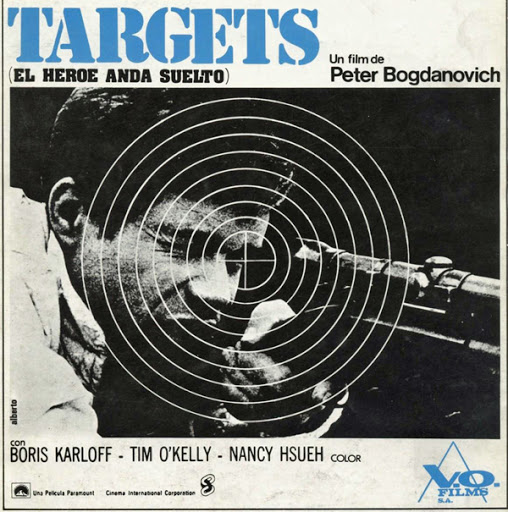
Peter Bogdonovich may have debuted by fixing up a movie for Roger Corman called Voyage to the Planet of Prehistoric Women, but Targets was his first film. He directed, co-written and co-produced a movie that does not feel like the work of an inexperienced filmmaker.
Maybe it was because he had been studying. As the film programmer for the Museum of Modern Art in New York City, he saw up to 400 movies a year.
Byron Orlok (Boris Karloff) sees no reason to be in horror films any longer. The news on TV every night is way more frightening than any film he can conjure. However, as a favor to a young director named Sammy Michaels (Bogdanovich), he will make one more appearance at a drive-in before leaving for his native England.
Bobby Thompson is an insurance agent and Vietnam War veteran who snaps. One morning, he decides to start killing, taking out his wife, mother and a delivery boy before climbing an oil tower to kill people in passing cars before heading to the very same drive-in that Orlok will appear at.
As Orlok’s final film is shown, Thompson begins murdering more people. However, as the elderly actor appears on screen and in-person, Orlak smacks him down with his walking cane, giving the police the opening they need to arrest him.
I love the concept of this film: it exists in the middle of two eras, with Karloff as the last remaining Universal Monster, coming up against the cynical and all too real evil that the New Hollywood would use as monsters.
While Thompson is based on Charles Whitman, Orlok isn’t anything like Karloff. Instead of being tired after years of acting and angry that he was only known for horror, Karloff was proud of his legacy.
The actor was in ill health. He had emphysema along with rheumatoid arthritis, with only one half of a lung still functioning. Years of abuse to his body wearing the heavy Frankenstein’s Monster makeup led to braces on both his legs, as well as the need to use a cane.
While this would be his last major film, he’d keep working, making films like Curse of the Crimson Altar, Fear Chamber, House of Evil, Cauldron of Blood, Alien Terror and Isle of the Snake People.
Bogdanovich only got to make this because Boris Karloff owed Roger Corman two days’ work. Corman told the young director that he could make any film he liked provided he used Karloff and stayed under budget. What really speaks to the actor is that even though he was only supposed to do two days work, he was so impressed with the script that he refused pay for the three additional days of work he did to complete the film.
Writing about the film for the New Beverly Cinema, Quentin Tarantino said, that Targets was “the most political movie Corman ever made since The Intruder. And forty years later it’s still one of the strongest cries for gun control in American cinema. The film isn’t a thriller with a social commentary buried inside of it (the normal Corman model), it’s a social commentary with a thriller buried inside of it… It was one of the most powerful films of 1968 and one of the greatest directorial debuts of all time. And I believe the best film ever produced by Roger Corman.”
Roger Corman knows how to get the most out of a movie. He turned the Russian Planeta Bur into both Voyage to the Prehistoric Planet and this movie. The former* has new scenes with Basil Rathbone and Faith Domergue, but the latter has one major reason to watch: Mamie Van Doren.
The pedigree of this movie is pretty wild, because it was adapted by Peter Bogdanovich, who chose not to have his name credited on the final film. And let’s not forget that this all ties back — since Corman loved to recycle what he recycled — into the early Francis Ford Coppola cheapy and Mill Creek box set favorite, Battle Beyond the Sun.
Five male astronauts and their robot John land on Venus and are attacked by a pterodactyl and then an entire culture of women, including Van Doren. Amongst their number are Verba (Mary Marr, who would go on to edit Rolfe Kanefsky’s softcore movies), Twyla (Paige Lee), Meriama (Irene Orton), Wearie (Pam Helton) and Mayaway (Margot Hartman, who in addition to being in this movie, would go on to be the chairman of the board of the First Stamford Corporation, one of the largest privately held commercial real estate companies in the State of Connecticut; she also wrote and starred in Violent Midnight, Descendant and The Curse of the Living Corpse).
Bogdonovich was asked by Corman to work on the film, as American-International Pictures wanted some girls in it, so he hired Mamie Van Doren and an entire cast of blondes, then went and filmed them for five days and did the narration.
Despite the fact that this had to be remixed together, you have to love the ending, where the robot left behind becomes the new god of Venus. Spoiler warning for a 52 year old film…
This movie looked like absolute junk, a tale of white colonialism that would be dated even a few years after it was made.
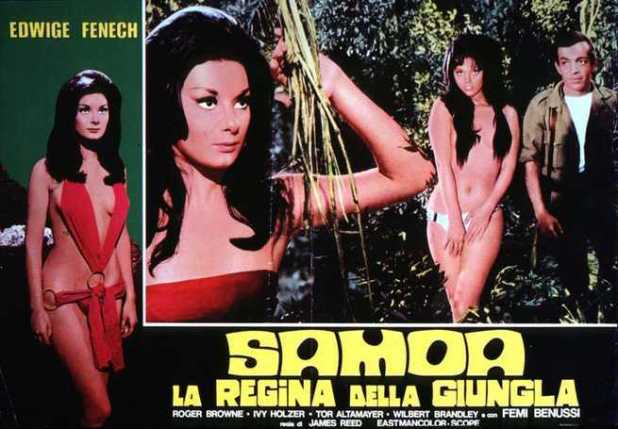
But then I realized that the jungle girl was played by Edwige Fenech and here we go.
Director Guido Malatesta made Colossus and the Headhunters and Maciste il vendicatore dei Maya, so I’m going to stop being mean and just say that he made simple films that were probably crown pleasers in their time.
Roger Browne, who would one day be the Senator in Emanuelle in America, is looking for a diamond mine and finds Samoa (Fenech), he has to decide between being a criminal and leaving with her tribes holy stones or settling down in the jungle with the queen of all giallo. Dude, how is this even a choice?
The independently wealthy Albert Zugsmith made millions selling ads. So he did what you or I would probably want to do if we had that much money. He started producing his own movies, starting with his American Pictures Corporation, which made Captive Women, Sword of Venus and Port Sinister all for under $100,000 each.
His first big success was Invasion U.S.A., which he followed with Paris Model and Top Banana before making a deal with Universal. There, he produced Female on the Beach with Joan Crawford, The Incredible Shrinking Man, Written on the Wing and Touch of Evil before moving to MGM, where he got High School Confidential!, which was part of a series of films he worked on with Mamie Van Doren, including The Beat Generation, The Big Operator, Girls Town and the first movie he directed, The Private Lives of Adam and Eve.
The movies that he directed definitely start moving in an exploitation direction from here on out, like the Vincent Price movie Confessions of an Opium Eater, Sex Kittens Go to College, the notorious bomb Dondi, Psychedelic Sexualis, Sappho Darling and Movie Star American Style or LSD I Hate You. He also produced Russ Meyer’s Fanny Hill.
That brings us to this burst of insanity.
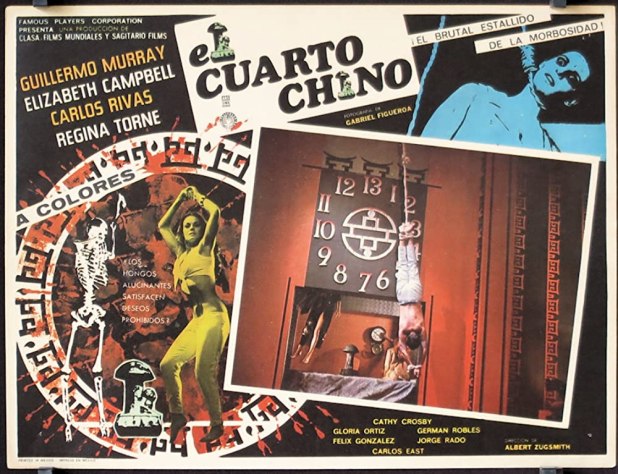
Nick Vidal (Carlos Rivas) owns the bank his father stole from the Cervantes family, with Juan Cervantes (Ivan J. Rado, The Wild Bunch) still working there. For some reason, Juan has no worries at all, while Nick can barely sleep and is obsessed with the shady deal. He’s also sleeping with his secretary, Sidonia (Regina Torné, La Senora Muerte).
Meanwhile, Consuelo the maid (Gloria Leticia Ortiz,Santo in the Hotel of Death) tries to hang herself and is stopped by her father Pedro (Germán Robles, who played Nostradamus the vampire in that series of films). It turns out that she too had an affair with Nick and can’t live without him. And while all that’s happening, Dr. Saluby (Guillermo Murray, El Mundo de Los Vampiros) has come to check on the injured maid and ends up sleeping with Nick’s wife Muriel (Elizabeth Campbell, Golden Rubi from the Wrestling Women movies).
To make this even more convoluted, Nick has been getting threats on bank stationary. He’s sure it’s Juan, so when he goes to the man’s house, instead of a fight, he’s warmly greeted and taken to the Chinese room that gives this movie its title. There, he sees a woman in a mask who is in a drug haze, which helps her get over the pain she feels from her deformed foot.
Nick’s nightmares kick into high gear, filled with gory dismemberments, dancing skeletons and him being bound to a giant clock.
Then, somehow, this becomes a murder mystery, as the maid is found hung again, but the real cause of death is choking by human hands. And anyone — everyone — has a reason for why she had to die, because it turns out that she’s pregnant with Nick’s child.
I have no idea how this film ended up made in Mexico with a mostly Mexican cast. That said, it’s really something. How many mushroom taking murder mysteries with dream sequences have you seen?






 B&S About Movies
You must be logged in to post a comment.