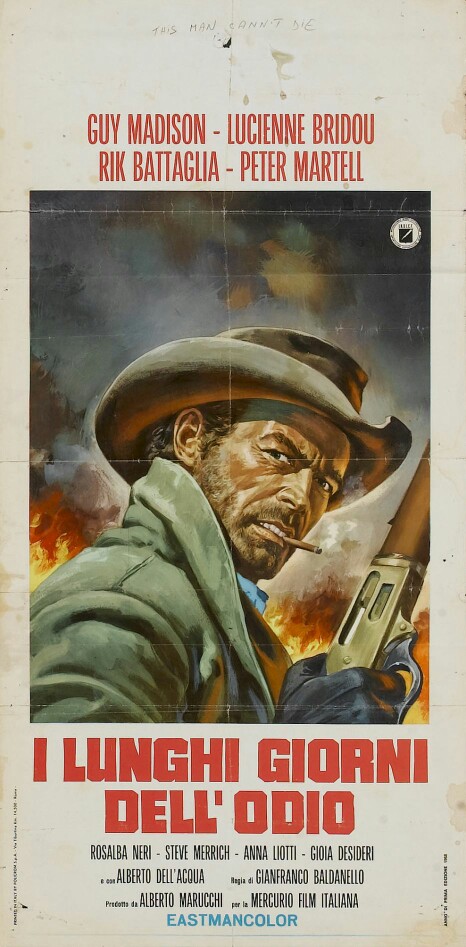
Known as This Man Can’t Die and Long Day of Hate, this Italian Western stars Guy Madison, who had been the title character in the TV series The Adventures of Wild Bill Hickock, as Martin Benson, a Civil War veteran and former outlaw who is trying to clean up his act by working as an undercover agent for the U.S. Army.
He’s already helped capture and execute three members of the gang he’s snuck into — he sends the reward and guns home to his father, a man who still looks at him as a criminal — but he’s tired of this life. Yet his hard work will get his captain promoted and he’s forced to stay working.
The gang learns that Benson was the man who has done them wrong, so they find out where his family lives and murder his parents and assault his sister, leaving her mute. When his brother Daniel finds one of the gang members near death, he decides to nurse him back to health so he and his brother can get revenge.
Maybe Benson’s life isn’t going so well. That said, Rosalba Neri is his girlfriend. There are worse things, right?
Director Gianfranco Baldanello — who often worked as Frank G. Carroll — also directed Colt In the Hand of the Devil, Danger!! Death Ray, Man with the Golden Winchester and Very Close Encounters of the Fourth Kind. He also wrote the giallo The Girl In Room 2Abut mostly worked as an assistant director. He also co-directed The Uranium Conspiracy with future Cannon Pictures boss Menahem Golan.
This movie has more nudity than several Italian westerns put together. That’s really all it has to make it stand out, other than the two great titles.
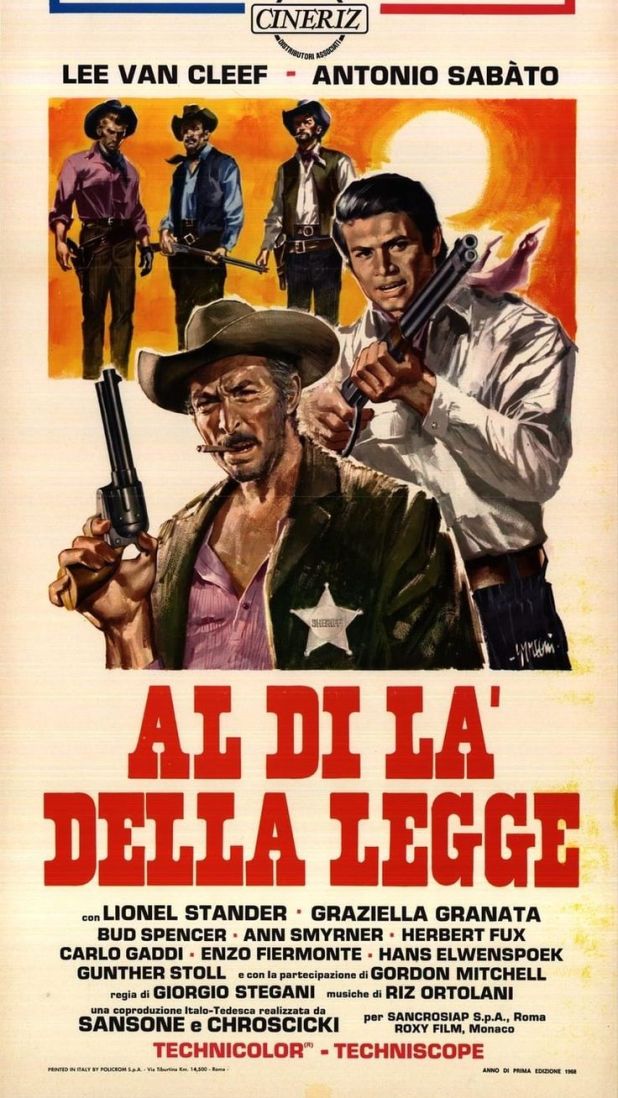
Billy Joe Cudlip (Lee Van Cleef) is not a good man. But he’s conflicted. Sure, he’s just robbed a stagecoach of $12,000, but he feels like he owes something to the man his crimes have hurt the most, a Czech immigrant named Ben Novack (Antonio Sabàto) who was supposed to deliver that money to hard working miners.
When another gang attacks the next shipment of money — led by Gordon Mitchell — and the sherrif is killed, things change for Cudlip. He’s offered the job of lawman, which his partners Preacher (an astounding Lionel Stander, trapped in Europe thanks to the blacklist) and freed slave Al (Al Hoosman, an amateur heavyweight boxer who fought in World War II and then settled in Germany, where he became an actor in thirty films) think will be quite helpful when it comes to taking all the town’s silver.
Except that the gangs that come to town are way worse people than Cudlip. He now feels compelled to protect the men, women and children of Silvertown, which goes against everything he believes in. Sooner or later, he’s going to have to choose between Ben and the town or Preacher and Al.
In a genre made up of loners who disappear after they get their bloody revenge or save a town, this is a rare Italian western with a hero who finds that he belongs. As the film closes, with his star cast aside, Ben stops him and says, You are not alone, Cud. You have us — you always did. You are our friend. And our sheriff.”
Director Giorgio Stegani only made nine movies, but he wrote one that made a major impact: Cannibal Holocaust.
This is also worth watching just to see Bud Spencer without his beard.
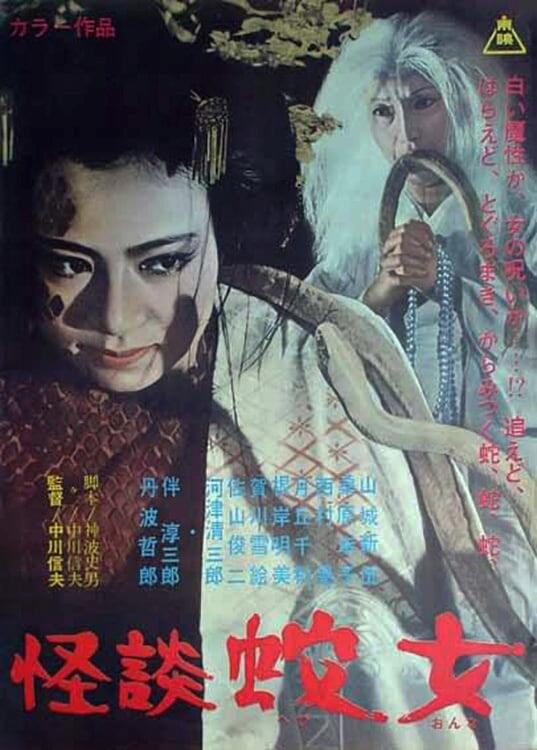
When a poor farmer named Yasuke dies, all of his fields are taken — legally if not ethically — by landlord Chobei Onuma. That man now takes Yasuke’s wife Sue and daughter Asa as servants to work off his debt, an action that introduces Chobei to the ghost of the farmer. He orders their home destroyed and a gigantic snake appears before being killed — a bad omen in Japanese culture and but the start of the curse.
Asa and Sue are abused not only by Chobei but also by his Masae and son Takeo. Sue tries to protect another snake but pays for that act with her life, leaving her mother alone to deal with the sexual advances of her new master’s son. Yet the ghosts haven’t left and while rich men may rule the physical world, they have no say over the supernatural one.
Directed by Nobuo Nakagawa (Jigoku) and written by Fumi Konami (Female Prisoner #701: Scorpion), this may not be the all-out shock that later Japanese horror would spray all over the screen, but it has moments of eerie calm amongst the otherworldly.
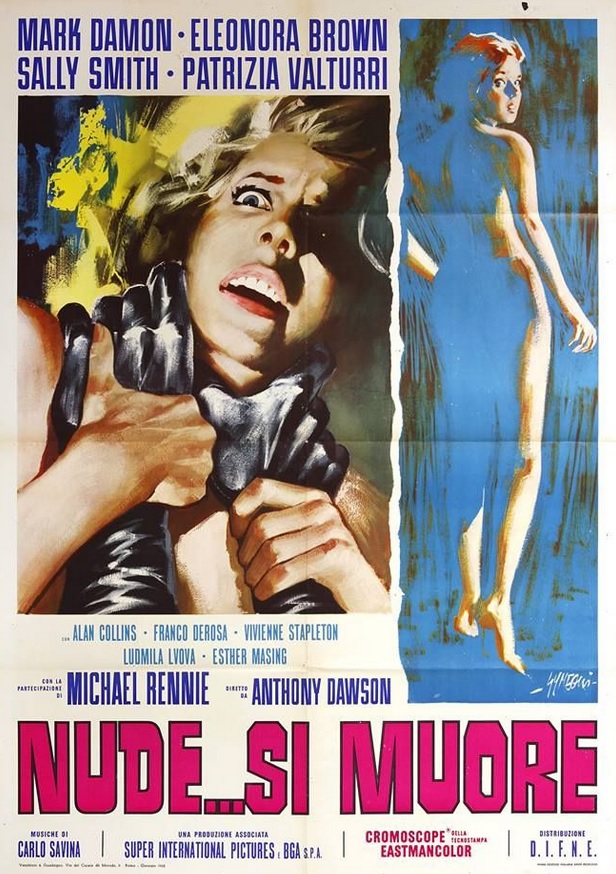
Naked…You Die (AKA The Young, the Evil and the Savage) is a pretty fun early giallo with good direction by Antonio Margheriti.
Yet it was very nearly was a Mario Bava movie.
According to Tim Lucas’ Mario Bava: All the Colors of the Dark, Bava was hired by Lawrence Woolner — the distributor of Hercules in the Haunted World and Blood and Black Lace in America — to direct a movie about a killer stalking a school. Cry Nightmare was going to be the title and Bava wrote the script with Brian Degas and Tudor Gates (Barbarella, Danger: Diabolik).
Lamberto Bava told Lucas that “Just a short time before the filming was to begin, Mario Bava had an argument with the producers and he abandoned the film.” As for Margheriti, who met Woolner when he distributed Castle of Blood, he said “I think Mario was busy at that time, working on Diabolik or something.”
Either way, locations were already secured, cast and crew had been hired and a theme song had already been recorded.
The drowned body of a woman is placed in a truck going to St. Hilda College. There, only seven students, two teachers — Mrs. Clay (Ludmilla Lvova) and Mr. Barrett (Mark Damon — Headmistress Transfield (Vivian Stapleton) and gardener La Foret (Luciano Pigozzi) are present.
Soon, the killing begins with Betty Ann being strangled and found by Lucille (Eleonora Brown in her last film until coming out of retirement in 2018), who is having an affair with Barrett. When she tells him to come see the body, it’s already gone, so they decide to leave the school.
The killings kick into gear with Cynthia (Malisa Longo, Ricco the Mean Machine) being killed in front of the gardener, who is soon killed as well and Denise (Patrizia Valturri) too. There’s also amateur detective Gillie (Sally Smith) on the case and Inspector Durand (Michael Renne from The Day the Earth Stood Still) trying to stop the killings.
All the girls wear similar uniforms — and outfits that change scene by scene — and nobody wonders why an older teacher can play Big Bad Wolf with Little Red Riding Hood and get away with it.
The aforementioned theme song “Nightmare” by Powell and Savina (Don Powell, who played Emanuelle’s father in Black Emanuelle 2 and did that film’s soundtrack, along with Carlo Savina, who composed the music for The Killer Reserved Nine Seats, Lisa and the Devil, Fangs of the Living Dead and so many more) and performed by Rose Brennan owes royalties to Neal Hefti.
Perhaps even wilder is the fact that the movie informs us that Gillie may be the daughter of James Bond.
Giallo would change in a few years to be bloody, sleazier and stranger. That said, this is a great example of an early version of this style of movie.
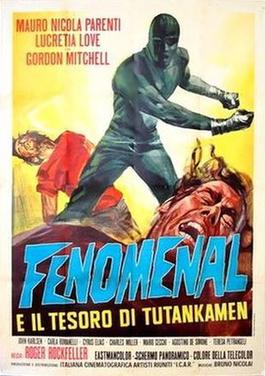
Directed by “Monsieur Cannibal” Ruggero Deodato under the name of Roger Rockfeller, this is a movie that even its director admits that he “didn’t give a shit about the film.” Deodato went on to claim that the producer and star of this film, Nicola Mauro Parenti, was “too stiff, a dog of an actor; I treated him like shit on the set, but then he called me again for Zenabel.” This was also his first directing job.
This is a fumetti movie not based on any existing character, but obviously in the same world as Kriminal and Danger: Diabolik. Unlike those movies, Phenomenal is the hero and he’s going up against Gordon Mitchell and his gang to keep the treasures of Egypt — the title does not lie — safe. There’s a lot of sitting around and talking where there should be action, but one look at the hero’s costume — a turtleneck and a stocking mask — shows you how inspired this was. Look — not everyone can do Eurospy or comic book action adventure.
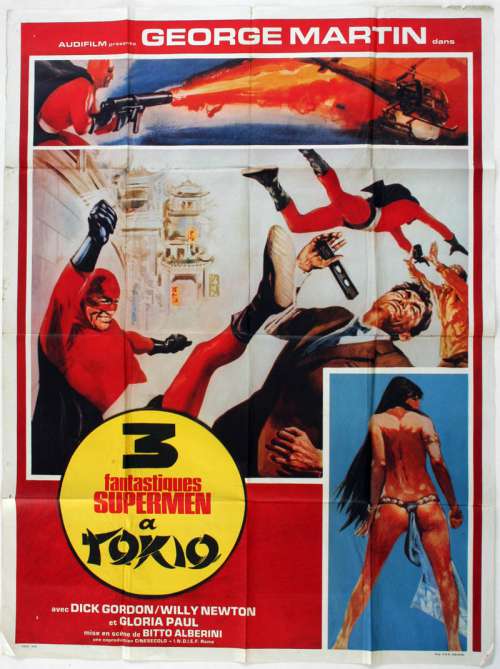
The Supermen series — this is the second in the series — was such a big deal that the series would become popular in Germany and Turkey, with each country making their own remixes of the movies. This is shot Italian style — exteriors in Japan, interiors back home.
The only movie in the series — outside of the aforementioned localized remakes — to never make it to America, this one has the Supermen seeking a miniaturization weapon in Tokyo, which is an excuse to chase women and eat lots of food, including a fried chicken dinner that ends up being dog, perpetuating that horrible racist urban legend.
Bitto Albertini replaces Gianfranco Parolini as director, while the first movie’s Tony Kendall, Brad Harris and Aldo Canti are now played by Jorge Martin (who is also in 1970’s Supermen and 1973’s Three Supermen of the West), Willi Colombini (Pollux from the Steve Reeves Hercules) and Sal Borgese (Superbug, the Craziest Car in the World; Super Fuzz), not for the better. That said, when the miniaturization ray just turns the cast into kids, well…that’s pretty funny (and works in the budget).
Gloria Paul plays an enemy agent in this and was nearly Domino in Thunderball, so that at least gives this some Eurospy credit.
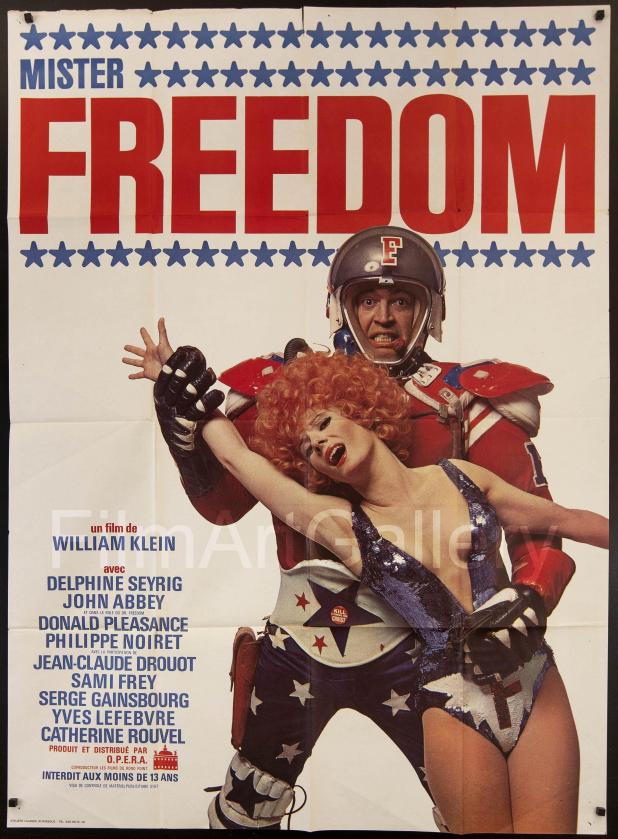
William Klein settled in Europe after serving in World War II and achieved widespread fame as a fashion photographer for Vogue. Ranked 25th on Professional Photographer‘s list of 100 most influential photographers, he directed Who Are You, PollyMagoo?, The Model Couple and several documentaries in addition to this movie, which critic Jonathan Rosenbaum wrote was “conceivably the most anti-American movie ever made.”
Mr. Freedom (John Abbey) works during the day as a beer drinking cop and at night as a government-sanctioned vigilante. He’s called to the Freedom Tower, which houses the military-industrial complex — to meet with Dr. Freedom (Donald Pleasence!) who wants him to go to France and find the killer of Capitaine Formidable and bring France back to the side of capitalism or die trying, as he’s equipped with a nuke that can wipe out the country instead of letting it fall to the Communists.
Mr. Freedom joins forces with Capitaine Formidable’s widow Marie-Madeleine (Delphine Seyrig, who made a film version of the SCUM Manifesto and Be Pretty and Shut Up, a pre-#MeToo 1977 film that featured Shirley MacLaine, Maria Schneider and Jane Fonda and concerned how women were treated within filmmaking), where he learned that their plan had been to run houses of ill repute to gain intelligence, a plan he endorses, as well as forming his own army that will stop Communism in France and build a “white wall of freedom” around the U.S. — decades before red hats and whitewashed fascism came back in fashion.
He also battles the Russian Stalinist Muzhik Man and Chinese Maoist Red China Man — which upset Marxist-Leninist folks at the 1968 Avignon Festival — and gets a secret tranceiver put into his teeth which sends Communist messages into his brain. This leads to the hero — or villain — building a secret base from which his operatives can start attacking Commiunism, which basically means being criminals themselves and causing anti-US demonstrations.
Mr. Freedom goes Kent State and fires a machine gun into a crowd of peaceful protestors, which causes Marie-Madeleine to reveal that she’s a double agent and killed her own husband. Mr. Freedom kills her just as the demonstrators attack his base and kill his followers. Seeing that France neither wants nor deserves American democracy, Freedom activates his bomb, which only kills himself.
Is it any accident that Mr. Freedom is wrapped up in the red, white and blue, plus football pads?
This feels like an indictment of comic book Hollywood four decades before that was even a thing.
Something Weird has made out lives so much richer, saving the strange, the smutty, the scary and everything in between. Working with the American Genre Film Archives, they created this mixtape of sheer lunacy which adds up the scare films of the past. You’ll never do drugs again until the next time to do drugs.
This blu ray has the following movies, all uncut and in 2K:
Beyond LSD (1967): This movie astounded me because instead of telling parents that their kids are maniacs, it tells them to listen to them because they’re going through some things. How is this even real?
Director Paul Burnford mainly made shorts and documentary films, like 1944’s Nostradamus IV and the 1943 blood transfusion ten-minute epic Brothers in Blood. He also directed the first movie in the Rusty series and an entry in the A Crime Does Not Pay series, Dark Shadows, which is about a psychiatrist matching wits with a killer.
In short — it’s less about drugs and more about how to treat your kids. It’s still relevant today.
The Bottle and the Throttle (1961, 1968): Narrated by Timothy Farrell, who was one of the two narrators and the psychiatrist in Glen or Glenda, as well Girl Gang,Pin-Down Girl, Dance Hall Racket, Test Tube Babies, The Violent Years, Jail Bait and many more. He was also a bailiff for the Los Angeles Marshal’s Department when he was acting in movies like Paris AfterMidnight, which was raided by the Los Angeles Vice Squad during filming.
A bunch of kids a drinking beach beers — Budweiser, Schlitz and Hamm’s — and Bill has had one too many. He ends up driving home and killing a child and breaking the back of her mother. Was it worth it?
Do you remember that wheel of how many drinks you had and how long until you sober up back in driver’s ed or health class? Man, I used to think of that all the time and here I am, now trying to gauge edibles which are magical and unpredictable lunacy when compared to whiskey.
The major difference between the 1961 and 1968 films is that the former is made with the help of the Culver City Police Department and the Culver City Unified School District while the latter is made with the West Covina Police Department. I’d like to think these organizations were scammed and paid twice for one movie.
“The little girl died on the way to the hospital and the mother will probably never walk again. No matter how your trial comes out, you’ll always have to live with those facts, won’t you Bill. A child dead. A mother crippled. Not a pleasant future to face at the age of 18.”
Pure nihilism.
Sidney Davis Productions also made The Dropout, Boys Beware (an anti-homosexual scare movie), the Ib Melchior-directed — yes, the guy who wrote Death Race 2000 and directed The Angry Red Planet — Keep Off the Grass, Skateboard Sense and LSD: Trip or Trap!
Curious Alice (1971): Dave Dixon, the Culture Czar, was the lead DJ of the legendary “Air Aces” on Detroit’s rock station WABX and the first person to play Sabbath, The Doors, Led Zeppelin and The Doors in the Motor City. Beyond co-writing Peter, Paul and Mary’s “I Dig Rock & Roll Music,” he co-wrote this animated film that explains drugs through Alice In Wonderland which is totally right on with the kids and four years after Jefferson Airplane did the same thing in “White Rabbit.”
The art in this movie is mind-boggling, however, and you’ll be entranced as Alice learns about LSD from the Mad Hatter, speed from the March Hare, heroin from the King of Hearts and barbituates from the Dormouse.
Made by the National Institute of Mental Health in 1971 and meant for use with ten-year-old students, if I had seen this before my teen years I would have done all the drugs in high school. The National Coordinating Council on Drug Education agreed, writing that viewers “may be intrigued by the fantasy world of drugs” after watching it.
The Distant Drummer (1970): A short-lived series of four 22-minute American documentary films that warned the kids about drugs, these were all directed by William Templeton (The Fallen Idol) and written by Don Peterson.
The first two movies in this series, A Movable Scene and A Movable Feast, were narrated by Robert Mitchum, who served 43 days at a California prison farm for possession of marijuana in 1948, a conviction that was overturned in 1951.
Here’s just a sample of Mitchum’s speech: “Thousands of snapshots on police station walls remain the only link between many of America’s most affluent families and the children who embodied their great expectations. Nearly everyone in the hippie community smokes marijuana — whether they call it pot, grass, hemp, gage, joint or mary jane — the marijuana is the basic background for the shared drug experience. The experience is shared to such an extent that roach pipes are always in demand — a roach is a marijuana butt and it requires some form of holder for those last few drags. The new generation, whether they are runaways or rebels-in-residence, use marijuana as a symbol of discontent with the basic values of the establishment. For some, there exists a social imperative beyond flaunting society’s rules — for these adventurers the mind-expanding drugs open a window on a whole new frontier…”
The other two parts, Bridge from No Place and Flowers ofDarkness, were narrated by Rod Steiger and Paul Newman.
Drugs, Drinking and Driving (1971): Herbert Moskowitz is now here to explain why you should never mix the three things in the title. I love that this movie has no issues with using the Mission: Impossible theme over and over and over, flaunting copyright law with each successive refrain.
This also seems pre-Jackass with a stunt where two drivers are each given drugs, one amphetamine and one barbituates, and then told to drive for 36 hours straight until they either pass out or wreck their cars.
LSD: Insight or Insanity (1967): “Now, everybody who takes it admits that there’s always the risk of a bad trip, a bummer, a freak-out, even a flip-out. But, why be lame, baby? Give yourself a real kick. Yes, a kick in the head!”
That’s Sal Mineo talking in this Max Miller-directed (the same dude who made the Sonny Bono anti-drug movie Marijuana) film which explains what LSD is, how it’s made and when people take it they jump in front of cars and take leaps off cliffs like Diane Linkletter out of the windows of the Shoreham Towers, blamed on LSD even if the last person who saw her alive — Edward Dunston — may have also was the last person to see actress Carol Wayne alive. Then again, both Dunstons could be different people and for some other reason, people seem to confuse them with David E. Durston, the man who taught us that Satan was an acidhead in I Drink Your Blood.
See, I may make some detours, but I always get you back on the road.
This ends with a Russian Roulette freakout and Mineo singing over the closing credits, which inform us that everyone in this movie was not an actor. You won’t be surprised.
LSD 25 (1967): Directed by David Parker and written by Hank Harrison — the father of Courtney Love — this movie is narrated by an LSD tab which proves that the creators of this may very well be getting high on their own supply.
“Today, you’re high. Tomorrow, you’re dead.”
Yes, LSD starts all happy explaining all the good things it does and by the end, your fingerprints can’t get out of any police database.
So go ahead and take that sugar cube. You’ll learn all the secrets of the infinite and then, you know, you won’t be able to tell anyone.
Because you’ll be dead.
Narcotics the Decision: Goofballs and Tea (1958): Written by Pittsburgh native Roger Emerson Garris, who was the story editor for the Sherlock Holmes TV series, this police training film is all about barbituates and marijuana. Yes, people once called drugs these words.
Narrated by Art Gilmore, who was on Dragnet and voiced the radio announcer on The Waltons, this movie lets kids know that it starts with sneaking their parent’s booze and ends up with you in jail, dead or worse. Avoid weed, avoid malt shops, avoid everything.
None for the Road (1957): Margaret Travis wrote 83 shorts that we know of, movies like The Other Fellow’s Feelings, Health: Your Clothing and Rowan and Martin on the Driveway One Fine Day, an industrial film for Phillips 66 Petroleum where the future Laugh-In stars run a gas station. This movie, too.
But the director? That’s Herk Harvey, who made around four hundred or more industrial films like Shake Hands with Danger. And one very important movie, Carnival of Souls.
Three men all use alcohol in different ways: not at all, a little and too much. They’re like the lab rats that we later see injected with alcohol, which sounds like a good way to spend a weekend. But wow, we’ve been warning people about drunk driving for 65 years and not everyone listens.
The Trip Back (1970): It’s no accident that an episode of Strangers With Candy was titled “The Trip Back.” Jerri Blank on that show is literally the star of this movie, Florrie Fisher, played for comic effect.
Fisher was married four times by the time she filmed this speech, first an arranged marriage, then to a pimp, then another drug addict and finally to a man she met via the mail. She credited her recovery to Synanon, which was originally established as a drug rehabilitation program and became one of the most dangerous and violent cults America had ever seen.
Wait, what?
Founded by Charles E. “Chuck” Dederich Sr., Synanon — a mix of togetherness (“syn”) with the unknown (“anon”) — was an alternative community centered on group truth-telling sessions called the “Synanon Game”, a form of attack therapy during which participants humiliated one another and exposed each other’s innermost weaknesses. There are theories that Dedereich was given LSD by Dr. Keith S. Dittman and Dr. Sidney Cohen, as well as encouraged to start Synanon as part of the CIA MK Ultra program.
Headquarted in a former beachfront hotel in Santa Monica called the Club Casa del Mar, women who joined Synanon had to shave their heads. Men were given forced vasectomies. Pregnant women were forced to abort their babies. Married couples were broken up and had to take new partners as the group became the Church of Synanon.
After Synanon’s transition into an alternate society in 1968, the game became a 72-hour ordeal for most members. The program of rehabilitation went from two years to a lifetime rehabilitation program, as they now preached that addicts would never truly be well enough to return to society.
Throughout this period, San Francisco area media covered the adult and child abuse caused by the church, but were often sued for libel by Synanon’s lawyers. If all of this sounds like Scientology, well…there was a group within the group called the Imperial Marines authorized to beat members into oblivion.
When NBC started reporting on the church in the late 70s, executives received hundreds of threats and Paul Morantz, a lawyer who had helped members escape, had a de-rattled rattlesnake placed in his mailbox. It bit him and put him in the hospital. A police search found a tape of Dederich speaking about Morantz, saying: “We’re not going to mess with the old-time, turn-the-other-cheek religious postures. Our religious posture is: Don’t mess with us. You can get killed dead, literally dead/ These are real threats. They are draining life’s blood from us, and expecting us to play by their silly rules. We will make the rules. I see nothing frightening about it. I am quite willing to break some lawyer’s legs, and next break his wife’s legs, and threaten to cut their child’s arm off. That is the end of that lawyer. That is a very satisfactory, humane way of transmitting information. I really do want an ear in a glass of alcohol on my desk.”
The teachings of Synanon influenced groups like CEDU, Daytop Village (the very place Nancy Reagan visited and became aware of the drug problem, which led to Just Say No), Phoenix House and those boot camps that always show up on daytime talk shows.
Back to Florrie Fisher.
An interview with David Susskind led to her appearing on The Mike Douglas Show, speaking at schools and an autobiography, The Lonely Trip Back. This film captures her speaking at a New York City high school, barraging the audience with a rambling dissertation on turning tricks, six of her marijuana friends all dying in the chair, jailhouse sapphic antics and shouting things like “I now know that I can’t smoke one stick of pot! I can’t take one snort of horse! I can’t take one needle of cocaine because I am an addictive personality! And that’s all I need is one of anything. Ya know I need one dress. If I happen to like this dress in tan, I buy the same dress in green and black and pink. This is the type of personality I am!”
Despite how horrible Synanon was for some, it worked for Florrie. Sadly, she died during the lecture tour she’s on in this movie due to liver cancer and kidney failure.
This movie is totally worth the price of this entire blu ray.
Users Are Losers (1971): Think drugs are for teens? This kid is saving up his milk money to pay for his habit, doing odd jobs and being incredibly thrifty just to get some marijuana. It made me think, parents are always on kids for throwing their money away, but this kid knows what he wants, works hard for it and then is selfless and shares what he gets with his friends.
Some kids also find one of their friends dead on a mattress and some young narc says, “If you blow pot, you’re blowing your future.” Get off my TV, kid.
Plus, you also get DRUG STORIES! NARCOTIC NIGHTMARES AND HALLUCINOGENIC HELLRIDES, a full-length mixtape from the AGFA team.
Now if you’ll excuse me, I must go blow some pot. Get toasty toast. Go clambaking. Fly Mexican Airlines. Run within an endless field. Walk the green ducks. Roll into the Backwoods. Be a ninja. Do some chiefing at the Rooney statue.
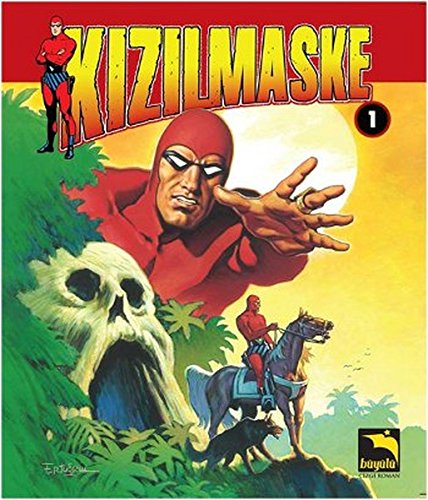
This is not the only remake of Lee Falk’s The Phantom that was made in Turkey. This version is Red Mask, which basically gives you a Street Fighter-style palette swap of the Ghost Who Walks. There’s also another Kizil maske that came out that very same year directed by Çetin Inanç. You can tell the difference because the former movie has a ripoff of the James Bond theme while the latter takes the Secret Agent Man theme. There’s also the 1971 movie Kizil Maske’nin Intikami (The Phantom’s Revenge).
The second Inanç-directed film also has a bad guy who looks like a Klan member with lightning bolts all over his hood and a Phantom that doesn’t even try to disguise that he’s completely taking the look and not caring about intellectual property. Actually, I kid, he has on a rad leather jacket and kind of looks like Dominic Fortune and there you go, that’s a reference that proves why I do a small website and am not shared out by the film Twitter universe just yet.
Also, all of these Turkish films are way better than the Billy Zane movie, which I refer to as Slam Evil! instead of its real title.
According to How the World Remade Hollywoodby Ed Glaser, I learned that the Phantom was a big deal in Turkey. While he’s purple in the U.S., he was originally intended to be grey. To make things somewhat confusing, in other counties, the Ghost Who Walks shows up in different colors: blue in Scandanavia, green in Australia and red in Turkey. Hence the title of this film.
And if you’re wondering where those hooded bad guys come from in the Çetin Inanç-directed movie, Inanç’s former boss was Yilmaz Atadniz, who directed Kilink: Soy ve Oldur. That’s the very footage these characters are cut and pasted from before we get to the movie’s main villains, “Al Capone” Arif and Fu Manchu. An Arabian Fu Manchu at that.
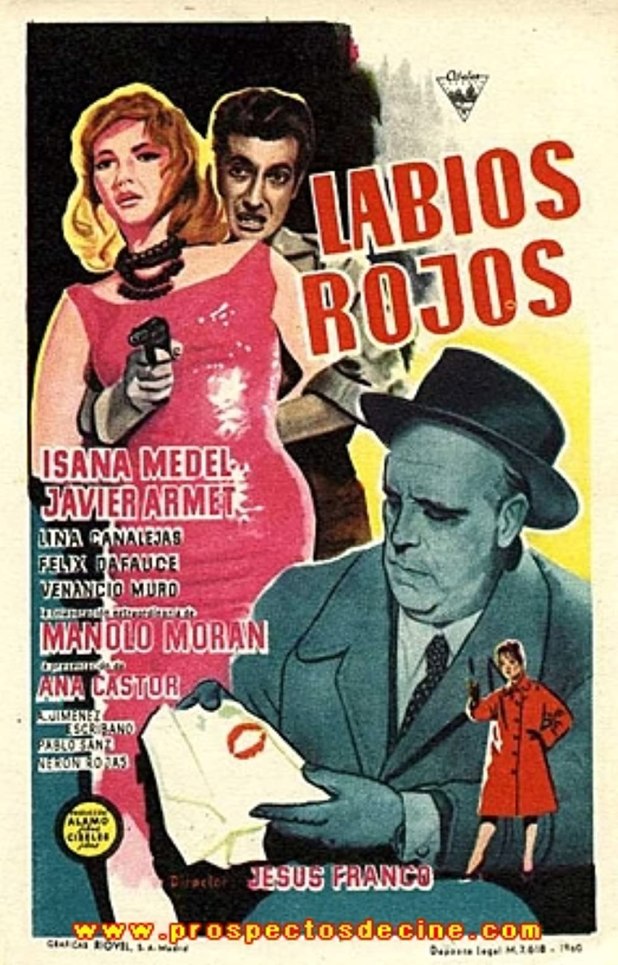
If we are to place our faith in the Jess Franco universe, it’s in the knowledge that there are heroes and there are villains. Regina and Diane would be on the side of good, even if they kind of bumble their way through most of their adventures. From Two Undercover Angels and Kiss Me Monster to Two Spies In Flowered Panties, Franco would return to these lady agents more than once.
Franco’s second movie, this has the detective duo seeking stolen diamonds — yes, this happens all the time in Franco Earth — and hey, if the men can’t solve it, they sure can.
This is way more chaste — understatement — than any of the Franco movies to follow. But it’s infused with some of his loves, like jazz, gorgeous dancing women and noir. It’s a good start and perhaps, at some point soon enough, there will come a break with reality, the discovery of a muse and the knowledge that you can really zoom a camera when you want to.

 B&S About Movies