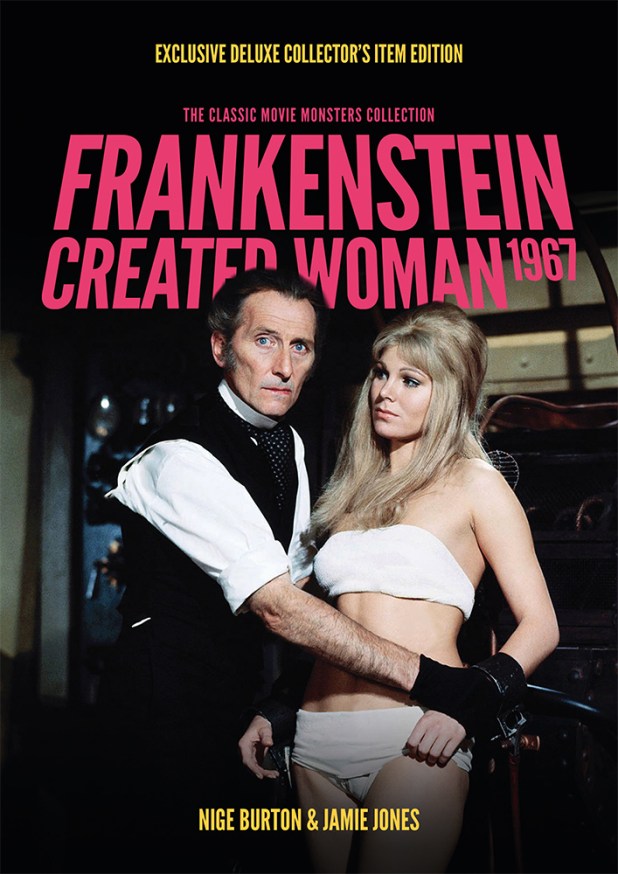
From flesh and innocence, Frankenstein has created the ultimate in evil. A beautiful woman with the soul of the devil!
With a tagline like that, how can you not watch this movie?
The fourth film in Hammer’s Frankenstein series is a thought-provoking exploration of the soul and morality. It’s the one in which we stop thinking about death as a physical matter and start delving into these profound questions.
The movie starts with Hans Werner watching his father executed by the guillotine. Then, we see him as a young man, working as an assistant to Dr. Hertz and Baron Victor Frankenstein (Peter Cushing, as it always must be). The doctors have learned how to trap the soul before it leaves the body — they must have been watching The Asphyx* — and think that they can transfer it into another body.
They get their chance when Hans is put to death defending the honor of his girlfriend Christina (Susan Denberg, Playboy Playmate of the Month for August 1966) after several rich men abuse her for her deformities and kill her father. After he follows in his father’s footsteps, the doctors can extract his soul.
Unable to live without Hans, Christina tragically drowns herself in a river. The doctors, however, decide to transfer Hans’ essence into the body of his lover. For months, the two doctors work to heal her physical maladies and make her the perfect woman. The big problem is that she’s haunted by Hans, who she sees as a ghostly apparition, and begins to hunt down the men who killed him and her father.
As the film closes, Christina realizes that she should have never come back to life, so she drowns herself again as Frankenstein somehow learns a lesson and walks away.
Directed by Terrence Fisher, this is the kind of Hammer film that I love. It boldly moves away from simply being modern versions of classic horror and creates its own unique commentary on the world through the lens of the fantastic.
*I realize that the movie was made five years after this, but the joke was too simple not to use.
I’ll give The Terrornauts two things: It has a great poster with the tagline “The virgin sacrifice to the gods of a ghastly galaxy!” and it’s only 75 minutes long. Based on The Wailing Asteroid by Murray Leinster, this film was double-billed with The Came from Beyond Space (which we’ll review directly after this) and both are considered amongst the worst films that Amicus released.
Project Star Talk has just ninety days to succeed in its mission to listen for radio signals from intelligent life from outer space. A message brings the entire team of Star Talk to an asteroid where they must defeat an entire planet of savages who are the last survivors of a galactic war. If they don’t, their evil planet will make its way to destroy Earth.
This was directed by Montgomery Tully, who also directed the Edgar Wallace story The Man Who Was Nobody twice — once for TV and again for theaters. He also made Battle Beneath the Earth.
I really want to see the movie that the poster is advertising more than what was made.
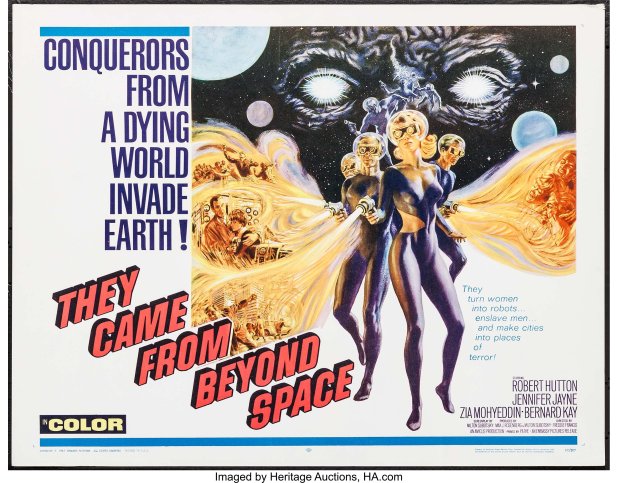
We already covered the film that this played double bills with — The Terrornauts — earlier today. And much like that movie, this one has a great poster that advertises a movie I want to see more than the one that I actually watched.
Based on Joseph Millard’s The Gods Hate Kansas, this was directed by Freddie Francis for Amicus. He claimed that the studio spent all of the budget for this on the aforementioned The Terrornauts, leading to an inferior film.
This one is about the Master of the Moon (Michael Gough!) spreading a “Crimson Plague” that wipes out a whole bunch of humanity so that the government will send the bodies of the victims to the moon to hide what really happened to them, at which point he will bring them back to life and use them to fix his spaceship.
It’s a really complicated plan that gets torn apart at the end by hero Dr. Curtis Temple, who basically tells the Master that if he’d just asked for help, humanity would have done it. This causes one of the most powerful beings in the galaxy to just start crying.
Supposedly this was Anwar Sadat’s favorite movie. I only have IMDB as a source for this, but I find that absolutely hilarious and have decided that it must be true.
For our “Ron Ormond Day” at B&S About Movies, I chose this early hicksploitationer* featuring an early role for Ron’s son, Tim. Tim would grow up to serve as an editor, cinematographer, writer (39 Stripes, The Second Coming), and director (the lost The Second Coming) on several Ormond family productions, which also included wife and mom, June Carr (her 2006 Variety obituary). Tim also acted in Ron’s films — only eight out of forty films — Girl from Tobacco Row, The Exotic Ones,If Footmen Tire You, The Burning Hell, The Grim Reaper, The Believer’s Heaven, and 39 Stripes. So, when in Ormondville, you might as well review White Lightnin’ Road to complete Tim’s acting resume . . . and honor the career of Earl Sinks — also the star of today’s second (non-Ron Ormond) film.
Who?
Read on, B&S surfer!
White Lightin’ Road (1967)
Look at that one-sheet! How can you NOT WATCH this?
This one has it all: Loose n’ tempting femme fatales, red-lining stock cars, driver rivalry, and love triangles between said rivals and femme fatales. So, yeah, the proceedings are just like any red-neckin’ romp with fast cars and faster women. And moonshine. And gangsters. And an illegal auto parts network. And murder. And shotgun weddings. And everything southern fried that we love. (Oh, Tim’s a young lad who hangs around the track that’s befriended by Joe, our ne’er-do-well hero.)
Earl “Snake” Richards — a ’50s rockabilly crooner who also appeared in Ormond’s Girl From Tobacco Row (1966), and a ’50s rock flick, That Tennessee Beat (we’re getting to it), before hanging up the clapboard — stars as Snake Richardson, the rough n’ tumble bad-boy racing rival of Joe (the one and gone Ter’l Bennett): your typical, straight-laced lad who has the need for speed. And, as in other back roadin’, moonshinin’ and asphalt romps, Ruby (the sexy n’ white-trashy, eyeball melting Arline Hunter; Playboy Playmate of the Month for August 1954), the bad guy’s girl, has eyes for the good guy. And she — one not to shriek from a good ol’ girl-on-girl catfight — gets Joe mixed up with Slick (played by Ron Ormond), who cons our lad into being the wheelman for a heist, which results in the death of a nightwatchman.
As you watch the trailer, you’ll take note that, unlike the Elvis (Viva Las Vegas) and Fabian (Fireball 500, Thunder Alley**) racing flicks Ormond emulates, there’s no stock footage: everything is staged and shot in-camera by Ron, himself, which makes White Lightnin’ Road superior to many of the racing flicks of the ’60s.
The new 35-mm trailer!
To say we love Ron Ormond’s films is a trope-laden understatement, as we’ve also reviewed Ron Ormond’s pre-salvation exploiters Mesa of Lost Women and Please Don’t Touch Me. And, if you feel like You Tubin‘ or Googlin’, you’ll discover that, after Buddy Holly went solo and left the Crickets hangin’, Earl Richards, aka Sinks, ended up fronting the Crickets. Oh, and did you know, Earl and the Crickets cut the original version of “I Fought the Law” made famous by the Bobby Fuller Four (and later the Clash; just heard it this week on a classic rock station)? True story.
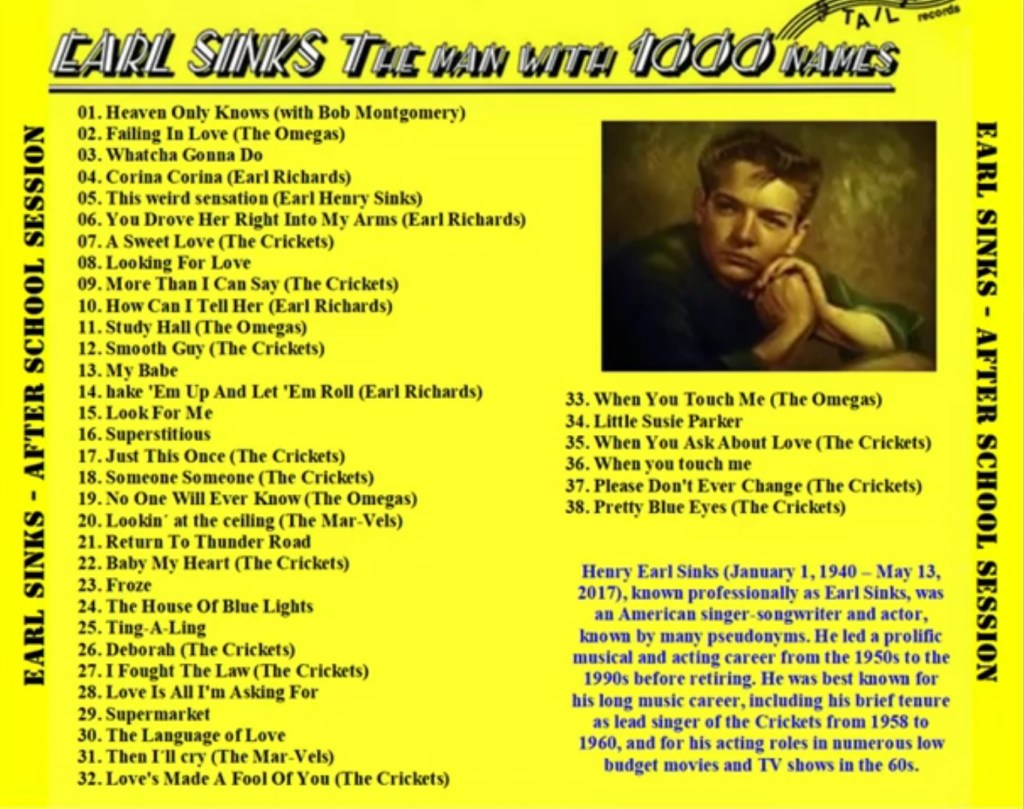
And, in a real treat, there’s a You Tube upload of the Earl Sinks compilation tribute CD The Man with 1000 Names — a super-fine, hour and a half of music featuring his work under the names Sinks, Earl Henry, Sinx Mitchell, and Earl Richards, as well as his work with the Omegas, the Hollidays, the Mar-Vels, and the Crickets. Embedded below, there’s a wonderful slideshow with Earl and the Crickets to the tune of their lost ’50s hit, “Someone, Someone,” to enjoy.
Earl “Snake” Richards in his acting debut for Ron Ormond.
Earl’s complete, career-spanning compilation/read his full biography on Wikipedia.
That Tennessee Beat (1966)
Earl Richards spotlighted on the newspaper ad for That Tennessee Beat.
The big selling point, here (this is B&S About Movies, after all), is American cinema chain owner and producer Robert L. Lippert, who we’ve waxed nostalgic in our reviews for just a few of his 300-plus films: Jungle Goddess, King Dinosaur, Project Moonbase, and Rocketship-XM. And Ron Ormond — the reason for this review — produced and directed several films for Robert L. Lippert, including many westerns with Lash LaRue. (Ormond also used Lash — as a therapist (!) — in the mondo sex-hypnosis romp, Please Don’t Touch Me. Another western star of old, Tex Ritter, worked with Ormond — as a priest (!) — in Girl from Tobacco Row.)
Star Trek: TOS scribe Paul Schneider — who gave two of the series’ best-known, first-season episodes: “Balance of Terror,” which introduced the Romulans, and “The Squire of Gothos” — pens; he also wrote episodes of The Six Million Dollar Man and Buck Rogers in the 25th Century. As for our director, Richard Brill: primarily a producer who worked on the TV series The New Steve Allen Show and Dateline: Hollywood, That Tennessee Beat was his only feature film.
This also proved to be the fifteenth and final film for (hubba-hubba) screen beauty Delores Faith, who wowed us in House of the Black Death (1965) with Lon Chaney and John Carradine, the 1966 Drive-In double-biller of The Human Duplicators and Mutiny in Outer Space, and her debut set in the far-flung future of 1980: The Phantom Planet (1961).
Then there’s our leading-lady, Sharon DeBord: During her slight, fifteen credit-career, she was Darrin Stephens’s secretary on TV’s Bewitched for several episodes. Did anyone one see her work in The Hoax (1972) with the recently passed (June 2021) Frank Bonner of Equinox fame? The Halloween rip Killer’s Delight, aka The Dark Ride (1978)?
Okay. Okay. I know. As Sam the Bossman would say: “Hey, don’t we have a movie to discuss?”
Sink — under his then stage name, Earl “Snake” Richards, is our leading man: Jim “The Nashville Kid” Birdsell. An aspiring country-western music star on the run after stealing money to fund a trip to Nashville, he’s subsequently robbed and left penniless by another road bandit. Luckily, Jim meets a brother and sister with a singing group who take him into the band and help him achieve his rock ‘n’ roll dreams. Jim, of course, falls in love with the sister, Opal Nelson (Sharon DeBord), as she and the Rev. Rose Conley (Minnie Pearl) put him on the straight and narrow.
As you can see from the newsprint ad, this film is packed — as is the case with all ’50s and ’60s rock films (see the similar The Road to Nashville; Mister Rock and Roll starring DJ Alan Freed) — with plenty of musical performances.
No disrespect to the ol’ Snake — and it’s not his fault, as he’s just a musician in an acting role — there’s not much of a story here; but again, as is the case with ’50s and ’60s rock films: the whole point is the performances. Remember, there was no MTV back then. And not everyone could afford a television to watch variety shows to see groups perform. And many couldn’t afford to go to concerts. So, it was movies, like That Tennessee Beat (distributed by 20th Century Fox, of all studios), which, for a mere buck a person (sodas and hamburgers were $.30 each*˟), brought the TV — and concerts — to America’s rural Drive-Ins.
You simply can not see a concert line up featuring Earl “Snake” Richards, Peter Drake, Boots Randolph (best know for the huge sax-driven hit, “Yakkity Yak”), the Statler Brothers, and Merle Travis (the film’s title song), not to mention the comedy stylings of the Grand Ol’ Opry’s grande dame, Minnie Pearl, for one dollar. Well, $4.00, if you toss in the sodas and burgers for you and your sweetie. So goes the genre of the “jukebox musicals” of old before Don Kirshner’s Rock Concert, ABC-TV’s In Concert, and NBC-TV’s The Midnight Special.
Sadly, I only have White Lightin’ Road recorded on an old VHS taped-off UHF TV. I also had That Tennessee Beat on a tape via UHF-TV, but lost that one to the blue screen of death. In all of my grey-market VHS years, I’ve never come across a copy of either film. And there’s no online streams to share of either film.
If there’s ever an actor-musician who deserves a restored, reissue box set of his films — only three, mind you — it’s Earl Sink. Make it happen, Arrow, Kino, and Severin. Yeah, we’re calling you out, our brothers. You can even toss in a restored greatest hits career-spanning CD of Earl’s tunes in the set.
** If you need more films with romance and burnin’ rubber (of the asphalt variety, dirty mind), check out our “Drag Racing Week,” as well as our “Savage Cinema (box set)” and “Fast and Furious Week” tributes, featuring review links to over one hundred films.
*˟ “Here’s How Much a ‘Cheap Date’ Cost Every Decade Since the 1940s” by Morgan Greenwald for Best Life.
For Henry Earl Sinks January 1, 1940 to May 13, 2017 You rocked, it, Snake!
About the Author: You can learn more about the writings of R.D Francis on Facebook. He also writes for B&S About Movies.
Editor’s Note: We previously reviewed Mission Stardust as part of its inclusion on Mill Creek’s Sci-Fi Invasion 50-film pack — the set also includes its even weirder, 1966 cousin, Mission Hydra, which we also re-reviewed with a new take, earlier today at 9 am.
Known in Italy as 4…3…2…1…Morte (aka, “Death”), this Primo Zeglio-directed science fiction movie is based on the German book series Perry Rhodan by K.H. Scheer and Walter Ernsting. Hugely successful throughout Europe and the Soviet Union, but relatively unknown in the U.S., the pulpy Rhodan paperbacks have been produced since 1961; as of 2021, 3000-plus, 66-page booklets and 850-plus spinoff novels have been produced. George Lucas named-dropped the books, saying that the American translations served as one of his inspirations alongside Flash Gordon (which he wanted to adapt, but couldn’t get the rights) in creating the adventures of Luke Skywalker and influenced the design of his verse’s spaceships.
As for Primo Zeglio, his directing career was not as successful — certainly not an Italian filmmaker we name drop in the B&S About Movies offices often; in fact, this is the only film of his that we’ve watched and reviewed — even after our month-long “Spaghetti Westerns Week” blowout. However, Zeglio is certainly a competent filmmaker and revered in his homeland for his spaghetti westerns, of which he made four: The Man of the Cursed Valley (1964) with Ty Hardin (another American TV hopeful from ABC-TV’s western Bronco, hoping for some Eastwood-buzz), Two Violent Men, with Spain’s George Martin (1964), The Relentless Four (1965; no not Kinski’s The Ruthless Four; different flick) with Adam West (again, no Eastwood upwind there for Batman), and Killer Adios (aka Killer Goodbye, aka Winchester) with Spain’s Peter Lee Lawrence (1968) (he was in Eastwood’s ’65 spaghetti western For a Few Dollars More); the film ended his 18- directing credit and 20-writing credit career. During those spaghetti romps, Zeglio produced his fair share of pirate and sword and sandal romps, the most notable being Revenge of the Pirates (1951), Captain Phantom, (1954), Morgan the Pirate (1960), and Sword of the Conqueror (1961).
In need of radioactive material that can be more powerful than uranium, Major Perry Rhodan (American-Canadian actor Lang Jeffries, whose career started with the ’50s American rock ‘n’ roll flick, Don’t Knock the Twist, and transition into a wealth of Italian sword and sandal, spaghetti westerns, and war movies) leads the four-man crew of the Stardust for the Earth’s first moon mission — and come to discover its populated, led by the platinum blonde-wigged Commander Thora of a crashed Arkonide spaceship (Swedish actress Essy Persson from the Vincent Price-starrer Cry of the Banshee, released by AIP in 1970) and her robot crew. Rhodan and his crew team with the Arkonides to rescue Crest (John Karlsen, later of Michele Soavi’s The Church) dying from leukemia, for which there is a cure on Earth. When our intrepid space travelers shuttle to Earth with Crest, Rhodan deals with a crewman’s betrayal in helping an international crime lord steal, not only the newly discovered radioactive material, but obtaining Arkonide technology by kidnapping Thora.
The caveats are afoot, as we’re only on the moon for little than half of the film; the remainder of the film is spent on Earth in the African desert (like it’s from a completely different film) with the evil Earthlings and the Arkonides in battle. The very pop-artish, dinky-but-effective effects were created, in part, by Antonino Margheriti, who designed the spaceships; the metal-octopus-cum-jelly fish alien ship (more like diving bell with octo-legs) is impressive (they are, in fact, original to the film and not cut in from any Russian space flicks, as some believe; and not as far as I can tell); Margheriti, of course, had his own series of Italian space operas beginning with Assignment Outer Space and his “Gamma One” series.
Fans of the Perry Rhodan book series, in their reviews of Mission Stardust, say it has very little to do with the first three Rhodan novels it purports to adapt. If you’re a fan of Star Trek: TOS and other ’60s-mod Italian sci-fi romps, there’s something here for you to nostalgia nosh your little VHS-cum-UHF lovin’ heart on; however, those weened in a post 2001: A Space Odyssey world, with the “realism” of films such as Silent Running, will have some MST3k-styled commentary fun with your friends as this moon romp unfolds.
Zeglio’s lone space romp is out there in a few different formats — and Mill Creek carries the shortest, U.S. version at 79-minutes. The original Euro-theatrical runs 94 minutes, there are also international 92 and 86 minutes prints that edit out the racer (e.g., sexual innuendos and suggestive) scenes. And while this was released in 1967 overseas, it came to be release in 1968 in the U.S. By that point, 20th Century Fox’s Planet of the Apes and MGM’s 2001: A Space Odyssey were released, along with Warner Bros. and Columbia Pictures’ technically accurate “first men on the moon” dramas Countdown and Marooned. The days of Margheriti’s “Gamma One” quartet and The Green Slime, also released in 1968, along with the Darren McGavin and Nick Adams-starring Mission Mars, were dated before they even hit the theaters.
There’s numerous uploads of Mission Stardust, but give this You Tube version a spin. Sadly, the U.S. public domain versions are missing the “futuristic” opening credits theme music. So don’t be duped by the uploaders who embedded their own, jokey music to the film. You can rent a cleaner, commercial-free version at Amazon Prime, which runs the 94-minute print, dubbed. Oh, and if you need to see another crazy, ’60s mod Italian space flick with Earthlings helping stranded aliens, then check out 2+5 Mission Hydra. We implore you: Watch the weird cousin to Mission Stardust that is 2+5 Mission Hydra, please. It’ll change your life.
Hey, You Tube comes through! Here’s the missing theme song, “Seli,” composed by Marcello Giombini:
Be sure to look for my reviews of 2+5 Mission Hydra and Mission Mars, as our “Space Week” tribute of reviews continues all of this week.
About the Author: You can learn more about the writings of R.D Francis on Facebook. He also writes for B&S About Movies and publishes music reviews and short stories on Medium.
The difference between pre-Max Rockatansky armageddon movies and post is that the end of times is a thing to be celebrated in the 80’s. It was seen as the next step in evolution and place we’d all have to emerge from, wearing facepaint and shoulder pads. Not so in the 50’s and 60’s, where sure nuclear war was inevitable, but so was the bleak death of the human race. No one would survive to roam the wastelands and build it all over again in these films.
In this film, a group of young women roam the fallout forests, led by an older woman in military fatigues who has to keep control, especially because these women seem to be obsessed with torturing animals. Seriously, they are the wet dream of 70’s Italian filmmakers and the nightmare of any rational person watching this movie. They then find an old hotel where only one old man lives.
Yes, a depressing Czech end of the world movie with no subtitles and people killing one another over polka records. Do I know how to pick movies to watch during a global pandemic or what?
AUTHOR’S NOTE: This review originally ran in Drive-In Asylum #21. You should buy it!
The film that dares to explain what most parents can’t…
SEE life begin!
SEE the actual birth of a baby!
There are some movies that I can’t wait to watch. And then there are others that I keep from watching, waiting for the right moment so that they achieve maximum viewing velocity and impact.
For years I’ve thrilled to the trailer for Teenage Mother, with its barking voice basically shouting to no one in particular, “It happens 250,000 times a year. Where is your daughter tonight? This is the story of a girl who wasn’t careful.”
I can word for word perform this trailer for you – go ahead, ask me next time you see me in person – so I was concerned. How could the movie live up to a ballyhoo build that promises a girl who turns brother against brother, a wanton lass so scandalous that roadshow presentations of her story would come complete with split audiences for the boys and the girls, as well as a nurse to explain “the real facts of life” with a “brief lecture about how we use our bodies.” The voiceover shrilly lays it all on the line, “every parent should bring our child. It explains things you can’t” in color and Cinemascope.
Also known as The Hygiene Story, a lesser title if there ever was one, this was produced by Jerry Gross. Obviously, he learned and applied the square up reel instructional angle that the legendary Kroger Babb employed when he roadshow four-walled Mom and Dad across America for decades. While Gross only directed two other movies – Female Animal and Girl On a Chain Gang – he also produced everything from All the Kind Strangers to Sweet Sweetback’s Baadasssss Song and The Black Godfather.
More than that, Gross was the genius who bought a movie called Caribbean Adventure, retitled it I Eat Your Skin and like some mad genius, had the vision to pair it with a movie that is literally LSD on filmstock, I Drink Your Blood.
Gross brought both of the Mondo Cane films to American theaters, complete with actors hired to play natives that would dance through the aisles. He also had a hand in getting Fulci’s Zombie, Fritz the Cat, Blood Beach, Johnny Got His Gun and The Boogeyman on screens. And he possessed the carny intelligence it took to rename Day of the Woman to the much more titillating – and money-making – nom de plume I Spit On Your Grave.
Nobody could title a movie like Jerry. He once said, “I guarantee that all these are selling titles. The public just cannot resist a film if the title drags them in. Stars don’t matter. Titles do!”
Jerry pulls a fast one here, as our heroine Arlene (Arlene Farber, the at-the-time wife of Gross, who appears in the film as a seedy truck driver) never even gets knocked up. She’s just lying to her boyfriend to get attention. So yeah – the movie Teenage Mother doesn’t even have a teenage mother in it, but is really about Ms. Peterson, a teacher who has angered all the parents with her sex education class.
Beyond all that, Teenage Mother provides an odd place for several stars to get their first on-screen credit. Earl Hindman, Wilson from Home Improvement, is here, as are Lynne Lipton (the voice of Cheetara on Thundercats), Alex Mann (who appeared in movies by Joe Sarno, Barry Mahon, Doris Wishman and Michael Findlay) and most surprising, Fred Willard. In his brief moment on screen, he breaks up an attack on Ms. Peterson, an act that the future star of Fernwood 2 Night said caused boos in some of the rougher showings of this opus.
But back to the story. Our heroine being mock pregnant has the town in an uproar and the hygiene class is the culprit.
“Teaching that stuff in school is like talking about the Devil right in church,” screams the matronly librarian – who should really speak in a hush, if you think about it – at one point. But for all the bluster of the trailer about how “this is a film about a girl who went all the way” and how this “may very well be the most important film that you will ever see,” the sleaze mostly resides in that five-minute get butts in the seats masterpiece.
I say mostly because Teenage Mother ends with the actual birth of a child – forceps and all – with the same voice as the aforementioned trailer, which I like to believe is Gross. It’s the most clinical and mechanical description of the miracle of birth you’ve ever seen, using words like Universal Joint, interior birth canal and minimal compression of the fetal head.
You have to love a movie whose climax is predicated on stock footage being shown, much less stock footage that Gross slipped some doctor fifty bucks for.
Never let anyone tell you that this world is bereft of magic. At one point, Jerry Gross walked the Earth and instead of using his genius for the kind of things that normal humans celebrate like inventing consumer products or running for political office, he blessed us all with mind-melting reels of cinema. He taught us so many things, foremost among them the knowledge that Satan is an acidhead and that Teenage Mother means nine months of trouble.
Known in Japan as Uchū Daikaijū Girara (Giant Space Monster Guilala), this film is Shochiku’s first monster movie and very well may be the first Japanese film to feature a woman — Peggy Neal — with blonde hair.
It’s also the first appearance of Guilala, one of the wackiest looking kaiju you’ve ever done seen.
The spaceship AAB Gamma is on its way to Mars to check out UFO sightings when it gets sprayed with spores that develop into the giant lizard known as Guilana, a monster that spits fire, eats nuclear power, can turn into a burning ball of light and can only be defeated by Guilalalium, which turns it back into a spote that gets shot around the sun.
In the 1990s after Nikkatsu Co. — who made Gappa, the Triphibian Monster — out of business, Shochiku announced Gappa vs. Guilala, which sadly never happened.
There was, however, Monster X Strikes Back: Attack the G8 Summit, a movie in which Guilala attacks world leaders and KIm Jon Il tries to fire nukes at him.
Toho’s A-list was all working on King Kong Escapes while Godzilla got what was left behind, just like what happened with Ebirah, Horror of the Deep. It’s the first movie where Godzilla’s son Minilla appears, a character created not for kids but for young Japanese women on dates who adore kawaii — or cute — versions of characters.
Minilla is discovered within his egg buried deep in the Earth, his crying disrupting a weather control system — well, that seems like a bad idea — that scientists are setting up on Monster Island, of all places. Some giant bugs called Kamacuras (Gimantis in America) try to eat the egg and Godzilla shows up to save the child and decimate those annoying insects.
Minilla grows to half our hero’s size and while he can only blow smoke rings, he’s still willing to fight a giant spider named Kumonga to save some humans, who respond to this kindness by freezing the island so that they can escape. Godzilla says, “Screw this,” and goes to sleep.
When this was released in Italy, it was titled Il Ritorno di Gorgo (The Return of Gorgo), which is an absolute slap to to the green face of Godzilla, seeing as how Gorgois an absolute ripoff of the original film.
EDITOR’S NOTE: Other than Son of Kong, no movie is as depressing as Voyage Into Space. Perhaps that’s why it wasn’t part of the first kaiju day. However, I brought it back for the second one, so try not to get too upset. This originally was on our site on December 9, 2019.
Voyage Into Space is my Vietnam.
It takes 4 episodes of the 26 episode series Giant Robo, or Johnny Sokko and his Flying Robot, and crams them into one movie. So why does it distress me so?
I saw it when I was probably 5 years old. I was obsessed with robots, like my Mazinger Z Shogun Warrior. I had never seen a movie where the robot dies at the end. Spoiler warning — the robot blows up real good at the end.
I cried for years. I might still be crying.
Earth has been invaded by an interstellar terrorist group known as the Gargoyle Gang, which is led by Emperor Guillotine, who spends all of his time hidden on the ocean floor in a UFO. Yes, that’s just how awesome this is.
They’ve been capturing scientists to create an army of extraordinary magnitude, err monsters, to conquer the Earth.
A boy named Daisaku Kusama, or Johnny Sokko in America, where he was voiced by a woman named Bobbie Byers who also shows up in Savages from Hell and The Wild Rebels, and Juro Minami — nee Jerry Mano in the gaijin world — from the spy team Unicorn are all that stands between aliens owning this big blue rock. It gets better for them when they meet scientist Lucius Guardian, who gives a small child the power to control a robot — great logic — before he gets killed and drops a nuke on the aliens.
Man, this Gargoyle Gang — they dress like the United Nations of bad guys, donning German, Soviet and Central American military gear all at once, topping it off with designer sunglasses — are bad guys. They have all manner of horrific beasts ready to destroy Earth. In this cut down movie, which is basically episodes 1, 2, 10, 17 and 26 of the show, you get 100 minutes of pure madness.
There’s Draculon the Sea Monster, who was known as Dakolar in Japan. Nucleon the Magic Globe — also known as Globar in Tokyo. Lygon, who swallows a train. The Gargoyle Vine, which has the much cooler name in Japan of the Satan Rose. And all manner of evil henchmen like Spider and Doctor Over. The full series even has an alien mummy and a peg-legged snakeman.
Unlike most anime and Japanese movies that were sent to the U.S. at this time, nobody thought that they should edit the violence out of this. So in one episode, a kid almost gets killed by a firing squad. And yeah — the ending — where the pharaoh robot dies saving the Earth? I remember going outside and staring into the sky, punching my fist into the ground, screaming at God. No, really. I did. For days. It was so bad that my mother had to write an entirely new ending for me so that I could get on with grade school.
You can watch this on the Internet Archive. Prepare yourself to be depressed.





 B&S About Movies
You must be logged in to post a comment.