CBS LATE MOVIE MONTH: The Clones (1973)

EDITOR’S NOTE: The Clones was on the CBS Late Movie on November 7, 1975, and April 18, 1977.

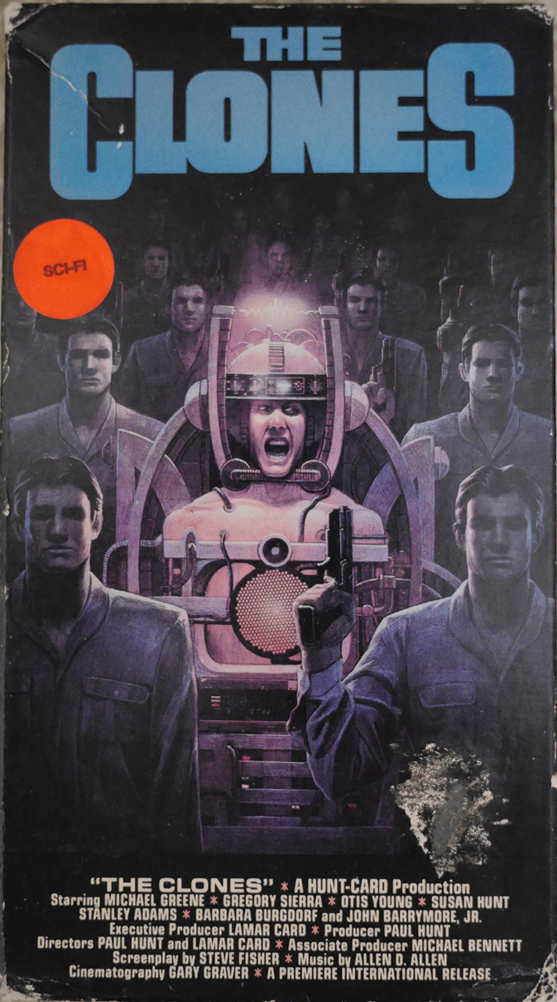
Dr. Gerald Appleby (Michael Greene) finds himself in a perplexing situation. He believes he’s been cloned. His conviction stems from a near-fatal escape from his lab’s explosion and the unsettling reports of his sightings in places he’s never been. This sets the stage for a gripping narrative as he goes on the run, pursued not only by the deranged scientist Carl Swafford (Stanley Adams, Cyrano Jones from the original Star Trek) but also by the ruthless thugs Sawyer (Otis Young, Blood Beach) and Nemo (Gregory Sierra, a stark contrast to his usual role as the virtuous Det. Sgt. Chano Amenguale on Barney Miller).

Directed by Paul Hunt (he also directed Twisted Nightmare and produced Demon Wind) and Lamar Card (who directed Supervan and Jukebox AKA Disco Fever, as well as the producer of Nashville GirlSavage Harvest and Project: Metalbeast), who co-wrote the film with Steve Fisher, who started writing movies back in 1938 with Nurse from Brooklyn. He also wrote the novel and screenplay for I Wake Up ScreamingHell’s Half AcreJohnny Angel and episodes of Peter GunnMcMillan & WifeCannon and Fantasy Island.

Most people will watch this movie and see a slow-moving film that goes nowhere, filled with fish-eye lens-addled drug scenes and an overwhelming sense of conspiracy doom. As for me, I read that sentence and only see the positives. Young and Sierra are having a blast; the ending is as cynical as it gets, and a lot of the ending takes place inside an amusement park that runs itself. It’s a movie that came out on VHS, has had no major DVD release and has never come out on Blu-ray.

You can watch this on Tubi.
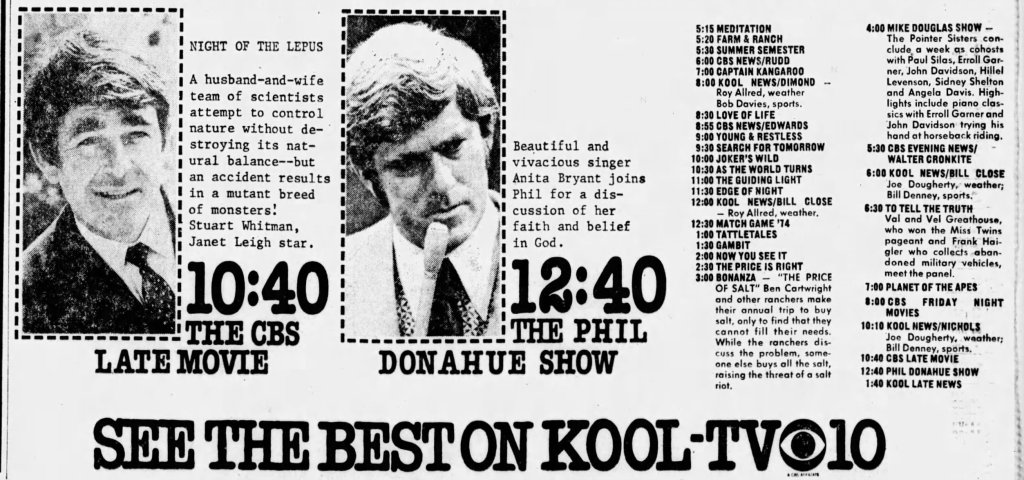
CBS LATE MOVIE MONTH: Night of the Lepus (1972)

EDITOR’S NOTE: Night of the Lepus was on the CBS Late Movie on September 13, 1974; October 17, 1975 and June 13 and August 24, 1976.

Based upon Russell Braddon’s 1964 science fiction novel The Year of the Angry Rabbit, this movie pits mankind against mutant rabbits and, well, if you can get past that idea, you’re probably going to love this movie.

Director William F. Claxton and producer A. C. Lyles came from Westerns, which explains the cast of this movie, which includes Stuart Whitman, Rory Calhoun and DeForest Kelley being in the cast as well as the shooting location, the Old Tucson Studios. It does not explain the effects, which are a combination of regular-size rabbits on miniature sets and people dressed in rabbit costumes.

Janet Leigh, who is also in this, told Starlog, “No one put a gun to my head and said I had to do it. What no one realized was that, no matter what you do, a bunny rabbit is a bunny rabbit. A rat, that can be menacing — so can a frog. Spiders or scorpions or alligators, they could all work in that situation, and they have. But a bunny rabbit?! How can you make a bunny rabbit menacing?”

Rancher Cole Hillman (Calhoun) seeks the help of college president Elgin Clark (Kelley) when thousands of rabbits invade his farm after their natural predators, coyotes, are killed off. Roy and Gerry Bennett (Whitman and Leigh) are brought in and they work on using hormones to disrupt the rabbits’ reproduction cycles but their daughter falls in love with the bunny and switches it out; the mutant bunny runs away and pretty much declares war on humanity.

The towns of Galanos and Ajo are eaten by the giant rabbits before the strange team of a drive-in audience and the National Guard trap the gigantic hares in an electrified field that kills all of them. And good news, because regular rabbits — and the coyotes — are back at the end of the movie.

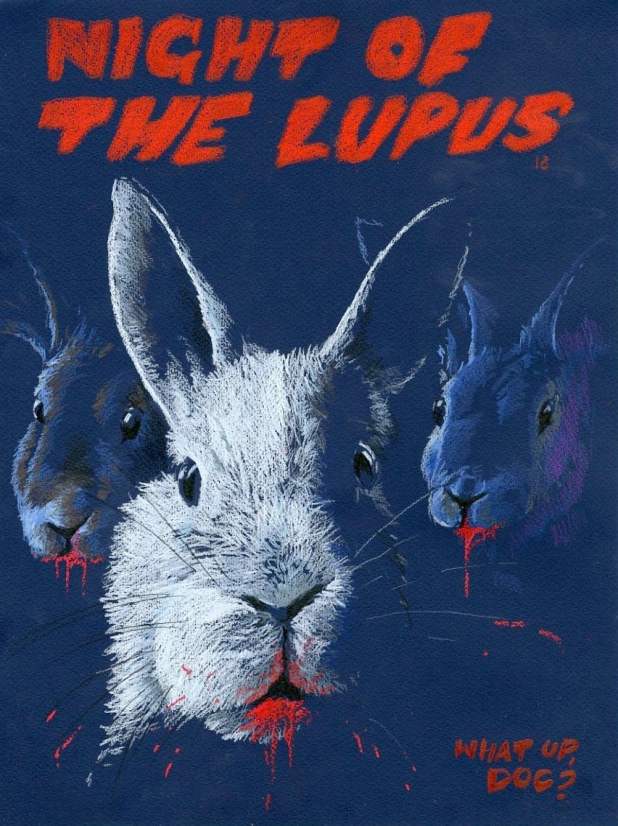
They tried to hide the rabbits on the poster — even changing the title from Rabbits — and then changed their mind at the last minute and gave away rabbit’s feet with the film’s logo on it.

Check out this ad for the CBS Late Movie show from Bill Van Ryn of Groovy Doom and Drive-In Asylum!

CBS LATE MOVIE MONTH: Kolchak: The Night Stalker: The Spanish Moss Murders (1974)

EDITOR’S NOTE: This episode of Kolchak: The Night Stalker was on the CBS Late Movie on June 29 and October 26, 1979; July 17, 1981; October 30, 1987 and February 26, 1988.

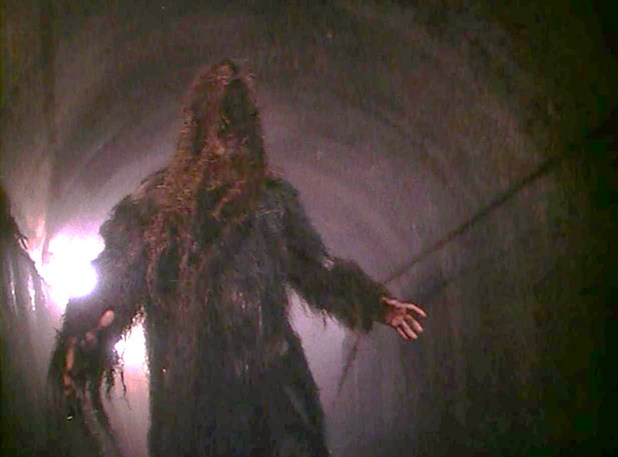
Chicago is filled with supernatural murders. This time, the only thing linking the killings of a sleep research center assistant (Elisabeth Brooks from The Howling!) and the chef of Chez Voltaire is that their chests were crushed, and their bodies were covered with Spanish Moss. Somehow, Kolchak learns that the crimes come from the Cajun myth of Pere Malfait, the Bad Father. Only a spear made of gumwood from the bayou can stop the monster, which Kolchak also finds, and then goes into the sewers to again battle the supernatural.

The monster has come to life thanks to the sleep studies of Dr. Aaron Pollack (Severn Darden), and as one of his patients (Don Mantooth) dreams of the boogeyman, the tactics to help him sleep unleash it in the real world. Kolchak comes up against another Chicago cop who wants none of his monkey business, this time Captain Joe “Mad Dog” Siska, played by Keenan Wynn.

The Spanish Moss Monster is played by Richard Kiel, the same bad guy two episodes in a row. The creature is based on a legend of a soldier who kidnaps, rapes and beheads and hangs a Native American princess from a tree. Her spirit becomes one with the tree, and she hunts down the soldier, killing him with the tree’s roots, which have become one with his hair. There’s also a Florida Moss Man legend of a “large man-like beast with a rank odor and covered with swamp grass” that was seen often in the late 1800s.

This was directed by Gordon Hessler, who also directed Scream, Pretty PeggyCry of the Banshee and Scream and Scream Again. It was written by Alvin R. Friedman and David Chase.

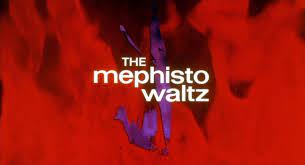
CBS LATE MOVIE MONTH: The Mephisto Waltz (1971)

EDITOR’S NOTE: The Mephisto Waltz was on the CBS Late Movie on July 29, 1977.

Paul Wendkos may have directed most of the Gidget movies, but he has quite the horror pedigree. There’s the TV movie Good Against Evil, Haunts of the Very Rich, the 1985 remake of The Bad Seed and the legendary 1975 TV movie The Legend of Lizzie Borden.

Because this is a Quinn Martin Production and CBS aired it extensively on TV, many people believe that it was a made-for-TV movie. However, it was actually released in theaters—the only movie that Twentieth Century Fox released for the entire calendar year of 1970, due to several of 1969’s movies failing at the box office.

Myles Clarkson (Alan Alda) once wanted to be a pianist but is now a music journalist. He gets to interview the world’s greatest piano player, Duncan Ely (Curd Jurgens, The Vault of Horror). It doesn’t start well, but then Ely discovers that Myles has hands perfect for the piano.

At that point, Duncan and his daughter Roxanne (Barbara Perkins) become friends with Myles and his wife Paula (Jacqueline Bisset), who doesn’t trust either of them. She was right to suspect them, as they’re Satanists who have transferred Duncan’s mind to Myles’ body. However, as Myles becomes a major star, she starts to like the man she’s married to more and more. She becomes seduced by the power, even if Duncan comes to her in dreams and tells her that their daughter must die.

After that dream, the daughter dies, which pushes Paula to investigate the Ely family. She then finds herself falling into the arms of Roxanne’s ex-husband, Bill (Bradford Dillman).

This is the 1970s, so of course, incest figures in. It turns out that Duncan and Roxanne have bartered with Satan to enable them to pursue their incestuous relationship by placing Duncan’s consciousness into Myles’ body. When Bill is killed with the same blue forehead murder style as Paula’s daughter, she starts to worry for her life. But simultaneously, she decides that no matter who is in her husband’s body, that’s the man she wants to be with.

So she does what any of us would do. She turns to Satan and kills herself, moving her mind into Paula’s body. Then, she returns to her husband, Paula’s father, in her husband’s body. Whatever issues there were with the marriage have been solved, thanks to the left-hand path and outright murder.

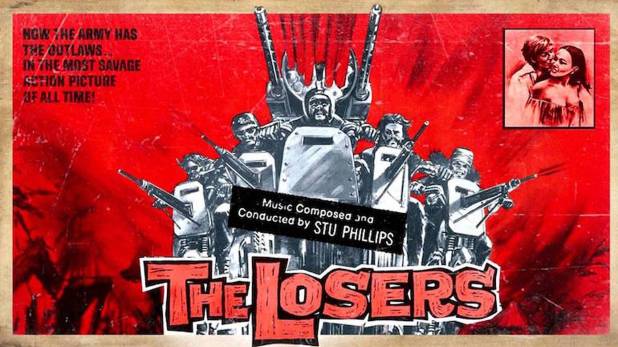
CBS LATE MOVIE MONTH: The Losers (1970)

EDITOR’S NOTE: The Losers was on the CBS Late Movie on October 3, 1975 and October 8, 1976.

Also known as Nam Angels, this Jack Starrett-directed film (he also made Run, Angel, Run!Race with the Devil and Hollywood Man, among others) has a great high concept: a biker gang called The Devil’s Advocates is sent to Cambodia to rescue an American diplomat because they are the only ones who can get the job done.

They’re led by a Vietnam vet — and the brother of the Army Major who has recruited them — Link Thomas, played by the always dependable William Smith. They’re under the orders of Captain Johnson (Bernie Hamilton, who was Captain Harold Dobey on Starsky and Hutch) and include fellow vets Duke (Adam Roarke from Dirty Mary, Crazy Larry and Frogs) and Dirty Denny, as well as Limpy (Paul Koslo, Vanishing Point) and Speed (Eugene Cornelius, who was Space in Run, Angel, Run!).

They head to Vietnam,  but come on, we all know it’s the Philippines because the mechanic who works on their bikes, Diem-Nuc, is played by Vic Diaz. It doesn’t matter because by the time you start trying to figure out locations*, our heroes are doing wheelies and blowing things up with rocket launchers and machine guns while they do wheelies.

This movie does have some basis in reality. Sonny Barger, the Maximum Leader of the Hells Angels, sent LBJ a telegram offering the skills of his club in the Vietnam War. That inspired Alan Caillou, who originally wrote that The Losers would live. Starrett and Smith rewrote the script to the ending we know now.

If you watch Pulp Fiction, you can see a scene from this movie being watched by Butch’s girlfriend the day after his fight. When he asks what she is watching, she says, “A motorcycle movie, I’m not sure the name.”

*They’re reused from Too Late the Hero.

CBS LATE MOVIE MONTH: The Story of G.I. Joe (1945)

EDITOR’S NOTE: The Story of G.I. Joe was on the CBS Late Movie on October 13, 1972 and May 18, 1973.

Ernie Pyle, a Pulitzer Prize-winning American journalist and war correspondent, is revered for his stories about the ordinary American men who fought in World War II. His work was so impactful that President Harry Truman acknowledged, “No man in this war has so well told the story of the American fighting man as American fighting men wanted it told. He deserves the gratitude of all his countrymen.”

As for this movie, when they were picking someone to play Pyle, he told the filmmakers, “For God’s sake, don’t let them make me look like a fool.”

Producer Lester Cowan picked Burgess Meredith, a captain in the Army at the time and could not be released from active duty. Presidential advisor Harry Hopkins overruled that order, overruled that order, and General George C. Marshall approved Meredith’s honorable discharge.

He spent time with Pyle in New Mexico as the writer recovered from surviving an accident bombing at the start of Operation Cobra in Normandy. They believed that Meredith was the best actor for the role besides Leslie Howard, who had recently died in a plane crash.

Director William A. Wellman, a decorated combat pilot during World War I who served in the Lafayette Flying Corps of the French Air Force and earned a Croix de Guerre with two palms for valorous action, asked the Army for 150 soldiers and demanded that they speak their own dialogue, live with the actors and train with them.

The 18th Infantry, U.S. Army, a unit that had never seen combat, is sent to the front lines. Lt. Bill Walker (Robert Mitchum) allows Pyle, who is inexperienced in combat, to accompany him. Despite a brutal defeat at the Battle of Kasserine Pass, they become efficient killing machines. The movie doesn’t shy away from the horrors of war, depicting a battle near Monte Cassino that forces the men into caves, eating from cold ration cans for Christmas and slowly losing their sanity. As a man Pyle watched get married dies in combat and another suffers a breakdown, the writer learns that he has won the Pulitzer, which seems like no comfort. After reuniting with the unit after the battle, he sees a long line of mules carrying the dead, the last one holding his friend Walker, which causes the men to weep openly.

Pyle’s poignant words, “For those beneath the wooden crosses, there is nothing we can do, except perhaps to pause and murmur, ‘Thanks pal, thanks.'”, encapsulate the profound loss and the enduring gratitude felt by those who survived the war.

Pyle was pretty honest about the movie, saying, “They are still calling it The Story of G.I. Joe. I never did like the title, but nobody could think of a better one, and I was too lazy to try.” Sadly, he was killed in action on Ie Shima during the invasion of Okinawa two months before the premiere of the movie about his life.

Sources

Cotillion : Ernie Pyle – War Correspondent. http://cotillion.mu.nu/archives/223272.php

William A. Wellman — Wikipedia Republished // WIKI 2. https://wiki2.org/en/William_Wellman

Story of G.I. Joe | International Military Forum – IMF. https://www.military-quotes.com/forum/story-g-joe-t515.html?s=71be3e6c2acdb3eb06984571079155df

In the Movies: Wartime Columns: Ernie Pyle: Indiana University. https://erniepyle.iu.edu/wartime-columns/in-the-movies.html

CBS LATE MOVIE MONTH: Kolchak: The Night Stalker: Bad Medicine (1974)

EDITOR’S NOTE: This episode of Kolchak: The Night Stalker was on the CBS Late Movie on September 21, 1979; July 10, 1981 and October 23, 1987.

“F. Scott Fitzgerald once wrote, ‘The rich are different than you and me.’ They sure are. They got more money. But there wasn’t enough money in the world to save some of Chicago’s upper crust members from a fiendish force so dark, it can only be called diabolic.” This quote sets the tone for the episode, hinting at the episode’s focus on the wealthy and their encounter with a sinister force.

With those words, Carl Kolchak embarks on a new episode, delving into the mysterious deaths of two Chicago socialites who killed themselves the same night and lost their precious gems. This leads him to the intriguing Native American legend of the Diablero, a sorcerer amassing a fortune in gems to break its eternal curse.

The highlight of this episode is when Karl goes to battle the legend at the Champion Towers, a luxurious high-rise in Chicago, bringing along a small mirror as seeing its reflection is the only way to stop this monster. Of course, Karl gets spooked and drops the mirror, shattering it and is alone, afraid and up against pure terror.

Despite facing a force that can hypnotize people into doing its bidding, Kolchak finds a mirror in the bathroom, transforms it into a skeleton, and then dusts. In a surprising turn of events, Canadian actor Victor Jory plays Charles Rolling Thunder, a role that might raise some eyebrows. And to top it off, the tribe in this episode, the Yoshone, is a fictional creation.

This episode was directed by Alexander Grasshoff (The Last Dinosaur) and was written by L. Ford Neale and John Huff, both of whom wrote the Burt Reynolds movie The Hunter’s Moon.

The makers of Kolchak must have really liked Kiel, as he would return the next episode to play the Paramafait in the next episode, “The Spanish Moss Murders.”

CBS LATE MOVIE MONTH: Sweet Hostage (1975)

EDITOR’S NOTE: Sweet Hostage was on the CBS Late Movie on September 17, 1977 and May 15 and November 17, 1978.

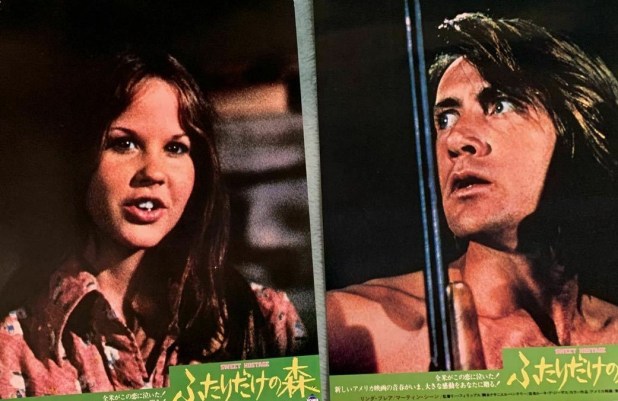
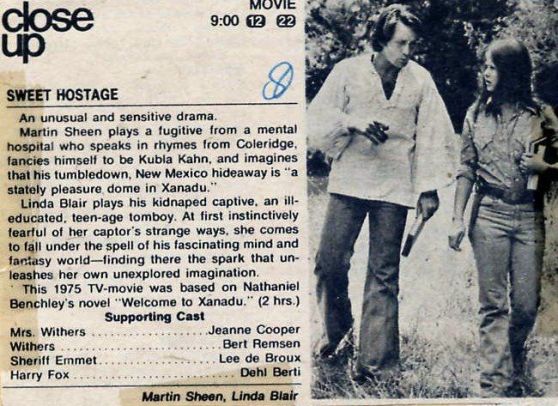
Based on Welcome to Xanadu by Nathaniel Benchley, this was the ABC Friday Night Movie on October 10, 1975 and two years later, it became the CBS Late Movie. It was directed by former actor Lee Phillips and written by Edward Hume.

It’s a tale that’s both simple and controversial. Leonard Hatch (Martin Sheen) kidnaps Doris Withers (Linda Blair) from the farm that she works on for her family. Despite being a mental patient, he treats her better than her family ever did, teaching her and respecting her boundaries. However, this is also a story of a thirty-one-year-old man kidnapping a teenage girl and her developing Stockholm syndrome. It’s a stark reminder that 1975 was a different time. After all, Linda Blair was only 16 when this was made.

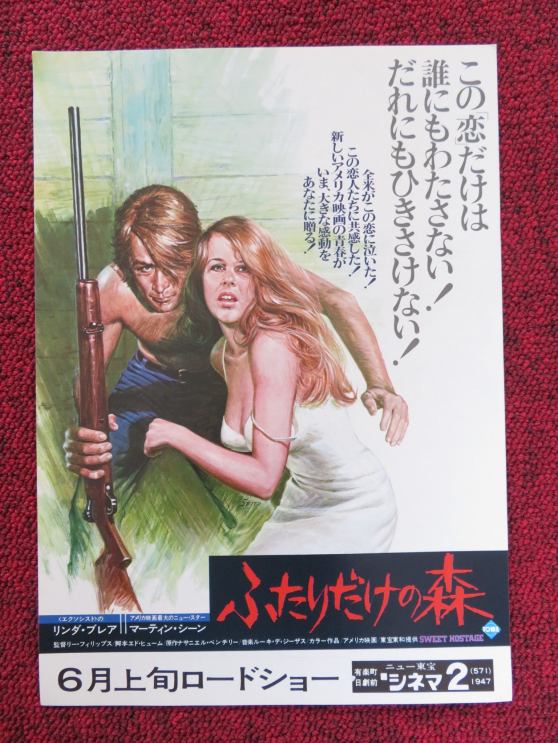
It was a big deal in Japan, where it played in theaters, and posters featured Blair in her nightgown. Although she didn’t want Sheen in the role and would have preferred her then-boyfriend Rick Springfield, she ended up “falling madly in love” with the twenty-one-years older Sheen, although they didn’t have a relationship.

As the story unfolds, these two characters find themselves in a surprising situation and fall in love. However, their budding romance is constantly interrupted by Doris’ parents and the police. The story concludes in a manner typical of a 1970s TV movie, leaving the audience with a sense of unexpectedness.

CBS LATE MOVIE MONTH: Satan’s School for Girls (1973)

EDITOR’S NOTE: Satan’s School for Girls was on the CBS Late Movie on September 5, 1975 and April 1, 1977.

The early 70s were a time when Satan seemed to reign. I first learned about Anton LaVey and the Church of Satan as a child by reading the TV Guide Book of Lists. They asked him what the most Satanic TV shows were, and he replied with a list that included so many of my favorite shows. It scared me as a twelve-year-old — could I be taken by devil worshippers and be made to celebrate the Black Mass? This cultural phenomenon of the 70s is a nostalgic left-hand trip for many of us.

Made-for-TV movies reflected the Satanic bent of the early 70s. This Aaron Spelling produced, David Lowell Rich (Eye of the Cat, Airport 79 – The Concorde) directed affair brings the devil to the boarding school, along with plenty of attractive girls ready to give their souls to the Son of the Morning Star.

Martha Sayers is running from a mysterious stranger who may or may not be related to Torgo from Manos: The Hands of Fate. She locks herself in her sister Elizabeth’s (Pamela Franklin, Necromancy, The Legend of Hell House, The Food of the Gods) house and hangs herself. Of course, the police just think it’s a suicide. But we know better — The Salem Academy for Women had to have something to do with it. Martha’s roommate warns Elizabeth to stay away, but she is determined to uncover the truth.

She takes the name of Elizabeth Morgan and enrolls at the school where she’s welcomed by Roberta (Kate Jackson!), Jody Keller (Cheryl Ladd!) and Debbie Jones (Jamie Smith-Jackson from Go Ask Alice, who is married to Michael Ontkean, Sheriff Harry S. Truman from Twin Peaks). The fact that Alice and two of Charlie’s Angels (Sabrina Duncan and Kris Munroe, I’ll have you know) playing devils in a movie thrills me to no end. And throw in Alice, and we have a movie!

Debbie keeps having outbursts in class, and another girl commits suicide, prompting Headmistress Williams to start worrying about the influence of the new girl. Then there’s that painting of Martha in a dungeon that Debbie painted but is now terrified of. Just imagine — Elizabeth snoops and finds that room on campus but is chased away by a man with a knife!

Roberta is now on Elizabeth’s side. After all, there are some crazy teachers, like the professor, who make them run a rat through a maze. And when Debbie tries to leave, her body shows up. Finally, Liz can’t take anymore and bursts into Professor Delacroix’s (Lloyd Bochner, who played Walter Thornton in The Lonely Lady) office. He screams that something is stalking him, so he jumps out a window, gun in hand. He runs through a swamp before being beaten to death with sticks by several students. The popular Dr. Joseph Clampett (Roy Thinnes, David Vincent from The Invaders, The Norliss Tapes) is the real killer. The plot takes unexpected turns, keeping the audience on the edge of their seats.

He’s leading a Satanic cult that believes that he’s the devil. Only Elizabeth and the headmistress survive as the rest of the girls sacrifice themselves to the flames. And Clampett? He survives the fire and then promptly walks outside and disappears.

Interesting Wiki story: In the film’s synopsis, whoever wrote it states, “the other girls stay behind to sacrifice themselves to their leader (But are saved by God and Jesus offscreen as they were forced).” How do they know? That certainly didn’t happen in the movie version I saw!

This was remade in 2000, with Kate Jackson playing the school’s dean and Shannen Doherty. That version is unreviewed. Why pick 2000 when you can choose 1973? If only all schools could be as ridiculous as the Salem Academy for Women! If only all rooms had shag carpeting, and there were constant wine mixers and murders and 70s garish fashions! My world is so dull by comparison!

CBS LATE MOVIE MONTH: Chamber of Horrors (1966)

EDITOR’S NOTE: Chamber of Horrors was on the CBS Late Movie on September 11, 1972.

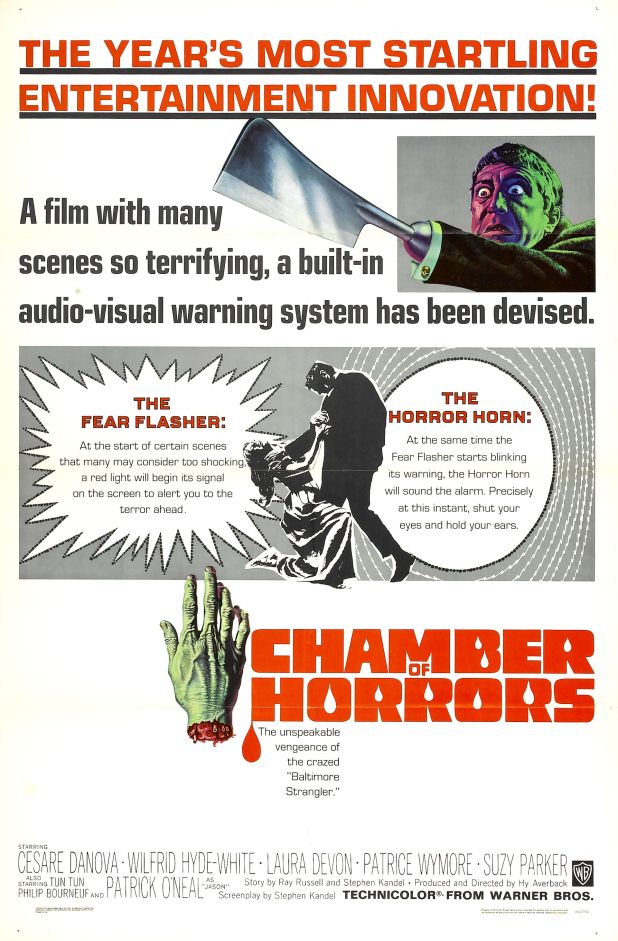
Ladies and gentlemen, the motion picture you are about to see contains scenes so terrifying the public must be given grave warning. Therefore, the management has instituted visual and audible warnings at the beginning of each of the four supreme Fright Points. The Fear Flasher is the visual warning. The Horror Horn is the audible warning. Turn away when you hear the Fear Flasher! Close your eyes when you hear the Horror Horn!”

Chamber of Horrors was initially intended to be a made-for-TV movie and a pilot for a series known as House of Wax. It was way too intense for that, so it came to theaters. It was pretty short — it’s only 99 minutes with padding — so they added two gimmicks: the Fear Flasher turns the screen red when something scary happens, and the Horror Horn makes plenty of noise when something gory is about to befall a character.

This was directed by Hy Averback, who directed and produced plenty of TV as well as directing the movies Where Were You When the Lights Went Out?, I Love You, Alice B. Toklas and The Story of Life, a 62-minute sex educational film with animation by several former Disney cartoonists. He was also the voice of the loudspeaker on M*A*S*H*. It was written by Stephen Kandel, who, in addition to writing tons of TV scripts, also wrote Winchester 73. Seriously, his TV credits hit every major show of the 70s.

Anthony Draco (Cesare Danova) and Harold Blount (Wilfrid Hyde-White) own a wax museum in Baltimore and have a side hustle as detectives. They join the police — including Wayne Rogers as Sgt. Albertson — in the hunt for Jason Cravette (Patrick O’Neal), a man who kills women and then marries her, which doesn’t seem like the usual way these things go. After being caught and sent via train to prison, he escapes by cutting off his own hand and running off to New Orleans, now with a hook where he once had fingers.

He finds a sex worker named Marie Champlain (Laura Devon) and transforms her into a lady — ironic, as Hyde-White played Colonel Pickering in My Fair Lady — and takes her back to Baltimore to seduce and murder the man who convicted him, Judge Walter Randolph (Vinton Hayworth). He chops off the dead man’s hands and head so the police can’t figure out who did the crime. He follows that by killing Dr. Romulus Cobb (Richard O’Brien) and sending that man’s hands to the police to taunt them.

Draco and Blount believe that the mysterious murderer is Cravette and that he’s sending an entire corpse to the police piece-by-piece, with the arms and head still missing. After he kills a police officer for the hands, Draco realizes that the head the killer wants will be his.

There’s a tease for the next episode: a body in the Iron Maiden in the museum turns out to be real. The detectives call the police, and, well, that’s the end of their adventures.

This was supposed to be a House of Wax series, so the sets from the original film are used in this movie. Tony Curtis also appears in a cameo, and William Conrad narrates the story.

Sources

Cool Ass Cinema: Chamber of Horrors (1966) review. http://www.coolasscinema.com/2010/11/chamber-of-horrors-1966-review.html?showComment=1290117394811