EDITOR’S NOTE: This episode of Kolchak: The Night Stalker aired on the CBS Late Movie on September 14, 1979; July 3, 1981 and February 5, 1988.
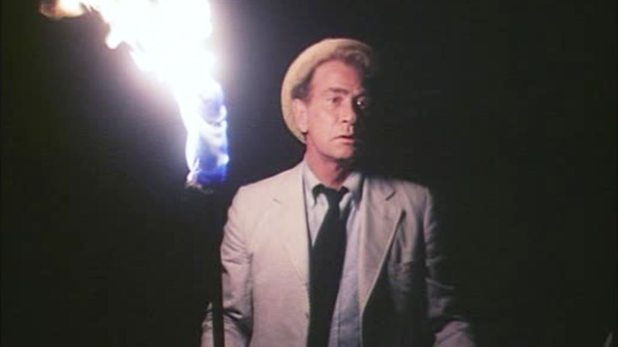
Carl Kolchak starts this episode with these sage words: “The old cliche that politics makes strange bedfellows is only too true. At one time or another, various and sundry politicians have found themselves, when it proved expedient, of course, sharing a blanket with the military, organized crime, disgruntled, gun-toting dairy farmers, the church, famous athletes, the comedians – the list is endless. But there was a senatorial race not so long ago right here in Illinois where the strangest bedfellow of all was found under the sheets. The strangest… and certainly the most terrifying.”
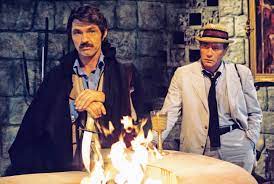
Our intrepid reporter, Kolchak, is on a mission to interview the enigmatic Senatorial candidate, Robert Palmer (Tom Skerritt). Palmer, a man seemingly always a step ahead of his opponents, who mysteriously meet their end, is shrouded in scandal. As Kolchak delves deeper, the suspense thickens, and the truth becomes more elusive.
At every one of these deaths, a large dog has been seen. Well, you don’t have to have the investigative skills of Kolchak to figure out that Palmer has sold his soul to Satan for power on Earth, a contract that his wife Lorraine (Ellen Weston) wants him to escape.
Palmer, in an attempt to divert Kolchak’s attention, offers him a contract. But Kolchak’s motivations are not driven by money or escape. He seeks a larger audience and a semblance of respectability. Yet, he is acutely aware that without his investigative work, these aspirations are meaningless. And now, the looming threat of the large dog adds to his moral dilemma.
“The Devil’s Platform,” one of four episodes directed by Allen Baron, is a testament to the mature storytelling of the series. Penned by TV-writing veterans Donn Mullally and Tim Maschler, this episode elevates the narrative to a level where even the Watergate scandal pales in comparison to the entry of Lucifer into the world of politics.
There’s an IMDB fact that Devil Dog: Hound of Hell was originally a sequel to this. That sounds like the kind of BS that lives in the IMDB trivia pages, but it would be nice if it were true.
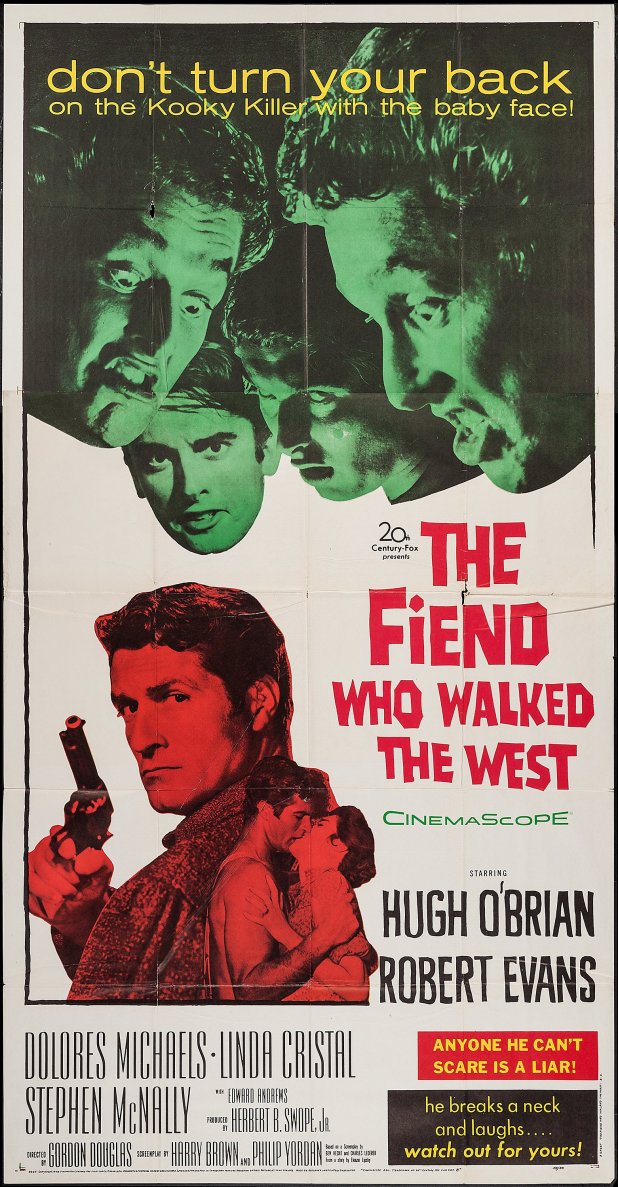
EDITOR’S NOTE: The Fiend That Walked the West was on the CBS Late Movie on July 18, 1973 and January 22 and July 30, 1974.
The inspiration for this movie is a fascinating blend of genres, directly drawn from the film noir Kiss of Death, which was also written by Ben Hecht and Charles Lederer. The director of that movie was Henry Hathaway, but this was made by Gordon Douglas, who started his career as an extra in the Our Gang movies. He also directed Kiss Tomorrow Goodbye, Viva Knievel! and In Like Flint.
Do you know who else was listed as a writer for this? Phillip Yordan. Yes, the same man who perhaps didn’t write most of the films on his resume, as he was a front for blacklisted writers, but definitely put together Night Train to Terror.
While Fox recycled the script* — and the Bernard Hermann score from The Day the Earth Stood Still — they did shoot this in CinemaScope, and it had a decent budget, but it was saddled with a title and campaign that made it look like a horror movie for kids — with an adults-only certification — and the alternate titles that were tried like The Hell-Bent Kid, Rope Law, Enough Rope, Quick Draw, Quick Draw at Red Rock and The Hell-Bent Kid II are all rather dull by comparison.
They should have used the intriguing French title Le Sueur au visage d’ange (The Killer with the Face of an Angel).
Daniel Slade Hardy (Hugh O’Brien) is a gunslinging criminal busted for a bank robbery and sent to prison for a decade. A decade before, he’ll see the baby his pregnant wife Ellen (Linda Cristel) will have. And a decade living with the psychotic Felix Griffin (Robert Evans), a man so deranged that he kills another prisoner by force-feeding his ground glass.
Yes, that Robert Evans.
The Kid Stays In the Picture Robert Evans.
The Chinatown, people getting killed to make The Cotton Club, Ali McGraw marrying Robert Evans.
The Robert Evans that turned a cocaine bust into community service by producing an anti-drug TV special, Get High On Yourself.
In his book, The Kid Stays In the Picture, Evans always talks down on his acting ability.
Is he any good in this? He’s not just good, he’s a revelation.
Also, 90% of my writing style comes from Robert Evans.
Griffin gets out early and makes his way to Hardy’s hometown, the place his cellmate always talked so lovingly about, and sets about killing everyone there, like shooting an old lady — who has the money from the botched bank robbery — with a bow and arrow before shotgunning another of the gang in the back. Then, as if getting the money isn’t good enough, he visits Hardy’s wife and frightens her so severely that she loses her baby.
Evans imbues his character with such menace, even taking on a woman of his own, May (Dolores Michaels). He declares that he’s so inside her head that he knows when she’s going to do something to hurt herself, then beats her unmercifully. Luckily, Hardy is released from jail as part of a secret plan to deal with Griffin.
Speaking of remakes, this movie was made a third time as Kiss of Death, with David Caruso as the hero and Nicholas Cage as the villain.
Look for future Tarzan Ron Ely as a deputy, Stephen McNally as the deputy and Edward Andrews as the judge. He was a noted character actor who often played authority figures, but most today would know him as one of Molly Ringwald’s grandfathers in Sixteen Candles or Mr. Gorben in Gremlins.
I had no expectations of this movie, and I loved every minute of it.
*A tip of the cowboy hat to Jeff Arnold’s West, which taught me that there was a trend of turning film noir into more box office-friendly Westerns, including High Sierra remade as Colorado Territory, House of Strangers becoming Broken Lance and The Asphalt Jungle putting on some spurs and being remade as The Badlanders.
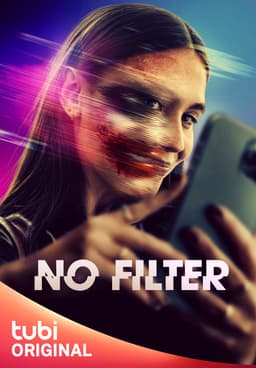
Michael Dupret directed and wrote the 2019 short #No_Filter, in which a girl named Anna tries new Instagram filters that bring the supernatural into her life*.
Now, he’s made this full-length movie. It’s from Belgium, but it’s in English and it won’t make you think it’s a foreign film.
You know this movie is such a surprise and delight. I loved every minute of it because I was so sure it was going to be a streaming J-horror rip-off. Instead, it is totally a movie that you would have rented at the store in the 1990s, which is a high compliment.
Anna in Bali (screen name @anna_withaA) is our heroine, played by Hannah Mciver. She’s on vacation with her family in Bali, where she catches up with her favorite influencer, Scary Scott (screen name @scare_scott), played by Samuel Van der Zwalmen.
He has a challenge where she has to make his friends happy — his scallowers — in one minute while trying to frighten him. Anna is really good at putting on a mask and sneaking up on him. He tells her it reminds him of Samara from The Ring, but she has no idea who that is. He’s nonplussed — even influencers are having younger people let them down with their lack of pop culture education these days — but impressed with her.
Here’s the only issue I have with the film. It makes an awkward cut here to Scott editing his videos and getting stalked, getting messages where he’s stabbing himself in the neck. That video comes true, and we cut to the opening credits.
It’d be nice to know how quickly things got spooky, but the film fixes this later, so stay tuned.
Cut to Anna’s bedroom and a pop punk song, where we learn she’s become popular in school thanks to her video of Scary Scott’s Scary Pic Challenge. A quick conversation shows how quickly today’s teens have moved past Mary Black-style urban legends, saying that even if you only scare yourself or your friends, it doesn’t matter unless it’s online. “If you can’t share it, it doesn’t exist,” Anna tells them.
She’s pretty philosophical, even telling her teacher Miss Potts (Dianne Weller), “Cicero said that if the face is the mirror of the mind, the eyes are its interpreters,” as she’s confronted about the honesty of social media.
Anna feels compelled to keep up her scare videos on social media, putting on face paint to scare her best friend Lauren (screen name @lau_reignn), played by Jasmine Daoud. Together, they work to make filters that distort photos and make them so frightening that they make people physically sick.
But things have to get dark at some point, right?
Jason (Kassim Meesters) is another streamer who is stalking Anna. They both record live videos simultaneously. Are all of these kids streaming content? Who is watching it?
Last year, Jason got kicked out of school because he kept sending dick pics to every girl and went after Lauren, who broke his nose. He’s trying to frighten Lauren by blasting loud music in her driveway. She comes outside only to find he’s dead in the trunk and has no eyes. Yet when she shares the footage with Lauren, all her friend sees is her trying to seduce Jason. This is where the film starts to deal with Anna becoming an unreliable narrator, as she has no idea if things happening to her are real or not, such as when she tries to confide in Lauren and learns that her best friend is hanging out with Mina(Priya Blackburn), the girl who bullied her, which sends her off the deep end. All she has left are her fans online, and many refuse to support her, saying she brought this on herself.
Within the phone, there’s now a Dark Anna, complete with black eyes, who does things like smash her fingers and stab them to frighten our heroine. She also shares photos of Lauren dead in the gym, which causes a further rift between the two friends.
That’s when Lauren invites over Tyler (Reiky de Valk), a guy she has a crush on, who oddly asks to take a shower at her place before she comes on way too strong. She breaks the tension between them by smashing a beer bottle in her hand. He leaves but then starts texting her photos in the bathtub, telling her to come upstairs. As she walks up the steps, Anna looks at herself on the phone, and there’s a fantastic camera effect as the black bars on each side of the phone slide out, and the image of Anna is replaced by her darker self, which goes upstairs and decimates Tyler.
Anna tries to escape from her demonic self. As she watches a streamer named silent_jill, she discovers that a surf influencer in Bali killed all of his friends and had the same black eyes. The supernatural influencer explains that in Bali, demons believe in a balance of light and darkness. The only way to stop the demon is purification by fire, a phrase which she shouts and stares directly at Anna through the screen.
That’s when we see a video of Scott and Anna looking at a piece of mirrored glass in a Bali temple, which is how she got possessed. This is broken by her parents calling in a panic as they make their way to the hospital, Lauren calling with the news that Scott’s body has been found, Mina dying on Facetime and Anna screaming that everyone has to delete all of their social media and burn their phones, never logging on to their accounts ever again, which is a form of death for influencers.
As her mother attempts to come back and settle her, Anna loses her mind completely — there’s another great shot in here where the Dark Anna remains in the middle of a large mirror while four small mirrors show Anna running in four different directors — and stabs her mother through the chest. She then knocks herself out by repeatedly slamming a door into her face.
When Lauren comes to save her, she can’t find her friend. Instead, she sees a camera set up in the bedroom. Looking at the videos, she can see Dark Anna, who grabs her by the hand and brings her into the makeup tutorial. There, she slices her throat and combines it with egg whites, honey and avocado. She smears her face with the mixture and then starts to eat it.
Lauren starts to close down all her accounts as she reflects on social media, saying there are two people in every selfie: One you look like and the other you really are. In response, the demonic form of her starts to headbutt from inside the monitor and threatens to break out. Anna burns all of her tech in a barrel, but at the last moment, shepauses to look at her face on the screen and admire herself.
Over the credits, other influencers begin to have black eyes.
No Filter is so much better than it has any right to be. In a year of influencer horror that barely makes the mark, it has something to say, says it well and delivers actual horror — and gore, too! — in a tense final act. It’s probably the best movie I’ve seen as a Tubi original.
*It’s similar to another short, Nakia Secrest’s Party Make Up by Nikki.
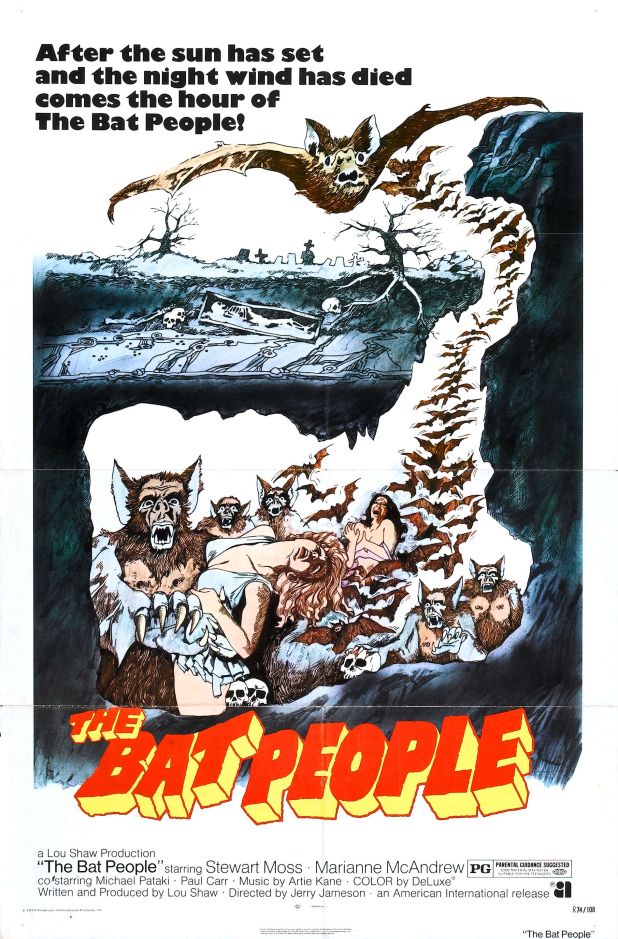
EDITOR’S NOTE: The Bat People was on the CBS Late Movie on February 7, 1975.
The Bat People, also known as It Lives By Night and It’s Alive, is a unique blend of horror and romance. Directed by Jerry Jameson (Starflight One, Terror on the 40th Floor) and written by Lou Shaw, this film has been described as having a leisurely pace. Some say it has a leisurely pace. Others say nothing ever seems to happen. Your enjoyment of this movie will depend on how much you enjoy a movie that likes to chill and let things roll.
Dr. John Beck (Stewart Moss, Doctor Death: Seeker of Souls) takes his new bride Cathy (Marianne McAndrew, Hello, Dolly!) deep into the Carlsbad Caverns. Ironically, Dr. Beck is a bat expert — a bat person, if you will — and gets bit by a fruit bat that turns him into a vampire. And just like me trying to fix something wrong in my house, everything he does worsens things instead of just calling in an expert. The plot takes a surprising turn that will keep you engaged and curious.
Dr. Kipling (Paul Kerr) thinks it might be all in his mind while Sgt. Ward (Michael Pataki) is probably going to kill him. He decides to become a bat and live in the caves forever, but true love wins out because his wife makes sweet love to him and becomes a bat person herself. Ah man, it brings a tear to the eye.
Actually, it really is love, because Miss and McAndrew were married in real life.
Sure, it made plod a bit, but where else can you see Stan Winston’s first work and a moment where Pataki’s car gets swarmed by bats?
Here’s a drink to go with this.
It Drinks By Night
1.5 oz. rum
1 oz. Kaluha
1 oz. milk
3 oz. cola
Add all ingredients to a glass filled with ice, andcola last.
EDITOR’S NOTE: This episode of Kolchak: The Night Stalker didn’t air on the CBS Late Movie. It wasn’t offered to CBS as ABC made a TV movie from this episode, “The Energy Eater,” and titled it Crackle of Death. As I’m a completist, I’m covering the episode this week.
A doppelgänger, a spirit with a sinister agenda, is at the heart of this episode. It’s targeting musical conductor Ryder Bond (Fred Beir), who has been spotted at crime scenes where victims died from spontaneous combustion. These victims, all colleagues and friends of Bond, draw Carl Kolchak into the mystery.
Carl, after getting to know Bond, decides to assist him. However, he’s in grave danger. If Bond falls asleep, his doppelgänger could emerge and kill, with Carl potentially being the next victim. Carl uncovers that an organized crime figure named Markoff, who dreams of being a conductor, is the malevolent force behind this. Markoff’s restless spirit is now targeting Bond to take over his life.
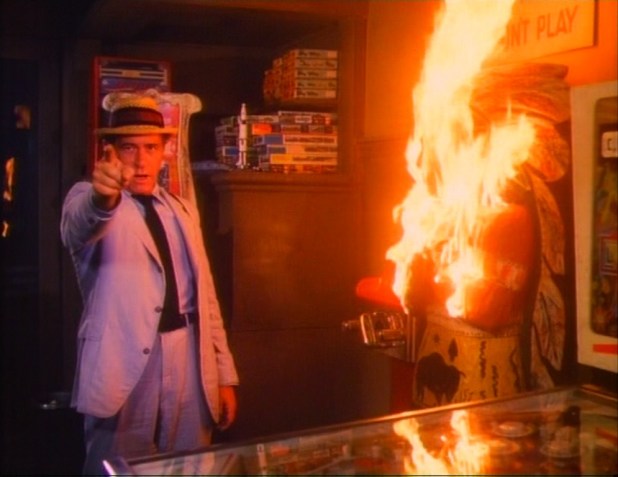
Carl must team up with fortune teller Marie (Madlyn Rhue) to combat this evil. Together, they devise a plan to stop the malevolent ghost. This involves a daring act of grave-robbing, using footage recycled from the “The Zombie” episode, and a fiery showdown at the arcade where Markoff died. It’s a risky plan, but their determination is unwavering.
This is one of four series episodes that Don Weis would direct. It was written by Bill S. Ballinger, who also wrote “The Ghost of Potter’s Field” episode of Circle of Fear and the movie The Strangler.
It ends with Carl finally being able to sleep, except it’s in the back of a police car, and he’s hauled off to jail. He closes the story by saying, “Well, I won’t have to worry about the doppelganger any longer. He’s back in his own body and will probably be cremated, which is rather sweet poetic justice for Frankie Markoff. My only worry now is to find Tony Vincenzo to try to raise bail. They’ve got me hooked on some stupid arson charge. But it’s Tony’s night to play cards, and I don’t know where he is. So I think I’ll spend a nice good night’s sleep in the slammer.”
EDITOR’S NOTE: The Norliss Tapes was on the CBS Late Movie on January 23 and May 26, 1975.
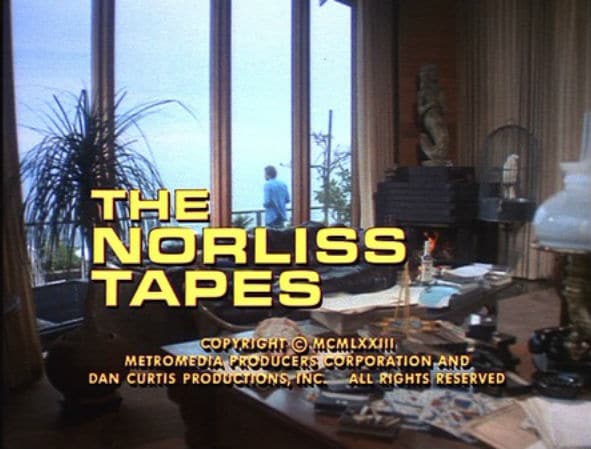
Occult investigator Norliss has disappeared, but his legacy lives on in a series of tapes that unfold the gripping narratives of his many escapades, such as his encounter with a widow and her undead artist husband. Originally developed as a series pilot by NBC, it was eventually broadcast as a TV movie on February 21, 1973.
Sanford Evans, our guide into the mysterious world of David Norliss (Roy Thinnes, Airport 1975, TV’s The Invaders), listens to the tapes that explain Norliss’s sudden disappearance.
A recent case concerned Ellen Cort (Angie Dickinson of TV’s Police Woman), whose husband has come back from the dead. It turns out that before his death from a mysterious disease, he had become involved with Mademoiselle Jeckiel (Vonetta McGee, Blacula), who gave him a scarab that he was buried with. Sheriff Tom Hartley (Claude Atkins!) doesn’t believe any of this, even when James keeps draining the blood of young women and a gallery owner who tries to break into his coffin and take his ring.
Bullets won’t stop the undead man, who’s also created a sculpture made of human blood that will bring the Egyptian deity Sargoth into our world. Our hero, Norliss, is kind of ineffectual, as the undead artist kills Jeckiel, killing Ellen’s sister and raising the demon. He finally stops the monster by setting the studio on fire with everyone inside, the dictionary definition of a pyrrhic victory.
That’s when Evans finishes the tape and wonders if this is Norliss’ last adventure. Nope. There’s another tape, even if the series never happened. That didn’t stop this TV movie from being aired in syndication and on the CBS Late Movie.
EDITOR’S NOTE: The Glass Bottom Boat was one of the first movies on the CBS Late Movie, airing on February 17, 1972. It also aired on July 31, 1972; February 19 and November 5, 1973 and March 12, 1976.
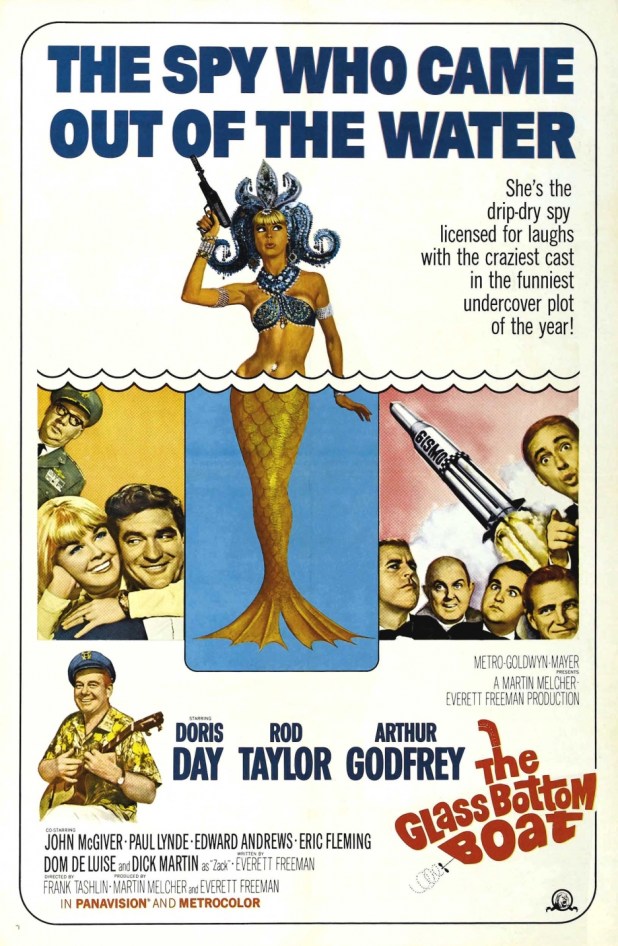
Also known as The Spy in Lace Panties, a title change that was likely made to emphasize the spy plot, this movie teams up animator-turned-director Frank Tashlin (who made one of my favorite movies of all time, The Girl Can’t Help It) and star Doris Day, who gets to sing, of course, but also gets pulled into a spy plot. It was written by Everett Freeman, the writer of The Maltese Bippy.
Day plays Jennifer Nelson, a widow helping her father (Arthur Godfrey) in his tourism business by dressing as a mermaid and swimming under his glass bottom boats. One day, she’s accidentally caught by Bruce Templeton (Rod Taylor) while he’s fishing; the embarrassment of her being nearly nude in front of him is compounded when she realizes that he works at her new position of employment, an aerospace research company.
Bruce’s new project is GISMO, a gravity system, and he hires Jennifer to write his biography. But really, in truth, he just wants to get with her. Jennifer also meets Julius Pritter (Dom DeLuise), a spy struggling to install a stereo in Bruce’s futuristic apartment while gathering information on him, and Edgar Hill (Eric Fleming), a CIA agent protecting Bruce and GISMO.
Love blooms, as it does in romantic comedies, but the issue is that Hill, security guard Homer Cripps (Paul Lynde!) and PR executive Zack Molloy (Dick Martin!) believe that Jennifer is a spy. Why would she call the same phone number multiple times a day and simply hang up after saying, “That’s enough, Vlamdir?”
As it turns out, ‘Vlamdir’ is not a Russian boss, but Jennifer’s dog. The poor pup’s only exercise during her work hours is running around the apartment, irritated by the ringing phone. In a classic rom-com twist, Bruce makes a blunder by underestimating Jennifer’s intelligence. She decides to play along and pretends to be a spy. This leads to a series of light-hearted hijinks at a party, but all’s well that ends well.
For TV aficionados, Norman and Mabel Fenimore (George Tobias and Alice Pearce) are the same characters Tobias and Pearce played on Bewitched. The film also features a memorable cameo by Robert Vaughn, and the theme from The Man from U.N.C.L.E. is heard on the soundtrack. Speaking of the show, Templeton’s ultra-technological apartment was repurposed as the evil spy base on a two-part episode of The Man from U.N.C.L.E., titled ‘The Concrete Overcoat Affair.‘
After this, Day only made four more movies — including the pure spy movie Caprice with Tashlin before starting what many would know her best for: The Doris Day Show. In that show, she sang the theme song, “Que Sera Sera,” which became synonymous with Day’s career and was also featured in her earlier films, like The Man Who Knew Too Much and Please Don’t Eat the Daisies.
The central character of the film is Peggy, a college student who aspires to become an artist. She applies for a job at the home of noted sculptor Jeffrey Elliott (played by Ted Bessell, TV’s That Girl) and his mother, the iconic Bette Davis. Peggy’s annoyingly chipper character adds a unique dimension to the story.
Let me give you some advice, in case you are a young girl looking for a housekeeping job and find yourself in a 1970s TV movie. If the house you’re working in has an Old Hollywood actress in it, run (refer back to my past rules of always avoiding Old Hollywood actors and actresses). And if you find out that there’s a room that you aren’t allowed to go into, don’t try to go into that room. Just get away as fast as you can.
However, Peggy’s curiosity gets the better of her. She stumbles upon Jeffrey’s collection of eerie demon sculptures, each more terrifying than the last. She also encounters George Thornton, whose daughter used to work in the house. This leads to a confrontation with the formidable Mrs. Bette Davis, a situation one should never find themselves in.
It turns out that Jessica, Jeffrey’s sister, is living in the room above the garage that Peggy isn’t allowed into. Again, get out. Now.
No, Peggy decides she wants to make a new friend. And what if that friend is really Jeffrey, who killed his sister and has split his personality with her inside his head? Oh, Peggy. You brought this on yourself.
Scream, Pretty Peggy is a fine slice of 70s TV movie thrills. Any time you have Ms. Davis deigning to be in a TV movie, you will get something good. But seriously, I wish these girls would wise up. There are better things to do in this world than live in a house of maniacs!
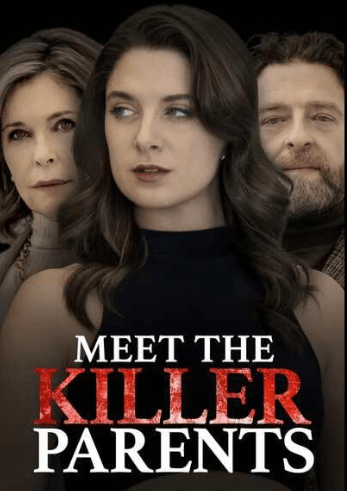
Grace Perkins (Katelyn McCulloch) has had a difficult life. An orphan, she says she went to a dark place before landing on her feet. Now, she has a stable job, a dependable roommate named May (Ericka Leobrera) and the man of her dreams, Rob Whitby (Connor McMahon).
This weekend is a big deal because Rob finally brings her to meet his parents, Stephen (Dmitry Chepovetsky) and Miriam (Kate Vernon). Mom is a rough one, continually bringing up how much she hated past girlfriends and how wrong they were, while Dad seems doting and even childlike.
Of course, this is entering Get Out territory, a reference to Jordan Peele’s 2017 film that explores racial and social issues. In this context, while everyone in the Whitby family is white, there is still the issue of class, and, well, the Whitbys are all certifiable. But have they met the wrong girlfriend?
Between every drink making Grace either drunk or sick and Penelope (Juno Rinaldi), the maid, confiding in her that numerous girlfriends who look just like her have come to the mansion and were never seen again, you can see the plot’s direction against our protagonist. But just when I thought that this was ripping off Jordan Peele, well, the movie flips the script — spoilers from here on out — because the family doesn’t want a slave or a body for old people to body swap with, but instead, they want Grace to become their dead daughter Jenny using mind control, psychic theater and a machine that can either change the color of your eyes or turn your face into gumbo. Those are the exact works in the movie.
Just when you think you’ve got that plot development figured out — and yes, that means that Rob has repeatedly had sex with many of his sisters or at least recreations of his dead sister that he probably — definitely — murdered in a pond — this movie is ready to throw another one at you.
Directed by Sam Coyle, who also made the Tubi original Deadly Estate, and written by Mike Rinaldi, this is one of the more enjoyable Tubi originals I have seen. It continues to lean hard into its premise, like an Italian remake remix rip-off, before finding its own way and closing with a completely outrageous final act that over-delivers on its promise.
EDITOR’S NOTE: This episode of Kolchak: The Night Stalker aired on the CBS Late Movie on June 22 and October 19, 1979; June 26, 1981 and January 22 and August 30, 1988.
Vincenzo gives Carl Kolchak another assignment: go out on the last voyage of the Hanover, a once excellent cruise ship — actually the RMS Queen Mary with some stock footage of another boat when it was on the ocean — on its final voyage as a swinging singles-only cruise.
Indeed, there’s no way that the supernatural will be on board.
Come on. It’s Kolchak: The Night Stalker.
One of the passengers is NATO officer Bernhardt Stieglitz (Eric Braeden), who last month turned in Montana and murdered an entire family. Now, he has a buffet of people to snack on as the Hanover heads into open waters under the full moon.
Working with the movie-obsessed Paula Griffin (Nita Talbot), Carl realizes that he does indeed have a werewolf on his hands — even if Paula thinks John Wayne was in Werewolf of London before realizing that it was Charlie Chan actor Warner Oland — and he has to steal the ship captain’s uniform and melts down the buttons to make silver bullets. This seems like a lot of work, but I’m writing about Carl’s adventures, not living them.
By this point, five episodes in, Carl has faced Jack the Ripper, an alien, a zombie and a vampire. The “monster of the week” format starts to show here as Carl is sent somewhere new, meets a partner of sorts, butts heads with authority and battles a monster that throws people all over the place.
What does work and elevates the show is the humor and how well McGavin imbues our hero. Plus, the werewolf is a sympathetic character who doesn’t want to be a killer. Carl’s ship roommate Mel (Dick Gautier) is also a blast.
Maybe the makeup isn’t perfect, and perhaps it all seems rather silly now, but Carl’s ending lines point to something more that made this show special: “The body was never recovered. When the old ship was scrapped, all evidence was scrapped along with her. Of the eleven crewmen and four passengers attacked by the beast, it is not known how many actually died. The injured… well, they disappeared. Rumor has it to Switzerland to undergo treatment for a rare blood disease. The shipping line would only admit to having had a psychotic stowaway onboard. The killer had fallen overboard after being cornered by the ship’s officers, so they said. All traces of Bernhard Stieglitz vanished. His baggage was gone. His name could not be found in any passenger manifest. NATO officials claimed that no such man had ever existed in their organization, and any attempt to publish a werewolf story about such a man would be met with the heaviest legal artillery. Vincenzo, always gun-shy, conveyed that message to me in no uncertain terms. So here the story sits. For good, I guess. No one but you or I know the real truth… the real story.”
We have become complicit in the conspiracy that Carl Kolchak has found himself coming up against repeatedly. Only we can understand his private struggle, that in the dogged search of the truth and the story behind it all, he’s just one man, surviving by dumb late just as much as skill or smarts. And there he remains, constantly finding and losing the threads of what’s lurking in the shadows.

 B&S About Movies
You must be logged in to post a comment.