Cinematic Void January Giallo 2024: Closed Circuit (1978)

EDITOR’S NOTE: Cinematic Void will be playing this movie on January 8 at 7:00 PM CT at Music Box Theatre in Chicago, IL. For more information, visit Cinematic Void.

As an audience comes together for an afternoon showing of a western* called I Giorno Dell’Ira starring Giuliano Gemma (A Pistol for RingoArizona Colt), one of the moviegoers is shot by the actor. As his gun smokes on screen, an old man lies dying. The cops investigate and learn that nearly everyone has something to hide, from a couple having an affair to two small-time criminals (Tony Kendall is one of them), some student protesters and a sociologist (Flavio Bucci) who has the feeling that this is all like a Ray Bradbury story.

The police make everyone remain in the theater, basically living there, surviving off of the snack bar and meals brought in from the outside world. The entire situation is photographed and then run back, recreated, which leads to a second person being shot. This frustrates the inspector, who makes the entire theater remain and watch it again, with him sitting in the place where two men have already died.

This is a movie not just about a murder but movies itself. There are posters for Let Sleeping Corpses LieThe Girl in Room 2ADay of Anger, Torn CurtainFour Flies On Grey VelvetYou’ll Like My Mother, SquirmThe Perfume of the Lady In BlackKing KongA*P*E* under the Italian name Super Kong and Tentacles. The moment that changes the movie, the gun being shot, changes the film from something that everyone is watching in a passive way to the most involving viewing they have ever seen. The film come alive, much like Cinema Paradiso or a movie that I am sure this had more than a small influence on, Demons.

Director Giuliano Montaldo made a movie that is at once a giallo and a science fiction story, as well as one that defies being easily figured out.

*It’s actually E per tetto un cielo di stelle (A Sky Full of Stars for a Roof).

You can get this from Severin.

THE FIRST DIA OF 2024!

This Saturday at 8 PM EST, join Bill and me on the Groovy Doom Facebook and YouTube pages for our first double feature of the year.

We’re giving you two blasts of Italian gothic horror weirdness starting with Atom Age Vampire! You can watch it on Tubi and YouTube.

If you’ve never watched the show before, each week we talk about the movie, show the ad campaign and then have a drink recipe that is based on the film. Then, you watch it yourself and come back for a discussion on what we’ve seen and the next movie.

Here’s the first cocktail.

Seddok

  • 2 oz. orange juice
  • 12 frozen raspberries
  • 2 oz. Chambord
  • 6 oz. champagne
  1. Mix orange juice, frozen raspberries, Chambord and ice in a cocktail shaker.
  2. Pour into a glass, then top with champagne.

The second movie is Werewolf in a Girls’ Dormitory. You can watch it on YouTube.

Howl at the Italian Moon

  • 2 oz. rum
  • 2 oz. pineapple juice
  • 1 oz. lime juice
  • 2 oz. ginger beer
  1. Fill a glass with ice, then pour in rum, pineapple and lime juice.
  2. Top with ginger beer and enjoy.

Get ready for Saturday!

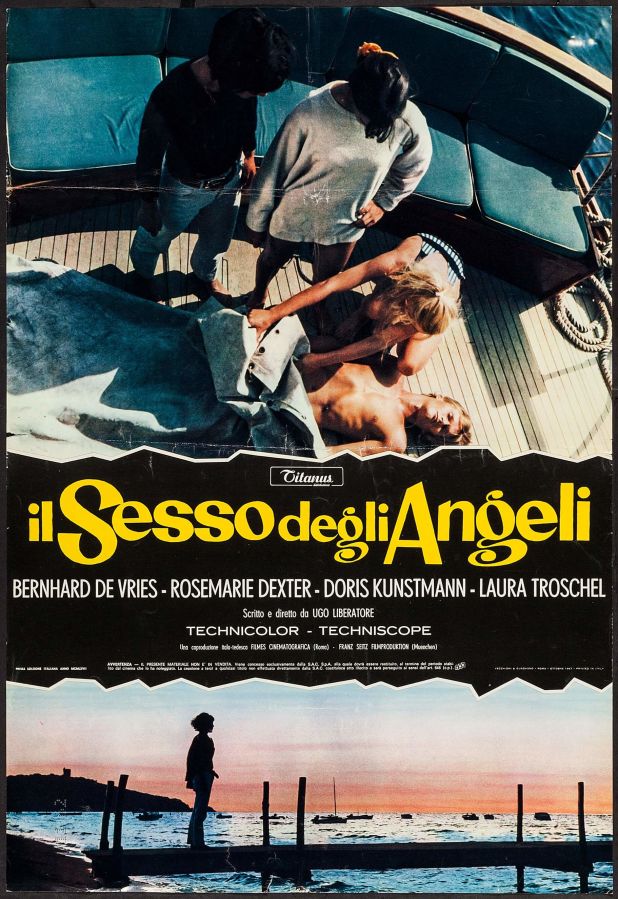
Il sesso degli angeli (1968)

Directed by Ugo Liberatore (Damned In Venice),  wrote it with Frank Seitz, this is all about three women — Nora (Doris Kunstmann, Seven Deaths in the Cat’s Eye), Nancy (Rosemary Dexter, Casanova 70) and Carla (Laura Troschel, Four Flies on Grey Velvet) leaving Nora’s lover Luca (Giovanni Petrucci) behind and taking her father’s boat on a voyage. Stealing Marco (Bernard De Vries) from his lover, they sail out for the Dalmatian coast of Croatia.

Of course, he’s going to be with each of the women, one after the other, but because they also plan on having LSD trips, you can imagine that none of this will work out well for him. Maybe if he had waited until Queens of Evil came out in 1970, Marco would be better armed for this trip. Or trips, right? Or a year for Top Sensation. They take a tape recorder with them to see what happens when they all get dosed, but when Marco wakes up with a bullet hole in his stomach — and no one knows why — things get dark. Should the girls get him help? Or will they try to care for him all on their own?

Despite its title — The Sex of Angels — this promise of carnal freedom comes with a horrible price, which means that it does so much of what exploitation always has: revel in sin yet condemn it at the same time. As Marco slowly and horribly dies from his painful injury, he’s further destroyed as his manhood is withered by being forced to dress in women’s robes and a fur coat, all while they sail past gorgeous coastlines.

Amazingly, The Sex of Angels was released in the U.S. by United Artists. It’s a great lesson in that old, “If it seems too good to be true, it is” moral. If three gorgeous women kidnap you, you’re probably going to die. Not everyone makes it in this and it does have the strange idea that acid will unlock the latent lesbian urge in women. I would say, “Only in Italy,” but I’ve seen it happen in enough films all around the world.

Cinematic Void January Giallo 2024: Deep Red (1975)

EDITOR’S NOTE: Cinematic Void will be playing this movie on January 6 at 10:00 PM MT at Coolidge Corner Theatre in Brookline, MA. You can get tickets here. For more information, visit Cinematic Void.

Deep Red is one of the few Argento movies that I’ve seen in a theater and the drive-in. It’s not the best film for the fast-moving grindhouse or drive-in, but it is a great film. After all, it started with a 500-page script that even Dario Argento’s family felt was too cryptic and continues with not just one, but two references to American painter Edward Hopper. This isn’t just a movie about murder. This is a movie that transforms murder into art.

We begin at Christmas, as two shadowy figures battle until one of them stabs the other. Screams ring out as a knife drops at the feet of a child.

Fast forward to Rome, as a medium named Helga Ulmann is conducting a lecture about her psychic powers. Within moments, she senses that one of the people in the theater is a killer. Later that night, that killer kicks in her front door and murders her with a meat cleaver (which is probably why this movie got the boring American title of The Hatchet Murders).

British musician Marcus Daly (David Hemmings, BarbarellaBlowup, Harlequin), who fits the giallo mold of the stranger in a strange land thrust into the middle of a series of murders that he must solve, is returning home from drinking with his gay best friend Carlo (Gabriele Lavia, Beyond the DoorInferno) when he sees the murder that we’ve just witnessed from the street. He runs to save Helga, but she’s thrust through the window and her neck is pierced by the broken glass of her window in a kill that has become Argento’s trademark.

As he tells the police what has happened, he notices that a painting on Helga’s wall is gone. That’s when Gianna Brezzzi (Argento’s soon-to-be wife, Dario Nicolodi, who met him during the filming of this movie) takes his photo, which ends up on the cover of the newspaper the very next day.

Unlike most giallo women, Gianna is presented as more competent and even stronger than our hero — she sits high above him in her Fiat 500 and continually bests Marcus every time they arm wrestle. Nicolodi is so perfect in this film that she both breaks and warms your heart at every turn.

Marcus isn’t your typical hero, though. When the killer attacks him, he doesn’t stop them by daring or skill. He locks himself in his study to escape them. He does remember the song the killer played — we also have heard it when Helga is murdered — that psychiatrist (and Helga’s boyfriend) Professor Giordani believes is related to some trauma that motivates the killer.

Feeling guilty that she’s caused the killer to come after Marcus, Gianna relates an urban legend of a haunted house where the sounds of a singing child and screams of murder can be heard. The truth lies in House of the Screaming Child, a book written by Amanda Righetti, which tells the truth of the long-forgotten murder. Marcus and Gianna would learn even more, but the killer beats them to her house and drowns her in a bathtub of scalding hot water (directly influencing the murder of Karen Bailey in Halloween 2). As she dies, the writer leaves a message behind on the wall, which our heroes find. They’ve already assumed the investigation — again, in the giallo tradition — and think the police will assume that Marcus is the murderer, so they don’t report the crime.

Marcus follows the trail of the killer from a picture in the book to the real house, which has been abandoned since 1963. As he searches the home, he uncovers a child’s drawing of a murdered man and a Christmas tree, echoing the flashback that starts the film. Yet when he leaves the room, we see more plaster fall away, revealing a third figure.

Marcus tells his friend Carlos all that he’s learned, but his friend reacts in anger, telling him to stop questioning things and to just leave town with his new girlfriend. At this point, you can start to question Marcus’ ability as a hero — he misses vital clues, he hides instead of fighting and he can’t even tell that someone is in love with him.

Professor Giordani steams up the Righetti murder scene and sees part of the message that she left on the wall. That night, a mechanical doll is set loose in his office as the killer breaks in, smashing his teeth on the mantle and stabbing him in the neck.

Meanwhile, Marcus and Gianna realize that the house has a secret room, with Marcus using a pickaxe to knock down the walls, only to discover a skeleton and Christmas tree. An unseen person knocks our hero out and sets the house on fire, but Gianna is able to save him. As they wait for the police, Marcus sees that the caretaker’s daughter has drawn the little boy with the bloody knife. The little girl explains that she had seen this before at her school.

Marcus finds the painting at the young girl’s school and learns that Carlo painted it. Within moments, his friend turns up, stabs Gianna and holds him at gunpoint. The police arrive and Carlo flees, only to be dragged down the street and his head messily run over by a car.

With Gianna in the hospital and his best friend obviously the murder, Marcus then has the Argento-esque moment of remembering critical evidence: there’s no way Carlo could have killed the psychic, as they were together when they heard her screams. The portrait that he thought was missing from the apartment was a mirror and the image was the killer — who now appears in front of him.

The real killer is Martha (Clara Calamai, who came out of retirement for this role, an actress famous for her telefoni bianchi comedy roles), who killed Carlo’s father in the flashback we’ve seen numerous times after he tried to commit her. She chases Marcus with a meat cleaver, striking him in the shoulder, but he kicks her and her long necklace becomes caught in an elevator which beheads her. The film ends with the reflection of Marcus in the pool of the killer’s blood.

While this film feels long, it has moments of great shock and surprise, such as the two graphic murders that end the film and the clockwork doll. The original cut was even longer, as most US versions remove 22 minutes of footage, including the most graphic violence, any attempts at humor, any romantic scenes between David Hemmings and Daria Nicolodi, and some of the screaming child investigation.

This is also the first film where Argento would work with Goblin. After having scored Argento’s The Five Days — a rare comedy —  Giorgio Gaslini was to provide music for the film. Argento didn’t like what he did and attempted to convince Pink Floyd to be part of the soundtrack. After failing to get them to be part of Deep Red, Goblin leader Claudio Simonetti impressed the director by producing two songs in one night. They’d go on to not only write the music for this film, but also for plenty of future Argento projects.

A trivia note: Argento’s horror film museum and gift shop, Profondo Rosso, is named after the Italian title to this movie.

Deep Red is the bridge between Argento’s animal-themed giallo and supernatural based films. While its pace may seem glacial to modern audiences, it still packs plenty of moments of mayhem that approaches high art.

Cinematic Void January Giallo 2024: A Blade in the Dark (1983)

EDITOR’S NOTE: Cinematic Void will be playing this movie on January 6 at 7:00 PM MT at Sie FilmCenter in Denver, CO. You can get tickets here. For more information, visit Cinematic Void.

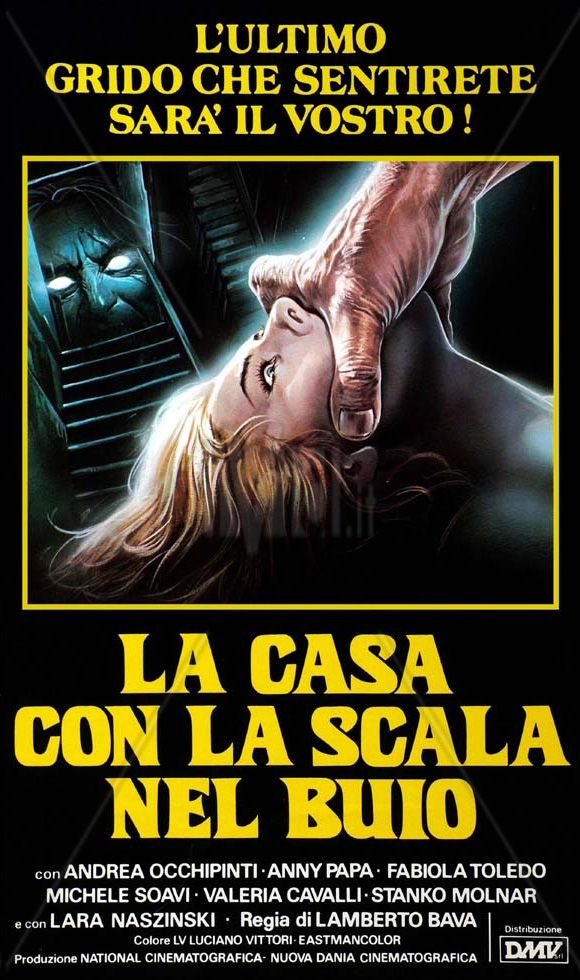
Known in Italy as La Casa con la Scala nel Buio (The House with the Dark Staircase), Lamberto Bava’s A Blade in the Dark was originally intended to be a four-part TV mini-series, with each segment ending with a murder. However, it was too gory for regular audiences, so it was released as a film. It was written by the husband and wife team of Dardano Sacchetti and Elisa Briganti, whose script was often at odds with what Bava wanted to put in his film.

Bruno (Andrea Occhipinti, The New York Ripper) is a composer hired to create the soundtrack for a horror movie. He’s been having trouble concentrating on the job, so he rents a house to sequester himself. He meets two women who used to know his rented villa’s former tenant, but when they disappear, he’s forced to watch the movie he’s scoring closer, as there’s a clue to the razor-wielding killer’s identity hidden within.

Bava worked as Dario Argento’s assistant for the movie Tenebre two years before this movie was made, so that has a big influence on this work. This is a movie unafraid to wallow in gore, feeling closer to the American slasher than the giallo. Then again, Lamberto was an assistant on the movie that predates the slasher, his father’s A Bay of Blood.

For the killer, he had difficulty finding someone who could convincingly appear to be a man and a woman. He turned to his assistant, Michele Soavi, who went on to direct plenty of great horror on his own.

For those that care about these matters like me — Giovanni Frezza, forever Bob from The House by the Cemetery — shows up in the movie within a movie that Bruno is writing the music to. He’s taunted by voices that chant “You are a female! You are a female!”

Also, in the true spirit of giallo and what the word means, every victim — and then the killer him or herself — is called out by the color yellow.

Cinematic Void January Giallo 2024: Opera (1987)

EDITOR’S NOTE: Cinematic Void will be playing this movie on January 5 at 10:00 PM ET at Cinema Salem in Salem, MA. You can get tickets here. For more information, visit Cinematic Void.

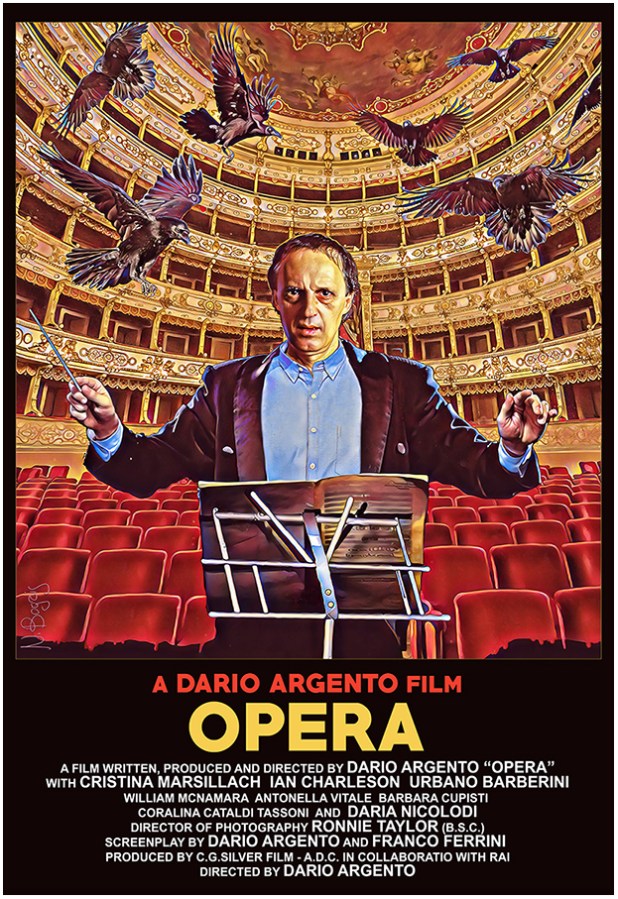
Mara Cecova is a diva and the star of a whole new way of performing Verdi’s Macbeth. But when she’s hit by a car as she argues with the director in the middle of the street, her role goes to her understudy, Betty. Ironically, in his book Profondo Argento, director Dario Argento claimed that the person playing the role of Betty, Cristina Marsillach, was the most difficult actress he would ever work with.

Despite her initial worries, Betty becomes an instant success on her opening night. At the same time, a black-gloved killer sneaks into one of the boxes to watch before murdering a stagehand with a coathanger. Grab your barf bags and motion sickness pills, everyone, Argento is behind the camera!

Of all the powerful shocks in Opera, perhaps the one that means the most to the viewer is that we share Betty’s torture — she’s repeatedly gagged, tied up and forced to watch the killer at work again and again as he tapes needles under her eyes. If she blinks too long or shuts her eyes, they’ll be shredded. It’s like Fulci’s wettest dream ever. In the same way, we are nearly complicit with the crimes we are forced to watch, particularly because they get more and more artfully composed.

Throw in the fact that Betty believes that the hooded killer is the same person who murdered her mother, she follows the giallo path for a protagonist and confides in someone else rather than the police. Her reason? The killer may know who she is.

Inspector Alan Santini (Urbano Barberini, Demons) is on the case, because there are so many clues, like the fact that the producer’s pet ravens were found dead after the show. As for Betty, she runs from the police and calls her agent Mira (Daria Nicolodi, Argento’s former wife and the writer of Suspiria and star of Shock) for advice.

Betty’s costume gets cut to ribbons, so she asks the wardrobe girl for help. While she works on the dress, they find a gold bracelet that they can almost read. But here comes the killer and his needles again, forcing her to watch him kill one more time. The wardrobe girl accidentally swallows the bracelet, so of course, we watch as the murderer slices her throat open to get it back.

Betty runs back to her apartment where Santini is waiting. He promises to send a detective named Soavi to watch over her (yep, The Church director Michele Soavi), but she doesn’t trust the man and leaves her apartment. That’s when her agent answers the next knock on the door by looking through the peephole. What follows is the most grand kill in the entire film — which is saying something — as we follow the bullet POV-style out of the gun and directly through her eyeball. Again, Fulci is somewhere wringing his hands.

Nicolodi had just ended a long relationship with Argento and did not want to be in this film. However, the shocking and complicated murder of her character changed her mind, even if she had to deal with an explosive device being put on the back of her head to achieve the final shot.

Betty escapes the killer again and runs to the opera house, convinced there is a connection between the murderer and her long dead and totally abusive mother. The next night, as she performs, the producer unleashes what is left of his ravens in the hopes that they’ll find the killer. Oh, they do alright — tearing his eyeball out of his head — FULCI ARE YOU THERE, IT’S ME DARIO — and rewarding you, the viewer, with POV shots that threaten you with vertigo. I’m getting dizzy even typing this.

I don’t want to give away the killer or even the second ending where the killer isn’t really dead. I just want to talk about the sheer Argento-ness of the final scene, where Betty wanders in a field and releases a lizard, giving him his freedom. Argento claims that this ending was inspired by Thomas Harris’s Red Dragon. Of interest, the director does NOT like the Michael Mann movie Manhunter. Me? Well, I love that movie. But I’d love to see Argento’s take. There’s was also a thought to another ending where Betty would fall in love with the killer.

Your enjoyment of this film really comes down to how much you like shocking amounts of bloodshed and Argento’s arty side. He based the film on his own failed staging of Macbeth, basing the role of the nervous producer on himself. And the idea of pins under the eyes? It comes from a joke about how Argento hated when people looked away during the death scenes in his films.

Believe it or not, Orion Pictures planned on releasing an R-rated version of this in the US called Terror at the Opera with eleven minutes of mayhem removed, as well as the Swiss Alps epilogue. Argento refused and Orion was losing money at a fast clip, so the movie only saw a limited video release. 

Opera is something else — filled with style and brutality. I loved it, but remember my warning as to how much you can handle.

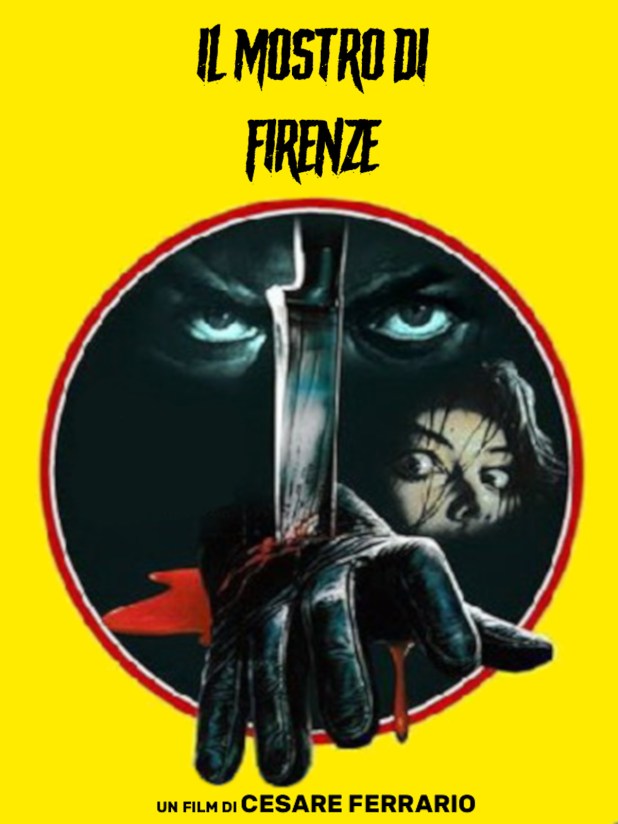
Il mostro di Firenze (1986)

Based on a true story, this is all about a series of sex murders that have been the talk of Florence for almost 15 years. A serial killer is murdering couples while they make love, then cutting off parts of the female anatomy. Whoever the murderer is, they start the film by killing two more people while they are camping.

Hunting for that killer are Giulia (Bettina Giovannini), a journalist who has been tracking the killer for four years, and her fiancee writer Andreas Ackermann (Leonard Mann) who is writing a book all about the crimes. He soon realizes that he’s become obsessed with the case and has constructed a profile of a wealthy man whose parent’s perversions made him impotent.

As the case was not solved when this came out, this film was pulled from theaters. The case was finally resolved in 1998. Four men — all friends — were the killer, including five of the killings committed by postal worker Mario Vanni, along with participation by Giancarlo Lotti and two others who were released due to lack of evidence.

Directed by Cesare Ferrario, this was also released as Night Killer. this has Leonard Mann in his second giallo after Night School.

The same year, Camillo Teti released The Killer Is Still Among Us which is a much rougher and more traditional giallo story.

Cinematic Void January Giallo 2024: Blood and Black Lace (1964)

EDITOR’S NOTE: Cinematic Void will be playing this movie on January 4 at 7:30 PM ET at The Little Theatre in Rochester, NY. You can get tickets here. For more information, visit Cinematic Void.

There’s no way to calculate the influence of Blood and Black Lace. It takes the giallo from where Bava started with The Girl Who Knew Too Much and adds what was missing: high fashion, shocking gore and plenty of sex. The results are dizzying; it’s as if Bava’s move from black and white to color has pushed his camera lens to the brink of insanity.

Isabella is an untouchably gorgeous model, pure perfection on human legs. But that doesn’t save her as she walks through the grounds of the fashion house and is brutally murdered by a killer in a white mask.

Police Inspector Sylvester takes the case and interviews Max Morlan (Cameron Mitchell!), who co-manages the salon with his recently widowed lover, the Countess Christina Como. Soon, our police hero discovers that the fashion house is a den of sin, what with all the corruption, sex, blackmail, drugs and abortions going on under its roof. Isabella was murdered because she had kept a diary of all the infractions against God that happened inside these four walls.

Nicole finds the diary and tells the police she will deliver it, but it’s stolen by Peggy. As she arrives at the antique store her boyfriend Frank owns, the killer appears and kills her with a spiked glove to the face. The killing is shocking. Brutal. And definitely the forerunner to the slasher genre.

Even after the cops arrest everyone in the fashion house, the murders keep on piling up. Peggy claims that she burned the diary, so the killer burns her face until she dies. Greta is smothered to death. And Tilde is killed in the bathtub, then her wrists are slit open, spraying red into the water and marking her as a suicide.

So who is it? Come on. You’re going to have to watch it for yourself.

The success of Black Sunday and Black Sabbath had given Bava the opportunity to do anything he wanted. His producers thought that this movie would be a krimi film along the lines of an Edgar Wallace adaption. Instead, Bava gave more importance to the killings than the detective work, emphasizing sex, violence and horror more than any film in this form had quite before.

Blood and Black Lace was a failure in Italy and only a minor success in West Germany, the home of Edgar Wallace. And in America, AIP passed on the film due to its combination of sex and brutality. Instead, it was released by the Woolner Brothers with a new animated opening.

Today, Blood and Black Lace is seen as a forerunner of body count murder movies and the excesses of later giallo films. To me, it’s a classic film, filled with Bava’s camera wizardry and love of color. It is everything perfect about movies.

Cinematic Void January Giallo 2024: Your Vice Is a Locked Room and Only I Have the Key (1972)

EDITOR’S NOTE: Cinematic Void will be playing this movie tonight at 7 PM PT at the Los Feliz 3 in Los Angeles. You can get tickets here. For more information, visit Cinematic Void.

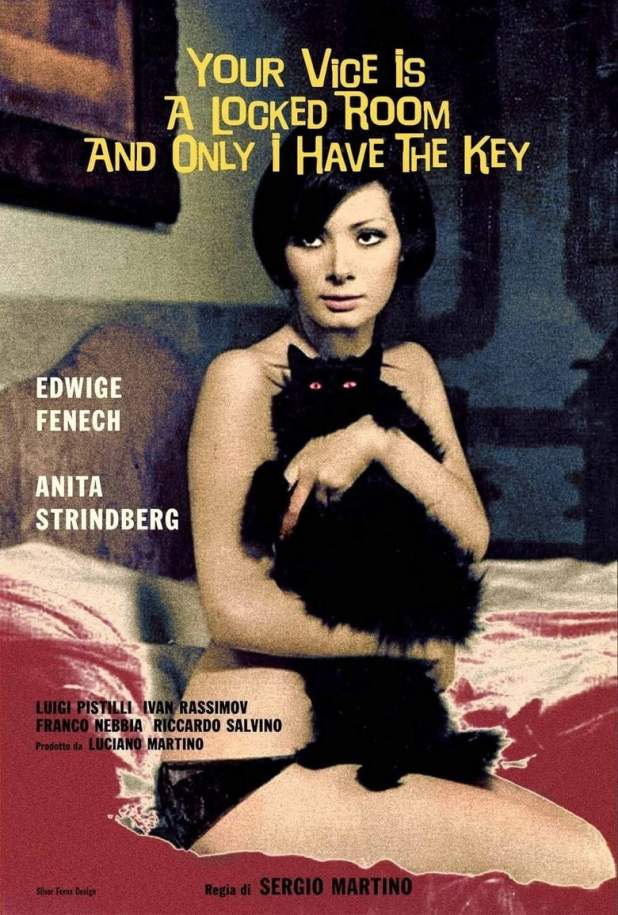
Has a movie ever had a better title? Nope. Sergio Martino’s fourth entry into the giallo genre, following The Strange Vice of Mrs. Wardh, The Case of the Scorpion’s Tail and the previously reviewed All the Colors of the Dark, it refers to the note that the killer leaves to Edwige Fenech’s character in Mrs. Wardh. And the title is way better than the alternate ones this film has — Gently Before She Dies, Eye of the Black Cat and Excite Me!

Martino wastes no time at all getting into the crazy in this one — Oliviero Rouvigny (Luigi Pistilli from A Bay of Blood, Iguana with the Tongue of Fire, Death Rides a Horse) is a dark, sinister man, a failed writer and alcoholic who lives in a mansion that’s falling apart (If this all feels like a modernized version of a Poe story like The Fall of the House of Usher, it’s no accident. There’s even an acknowledgment that the film is inspired by The Black Cat in the opening credits.). His wife, Irina (Anita Strindberg from A Lizard in a Woman’s Skin and Who Saw Her Die?), suffers his abuses, but never more so than when he gathers hippies together for confrontational parties. He makes everyone pour all of their wine into a bowl and forces her to drink it, then humiliates their black servant Brenda until one of the partygoers starts singing and everyone joins in, then gets naked. This scene is beyond strange and must be experienced. Luckily, I found the link for you, but trust me — it’s NSFW.

The only person that Oliviero seems to love is Satan, the cat that belonged to his dead mother. A black cat that talks throughout every scene he’s in, his constant meows led to my cats communicating with the TV. God only knows what a 1970’s giallo cat said, but it seems like his words spoke directly to their hearts.

One of Oliviero’s mistresses is found dead near the house, but he hides her body. The police suspect him, as does his wife. Adding to the tension is the fact that Irina hates Satan, who only seems to care about messing with her beloved birds.

Remember that servant? Well, she’s dead now, but not before she walks around half-naked in Oliviero’s mother’s dress while he watches from the other room. She barely makes it to Irina’s room before she collapses, covered in blood. Blood that Satan the cat has no problem walking through! He refuses to call the police, as he doesn’t want any more suspicion. He asks his wife to help him get rid of the body.

Oliviero’s niece Floriana (Edwige Fenech, pretty much the queen of the giallo) is in town for a visit, learning how Oliviero hasn’t been able to write one sentence over and over again for three years, stuck in writer’s block (and predating The Shining by 5 years in book form and 8 years away from Kubrick’s film). Unlike everyone else who tolerates Oliviero’s behavior or ignores it, Floriana sees right through the bullshit. The writer is used to seducing every woman he meets and she initially rebuffs him, even asking if it’s true that Oliviero used to sleep with his mother. He angrily asks if it’s true that she’s a two-bit whore. “Those would be two bits worth spending,” is her caustic reply.

Irina confides all of her pain to Floriana as the two become lovers. And another girl gets murdered — perhaps by Oliviero. Then, a dirt bike racer comes to drop off milk and hit on Floriana. Whew — I was wondering when this film would get hard to follow and start piling on the red herrings!

After being questioned by the police, Oliviero comes home to choke his wife. He stops at the last second…then we’re off to the races! The motorbike races! The milkman loses when his bike breaks down, but he’s the real winner — taking Floriana back to the abandoned house that he lives in. And oh look — there’s creepy Oliviero watching the action.

Meanwhile, Satan has gotten into the coop and chowed down on several of the birds. Irina catches him and they have quite the battle. He scratches her numerous times before she stabs him in the eye with a pair of scissors. An old woman watches and is chased away by Irina’s yelling.

She’s afraid that her husband will kill her once he learns that she killed Satan. And Oliviero keeps wondering where the cat is, especially after he buys the cat his favorite meal from the store — sheep eyes. That said — Satan might not be so dead, as we can hear his screaming and see him with a missing eye.

Floriana puts on Oliviero’s mother’s dress, asking if this is what the maid looked like before she died. Whether it’s the dress or the forbidden family love or just her beauty, he rips off her dress — at her urging, mind you — and begins making love to his niece. We cut to Idrina, caressing her pet birds, when Oliviero confronts her with scissors and questions about Satan. He almost stabs her before he ends up raping her inside the coop, while Floriana looks on. She playing them off the other, even telling Idrina that she’s slept with her husband. She also tells her that Oliviero wants to kill her, so she should kill him first.

Idrina wakes up to the sound of Satan, but can’t find him anywhere. What she does find is her husband in bed with Floriana, who is belittling him. With every sinister meow, there’s a zoom of the cat’s damaged eye. Finally, Oliviero attacks her for spying on him, slapping her around before he leaves to write. She walks the grounds of the mansion, seeing the motorcycle rider make a date with Floriana and catching sight of Satan, who runs from her. In the basement, she finds scissors and the hidden bodies of her husband’s lover and the murdered maid. In a moment of clarity — or madness — she stabs her husband while he sleeps. The sequence is breathtaking — a giallo POV shot of the murder weapon intercut with the same sentence being typed over and over interspersed with all of the abuses that Oliviero had wrought upon her. She stabs again and again before Floriana interrupts, asking her if it was easy. The sentence that the author had written again and again was him claiming that he would kill her and there was a space in the wall for her, so obviously, she had to kill him.

As for Floriana, all she wanted was the family jewels, which were hidden in the house. They seal Oliviero’s corpse within the wall while Walter watches from afar. He’s played by Ivan Rassimov, who does creeping staring dudes better than anyone else — witness his work in All the Colors of the Dark. And it turns out that he’s the real killer! He’s been typing “vendetta” over and over again. Floriana asks if Idrina was planning to kill her before she runs off into the night, then Walter appears to kiss Idrina. Turns out they were working together all along — she tells him where to find Floriana the next morning. Holy shit — Idrina reveals her whole plot, revealing how she drove her husband crazy, making him believe that he could have been a murderer! She wishes that there was an afterlife so Oliviero’s mother — who she killed! — could tell him how great her revenge was. She ends by wishing that her husband was still alive so that he could suffer for eternity.

Walter sets up an accident that takes out Floriana and her boyfriend, as their motorcycle crashes, sending blood across the white heart of a billboard and out of her lips. He tosses a match on the gasoline-soaked highway, burning both of their corpses. He collects the jewelry and gives it to Idrina, who responds by shoving him off a cliff!

When she returns to the mansion, the police are there, as there were alerted to her stabbing Satan by the old woman. They come inside the house to write a statement, but hear the sound of Satan’s meows. Following the sound, they find him inside a wall — with the corpse of her husband!

Your Vice is a Locked Room and Only I Have the Key is superb. An intriguing story — only a few derailing giallo moments (like the killing of the girl in the room with the dolls and the B roll motocross scenes) — with great acting, eye-catching camerawork and some genuine surprises, it’s well worth seeking out and savoring.

Cinematic Void January Giallo 2024: House of Psychotic Women (1974)

EDITOR’S NOTE: Cinematic Void will be playing this movie tonight at 6:45 PM at the Music Box Theater in Chicago, IL. You can get tickets here. For more information, visit Cinematic Void.

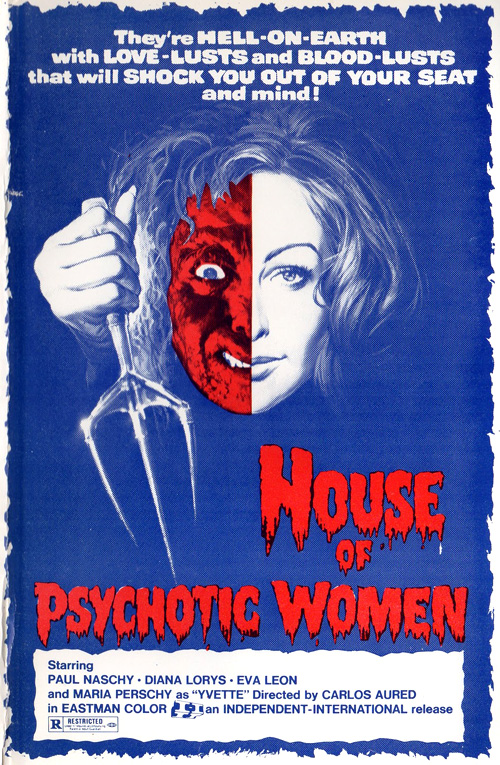
This movie is also known as Blue Eyes of the Broken Doll, which is an edited version for U.S. audiences. There’s also an even further edited TV version called House of Doom. I’ll tell you, this is the only movie I can think of where the children’s song “Frere Jacques” plays during murders.

It was directed by Carlos Aured, who would also make Horror Rises from the TombCurse of the Devil and The Mummy’s Revenge with this movie’s star and co-writer, Paul Naschy.

Naschy plays a ne’er do well named Gilles who wanders into a French town looking for work but ends up getting a ride from a woman named Claude (Diana Lorys, Fangs of the Living Dead) with a fake hand. She soon hires him to put in some work on the house that she shares with her sisters, the insatiable Nicole (Eva Leon) and the wheelchair-bound Yvette (Maria Perschy).

Oh yeah — it’s giallo week. I forgot to mention that a black-gloved killer is murdering only blue-eyed women and putting them eyeballs into glasses of water. The top suspect? Lucio Fulci. No, no, it’s Gilles.

All those eyeball scenes earned this movie a spot on the section 3 video nasty list. Trust me — it’s not as rough as many of the films on that list, but it probably disturbed enough people that it got picked. It’s an odd film with a strange atmosphere.