CBS LATE MOVIE MONTH: Kiss Meets the Phantom of the Park (1978)

EDITOR’S NOTE: Kiss Meets the Phantom of the Park was on the CBS Late Movie on December 27, 1985 and July 21, 1986.

Known as Attack of the Phantoms in Europe and Kiss Phantoms in Italy, this movie has been an embarrassment to Kiss the band and their fans, the Kiss Army, for years. As a six-year-old in 1978, I was certainly aware of the band, as many of my friends had the toys and their older brothers and sisters had the records. But they always seemed strange to me — I was always wondering why they weren’t heavier. It wasn’t until I moved past their 1980’s work and started to enjoy the first few albums that I learned just how much fun Kiss could be.

That’s probably why this movie doesn’t upset me at all. In fact, I kind of love it.

In 1977, Kiss had an income of more than ten million dollars. Their manager Bill Aucoin believed that the traditional cycle of album releases and touring had taken Kiss as far as they could go. So what was the next level? Kiss would become superheroes. Seeing that band boss and bassist Gene Simmons was a huge comic fan, this move made perfect sense.

Round one was a Marvel comic, with the band mixing their blood into the ink for the cover. Round two was this, a Hanna-Barbera produced movie that was a rush job, with all four band members given a crash course in how to act that didn’t really take for anyone but Simmons, who would go on to menace Tom Selleck in Runaway and John Stamos in Never Too Young to Die.

Screenwriters Jan Michael Sherman and Don Buday spent time with each Kiss member so that they could properly learn their characters. “Space Ace” Ace Frehely was known to be pretty strange, frequently saying “Ack!” The writers decided that he would be like Harpo Marx and that would be the only word he would say. Ace responded by demanding more lines or he would quit the film.

Both Frehley and “Catman” Peter Criss hated the long downtime that comes with movie making. They were both dealing with substance abuse issues at the time, too. Nearly none of Criss’ dialogue is his voice. It’s Michael Bell other than when he sings “Beth.” In fact, Frehley got in a fight with director Gordon Hessler (Scream, Pretty Peggy) and left, so for one scene you can clearly see his stunt double taking his place. How can you tell? Well, Ace isn’t black but his double is.

Much of Kiss’ acting in this film is them performing in the parking lot of Magic Mountain in front of 8,000 fans. Those fans were drawn by free tickets from local station KTNQ and DJ “The Real” Don Steele, who shows up here, as well as in plenty of Roger Corman alma mater films like GremlinsDeath Race 2000Rock ‘n Roll High School and Eating Raoul. In 1970, he was so famous that a “Super Summer Spectacular” spot Don Steele contest led to two teenagers trying to track down the DJ accidentally ramming a car into a highway divider, killing a man. The case that came out of it made it the whole way to the Supreme Court of California and Weirum v. RKO General, Inc., 15 Cal.3d 40 is still studied in American law schools in regards to the subject of foreseeability in torts law.

Within Six Flags Magic Mountain, Abner Devereaux (Anthony Zerbe, The Omega Man) is upset that his animatronics are playing second banana to an appearance by Kiss. That may be because his creations have been eating up park revenue. Devereaux is a real piece of work, enslaving Sam Farrell and other employees and a gang of punks (one of them, Dirty Dee, is played by Lisa Jane Persky, who was an early CBGB audience member and girlfriend of Blondie bass player Gary Valentine, who write “(I’m Always Touched by Your) Presence, Dear” for her. She has gone on to appear on Quantum Leap and in multiple projects with Divine. Another punk, Chopper, has a vest with a Satan’s Mothers patch, the exact same logo that would be used again the next year for Walter Hill’s The Warriors).

As Sam’s girlfriend Melissa searches for him as the mad scientist of the park is fired and Kiss plays their concert. After the show, we realize that Kiss are nearly ascetic magicians given to magical pronouncements and superpowers, particularly “Demon” Gene Simmons whose voice rumbles whenever he speaks and “Starchild” Paul Stanley who can read minds.

Devereaux eventually steals the mystical talismans that give Kiss their powers and replaces them with evil robotic duplicates. Of course, Kiss gets their powers back and wins over the crowd and saves the park.

Before the movie aired on TV, a private screening was arranged for Kiss. While their management and hangers-on loved it, the band was incensed and refused to allow anyone to speak of the movie in their presence.

This is quite literally a Scooby-Doo movie, only topped by the 2015 cartoon Scooby-Doo! and Kiss: Rock and Roll Mystery, where Kiss wrote a song all about Fred, “Don’t Touch My Ascot.”

Ironically, soon after this film, Gene Simmons and Paul Stanley would replace the increasingly unreliable and out of control Ace and Peter with an endless series of duplicates who had no ownership or voice in the band’s future. So you can kind of watch this film as a precursor to the very behavior that band would embody in the future. Perhaps the robotic Gene is now the real Gene? The mind boggles.

If I ever met Simmons — my brother has, he gave a keynote speech at a Major League Baseball annual retreat, something I find inordinately hilarious — I hope he looks at me and roars like a lion before intoning, “No gratitude need be voiced. Your mind speaks to us!”
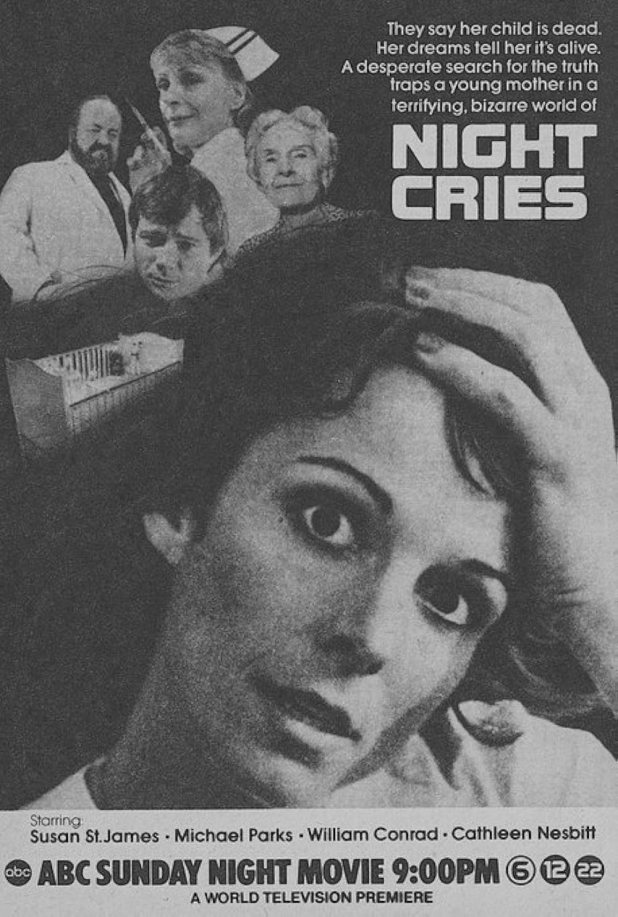
CBS LATE MOVIE MONTH: Night Cries (1978)

EDITOR’S NOTE: Night Cries was on the CBS Late Movie on January 8 and July 9, 1982.

Jeannie (Susan Saint James) and Mitch Haskins (Michael Parks) have just had a baby. Or at least that’s what they thought, as when Jeannie wakes up, in a room with a woman who has just lost a child, she’s shocked to learn that her baby has died.

She’s sure that her daughter was taken from her and keeps having horrific dreams of a house and being attacked by Nurse Green (Delores Dorn). She decides to work with a sleep expert, Dr. Whelan (William Conrad), to discover what exactly has happened.

Those dreams are so amazing. Jeannie dreams a baby carriage has gone into water and when she saves it, it’s a grandfather clock. Directed by Richard Lang (Don’t Go to Sleep) and written by Brian Taggart (The Spell), this TV movie uses those dreams to make use of its low budget and become really odd in the best way.

I also am amazed that the house in her dreams gets explored and its owner, Mrs. Delesande (Cathleen Nebitt), just lets her in. The 1970s were way too forgiving of people who come to your home and say, “I’ve been dreaming of my dead child in your house” and they just let the dreamer explore the home. This would never happen today, right?

Then again, when you have real skeletons in your closet, let people look around.

Also: James and Conrad’s scene where they argue about her dream is really intense. The bedside manner of 70s made for TV doctors is really not good.

You can watch this on YouTube.

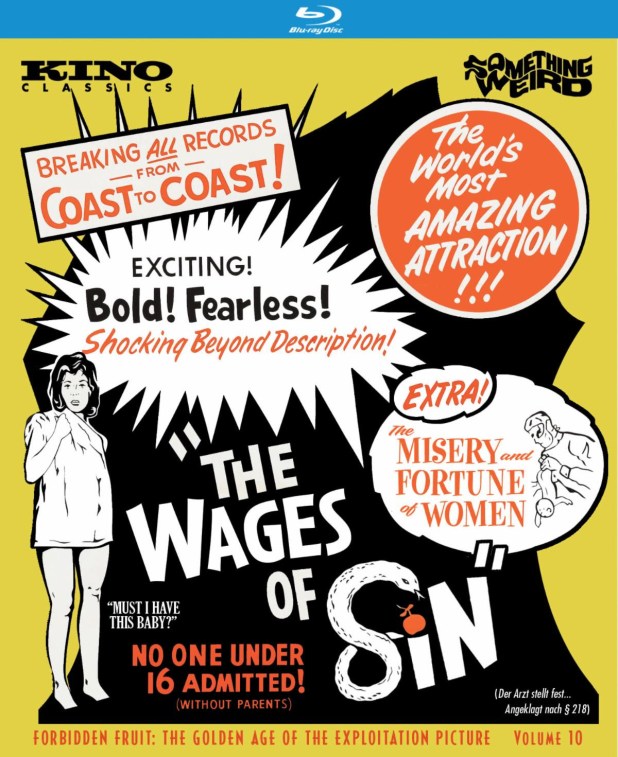
The Sizzlin’ Something Weird Summer Challenge 2024: The Wages of Sin (1966)

Roadshow Rarities (June 30 – July 6) In the old days of theatrical releases some of the more lavish movies would be promoted by holding limited screenings in large cities. These roadshow releases would generate hype before the nationwide release and allow producers to tweak the film to the audience’s reaction. This model also worked for low budget productions that may have had no intention of a wide release. These explo roadshows traveled an informal circuit of theaters, churches, revival tents, high school auditoriums and anywhere else they could run a projector. They frequently promised more than they delivered and left town before the angry audience could catch up to them. Through the restoration efforts of SWV many of these movies have survived to piss audiences off to this very day!

Somehow, this West German movie originally called The Doctor Speaks Out (Der Arzt stellt fest…) played to American audiences as The Wages of Sin and The Price of Sin. Sure, in its native country it was a mediation on abortion, but over here, it was a chance to see a woman fully nude. Never mind that she was having a baby at the time.

Being that this played the grindhouse circuit, it also came complete with a not-real doctor discussing the miracle of birth and then, yes, showing more babies come out into the world in shocking detail.

Those moments are on the Something Weird blu ray re-release that Kino Lorber has just put out. You also get a second movie, The Misery and Fortune of Women, audio commentary by film historian Alexandra Heller-Nicholas a medical lecture and book pitch by Donn Davison, who released this movie in America and two baby birthing films, Life and Its Secrecies and Triplets by Cesarean Section.

What an astounding time for movies. And just think — you can have this on your shelf, just like I do, when someone is at your house and wonders, “You know, I’ve always wanted to see triplets get cut out of a human being.”

CBS LATE MOVIE MONTH: Ghost Fever (1987)

EDITOR’S NOTE: Ghost Fever was on the CBS Late Movie on August 26, 1988.

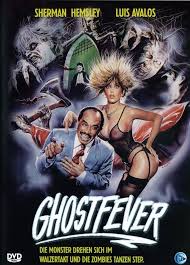
Sherman Hemsley from The Jeffersons is Buford Washington. Luis Ávalos from The Electric Company is Benny Alvarez. And they’re Greendale County, GA — yes, a black man and a Latino in the South! — police officers sent to serve an eviction notice to a plantation when the ghosts of the former slavemaster that owned the house, Andrew Lee (Monogram Pictures star Myron Healey) and one of his slaves named Jethro (also Hemsley) defend the home from beyond. Yes, a black man and his owner working together!

There’s also a torture room that neither Lee nor Jethro know about. That’s because it was the super racist grandfather vampire who did it all and his granddaughters — Linda (Deborah Benson) and Lisa (Diana Brookes) — need help.  Cue the scary music, bring in Madame St. Esprit (Jennifer Rhodes) and the ill-fated seance. Meanwhile, zombies pop up and Buford has to win the house from the bank in a boxing match against Joe Fraizer.  Smoking Joe isn’t the only combat sports veteran in this, as former pro wrestler Pepper Gomez is in the cast.

Then, the ghosts kill Benny and Buford, keeping the house — and the girls — all for themselves. If this seems like a narrative shift in a slapstick comedy, then you’re correct.

Screenwriter Oscar Brodney hadn’t written a movie in 16 years before this, but he did write Harvey, which does not translate into making this movie a success. The Alan Smithee credited for this film is really Lee Madden, who made Hell’s Angels ’69, The ManhandlersAngel UnchainedThe Night God Screamed and Night Creature. He hadn’t made a movie in eight years, but that could be because he was busy making commercials for car lots.

This was filmed in 1985 but not released until 1987 due to extensive re-shooting and re-editing, resulting in Madden demanding that his name be removed from the credits. It was produced by Hemsley and he lost most of the money he’d made in his career on this.

Oddly enough, Hemsley was super into prog rock and allegedly worked with Yes’s Jon Anderson on a funk-rock opera by the name of Festival Of Dreams about the “spiritual qualities of the number 7.” Daevid Allen from Soft Machine and GONG claimed that Hemsley had an LSD lab in his basement and had a room named the “Flying Teapot room,” named for the GONG song, with “…darkened windows and “Flying Teapot” is playing on a tape loop over and over again. There were also three really dumb-looking, very voluptuous Southern gals stoned and wobbling around naked. They were obviously there for the guys to play around with.

They used to call PCP Sherman Hemsley because it made people rude, just like his character. I believe that maybe he was making it!

Here’s the man dancing to Nektar’s “Show Me the Way.”

Let’s therefore forget this movie and enjoy the magical world we live in, where Yes and George Jefferson make music together.

You can watch this on YouTube.

CBS LATE MOVIE MONTH: Won Ton Ton: The Dog Who Saved Hollywood (1976)

EDITOR’S NOTE: Won Ton Ton: The Dog Who Saved Hollywood was on the CBS Late Movie on September 4, 1981.

We live in a magical reality, the kind of place where Michael Winner, the same man who made some of the roughest films ever — Death WishDeath Wish 2Death Wish 3The MechanicThe Sentinel — made this movie that’s a kind of, sort of biography of Hollywood star dog Rin Tin Tin.

It was originally called Won Ton Ton, the Dog Who Saved Warner Bros. before Paramount bought the film and, well, the movie had to change its name, right?

Estie Del Ruth (Madeline Kahn) has made her way to Hollywood, followed by a dog named Won Ton Ton. While she has dreams of being a star — and a director who continually and unsuccessfully pitches movies that will be made many years later named Grayson Potchuck (Bruce Dern) tries to help — the truth is that the dog has all the talent.

This is less a film than a collection of vignettes about the Golden Age of Hollywood, such as Ron Leibman’s effeminate take on Rudolph Valentino and Art Carney, Phil Silvers and Teri Garr as players in the tale of Estie and Won Ton Ton.

The draw for me — beyond how strange it is that Winner directed this comedy misfire — is the huge cast of Hollywood legends, many of whom made this movie their final role. Here are as many as I could remember:

Dorothy Lamour: One-time star of the Hope and Crosby Road movies, she shows up here as a visiting film star.

Joan Blondell: Often cast as a gold digger, Blondell’s career stretched back to vaudeville. She’d appear in two more movies after this: The Champ and Grease.

Virginia Mayo: Warner Brothers’ biggest box-office money-maker in the late 1940s, Mayo continued acting until 1997. She was one of the first actresses to be awarded a star on the Walk of Fame.

Henny Youngman: The rapid-fire standup who would always say, “Take my wife…please.”

Rory Calhoun: Readers of this site will definitely know Calhoun, as he reinvented himself in the 80’s, appearing in genre films like Motel HellHell Comes to Frogtown and the first two Angel films.

Aldo Ray: Much like Calhoun, Ray appeared in just about every genre film he could in the later part of his career. Shock ‘Em DeadHuman ExperimentsThe GloveDon’t Go Near the ParkHaunts…I can and will go on.

Nancy Walker: This star of Rhoda would go on to direct an even bigger bomb than this: Can’t Stop the Music, the unreal story of the Village People.

Ethel Merman: Playing Hedda Parsons here, Merman was considered the First Lady of musical comedy.

Rhonda Fleming: Her name in this movie is Rhoda Flaming, which is…par for the course of this film. She was known as the Queen of Technicolor for how well she filmed.

Dean Stockwell: If you only know him from Quantum Leap, I’d recommend you check out his roles in To Live and Die in L.A. and Married to the Mob.

Tab Hunter: Known for his clean-cut, boy next door looks, his later years are marked by interesting turns, such as playing Mary Hartman’s dad on the spin-off Forever Fernwood and appearing with Divine in Polyester (1981) and Paul Bartel’s Lust in the Dust.

Dick Haymes: This big band vocalist sang in the session where Bing Crosby and The Andrews Sisters recorded both “There’s No Business Like Show Business” and “Anything You Can Do (I Can Do Better).”

Robert Alda: Yes, he’s Alan’s dad. But you knew that. And you also knew that he played Father Michael in Mario Bava’s House of Exorcism.

Victor Mature: This would be the actor’s last major role; he also shows up in a cameo at the end of Winner’s film Firepower.

Edgar Bergen: As Professor Quicksand, this is one of his few roles not holding one of his trademark partners like Charlie McCarthy or Mortimer Snerd. He’s also in The Phynx, which still blows my mind.

Henry Wilcoxon: You may not know that he was very involved with the films of Cecil B. DeMille, but you do know him as the priest caught in a rainstorm in Caddyshack.

Yvonne DeCarlo: In 1950, the Camera Club of America voted her “Sexnicolor Queen of the Screen.” You know those guys — the pre-Internet creeps that’d hire women to pose for them as they stood around en masse. DeCarlo is better known as Lily Munster, she also appears in the kind of movies that this creep enjoys, namely Satan’s CheerleadersSilent ScreamPlay DeadGuyana: Cult of the DamnedAmerican Gothic and Mirror, Mirror.

There are literally dozens and dozens of stars here, so get ready…

Edward Le Veque (the last surviving member of The Keystone Kops); William Benedict (Whitey of The Bowery Boys); Huntz Hall of The Dead End Kids; silent stars Carmel Myers, Dorothy Gulliver, Maytag repairman Jesse White; comedians Jack Carter and Shecky Greene; Marilyn Monroe rival Barbara Nichols; Variety columnist Army Archerd; Fernando Lamas; Zsa Zsa Gabor; Cyd Charisse, whose legs were once insured for $5 million dollars; Doodles Weaver (who also shows up in plenty of insane movies like The Zodiac Killer); cowboy actor Pedro Gonzalez Gonzalez; Dick Van Dyke Show co-star Morey Amsterdam; Monroe/JFK scandal magnet Peter Lawford; Eddie Foy Jr.; Patricia Morison; The Adventures of Wild Bill Hickok star Guy Madison; John Carradine as a drunk (yes, I realize that this is an easy target; I also realize that I watch at least one movie with Carradine in it a day); Regis Toomey, who is also in another dog of a film C.H.O.M.P.S.; Ann Rutherford (Gone with the Wind); Milton Berle (once perhaps the most famous person in entertainment); Keye Luke (a founding member of the Screen Actors’ Guild as well as the original Brak on Space Ghost and Mr. Wing from Gremlins); Walter Pidgeon (he’d be in one more movie, the Mae West vehicle Sextette); character actors Phil Leeds and Cliff Norton as dogcatchers; Winnie the Pooh’s original voice Sterling Holloway; two of the Ritz brothers who were also in Blazing Stewardesses; Edward Ashley (Professor Sutherland from Waxwork); Fritz Feld (who is also in The Phynx); George Jessel; Ken Murray; Stepin Fetchit (considered to be the first African-American to have a successful acting career, now seen as an example of how Hollywood treated minorities); Tarzan actor Johnny Weissmuller; Louis Nye; Dennis Morgan; William Demarest (Uncle Charley from My Three Sons); Billy Barty who plays an assistant director; Ricardo Montalban; Jackie Coogan; Roy Rogers’ sidekick Andy Devine; Broderick Crawford (of his many movies, I’ll let on that Harlequin is one of my favorites); Richard Arlan; Jack La Rue; former pro wrestler “Iron” Mike Mazurki; as well as singers Dennis Day, Janet Blair, Jane Connell, Ann Miller, Rudy Vallee and Gloria DeHaven.

When Augustus von Schumacher attended the premiere — he was the dog who played the lead role — he walked in with Mae West. Now that’s how you become a star.

As for the movie — unless you’re someone like me that gets excited about cameos, you’re going to hate it.

CBS LATE MOVIE MONTH: Count Yorga, Vampire (1970)

EDITOR’S NOTE: Count Yorga was on the CBS Late Movie on August 16, 1974 and August 14, 1975.

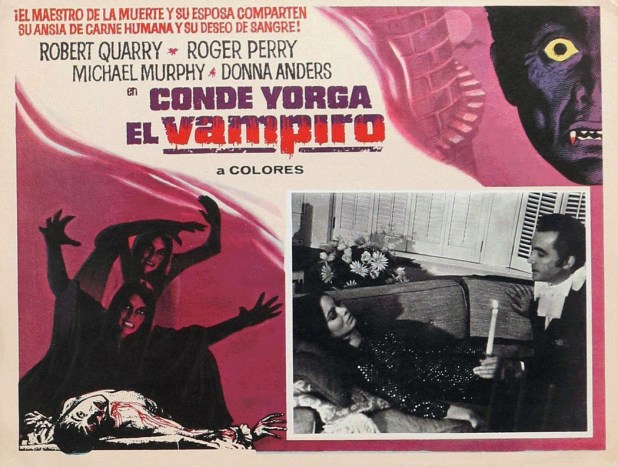
Directed and written by Bob Kelljan, Count Yorga, Vampire was originally going to be soft core porn movie, The Loves of Count Iorga. In fact, some prints have that title. Robert Quarry, the man who would be Yorga, told producer Michael Macready that he would play the vampire if they turned the story into a non-sexual horror movie.

Donna (Donna Anders) is trying to contact her recently deceased mother via séance by Count Yorga, a mystic who has recently moved to America. Donna becomes hysterical and needs to be calmed by Yorga; afterward she reveals to her friends that Yorga was her mother’s last over and when she died, he demanded that she be buried and not cremated.

Yorga then conducts a campaign of terror, biting Erica (Judy Lang), who goes from party girl to vampire eating her own kitten — don’t worry, it’s just a kitten covered in lasagna — in a matter of hours. Oh yeah — Donna’s mom (Marsha Jordan) is now one of Yorga’s brides and it’s the swinging seventies, so he commands her to make love to one of his other undead women on a cold cemetery slab.

By the end of the film, Yorga and his brides have wiped out just about every one of Donna’s friends and strengthened his hold over her, which extends potentially beyond the grave. Again, it’s the seventies and life is cruel and cheap and happy endings aren’t often found after the New Hollywood. The count is also self aware and watches Countess Dracula.

CBS LATE MOVIE MONTH: The Comedy of Terrors (1964)

EDITOR’S NOTE: The Comedy of Terrors was on the CBS Late Movie on September 1, 1972 and April 30, 1973.

American-International Pictures follow up to The Raven, this movie reunites Vincent Price, Peter Lorre and Boris Karloff. Adding to the trio is Basil Rathbone, giving this film an astounding cast. They’re all working from a script by Richard Matheson and direction by Jacques Tourneur, who for my money made some of the greatest horror movies ever like Night of the DemonThe Leopard Man and Cat People.

Price is Waldo Trumbull, a funeral home owner, a business that he stole from his partner Amos Hinchley (Karloff) after marrying his daughter Amaryllis (Joyce Jameson). They only have one coffin, which saves them money, as Felix Gillie (Lorre) dumps the bodies when he isn’t setting up the death of wealthy clients.

Rathbone plays John F. Black, Esq., the landlord that tries to evict Trumbull but keeps dying and coming back to life, giving soliloquies and dying again. The cat, who keeps waking him up due to allergies, is played by Orangey the cat, who also menaced The Incredible Shrinking Man.

While a fun movie, this one could have really used Corman’s touch. That said I’m a big fan of Tourneur. It wasn’t a big success, but it’s still worth a watch. You might even spot the hearse coach that now is part of Disneyland’s Haunted Mansion.

The Vourdalak (2023)

The Family of the Vourdalak by Aleksey Konstantinovich Tolstoy, written on Tolstoy a trip to France from Frankfurt where the author was attached to the Russian Embassy, has been filmed before. The most obvious adaption is “I Wurdulak” in Mario Bava’s anthology Black Sabbath. Starring Boris Karloff as the father and Mark Damon as the young nobleman, it’s a classic horror film. Less known, but still incredible, is Giorgio Ferroni’s more modern take, The Night of the Devils, the 2020 Argentina film Sangre Vurdalak and the animated Vrdlk: Family Of Vurdulak.

I’m so happy to report that director Adrien Beau has found another take on the film that makes it fresh and exciting.

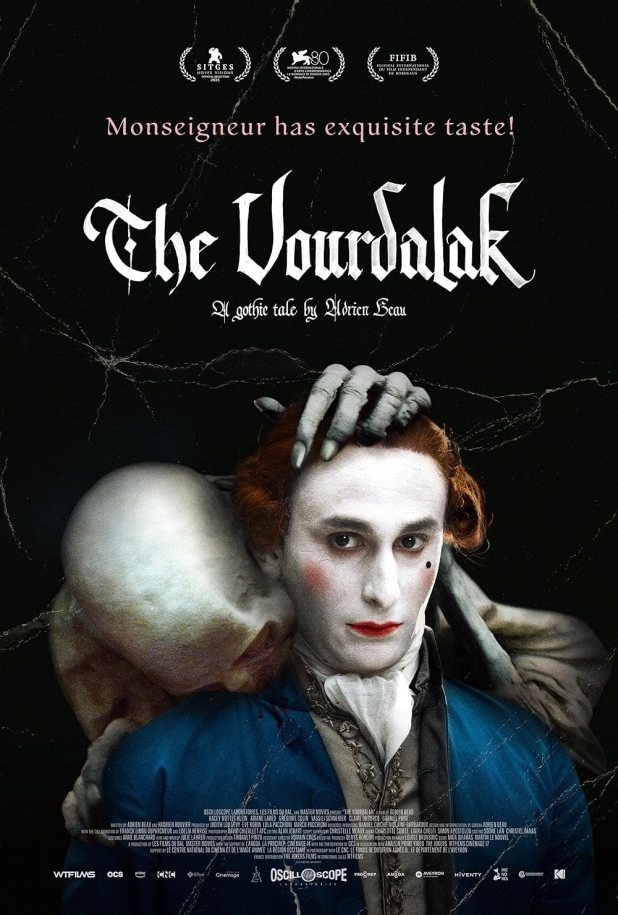
Arriving on a stormy night, Marquis Jacques Antoine Saturnin d’Urfé (Kacey Mottet Klein), a noble emissary of the King of France, finds himself the last survivor of a royal group that has been attacked by a mysterious group. He has somehow found his way to a home in the woods. Belonging to Gorcha (that’s also Belew’s voice and he co-wrote this movie with Hadrien Bouvier), he is fed and kept safe by the man’s sons Jegor (Grégoire Colin), Vlad (Gabriel Pavie) and Piotr (Vassili Schneider), along with Jegor’s wife Anja (Claire Duburcq) and Gorcha’s daughter Sdenka (Ariane Labed). As for the father, he disappeared some days ago looking for revenge on a man named Alibek.

If you know the story, you know what’s next. If Gorcha never comes back, he will be killed. But if he does survive, it could be much worse. In six days, he will become a vampiric vourdalak and have no problem killing and dining on all of those that he loves.

The Marquis instantly falls for the mysterious Sdenka, a young woman who gave her heart to another traveler and now cannot be married. She refuses to discuss her family, the supernatural curse that her father may suffer, and even resists being seduced by nearly launching the powdered wigged man off a cliff, the same place she was to meet her lover and escape her doomed family. But now, that man is dead and her hopes are as well.

And then Gorcha is found, a dead thing barely able to move, demanding a feast and that their dog be shot and killed. He has become something unearthly — the puppet used for this film is astounding, feeling like something out of the art of Mike Mignola come to life — and like all vourdalaks, the blood that they want most is the blood they have created.

He does exactly that, working his way through the family, as well as pitting them against one another. he forces the Marquis and Sdenka to dance for him while revealing that he was the one who killed her lover. Then, his son Piotr, appears covered in makeup and flowers, ready to destroy his begetter before he’s shot, his blood spraying all over his sister’s face. Jegor attacks the nobleman and says that in the morning, he will be given a horse and if he ever comes back, he will be murdered.

Chained in the dungeons overnight, the nobleman must watch helplessly as the now undead Vlad kills his mother, Anja, just before Sdenka tells him that she plans to finally leap to her demise. As he rides away, he plans to return, looking for the woman he loves. He finds her back at her home and she finally seduces him, wrapping her thighs around in as she begins to drink his blood, revealing that the Marquis is between the thighs of Gorcha. He leaps to his feet, stakes the vampire, and leaves the house in flames.

He rides to find Sdenka and tells her that while his time is short, she can live. He gives his horse and a map to get to Europe, then takes her place, jumping to his death. She rides away, chewing on a shroud, just as her father once did, leaving us wondering if she will pass her curse to the noblewoman who has written that she has taken her in.

Shot in Super 16 and filled with colors unseen in movies in decades and a family that destroys each other through supernatural means, but they may have been destroyed in spirit long before. As Piotr tells the Marquis, “Love itself is a curse in these parts.” Gorcha uses that love against them, whether placing himself as their protector by hanging the head of Alibek above their door or alternating between cruelty and kindness, just like every abuser. Is the Marquis any better, a man not above bringing up his station while fretting about the malaise of the upper class?

This is above all else beautiful and eerie, with a lead vampire more alive than most human actors, a bloodsucker who even sounds terrifying, sucking at his burial cloth, hungry for those he once supposedly loved. I felt just as hungry as him, devouring every frame of this masterwork.

The Sizzlin’ Something Weird Summer Challenge 2024: Because of Eve (1948)

Roadshow Rarities (June 30 – July 6) In the old days of theatrical releases some of the more lavish movies would be promoted by holding limited screenings in large cities. These roadshow releases would generate hype before the nationwide release and allow producers to tweak the film to the audience’s reaction. This model also worked for low budget productions that may have had no intention of a wide release. These explo roadshows traveled an informal circuit of theaters, churches, revival tents, high school auditoriums and anywhere else they could run a projector. They frequently promised more than they delivered and left town before the angry audience could catch up to them. Through the restoration efforts of SWV many of these movies have survived to piss audiences off to this very day!

Sally and Bob have been married a year and there’s some good news. It seems like she’s pregnant. That means they go to see Dr. West, who has no idea what HiPPA laws are or the privacy of the patient and we learn about how Sally had a baby with Bob’s best friend who died in World War II and their issues with VD and when things get weird, he makes them watch some other movies within the movie like The Story of V.D.The Story of Reproduction and The Story of Life and oh man, throw away your popcorn because you know it’s time to see diseased vaginas and penises. Let’s throw in a cesarian and regular birth, because the people demand it!

After the movie, perhaps you’d like to purchase The Mid-Century Marriage Guide?

Director Howard Bretherton made a hundred or so low budget westerns and was a master of editing in camera, a skill he passed on to his son David Bretherton, who edited Cabaret and Westworld, and his granddaughter Gillian L. Hutshing, who was on the editing team for Blade RunnerRadEyes of Fire and The Monster Squad.

CBS LATE MOVIE MONTH: RPM (1970)

EDITOR’S NOTE: RPM was on the CBS Late Movie on October 25, 1973 and April 20 and August 31, 1976.

Stanley Kramer called his movies heavy dramas but they’re what are often called message films. A liberal, he brought issues to the public eye through his movies like the dangers of nuclear war (On the Beach), fascism (Judgement at Nuremberg, Ship of Fools), creationism against evolutionism (Inherit the Wind), greed (It’s a Mad, Mad, Mad, Mad World) and racism (The Defiant OnesGuess Who’s Coming to Dinner).

While Pauline Kael saw his movies as “melodramas,” and “irritatingly self-righteous,” she also had to realize that they had “redeeming social importance.”

But in 1970, maybe he was past his expiration date.

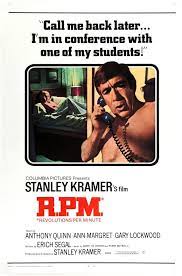
Did he feel like Professor F.W.J. “Paco” Perez (Anthony Quinn) does in this movie? For years, Paco has been the radical, the one that stood outside the mainstream. He says at one point that he fought Franco and McCarthy and has learned so much, but the young people don’t want to learn anything. Did Kramer feel that way, an old man in the New Hollywood that was so much more in touch with the youth?

Is Paco just a fifty-year-old fanny chaser, as out of touch with the time as the administration he’s been asked to be a part of?

Radical student activists — Paco is impressed that the blacks and whites have worked together — occupy the administration building with a list of 12 demands. President Tyler (John Zaremba, who spent the 70s and 80s wandering the Earth searching for the best beans for Hills Brothers Cofee) resigns and the Board of Trustees looks at the list that the students have written up of the presidents they would be happy with.

Top on the list? Paco.

It’s after midnight and he’s asleep with his grad student girlfriend Rhoda (Ann-Margret). Yet he’s urged to rush out and fix things. The next day, he starts his new job, showing up on a motorcycle.

Paco reads their demands and many of them, like inner-city scholarships, a college reinvestment program, no military research on campus and adding an African American to the all-white Board of Trustees make sense. But the idea that students can hire and fire faculty doesn’t work for him. He’s already reached the first time where his theory and reality begin to not work together.

With Rossiter (Gary Lockwood) and Steve Dempsey (Paul Dempsey) leading the students, Paco tries to be the person between them and the Board of Trustees. But when Rossiter says that he will destroy all of the campus’ computers, Paco has to make the tough decision to call in the police. They come charging in with tear gas, turning their hero professor into just one of the old people never to be trusted. When the cops round up the students, Rhoda is one of them.

What they don’t know is that Paco has signed off on their bail. Yet he still walks past the crowd and is screamed and booed at. He has learned the hard way that the lessons of books and classrooms often mean little in the real world.

I really liked the songs by Melaine, “We Don’t Know Where We’re Goin’” and “Stop! I Don’t Wanna Hear It Any More,” that were in this. It’s quite preachy, but it also feels like this movie was Kramer attempting to determine where he fit in any longer. Then again, Kramer would say that this was his least favorite film that made the lowest amount of money. The dialogue may get silly sometimes, but that’s because it’s written by Erich Segal, who also did Love Story.

After this movie, however, I understand why my dad and other older male relatives would say Ann-Margaret’s name with the reverence they otherwise reserved for the saints.

You can watch this on Tubi.