CHILLER THEATER MONTH: The Horror of Frankenstein (1970)

EDITOR’S NOTE: The Horror of Frankenstein was on Chiller Theater on Saturday, November 30, 1974 at 11:30 p.m., Saturday, July 10, 1976 at 11:30 p.m. and Saturday, December 9, 1978 at 11:30 p.m.

Directed by Jimmy Sangster, written by Jeremy Burnham and Sangster and starring Ralph Bates as Baron Victor Frankenstein, this started as a remake of Curse of Frankenstein before Hammer allowed Sangster to write it as a parody. This was an attempt to make Bates into the new Hammer star.

Shot on the sets of Taste the Blood of Dracula and The Vampire Lovers and playing double features with Scars of Dracula, this also has David Prowse as the monster. He’s the only actor to play the role twice for Hammer, as he’s also in Frankenstein and the Monster from Hell (and wore Universal Frankenstein’s Monster makeup in Casino Royale).

Victor Frankenstein isn’t sympathetic at all in this. He kills his father to get the title of Baron von Frankenstein, goes to medical school in Vienna until he’s caught knocking out the dean’s daughter and then he comes home to assemble the dead into his creation.

Dennis Price and Joan Rice are good as the graverobbers, but despite the idea of starting a new series with a younger Dr. Frankenstein, this feels less special than the past of Hammer. Even the ending, where the monster gets covered by acid, is a let down. But still, it’s a Hammer movie and even a bad one has some reasons to watch.

CHILLER THEATER MONTH: It! The Terror from Beyond Space (1958)

EDITOR’S NOTE: It! The Terror from Beyond Space was on Chiller Theater on Saturday, July 23, 1966 at 11:20 p.m. and Saturday, September 19 at 11:15 p.m.

In 1973, Earth is on its second manned mission to Mars. Only Col. Edward Carruthers (Marshall Thompson) survived and it’s thought that he killed the other nine members of his crew. He tells anyone that will listen that a monster was behind it all. Commander Col. Van Heusen (Kim Spalding) orders Carruthers to be watched at all times, but it’s not him they should be worried about.

The monster that Carruthers warned everyone about is on the ship and bullets won’t stop it. Nor will grenades, electricity or radiation. It is played by Ray “Crash” Corrigan in his last role and he was a handful for special effects artist Paul Blaisdell, refusing to get fitting for the costume and drunkenly tearing it apart almost every day. By the end of filming, Blaisdell had just about had it with how he was treated by Corrigan and Shirley Patterson, who hated that she was stuck in a science fiction movie. The problems for Blaisdell were compounded when United Artists kept the costume and used it again in Invisible Invaders.

Directed by Edward L. Cahn and written by Jerome Bixby, this recycles the music from Kronos and used parts of the costumes from the Buck Rogers serials and Destination Moon. Yet for such a low budget film, it went on to be the obvious inspiration for Alien.

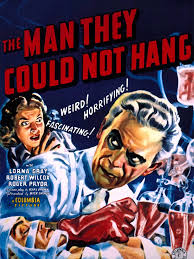
CHILLER THEATER MONTH: The Man They Could Not Hang (1939)

EDITOR’S NOTE: The Man They Could Not Hang was on Chiller Theater on Saturday, January 22, 1966 at 1:00 a.m.

Directed by Nick Grinde (The Man with Nine LivesBefore I Hang) and written by Kurt Brown (A McKeesport native who was the assistant to D.W. Griffith’s cameraman G.W. Bitzer before becoming a cinematographer; he was the son of comedian and character actor William H. Brown and his mother was Lucille was an actress), The Man They Could Not Hang stars Boris Karloff as Dr. Henryk Savaard, a somewhat mad scientist who has invented a procedure for bringing the dead back to life.

The film begins with him being arrested and about to be executed for murdering a young medical student who volunteered to be killed as part of the testing phase of this procedure. On death row, his assistant Lang (Byron Foulger) signs papers to take possession of the doctor’s body and then he is lynched.

That’s just the start of the movie.

Lang surgically repairs Savaard’s neck and then, like a 1930s version of Dr. Phibes*, he ensures that six of the jurors that convicted him all die by hangings that appear to be suicidal. Only Scoop Foley (Rbert Wilcox) believes that the doctor is still alive and killing everyone who did him wrong. By the point that jurors are being killed every quarter hour, people start to take him seriously.

Virginia Pound — billed here as Lorna Gray — is Savaard’s daughter. She played plenty of comic roles — opposite Buster Keaton in Pest from the West and the Three Stooges in You Nazty Spy!Oily to Bed, Oily to RiseThree Sappy People and Rockin’ thru the Rockies — as well as receiving co-billing in several Republic movies and serials. I love how at the end she holds off all of these important doctors and basically sacrifices herself twice.

After this film, The Man with Nine Lives, Before I Hang and The Devil Commands, Karloff had played basically the same role four times. So when he did a fifth takeoff on the same idea, The Boogie Man Will Get You, it was treated as a parody of this storyline.

Also: Open heart surgery is science fiction in this film.

*One of the victims is killed by picking a phone up and a needle going in their ear to kill them. That’s a total Phibes kill.

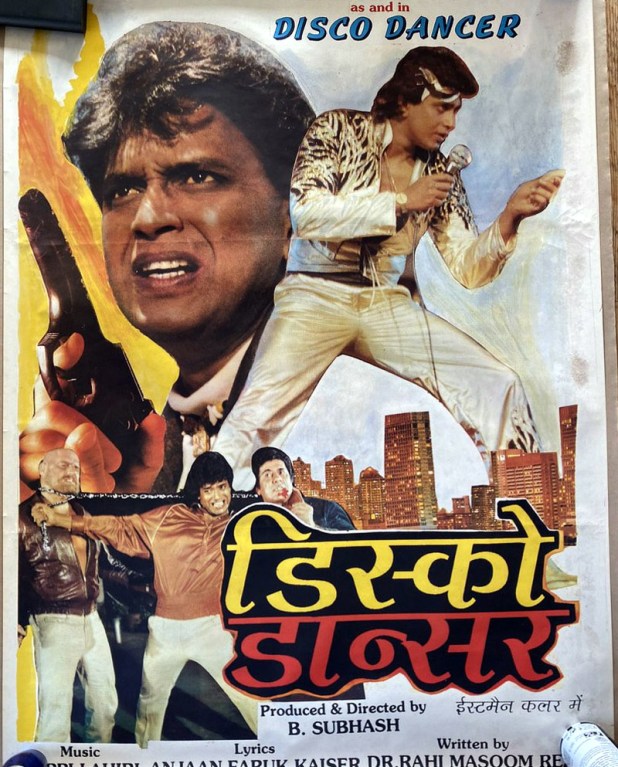
2024 Scarecrow Psychotronic Challenge Day 21: Disco Dancer (1982)

21. STAGEFRIGHTS: Musicals are hell to endure. Can I get a hell yeah!?

In his childhood, Anil (Mithun Chakraborty) watched helplessly as a rich man named P.N. Oberoi (Om Shivpuri) beat his mother in the streets and then had numerous thugs slap him around. All Anil wanted to do was dance and sing. Now, he has to live with this memory.

Yet dance and sing he does, as he’s noticed by David Brown (Om Puri), a manager who wants to replace his current disco star Sam (Karan Razdan) as his ego has grown too big. Now known as Jimmy, our hero becomes a disco star while falling in love with his enemy’s daughter Rita (Kim)

Oberoi is one of the most brutal villains I’ve seen in a movie in a long time. He hooks Jimmy’s guitar up to an electrical current in the hopes of killing him, but it fries his mother instead. Now, Jimmy can’t play the guitar and thanks to Oberoi’s henchmen, he can’t walk either. Rita must nurse him back to health and get him ready for the stage.

The film ends at the International Disco Dancing Competition, where Jimmy gets on stage and can’t sing. Rita gets up and starts screaming at him, trying to force him to sing. Finally, Jimmy’s uncle Raju (Rajesh Khanna) throws him a guitar and tells him that his mother is in his music. He plays like he never has before, winning the contest, just in time for Oberoi’s killers to rush the stage and shoot Raju.

This has stopped being disco.

Jimmy goes for revenge, killing every single guard through dance fighting, before getting justice in the most perfect way possible. Electrocution.

Disco Dancer was a huge hit, not just in its own country, but in Southern and Central Asia, Eastern and Western Africa, Japan, the Middle East, East Asia, Turkey and the Soviet Union. There’s even a Jimmy statue in Osaka! It also inspired the Devo song “Disco Dancer” and “Jimmy Jimmy Jimmy Aaja” appears in You Don’t Mess With the Zohan and was covered by M.I.A.

The soundtrack may not always be pure disco, but at times it has some wild sounds, like how “Koi Yahaan Nache Nache” samples “Video Killed the Radio Star,” French disco star Marc Cerrone’s “Cerrone’s Paradise” is used — probably without permission — and “Krishna Dharti Pe Aaja Tu” used parts of “Jesus” by Tielman Brothers, who were the first Dutch-Indonesian band to successfully venture into the international music scene. There’s another French disco song that’s sampled in this, Ottawan’s “T’es Ok T’es Bath.”

This movie has all the colors, all the drama, all the disco dancing. Seriously, it’s incredible even if the music isn’t all that disco at times. If you’re just starting to get into Bollywood films, this is a great place to start, because this truly has some mind destroying scenes.

You can watch this on YouTube.

ARROW 4K UHD RELEASE: Trick ‘r Treat (2007)

Inspired by Season’s Greetings, an animated short created by Trick ‘r Treat writer and director Michael Dougherty, this film tells the story of the night of Halloween in Warren Valley, Ohio. It’s nonlinear the way it all plays out (think Pulp Fiction) and several of the stories cross over. They all have one thing in common — Sam, a little trick or treater dressed in pajamas and a burlap sack for a mask. If anyone goes against the rules of the holiday, he’s there to ensure they pay for it.

I love the look of Sam. For the first part of the movie, I was sure he was just a little trick or treater who was left behind by his friends and was witnessing everything going on. Once you realize what he’s doing, you start rooting for the little guy.

From a couple who take down their decorations too soon to an obese boy who can’t stop smashing pumpkins, everyone gets their reward. There’s also the school principal and potential serial killer Steven Wilkins, the elderly recluse Mr. Kreeg (the always great Brian Cox), a gang of kids trying to frighten Rhonda with the Halloween School Bus Massacre urban legend and a group of four girls out to party (including Anna Paquin as a shy virgin). Each of their tales will all be intertwined, complete with murder, gore, werewolves, zombies and finally, Sam’s secret face.

This feels like the great lost 1980’s horror movie and I loved every single minute of it. They’ve been teasing a sequel for a few years and now I can’t wait for everyone to get their act together. Writer/director Michael Dougherty was also behind the film Krampus.

The Arrow Video limited edition Trick ‘r Treat release has a brand new 4K restoration by Arrow Films, approved by writer-director Michael Dougherty.

Extras include brand new audio commentary with writer-director Michael Dougherty moderated by James A. Janisse & Chelsea Rebecca from Dead Meat Podcast; an archival audio commentary by Michael Dougherty, conceptual artist Breehn Burns, storyboard artist Simeon Wilkins and composer Douglas Pipes; interviews with actor Quinn Lord, production designer Mark Freeborn, director of photography Glen MacPherson, costume designer Trish Keating and creature designer Patrick Tatopoulos; Mark Freeborn Remembers Bill Terezakis, a new tribute to the late make-up effects designer; archival features and interviews; Season’s Greetings, a short film from 1996 directed by Michael Dougherty with optional director commentary; school bus VFX comparison; deleted and alternate scenes with optional commentary by director Michael Dougherty; FEARnet promos; a Sam O’ Lantern; a storyboard and conceptual artwork gallery; behind the scenes gallery; a comic book set in the Trick ‘r Treat universe and a trailer.

It’s all inside a reversible sleeve featuring original and newly commissioned artwork by Sara Deck and has a double-sided foldout poster featuring original and newly commissioned artwork by Sara Deck, six postcard-sized artcards and an illustrated collector’s booklet featuring new writing on the film by Becky Darke and Heather Wixson.

You can get this from MVD.

ARROW 4K UHD RELEASE: Hellraiser: Quartet Of Torment

We’ve all seen Hellraiser, I hope, by now, but if this movie has eluded your collection, as it once did mine, this Arrow Box set is incredible and will fit the bill. As the Cenobites say, “We have such sights to show you.”
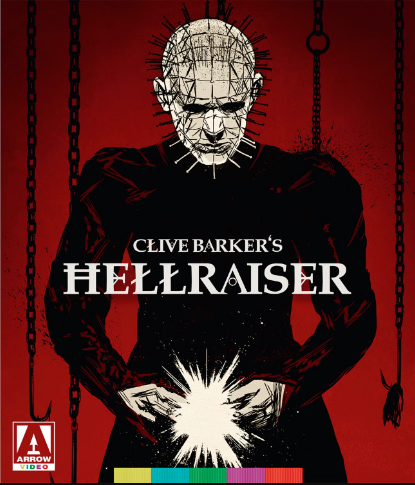
Hellraiser (1987): Horror movies don’t scare me. Not anymore. Some of them disturb me, like the cannibal films. But only one still kind of scares me. And that would be Hellraiser.

There was a time, before the eight sequels to the film and BDSM became well-known fodder on shows like Law and Order that Hellraiser seemed like it came from some alien land more than its true origins. The monsters of the piece, the Cenobites, looked like nothing we’d never seen before, all leather, blood and open festering wounds. The idea that sex and pain could be united wasn’t trite back in 1987, so it’s difficult to convey the power and fear this film had. It feels wrong. It feels dirty. It feels evil.

How this movie was made for $900,000 blows my mind. It looks lush and gauzy at times and at others, like when we see Frank’s heart and veins being formed, positively nightmarish. It shouldn’t be this good — it was Clive Barker’s directorial debut after seeing two of his stories, Underworld and Rawhead Rex, get made into films he didn’t agree with. What kind of deal with the devil did this guy make to turn out something so perfect on his first try?

The misconception that many people have of this film is that the Cenobites are the villains or the horrific part of the film. If we go to the poster for proof, it says “Demon to some. Angel to others.” Pinhead and his gang are there to move the story forward and certainly look frightening, but they are bound by the rules of Hell and the Lament Configuration, the puzzle box that sets the events of the film in motion. Matter of factly, these rules aren’t truly defined yet — is Pinhead a tortured soul stuck in the wheels of some hellish bureaucracy? Who created these boxes? None of this matters — “You solved the box. We came.” Yes, it can be that simple. You don’t need to know all of those answers right now. When Frank buys the box and Morocco and solves it, he gets the answer to limitless pleasure and the drug of all drugs — as Frank says, “I thought I’d gone to the limits. I hadn’t. The Cenobites gave me an experience beyond limits. Pain and pleasure, indivisible.”

That’s one of the real horrors of this film: people will do anything to chase a high. That high may be drugs. It may be pain. It may be a sexual experience that makes the mundane life you’re stuck in — like Julia, bored with a suburban life with a husband she never really wanted in the first place. The chance to be with Frank again, no matter if she has to seduce and kill for him, is everything. Notice that as he gains more muscle and skin with each drop of blood, she becomes more and more attractive, her skin gaining new color.

The main horrors of this film are family and other people. The Cotton family had issues before the Cenobites took one step out of Hell. The most horrific part of the film comes when Frank wearing Larry’s skin, stares at his niece in a moment of sexual longing and says, “Come to daddy.” Sure, there are horror film trappings, but this type of morally bankrupt behavior isn’t something confined to the cinema. So much of the betrayal and madness of Frank and Julia could happen. It happens every day.

Hellraiser exists on the border of reality. It’s fantastic, but it feels like it could happen. It’s the dangerous fiction that could overwhelm your truth if you go too far. In that it’s quite similar to Barker’s Candyman, which posits that saying the name of its titular character three times in a mirror is all it takes for him to come for you. That seems too unrealistic, but do you want to take the chance? And much like the black leather garbed creatures in this film, Candyman must adhere to a dream logic that only comes into our reality when you allow the genie from the bottle.

Hellbound: Hellraiser II (1988): Most of the cast and crew of Hellraiser returned to make this movie and you know, despite the reduced budget, the dark tone of this movie and continuation of the themes from the original makes this one of the better horror sequels.

Kirsty Cotton (Ashley Laurence, returning from the first movie) is admitted to a psychiatric hospital where Doctor Channard and his assistant Kyle MacRae listen to her story. She begs them to destroy the bloody mattress her stepmother Julia Cotton (Clare Higgins) died on but Channard ends up being a man who has been obsessed with the Lament Configuration. After a patient slices himself open upon that cursed object, Julia comes back to our reality.

Channard and Julia have been luring mentally disturbed men to his home so that Julia can feed off of them. Meanwhile, Kirsty meets Tiffany, a girl skilled at solving puzzles who is forced by the doctor and his demented mistress to open the gates of Hell with the infernal box at the heart of this story.

Within the dimension of Leviathan, the humans are more duplicitous than the demonic Cenobites that carry out the orders of their master.

Barker had plans to show how each of the Cenobites had once been human and how their own vices lead to their becoming angels to some, demons to others. You’d think that with the success of the first film they could have had a little more money here.

Another intriguing notion is that Julia was originally supposed to rise from the mattress at the end of the movie as the queen of hell and be the recurring character. As the first movie gradually became a success, Pinhead ended up becoming the favorite.

Back in the video rental days, I may have brought this home more than twenty times. I was obsessed by the look of Leviathan’s dimension and the strange sound that it makes — Morse code for God — blew my teenage mind. It still holds up today, despite a litany of lesser sequels.
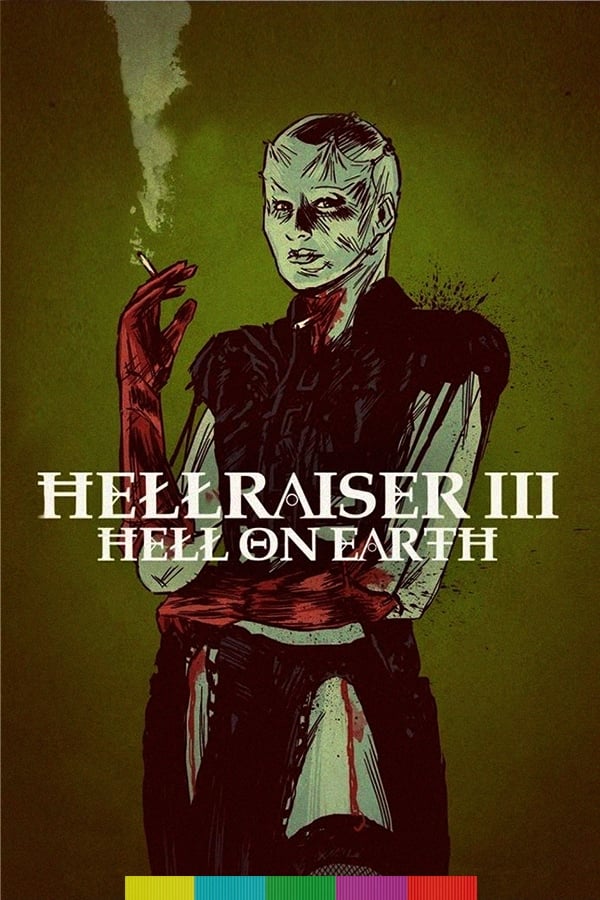
Hellraiser III: Hell On Earth (1992): Anthony Hickox made both Waxwork movies, so that qualified him to take on the third trip to visit the Cenobites, which was necessary as the two films that had already come out were huge rental successes.

Series creator Clive Barker reprised his role as executive producer, though he was largely uninvolved until post-production, while Tony Randel at least contributed the story.

At the end of the last film, as Pinhead tried to reclaim his humanity, he finds himself split into his demonic form and as the limbo-trapped British Army Captain Elliot Spencer. As for Pinhead, he and the Lament Configuration remain within the Pillar of Souls that appeared as the last movie finished.

The pillar is bought as art by a club owner and when one of his sexual conquests is dragged into it and absorbed, Pinhead emerges and demands more blood. Without the influence of Spencer, Pinhead has become true evil and is using our reality for his own pleasure, which is against the regimented laws that the Cenobites live by.

Ashley Laurence returns for a cameo, as her Kirsty character explains the events of the previous films. And hey — Armored Saint plays the club!

Between the Barbie and CD Cenobites and the more American locale, this film suffers in comparison to the first two movies. That said, when viewed against what was to come, it ends up being pretty decent. The idea that Pinhead lost his faith in humanity after war rings true even many decades later.

Hellraiser: Bloodline (1996): Directed by Kevin Yagher and Joe Chappelle, this is the last Hellraiser to play theaters, only has one returning character in Pinhead (Doug Bradley), the last to involve Clive Barker and is both a prequel and a sequel.

Yagher left the production after Miramax demanded new scenes be shot. This is a theme that will appear in nearly every 90s horror movie that Miramax got their weird creepy hands on. The new scenes and re-shoots changed several characters’ relationships, gave the film a happy ending, introduced Pinhead earlier and cut 25 minutes of the original cut Yagher turned in. These were enough changes that he was able to use the Alan Smithee credit.

Dr. Paul Merchant has designed a space station to be in the shape of a giant Lament Configuration. Yes, within four movies, the Hellraiser franchise does what it took Jason Voorhees ten to arrive at. Yes, we’re in space. And we’re also going back in time, as Merchant’s ancestor creates the original box that starts all of these demonic events.

The Merchant bloodline has been cursed ever since they helped open the gates to Hell. There’s also a new Cenobite, Angelique, who tempts people and this puts her into conflict with Pinhead, who only believes in pain. There’s also a Merchant ancestor in 1996 that has created The Elysium Configuration, an anti-Lament Configuration that creates perpetual light and will close the pathways to Hell forever.

Bruce Ramsay ended up playing all of the Merchants and I kind of like that the end of this movie attempts to close the story. How crazy is it that this was Adam Scott’s film debut?

As you can imagine, Arrow has gone wild on this, packing this set. You get brand new 4K restorations of all four films from the original camera negatives by Arrow Films, as well as a 200 page hardback book, Ages of Desire, with new writing from Clive Barker archivists Phil and Sarah Stokes. There’s also a limited edition layered packaging featuring brand new Pinhead artwork.

Here are the extras by movie:

Hellraiser

Brand new audio commentary featuring genre historian and unit publicist Stephen Jones with author and film critic Kim Newman, an archival audio commentary with writer/director Clive Barker and actor Ashley Laurence moderated by Peter Atkins, another archival audio commentary with writer/director Clive Barker, a brand new 60-minute discussion about Hellraiser and the work of Clive Barker by film scholars Sorcha Ní Fhlainn (editor of Clive Barker: Dark Imaginer) and Karmel Kniprath, a brand new visual essay celebrating the Lament Configuration by genre author Alexandra Benedict (The Beauty of Murder), a brand new 60-minute discussion between acclaimed horror authors Paula D. Ashe and Eric LaRocca celebrating the queerness of Hellraiser and the importance of Clive Barker as a queer writer, a brand new visual essay exploring body horror and transcendence in the work of Clive Barker by genre author Guy Adams (The World House), newly uncovered extended EPK interviews with Clive Barker and stars Andrew Robinson, Clare Higgins, Ashley Laurence, and effects artist Bob Keen, shot during the making of the movie , with a new introduction by Stephen Jones and Kim Newman, the original 1987 press kit, archival interviews with Sean Chapman, Doug Bradley and Stephen Thrower on the abandoned score by his band Coil, trailers, TV ads, an image gallery and drafts of the screenplay.

Hellbound: Hellraiser II

Brand new audio commentary featuring Stephen Jones and Kim Newman, archival audio commentary with director Tony Randel, writer Peter Atkins and actor Ashley Laurence, another audio commentary with director Tony Randel and writer Peter Atkins, a brand new 80-minute appreciation of Hellbound, the Hellraiser mythos and the work of Clive Barker by horror authors George Daniel Lea (Born in Blood) and Kit Power (The Finite), a brand new appreciation of composer Christopher Young’s scores for Hellraiser and Hellbound: Hellraiser II by Guy Adams, archival on-set interviews, behind the scenes footage, archival interviews with Sean Chapman, Doug Bradley, barker, Randel, Keen and Atkins, trailers, TV ads and an image gallery.

Hellraiser III: Hell On Earth

Alternative unrated version (contains standard definition inserts), brand new audio commentary by Stephen Jones and Kim Newman, archival audio commentary with screenwriter Peter Atkins, archival audio commentary with director Anthony Hickox and actor Doug Bradley, previously unseen extended interviews with Clive Barker and Doug Bradley, FX dailies, archival interviews Paula Marshall, Anthony Hickox and Doug Bradley, a trailer and an image gallery.

Hellraiser: Bloodline

Brand new audio commentary featuring screenwriter Peter Atkins, with Stephen Jones and Kim Newman, a brand new featurette exploring the Cenobites’ connection to goth, fetish cultures and BDSM, a newly uncovered workprint version of the film, providing a fascinating insight into how it changed during post production — this is worth the price of the entire set! — as well as an archival documentary on the evolution of the franchise and its enduring legacy, featuring interviews with Scott Derrickson, Rick Bota and Stuart Gordon, an archival appreciation by horror author David Gatwalk of Barker’s written work, from The Books of Blood to The Scarlet Gospels and a trailer.

You can get this on 4K UHD or blu ray from MVD.

UNSUNG HORRORS HORROR GIVES BACK 2024: Legend of the Roller Blade Seven (1992)

Each October, the Unsung Horrors podcast does a month of themed movies. This year they will once again be setting up a fundraiser to benefit Best Friends, which is working to save the lives of cats and dogs all across America, giving pets second chances and happy homes.

Today’s theme: Karen Black

Donald G. Jackson made The Demon Lover while working in a Detroit car factory before heading out to Hollywood to make movies like I Like to Hurt People and Hell Comes to Frogtown. He met up with Scott Shaw and together, they invented something they called zen filmmaking, which is all about making movies with no screenplay, just an idea.

Together, they made several end of the world rollerblade movies — Roller BladeRoller Blade Warriors: Taken by Force, The Roller Blade Seven, The Legend of the Rollerblade Seven and Return of the Roller Blade Seven — and this is in the middle of them. And oh yeah, Rollergator.

Hawk Goodman (Shaw) has been sent on a mission by Father Donaldo (Jackson) to rescue Sister Sparrow Goodman from Saint Offender (Joe Estevez) and the Pharaoh (William Smith), a man who rules over the dead world of the future time. Inside the Wheelzone, most travel by rollerblade or skateboard. Yet Hawk has embraced the two wheel Harley.

To learn all he will face, Hawk must trip out with Tarot (Karen Black), learn to skate and then take his samurai sword and join up with Kabuki (Claudia Scholz), the banjo playing Axxx Man (Joe Coolness) and Stella Speed (Allison Coleman, who would later in life be a producer and director of reality shows like America’s Next Top Model). They will battle rollerblade ninjas, the Black Knight (you guessed it, Frank Stallone), the metal-clad Kabuki Devil (Don Stroud) and so many more enemies.

This footage from The Rollerblade Seven was combined with footage from the sequel, Return of the Roller Blade Seven, and played as Legend of the Roller Blade Seven on USA Up All Night. And yes, that’s Rhonda Shear as Officer Daryl Skates. Not to mention Jill Kelly as Deserette and several half nude women as O’ffenderettes and wheelzone warriors.

I often advise taking drugs during movies but this one may need you to be sober. There’s one scene where Hawk keeps pulling out of the same parking lot eight times in a row. Even if you’re totally clean, you’re going to be high by the end.

“You’re going into the wheel zone? There is so much danger!”

“So much danger?”

“So much danger!”

“So much danger?”

“So much danger!”

You know how in old 1980s adult films they’d try a plot and you’d wonder when the sex would happen? This is that without any sex to get in the way. It’s just swords, martial arts, religion, butts, skating, parking lots, punks, face paint, some more butts and repeated dialogue. But yeah, William Smith in a wheelchair being evil, mushrooms with Karen Black and the neglected Stallone and Estevez brothers.

I want action figures of every character in this movie.

You can watch this on YouTube with all of the nudity…

An edited version

And the unseen scenes.

I HOPE YOU SUFFER OCTOBER FILM CHALLENGE: Amityville Christmas Vacation (2022)

EDITOR’S NOTE: The I Hope You Suffer podcast said that “Since everybody is doing these movie challenges now, we made the only one worth doing.” Bring the pain.

Steve Rudzinski directed CarousHELL and CarousHELL 2 so I’m giving him a pass on this one, because we all have an Amityville movie in us somewhere and hey, at least he made one that defies the mold. Along with co-writer Bill Murphy, he’s telling the story of Wally Griswold (Rudzinski), the same character he plays in the Meowy the cat series of movies.

Wally has won a trip over the holidays to Amityville and to stay overnight at a Christmas-themed bed and breakfast which is, you guessed it, the former home of the Lutz and DeFeo families. He falls in love with someone else in the house who ends up being a ghost, a fact that he is absolutely clueless about and we have a combination Amityville and Hallmark Christmas romantic comedy all at the same time.

Ben Dietels from Neon Brainiacs is in it and it’s only fifty minutes long. These are both quite good reasons to watch this movie. It’s fully aware of how silly it all is without being so in on the joke that it gets lame. It’s also relatively family safe with none of the usual insanity of these movies. I’m just happy that it’s a real movie, that it’s fun and that I got to watch it.

You can watch this on Tubi or order it from the filmmaker.

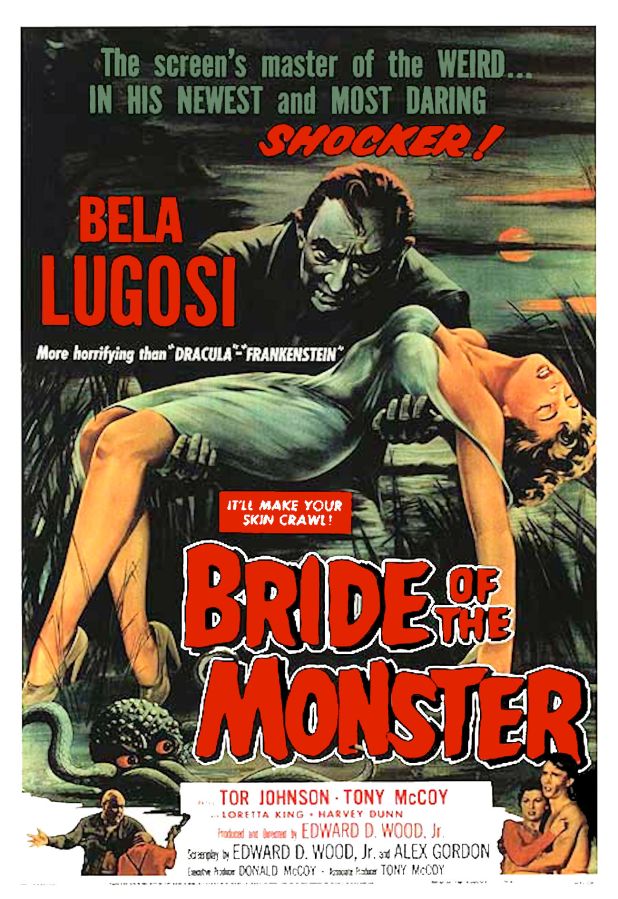
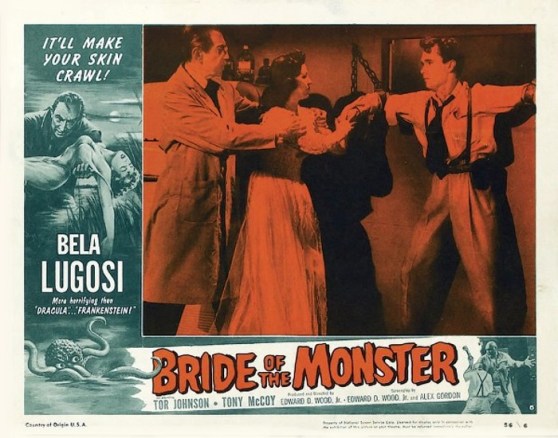
CHILLER THEATER MONTH: Bride of the Monster (1955)

EDITOR’S NOTE: Bride of the Monster was on Chiller Theater on Saturday, February 12, 1966 at 11:20 p.m., Saturday, March 24, 1973 at 11:30 p.m., Saturday, February 1, 1975 at 11:30 p.m., Saturday, October 4, 1975 at 1:00 a.m. and Saturday, August 12, 1978 at 11:30 p.m.

Two psychotronic film experiences shaped my early love of discovering strange movies.

HBO showed It Came from Hollywood, a movie written by Dana Olsen (Wacko, The ‘Burbs) and directed by Malcolm Leo and Andrew Solt. It’s packed with clips of all manner of strange films, as well as wraparound segments hosted by Dan Aykroyd, John Candy, Gilda Radner, Cheech Marin and Tommy Chong.

So many of the films featured as clips in this movie — trust me, in the early 80’s we couldn’t even afford a VCR, so the opportunity to see any of these movies depended on the whims of what movies would show up on UHF channels — include many films that would impact my life, such as Glen or GlendaRobot MonsterCreature from the Black LagoonThe Violent YearsDragstrip GirlThe Amazing Colossal ManPlan 9 From Outer SpaceThe TinglerThe Incredibly Strange Creatures Who Stopped Living and Became Mixed-Up Zombies, Son of GodzillaA*P*E*The Incredible Melting Man and so many more. Note that many of these movies belong to Ed Wood. We’ll get back to him in a second.

Writers Harry and Michael Medved worked as consultants on this film, which leads me to the next experience: their books. I was gifted these by my uncle, who recognized my love of horror movies and would use his job as a librarian to find me books to read about the movies that I loved so much, such as the legendary orange cover hardback Crestwood Monsters series.

Again, in the pre-internet days, writers like the Medveds were the only ones who you could find writing about strange movies and most of what they said about them colored the perceptions that people will always have. In fact, in the first of their books, the aforementioned The Golden Turkey Awards, they voted Ed Wood as the worst director of all time. The worst film, as written in by their readers, was his Plan 9 From Outer Space (the runner-up was another of my favorites that the world hates, Exorcist II: The Heretic).

The second book, The Fifty Worst Films of All Time, contains many films that I’d also grow to love for their own merits that the rest of the world seemed to ignore, such as Airport 1975Bring Me the Head of Alfredo Garcia!Godzilla vs. the Smog MonsterThe Horror of Party BeachJonathan Livingston SeagullThe Last MovieThe Story of Mankind and Valley of the Dolls.

As I read these books, I started to realize that perhaps the Medveds didn’t know everything about movies. When Michael Medved and Jeffrey Lyons replaced Siskel and Ebert on Sneak Previews in 1984, I realized that my suspicions were correct. That’s when I started re-evaluating these films.

That’s when I learned that Ed Wood was pretty great.

Bride of the Monster is considered to have the biggest budget that Wood ever enjoyed — $70,000 or $678,000 in today’s cash. That money came from a rancher named Donald McCoy, who became the film’s de facto producer. He had two demands: his son Tony would play the film’s hero, Lieutenant Dick Craig. And the movie had to end with an atomic explosion.

The final film, which originally premiered under the title Bride of the Atom, was released through a deal with Samuel Z. Arkoff, who made more money off the movie than Wood. Enough, in fact, to fund American-International Pictures.

This movie would also mark the final speaking role for Bela Lugosi. It’s nearly a sequel to The Corpse Vanishes and finds Lugosi recreating the hypnotic stare that he’d used in previous movies like Dracula and White Zombie.

The Golden Turkey Awards claims that Lugosi’s failing health/mental faculties — or Wood’s incompetence as a director — led to him telling the Lobo character that he is “as harmless as a kitchen.” The truth is that Lugosi says the line correctly: “Don’t be afraid of Lobo; he’s as gentle as a kitten.” Sadly, again, the Medveds’ version of reality is what has stuck with us.

Bela’s speech in this movie reveals the darkness and pathos in his soul. I’m always reminded of it and how it must have felt to recite: “Home? I have no home. Hunted, despised, living like an animal! The jungle is my home. But I will show the world that I can be its master! I will perfect my own race of people. A race of atomic supermen which will conquer the world!”

The film begins in the woods, where two hunters try to hide from a rainstorm in the Willows House, where Dr. Eric Vornoff uses an octopus — urban legend states that it was stolen from the Republic Pictures lot and the John Wayne film Wake of the Red Witch — and his manservant Lobo (former pro wrestler Tor Johnson) to kill both of them. Well, after he experiments on one of them, of course.

We cut to a police station, where the police discuss twelve recent murders that all feel connected. This is also the opportunity to meet our heroes: Captain Tom Robbins (Harvey B. Dunn, Teenagers from Outer Space), Lieutenant Dick Craig (the son of the producer, as mentioned earlier), Janet Lawton (Loretta King; according to actress Dolores Fuller, who usually had the lead in Wood’s films, she offered to help finance the movie if given this role. However, Loretta denied this.) and Professor Vladimir Strowski. In this scene, there are also cameos by a drunk (Ben Frommer, who was Count Bloodcount in Transylvania 6-5000) and a newspaper seller (William Benedict, Whitey of The Bowery Boys).

Janet decides to take off for the house herself to investigate and is soon captured and transformed into, well, a Bride of the Monster. It takes Lobo — who ends up having a heart — to stop the experiments and sham marriage, allowing our heroine to escape and Lugosi’s character to gain superhuman atomic powers, powers that end up finding him battling that octopus, his home being destroyed by a strike of lightning and a nuclear blast wiping him off the face of the Earth.

After all, as the movie reminds us, he “tampered in God’s domain.”

Paul Marco shows up in this film as a goofball cop named Kelton. He’d play the same role in Plan 9 from Outer Space and Bride of the Monster‘s spiritual sequel, Night of the Ghouls. Thought to be a lost film until Ed Wood fan Wade Williams discovered that the film was sitting in a lab, held hostage due to its bills never being paid. It was released to home video in 1984 and also has Johnson returning as Lobo. Johnson would also play a character with the same name in The Unearthly.

You can watch this on Tubi.

CHILLER THEATER: Count Dracula (1970)

EDITOR’S NOTE: Count Dracula was on Chiller Theater on Saturday, June 1, 1974 at 11:30 p.m., Saturday, March 8, 1975 at 11:30 p.m., Saturday, November 1, 1975 at 11:30 p.m., Saturday, January 7, 1978 at 11:30 p.m. and Saturday, August 26, 1978 at 11:30 p.m. I am beyond happy that yinzers would turn on Chilly Billy and be attacked by a Jess Franco movie.

After years of being in Hammer Dracula movies, Christopher Lee starred in this Harry Alan Towers produced, Jess Franco directed version of Bram Stoker’s novel.

There’s a great cast and by that, I mean the kind of cast that I look for in movies. Klaus Kinski, (before he played Dracula in Nosferatu the Vampyre and Nosferatu In Venice) is Renfield, Herbert Lom is Van Helsing, Frederick Williams (A Bridge Too Far) is Jonathan Harker, Maria Rohn (Venus In Furs) is Maria, Paul Muller is Jack Seward, Jack Taylor is Quincey Morris (he had vampire hunting experience after being in the Mexican Nostradamus films) and Soledad Miranda — and who else, really? — is Lucy.

This could have had an even wilder cast, as both Vincent Price — sadly under his American-International Picture exclusive contract — and Dennis Price were both selected to play Val Helsing.

At the same time that this was being made, so was Cuadecuc, vampire, which was shot on the same sets with the same actors by the experimental director — and a senator elected in Spain’s first democratic elections who participated in the writing of the Spanish Constitution — Pere Portabella.

As for Franco’s film, it’s one of the first attempts at being faithful to the novel, with Dracula starting as an old man and gradually gaining in vitality as the movie goes on. Lee* was supposedly tired of playing Dracula and was only convinced to join the cast only after being promised that this movie would be faithful to Stoker. It still plays fast and loose; oddly enough Towers has claimed he tricked Kinski into being in this with a fake script. Franco has said that that wasn’t true, but what was is that Kinski ate real flies.

I wouldn’t expect the Franco madness that most associate with him, but this is the first extended time he’d work with Miranda before the films they’d be known for making together (she was an uncredited dancer at just eight years old in Franco’s Queen of the Tabarin Club). But there’s a great Bruno Nicolai score, Lee is super into everything he’s doing, the sparse sets work and Bruno Mattei was one of the editors.

There’s always been a contingent of people who claim this movie is boring, but look, any movie with Soledad Miranda in it is worthwhile.

You can watch this on Tubi.

*To be fair, Lee played the role three other times in 1970: in One More TimeTaste the Blood of Dracula and Scars of Dracula.