POPCORN FRIGHTS 2023: The Texas Chainsaw Massacre (1974)

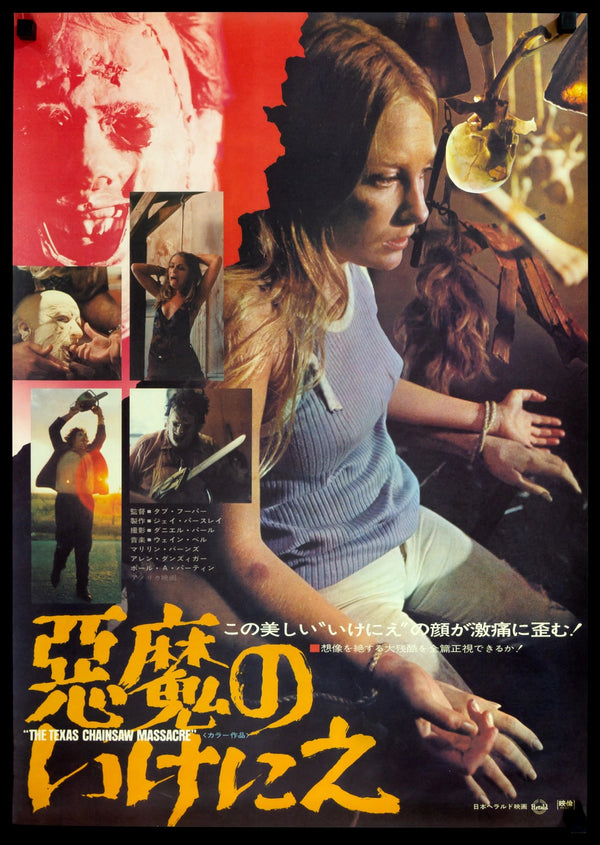
The Texas Chainsaw Massacre is not a movie. It is a force of nature. Where Night of the Living Dead took 1960s horror past giant monsters and gothic monsters into modern concerns within the conceit of zombies. This film doesn’t need to exist within the supernatural. In fact, it’s so outside the realm of the unreal that so many people think it’s based on a real story. Or even is a real film, years before movies like The Blair Witch Project tried to pull stunts like that.

The real stunt of this movie is that it was made in the first place. Filmed in an early 1900s farmhouse in Round Rock, Texas on a small budget, the crew shot the film seven days a week, 16 hours a day, with temperatures that reached 110° F. Gunnar Hansen, who played Leatherface, was really a poet. A poet wearing a dead skin mask for 16 hours a day for over twenty-five days straight. 

The house was filled with real animal remains, animal blood from a local slaughterhouse and furniture made from animal bones. As you can imagine, keeping all these dead things trapped within a poorly ventilated house led to conditions which were anything but fair to the actors.

Director Tobe Hooper envisioned this film as a PG-rated film, so he made each cut work so that you never see any of the actual carnage. But it backfired — as a result, the film’s entire feel is one of brutality. It’s actually hard to watch unless you properly prepare yourself for it.

“The film which you are about to see is an account of the tragedy which befell a group of five youths, in particular, Sally Hardesty and her invalid brother, Franklin.” That opening dialogue, by future sitcom actor John Larroquette for the price of a joint, suggests that the film you are about to watch is true. While it has some basis in the stories of Ed Gein and Elmer Wayne Henley, there never really was a Texas Chainsaw Massacre. It was invented by Hooper and writer Kim Henkel. Yet there’s always someone willing to convince you that there was.

It’s actually a pretty simple film. A vanful of hippies comes face to face with a cannibal clan who are being forced out of their way of life by industrialized improvements to the meat processing industry. Despite their astrology, peace and love, they are utterly annihilated and even the strongest of them is driven insane by the end.

The Texas Chainsaw Massacre is a film that ignores the rules of the hero’s journey and characters needing to undergo some personal growth. Everyone is lucky if they survive and even the villains and heroes that do won’t make it for long. Modern highways will push their way into the backwoods. Police procedures will improve. And the only work this clan will have is just trying to keep their way of life alive.

You can see the bloody influence of this film on nearly every horror film that came in its wake. Hell, Rob Zombie has made an entire career out of trying to remake something a tenth this good. This is a film that oozes malevolence and ill will from the very moment it begins to play.

I’m always struck by the fact that hardly anyone involved ever made their money back. The film’s original distributor was Bryanston Distribution Company, which turned out to be a Mafia front operated by Louis “Butchie” Peraino, who used Chainsaw to launder money that he had made from Deep Throat. The investors did make their money back, but the crew only made $405 each, scant pay for the hell on Earth they went through (Edwin Neal, the Hitchhiker, claimed that this film was more miserable than being in Vietnam and he’d wanted to kill Hooper for some time). After an arrest for obscenity, the cast and crew filed suit against Peraino and were awarded $25,000 each, which came from new owners New Line Cinema.

There’s a sequel to this film which exists in its own universe. I love that it’s everything that this movie isn’t. It’s a middle finger to expectations and ends with a final shot that is at least the equal of this film.

The Texas Chainsaw Massacre is part of the Popcorn Frights Film Festival. You can get a virtual pass to watch the festival from August 10 to 20. To learn more, visit the official site. To keep track of what movies I’ve watched from this Popcorn Frights, check out this Letterboxd list.

THE FILMS OF COFFIN JOE: Awakening of the Beast (1970)

José Mojica Marins directed movies for six years before making At Midnight I’ll Take Your Soul, the first appearance of Brazil’s national boogeyman, Zé do Caixão, or Coffin Joe.

Joe is a man with no morals but a devotion to Nietzschian philosophies and absolute hatred for religion with the goal of achieving immortality through the birth of a perfect son. And while he does not believe in the supernatural, he often finds himself walking through visions of the otherworld.

Coffin Joe came to Marins — the man who would often be referred to as the character interchangeably — in a very magic way. “In a dream saw a figure dragging me to a cemetery. Soon he left me in front of a headstone, there were two dates of my birth and my death. People at home were very frightened, called a priest because they thought I was possessed. I woke up screaming, and at that time decided to do a movie unlike anything I had done. He was born at that moment the character would become a legend: Coffin Joe. The character began to take shape in my mind and in my life. The cemetery gave me the name, completed the costume of Joe the cover of voodoo and black hat, which was the symbol of a classic brand of cigarettes. He would be a mortician.”

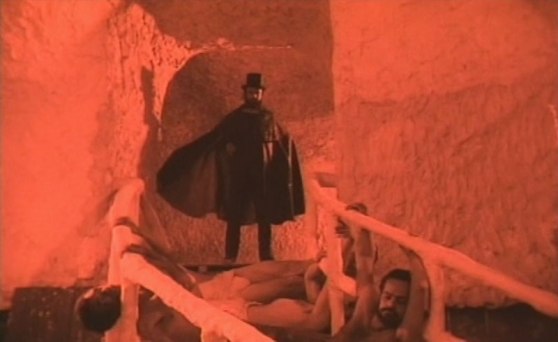
Awakening of the Beast begins in black and white, as a series of vignettes of the ways that drug users debase themselves are shown in lurid, sweaty detail. A TV panel debates the idea that sexual perversion is caused by the use of illegal drugs, with more stories that illustrate this point. The TV show needs an expert on depravity, so they ask Marins to appear on the show.

Afterward, the doctor who conducted the experiment doses four volunteers and asks for them to stare at a poster of The Strange World of Coffin Joe. Supposedly Marins didn’t know much about using drugs, but he intended this movie to speak against the fact that the uses of drugs are treated worse than the suppliers and that the Brazilian film industry saw him as no better than a long-nailed drug dealer.

The acid trip that follows is highlighted by Coffin Joe, ranting against anyone and everyone. Of course, this film was banned by the very establishment it rails against. So basically, Coffin Joe is a self-fulfilling prophecy; the maniac attacking belief structures created by an artist who only believes in the power of film.

“My world is strange, but it’s worthy to all those who want to accept it, and never corrupt as some want to portray it. Because it’s made up, my friend, of strange people, though none are stranger than you!”

CBS LATE MOVIE MONTH: Kolchak: The Night Stalker: The Devil’s Platform (1974)

EDITOR’S NOTE: This episode of Kolchak: The Night Stalker aired on the CBS Late Movie on September 14, 1979; July 3, 1981 and February 5, 1988.

Carl Kolchak starts this episode with these sage words: “The old cliche that politics makes strange bedfellows is only too true. At one time or another, various and sundry politicians have found themselves, when it proved expedient, of course, sharing a blanket with the military, organized crime, disgruntled, gun-toting dairy farmers, the church, famous athletes, the comedians – the list is endless. But there was a senatorial race not so long ago right here in Illinois where the strangest bedfellow of all was found under the sheets. The strangest… and certainly the most terrifying.”

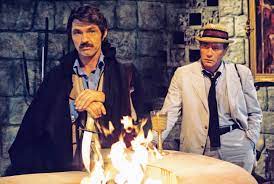
Our intrepid reporter, Kolchak, is on a mission to interview the enigmatic Senatorial candidate, Robert Palmer (Tom Skerritt). Palmer, a man seemingly always a step ahead of his opponents, who mysteriously meet their end, is shrouded in scandal. As Kolchak delves deeper, the suspense thickens, and the truth becomes more elusive.

At every one of these deaths, a large dog has been seen. Well, you don’t have to have the investigative skills of Kolchak to figure out that Palmer has sold his soul to Satan for power on Earth, a contract that his wife Lorraine (Ellen Weston) wants him to escape.

Palmer, in an attempt to divert Kolchak’s attention, offers him a contract. But Kolchak’s motivations are not driven by money or escape. He seeks a larger audience and a semblance of respectability. Yet, he is acutely aware that without his investigative work, these aspirations are meaningless. And now, the looming threat of the large dog adds to his moral dilemma.

“The Devil’s Platform,” one of four episodes directed by Allen Baron, is a testament to the mature storytelling of the series. Penned by TV-writing veterans Donn Mullally and Tim Maschler, this episode elevates the narrative to a level where even the Watergate scandal pales in comparison to the entry of Lucifer into the world of politics.

There’s an IMDB fact that Devil Dog: Hound of Hell was originally a sequel to this. That sounds like the kind of BS that lives in the IMDB trivia pages, but it would be nice if it were true.

Sources

Let’s Get Out Of Here!: 31 Days of Monsters!. https://craiglgooh.blogspot.com/2010/10/31-days-of-monsters.html

CBS LATE MOVIE MONTH starts now!

The CBS Late Movie — also known as CBS Late Night and Crimetime After Primetime — started on February 14, 1972. Late nights were still new for the Tiffany Network, as many of their stations were playing old movies after the news, but affiliates started to discover that there were less and less new movies available.

Those stations wanted something new.  A 1966 poll revealed that approximately 80% wanted a late evening entertainment show Mondays through Friday, just like NBC’s The Tonight Show. Starting in 1969, they gave Merv Griffin a late night show but his syndicated ratings didn’t come over to late night and he couldn’t compete with Johnny Carson.

With the CBS Late Movie, the network committed to providing classic feature films as well as the debut of more recent theatrical fare. By the second month of this strategy, they were drawing better ratings than Carson, at least for a short time.

In a reality without VCRs, much less streaming movies, the CBS Late Movie — which ran from 11:30 P.M. to 2:30 A.M. — provided an eclectic mix of newer films, made for TV movies, pilots that weren’t bought, collected episodes of canceled shows, episodes of popular shows and some strange films that otherwise may have never aired on TV.

The first run of movies came from a new package of MGM films that had not been previously televised, as well as packages of 1950s Warner Bros. and MGM films that had been run only on local and independent stations but never on a network. In the first two weeks, eight of the ten movies were world television premieres.

Starting in 1976, back-to-back reruns of different one-hour television series started. This was my first chance to see Kolchak, The Night Stalker on TV, as well as British shows like The New Avengers and Return of the Saint and Canadian shows like Night HeatHot ShotsAdderely and Diamonds. When ABC canceled T.J. Hooker, the show appeared in late night with new episodes and even a TV movie.  There were also original shows like Beyond the Screen and an American version of Top of the Pops.

The Pat Sajak Show took over the timeslot in 1989 and by that point, most stations would show syndicated programming. Eventually, David Letterman would come to CBS and take over the late night programming. There was the 1991 Crimetime After Primetime block, CBS Summer Showcase in 2015 and even a period where there was original late night programming including The Kids in the Hall along with re-airings of The Prisoner.

Much of what I love of pop culture comes from summer nights watching the CBS Late Movie with my dad. I can vividly recall so many films and episodes of Kolchak. I’d plan for what was coming with my TV Guide and can remember one time that we watched the first segment of an episode of Kolchak and were able to get hot dogs and be back home by the end of the never-ending commercial breaks. The first one would often end by almost 12:30 A.M. for a show that started at 11:30 P.M.

All this month, I’ll be spotlighting movies that aired on CBS when everyone else was asleep. You can see the entire list on Letterboxd and if you’d like to contribute, I’d be honored.

Sources

Wikipedia: The CBS Late Movie

Retro Junk: The CBS Late Movie

ARROW BOX SET RELEASE: Enter the Video Store – Empire of Screams: Arena (1989)

Somewhere in the galaxy, there’s a space station that seemingly is the Catskills, complete with burlesque, boxing and even a diner. That’s where Steve Armstrong (Paul Satterfield, who was eaten by “The Raft” in Creepshow 2) works as a short order cook along with the multiple-armed Shorty (Hamilton Camp), who seemingly knows everyone and lives deep within the lower regions of the station. After he knocks out an unruly customer — an alien gladiator named Vang — they get fired. A fight manager named Quinn (Claudia Christian, Maniac Cop 2) can’t believe that a human didn’t just last with one of the aliens but even defeat them. He doesn’t want to fight but once he and Shorty get busted stealing from a casino by manager Rogor (Marc Alaimo) and Weezil (Armin Shimerman). They keep Shorty for ransom, so Steve has to go to Quinn and enter the arena.

After defeating Sloth, Steve starts his road to the top, a lot like the original Body and Soul. The humans on the space station start to believe in themselves as a result — like the last human arena champion, Marcus Diablo, who is played by former Dick Malloy Agent 077 Ken Clark in his last role — and Rogor decides to ruin it all. He gets Jade (Shari Shattuck, Desert Warrior) to seduce and poison him the night before he’s due to battle the champion, the monstrous Horn. Can he win the big fight?

This is the kind of movie that dazzles you with how many effects it can pack in for no budget whatsoever. You’ve got John Carl Buechler on special makeup effects, along with Jeffrey S. Farley, Bruce Barlow and Scott Coulter. Plus, the special effects crew had Renato Agostini leading the Rome crew, Screaming Mad George and his team (Ron Goldstein, Adam Hill, Bill Sturgeon, Steve Wang, Shimpei Kitamura, Mike Le Vitry and Marc Lynn), Michael Deak (who is inside nearly every monster costume), Mike Elizalde, Patrick Simmons and David Stipes. The movie is incredible not just because of the story and actors; these guys made the film with their creativity on a small budget.

Director Peter Manoogian was the first assistant director on The SeductionParasiteThe SlayerGalaxy of Terror and Metalstorm: The Destruction of Jared-Syn before directing Enemy TerritoryDemonic Toys and Eliminators. The writers were Danny Bilson and Paul De Meo, who wrote TrancersZone TroopersThe Rocketeer and The Flash 90s TV series.

How can you not love a movie that uses a Marx Brothers reference, as the speakeasy’s password — swordfish — is the same as their movie Horse Feathers? The idea that there’s a floating boxing arena in space with bars, fast food and fights — this is so Deep Space Nine that Marc Alaimo and Armin Shimerman would go on to play Dukat and Quark, so Babylon 5 that Claudia Christian would play Commander Susan Ivanova — and humans live in the slums is so rich with potential that I’m shocked that more people aren’t wild about this movie and sad that there was only one of these films.

Robot Jox is part of the Enter the Video Store — Empire of Screams box set. Extras include new audio commentary with director Peter Manoogian, moderated by film critics Matty Budrewicz and Dave Wain from The Schlock Pit, an alternative full frame presentation, new interviews with co-screenwriter Danny Bilson — who comes off as honestly pretty conceited and discusses a bottom of the barrel poster he saw in an Italian film office for a movie he calls I Eat My Own Guts which is obviously Antropophagus — and special make-up effects artist Michael Deak — who comes off as exactly the opposite and is a delight as he discusses meeting with Joe D’Amato and working in Italy — as well as a trailer and an image gallery. You can get this from MVD.

Junesploitation: The Wild Beasts (1984)

June 13: Junesploitation’s topic of the day — as suggested by F This Movie— is Animals! We’re excited to tackle a different genre every day, so check back and see what’s next.

There are a lot of people who reckon with the art versus artist and worlds of troubling media all the time. Like, well, me. Because if you watch a lot of Italian cinema eventually you will come across a very casual — one would say cruel — attitude about the way animals are treated in their exploitation cinema. From the way horses are thrown around in their Westerns to mondo and cannibal films that are outright celebrations of butchery, Italian cinema can test one’s love of nature. Then again, you go and eat processed meat for dinner and enable an incredibly more brutal industry, so perhaps we all have something to atone for.

Regardless, the first time I watched The Wild Beasts, I made it as far as the credits, where a horse’s parts — including its head and out of mouth tongue — are cut to pieces on camera and served to several wild cats. It jarred me so much that I just couldn’t deal with anything after.

Years later, I feel that my explorations into the dark heart of the cinema of my home country have scarred me to feelings like this. After all, this movie was directed by Franco E. Prosperi, who was part of the team with Gualtiero Jacopetti that popularized the mondo genre. The only fictional movie that Prosperi ever made, Wild Beasts is a rough watch but in no way as senses destroying as the other movies Prosperi had a hand in making, such as the two Mondo Cane films, Africa Blood and Guts or perhaps the most upsetting movie I’ve ever endured, Goodbye Uncle Tom.

But he’s going to try.

There have been ecohorror movies before and animal attacks shared as horror. But when you hear “Italian animal attack movie,” you worry that you just might not be able to deal with what you get.

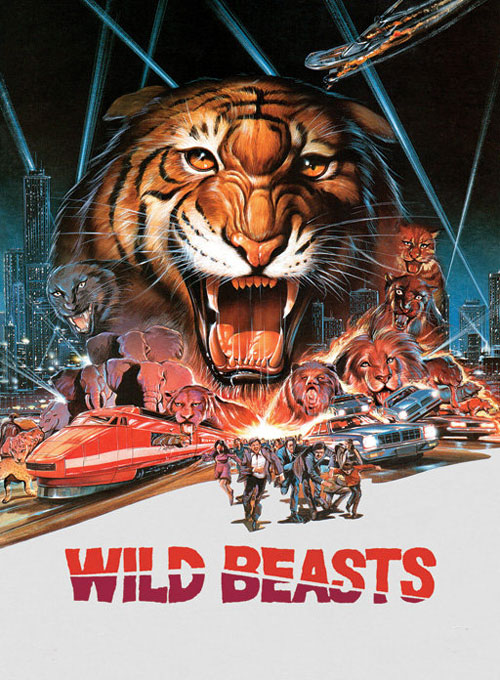
Wild Beasts starts with what we Italian film lovers affectionately refer to as bullshit science. PCP has been released in the water supply of Frankfort and is mostly concentrated in the zoo. That means that every animal there that drinks water has found itself in a severe psychotic state where they feel no pain, experience time differently and are floating in a haze. They also have decided that this is when humanity must pay, like Day of the Animals but way, way worse.

This would be a big problem already, but then there’s also the issue of the new computerized security system at the zoo. Of course it fails, because technology always fails in animal attack movies. And even if it didn’t, the elephants have lost their minds and rampage through a wall, unleashing an entire jungle of apex predators into the streets where they’re free to shred people into the same kind of meat as that horse. Now, I cheer that on while the horse bothers me, but I also know that for the most part, the stunts didn’t scar people for life or kill anyone. This wasn’t Roar, a movie where every single member of the cast and crew was nearly killed and Melanie Griffith was scalped.

The movie also begins with a quote from Francis Thrive that says “Our madness engulfs everything and infects innocent victims such as children or animals.” Again, if you’ve watched enough Italian genre movies, you start to understand that their creators have a propensity to not only make up quotes, they even make up authors. This high minded introduction to a low minded movie doesn’t come from some great philosopher. Francis Thrive is Franco E. Prosperi. Thanks for confirming my suspicions, Bleeding Skull.

From here on lies animal madness. After a short setup — we meet zoologist Dr. Rupert Berner (Antonio Di Leo) as he works with the big cats he meets reporter Laura Schwarz (Lorraine De Selle, who really endured the worse of Italy’s excesses in movies like Cannibal FeroxEmanuelle in AmericaViolence in a Women’s Prison and its sister film Women’s Prison MassacreHouse On the Edge of the Park, the Joe Dallesandro-starring Madness and S. S. Extermination Camp), a mother that obviously hates her deranged daughter Suzy (Louisa Lloyd) who keeps calling her and making noises on the phone with her frog puppet. How much does she despise her child? A line of dialogue in this movie is “Children are extraterrestrials that come from outer space to destroy their parents.”

From here on out, all is lost. A couple batter-dipping the corn dog in the back of a car are swarmed by rats — which also destroy a cat and in no way does that scene seem fake — and killed. The only way to stop these rats is with flamethrowers and yes, this being Italian cinema, I believed that every rat set ablaze and stomped was real, just like in Rats: The Night of Terror, the only film I’ve seen that equal this level of human on rat and rat on human trauma.

Yet the animal wilding is not done yet. No, a cheetah runs wild through the streets — this is set up to look like perhaps Seattle at times and says its Frankfort and a “northern European city” but it’s really Rome and Hamburg — as an entire army of animals stampedes down the empty shopping districts in near surreal moments. The cheetah catches up to a woman in a Volkswagen bug which leads to this line of what should be award-winning writing:

Inspector Nat Braun: Is she out of her mind?

Dr. Rupert Berner: No she’s not crazy, she’s being chased by a cheetah!

The woman slams into another car and is burned up to the point that she looks like she’s possessed. These two learned men just pick her limp body up and throw it in the back of their car while the cheetah keeps running about, joined by hyenas that attack a slaughterhouse — yes, that’s really a pig being destroyed and you may wonder, “Well, it was going to get sliced up by humans,” but do you need to justify this any more? — and elephants stomp an airplane to pieces and a tiger gets loose inside a subway car.

Here’s where you can cheer, as an elephant stepped on Prosperi’s foot during the filming of the airport sequence. And the tiger got loose in the subway station and hid in a bathroom before deciding to go on top of a train. And Di Leo was nearly decapitated by the polar bear that wanders through the hallways of a school. Anything for art, right? Or sleaze.

Remember that ballet school? The place where Laura is supposed to get her daughter? Well, all the kids drank the water and little Tommy has already killed his teacher with a hatchet and is asking who wants to play his favorite game with him called Playing Dead.

If you’ve made it through these thousand words and said, “This sounds more like a mondo than a narrative movie,” you’re right. It’s a collection of moments set to knock your brain out of your skull. This is also a disaster movie that spends all of a minute setting up the human drama and then deciding that none of those issues need resolution and instead, know that we came here to watch people get torn to bloody pieces. It delivers.

It’s also a movie that remembers how wild it gets when Dickie attacks Emily at the end of The Beyond and gives us a scene where a dog bites the hand that feeds of its blind owner while he’s trying to listen to classical music.

I love that after building the tension for an entire movie, it ends with type on the screen saying that everything is alright. Or is it?

Also this movie is the worst — or best, honestly — of exploitation because it has this message about animals and why they’re important and then it destroys them. Some folks claim this has a disclaimer that no animals were injured in the making of this movie, but we all know that that is outright bullshit. I mean, Prosperi and Jacopetti may have flown a time travel helicopter to share a message about America’s slavery past — but really Goodbye Uncle Tom was shot using the real slaves of Haitian dictator Papa Doc Duvalier.

It’s hard to give a trigger warning when this whole movie is a giant gun pointing directly at your face.

From Parrots to Elephants: Worldwide Animal Rescues (2020)

I’m a big fan of the films of Cybela Clare. Either you’re going to get a movie about horrific alien hybrid and human conspiracies, how we have to take care of animals or one about how we have to take care of animals and battle the aliens that are trying to take over our world.

The first movie of hers that I saw was Bird’s Eye View – An ET’s Solution for Humanity, which I described as a spy adventure as well as a real-life version of Footprints on the Moon with no Klaus Kinski to abuse our heroine.

This one is just a lot simpler.

It’s just about animals.

From Thailand to Brazil and across North America, Cybela meets caretakers who rescue and rehabilitate animals, who in turn give them back love. You’ll watch her bathe with elephants and dance with them, as well as meet rescued farm animals and even a bald eagle named Freedom.

I was waiting for the reveal of Draconians behind all of this, but it never comes. No, this is an incredibly relaxing journey along with Cybela. Not into a world where black pyramids lie in horrifying wait below Alaska, but one where cute animals need her help.

That said, it does take place in the same universe where Cybela was abducted as a child and lost her bird Spooky.

You can watch this on Tubi.

88 FILMS BLU RAY SET RELEASE: In the Line of Duty AKA Yes, Madam (1985)

After Inspector Ng (Michelle Yeoh) stops a gang from robbing an armored car, she learns that an assassin has killed a man who ends up being her boyfriend, Westerner Richard Nornen. As he lay dying, two pickpockets had gone through his belongings and taken what he died for, a secret microfilm that has info on all of the major gangs in Hong Kong. This brings in Scotland Yard’s Carrie Morris (Cynthia Rothrock) to find that microfilm — I love movies based on hidden microfilm, I must confess — and the two female cops take down the crooks in spectacular fights as their rivalry gives way to grudging respect.

This was Rothrock’s first film and it doesn’t show at all. While working as part of a martial arts demonstration team, Inside Kung Fu that team seeking a new male lead. Even though only one role was mentioned, the team brought their female fighters and the studio was so impressed with Rothrock that they rewrote the film for her. She was surprised as she thought this was going to be a period film and not a modern cop movie.

It’s also an early starring role for Yeoh, who was credited as Michelle Khan. Her first acting work was in a television commercial for Guy Laroche watches. She was told that it was with an actor named Sing Long. She didn’t speak Cantonese, so she had no idea that that was Jackie Chan. She appeared in The Owl vs Bombo and Twinkle, Twinkle, Lucky Stars before this; afterward, she was in Royal Warriors, Magnificent Warriors and Easy Money before her retirement, as she married Dickson Poon, who was the D in the D&B Group that made this movie. She’d come back in 1992 after her divorce for the incredible Police Story 3Super Cop. Today, thirty years later, she’s one of the biggest stars anywhere in the world.

I think it’s kind of amazing how much of the score of Halloween shows up in this movie, almost a prophecy that one day, Yeoh and Jamie Lee Curtis would have to battle in Everything Everywhere All At Once.

88 Films’ In the Line of Duty Series includes 1985’s Yes, Madam!, 1986’s Royal Warriors, 1988’s In the Line of Duty 3 and 1989’s In the Line of Duty 4. This film is available in Cantonese and two different English dubs and extras like new subtitles, commentary by Jong Kong film expert Frank Djeng, an interview with Cynthia Rothrock, select scene commentary with Cynthia Rothrock and Frank Djeng, interviews with Men Hoi and Michelle Yeoh, an archive Battling Babes feature and a trailer. There’s also a gorgeous book and posters for each movie. You can buy the set from MVD.

APRIL MOVIE THON 2: Koyaanisqatsi (1982)

April 27: Until You Call on the Dark — Pick a movie from the approved movies list of the Church of Satan. Here’s the list.

The first movie in Godfrey Reggio’s Qatsi trilogy — followed by Powaqqatsi and Naqoyqatsi — this combines Ron Fricke’s cinematography and Philip Glass’s score to create a feeling of zen or restlessness, depending on how it is viewed. There are no words as Reggio said, “…it’s not for lack of love of the language that these films have no words. It’s because, from my point of view, our language is in a state of vast humiliation. It no longer describes the world in which we live.” Instead, the Hopi word koyaanisqatsi is all we know, which means “life out of balance.”

Reggio and Fricke met when the director was working on a media campaign for the Institute for Regional Education and the American Civil Liberties Union. These ads were about how technology controls the world and invades our privacy. The TV spots were so popular people called stations to see when they would air again; it was also successful in that it got ritalin eliminated as a behavior controlling drug in New Mexico schools. Afterward, with just $40,000 left in his budget, Fricke told Reggio that they should make a film.

Shot with a mix of styles and media — 16mm, 35mm made with a 16 mm zoom lens shot onto 35 mm film with a zoom extender, time lapse photography, captured stills in New York’s Time Square with chemicals changing up the results, the New York traffic and congrestion time lapse work of cinematographer Hilary Harris and even images added of the Great Gallery at Horseshoe Canyon by Francis Ford Coppola, who became a champion of the movie —  Koyaanisqatsi is about giving you an experience. The director has even said that what the movie is about is up to you. It ends with these three prophecies:

  • “If we dig precious things from the land, we will invite disaster.”
  • “Near the day of Purification, there will be cobwebs spun back and forth in the sky.”
  • “A container of ashes might one day be thrown from the sky, which could burn the land and boil the oceans.”

In the Live Journal of Rev. Warlock DRACONIS BLACKTHORNE, he says of this work, “Koyaanisqatsi is certainly a Satanic meditation, which would prove beneficial after any interaction with the herd, a veritable “eye in the sky” – asserts the “larger picture”, as it were.”

The Church of Satan film list says, “Satanic elements include a misanthropic contempt for Humanity, the Command to Look, and The Balance Factor.”

The ultimate rejection of herd mentality lies within this film, as it invites you to create a meaning that only has one owner. You.

You can watch this on Tubi.

10TH ANNUAL OLD SCHOOL KUNG FU FEST: The Bravest Revenge (1970)

The second movie in The Swordsman of All Swordsmen trilogy, this is about Shi Fang Yi (Polly Shang-kuan) and her family, who work to avenge the murder of her father at the hands of Chau Mutien (Yi Yuan). They spend five years under five masters and Hsih Fung Yi becomes the mistress of the double daggers, her older brother is a swordfighter, the middle brother can walk on water and fights with a chain, and the youngest brother can put his fingers through rocks and catch knives right out of the air.

Still, even with those skills they aren’t good enough. They need Tsia Ying-chieh (Tien Peng) to help them.

I mean, when the bad guy has a sword that can reflect the sun into your eyes, you need all the help you can get.

Directed by Chien Lung, this has Chau Mutien kill around fifty cops when he’s just trying to enjoy a brothel and then the heroes go through several movies worth of henchmen one after the other. If you like movies with a big body count, this is ready to sate your lust for murderous wuxia magic.

Want to see it for yourself?

You can watch The Bravest Revenge online with Metrograph At Home. It’s part of the 10th Old School Kung Fu Fest: Sword Fighting Heroes Edition from April 21-30, 2023!

Tickets are on sale right here!