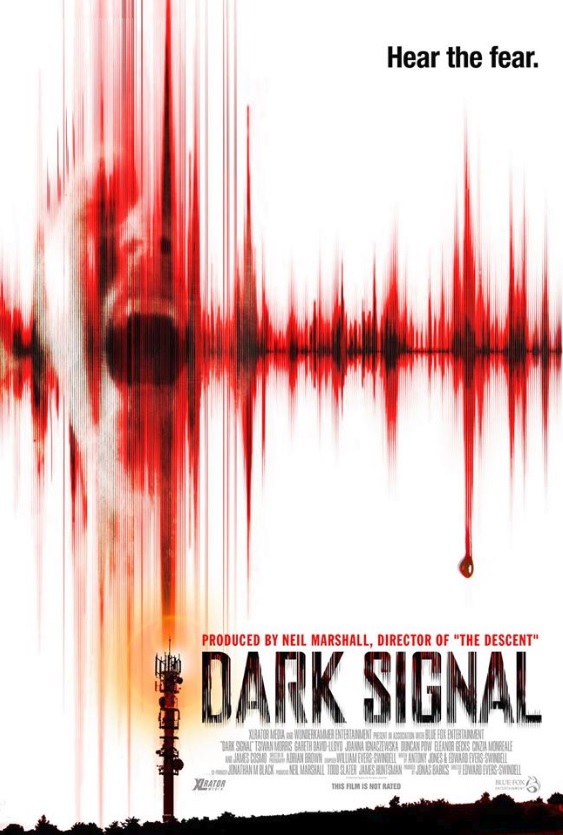
Dark Signal (2016)

The mountainous, remote wooded expanse of Snowdonia, North Wales, is terrorized by the Wedlock Killer. The savage and brutal attacks of five women share a common trait: their wedding ring fingers were removed by a bolt cutter. Luckily, Sarah, the next victim, was watching an expositional TV news report so we can learn this useful, bloody tidbit—and save it for later to season this story where The Shining meets The Ring—with a dash of Ju-On and a soupçon of 2005’s White Noise starring Michael Keaton.

Yep. There’s a ghost in the machine and a pseudo-giallo killer on the loose.
Watch the trailer.

After the first kill we’re introduced to the jaded, motorcycle riding and chain-smoking (ah “character development”) Laurie Wolf (Siwan Morris of Britain’s long-running Eastenders). She’s a DJ who can’t find a new gig in the wake of hosting her final show on the soon-to-be-closed down Radio JAB, a local station victimized by corporate network automation. Ben (Gareth David-Lloyd of Syfy Network’s Warehouse 13 and the BBC’s Doctor Who spin-off, Torchwood), Laurie’s producer, has on an online affair with Kate (excellent Polish actress Joanna Ignaczewska of 2014’s The Scopia Effect), a single mother dealing with a spiteful ex-husband. Kate’s financial desperation thrusts her into agreeing to be the getaway driver for a robbery planned by her dubious boyfriend Nick, who’s out to rob a “business associate”—in those very same remote woods.

Uh-oh.

When the car’s electrical system fails and the radio turns to static, Kate meets a bloody, long-haired ghost that haunts the woods: Kate’s about to be Yūrei’d.

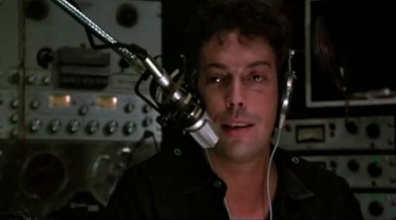
Now that’s a radio studio! On the air with Laurie Wolf on Radio JAB, the voice of Snowdonia, Wales.

Meanwhile, back on the final broadcast of the “Howl at the Moon” radio programme on Radio JAB, the divine Ms. Wolf and Ben decide that, as a final act of defiance against the station’s owners, they’ll break format and interview Carla Zaza, a questionable psychic (Cinzia Monreale of Dario Argento’s The Stendhal Syndrome and Lucio Fulci’s The Beyond) and hold an on-air séance.

A questionable psychic and a skeptical, bitchy chain-smoker who thinks it’s all fake?

Uh-oh.

Cue Sadako’s onryō-creeks n’ crackles and turn up the radio static: the bogus psychic made contact with the EVP (electronic voice phenomenon) spirit of Sarah, the last victim of the Wedlock Killer, who’s now using the airwaves of Radio JAB to extract her revenge.

Way to push that J-Horror angle, Mr. Distributor.

When watching this Wales-shot horror, as with any British, Scottish, or Australian-shot film, Dark Signal can be a hard watch due to the thick Welsh accents. Fortunately, TubiTV’s upload features a closed captioning feature so you can get the full enjoyment from this nicely-shot and acted debut feature from writer/director Edward Evers-Swindell.

Produced by Neil Marshall, the director behind Dark Soldiers (2002), The Descent (2005), Doomsday (2008), and Hellboy (2019), Marshall and Swindell will be back in theatres in 2020 with the Swindell-penned and Marshall-directed The Reckoning.

About the Author: You can read the music and film reviews of R.D Francis on Medium and learn more about his work on Facebook.

Radioland Murders (1994)

How much does a $15 million film about an early 1940’s radio station earn in box office? Less than a million and a half, that’s how much. And you thought Howard the Duck bombed? Not everything can be Star Wars, eh, Indy?

George Lucas conceived the idea for Radioland Murders during the writing of 1973’s American Graffiti as a homage/remake of the Abbott and Costello films of old, 1942’s Who Done It in particular, which had the screwball comedic duo solving a murder at a radio station. To whip the “who done it” script into shape, Lucas brought on American Graffiti’s husband and wife screenwriting team of Gloria Katz and Willard Huyck, who also worked on Indiana Jones and the Temple of Doom (1984) and Howard the Duck (1986) and, of course, they doctored Star Wars. Of course, we ‘80s video fringers and ‘70s Drive-In connoisseurs remember them best for their feature film debut, 1973’s Messiah of Evil (a movie so good, we reviewed it three times: HERE, HERE, and HERE).

For the roles of the estranged husband and wife radio team (Bud and Louella?) who become reluctant detectives to solve the murder of station owner General Walt Whalen on the inaugural night of WBN Chicago’s broadcast, Lucas cast Brian Benben from HBO’s “adult-themed” family-situation comedy Dream On (1990 —1996) and Mary Stuart Masterson, best known for her work in John Hughes’s Some Kind of Wonderful (1986). To say this retro radio romp killed both of their careers is an understatement. While Masterson pressed on with roles in several forgotten indie films, Radioland Murders proved to be Benben’s final film. Director Mel Smith never worked in mainstream Hollywood again and reverted back to British cinema. His most notably effort was Bean, the 1997 film version of the British series Mr. Bean, as well as 1985’s Morons from Outer Space, which he wrote and starred.

So, uh, is Radioland Murders funny? Is it “screwball” funny?

Nope. Not in the slightest. The Three Stooges, Abbott and Costello, Laurel and Hardy, even The Ritz Brothers and Dean Martin and Jerry Lewis are of a time and place. And when we want to go there, we want to see the originals—and nobody is clamoring to see Brian Benben as the lead in a feature film, let alone a send up of a 1930s “who done it” comedy. It makes you wonder how the movie would have turned out if Steve Martin and Cindy Williams starred as the leads as originally planned. . . .

Rounding out the cast is a who’s who of familiar character actors with Ned Beatty (Superman ’78), Michael Lerner (Roland Emmerich’s Godzilla ’98; Senator Brickman in X-Men: Days of Future Past), Christopher Lloyd (Dr. Brown from Back to the Future), Michael McKean (This is Spinal Tap), Jeffrey Tambor (Tom Manning in the Hellboy franchise), and Steven Tobolowsky (Commissioner Hugo Jarry in HBO’s Deadwood). Also be on the lookout for Corbin Bernsen (TV’s L.A Law, the Major League film franchise), Bobcat Goldthwaite, Larry Miller (The Nutty Professor franchise), and Harvey Korman who—ironically—starred as Bud Abbott in the 1978 TV movie bio-flick Bud and Lou.

“Hey, Abbott! Who done it?”

“I don’t know, Lou. The guy who played first base?”

“What do you think, R.D?”

Me? I’d rather skip Radioland Murders and watch you guys in Who Done It? instead. But with that supporting cast, B&S readers would probably want to take a look-see over on Amazon Prime and Vudu.

About the Author: You can read the music and film reviews of R.D Francis on Medium and learn more about his work on Facebook.
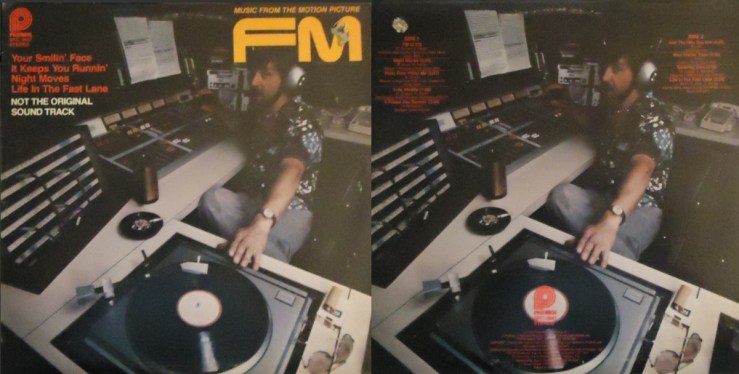
RADIO WEEK REWIND: FM (1978)

Michael Brandon (Four Flies on Grey Velvet) stars as Jeff Dugan, the ultra-cool program director at Q-SKY Radio, LA’s number one rock station. Never mind the fact that the station has the frequency 71.1, which is impossible in the US as the FCC frequency range goes from 87.8 to 108.0. Also, in the US, there are no radio stations with “Q” prefixes: East of the Mississippi, all stations begin with “W,” while stations west of the Mississippi start “K.” There’s only one major exception — KDKA in Pittsburgh. In Canada, stations use “C,” while “X” is utilized for stations in Mexico.

Q-SKY has all manner of crazy on-air personalities, like Mother, who sounds a lot like Alison Steele, the Nightbird, who also inspired Stevie in The Fog (others have said she’s based on Mary “The Burner” Turner from KMET). She’s played by Eileen Brennan from The Last Picture Show. There’s also The Prince of Darkness (Cleavon Little, who beyond Blazing Saddles, Surf II and Once Bitten also played the DJ Super Soul in the movie that inspired Tarantino’s Death ProofVanishing Point), low rated Doc Holliday (former Detroit Lion Alex Karras), his replacement Laura Coe (Cassie Yates, The Evil) and Eric Swan (Martin Mull!) who is obsessed with being a success in show business and with women.

Despite Jeff getting the station to number one in the number two market in the country, his corporate bosses only want him to sell more advertising time. Then, sales manager Regis Lamar gets him a deal to advertise for the Army, he refuses. His bosses order him to run the ads so he quits. The remaining DJs protest by locking themselves in and even physically battling the police.

Everything works out — the station’s owner (Norman Lloyd, Jaws of Satan and Amityville 4: The Evil Escapes) is inspired by the DJs and fires the sales staff. Meanwhile, dumped by his true love and fired by his manager, Eric Swan has a mental breakdown while on the air.

Director John A. Alonzo, then noted as a cinematographer on Vanishing Point, Chinatown, Black Sunday and — after this film — Scarface, made his directorial debut with FM.

Screenwriter Ezra Sacks worked at Los Angeles’ fabled FM station KMET in the early 70’s when AOR — Album Oriented Rock — was in its infancy and being created by KMET program director Mike Herrington. The Army commercial incident depicted by Sacks in the film is based on an actual on-air incident in which KMET’s top-rated nighttime DJ, Jim Ladd (On the Air Live with Captain Midnight) ran an anti-army commentary on the air after running an army spot. The incident is chronicled in Ladd’s autobiography, Radio Waves: Life and Evolution on the FM Dial.

The head of MCA Irving Azoff participated in the making of the film as executive producer, but he disowned it before release and asked that his name be removed from the credits, as he felt that the film was “not an authentic representation of the music business” and that the studio didn’t give him creative control over the film, particularly when it came to the music. Then again, nearly every band in this movie was on MCA. You know — a movie all about rock and roll and rebellion with Jimmy Buffett in it. A negative soundtrack review by Rolling Stone magazine pointed out the music was heavily biased towards “commercial” musicians who Irving Azoff managed — in conflict with the so-called rebellious, progressive-underground rock format practiced by the very stations on which FM’s faux-station was based.

Another funny point of contention is that AM stations made their own edit of the movie’s theme song, Steely Dan’s “FM (No Static at All),” by clumsily interjecting the letter A in the title from the song “Aja” so that the song became “AM” on their channels.

Finally, while some claim that the TV show WKRP in Cincinnati was based on FM — an easy mistake, with so many characters seeming so similar (WKRP’s “Venus Flytrap” vs. FM’s “Prince of Darkness” in particular) — WKRP series creator Hugh Wilson has claimed that the sitcom was already in development and I’ve also read that a pilot had already been shot. Seeing as how the show debuted in September and this movie came out in April, that was a real worry. But by the time the show aired on CBS, many had forgotten this movie.

For years, this has been a difficult release. The soundtrack gave the film issues when it was released, with multiple versions being released due to the lack of clearing music rights. In fact, this movie was originally on our list of movies that have never been on released on DVD until Arrow made the announcement that they were releasing it.

The film includes “acting” appearances by Tom Petty and REO Speedwagon, along with live performances by Linda Ronstadt and Jimmy Buffett (who recite a few lines of dialog in the process); Steely Dan performs the title theme, which became a real-life radio hit. The Eagles, James Taylor, Bob Seger, Dan Fogelberg, Billy Joel, and Queen were also featured on the Platinum-plus soundtrack album. While the soundtrack became more popular than the actual film it promoted and there was a need to repress copies, it was stymied by clearance rights; it was remedied by having a group of session musicians — Studio 78 — cut an all-covers version for bargain label, Pickwick.

In addition to a high definition 1080p presentation of the film — transferred from original film elements — this blu ray also includes new interviews with the movie’s star Michael Brandon, its writer Ezra Stacks and a video appreciation of the era of FM radio and the soundtrack of the film by Glenn Kenny.

You can get FM from Arrow Video or directly from MVD.

Thanks to R.D Francis for his help with this article, as FM is one of his favorite films.

DISCLAIMER: This movie was sent to us by Arrow Video, but that has no impact on our review.

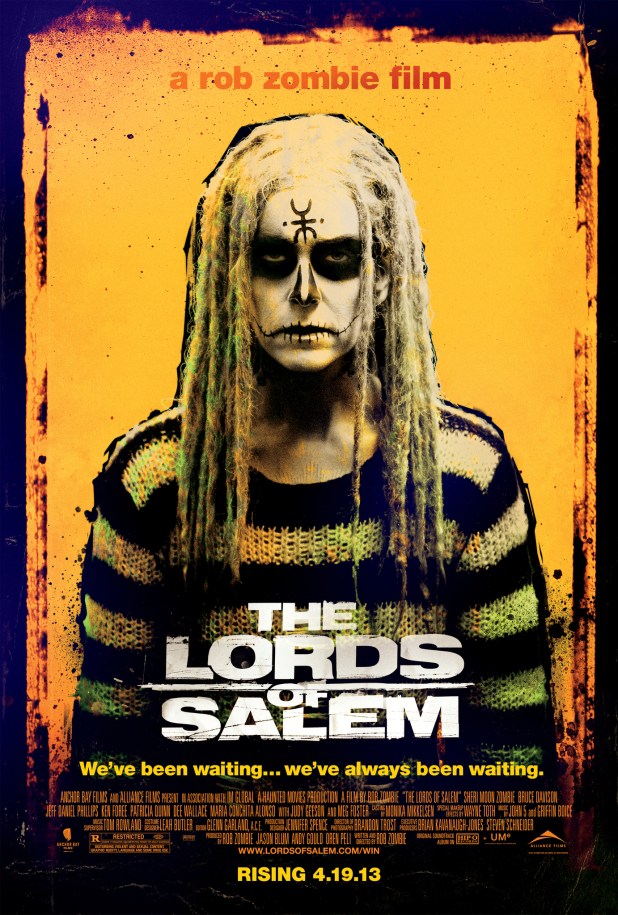
The Lords of Salem (2012)

You know, I’ve said it before and I’ll say it again. Rob Zombie would be a fun person to go see a drive-in all nighter with. But man, when he makes movies, I just get the hives.

But hey — it’s radio week. And Heidi, the recovering addict who has become a radio personality in Salem, fits the bill. Of course, she’s played by Sheri Moon-Zombie, but if you’ve seen one of Mr. Zombie’s films, you know that she’s showing up somewhere. Hell, I’d do the same thing too if I made a film. People would complain that Becca is in everything and I’d just get sad.

One night, as Heidi does her morning show-style show at night with Whitey (Jeff Daniel Phillips) and Herman (Ken Foree, Dawn of the Dead), a box shows up with a record that is supposed to be a new black metal band called The Lords.

You know, you’d think Rob Zombie would know a bit more about black metal. But nope.

Anyways, this music creates visions in Heidi’s head and begins to possess her, which continues in her apartment, as the old women downstairs end up being witches. The fact that they’re played by Judy Geeson, Dee Wallace and Patricia Quinn hammers that point home.

Bruce Davison and Maria Conchita Alonso are in this as a Salem witch trial expert and his wife who try to help Heidi, but she’s already too far gone and trapped in a Rob Zombie movie after he watched a bunch of Ken Russell outtakes.

Andrew Prine also walks on as a 17th century priest putting Meg Foster’s witch character to death. I mean, if you can get Simon King of the Witches and Evil-Lyn in the same movie, why not? Zombie ups the ante with Camille Keaton, Barbara Crampton, Michael Berryman, Sid Haig, Lisa Marie, Clint Howard and Udo Keir, making this movie like going to a horror convention without paying $50 to get a photo with your favorite genre star.

It could have been even better, as Richard Lynch shot some scenes for this film. However, due to his worsening health and blindness, Prine took over his role. The money was so tight that the major scene that would have had Lynch, Berryman, Haig and Prine on screen together was never re-shot.

Wait — so where are Keaton, Keir and Howard? They were in a planned film-within-a-film called Frankenstein and the Witchhunter, which was supposed to look like a Hammer film. It didn’t make it into the final movie.

I guess, of all Zombie’s films, this one comes in second place behind House of a 1000 Corpses. You have to admire the audacity of a movie where the lead character gives birth to a mollusk baby while “All Tommorrow’s Parties” gloomily plays. I mean, I was laughing so hard I fell off my couch. And Becca has tried to watch this numerous times to try to convince herself that it’s a better movie than it is. She’s rarely wrong, but this may be one of those times.

Airheads (1994)

ABOUT THE AUTHOR: Gregg Harrington is a podcaster, freelance journalist, musician and amateur screenwriter, known primarily for co-hosting the ’80s horror podcast Neon Brainiacs along with local filmmaker and actor Ben Dietels. When he’s not talking about Jason Voorhees or Freddy Krueger, he can be heard playing drums in the heavy grunge revival band, Pummeled and masterminding the straight edge power violence band, Rabid Pigs.

The importance of the radio has waned in the 21st century. The evolution of on-demand content via the Internet and other venues where we take in what we want when we want did a pretty swift job of dismantling the tastemaker privileges of the radio business. You can even hear it when you listen to the radio: Pittsburgh’s local “alternative” station has become an amalgamation of a handful of grunge bands, modern pop and one-hit wonders from the early 2000’s. You can hear Nirvana, Imagine Dragons, Pantera, New Radicals and Three Doors Down back to back. It’s weird. It’s also weird to think of a time where stations dictated what bands were huge and had more of a hand in curating local concerts and festivals.

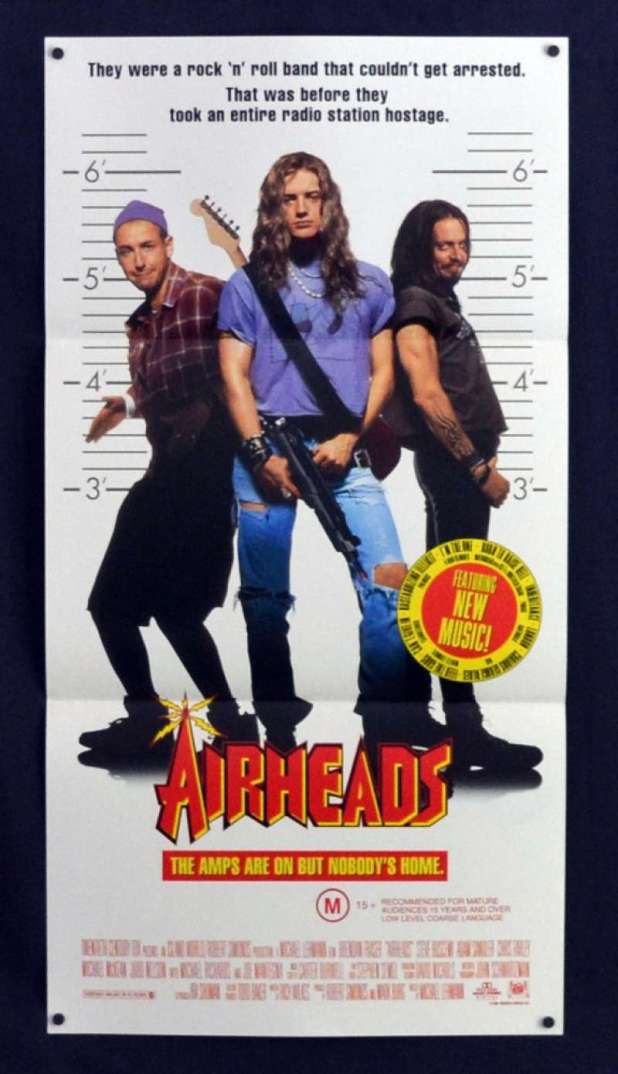
One bastion of the importance of radio is 1994’s rock comedy Airheads, directed by Michael Lehmann (Heathers, Meet the Applegates). While Lehmann is known more for television directing these days, he certainly hit a home run with me in my adolescence with Airheads. Wearing out my VHS of it and later watching it over and over on Comedy Central glued each line of dialogue to my brain. Boasting an impressive cast and an even more impressive soundtrack, Airheads finds itself acting as a time capsule, capturing the hostile takeover of grunge, usurping the tight grip hair metal had on the American music scene, and recording a time where radio play made or broke local bands. Our absentminded heroes, played by Brendan Fraser, Steve Buscemi and Adam Sandler do a bang-up job embodying the spirit of musicians trying to “make it” in the 90s.

Down on their luck rock band the Lone Rangers are trying as hard as they can to get noticed around the Los Angeles music scene to no avail, so they resort to breaking into the local radio station, KPPX Rebel Radio, to force the station’s lead DJ, Ian The Shark (Joe Mantegna), to play their demo. When things go south due to the meddling of station manager Milo (Michael McKean), the gang pulls out an arsenal of toy guns that look extremely real and take the entire radio station hostage. From there, hilarity ensues. The chaos of the whole situation is fueled by the police presence outside and the shenanigans inside the station and over the airwaves, culminating in a feeding frenzy of a music video shoot in the parking lot and, later, in jail.

The musical touchstones of the film are many. For starters, Airheads revolves around the emerging single by the Lone Rangers (“there’s three of you, you’re not exactly lone”), “Degenerated”, which was originally performed by the New York punk band Reagan Youth. Kind of strange to think about that since the Lone Rangers are supposed to lean more towards Guns N Roses than east coast punk music. The movie version features Brendan Fraser on vocals with White Zombie’s guitarist Jay Yuenger and bassist Sean Yseult on the track as well. Speaking of White Zombie, for the club scene in the middle of the film, they can be seen performing “Eat The Gods” at the Whisky. Funny enough, the role of the live band was initially offered to Cannibal Corpse, but after the producers found out they had already appeared as a club band in Ace Ventura: Pet Detective, they opted to go with White Zombie instead. It’s been reported that Metallica and Testament also turned down an offer to portray the band in that scene as well. The movie’s background is also doused in music ephemera, mostly of the punk and extreme metal variety. Stickers and posters can be seen with the logos of Cro-Mags, Obituary, and more. I’ve always felt this clashed with the Lone Rangers’ leanings more towards Sunset Strip glam metal, but I appreciate it nonetheless.

Airheads’ soundtrack is also pretty great, which is not surprising given the amount of 90s movie soundtracks that have lived on in the public consciousness (Judgment Night, Singles, Spawn, etc). Kicking off the movie is a re-recording of the Motorhead track “Born To Raise Hell”, which features guest spots from Ice-T (Body Count) and Whitfield Crane (Ugly Kid Joe, Life Of Agony). The original appeared on the band’s 1993 album Bastards. It’s a Motorhead song so you know it kicks ass. It’s also a great song to put over the opening credits, which is composed of the names of cast and crew along with time-lapse animations of random scenarios like making a sandwich and changing guitar strings. There are a few interesting cover songs on the soundtrack as well, including 4 Non Blondes covering “I’m The One” by Van Halen and, even more surprising, Anthrax covering the Smiths deep cut “London”. Coincidentally, Anthrax is also featured on the August 1993 cover of R.I.P. Magazine being read by Carter (David Arquette) during the film. Primus, Prong, the Ramones and the Replacements also make appearances as well.

As far as the movie itself, while it may not have gotten the best reviews or box office return, Airheads has lived on as a great music comedy, which I find to be on par with a film like This Is Spinal Tap. The villain-type characters portrayed by Michael McKean and Judd Nelson are spot-on, and the litany of secondary characters led by Joe Mantegna, Ernie Hudson and Chris Farley knock their performances out of the park. Plus, how many 90s comedies were made featuring three former Saturday Night Live cast members, two Ghostbusters, and a handful of MTV’s mover and shakers? Airheads is a truly fun watch and a visit back to a simpler time where people were radio stations were so influential, they were worth breaking into and taking hostages to get airplay.

You can stream it on Amazon Prime.

We also discuss Airheads as part of our “Exploring: Eddie Van Halen on Film” and “Exploring: 50 Gen-X Grunge Films of the Alt-Rock ‘90s” features.

Mayor of the Sunset Strip (2003)

George Hickenlooper was a director who excelled at telling peoples’ stories. Edie Sedwick in Factory Girl. Jack Abramoff in Casino Jack. And documentaries on Dennis Hopper, Apocalypse Now, Peter Bogdanovich, Monte Hellman and this take of Rodney Bingenheimer, Rodney on the ROQ, the Mayor of the Sunset Strip, the man who launched so many bands into American consciouness.

When Rodney was 16, his mother dropped him off at Connie Stevens’ house, told him to get her autograph and abandoned him. He ended up as a stand-in for Davy Jones, as the live-in publicist for Sonny & Cher, opened a club, brought glam to the U.S. and took to the air on Los Angeles’ KROQ.

The list of bands that Rodney broke on his show includes The Runaways, Blondie, the Ramones, Social Distortion, Van Halen, Duran Duran, Oasis,The Donnas, No Doubt, The Offspring, The Go-Go’s, The B-52’s, X, The Smiths, Suicidal Tendencies, Dramarama and Nena.

In fact, I always wondered how a song like “99 Luft Balloons” broke in our country. It was because Nina Hagen and Christiane Felscherinow liked the song and asked Rodney to play it. The rest was 80’s video history. And in the same way he brought glam to the U.S., he’d bring Britpop here as well.

This movie took six years to produce and presents Rodney as a Zelig, a person that was there for the biggest moments in rock ‘n roll. He got Bowie his record contract, but he lives in a small apartment and until 2017, was happy playing music on Sundays from midnight to 3 AM on KROQ. But no more.

Rodney wasn’t the only Mayor of the Sunset Strip. There was also Bobby Jameson, who released Songs of Protest and Anti-Protest under the name Chris Lucey. He appears in Mondo Hollywood and his role in the Sunset Strip riots earned him the title.

Then, there was the shadowy cult figure Kim Fowley, who held sway over the Runaways (duBeat-e-o), recorded the song “Alley Oop,” wrote “They’re Coming to Take Me Away Ha-Haaa!,” co-wrote “King of the NIght Time World” for KISS, produced the demos for Gilby Clarke’s band Cherry, started another version of the Runaways and even had the time to make a mess of underground films.

Rodney comes from a time when celebrity actually mattered, when rock and roll felt like something and when one play of a song could make you rich and get you laid. We’ll never know that era again.

You can watch this for free on Tubi.

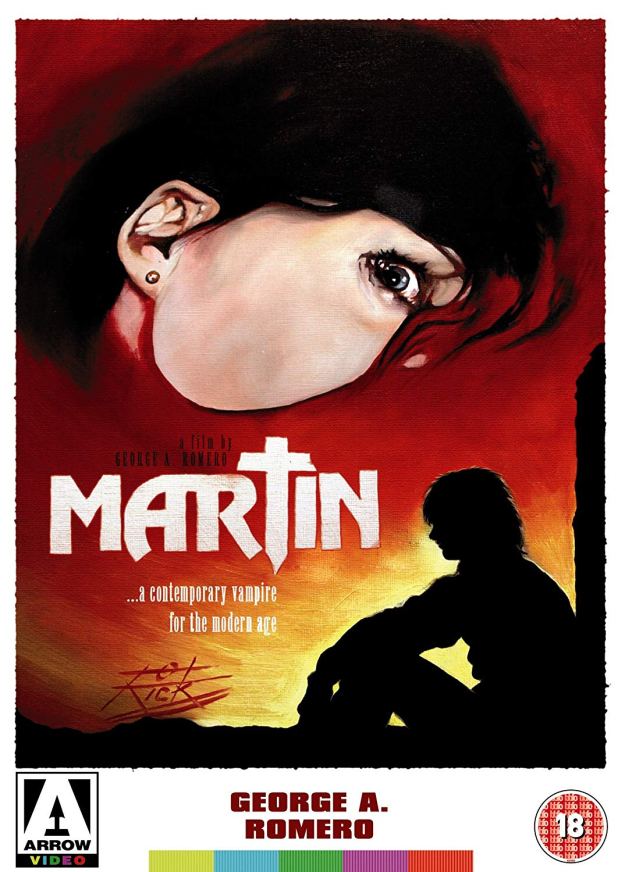
RADIO WEEK REWIND: Martin (1978)

In the five years between The Crazies and Martin, much had changed, both in the life of George Romero and his adopted hometown of Pittsburgh.

After the post-World War II economic boom, an outdated manufacturing base — that had already been overextended for the past two decades — was further taxed by hostile relationships between management and labor. And Pittsburgh had even worse issues than the rest of the country, as the raw coke and iron ore materials to create steel were depleted, raising costs. The giant Pittsburgh mills also faced competition from non-union mills with lower labor costs.

As a result, layoffs began happening throughout the region. For example, Youngstown, OH — about an hour and a little more from the Steel City — never recovered from the Black Monday of September 19, 1977 and the closing of Youngstown Sheet and Tube.

According to a 2012 story in the Pittsburgh Post-Gazette, by January 1983, the regional economy officially bottomed out. Unemployment in Allegheny County (where most of the Pittsburgh metro calls home) hit between 14 and 18% with 212,000 jobless individuals. It’s never been that high before or since. And in areas like Beaver County (close to where your author grew up and also where my grandfather worked in the furnaces for forty years), home to industry giants Jones & Laughlin Steel Corp. and Babcock & Wilcox Co., the unemployment hit a staggering 27%. That’s higher than the Great Depression. And for many of the 300,000 manufacturing workers impacted by these changes — before this, you went to high school, you worked in the mill, you had kids, you died — Pittsburgh was dying.

George Romero found himself in similar straits. He was nearly a million dollars in debt thanks to the failure of every film after Night of the Living Dead. He’d taken to working on sports documentaries like his Pittsburgh-centric series The Winners and even directed The Juice is Loose, the story of football hero OJ Simpson — albeit years before his reversal in fortune — and Magic at the Roxy, a TV magic special. He confided in producer Richard P. Rubinstein that he was nearly out of cash. While the producer counseled Romero and explained that bankruptcy was an option, Romero didn’t want to screw over the people who helped him make his films. This action gave Rubinstein plenty of respect for the director and led to their partnership. While this, their first film together, didn’t pay back those investors, Dawn of the Dead would.

Deciding on Braddock — one of the hardest hit mill towns — and utilizing family and friends, Romero started to film what he would later call his favorite film.

In the film’s first script, Martin was an older man who is definitely a vampire, struggling to live (unlive?) in the modern world. But after seeing John Amplas in a Pittsburgh Playhouse production of Philemon, Romero rewrote the film to make Martin younger and more innocent.

Martin’s family has all died in Indianapolis, so he’s on his way to Pittsburgh — but not before shooting a woman up full of drugs and drinking her blood. He’s met at the train station by his uncle, Tateh Cuda, and taken to his new home. Even today, Braddock is one of the most run-down sections of Pittsburgh — the decay evident in the movie got a lot worse before John Fetterman was elected and numerous civic campaigns have brought new business in. That said — it’s still a great setting for a horror film.

Cuda and his niece Christine share a home and have allowed Martin to stay. The old man gives Martin several rules, including one that if ever kills anyone in Braddock, he’ll stake him through the heart. He keeps crucifixes and garlic all over the house, continually telling Martin that first, he’ll save his soul, and then, kill him. Martin yells at Cuda, showing him that he can touch the crucifixes and eat the garlic and bitterly exclaims, “There’s no real magic…ever.”

This is in direct contrast to Martin’s fantasies, shot in black and white (there’s supposedly a 2 hour and 45 minute cut of this film that’s only in black and white) like a romantic vampire movie, where women willingly give up their throats to him. The truth — he barely defeats the women in battle, needs drugs to sedate them and with no fangs, he must use a razor blade to kill them.

Despite Cuda’s continual threat of death, he hires Martin to work in his butcher shop as a delivery man. This allows him to meet several women, including Mrs. Santini, who tries to seduce him. Unlike his dreams of control over these women, he can’t even control his own feelings and runs away.

Pittsburgh has always been a talk radio town — local powerhouse KDKA boasts a 50,000-watt antenna that can be heard throughout most of the continental US in the evening — and Martin takes advantage of this, calling a local DJ (Michael Gornick, director of Creepshow 2) to try and figure out life. He becomes known as “The Count” and is one more lonely voice seeking comfort until the sun comes up — again, in marked contrast to the way vampires traditionally fear daytime. The DJ segments hit close to home — I was a long-time listener (1989-2005) of Bob Logue’s Undercover Club. Pittsburgh has a long history — as stated above — of radio shows like Party Line. We’re slow to give up on technology, so AM radio still remains strong here.

Martin tries to keep his thirst under control, but finally sneaks out to the big city — Pittsburgh is very much a bridge and tunnel town where folks stay within one of the ninety small neighborhoods that make up the overall town — and attacks a woman he’d seen at Cuda’s market. But she isn’t alone — she already has an extramarital lover over — and Martin barely overcomes them both before he drugs and rapes the woman. Martin gives in to another hunger after this — a yearning for sex based on love — that he finds with Mrs. Santini.

Meanwhile, Christine, Martin’s sole advocate in the home, finally gives up on living with the uultra-religiousCuda and leaves, despite her unfulfilling relationship with her boyfriend (played by an incredibly young Tom Savini). She is slapped across the face by Cuda and shocks him by not registering the blow, instead telling that his time is over and that she doesn’t care what he or the church says.

Martin loses control once he realizes that Christine won’t come back, so he goes into the city and attacks two homeless men, but is almost killed in a battle between the police and drug dealers. He returns to Mrs. Santini’s house to try and escape with her, but she has already killed herself.

In a quick, shocking scene, Cuda dispatches Martin — who he blames for Mrs. Santini’s death — with a stake. During the credits, Cuda buries him as radio callers ask what happened to The Count. The answer? He’s freshly buried, with a crucifix over his grave.

Martin is not only Romero’s most personal films, but it’s also one of his most technically polished. The scenes where the talk radio dialogue plays against Martin’s actions allow for exposition without sacrificing pace. And the black and white versus color sequences — particularly the exorcism scene — play out as a grisly counter to the expected Wizard of Oz dichotomy.

Most strikingly, Martin presents a sympathetic hero versus a snarling monster. The true vampires in the film are the city of Pittsburgh itself, losing the vital blood of young men that once were pumped through its mills and mines and now would go elsewhere, abandoning the city for jobs and lives elsewhere. It would not be until the early 2000s that the city would rise, more phoenix than vampire, and become the tech and gourmet destination that it is today. To go from the Braddock of 1978 to a five-time most livable city in the country has been quite the journey.

The second — and perhaps main — monster of the tale is Tateh Cuda. Whereas we have been traditionally taught to see Dracula as the villain and Van Helsing as the hero, this is a man who will not break from the ways of old, the days when the word of men and church stood above all. He is not to be defied — and when he is and his manhood is decimated by Christine’s departure and final words — all he can do is reassert said manhood in the most phallic way possible: a wooden stake through the heart of the other child he has lost. More than Martin — who questions if he truly is a vampire or not and if he can escape the family cruse — Cuda is trapped in his ways and will never leave them.

When faced with the change of guard at his church, Cuda cannot understand why so many are abandoning not only their faith but the city itself.  When faced with the retirement of a priest he has known his whole life, he yells at Father Howard (Romero, in a small role) “Retired? Huh! Father Carelli is younger than I am. He asked to leave. He left like the rest of them. He thinks this town is finished!” Then, he learns that Carelli left only because cancer has taken him. Father Howard stands in contrast to the pre-Vatican 2 Catholic faith, a new style priest who laughs at The Exorcist without realizing that to someone like Cuda, those rites are very real.

Note: Lincoln Maazel, father of well-known orchestra conductor Lorin Maazel, played Tateh Cuda and lived to be 106 years old — he was already 75 when Martin was filmed.

Martin is not often said in the same breath as Romero’s zombie films and that’s a shame. It remains my favorite of his works, as there are so many ways to analyze the film. It’s not light watching or escapism, but the questions that it poses will stay with you long past the end of the film.

PS – Martin is not an easy film to find. I was satisfied knowing that I could get it at the Carnegie Library until I found my copy at VHSPS.com (sadly, it’s no longer available on their online store, so I’m glad I got my copy).

When the Dark Man Calls (1995)

If you’re a voracious reader of mystery novels, especially if you grew up in the ‘80s, chances are you may have read at least one of the prolific Stuart M. Kaminsky’s 60-plus novels concerning the adventures of the ‘40s film noir-styled gumshoe Toby Peters, Moscow Police Inspector Rostnikov, and grizzled Chicago police officer Abe Lieberman.

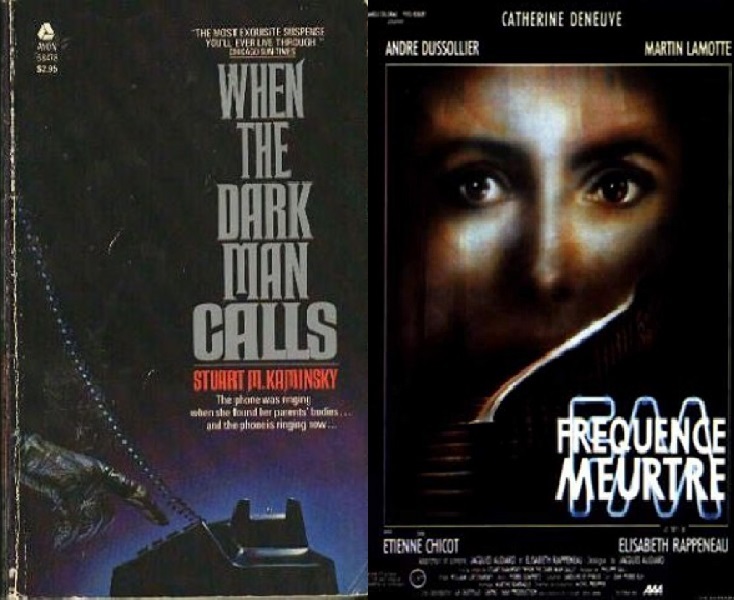
However, when it came time to adapt Kaminsky’s best sellers to the big screen, it was his two standalone non-series novels, 1983’s When the Dark Man Calls and 1985’s Exercise in Terror, which made the transition. While Exercise in Terror became the 1993 USA Network TV movie Hidden Fears starring Meg Foster (John Carpenter’s They Live, Stepfather 2, Deep Family Secrets) and Frederic Forrest (Apocalypse Now, The Rose, One from the Heart), When the Dark Man Calls was first adapted into the 1988 French thriller Fréquence Meurtre (aka Frequency Death, Frequent Death) starring Catherine Deneuve.

Kaminsky’s New York Times–and European–best seller and the 1988 French language film adaptation.

In this inferior, homogenized English language version shot on-the-cheap in Toronto as a USA Network original movie (in the days before the channel was usurped by the NBC Network to run all-day Law and Order marathons), TV actress Joan Van Ark—who’s no Catherine Deneuve in the thespian department—stars as Julianne Kaiser, the stalked Chicago talk radio psychologist.

Yes, you guess it: As with any stalked radio psychologist, Julianne has her own closet of repressed memories and tormented skeletons: Twenty-five years ago, when she was a ten, she discovered her parents murdered in their bed. It was her testimony that put away the killer, Mr. Parmenter (Tango & Cash; Clint Eastwood stock player Geoffrey Lewis), a border who lived in the back room of their home—and he always claimed his innocence. Now that Parmenter has been released, he begins making threatening calls to her show. Then, when he turns up dead and the calls don’t stop, the whodunit red herrings start flipping and flopping.

Who killed Julianne’s parents? Who killed Parmenter? Who’s stalking her and harassing her 14-year-old daughter?

Is it her vengeful, soon-to-be ex-husband Max (familiar TV actor Barry Flatman; The Dead Zone with Christopher Walken; still acting on ION Network’s Private Eyes)? Is it her doting, construction company-owning brother Lloyd (Chris Sarandon from Fright Night) with his own closet of secrets? And there’s Michael (genial TV actor James Read; ‘80s TV series Remington Steele; still acting on the U.S soaps Days of Our Lives and General Hospital), her ex-boyfriend cop bumbling about, still carrying a torch for Julianne.

While the quality in casting, acting, and direction in a ‘90s-era USA Network original movie is certainly a step above a present-day Lifetime original flick and raises the violence bar (just a smidgen), When the Dark Man Calls is still a thriller with no thrills or suspense—ironically, just like a Lifetime movie. And that’s a shame when considering the great critical reviews for Kaminsky’s 1983 novel. (Because of the radio angle, I read it back in the ‘80s and it is a page turner. Kaminsky’s works should not only be better known, but subject to more film adaptations.)

Yes, Joan Van Ark is certainly gorgeous and she looks fantastic on screen (and still acting on a wide array of films and series). But so is Catherine Deneuve. While Ark is affable enough in an ensemble cast of a hit nighttime TV drama, in her case, Dallas and Knots Landing, carrying an entire picture as the put upon damsel-in-distress isn’t her forte; under her tutelage the on-the-edge-of-your-seat plot twists of Kaminsky’s novel fall flatter than a dead herring.

Sure, we get the always awesome Geoffrey Lewis as the revengeful convict and Chris Sarandon’s harboring-dark-secrets brother as part of the bargain (if not for them both, I wouldn’t have stuck with this one to the end) and they deliver the goods, but they’re not in the film long enough to make a lasting impact.

On the plus side: The set design is solid and the radio station looks pretty legit for a low-budget set build. But who built it, Irwin Allen? Yep, it’s more budget conscious, ambiguous dark voids to nowhere. (In all my years in the business I never, ever worked in a studio so dark.) And those dumbbell faux call letters of WRAP (talk, “rap,” really?). And the total lack of a 7-second audio delay in the studio. And the fact that no radio station would ever risk FCC fines or license loss by putting live calls on the air from a serial stalker—even with an audio delay—for the sake of “ratings” or to “catch a killer.” Another problem: Joan’s age. If we abide by the flashbacks and flash forwards, Julianne Kaiser is 35—a very hard 35: Van Ark was already in her 50s—again, she looks great—when she shot this flick. All of it stretches the limits of screenwriting credulity.

Unfortunately, the Catherine Deneuve version isn’t available online for a comparison—and it was never released on stateside video. However, When the Dark Man Calls was released by Paramount as a VHS in the states and overseas. There are no official online streams available, so you’ll have to settle for this VHS rip posted on You Tube.

If you’d like to watch Kaminsky’s Hidden Fears, it is also available on You Tube.

About the Author: You can read the music and film reviews of R.D Francis on Medium and learn more about his work on Facebook.


Shattered Illusions (1998)

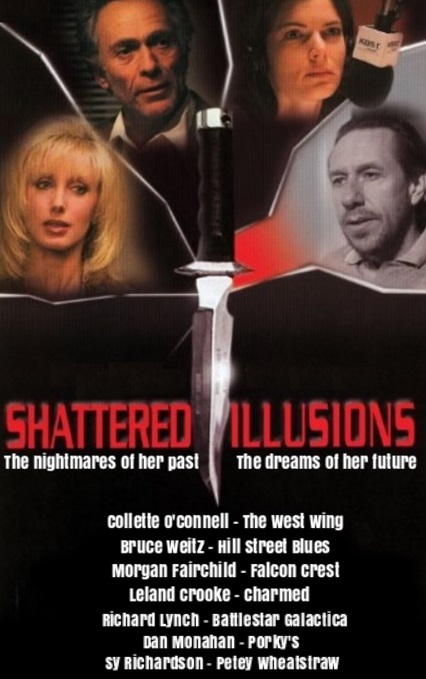
Lynn Richards (Collette O’Connell, guest roles on TV’s Law and Order: Criminal Intent and CSI: Crime Scene Investigations) is an (expositional) small town Christian radio psychologist (who babbles about “conquering life’s illusions,” thus the title) who lands the gig of a lifetime: a drive time airshift on KBST “K-Best 98 FM” Los Angeles.

Of course, all radio stations in the “radio psycho” universe suffer from low ratings and ad revenues. And we know this, thanks to station manager Richard Lynch—yes, Ankar Moor from friggin’ Deathsport—telling us “K-Best” is getting killed in the ratings by its main competitor. “We just lost five more shares to KTLL!” Ankar Moor snipes at Pee Wee—yes, it’s Dan Monahan from the Porky’s franchise, as the station’s program director.

Oh, yeah. This movie had me at “Ankar Moor.” Richard Lynch as a working stiff running a radio station? He’s not kicking someone’s ass or shedding any blood? I’m all in.

“But he’s at least the serial killing stalker, right?”

Nope.

“Is he at least a ‘red herring’ and we think he’s the serial killer?”

Nope.

“Oh, then Pee Wee, the ‘80s version of McLovin from Superbad, is the serial killer?”

Nope.

“Is he a ‘red herring’?”

Nope.

Of course, as with any female radio psychologist of the Lifetime cable channel variety, Lynn’s harboring her own personal demons and could use a shrink of her own. But wait, she’s already been through psychiatric treatment as result of her attempted teenaged suicide—a suicide that resulted from the depression of her alcoholic father Henry (Bruce Weitz of TV’s Hill Street Blues, Judging Amy, ER) causing a car wreck (tightly shot “flashbacks” of grimacing faces amid few shards of glass) that killed a family, killed her mother, mentally damaged her little sister (now a teen that she takes care of), and sent her father to jail for 12 years.

Hey, maybe Dr. Angie (Morgan Fairchild!), the obligatory “bitchy” psychologist (I guess the producers settled when Joan Collins didn’t return their calls) can help Lynn? Nah, Dr. A’s got a bone to pick with Lynn: Pee Wee promised the drive time shift to her.

“Oh, so Morgan Fairchild goes psycho!”

Nope.

“Is she a ‘red herring’?”

Nope.

“Dude, this movie sounds like it sucks.

Yeah, this psycho pool has a bad case of red algae that killed off all of the herrings and not even a dose of Richard Lynch, a pinch of Pee Wee, and the familiar face of ‘80s TV actor Sy Richardson from Rudy Ray Moore’s Petey Wheatstraw (and Bad Dreams, Repo Man, Sid and Nancy, the list goes on and on) as the detective can change the pH balance and stop the aquatic carnage.

It’s not that this first time—and only—effort by the female writing and directing team of Toni Callas and Becky Best is incompetent. Sure, we’ve seen better, and there are films are that far worse—way worse (the somewhat similar “radio psycho” romp Open House comes to mind). All of the “parts” are there for Shattered Illusions to be an edge of your seat neo-noir of the Basic Instinct variety (a radio talk host instead of novelist).  But there’s no mystery, suspense, or thrills—as is the case with the low-budget stalked-female-radio host romps of the Lifetime variety. And outside of Lynch and Sy Richardson, the acting is dreadful. If you ever wondered why you never saw Pee Wee in anything after Porky’s, this movie answers that question.

“So why do they keep having their ‘meetings’ in the restroom? Why is The Lynch looking up under stalls at Pee Wee? Is it a Porky’s homage?”

Uh, I guess so.

“Okay, so who’s the serial stalker? Is it her father who just got released from prison?”

Nope.

“Is it the no-name actor that plays the school teacher who rehabilitated Lynn’s sister, the one with whom Lynn’s now having a torrid love affair?”

Nope.

When Lynn was locked up in the nuthouse, Adam (familiar TV actor Leland Crooke from Charmed and Angel), one of the inmates from her group therapy sessions, fell in love with her—and he was heartbroken when she was released. Then, he heard the voice of his lost love return on the radio. So he goes “Michael Myers” and breaks out. And he kills his doctor and house squats—and builds a doll house, complete with little paper doll replicas of him and Lynn. And he collects portable radios and has them all tuned to KBST. And he kills a dog that Lynn complains about on the air. And he kidnaps her brutish neighbor (Michael Horse of TNT’s Claws and the 2017 Twin Peaks series reboot) that she complained about on the air. If Lynn complains about it, like the car repair guy that screwed her, Adam “fixes it” and calls into the show with an update.

Now, Ankar Moor was never on board with hiring a Christian radio host in the first place, and the station’s board of directors is on his ass: “It’s been two weeks and her numbers aren’t up!” so Ankar wants to fire her. But Pee Wee is the type of program director who thinks that animals and people dying at the hands of a serial killer obsessed with one of their hosts is “publicity that money can’t buy.”

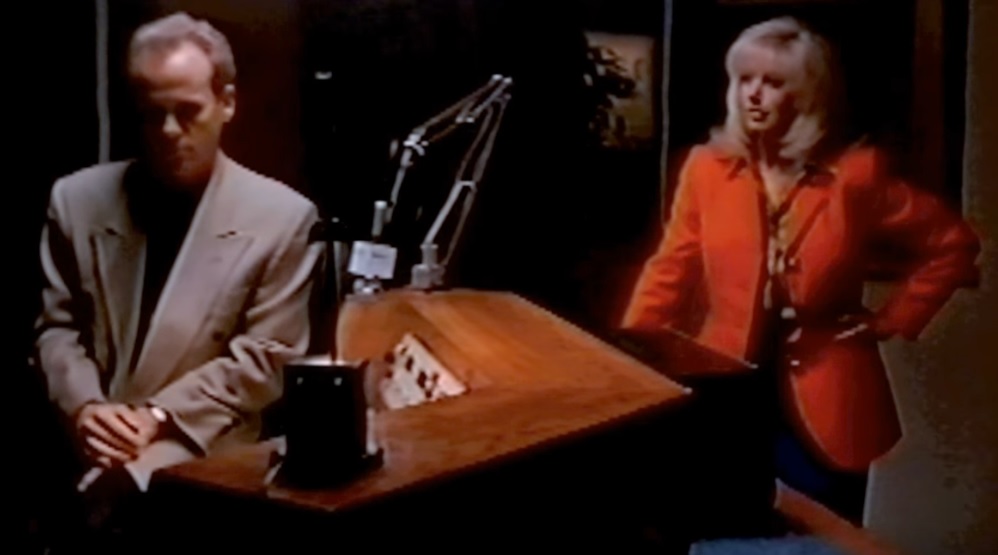
At least they shot inside a real (and uncredited) Los Angeles radio station. And Ankar Moor, Pee Wee, and Morgan all “sound” like real radio people.

My suggestion: Don’t buy any ad time on KBST and change the frequency so the ratings tank and Ankoor Moor can flip the format and get his ad rates up. Better yet: he’s gets fired and washes out of the radio industry. Then he’ll fall headfirst into a wicked gambling addiction, develop a severe case of germaphobia, and create a bogus knock off of Rollerball in Ground Rules.

To say Shattered Illusions is an out-of-print obscurity is an understatement; there are DVDs out there in the online marketplace, but be wary: they look like grey-market rips to me. There was a copy on a Tubi-like site known as Echelon First Run Films; however that site no longer exists.

About the Author: You can read the music and film reviews of R.D Francis on Medium and learn more about his work on Facebook.
Times Square (1980)

ABOUT THE AUTHOR: An American living in London, Jennifer Upton is a freelance writer for International publishers Story Terrace and others. In addition, she has a blog where she frequently writes about horror and sci-fi called Womanycom.

A cult classic about teenage rebellion, the medium of radio (and the importance of rock music) features throughout Times Square (1980.) In the plot, it’s the vehicle through which the two protagonists connect. Initially, to each other and eventually to the greater adolescent female population of 1980 New York City. 

Two girls, Nicky Marotta (Robin Johnson) and Pamela Pearl (Trini Alvarado) come from divergent backgrounds. One is a street kid with no family bounced from home to home and the other the motherless daughter of a wealthy politician gaining notoriety for cleaning up the area where Nicky lives. Times Square. The two meet in the hospital where each is being examined for perceived mental illness.  

Despite their apparent differences, both are misunderstood by the adult establishment.  The girls connect through their love of music their shared fandom of an all-night radio show hosted by Johnny LaGuardia played by the velvety-voiced Tim Curry, who is excellent as always. Pam admires Nicky’s free spirit, and Nicky admires Pam’s intellect. The casting of the two leads is perfect. 

Following her discharge, Nicky goes back to break Pam out, wandering the hospital corridors, blasting The Ramones’ classic “I Wanna Be Sedated” on her boombox to entice her new friend to defiance. Together, they escape in a stolen ambulance and hole up in an abandoned warehouse by the east river. 

DJ Johnny picks up on the story and uses it to start a movement against Pam’s father, whom he despises for trying to gentrify his neighborhood. He puts the girls on the air and makes them famous. They become Icons for other disaffected young ladies itching to rebel against the “banality” and “boredom” of their everyday lives. They start a band called The Sleeze Sisters and begin spreading their message through their music all over the airwaves in graffiti throughout the city. Even when the girls engage in potentially dangerous hijinks–they throw televisions off of high-rise buildings onto busy sidewalks as a symbolic gesture against societal brainwashing–Johnny supports and protects them. 


Eventually Pam, who has been building up her self-confidence working as a stripper who “won’t dance nude” tires of Nicky’s high jinx and develops a crush on Johnny. Although it never explicitly says the two are lovers, their sleeping arrangements and Nicky’s jealous reaction to Pam’s wandering eye says it all. Nicky sets up an interview situation designed to prove to Pamela that Johnny is only in it for himself. He’s tired of his job on the night shift and sees this movement to boost his own brand and his show’s ratings. She suffers a mental breakdown and throws herself into the East River only to climb out asking herself, “What the fuck am I doing?” Johnny calls a doctor, who sedates her. Upon seeing this, Pam confronts Johnny angrily. She hates seeing her friend devoid of her usual fighting energy and inspires her to perform one last act of ultimate provocation. An illegal concert in Times Square. 

Full soundtrack recreated on You Tube.

Pam calls all the news outlets and announces the free gig to take place on top of a theatre marquee smack in the middle of Times Square. Johnny’s message on the radio brings girls from all over the five boroughs to see their hero perform, dressed for the occasion with their eyes blacked out “like a criminal.” The cops show up to shut them down, leaving Nicky one last chance to grand stand “about life” and to thank Pam for changing hers for the better. She knows Pam must go home. Her Dad is watching from below. As a duo, the girls have taken things as far as they can and now it’s time for them to walk their own individual paths, each armed with the determination and confidence inspired by the other. 

Screen Shot 2020-03-15 at 2.47.05 AM

As a final farewell, Nicky salutes the police and Pam and jumps into the crowd. They catch her and disappears into a sea of look-alikes. Pamela reunites with her Dad and the credits roll. Over a Bee Gee’s song. An odd, preternatural choice made by producer Robert Stigwood, who managed them at the time. They have no business being on a soundtrack with Patti Smith, The Ruts, David Johansen, Lou Reed,  XTC, and the Ramones. Moyle and star Johnson discuss this at length on the commentary track for Anchor Bay’s 2000 release. 

Along with being a fun ride, the film is also a beautiful snapshot of what Times Square was like in 1980. The real one. Before it became boring and banal. It’s magnificent in its corruption. You can almost smell the dried semen in the 42nd Street porn theatre the girls run through dodging law enforcement in the second act. It might be odd to say that I miss that time in New York’s history. As Nicky says in the film, “No sense makes sense.”