PURE TERROR MONTH: Terror-Creatures from the Grave (1965)

Massimo Pupillo is mainly known for three horror films: Terror-Creatures from the Grave, Bloody Pit of Horror and La vendetta di Lady Morgan. Afterward, he claimed to be done with horror forever before making Django Kills Softly and the mondo Love: The Great Unknown. He claimed to be disgusted by his films and went into television. He may or may not be dead, as some claim that happened in 1999. There’s no evidence, though. There was some confusion when the producer of this movie, Ralph Zucker, died. Pupillo had given up the directing credit for this film and let Zucker take credit. His Americanized credits list him as Max Hunter on other movies.

Luciano Pigozzi plays one of the servants. I am duty-bound to report that he would go on to play Pag in Yor Hunter from the Future.

The main reason to watch this is Barbara Steele. The producers were aware of this, as she’s on every poster. This is yet another role where she’s an unfaithful wife, but I think if you were married to her, you’d probably let her do anything she wished.

In this one, an attorney arrives at a castle to settle the estate of its recently deceased owner, whose spirit is still roaming the cobwebbed halls of the castle and summoning the spirits of plague sufferers. And then, as usually happens, people start to die.

Beyond watching this on the Pure Terror set, you can also discover the best possible release on Severin’s Nightmare Castle set, which also features this movie and Castle of Blood.

PURE TERROR MONTH: The Sadist (1963)

About the author: Robert Freese has been a staff writer for Videoscope Magazine since 1998. He also contributes to Drive-in Asylum. 

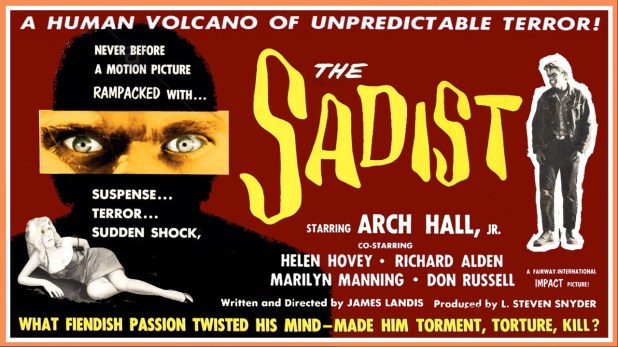
Teachers Ed Stiles (Richard Alden), Carl Oliver (Don Russell) and Doris Page (Helen Hovey) are on their way to L.A. for a Dodgers game when their fuel pump goes out on a desert back road. They pull into a seemingly deserted filling station but find no help. Ed pokes around looking for a replacement fuel pump while Carl and Doris discuss the rules of baseball over a couple cold Coca-Colas.

It’s not long before giggling, gun-toting loony Charlie Tibbs (Arch Hall, Jr.) and his psychotically silent gal pal Judy Bradshaw (Marilyn Manning) make their presence known. They hold the teachers hostage, pushing Ed to fix the car so they can make a getaway (Tibbs and Bradshaw are on the run for a recent murder spree and the authorities have an APB out on them. Ed knows that as soon as the car is fixed, it’s “bullet in the head time” for each of the teachers.).

Soon, Charlie tires of waiting and starts terrorizing the teachers, particularly middle-aged Carl. He pistol whips the poor guy then, in one of the most cold-blooded scenes ever committed to film, makes the guy beg for his life while he swigs down a Grape Nehi. Charlie promises to shoot Carl when he finishes the soda pop. 

At this point, viewers know beyond a shadow of doubt that anything can happen to anyone at any time. Please don’t think for a second that just because this picture was made for drive-ins back in 1963 that it is some goofy, throwaway horror flick. This sucker is mean, nasty, plays dirty, has teeth and isn’t afraid to use them.

Inspired by real life psychopath Charles Starkweather and his 14-year-old girlfriend Caril Fugate, Hall, Jr. pours on the crazy the second he creeps onto the screen and does not let up until the film’s conclusion. Manning’s character is 18, as we’re told by a radio news report, and her silent portrayal of Judy is absolutely chilling.

Amazingly, the film starts at a high point early on, and continues to ramp up the thrills until the final chase through the desert. The Sadist is a taut, twisted psycho-thriller that has never gotten the credit it deserves for helping evolve the “psycho/slasher” genre. This is definitely a film cut from the same mold as Psycho and helped pave the way for such gruesome drive-in fare as The Last House on the Left and The Texas Chainsaw Massacre (It is easy to see the characters of Charlie and Judy as early prototypes for Mickey and Mallory Knox from Oliver Stone’s Natural Born Killers and the image of the barefoot and bloodied heroine wandering out of the desert, away from the psychopaths, into seeming safety, is a familiar trope in most of the films by Rob Zombie.).

Don’t get me wrong, The Sadist is not nearly as graphic as the films that evolved from it, but for a flick made in 1963 with the drive-in audience in mind, it has many truly shocking moments and is a wonderfully effective psycho thriller.

Hall, Jr. starred in a string of drive-in films for his father, stuff like The Choppers in 1961, Eegah in 1962, also with Manning, and Deadwood ’76. After appearing in two films with Hall, Jr., Manning did one more feature, 1964’s What’s Up Front!, before leaving the picture business.

Hero Alden appeared in a number of films and TV shows over the years, including horror flicks like The Pit and Deadline. This was Hovey’s single foray into filmmaking, which is a shame as she delivers a great performance. (She was Hall, Jr.’s cousin.) Russell worked on a couple of other films during this time period but only acted in one other flick, portraying the greasy-faced Ortega in Ray Dennis Steckler’s classic The Incredibly Strange Creatures Who Stopped Living and Became Mixed-up Zombies.

Director Landis went on to write and/or direct a couple more exploitation flicks aimed at the ozoners, Rat Fink and Jennie, Wife/Child among them. The sharp cinematography is courtesy Vilmos Zsigmond, who started his career working on small indie flicks before graduating to an illustrious big time, award-winning Hollywood career.

I’m happy The Sadist is part of the Pure Terror collection, as well as others, as it allows more fans easier access in discovering this tough little exploitation gem (It doesn’t hurt that there are 49 other titles along with it from which to pick a Friday night double feature. Might I suggest pairing this one with Anatomy of a Psycho or The Embalmer for a terrific double shot of 60’s psycho-drama.).

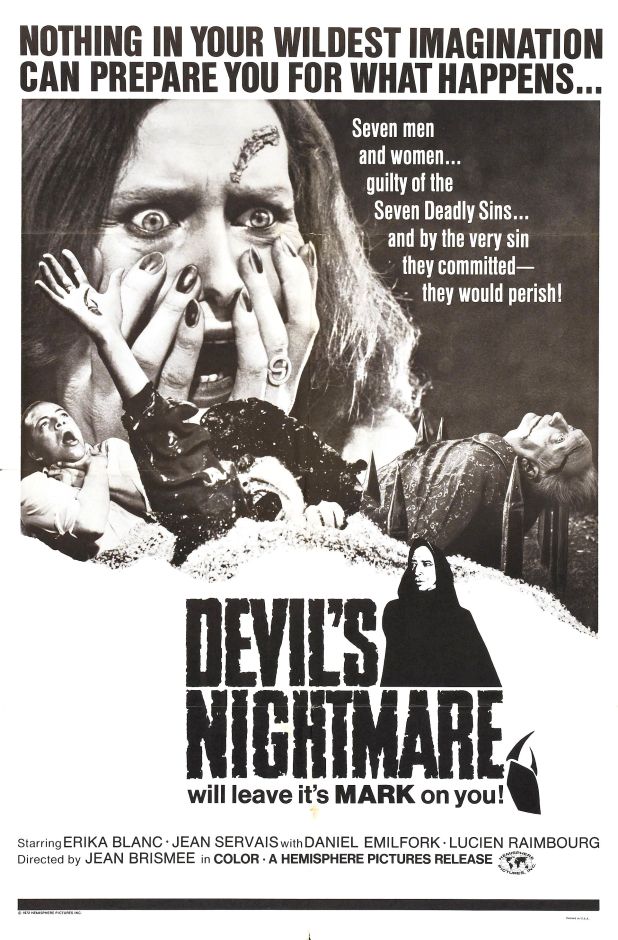
PURE TERROR MONTH: The Devil’s Nightmare (1971)

ABOUT THE AUTHOR: An American living in London, Jennifer Upton is a freelance writer for International publishers Story Terrace and others. In addition, she has a blog where she frequently writes about horror and sci-fi called Womanycom.

Directed by Belgian Jean Brismée, the film was a co-production between companies in Belgium and Italy and fits comfortably into the sub-genre of Euro-horror combining gothic atmosphere, supernatural elements, lots of sex and violence. 

The film opens at the end of WWII during a bombing raid. A Baron’s wife has just given birth and died immediately after. The Baron orders the servants out of the house for safety and murders his newborn daughter in her cradle. The scene – shocking even by today’s standards – uses a real baby in the special effect. A good way to grab the audience’s attention for sure. 

We then flash forward to present-day 1971. A busload of tourists from all walks of life, including a Priest named Sorel, and their driver – each representing one of the seven deadly sins – get lost on their way to their intended destination. A creepy-looking fellow dressed all in black (Satan) gives them directions to a nearby castle owned by the Baron. He gives them all rooms and over dinner, tells the group of his family’s curse. Centuries ago, an ancestor of the Baron’s sold his soul to Satan in exchange for the first-born female of each generation becoming a succubus in His service. By coincidence, this very night happens to be the anniversary of the Baroness’s murder in her cradle. Enter Lisa (Erika Blanc dressed all in white), who shows up at the door out of nowhere to visit Martha the Baron’s maid. 

Lisa is the daughter of the Baron’s older brother who had a secret affair with Martha. The unaware Baron killed his daughter for nothing and now Lisa is free to set about killing all the guests in the castle. She changes from her innocent white frock into an amazing black midriff-bearing dress and traps all but one guest within a state of their own particular sin – pride, greed, lust, envy, gluttony, sloth and wrath. Each soul will go to Satan. 

Erika Blanc’s performance is stellar. Whenever she changes into the succubus, her skin turns pasty gray and her lips become black. Her face contorts ferociously like an animal. Especially when Satan shows up and commands Lisa away from Father Sorel so that he may deal with the Priest himself. She slinks away like a hungry scolded cat from unfinished prey. 

Father Sorel strikes a deal with Satan. His soul in exchange for the lives of his fellow travelers. He wakes finding everyone alive and well at breakfast except the Baron who has been injured during his morning fencing exercises. Father Sorel sends the tourists on their way, offering to stay behind to look after the dying man. 

Satan is not trustworthy (of course) and drives his horse-drawn carriage directly into the path of the bus, causing it to plummet off of a cliff and explode. He’s got all the souls he wants now, including Father Sorel, whom Lisa hugs for comfort as her boss looks on knowingly. 

The film is incredibly atmospheric. The gothic-style location – the Chateau des Prince de Ligne in Antoing, Belgium – is put to great use. The long corridors seem to go on forever into the darkness and all the guest rooms are decorated in a different theme. 

It’s the music, however that elevates this film to new heights. Composed by Alessandro Alessandroni who came to fame for playing the guitar and whistling on Ennio Morricone’s theme for Sergio Leone’s A Fistful of Dollars (1964.) Here, he uses a fuzztone guitar/harpsichord theme which is both haunting and catchy. 

In the days before Blu-Ray The Devil’s Nightmare was circulated for years under several different titles in various versions on VHS and bargain-bin DVDs. The most common was The Devil Walks at Midnight. The Mill Creek print in the Pure Terror collection is sub-par when compared to the recent Blu-ray release by Arrow Video but it’s still worth a watch as the movie itself is a classic. 

EDITOR’S NOTE: To read Sam’s take on this movie, head over here.

PURE TERROR MONTH: Blood Sabbath (1972)

ABOUT THE AUTHOR: An American living in London, Jennifer Upton is a freelance writer for International publishers Story Terrace and others. In addition, she has a blog where she frequently writes about horror and sci-fi called Womanycom.

2024 update: I was a bit hard on this film the first time I watched and reviewed it. I’ve watched it three times and there’s something dreamlike about it that grows on you. It’s now one of my favorites precisely because of all its flaws.
Blood Sabbath’s Internet Movie Database list of Plot Keywords includes: acoustic guitar, public nudity, walking naked in the woods, bare breasts, foot chase, selling soul and goat. If these ingredients were put together in the right way, it would make an entertaining film. Blood Sabbath (1972) is not that film. It is ambitious but also boring. 

Every director has to start somewhere. Brianne Murphy’s story is more interesting than the film itself. After moving with her family to America, she studied acting in New York. She joined the circus as a trick horse rider and eventually landed in Hollywood where she married low-budget filmmakers Jerry Warren (The Wild Wild World of Batwoman) and Ralph Brooke (Bloodlust!) successively. She eclipsed them both in talent and went on to become an Emmy-award-winning cinematographer on the ‘70s TV shows Wonder Woman, Little House on The Prairie, and Highway to Heaven. In 1980 she became the first female director of photography on a major studio film, Fatso starring Dom DeLouise, directed by Ann Bancroft. 

In 1982 Murphy won the Academy Award for Scientific and Engineering Plaque for the co-design and manufacturing of the MISI Camera Insert Car and Process Trailer. A camera rig that allows driving scenes to be filmed with a towing apparatus – a standard piece of equipment in today’s higher-budget productions. Blood Sabbath (1972) was Brianne Murphy’s only foray into directing. 

The film stars Tony Geary (Luke Spencer of TV’s General Hospital) as a whiney recently discharged (or was he?) Vietnam Vet named David. The film opens with David wandering through the woods of Mexico with nothing but a sleeping bag and acoustic guitar slung over his shoulder. While camping under a tree, he is assaulted by a band of naked American hippie chicks. For most cis-gender heterosexual males, this would be cause for celebration but David inexplicably screams, “Hey! What is this?” and “Christ! Get away from me!” as they tear his pants off. 

After running away from the women and fainting next to a small lake, David is revived by a beautiful water nymph named Yyala (Susan Damante) who speaks to him softly until he passes out again. This time, he is aided by a grizzled old guy name Lonzo (Sam Gilman) who lives in a shack in the woods and survives off the fish in Yyala’s lake. The closest neighbor is a coven of witches who live on a nearby mountain. They are led by Alotta, Queen of the Witches played by Dyanne Thorne. She does indeed have a lotta.

One day, Alotta spies on Yyala and David making out and decides she’d like to have David for herself. She performs candle Magick and tries to cast a love spell on David, to no avail. He is smitten with Yala. Sadly, they can never consummate their love for each other because he is “of the land” with a soul and she is “from the sea” without one. Perhaps the script was written to be filmed by the sea and all the location scout could find was a tiny lake? It’s just one of several inconsistencies throughout the film. 

Now desperate to be rid of his soul, David accompanies Lonzo to the local village’s annual harvest celebration. Their fruitful bounty is not because they’re good farmers. Once a year, the villagers choose a female child to be brought by Lonzo to the witches on the mountain. Alotta, takes the little girl’s soul and inducts her into the coven to grow and up and live among them. In return, Alotta casts a spell to ensure healthy crops for the farmers. 

David stops Lonzo and trades places with this year’s chosen child. Then he can be with Yyala for all eternity. David makes a deal with Alotta that he can be with Yyala with one caveat. If Yyala should ever tire of David and leave him, he must return to Alotta and be her lover instead.

The soul removal ceremony is a success and David and Yyala enjoy a montage of happiness frolicking through the fields over shots of flowers, and groovy flute and synth music. At the next full moon Alotta tricks David into participating in a blood sacrifice and seduces him by appearing to him as Yyala. Then, she plays Yyala, David and Lonzo against each other by telling them each a different story of the evening’s events, causing all manner of mistrust, murder and mayhem.

The film concludes on an interesting albeit confusing note. David vengefully stabs Alotta (not before she takes her clothes off to the sound of cats growling.) As she lay dying, she places her final curse on him that he be killed by his own people. He staggers off into a field, has a ‘Nam flashback and is killed after being run over in a field by the hippies from the beginning of the film. Was David dead all along, killed in Vietnam? It seems so. In the final shot, his spirit swims off into the sunset with Yyala. A happy ending of sorts that likely takes inspiration from the same award-winning 1962 French short film An Occurrence at Owl Creek Bridge. The same film that Jacob’s Ladder (1990) drew from 18 years later. An ambitious idea let down in Blood Sabbath by a slow plot, poor dialogue and bad acting. A good effort, but overall a letdown. Fortunately, Brianne Murphy’s career was not bogged down by the film.

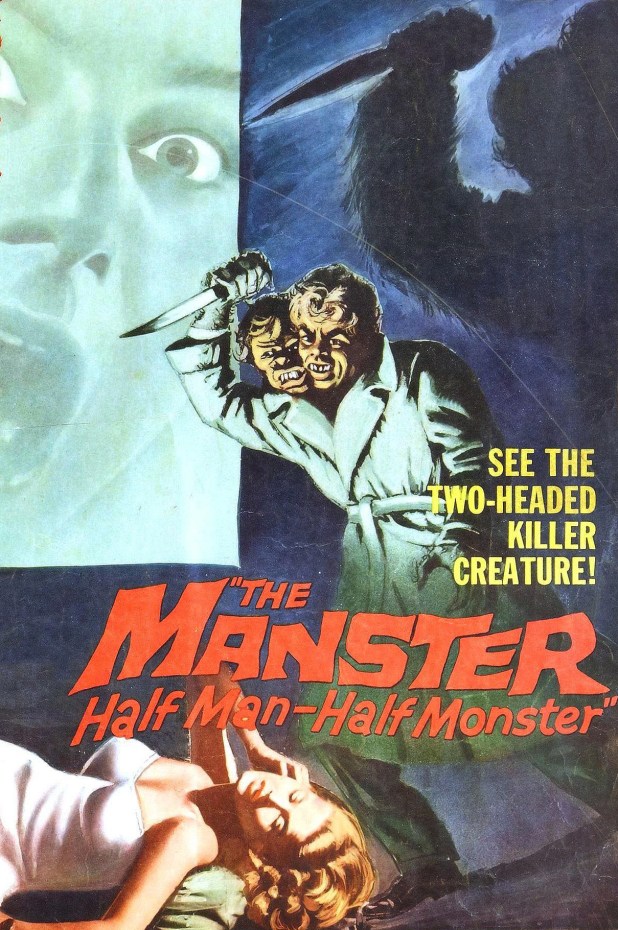
PURE TERROR MONTH: The Manster (1959)

Thanks to Dustin Fallon from Horror and Sons for this entry. He’s always been a big promoter of our site and has been instrumental when it comes to getting writers for this project. I’ve always had fun writing for his Halloween projects and am so glad that he repays the favor. 

The Manster is a 1959 film written by George Breakston. Breakston started his career as a child actor in the 1930’s, eventually moving into producing and directing in the 1950’s. However, for this film, Breakston shared directorial duties with Kenneth G. Crane. While Breakston had primarily directed jungle-themed action flicks up until that point, Crane had already established something of a genre film pedigree, having directed 1957’s Monster from Green Hell and edited the US release of Ishiro Honda’s 1955 film Jū Jin Yuki Otoko (released in the States as Half Human in 1958). The Manster was first released in Japan in 1959 as The Two-Headed Killer, but re-titled for its 1962 American release.

The film opens to find the women of a small Japanese village attacked by a large ape-like creature. This is followed by a scene featuring a scientist who is arriving at his lab to look for the escaped creature, whom he refers to as “Kengi”. In the lab is a large cage containing a heavily deformed woman, whom the scientist sadly tells that he is unable to safely release. The creature soon appears, and it is revealed that not only was this beast once a man, but that he was actually the scientist’s brother!! The scientist, a Dr. Suzuki, releases a noxious gas from a large machine and even shoots the beast a few times in order to stop it. He tosses the corpse of the creature that was once his brother into an incinerator, which both saddens and angers the caged woman.

Some time later, and presumably not too long after the opening events, an American reporter arrives at Suzuki’s laboratory. The reporter, a man named Larry Stanford (Peter Dyneley, who is probably best known for providing the voice of “Jeff Tracy” on The Thunderbirds), has been assigned to write an article covering Suzuki’s research on the effects of cosmic rays in evolution. The assignment is to be his last before returning home to his wife in New York, whom he has not seen for months.  However, once Suzuki discovers that the man is in Japan alone, he seizes the opportunity to use Stanford, albeit without the man’s consent or knowledge, as the latest guinea pig in his series of genetic research experiments. Suzuki offers Larry a sedative laced drink and, once unconscious, injects him with an experimental chemical agent.

 Larry later awakens from the stupor, but the doctor admits nothing of what he has done to the American. Suzuki gives the reporter a few non-incriminating photos from earlier research and experiments, the creature that was once known as “Kengi” clearly omitted from the included images. Larry departs, believing his story to be completed. That is, until a few days later when Suzuki rings Stanford’s Tokyo-based office to say that he is in town and would like to meet with Larry for some drinks.

Before his night out with the scientist, Larry calls his wife back home in the States. The couple express just how much they miss each other, and how they can’t wait for Larry to finally be back home. However, Larry’s words of love and devotion are seemingly quickly forgotten as he is next seen kissing up on a geisha at a small get-together organized by Suzuki. Stanford becomes increasingly inebriated as the night progresses, quickly becoming just another slobbering drunk who can’t keep his hands off the ladies.

Stanford succumbs to the spell of this new carefree way of living, even delaying his return home so that he can enjoy more of the moral degradation that he’s been lead into. He begins to ignore calls from his office and from his wife, instead spending his free time with the geishas that Suzuki arranges or out getting sloshed off of sake with the scientist at bath houses. Suzuki even initiates a romance between Stanford and his assistant, Tara, in the hopes of further distracting the man from his obligations at work and at home in order to observe the results of his secret experiment. It’s during one of these mineral baths with the lovely Tara that Larry first begins to feel the effects of Suzuki’s injection, although he has no clue what is happening to him nor why.

Larry moves from spending his free time with geishas to spending all of his time with Tara, drunkenly stumbling from evening to evening, out on the town with the woman. However, one evening turns particularly sour for Larry when he and his new “lady-friend” return to his hotel room to find his wife waiting for him. Suspecting that infidelity may be behind his delayed return home, Mrs. Stanford offers her husband an ultimatum: return home with her or stay in Japan with Tara. Unfortunately, her ploy backfires.

Larry leaves the hotel with Tara, returning the woman to her home. Tara informs Larry that she would be willing to commit to a relationship with him, but not while his current marriage is still… well, “current”. Larry returns once again to the hotel, this time to officially end his marriage. However, upon returning to the hotel room, the effects of Suzuki’s serum begin to physically manifest in full. The married couple get into a heated argument, with Larry prepared to choke out his wife before she flees from the room in terror.
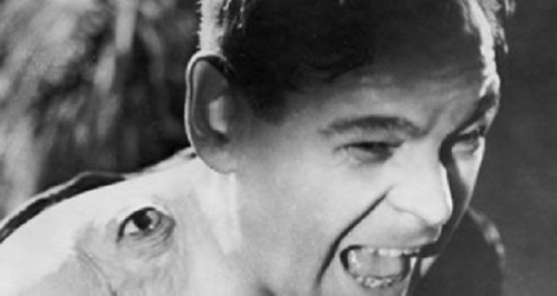
Confused, angered, and unable to control the changes coming over him, Larry wanders the streets of Japan. He comes across a small Buddhist temple, killing the priest that waits inside. He later awakens on the floor at Tara’s home, and despite now wearing the dead priest’s prayer beads, he remains completely oblivious to his earlier act of evil. Any attempt to recall the events from earlier are dismissed once Tara decides that sex is more important.

Larry continues to wander the streets, frequently losing control to the force taking over him and murdering more women who have made the mistake of walking at night unaccompanied. Meanwhile, Dr. Suzuki sits proudly by, unconcerned by the side effects or repercussions of what he has wrought. By this point, Tara has developed feelings for the American, and vocally disapproves of the doctor’s methods. Granted, it’s far too late to actually change things now as Larry has already become a hairy, 2-headed monstrosity with a propensity for killing.

From here, The Manster devolves into a marginally tedious “chase film”, with the Japanese police force attempting to track and stop the creature once known as “Larry” to little success.  The prop used for the beast’s other head is pitifully ineffective, except for perhaps the scene in which we can see it up-close and making facial expressions. Granted, this scene actually features a person in facial appliance playing the role, but the effect is still quite laughable, even by effects standards of the era.

Meanwhile, Suzuki prepares a counter agent to inject the “Stanford monster” with, should it return to the lab. And “The Larry’s” do indeed soon return, destroying the lab and killing Suzuki in the process, but not before the doctor can inject the man. This conclusion coincides with the eruption of a volcano near the lab. There would seem to be some semblance of humanity left within Larry, as he has the decency to save Tara from the lab. Well, maybe “decency” isn’t exactly the right word to use, seeing as the Manster backhands the woman into unconsciousness first, and how he’s only saving her so that he can mate with her later on.

The two halves finally do split apart, allowing the “real” Larry to revert to his normal self. The other half’s first and only act of independence is to toss Tara into the open mouth of the volcano, only to be pushed in itself mere seconds later. Larry is carried away to seek medical assistance, but thankfully, the local police have full intention of filing charges against Larry for his crimes. The film attempts to end with an uplifting monologue from the editor character in which he tells Mrs. Stanford, as well as the audience, to believe in the inherent “goodness” of Larry’s spirit, as well as that of all men. While that is all well and good, Larry still murdered a bunch of people. That fucker’s gonna fry!

Ultimately, The Manster is a surprisingly sleazy, yet moderately entertaining take on the “Jekyll and Hyde” tale. Performances are respectable, even if the dialog is a little thin. Unfortunately, the film’s selling point, which would be the titular “monster”, is more than underwhelming. Arguably more damning, even at just over 70 minutes long, poor pacing makes the second half of the film drag.

While, overall, I do enjoy the film for what it is, this one may be a “tough sell” for many. The Manster, in my humble opinion, while watchable, is not one of the stronger films on this box set.
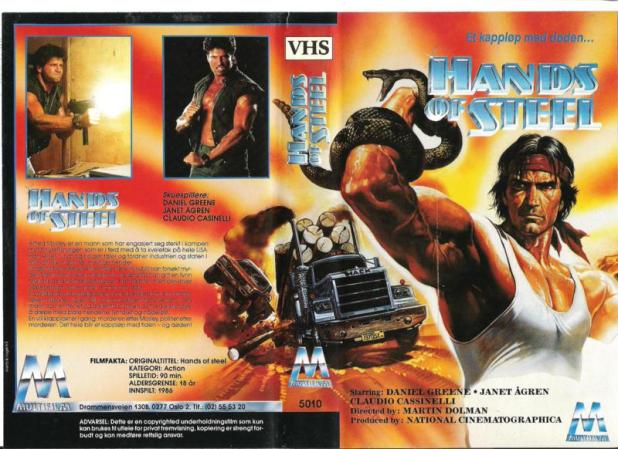
PURE TERROR MONTH: Hands of Steel (1986)

While we’ve watched Hands of Steel before, sometimes it’s nice to go back to a film after you’ve experienced more in life. After watching Over the Top and Shocking Dark, a movie like this makes more sense. Of course, not a lot as it’s an Italian ripoff film being made halfway between Arizona and Italy. And Hands of Steel, itself, is ripped off — in both story and artwork — in Top Line and Cy-Warrior.

It’s also sadly the last movie that Claudio Cassinelli would appear in, as he died in a helicopter crash during filming as the rotor blades struck the underside of the bridge and broke off, sending the helicopter into a canyon.

The National Transportation Safety Board would go on to discover that there were prescription drugs in the pilot’s hotel room that may have impaired his judgment. Luckily, because John Saxon was a stickler for Screen Actors Guild rules, he refused to appear in any of the non-union American shot footage, only doing his part in Italy. He believes that the SAG saved his life, as otherwise, he would have been on that helicopter.

Our hero is improbably named Paco Queruak and he’s played by Daniel Greene, who played Dwayne Cooley on TV’s Falcon Crest. He’s gone on to appear in several Farrelly Brothers movies like KingpinMy, Myself and Irene; There’s Something About MaryFever Pitch and Shallow Hal.

While this movie never seems to outrightly state that it’s after the end of the world — obviously, it’s Arizona and everyone still has motorcycles and trucks — it’s all about how Paco was created by evil industrialist Francis Turner (John Saxon) to kill an ecological leader. Our hero fails in his mission and runs away to the American Southwest, where he gets involved in the sport of arm wrestling.

Janet Agren from Fulci’s City of the Living Dead shows up, as does B&S About Movies spiritual avatar George Eastman, whose real voice can be heard in this movie. He plays an evil arm wrestler who tries to kill Paco.

This is what we call a hybrid movie, even if the cocktail doesn’t always add up. Here’s how to make a Hands of Steel:

Mix ingredients and stir. Add in Italian filmmaking insanity, let breathe.

Martin Dolman, the creator of all this, is really Sergio Martino, who in this writer’s opinion had the best four year run of movies of nearly any director ever, starting with 1971’s The Strange Vice of Mrs. Wardh and ending with The Suspicious Death of a Minor, with movies like All the Colors of the DarkYour Vice Is a Locked Room and Only I Have the Key and Torso in between.

This is not the most insane Martin Dolman movie that was shot in the United States. It’s strange, but nowhere near as marvelously batshit as American Tiger, a movie that has a gymnast under an astrological curse that drives a rickshaw battling Donald Pleasence as a televangelist who is really a warthog. Yes, this is a real movie.

You can either choose to watch this on the Pure Terror Set, on Amazon Prime or grab the blu ray from RoninFlix. There’s also free copies on You Tube HERE and HERE.

And since we “never say never” at B&S About Movies, we reviewed the adventures of Paco one more time with its inclusion on Mill Creek’s Sci-Fi Invasion Set in November 2020. You can check out all of the movies on the Mill Creek Pure Terror Box set as part of this recap.

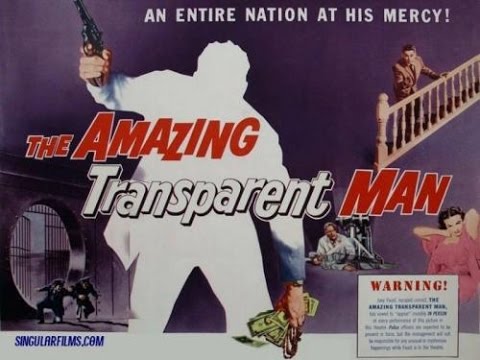
PURE TERROR MONTH: The Amazing Transparent Man (1960)

ABOUT THE AUTHOR: Craig Edwards is an award-winning blogger as well as a self-proclaimed Media Guy and a consumer of pop culture for a lot of years. He also writes a great blog called Let’s Get Out of Here


Famed low budget director Edgar G. Ulmer helms this science fiction flick which has apparently fallen into the public domain, which resulted in it being available on countless bargain VHS tapes and now in untold numbers of cheapie DVD sets, much like the very one we’re shining the spotlight on.

Former Army guy Krenner (James Griffith), plans to conquer the world with his soon-to-be army of invisible thugs and he is willing to do anything to make that happen. Krenner forces Dr. Ulof (Ivan Trisault) to work to perfect the invisibility machine Ulof invented. He keeps Ulof’s daughter, Maria (Carmel Daniel) as a hostage with the help of his henchman, Julian (Red Morgan). Ulof needs radioactive elements to improve the invisibility machine which are understandably rare and kept under guard in government facilities. Krenner busts Joey Faust (Douglas Kennedy) out of prison to steal the materials he needs. Faust pulls the robberies using the invisibility power – but chaffs working for the dictatorial Krenner. Soon everyone in the house, including Krenner’s girlfriend Laura (Marguerite Chapman) is working some kind of double cross or secret agenda; and it’s readily apparent that no one is particularly likable – so who’s going to be the treacherous victor?

While it’s obviously a very low budget talkfest, there’s just SOMETHING about Edgar G. Ulmer’s movies that interest me. Consequently, I like this little dud which is usually touted as one of the worst of all time. Ulmer only made two more movies before retiring; but his touch is still evident all over this. Sure, it’s low-budget; it’s static; it’s talky – but I’ve seen it now like three times, and I still enjoy it.

I can’t defend the movie – but to me this works – it’s not an epic of production values and amazing effects – though there are a few sprinkled in – but it works as the little sci-fi talkfest it is. If it sounds at all interesting it is worth a look and it’s certainly not hard to find.

PURE TERROR MONTH: The Thirsty Dead (1974)

A movie starring a Pittsburgh born-and-bred actress who starred as Yeoman Tankris in “Wolf in the Fold” on Star Trek, and as Jeanne Leeds, one of Mr. Drysdale’s secretaries on The Beverly Hillbillies, and as Darlene Wheeler, Ebb’s girlfriend on Green Acres?

Yeah, I know it’s weird that I can “six-degree” Judith McConnell like that. She’s this Pittsburgh born-and bred-Trekkies dream! To the transporters, Scotty!

Hold on there, Bones. Stow the pocket rocket.

Before Judith McConnell beamed to the Philippines to quench the blood lust of fellow ‘60s television mainstay, John Considine (who made his film debut as “Doctor Death” in 1973’s Doctor Death: Seeker of Souls), she had to meander through the New Mexico desert so a devil-worshipping cult could maintain their eternity in The Brotherhood of Satan (1971).

. . . And somewhere between being a member of Ted V. Mikels’s The Doll Squad (1973) and finding steady work in the American daytime dramas As the World Turns, Another World (86 shows), One Life to Live, and Santa Barbara (over 1,000 episodes!), she appeared in this Filipino pseudo-vamp potboiler.

So, this movie is about . . .

Hey, there’s Filipino cheap-fest mainstay and Ciro H. Santiago’s favorite actor, Vic Diaz, from Beast of Yellow Night, The Big Bird Cage, Superbeast, Daughters of Satan, Black Mama White Mama, and Equalizer 2000!

Gulp! It’s Brigette Bardot’s doppelganger, Jennifer Billingsley, from Burt Reynolds’s rednecksploitation classic, White Lightning (1973)!

There’s that bucktoothed hottie, Tani Guthrie, from Daughters of Satan (1972) playing another twisty, witchy-bitchy blood priestess!

R.D! We get it! All of the B-Movie actors you love are in the movie. What’s it about? Is it as tantalizing as the art work depicts? A film featuring Judith McConnell strapped to assembly-line style tables under the tagline: They need a special liquid to stay young. It is thick, red and warm, must be hot n’ sexy!

Yeah, you’d think.

It starts off AWESOME, with Judith McConnell go-go dancing in a cage for a bunch of horny, on-shore leave U.S sailors . . . that’s kidnapped by mysterious, crimson-hooded figures. . . . That’s what’s great about these Filipino horror flicks: there’s never a shortage bikini-clad, hot white chicks to kidnap and sacrifice.

So, anyway . . . going along for the boat ride to Baru’s (John Considine) plastic-trees jungle and papier-mâché caves, jungle-cult island getaway are Fredricka Myers, Chiqui da Rosa and, GULP!, Jennifer Billingsley who, at first, assume they’re going to shipped to Hong Gong for the sex trade.

Didn’t you girls read the “plot twist” in the script? You’re going to be “blood cows” for some eternal youth elixir hocus pocus in the name of a “God” that is a . . . disembodied talking head in a glass box?

So how does the mayhem end? I bet they’re building a Frankenbabe with all the “best parts,” like in Blood Cult (1985), to put the “head” on, right?

Nope.

Baru decides to defy the “Ring of Age” and spend his mortal life with Jennifer Billingsley. Yep, the little head out thinking big head screws up yet another evil plan. . . .

What? Huh? Ssork! Is the movie over?

Yeah, this one’s a sleeper that even Judith the babe can’t save. If this had only been a Star Trek episode where Kirk and the gang land on a planet with a blood-cult society tying up all the red mini-dress lassies. . . . Why the hell not? With all the flowing pastel getups and Considine’s high-collared Dr. Strange wares, it looks like that Star Trek episode with David “Hutch” Soul feeding that stone-cave god. (Check out this review of Soul’s In the Line of Duty: The F.B.I Murders for last month’s Scarecrow Pyschotronic Challenge.)

It’s not a surprise the film ended up being the first and last writing-directing features effort for television actor-director Terry Becker, who directed episodes of Mission: Impossible and starred as Chief Sharkey on Voyage to the Bottom of the Sea.

After The Thirsty Dead, John Considine returned to TV work; in the ‘80s, you couldn’t not see him on a TV series—mostly notably the daytime drama, Santa Barbara, and multiple episodes of MacGyver.

As for Judith McConnell: She’ still thespin’ in 2019 with roles on the successful web-soap opera, The Bay, and truTV’s comedy series, I’m Sorry. . . .

Oh, by the way: Judith McConnell maintains a “Bacon Rating” of “1”; she co-starred with Kevin Bacon in 2016’s The Darkness. It was produced by Blumhouse Productions, known for the low-budget horrors Paranormal Activity, The Purge, Get Out, Insidious, Happy Death Day, and Halloween.

About the Author: You can read the music and film criticisms of R.D Francis on Medium and learn more about his rock ‘n’ roll biographies, along with horror and sci-fi novellas, on Facebook.

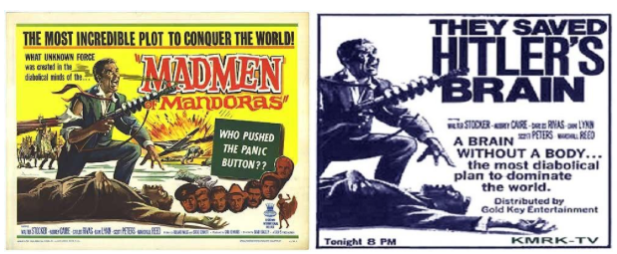
PURE TERROR MONTH: They Saved Hitler’s Brain (1968)… or The Madmen of Mandoras (1963)

Thanks to Dustin Fallon from Horror and Sons for this entry. He’s always been a big promoter of our site and has been instrumental when it comes to getting writers for this project. Plus, he’s one hell of a nice guy. 

They Saved Hitler’s Brain is a 1968 film directed by David Bradley, who also directed 2 well-known films starring Burt Lancaster, “Peer Gynt” and “Julius Caesar”.

You know what? Strike that last sentence.

The Madmen of Mandoras is a 1963 film from director David Bradley, who also directed 2 well-known films starring Burt Lancaster, “Peer Gynt” and “Julius Caesar”. They Saved Hitler’s Brain is really just the same damned movie, re-titled for television distribution in 1968 and featuring new footage shot specifically for its broadcast re-release.

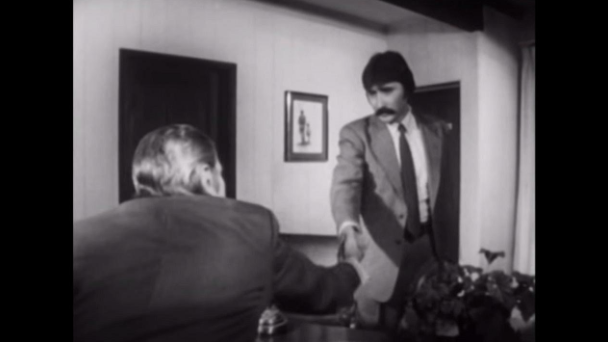
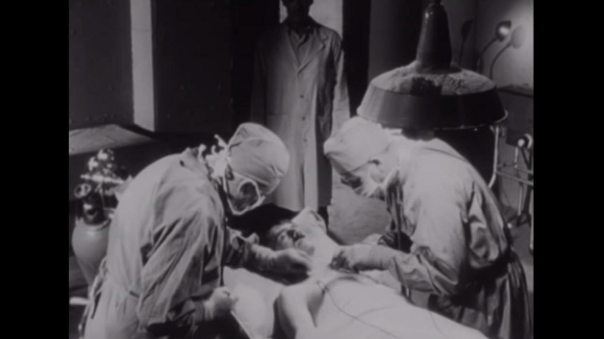
The new footage, which is essentially an entirely new opening for the film, is a bunch of muddled nonsense that attempts to expand upon the original film’s plot, but in truth adds nothing of value or importance to the film, and actually slows down the film’s pacing. The film opens with a scientist who has been working on a secret government project to create a serum for the deadly chemical weapon known as “G-gas” (which the government fears may be used as a weapon by hostile countries) being blown to bits when he triggers a bomb connected to his car. A government agent, who looks suspiciously like Hall of Fame closer Dennis Eckersley, is assigned to the case.

The opening moments of The Madmen of Mandoras are edited into this new footage through the use of some rather abrupt and jarring transitions, with the difference in film quality immediately apparent. These scenes highlight a military briefing on the lethal “G-Gas”, where it is stated that the antidote must remain well guarded, as its falling into the wrong hands could have dire consequences for the entire world. Of course, this just means that a scientist working on the antidote is soon captured by agents of the surviving Third Reich!

They Saved Hitler’s Brain attempts to add some additional action to its runtime by meshing footage from the original film with the newly created scenes so that it appears that Eckersley and his new female partner are trying to thwart the abduction. However, both agents fail to do so and are killed for their efforts, saving viewers the nightmare of dealing with them any longer. This, in essence, wraps up the “Hilter’s Brain” portion of this review, as well as the newly created portions of the film. Now, forget they ever happened because they are total shit!

As for the real film, The Madmen of Mandoras….

Near the end of WWII, Nazi scientists discover a means of preserving the life of Adolph Hitler into perpetuity, allowing the man to continue his plans for world domination for years to come. Well, at least his severed head is preserved, severed from his body and placed into a small glass tank filled with various “life-sustaining” fluids. A decoy of the Fuhrer is left behind to deceive the Allied forces into believing that the madman had been killed and his plans for domination thwarted. The surviving officers of the Reich, with Hitler’s head in tow, flee to the fictional South American island nation of Mandoras, where they secretly plan their next steps.

Years pass and with the creation of the G-gas weapon, the Nazis have found the key to their resurgence. The only thing standing in their way is the antidote, which counters the gas’s effects, should it ever be released. As such, Nazi agents are sent to America with orders to abduct a certain Professor John Coleman, one of the scientists working on the serum. However, the government of Mandoras is not without knowledge of the Nazi’s schemes and have sent their own agent to prevent the plan from succeeding.

The Mandorian (Is that the correct terminology for the natives of this tiny fictional country?) agent fails and Coleman is taken despite his interference. Also captured are Coleman’s youngest daughter, Suzanne, and her boyfriend, David. The next intended target is Coleman’s son-in-law, Phil Day, who works for US intelligence. Granted, they weren’t intelligent enough to predict an incident such as this, or Coleman would have had some sort of security detail. The Mandorian agent prevents Phil and his wife’s abduction, but is shot and killed in the process. However, as this is a movie, the man is able to disclose the entire elaborate conspiracy to Phil before he expires.

Phil and his wife, Kathy, soon board a flight to Mandoras. Upon landing, the couple are “greeted” by the island nation’s police force, which in this case is just Creature From the Black Lagoon co-star Nestor Paiva and his seemingly slow-witted assistant. The couple are treated as “special guests” of the nation, even though no one should have known that they were visiting, and are shown to the island’s finest hotel. Okay, so it’s the only hotel.

Not long after settling into the hotel room, the Days’ are shocked to find a man sneaking into their room, despite their still being in it at the time. After a brief scuffle, the man is introduced as “Camino”, the twin brother of the Mandorian agent killed in America. Camino discloses that he, like his late brother, are working to stop the Nazi resurgence. He warns the couple that many nefarious eyes are now watching them and that danger can wait around any corner.

Essentially ignoring this warning, Phil and Kathy head out to a small local bar. There, they find Suzanne dancing away to the brass band that is playing. Suzanne informs her sister that the men that kidnapped her were quite friendly, which really doesn’t seem like the actions and behavior of a group known for their acts of genocide. Suzanne is also not aware of David’s whereabouts, but she also doesn’t seem overly concerned either. The good nature of the Nazis is proven untrue when a failed attempt on Phil’s life leaves another man dead and a dancer with a bullet in her side. After the dust has settled, Phil notices that Kathy and Suzanne are no longer in the bar. Making matters worse, Phil is arrested before he can even begin to search for the women.

Phil is escorted to the Mandoras’ presidential palace, which the Nazis have overtaken to use as their new base of operations. Phil is placed into a jail cell, where not only Kathy and Suzanne await, but Professor Coleman as well. David resurfaces, revealing himself to be a Nazi officer who has been involved in the plot for quite some time, brutally bitch-slapping Suzanne when she confronts him. However, the incarceration proves to be brief when Paiva and the nation’s president appear to release the captives, disclosing that they’ve secretly been fighting against the Nazi insurgence.

Hitler’s severed head finally makes its grand entrance, leading his forces as they prepare their bombers for a worldwide G-gas attack. This plan doesn’t get very far though, as Phil, Camino, and the rest of the men launch an all-out assault on the small, single-engine plane that is actually shown. I did mention that this was a low-budget film, right? You won’t be seeing much more than stock footage of bombers. Here, you’ll just get a Cessna.

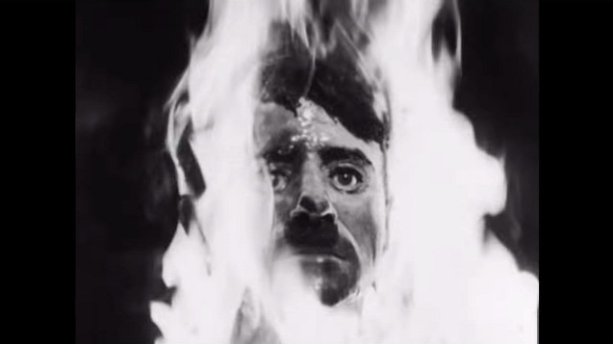
As one might expect, the heroes win, preventing the world from falling into the hands of the Third Reich. What you might not expect, especially from a film of this age, is the grisly closing image of Hitler’s disembodied head, here portrayed by a wax mold, gruesomely melted away by flames. While it is quite evident that the head is indeed wax, it’s still fairly gnarly watching the wax melt away like layers of skin and flesh from the skull-shaped creation. In fact, the scene was deemed disturbing enough to viewers that it had to be (marginally) edited down for the television re-issue.

The Madmen of Mandoras, or They Saved Hitler’s Brain, or whatever you choose to call it is a fun slice of pro-American/anti-Nazi propaganda layered in a healthy dose of 1940’s/50’s era comics “pulp”, and sprinkled with a pinch of early 60’s pop culture sensibility. It doesn’t require a lot of thought and generally moves at a steady pace, although the footage added to the television re-release does make the first half of the film drag noticeably. The film feels more than a little dated by today’s standards, but still provides some solid entertainment for a rainy weekend afternoon or one of those nights when you’re just not sure why you are even still awake.

PURE TERROR MONTH: The Werewolf of Washington (1973)

Milton Moses Ginberg started his directorial career with Coming Apart, a near-documentary which starred Rip Torn as a mentally disturbed psychologist who has been filming his sexual affairs. Sally Kirkland was also in the film, which was shot within a one-room, 15’x17′ set.

This movie is absolutely nothing like that movie.

Jack Whitter (Dean Stockwell) is the press secretary for the White House. While he’s in Hungary, a Communist werewolf bites him, which is no help at all when he moves back to our nation’s capital and starts making time with the President’s daughter.

Of course, now he’s also killing members of the President’s Cabinet with all of the murders forming the shape of a pentagram. I guess it’s up to the Second Daughter to take him out with a silver bullet, eh?

You have to admire a movie that posits Clifton James, Sheriff J.W. Pepper from the 1970’s James Bond films, as our nation’s attorney general.

Beyond this being on the Pure Terror box set, you can also watch it for free on the Internet Archive.