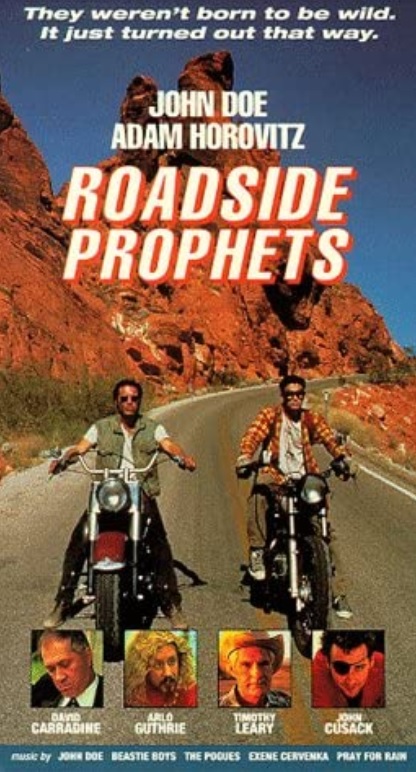
Roadside Prophets (1992)

Filmmaker Abbe Wool made her feature film debut as a screenwriter with her 1986 chronicle on the Sex Pistols’ Sid Vicious with Sid and Nancy. And she made her directing debut on this troubled production — her only directing effort (which she also wrote) — a reimaging of Easy Rider starring John Doe of X — in one of his few leading man roles (see A Matter of Degrees) — and Adam “King Ad Rock” Horovitz of the Beastie Boys.
Watch the trailer.

According to an October 1991 Los Angeles Times report on the troubled production, it’s learned the film did not start with Abbe Wool, but with aspiring, first-time filmmakers Bill Henderson and James Whitney. The duo planned to co-direct their ’80s updating (as with the later Me and Will and Easy Rider: The Ride Back) of the ’60s counterculture classic — a film that transitioned Jack Nicholson from television (he did an Andy Griffith episode!) into a film career.

Then the writing-directing duo had a fallout with their longtime friend David Swinson, an ex-concert promoter who served as the project’s producer. To hear Henderson tell it, Swinson sold out him and Whitney by making a deal with New Line Cinema. And, with that, the intimate, low-budget indie the first time writer-directors wanted to make as an industry calling card became a bloated $3 million dollar project. Wool was given the green light as result of her track record in bringing Sid and Nancy to the screen — a film that brought British actor Gary Oldman his first widespread acclaim.

While the critical reviews were mixed and the film flopped in both theaters and on home video — and was, in fact, hard to find on home video — Roadside Prophets earned cult status as result of its incessant cable airings in the grungy ’90s (yeah, this is Over the Edge all over again).

Yeah, I love this movie. How can you not love a flick with John Cusack going el loco with an eye patch? Then again, I enjoyed — and everyone else hated — what Melissa Behr and Phil Pitzer did with their respective counterculture updates, so what do I know?

Joe Mosley (John Doe) is a Harley-riding factory worker whose slightly-tweaked friend Dave (David Anthony Marshall; Willie Hickok in Another 48 Hours) tells him about a can’t-loose casino in the town of El Dorado — just before Dave is electrocuted in a video arcade. After honoring Dave’s wishes to be cremated and have his ashes spread in the desert (as in another of my road-flick favorites, 2003’s Grand Theft Parsons), Joe decides to stay on the road and find Dave’s mystical, Nevada casino. Along the way, Joe meets Sam (Horovitz), an eclectic free-spirit traveling America’s back roads to find the Motel 9 where his parents committed suicide (plot spoiler: Sam may be Dave’s ghost).

Along the way, the ’60s retro-counterculture duo meet a diverse cast of characters — the “roadside prophets” — comprised of the diverse cast of Flea from the Red Hot Chilli Peppers (Suburbia), ’60s icons Arlo Guthrie and Timothy Leary, David Carradine (Night Rhythms), an eye-patched John Cusack, Sam Raimi cohort Aaron Lustig (Bad Channels), Stephen Tobolowsky (Ned Ryerson from Groundhog Day!), and a very early-in-their careers Done Cheadle (War Machine in the Iron Man franchise!) and Lin Shayne (the Insidious and Ouija franchises!).

In addition to his work as a leading man, John Doe also scored the film, while the soundtrack features solo tunes from his ex-wife Exene Cervenka (we’re reviewing her work in Salvation! this week, look for it), the Beastie Boys, the Pogues, Pray for Rain, Gary U.S. Bonds, and tunes collectively written and performed by members of X and the Blasters. And yes . . . that’s David Carradine performing the song “Divining Rod” that he also wrote. And that’s Harry Dean Stanton crooning “Make Yourself at Home.”

Wool eventually left the director’s chair and word processors for a successful behind-the-camera career as a camera electrician on films such as The Big Lebowski, Space Cowboys, Charlie’s Angels, and Planet of the Apes ’01. (Be sure to check out out Planet of the Apes tribute week of sequels, remakes, and ripoffs.)

About the Author: You can read the music and film reviews of R.D Francis on Medium and learn more about his work on Facebook. He also writes for B&S About Movies.

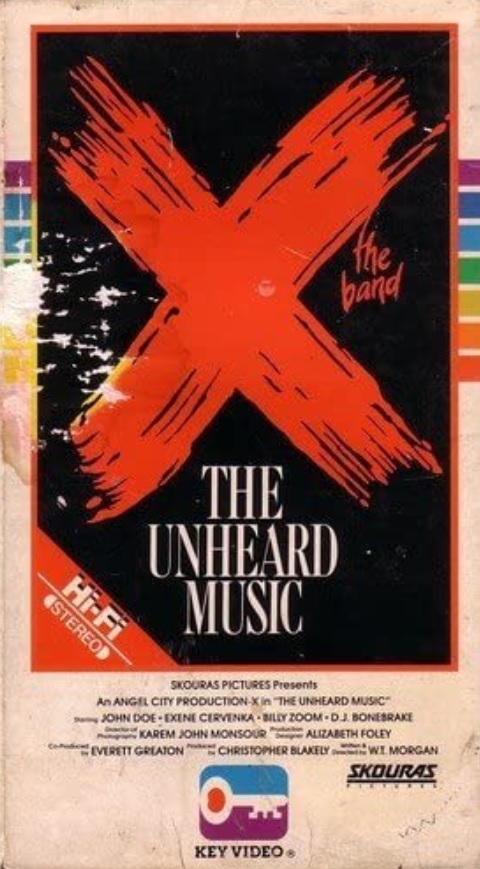
X: The Unheard Music (1986)

Writer and director W.T Morgan is a name engraved in the history of the Los Angeles punk band X. When Morgan made his debut foray into feature film narrative work with his rock ‘n’ roll love letter to his college radio roots in A Matter of Degrees (1991), he cast X’s bassist John Doe in one of Doe’s best-remembered roles as a burnt-out college rock disc jockey at odds with the commercialization of radio broadcasting. And that theme of the homogenization of music and radio industries carries through in this rock-doc.

Watch the trailer.

As with the four-years-in-production schedule Doe experienced with his first acting gig in Border Radio (started in 1982, released in 1987), W.T Morgan followed the band around Los Angeles and Southern California between 1980 to 1985. In addition to its sixteen-song strong soundtrack of the band in the studio and live on stage, the film also features band interviews, along with footage and insights from local disc jockeys, record store owners, and other local movers and shakers.

Granted with a limited art house release, this is one that punkers were first exposed to as result of its multiple showings on HBO and the resulting VHS tapes that hit the shelves. The DVD and Blu-ray version was issued on December 7, 2011, and includes a special features section with John Doe and Exene Cervenka discussing the film.

X: The Unheard Music is available on a wide variety of VOD streaming platforms, but we found a copy on You Tube. This is X in their prime. If there’s any punk document to watch, it’s this one. Watch it. And they still got “it,” as this 2019 full concert, courtesy of The Current.

About the Author: You can learn more about the writings of R.D Francis on Facebook. He also writes for B&S About Movies.

Black Cat Run (1998)

Before he gained mainstream Hollywood notice for the Val Kilmer-starring The Salton Sea (2002). Before he went mainstream with two back-to-back Shia Labeouf-starrers with Disturbia (2007) and Eagle Eye (2008). Before he gave us xXx: The Return of Xander Cage (2017) and tossed his hat in the ring to direct the upcoming G.I Joe: Ever Vigilant, D.J Caruso directed this Frank Darabont (The Shawshank Redemption, The Green Mile, The Mist) co-penned retro-action flick for HBO Films that aired on the cable network on September 18, 1998.

Hot from his 30-plus episode run on TV’s Melrose Place and his debut in a theatrical-starring role with Starship Troopers (1997), Patrick Muldoon (American Satan, The Comeback Trail) stars as Johnny Del Grissom, a gas-station attendant who chases down the chain gang escaped convicts who abducted his girlfriend — and he’s also on the run, as he’s blamed for her father’s murder (Rex Linn, TV’s Better Call Saul and Young Sheldon). And, of course, her pappy is the sheriff. And so ensues the Fast & Furiousness with Johnny chasing down the convicts and Deputy Norm Babbit (Jake Busey, S.F.W. and Starship Troopers) chasing down Johnny.

Macon County Line or Jackson County Jail, anyone? Yes, please!

Seriously, how can you not like a movie (and there are detractors) that rolls out a tricked out Olds 442 tweaked with Nitrous . . . and gives you John Doe, our favorite punk bassist from Los Angeles, matching thespin’ chop-for-chop alongside Kevin J. O’Connor (Deep Rising, The Mummy), Peter Greene (Pulp Fiction, The Mask), our favorite ex-Bond girl Lois Childs, and Jeffrey DeMunn (currently starring on Showtime’s Billions; Dale Horvath on The Walking Dead)?

You can’t. Not with a writer and director and cast like that.

In spite of its obviously low budget, Black Cat Run burns rubber and then some, all working in a Mad Max, big-dumb-engine sort of way, which was just an Aussie western trading out horses for horsepower.

And we love it, for this is pure A.I.P retro-cinema: a ’70s Drive-In dream that would make Roger Corman proud, filled with 44-Magnums, exploding tanker trucks, cheesy one-liners that would make make Eastwood cringe, and every other B-Movie absurdity you can think.

Watch the full movie as a free rip on You Tube. You can thank us later.

About the Author: You can learn more about the writings of R.D Francis on Facebook. He also writes for B&S About Movies and publishes on Medium.

Touch (1997)

If you know your Quentin Tarantino, and we know you do, you know the career of American novelist Elmore Leonard through the Q’s adaptation of Leonard’s Rum Punch (1992) as Jackie Brown (1997). Of course, that was preceded by Barry Sonddenfeld’s adaptation of Get Shorty (1995) starring John Travolta, which was based on the 1990 novel of the same name, and Steven Soderbergh’s Out of Sight (1998) starring George Clooney, which was based on the 1996 novel of the same name.

Of course, long before Tarantino exposed Leonard to a new audience, Leonard’s novels produced the Burt Lancaster-starring Valdez is Coming (1971), the Charles Bronson-starring Mr. Majestyk (1974), Stick (1985) with Burt Reynolds (Smokey and the Bandit), and 52 Pick-Up with Roy Scheider (Sorcerer). And Tarantino hasn’t given up on Leonard: back in 2009 he optioned the 1972 novel Forty Lashes Less One. But since the Q has stated he’s not making anymore films after Once Upon a Time . . . in Hollywood, sans his interest in doing a Star Trek film, we’ll have to accept that film will never come to fruition.

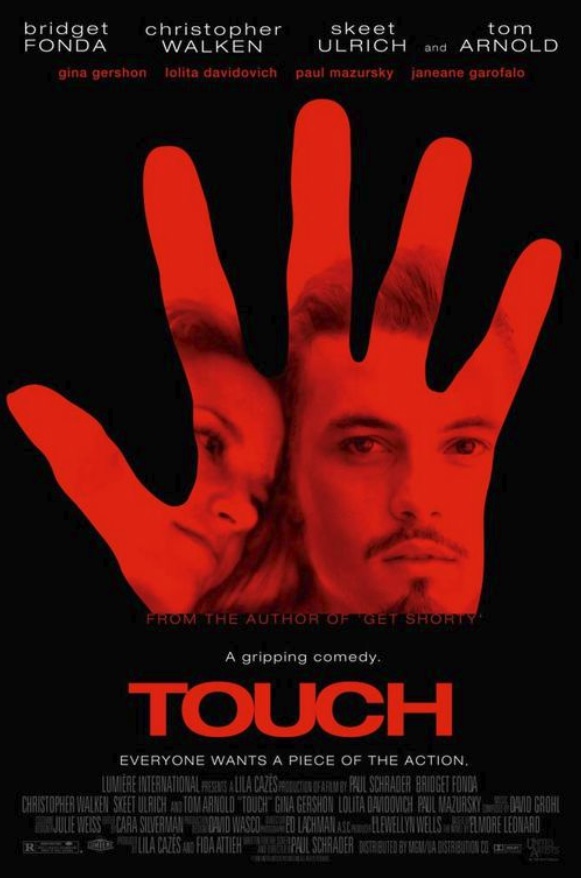
Courtesy of impawards.com

In all, twenty-six of Leonard’s novels and short stories have been adapted for the screen, with nineteen as motion pictures and another seven as television series and TV movies. And this film co-starring John Doe of X is one of those movies.

And unlike most of his works, which were westerns, mostly crime dramas, and a smattering of suspense thrillers, Leonard broke “format” and came up with Touch (1987), a lesser known, dramatic-black comedy concerning an ex-Monk (Skeet Ulrich of Scream fame) who becomes a substance abuse counselor; when he acquires the divine abilities of faith healing, he’s manipulated by a fundamentalist preacher (Tom Arnold) and washed up evangelist (Christopher Walken). Love triangles ensue with Bridget Fonda (Singles) and Gina Gershon (Prey for Rock & Roll). And Anthony Zerbe (Mathias from The Omega Man) shows up as a Father Donahue, a Catholic Priest.

Now, you would think that an Elmore Leonard novel adapted and directed for the big screen by Paul Schrader of Taxi Driver fame (and his rock ‘n’ roll love letter with Joan Jett’s Light of Day) would be a box office winner.

Wrong.

As with the poorly reviewed and, in most cases, rarely seen, and/or poorly distributed Be Cool (2005; with John Travolta), Freaky Deaky (2012; with Christian Slater of Playback), and (the truly awful) Life of Crime (2013; with a woefully miscast Jennifer Aniston), Touch failed in its test screenings and in its limited theatrical release before being dumped into the home video market.

And not even its alternative rock tie-in to the then “hot” grunge-rock wave engulfing America from the Pacific Northwest could save the film.

At the time, I was spinning alt-rock tunes and the Touch soundtrack was an instant add to our station’s rotation due to its grungy pedigree. All of the alt-rock rags and radio trades of the day made much ado about the film as one of the post-Nirvana projects by Dave Grohl; the drummer composed the film’s soundtrack (and played all of the instruments) for his new Capitol Records imprint, Roswell Records, a concern that found great success with the 1995 freshman and 1997 sophomore releases by Foo Fighters: Foo Fighters and The Colour and the Shape. While the majority of the soundtrack features instrumental tracks to score the film, it also featured the songs “This Loving Thing (Lynn’s Song),” a collaboration between John Doe and Dave Grohl (Doe would later rearrange the song with his solo band, John Doe Thing). Grohl also collaborated with Louise Post of Veruca Salt (remember “Seether“?) on the film’s title cut theme song, “Touch.” (Luckily, the extremely rare soundtrack is uploaded to You Tube to enjoy.)

Now, remember as you watched the quintessential grunge flick, Singles (1992), after Soundgarden released their fourth studio album, Superunknown (1994), you began to recognize snippets of that album’s songs — “Spoonman” in particular — appearing as instrumentals in the film? (An uncredited Chris Cornell scored the film for Cameron Crowe.) Well, in the grooves of Touch you’ll hear snippets of Dave Grohl’s drum rolls and fills — “Stay Away” (aka “Pay to Play” in its demo form) in particular — from Nirvana’s breakthrough album, Nevermind.

At the time, Nirvana was hot, John Doe knew a good thing with grunge when he heard it and got X back into the studio — after their 1987 demise — with Hey Zeus! (1993), and Louise Post was the new alt-rock darling with MTV offering their full support to Veruca Salt and their debut, American Thighs (1994; You Tube).

So, with that alt-rock pedigree behind it, darn right alt-rock stations were spinning the soundtrack. My station even used the instrumental tracks for various production vignettes. And, as with the John Doe-starring A Matter of Degrees (1991), the Touch soundtrack was better known and more successful than the actual movie it intended to promote.

Now, if you remember your grunge (soap) operas, you’ll recall Dave Grohl wrote “Everlong” from The Colour and the Shape (1997), inspired by his ongoing romance with Louise Post. However, prior to her romance with Grohl, Andy Thompson, the lead vocalist and guitarist with the Dallas, Texas, alt-rock quartet the Buck Pets was a bit more blatant in his love for Louise Post: the Buck Pets’ eponymous Island Records debut (1989) closed out with “Song for Louise Post.”

Ah, sigh . . . alt-rock love with Punk Rock Girls.

Been there. Done that. And heart broken. Curled up on the couch watching the VHS of Touch with Kim, my little “punk rock girl,” aka my “Louise Post,” is one of my cherished memories; her apartment wafted with vanilla incents and clove cigarettes. A “Greasy Boys Pizza” on the coffee table. And she never did return my copy of the Touch compact disc.

I hope Kim still has that CD, plays it, and remembers me the way I remember her, as I write this review for B&S About Movies “John Doe Week.” And Kim and I really did hang out a place called the Zipperhead (Room). And she liked Mojo Nixon and we went to see the Dead Milkmen live. We went to quite a few club concerts together.

True love. Now I am an adult and life sucks. To touch that alt-rock dream, again. So thanks for the memories, Mr. Doe. I need to buy you beer, my friend.

Touch was previously available as a free-with-ads stream on TubiTV, but has since been pulled. You can, however, stream it for a nominal fee on Vudu.

About the Author: You can learn more about the writings of R.D Francis on Facebook. He also writes for B&S About Movies.
Pleased to Meet Me (2013)

When it comes to musicians as actors, John Doe is the “Bruce Campbell” of the profession. Campbell has stated in interviews that he accepted his lot as an actor, in that he’d never be a leading man (after losing out to Billy Zane for The Phantom), instead getting smaller support roles in A-List pictures and leading man roles in B-Movies.

Watch the trailer.

And this seems to be the lot rolled by John Doe. Not that John cares: he’s always a musician first and an actor second. So, like Ash, we’ll see John in the supporting cast of a bloated Hollywood project mixing it up with the likes of Ryan Reynolds Ben Affleck and Sandra Bullock (Forces of Nature*) and Patrick Swayze (Road House*), then see him as a leading man in an indie project (his upcoming, 82nd film, D.O.A.: The Movie, and the-2002-still-can’t-find-a-copy Under the Gun co-starring Christopher Atkins).

In this Kickstarter-financed, shot-in-two-week-mostly-on-the-first-take film named after an old album from ‘80s college radio darlings the Replacements, John Doe leads a pleasurable cast of veteran musicians thespin’ for the cameras. In his support are Aimee Mann (yes, the Til’ Tuesday “Voices Carry” girl),’70s folk singer Loudon Wainwright III (of the 1972 novelty hit “Dead Skunk (in the Middle of the Road)”), and ’80s college rock folkie Joe Henry. More current indie-rock fans will recognize Whispertown’s Morgan Nagler, Over the Rhine’s Karin Berquist, and the Broken Spurs’ Adam Kramer in the cast.

Doe is somewhat playing himself: Pete Jones, a legendary rocker at a personal and professional crossroads. The muse has left him. He can’t seem to get his long-in-the-studio album finished. He’s dodging bankruptcy, foreclosures, and lawsuits from his record label. He needs help.

That help comes in the form of his ex-wife and former producer Laura Klein (Aimee Mann) who now works as a National Public Radio reporter. Referencing her inner, old studio producer, she believes Pete’s artistic rut is the result of losing his “musical purity.” So, for an episode of her syndicated radio program “World Café, she devises a 24-Hour experiment where she’ll place an online classified ad to form a one-day eclectic band of six random musicians to record a new Pete Jones tune.

This mostly ad-libbed, improvisational comedy project that comes off as a more serious, Spinal Tapish mockumentary is based on a 2002 episode of the National Public Radio program “This American Life.” In that program, a group of strangers were recruited from classified ads to enter the studio for one day to craft a cover of Elton John’s “Rocket Man.”

If you’re a fan of Louisville Kentucky’s indie-rock and folk scene (where this was shot) and hep to obscure references to early ‘90s college rock bands like Sleater-Kinney and Pussy Riot—along with Loudon Wainwright III as a socially maladjusted Theremin player and seeing John Doe in a leading-man role (check all those boxes for moi)—then there’s something here for you to watch.

This one is hard to find and is only available for streaming on the Vudu platform. Sorry, Amazon Prime users: there was a streaming copy, but it’s no longer available. But keeping checking back to see if it returns.

About the Author: You can learn more about the writings of R.D Francis on Facebook. He also writes for B&S About Movies.

* Look for our full reviews of Forces of Nature and Road House, this week.

Georgia (1995)

This entry in our week of John Doe film reviews is a personal, family-affair project for its star Jennifer Jason Leigh (who made her debut in Eyes of a Stranger and captured young male hearts as Stacy Hamilton in Fast Times at Ridgemont High). Leigh produced the screenplay written by her mother, screenwriter Barbara Turner.

Courtesy of timberroseway/PicClick

As an actress, Turner got her start in 1955’s Blackboard Jungle and 1958’s Monster from Green Hell; she came into her own as a screenwriter with 1966’s Deathwatch starring her then husband — and Jennifer’s dad — Vic Morrow (Message from Space, Escape from the Bronx). Her other notable writing efforts include Cujo (which she nom de plume’d as Lauren Currie) and the Academy Award-winning Pollock.

As her co-star, Leigh chose her long-time friend Mare Winningham (St. Elmo’s Fire), whom she known since she was thirteen years old. The choice proved effective, as it provided Winningham with her lone Academy Award-nod — for Best Supporting Actress. For their director, Leigh and Turner chose long-time family friend Ulu Grosbard. A well-regarded theater director (The Subject Was Roses, A View from the Bridge), he worked extensively as a second unit director on the box office hits Splendor in the Grass, West Side Story, The Hustler, and The Miracle Worker; he counts Dustin Hoffman and Robert De Niro as his close friends.

As is the case with fictional rock n’ roll films that are not biographical (Ray, Walk the Line, What’s Love Got to Do With It), while critically acclaimed, it failed at the box office and failed to find a cult audience on video (see Prey for Rock & Roll; Paul Simon’s One Trick Pony comes to mind). The story concerns the artistic sibling rivalry of the Flood sisters. Leigh is the jealous and less talented, punky bar room howler of the Janis Joplin variety continually at odds with Georgia, her critically-acclaimed country-singing sister.

John Doe serves as a member of Sadie’s band; he assisted the cast in the recording of the film’s thirteen-song soundtrack featuring covers of tunes by Lou Reed (“I’ll Be Your Mirror,” “Sally Can’t Dance,” “There She Goes Again”), Elvis Costello (“Almost Blue”), and Van Morrison (“Take Me Back”). If you You Tube “Georgia 1995,” you’ll populate several clips from the film featuring Leigh’s vocals.

It’s powerful stuff on both the acting and musical fronts. Watch it. You can stream it as a VOD on Amazon and You Tube.

We love our rock ‘n’ roll chocolate in our movie peanut butter at B&S, so be sure to check out our “Rock ‘n’ Roll Week” Round Ups, Part 1, Part 2, and Part 3, offering over 100 links to rockin’ reviews. We also rounded up our John Doe film reviews, here.

About the Author: You can learn more about the writings of R.D Francis on Facebook. He also writes for B&S About Movies.

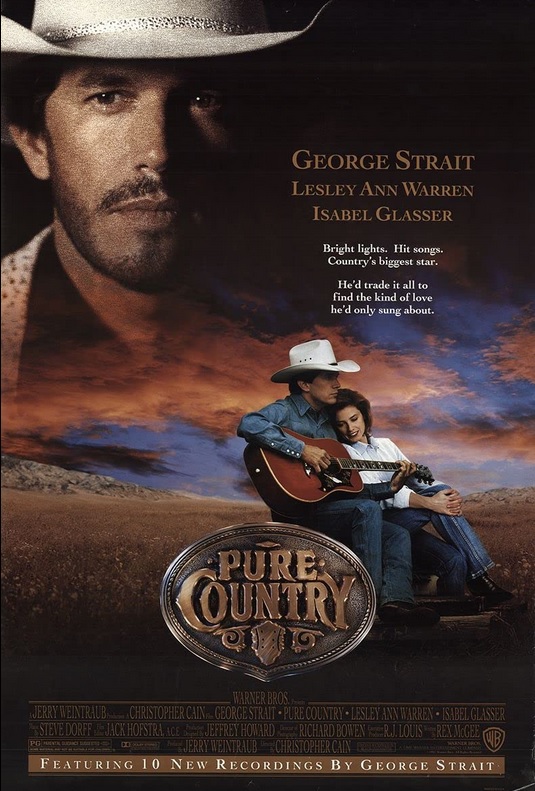
Pure Country (1992)

This attempt to transform country superstar George Strait into a chiseled-chin leading man is the feature film debut — and lone feature film — written by Rex McGee, through he returned with Where There’s a Will (2006), a cable movie directed by John Putch (who made his acting debut in the 1981 NBC-TV movie Angel Dusted and appeared as a grown-up Sean Brody in Jaws 3-D).

The film’s director, Christopher Cain, previous helmed 1987’s The Principal starring Jim Belushi (who, in a meta-WTF of of all time, had his character, Rick Latimer from that film, re-appear in the 1991 sci-fi flick Abraxas). Cain also gave us the Brat Pack western — and that overplayed and annoying Bon Jovi song — Young Guns (1988). He followed up Pure County with The Next Karate Kid (1994) starring Hilary Swank from the recent, controversial box office bomb The Hunt. Of course, we are all about the Big Three and cable network TV movies of the ’70s through the ’90s, so we remember Cain at B&S About Movies for Wheels of Terror, which aired on the USA Network (you know, back in the days before USA ditched original content to become an aftermarket shill for NBC-TV series).

While Pure Country barely made back its $10 million budget, the accompanying soundtrack became George Strait’s biggest, best-selling album. And on a sadder note: the film marked Rory Calhoun’s (Motel Hell) last film appearance; he died in April 1999. Calhoun is the wise father of Strait’s love interest played by Isabel Glasser. Retreating into TV work and indie films soon after, she co-starred with Robert Patrick and Rutger Hauer in the 1998 Top Gun ripoff Tactical Assault.

Strait is a character not far removed from his real self: he’s world-renowned country star Wyatt “Dusty” Chandler. However, unlike Strait, Dusty’s a trouble soul: he’s tired of the lights and smoke and the sets. And he’s none to fond of a new song called “Overnight Male” written by Buddy Jackson (Kyle Chandler), his manager Lulu’s (Lesley Ann Warren) boyfriend, being forced on him.

So, in a plot twist analogous to Neil Diamond’s 1980 remake-bomb of The Jazz Singer — Dusty cuts off his trademark beard and ponytail and splits for the open road. And does this sound a lot like when Rick Springfield made his play for the silver screen — and bombed, just like Neil Diamond before him — in 1984’s Hard to Hold?

Yep. It’s the same old he-has-everything-but-really-has-nothing story. And love is always the answer to get back on top.

Just how many of these musician-vanity projects — where the soundtrack always performs better on the Billboard charts than the film on the Variety charts — will Hollywood make before they realize their attempts to transform “then hot” musicians into A-List leading-actors (well, outside of David Bowie, Willie Nelson, and Kris Kristofferson) doesn’t work?

Billie Eilish? Hollywood is calling. And for your own sake, don’t pick up the iPhone.

While the story is a simple, hokey story, truth be told: Strait is a pretty decent actor and he would have been better served by breaking into the business with a non-musical role, you know, as with Trace Atkins, Dwight Yoakham, Tim McGraw, Randy Travis, and Tobey Keith.

Oops! I stand corrected. There are musicians that can act. Open mouth. Insert crow.

Hey, wait! Where’s John Doe?

While Johnny D. didn’t make the marquee as a co-star, he — as he always does, and as he did in Great Balls of Fire (also reviewed this week) alongside Dennis Quaid — is excellent in his support role as Dusty’s longtime friend and drummer, Earl Blackstock.

And did you know that director Christopher Cain’s adopted son is Dean “Superman” Cain? And did you know Dean co-wrote — with the Roger Corman-bred George Armitage (Private Duty Nurses, Night Call Nurses, Darktown Strutters, Gas-s-s-s, and the 1979 TV movie Hot Rod) — a female-driven sequel directed by his dad in 2010, Pure Country: The Gift, that starred country star Katrina Elam?

It’s okay. No one did.

And that there was a third sequel: 2017’s Pure Country: Pure Heart?

But we did see the original, thanks to John Doe.

About the Author: You can learn more about the writings of R.D Francis on Facebook. He also writes for B&S About Movies and publishes on Medium.

Slam Dance (1987)

John Doe made his first big screen appearances in the 1981 music documentaries The Decline of Western Civilization and Urgh! A Music War. While he made his big screen debut as an actor in Oliver Stone’s Salvador (1986; reviewed this week), he actually made his first foray into acting with Allison Anders’s Border Radio (1987), which began shooting in 1983. After scoring his first mainstream acting gig in Salvador, Doe found himself on another hot ticket, this time with much-ballyhooed Chinese director Wayne Wang.

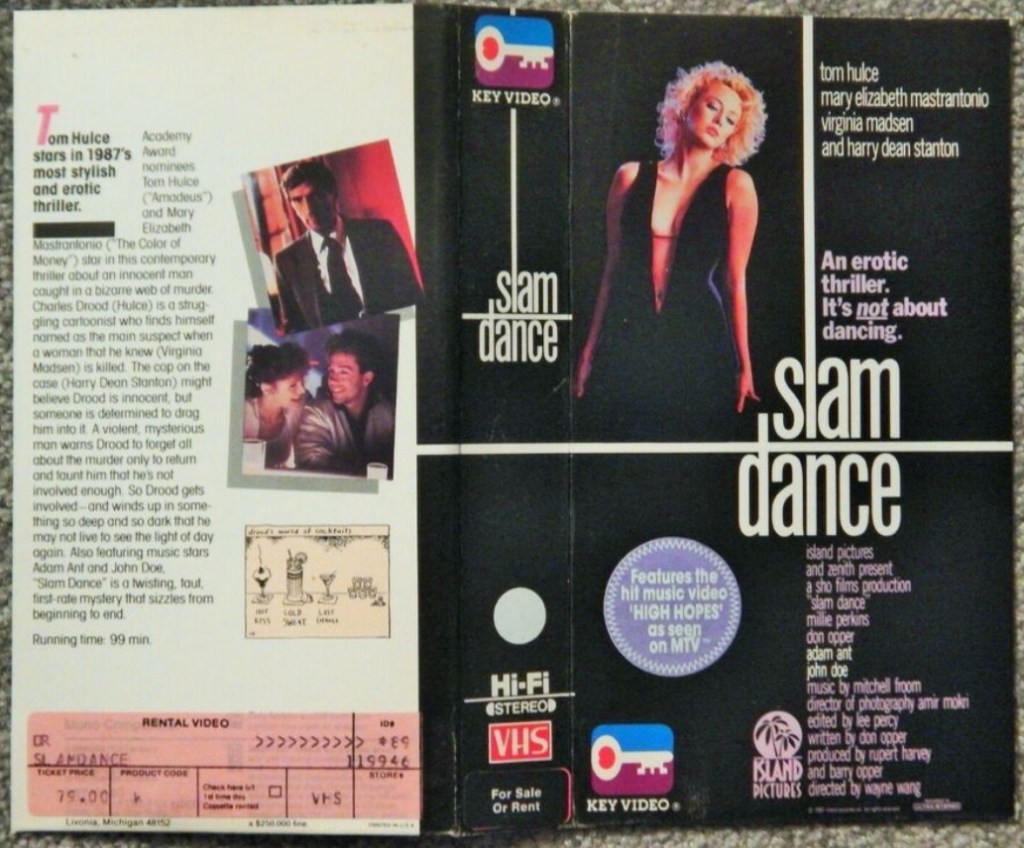
Ah, the VHS sleeve we remember/courtesy of rtsrarities/eBay via pinterest

Born in British Hong Kong and trained at California College of the Arts, Wang made his debut with the 1972-shot — for $16,000 — and released in 1975 gangster drama A Man, A Woman, and a Killer. The film was poorly reviewed and it wasn’t until his next film, Chan is Missing (1982), that Hollywood stood up and took notice; the film is recognized as the first Asian-American feature film to gain theatrical distribution and acclaim outside of the Asian marketplace place. Gene Siskel and Roger Ebert of PBS-TV’s Sneak Previews loved him. Courtesy of Wang’s choice to shoot in black & white to carry through the film’s mystery-noir narrative, he was hailed as the next “John Cassavetes.” Wang’s next feature, another Asian-centric narrative cast with Asian actors, Dim Sum: A Little Bit of Heart, repeated the box office and critical acclaim of Chan is Missing.

And, with that, Hollywood was ready for Wang to take on an American feature film. Island Pictures, a subsidiary of Island Music, fronted Wang the $4.5 million to shoot the Don Opper-penned (Android and City Limits; rewrites on Critters) film noir Slam Dance. The film was a critical and box office bomb that cleared less than a half million in American box office receipts. Wang himself was so displeased with the end product — which he blamed on producer interference — he tried to have his name removed from the film.

And since it was the first “mainstream movie” for both Opper and Wang, it killed off their mainstream hopes in Hollywood. Opper didn’t write another movie until the Hallmark Channel (!?) disaster film Supernova (2005), an Australian-produced feature film that starred Luke Perry, Peter Fonda, and Tia Carrere. While Wang directed three more indie, low-budget films, he returned to mainstream critical good graces with The Joy Luck Club (1993) and Miramax-distributed Smoke (1995).

Tom Hulce, who was never able to consolidate his Oscar tour de force in Amadeus (1984) into a leading-man career of distinction, stars as C.C. Drood. Drood is a married cartoonist involved noirish intrigue after his lover, Yolanda (a very hot Virginia Madsen), who makes her living as a call girl, is found murdered. In addition to having John Gilbert (John Doe), a corrupt cop looking to pin the murder on Drood, Yolanda’s lesbian lover, Bobby, has hired a hit man (Don Opper) to kill Drood. Of course, Gilbert and Bobby, were in on the murder all along. Another wrench in the noir works is new wave star Adam Ant as Drood’s agent. And the musician connections of the film carries through with keyboardist Mitchell Froom, who got his start with the bands Montrose and Gamma led by Ronnie Montrose, composing the film score.

As for the actor that led to us reviewing this film: John Doe followed up his smaller support role in Salvador with class and style; he should have made a much greater leap into feature films after turning in equally stellar (in larger roles) performances in the much-aired cable cult favorites of Road House (1989) and Great Balls of Fire (1989) (reviews for both this week!). Unfortunately, Doe’s next two films, Liquid Dreams and A Matter of Degrees (both 1991) failed at the box office. Doe fared better with his next work — going thes-for-thesp — as professional gambler Tommy “Behind-the-Deuce” O’Rourke in the Kevin Costner and Dennis Quaid-starring Wyatt Earp (1994; reviewed this week, look for it).

While it’s available as a rental on Vudu, we found a free-with-ads steam on TubiTV — denied! — it’s been pulled. But you can stream it over on Amazon Prime. Oh, and regardless of the pretense of Doe and Ant — and its title — this is not a “punk film.” You’ve been caveated. You can watch the trailer and opening seven minute from the VHS, via You Tube.

About the Author: You can learn more about the writings of R.D Francis on Facebook. He also writes for B&S About Movies.
The Changin’ Times of Ike White (2020)

Ike White is one of those musical obscurities, like Jim Morrison’s doppelganger from 1974, The Phantom, or “Sugar Man” Rodriquez, dubbed as a Bob Dylan doppelganger (ironically, both are from Detroit), that you won’t read about in Rolling Stone Record Guides or musicpedias. Ike White is an artist — like unheralded R&B soul artists Gil Scott-Heron and Shuggie Otis — that should have been as chart-topping on radio station playlists and Billboard sales charts as Stevie Wonder. Or Al Green. Or Curtis Mayfield. We should speak of Ike White with the fervor afforded to George Clinton and Bootsie Collins. And King Sunny Aide. And Sun Ra. And Taj Mahal.

And, for a time, Ike White was. Then he simply vanished.

Ike White — sans our mentions of the chart-topping and commercially-aware artists of George Clinton, Al Green, Curtis Mayfield, and Stevie Wonder — was an artist for record geeks. For he was an artist you heard of in the dusty, molded cardboard repositories of vintage vinyl outlets and record swap meets. He was a man doing life for murder; a multi-instrumentalist (even drums) discovered by the man who discovered Jimi Hendrix and took War and Sly and the Family Stone to the top of the charts. Sadly, even with the patronage of Jerry Goldstein and, eventually, Stevie Wonder himself — who secured Ike a new attorney and successfully got his prison sentence suspended — Ike White was a troubled soul beyond help.

And after one critically-acclaimed album — recorded inside prison — and an offer from CBS-TV to produce a TV movie about his life, Ike White went off the grid for over 40 years — like “Sugar Man” Rodriquez.

And like the similar-themed document Searching for Sugar Man, a film which reignited the forgotten musical career of Rodriquez, so could have The Changin’ Times of Ike White. Instead, this BBC-TV production does not offer us the expected, uplifting fairy tale ending; it instead shifts from a life document into a twisted mystery about a man that many thought they knew; a life more complicated than anyone could have imagined.

This is the one time when you drop your hesitations on watching a documentary for your evening’s entertainment — and watch it. You’ve never seen a documentary about a life with character revelations and plot twists like the life of Ike White.

There’s more forgotten musicians getting their much-deserved dues in the frames of Witch: We Intend to Cause Havoc and Orion: The Man Who Would Be King.

You can learn more about the film at its official Facebook page and at Kino Lorber. You can listen to Changin’ Times, Ike White’s debut album — recorded with a backing band of Santana bassist Doug Rauch (also did a stint with Davie Bowie) and Sly and the Family Stone drummer Greg Errico (a walking rock ‘n’ roll Venn diagram) — in its entirety, on You Tube.

About the Author: You can learn more about the writings of R.D Francis on Facebook. He also writes for B&S About Movies.

Vinyl Generation (2020)

Imagine a world where undercover cops attend record swaps and concerts — and arrest people for crimes against the government.

In Czechoslovakia, it was a reality.

In our recent “Rock ‘n’ Roll Week” review of the Sex Pistols The Great Rock ‘n’ Roll Swindle and The Filth and the Fury, we discussed punk — the music, the fashion, and attitude — was an artistic expression of the frustrations of the British working class and unemployed against the stodgy and greedy British class system. In America, with the advent of the Ramones in New York and X in Los Angeles — while it was admittedly less street and more Tribeca and Sherman Oaks — an antithesis subculture to mainstream music arose; a coterie network of fanzines, stores, and club venues to promote the music and the (commercialized, new-waved in America) message.

And those same frustrations — with even greater political and cultural consequences — flourished in the Czechoslovakia.

In this 2016 Czech import, Vinyl Generation chronicles the generation that came of age during Czechoslovakia’s Velvet Revolution — a non-violent transition of power that lasted from November 17 to December 29, 1989 — which signaled the end of communist totalitarianism in Eastern Europe.

As with their late ‘70s British brethren, late ’80s Czech teens used the West’s punk and burgeoning alternative-grunge music to initiate a cultural shift — even if it meant breaking federal laws, as it was illegal to buy or sell Western records and magazines (at swaps held in city parks) or attend underground, unauthorized concerts. Some of those illegal concerts featured Lou Reed, Frank Zappa, Mudhoney*, and Lydia Lunch (Cha Cha), whose never-before-seen concert footage is seen here — at least by U.S. audiences — for the first time.

You can learn more about this Dark Star Pictures release at the film’s official website vinylgeneration.net and official Facebook page. You can begin streaming the film on Amazon Prime and Vudu and on Tubi (as a free-with-ads-stream) on November 26, 2020.

About the Author: You can learn more about the writings of R.D Francis on Facebook. He also writes for B&S About Movies.

Disclaimer: This was sent to us by the film’s PR company. That has no bearing on our review.

* We explored a wide array of Grunge-era films with our “Exploring: 50 Gen-X Grunge Films.”

There’s also more music-oriented films to be discovered with our “Exploring: Radio Stations on Film” featurette. Other recent rock-docs we’ve reviewed include Suzi Q, Desolation Center, Lo Sound Desert, and CREEM: America’s Only Rock ‘n’ Roll Magazine.