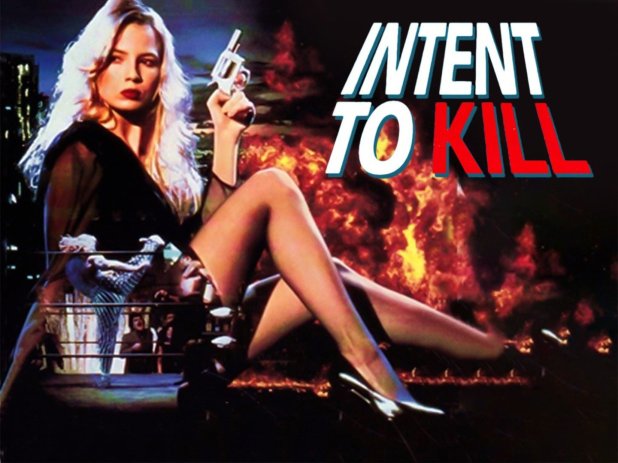
Intent to Kill (1992)

Wikipedia claims that this is the first movie given an NC-17 for violence instead of sexual content. By the look of things — you can see the rating on the MPAA site — it seems true but after all, sometimes hype is better than the actual real tale, right?

Police detective Vicki Stewart (Traci Lords) is undercover as a prostitute with her lover Al (Scott Patterson) as backup when she finds the crook she’s been hunting, Salvador (Angelo Tiffe). As he starts making out with her, he finds her concealed handgun and everything goes wild with cars blowing up, machine guns firing on crowded streets and Lords even flying out of the limo.

Captain Jackson (Yaphet Kotto) takes her off the case after all of the property damage, even if she got $50 million worth of drugs off the streets. As for Salvador, his boss gives him a week to get the white powder back.

If Vicki isn’t on the case, she’s going to have some fun. She overhears a rape victim being discharged and tells her there’s no way that the three men who destroyed her will ever see jail. Instead, she visits them at home and brutalizes them. She also goes to a factory where the boss sexually harasses women and slaps him into oblivion, all things that get her in even more trouble.

Vicki has had what we call “a day” and it gets worse when she catches Al in bed with someone else. She sets his car on fire and then heads back to the police station, the very place where Salvador is coming to get his cocaine.

Directed and written by Charles T. Kanganis, this is the perfect use of Traci Lords in a movie. She’s a near-unstoppable force of destruction who is the best cop on the force despite how much destruction happens around her. She’s actually a very male-coded hero and yet, you know, looks like Traci Lords.

You can watch this on YouTube.

Ice (1994)

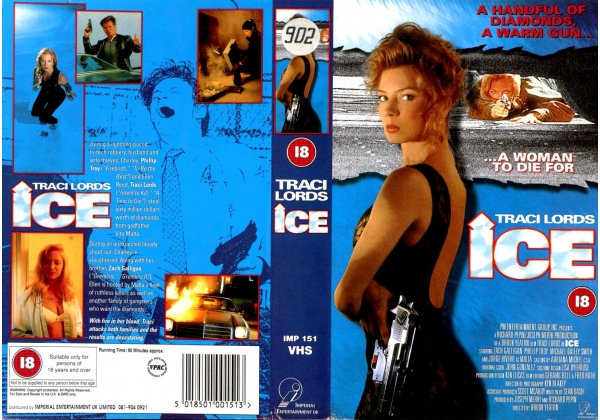
Ellen (Traci Lords) and Charley Reed (Phillip Troy) are burglars who are on the right side as they work for insurance companies, stealing back things that have been taken by others. This job brings them to the safe of organized crime kingpin Vito Malta (Jorge Rivero), which contains gems taken by his men from a jewelry store. Before you can say, “Why is Traci Lords a never nude in this?” she’s in the shower, fully clothed with her husband, the mission complete.

Her husband, however, is an idiot. Instead of marveling at his luck at getting to take pants on showers with Traci Lords whenever he wants, he decides to not give the jewelry back to the insurance company and fence it with Ellen’s brother Rick Corbit (Zach Galligan). Malta figures this out and his men chase them down, killing Charley, nearly ending Rick’s time on this planet and sending Ellen to the police station.

Detective Alan Little (Jaime Alba) remembers Ellen when she was a jazz singer, so he has a crush on her and allows her to go get revenge.

A PM Entertainment action film, this was directed by Lords’ husband at the time,  Brook Yeaton. It’s the kind of action film that if it came on Cinemax at 2:45 a.m. and you were high, you’d probably not get up to turn the channel. In short, the movies that I spend most of my life finding and writing up.

You can watch this on YouTube.

G-Minus-One (2023)

ABOUT THE AUTHOR: Jennifer Upton is an American (non-werewolf) writer/editor in London. She currently works as a freelance ghostwriter of personal memoirs and writes for several blogs on topics as diverse as film history, punk rock, women’s issues, and international politics. For links to her work, please visit https://www.jennuptonwriter.com or send her a Tweet @Jennxldn

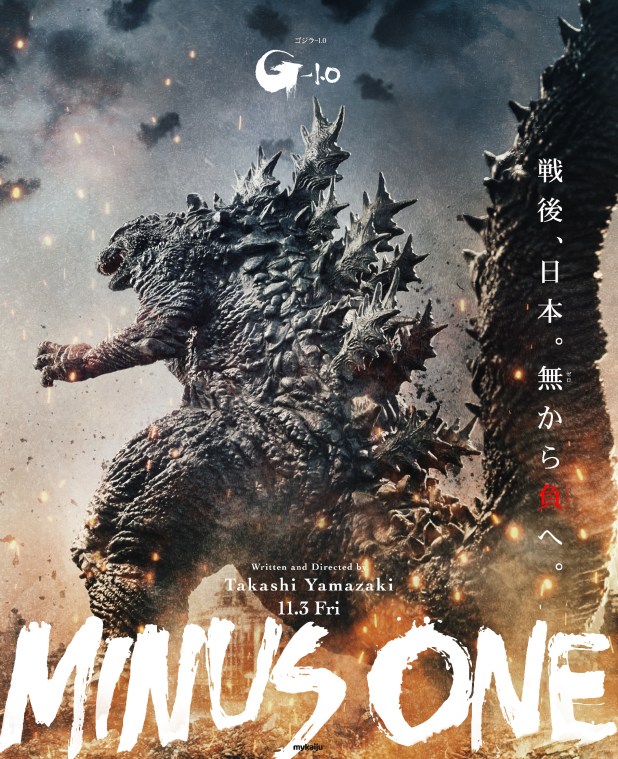
No long-time kaiju fan was more pleased than I when rumors began to swirl that Godzilla Minus One – the first Japanese Godzilla film in more than a decade – wasn’t just good. It was great. I didn’t want my expectations to ruin the experience of seeing the film for the first time, so I avoided spoiler-laden websites and subreddits.

Secretly, I was super excited. I hadn’t seen a Godzilla movie on the big screen since the 2014 American series launch Godzilla. A film that left me with the same feeling one has when they’re hungry and they eat bad pizza. It fills you up, but the calories are empty. I never saw any of the sequels because I was now certain that Hollywood, regardless of how much money they spend on effects or how many great actors they cast, will never truly be able to make a great Godzilla movie. It’s a film series that is uniquely Japanese. No other country on earth has had an atomic weapon dropped on it in a time of war. And that makes them uniquely qualified to make movies about an atomic monster. The original 1954 film was infused with melancholy and a foreboding sense that no matter how bad things are, they can always get worse.

Godzilla Minus One recreates that feeling better than any other Godzilla film made since then.

The film begins at the end of WW2. When Japan had nothing. Zero. Then Godzilla shows up and things get worse. Minus One.

Kamikaze pilot Kōichi Shikishima (Ryunosuke Kamiki) abandons his mission and lands on nearby Odo Island with “technical problems.” While there, a giant lizard known by the locals as Gojira goes on a rampage. Once again, Shikishima freezes and cannot bring himself to shoot the monster. Tachibana (Munetaka Aoki), the only other survivor of the attack, blames Shikishima for the death of his comrades.

The next act in the film shows an accurate portrayal of the grim life of post-war Japan where people survived on their wits and the kindness of strangers. Shikishimi, now suffering from PTSD and cultural shame, forms a makeshift family with a young woman named Noriko (Minami Hamabe) and an orphaned toddler named Akiko (Sagae Nagatani.)

He gets a job on a boat sweeping mines from the sea and it isn’t long before his old buddy from Odo Island makes his next appearance. This time he’s huge, having grown even bigger from America’s A-bomb test on Bikini Atoll in the pacific.

The boat team crosses the big guy’s path, and a chase ensues. Despite the film’s paltry (by Hollywood standards) 15-million-dollar budget, the jeopardy in this scene feels real. I’ve always loved it whenever Godzilla swims, but it’s the first time I’ve felt like I was watching Jaws with a kaiju.
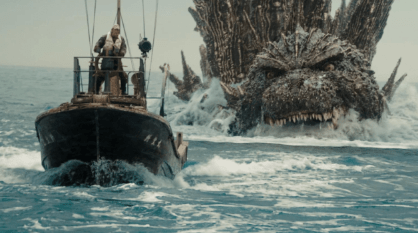
When the big guy finally makes landfall and attacks Ginza, it’s one of the best sequences ever achieved by Toho Studios. Not only is the destruction from G’s heat ray astounding in its execution, but it’s also one of the rare times we see Godzilla himself suffer what appears to be painful injuries after unleashing his weapon. (See GMK from 2001 for another great example of this.)
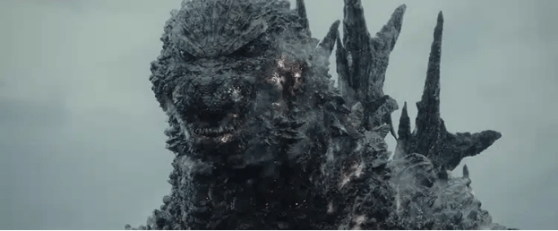
The resulting nuclear explosion blows Oppenheimer’s bullshit a-bomb away. And that’s important. I for one, am pleased as punch to see transnational audiences embrace a low-budget monster movie. IAs I’m writing this, Godzilla Minus One has grossed over 104 million dollars globally and is Oscar nominated for Best Special Effects. It should have been nominated for Best Picture. This movie succeeds on every level where every other budget-bloated major Hollywood 2023 release has failed.

Godzilla Minus One is a compelling drama. It’s also a period piece that’s historically accurate. Are you listening, Ridley Scott? It’s scary, exciting and fun. All for a cool 15 mill. This movie is proof positive that story and well-developed characters matter and you don’t need a billion dollars and 3 hours to do it. Did I mention the film was released globally entirely in Japanese with subtitles? So much for the “audiences don’t like to read” argument.
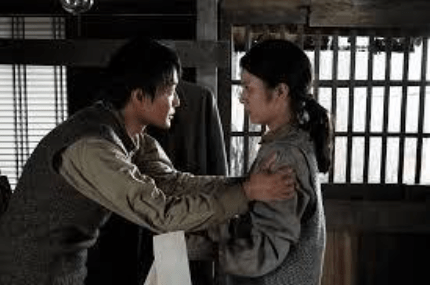
In the finale, Shikishima joins forces with Tachibana and a team of war veterans to do what the Japanese government can’t do and what the U.S. government won’t do. They defeat Godzilla in a thrilling finale. Or do they? Godzilla has powerful regenerative abilities. In Godzilla 2000 these cells were called Regenerator G-1. Here, they don’t name this ability, but it’s a nice callback for die-hard fans and the end result is the same. Godzilla is never defeated for long in any movie. If it were that easy, he wouldn’t be the star of cinema’s longest running series in history. Kudos to writer/director/effects artist Takashi Yamazaki for achieving something I never thought I’d see in my lifetime. He’s made Godzilla relevant again in a serious way. Without cheesy dubbing.

Toho Studios, if you’re reading this,

もっとゴジラ映画をお願いします!

Motto Gojira eiga onegaishimasu!

More Godzilla films, please!
The Legend of the Suram Fortress (1985)

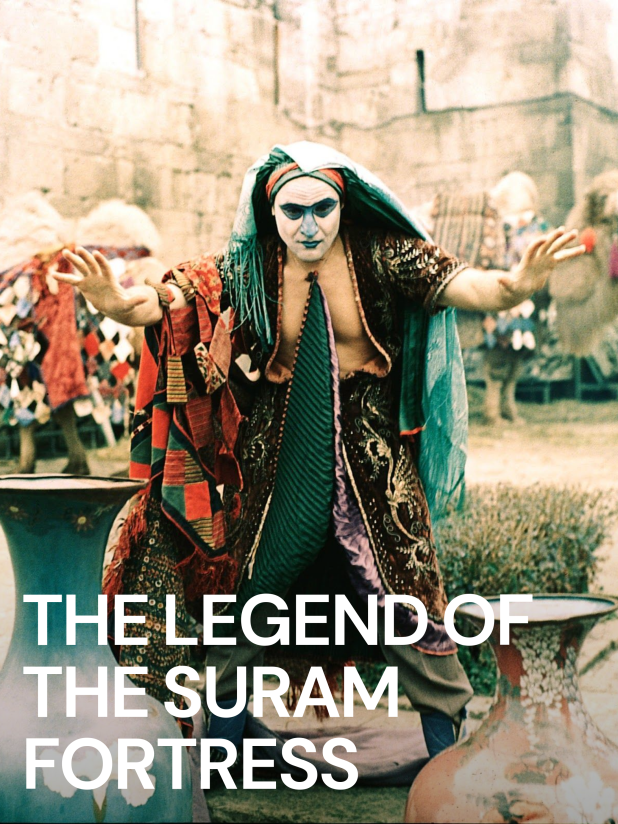
I’ve never seen a movie that looks like The Legend of the Suram Fortress.

Directed by Georgian SSR-born Soviet-Armenian director Sergei Parajanov and Georgian actor Dodo Abashidze, this was the first movie that Parajanov had made in 15 years after being censored by Russia and 4 years in jail for “lewd acts and bribery.” That’s because he was bisexual and he was sentenced to five years in a hard labor camp despite a letter from Andrei Tarkovsky to the Central Committee of the Communist Party of Ukraine, which stated, “In the last ten years Sergei Parajanov has made only two films: Shadows of Our Forgotten Ancestors and The Colour of Pomegranates. They have influenced cinema first in Ukraine, second in this country as a whole, and third in the world at large. Artistically, there are few people in the entire world who could replace Paradanov. He is guilty – guilty of his solitude. We are guilty of not thinking of him daily and of failing to discover the significance of a master.” The letter was also signed by Robert De Niro, Francis Ford Coppola, Martin Scorsese, Leonid Gaidai, Eldar Ryazanov, Yves Saint Laurent, Marcello Mastroianni, Françoise Sagan, Jean-Luc Godard, François Truffaut, Luis Buñuel, Federico Fellini, Michelangelo Antonioni, Andrei Tarkovsky and Mikhail Vartanov.

This is not the first tragedy in his life, he was married to a Muslim woman who converted to Eastern Orthodox Christianity for him. Her relatives saw this as blasphemy and killed her. Knowing this will make this movie even richer for you, as he lived the pain that his characters do.

Much like The Color of Pomegranates, this film uses tableaux — a static scene containing one or more stationary actors who poses with props and scenery, combining theater and visual art to tell the story — to create a surreal effect as it moves from dramatic image to image, filled with actors who each speak their part within these pieces of motion art.

This is an adaption of a traditional Georgian folk story of Durmishkhan, who has been freed by his master and now wants to buy the freedom of his lover Vardo. He is told another story by a merchant who lost his mother because of the cruel nature of his master. He killed that man and became a Muslim to escape the law.

Durmishkhan works for this man and marries a woman and has a son named Zurab. As his boss retires, he gives the business to him and converts again, this time to being Christian and dreams of the Muslims killing him for his crime.

Vardo becomes a fortune teller who is called upon when the Muslims invade their country. Despite all their efforts, the Suram Fortress is falling. She fortells that a blue-eyed young man from the countryside must be walled inside the fortress alive and it will stand. The bou who she be her son, Zurad, volunteers and gives his life to save the country and Christianity.

The band Voidcraft used this movie for one of their videos, “The Vertical Mammal.”

The Legend of the Suram Fortress feels like a movie that was made before cameras were invented, if that makes sense, something captured through time and delivered to us in the future. Filmed in the grassy scenery of Georgia with all actors facing the camera as we study the frame for its many meanings. It’s presented plainly but holds many secrets, literally the most pure expression of the secret and the occult.

You can watch this on YouTube.

Burned At the Stake (1982)

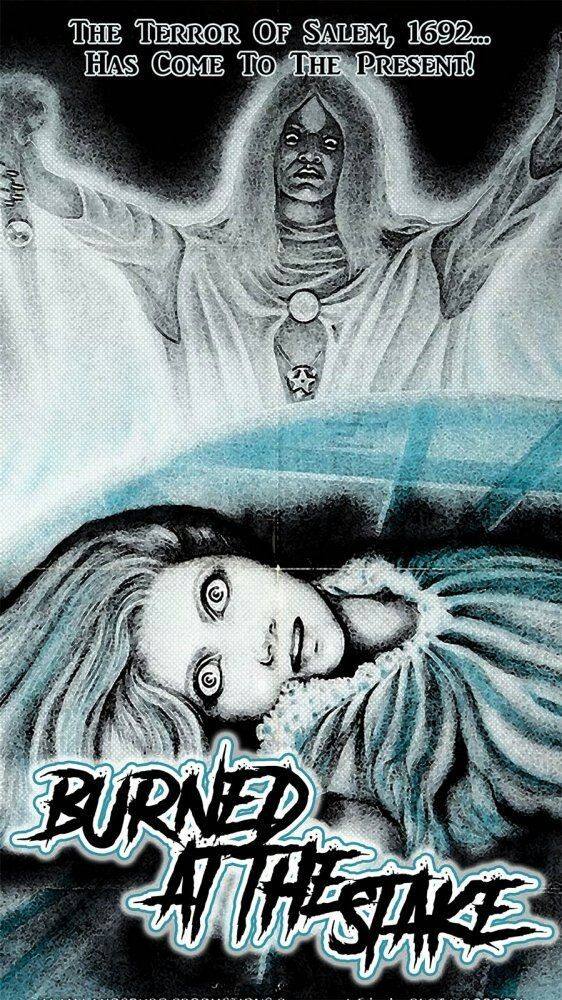
Also known as The Coming, this movie starts in the late 1600s in Salem, as Ann Putnam (Susan Swift) is caught experimenting with black magic. To protect herself, she turns over the names of those who were also involved, sending Reverend Samuel Parris (John Peters) on an orgy of stake burnings to not only destroy all of the witches but to bring back the fear of the Lord in his worshippers. Meanwhile, in 1982, Loreen Graham (also Susan Swift) is possessed by Ann’s spirit.

By 1982, Bert I. Gordon had given up on giant animals after Empire of the Ants and would go on to make movies like Let’s Do ItThe Big Bet, Secrets of a Psychopath and Satan’s Princess. That said, along the way, he’d made Picture Mommy Dead and Necromancy, so he was about more than Costco sized vermin.

Ann Putnam is a real person who, at the end of her life, tried to atone for all the people who died at her hands — well, as the result of her identifying them — and said that they were innocent. As for Gordon, making this near the end of a long career, he’s put together a movie that can’t decide if it wants to be supernatural or a dream. He’s still making an occult movie that could play as a made for TV film minus all the profanity and gore the genre had embraced by 1982.

In this film. Putnam can only save a young girl by changing history and bringing someone back in time to fix it. It honestly makes no sense but had enough eerie visuals to keep me watching. There’s a skeleton-handed killer who the movie never really explains and we wonder who the protagonist is, who the villain is and how we’ll get the story all figured out. I wonder if Gordon ever divined it himself.

You can watch this on YouTube.

Kings of the Square Ring (1980)

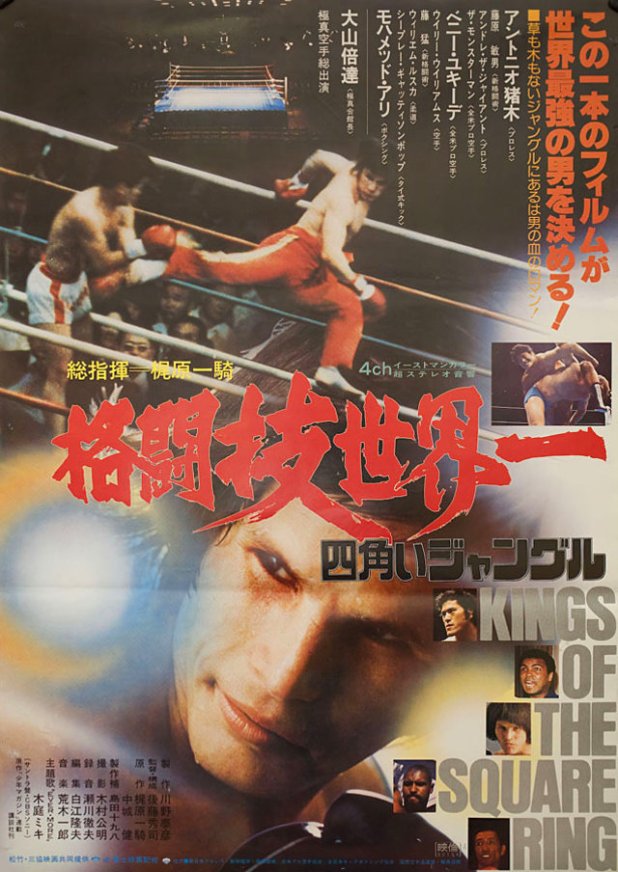
Directed by Shuji Goto, Kings of the Square Ring comes from a curious time in the time of pro wrestling, martial arts and what would someday be known as mixed martial arts.

This film shows nearly every style that was known in the late 1970s when it was filmed. You get to see kickboxer Benny “The Jet” Urquidez fighting Takeshi Naito, sumo Takamiyama and Muay Thai expert Toshio Fujiwara — the first Japanese person to win a title in that style — against Monsavan Lukchiangmai and Seepree Kiatsompop. Plus, you get boxing, as Paul Fuji fights Abdul Bey.

The majority of the film is devoted to New Japan Pro Wrestling and its star Antonio Inoki. It first shows the fight he had with Muhammad Ali — a match that everyone thought was fake but was more real than either man wanted it to be — as well as a fight with Everett “Monster Man” Eddy, who was in Disco Godfather and did stints for Petey Wheatstraw. There’s even training footage of Willy Williams, who was one of Inoki’s most famous challengers, a man who fought bears and trained in a waterfall like a real person who had come straight out of a Street Fighter video game.

Beyond the intense Karl Gotch-taught training in the New Japan dojo, the film also shows Inoki battle Bob Backlund, Andre the Giant and Tiger Jeet Singh, as well as a match between Willem Ruska and Buffalo Allen, who would later become Bad News Brown in the WWF.

This reminds me of Fist of Fear, Touch of Death, another 1980 documentary on the mysterious world of martial arts. It had to make Inoki happy that his obviously not real world of real martial artists and fighters coming to Japan to challenge him would be treated as fact by an actual movie.

What remains is a true document for fans of this era and the opportunity to see matches and people you may have only seen in magazines, read about or seen clips of.

You can watch this on Tubi.

Vampirella (1996)

Vampirella was created by Forrest J Ackerman and comic book artist Trina Robbins for Warren Publishing, first appearing in her own black and white horror comic magazine, making Vampirella a sister book to Creepy and Eerie. Archie Goodwin was the main writer who took her from a host of horror stories to a character all her own.

In the Warren magazine — the origin has since been changed as the comic book is now published by Dynamite — Vampirella comesfrom the planet Drakulon, a world where blood flows like water for most of the year, until droughts threaten the planet. When an American space ship crashes on her planet, she follows the astronauts home to try and save her people. There, she learns that Dracula is one of the Vampiri, the people of Drakulon, and has been corrupted by demons.

In the movie — which was one of the Roger Corman Presents Showtime films — Vlad Tepish (Roger Daltry) kills all of the rulers of Drakulon and leaves for Earth to take it over. Ella (Talisa Soto) follows him to get revenge for her father.

After being stuck on Mars, she is taken to Earth by a spaceship crew and soon joins Adam Van Helsing (Richard Joseph Paul) and his army of vampire hunters as they head to Vegas to battle Tepish, who is now singer Jamie Blood.

This film was in development for a long time. All the way back in 1976, Hammer was going to make it with wither Caroline Munro and Valerie Leon as Vampirella and Peter Cushing as her friend Pendragon, as well as roles for Orson Welles and Donald Pleasence. Supposedly, Jim Warren wouldn’t give up the merchandising rights.


Riccardo Chiaveri’s interpretation of Munro as Vampi.

Valerie Leon as Vampirella.

Hammer and American-International Pictures almost made a Vampirella movie in 1976 with John Hough directing, Christopher Wicking writing and Barbara Leigh as Vampirella.

There was also a 2019 script reading that had Munro, Judy Matheson and Georgina Dugdale, Munro’s daughter, as Vampirella.

When asked about the film, director Jim Wynorski was not happy with the film that he made, telling Big Gay Horror Fan “My take on Vampirella is that it’s a mess. The last time I watched it was to do the commentary which was awhile ago. It’s a film I cannot watch. Everything went wrong. Everything! I like Talisa Sota as a human being. She’s very pretty and she’s very sexy. But she’s not Vampirella. They forced me to use her. She just didn’t have the body for the costume. Roger Daltry was great. But, yeah, it was in Vegas. There was embezzlement on the set. It was really a nasty, nasty picture to work on. And it came out badly, too. So, I’m just saying that’s one that I look at and say, it could have been and it wasn’t…I should have had Julie Strain. But they didn’t think Julie Strain meant anything. So they put somebody wrong in the role. I should have stopped and said let’s just not do this. But, I was going to lose the rights in 6 months, so I did what I had to do. At least, I got the film made. But I should have said no.”

You can download this from the Internet Archive.

Avere vent’anni (1978)

It’s so strange how we find movies today.

There’s a copy of To Be Twenty that’s on Films & Clips, a YouTube channel that has lots of hard to find Italian movies. And if you watch that one, well, you may think that this is a fun loving comedy. And I’m here to sadly inform you that while that’s the movie I wish this was, it is certainly not the movie that it is.

That’s because the original version — the one that the director, Fernando Di Leo preferred — is 98 minutes long and the first 90 minutes will not prepare you for the last eight. The version that was cut and played in theaters after that one failed — and was dubbed for America — is 85 minutes and all sexual hijinks and fun.

Lia (Gloria Guida, who went from Miss Teenage Italia 1974 to starring in commedia sexy all’italiana films like Monika and La minorenne; she’s also in Bollenti spiriti and La casa stregata) and Tina (Lilli Carati, the runner-up of Miss Italia 1975; she’s in four Joe D’Amato movies —  La Alcova, Christina, The Pleasure and A Lustful Mind — and acted in adult films in the late 80s and was also addicted to cocaine and heroin. She retired from public life in 1990 but returned to acting to play an occultist in Violent Shit: The Movie, which was dedicated to her as she died before it was released). They’re two young and, frankly, gorgeous women who decide to hitchhike to Rome and experience the world of free love.

As the girls say, We’re young, we’re beautiful, and we’re pissed off.”  That takes them to a commune where they hope to find the pleasure that they’ve heard of and the leader, Nazariota (Vittorio Caprioli), allows them to stay as long as they sleep with the members. It sounds exactly like what they want, but every man in the place is either asleep, high, smells or a combination thereof. Tina does finally find Rico (Ray Lovelock) while we get to know the other members, who include a clown called Arguinas (Leopoldo Mastelloni) who has been meditating for three months and a single mother of three named Patrizia (Daniela Doria).

This episodic movie finds our two heroines taking part in a documentary where Lia shares how she grew up in a church orphanage and Tina reveals that her rich parents only cared about keeping her pure, which caused her to rebel. They also sell encyclopedias which leads them to meet all manner or strange people, all before the cops bust the commune — Arguinas is even accused of being in the CIA — and the ladies are told if they don’t go back home by dark, they will be arrested.

Now, depending on the cut you watch, that’s the movie. Unless you want to see the director’s cut. And if you care about the girls, you won’t.

On their way home, they stop to eat and dance while a jukebox plays. Several men take notice and follow them outside and take their turns assaulting them, beating them and leaving them for dead. The movie closes on their nude and destroyed bodies.

I mean, this is a sex comedy that also has readings from the Skum Manifesto and hippies portrayed as morons around ten years after their shelf date. But Di Leo drops the floor out from under you as until now, this has all been played as a humorous sex film. You are unprepared for what happens and I don’t think he was trying to make a point about the way men treat women. It feels like he’s punishing Lia and Tina for using their bodies and enjoy all the sex they’ve had.

At once, it’s a movie with goofy dialogue like “As you already know, all the ideologies and religions man has invented over the centuries have all failed. But it finally reached this unbearable level when Christianity, Marxism and psychoanalysis created general and personal conditions that are conducive to schizophrenia” and an ending that feels like a snuff film.

The director also made Blood And Diamonds, Naked ViolenceSlaughter HotelCaliber 9Madness — it’s all making sense now — and Naked Violence. I wish that I had just stuck to the America cut, but sometime we need to expose ourself to things and learn from them. I wish this was a message movie, like I said, but I think it’s a message I don’t agree with.

Blue Tornado (1991)

This movie is everything I love about Italian exploitation films.

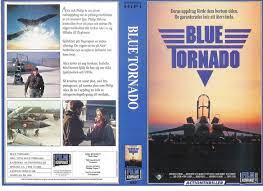
It’s logo looks exactly like Top Gun while the title refers to Blue Thunder.

It has a cast partly made of American TV actors — Dirk Benedict and Ted McGinley — and international stars like Patsy Kensit and David Warner.

It’s directed by Antonio Bido, who also made The Bloodstained Shadow and Watch Me When I Kill, who co-wrote it with Gino Capone, who also wrote Conquest.

It stars as a ripoff of Top Gun and somehow has some amazing shots of real jets in action instead of stock footage. Obviously, Bido got access to some Italian military bases and uniforms to make this look good. So when it starts like any flyboys against the establishment movie, you may be fairly shocked — spoiler warning — when aliens show up.

As they work on new flight maneuvers, Colonel Alex Long (Benedict) — he’s Maverick but his call sign is Firebird — and Philip (McGinley) — he’s Goose but answers to Thunder — see mysterious lights. After being warned off, Phillip wants to see exactly what it is and flies directly into the light, disappearing and his plane showing up the next day. Alex is accused of sabotaging his friend’s plane and making up the UFO tall tale. He’s finally able to convince his commander (Warner) to take another trip which costs NATO several more jets. Finally, he becomes friends with a UFO expert named Isabella (Kensit) and prepares to find Phillip by climbing a mountain, guided by Phillip’s dad who just so happens to be a mystic mountaineer.

I thrilled to Lieutenant Starbuck (or Templeton “Faceman” Peck) being best friends with Jefferson D’Arcy. The best part is when Alex gets to the mountain’s peak, his friend is just standing there, backlit by a UFO and they just leave. That’s the ending. Pals, walking down a mountain, after literally finding aliens, no words need be said, I guess.

In Aenigma: Lucio Fulci and the 80s, Bido claimed that Fulci saw a private screening of this movie, then got up on stage and said, “Nobody in Italy would have been able to do something like that.” This does not seem like something Fulci would do or a movie he would like.

How wonderful is it that this movie ends with the quote  “There’s life on every star” from Goethe?

You can watch this on YouTube.

St. Helens (1981)

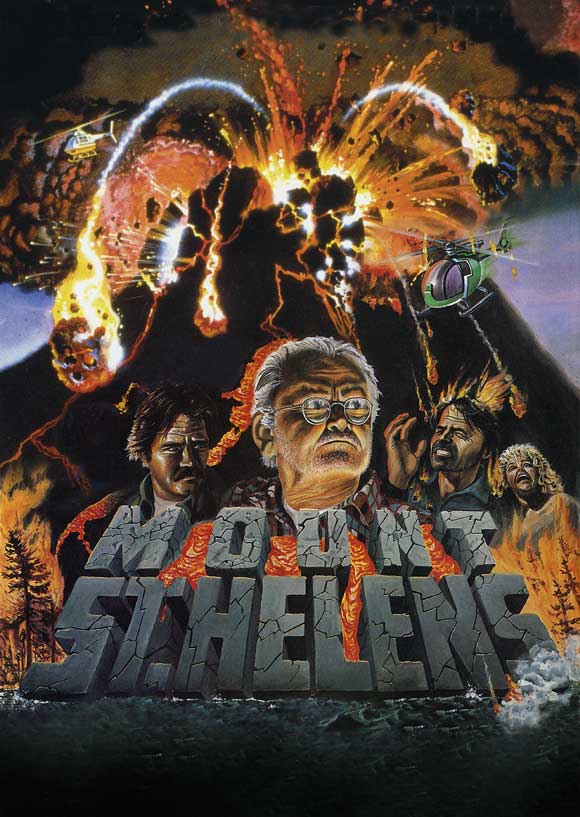
Directed by Ernest Pintoff, written by Peter Bellwood and Larry Ferguson and based on a story by Michael Timothy Murphy and Larry Sturholm, St. Helens aired on HBO on May 18, 1981, a little more than a year after the real eruption.

St. Helens begins on March 20, 1980 with an earthquake measuring 5.1 on the Richter scale being unleashing by the volcano, the first activity in more than a hundred years. It causes Otis Kaylor (Ron O’Neal) to nearly crash into some loggers as he makes an emergency landing.

United States Geological Survey volcanologist David Jackson (David Huffman) soon shows up to learn more. He’s actually playing someone very close to David Johnston, a scientist who died in the actual volcanic eruption. His parents were angry that not only was her son portrayed as a daredevil but also how much the movie got wrong about the science. Before the movie aired, 36 scientists who knew Johnston signed a letter of protest against the film, saying that “Dave’s life was too meritorious to require fictional embellishments” and that he “was a superbly conscientious and creative scientist.”

He soon becomes friends with a waitress and single mom named Linda Steele (Cassie Yates) and upsets her boss Clyde Whittaker (Albert Salmi) and the locals at Whittaker’s Inn about the danger of the eruption, all while Sheriff Dwayne Temple (Tim Thomerson) tries to keep law and order.

Watching this movie in 2024, it’s amazing how MAGA the people of the town are. It’s no accident that Bill McKinney from Deliverance is one of them. The loudest is the owner of the Mount St. Helens Lodge, Harry R. Truman (Art Carney), who refuses to leave the blast radius and becomes so famous for his stand that he basically can’t leave if he wants to live up to the character that he has created for himself. His sister, Gerri Whiting, served as a historical consultant for the film. According to her, Harry Truman and David Johnston were friends.

At 8:32 a.m. PDT on May 18, 1980, David hikes to find a massive bulge that has been growing on the north face of the mountain while Harry goes fishing in Spirit Lake. As David promised to the locals, they are both annihilated by a force similar to a nuclear bomb going off in their faces.

Sadly, the David who played David — David Huffman — died a sad death as well. He was only 39 years old when he was stabbed twice in the chest while fighting with a would be car thief. He died near instantly.

Why would I watch a movie so surrounded by death and sadness? Because it’s the first Hollywood movie scored by Goblin. Let me tell you, there’s nothing that says the Pacific Northwest more than Italian prog rock.

You can watch this on YouTube.