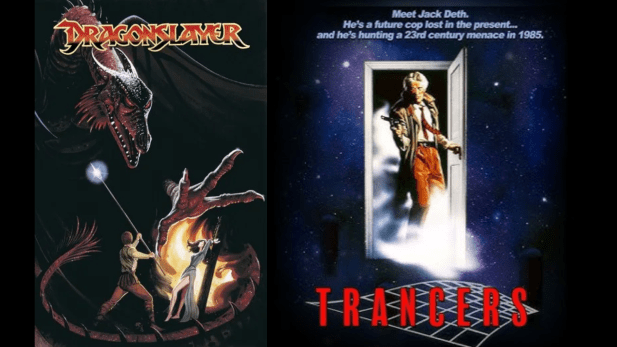
APRIL MOVIE THON 4: Dragonslayer (1981) and Trancers (1984): Two Great Film Scores but Only One in Service of Its Film

April 3: National Film Score Day- Write about a movie that has a great score.

ABOUT THE AUTHOR: Exploitation-film historian A.C. Nicholas, who has a sketchy background and hails from parts unknown in Western Pennsylvania, was once a drive-in theater projectionist and disk jockey. In addition to being a writer, editor, podcaster, and voice-over artist, he’s a regular guest co-host on the streaming Drive-In Asylum Double Feature and has been a guest on the Making Tarantino podcast. He also contributes to the Drive-In Asylum fanzine. His essay, “Of Punks and Stains and Student Films: A Tribute to Night Flight, the 80s Late-Night Cult Sensation,” appeared in Drive-In Asylum #26.

Dragonslayer (1981) and Trancers (1984): Two Great Film Scores but Only One in Service of Its Film

The mating of visuals to music can be transcendent. Think of how many movies, even stone-cold masterpieces, wouldn’t be as effective without their iconic scores by musical geniuses such as Max Steiner, Erich Korngold, Bernard Herrmann, John Williams, Miklos Rozsa, Henry Mancini, John Barry, Jerry Goldsmith, Vangelis, Danny Elfman, and, of course, the greatest film composer of all time, Ennio Morricone.* And we can’t forget groups who did scores, like Goblin, Tangerine Dream, The Beatles, Pink Floyd, The Who, Nine Inch Nails, and Queen. Music has always been a part of movies even in the silent era. 

A great score can elevate a movie or hurt it. My fundamental maxim for judging the effectiveness of a score is whether I’m paying more attention to the score than the film itself. During my prime theater-going days, I went to see Dragonslayer, a now-forgotten film from 1981, a year packed with classics like Raiders of the Lost Ark, The Empire Strikes Back, Superman II, Altered States, Flash Gordon,** The Evil Dead, An American Werewolf in London, The Howling, Ms. 45, and Possession. I’d read in reviews before buying my ticket that the score by legendary composer Alex North was exceptional. My expectations were high.

So there I sat on opening day in a Philadelphia grindhouse—not one of the scarier ones—enjoying Dragonslayer, a decent enough film. And the reviewers were right: Alex North’s score was fantastic. (It was later nominated for an Academy Award.***) The score was so good that it took me right out of the film’s universe. The music had transformed this urban shithole, with urine-stained floor, broken seats, and tattered velvet curtain, into Carnegie Hall. (If only it could have literally done that—and changed the wino snoring next to me into a tuxedoed high-society type offering me a single malt Scotch.)

It was then that I realized that this was not a good thing. All the effort that had gone into creating that awesome-looking dragon had been lost on me. I’d closed my eyes and was zoning out to the music. While it was a classic symphonic score, it wasn’t the usual rousing John Williams stuff. Instead, it was more brooding. North had incorporated complex lines with counterpoint and some atonality. It’s not that the score was inappropriate to the action. It’s just that it was so much better than the film itself that it became a distraction and put a damper on my viewing experience. Dragonslayer’s score, though outstanding, does no service to the film it supports.

But sometimes—more accurately, rarely—a film with a few good elements that would otherwise be forgotten is improved so much by an unexpectedly great score that both the film and its score live on, each beloved. Case in point: Trancers (1984) a film I first watched on home video. 

On paper, Trancers doesn’t look like much: a low-budget mash-up of Blade Runner and The Terminator that Charles Band and his Empire International Pictures dumped into Chicago and LA theaters to make a few bucks before the VHS cassettes hit the shelves at Blockbuster. But Empire made exploitation films that were a cut above the rest, so it looked good, courtesy ace cinematographer Mac Ahlberg. And it had some other good things going for it: stand-up comedian Tim Thomerson, perfectly cast as Jack Deth, the futuristic gumshoe; future Best Actress winner Helen Hunt as his juvenile love interest; and a funny, clever screenplay from Danny Bilson and Paul De Meo. That duo went on to write even more great stuff, including Zone Troopers (1985), Eliminators (1986), and The Wrong Guys (1988) for Empire; The Flash (1990) for television; The Rocketeer (1991) for Disney; and Da 5 Bloods (2020) for Spike Lee, which was released after De Meo’s death. These things make Trancers memorable, to be sure, but you’ll be blown away by the score by Phil Davies and Mark Ryder.

Like the score in many 80s films, the Trancers score used the premier electronic instrument of the day, the Fairlight synthesizer. The main theme, which serves as the musical motif throughout the film, is simplicity itself: an initial burst of synthesizer whine, followed by a slow, haunting melodic line in a minor key supported by swelling harmonies. It’s mournful mood music that stands in contrast to the film’s action scenes. The film may be part science fiction, part noir, but the music emphasizes the noir. Like the Dragonslayer score, it calls attention to itself, but does so in a way that doesn’t violate my rule. Instead of distracting, it engages.**** George Bernard Shaw once said, “Music washes away from the soul the dust of everyday life. To this day, I can’t listen to the Trancers soundtrack without being moved.

Trancers was so successful on home media that it became a franchise with seven installments.***** Charles Band’s brother Richard, Empire’s house composer, reworked Davies and Ryder’s compositions through Trancers III before the uneven series turned to other composers and music with lesser effect. Recently, there’s even been talk of a Trancers TV series. Jack Deth may live on, abetted, I hope, by the original Trancers score.

But, you ask, “Isn’t the Trancers soundtrack just a knock-off of Vangelis’s opening theme from Blade Runner?” It’s true that Trancers and Blade Runner are both science-fiction films with synthesizer scores. The difference is that the Trancers score, even if it was inspired by Blade Runner, is better. If you weren’t scorched by my hot take there, here’s a molten-lava take: The Trancers score is among the best movie scores of all time. If you don’t believe me, some kind soul has put together a 10-hour loop of the theme, which you can listen to on YouTube.

There you have it: two genre films, Dragonslayer, a big-budget studio film with high ambitions, and Trancers, a low-budget exploitation film with modest ambitions, both with excellent scores. But only one score does what it’s supposed to do, and it does so beautifully. I want the Trancers theme played at my funeral as I head down the line to the next life.

* For my money, the scene in The Good, the Bad and the Ugly with Eli Wallach as Tuco running through the cemetery to “Ecstasy of Gold” by Maestro Morricone is the greatest music cue in any movie ever. If perfection can exist in this world, this is it. 

** If you read any discussion of movie soundtracks mentioning the rock group Queen, you’ll always sing aloud “Flash! A-ah… Savior of the universe!” See? You did just now. It’s an immutable law of the universe.

*** North received 15 Academy Award nominations, including one for the American standard “Unchained Melody,” which he wrote early in his career for the film Unchained. If that was the only thing he’d ever written, I’d say he had an amazing life.

****  Just last month, Band released to YouTube a black-and-white remastering of Trancers. The noirish score complements the monochrome images even more brilliantly.

*****Six features and one 20-minute short. The short, originally intended as a segment of the Empire portmanteau film Pulse Pounders, was shot in 1988 but was unreleased until 2013. It fits between Trancers and Trancers II on the series’ timeline and is lovingly called “Trancers 1.5” by fans.
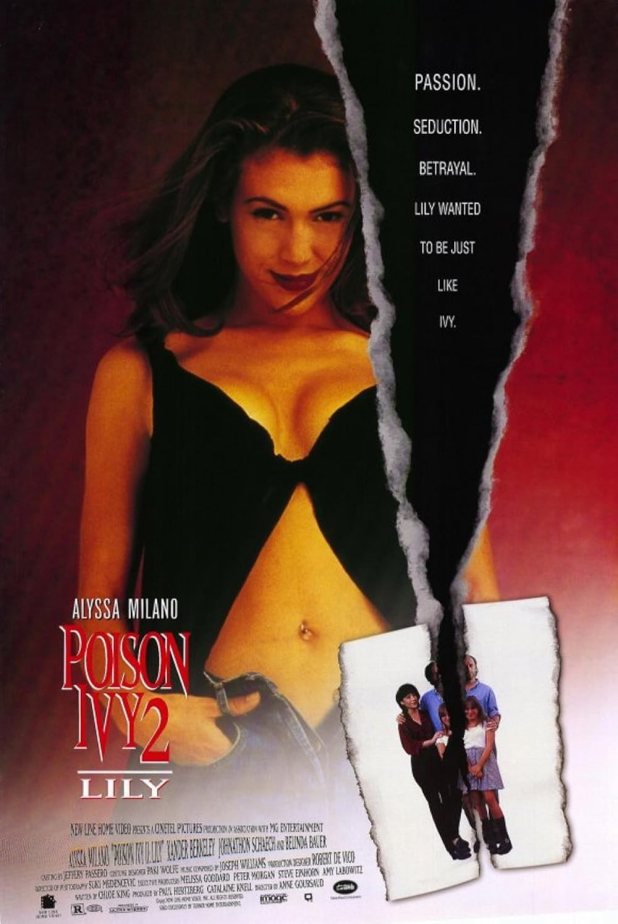
 

APRIL MOVIE THON 4: Poison Ivy II: Lily (1996)

April 2: Get Me Another- A sequel or a movie way too similar to another film.

Anne Goursaud may be known for editing Francis Ford Coppola’s films Bram Stoker’s Dracula, The Outsiders and One from the Heart, but she also had a run of directing in the 90s, working with Alyssa Milano to make this and another erotic film, Embrace of the Vampire, before also directing Love In Paris, which was released in the U.S. as Another 9 and 1/2 Weeks and brought back Mickey Rourke as John Gray and giving him a new love interest played by Angie Everhart. As you can imagine, it did not do well.

She also made this a sequel to Poison Ivy by name only. Milano is Lily Leonetti, a girl from Kalamazoo who has come to California to learn to be an artist. She moves in with Tanya (Kathryne Dora Brown), Bridgette (Victoria Haas) and Robert (Walter Kim), three fellow students who each have their own unique artistic skills. She soon finds a diary and nude photos of a girl named Ivy, who she becomes obsessed over, wishing that she could be as fearless as her.

Those photos: Jaime Pressly confirmed in 2008 that they are her, saying “Drew plays Ivy in the first Poison Ivy film, and in Poison Ivy II, Alyssa Milano plays the art student who moves into Ivy’s old room in a house with other students. She finds a diary and pictures of Drew’s character in a closet. The pictures are supposed to be of Drew, but they’re of me, though you never see my face.”

Pressly is the lead in the next movie, another unconnected effort, Poison Ivy: The New Seduction.

As she takes classes from Donald Falk (Xander Berkeley, Christopher in Mommie Dearest), he tries to seduce her, all while she’s babysitting his daughter Daphna (Camilla Belle), becoming friends with his wife Angela (Belinda Bauer) and falling in love with fellow student, the complicated sculptor Gredin (Johnathon Schaech). By the end of the movie, she’s changed so much that he’s fallen out of love with her, the teacher tries to assault her during Thanksgiving dinner, and his daughter runs into traffic.

This may be the most 90s movie to ever exist, feeling like Delia’s catalogue becoming a sentient being through Hot Topic. There’s one song that sounds so much like Portishead that I was convinced it was a remix I had never heard before. Monks chant over nearly every song, and I’m shocked that nobody shops at Wet Seal in this. This movie goes to the mall, right?

Anyway, the married art teacher gets so enraged over Alyssa Milano that he tries to shove her out the window. Her boyfriend—who came back to her—saves her at the last minute. She stays in California, but how can they return to art school?

This would be Milano’s last movie with nudity, but perhaps two was enough for most teenage 90s boys. Maybe the internet got in more homes and they learned that. they didn’t need to go to the video store to see nude women. Alyssa Milano had bigger and better things to do. As for the series — well, the title — there would be two more that I will get to.

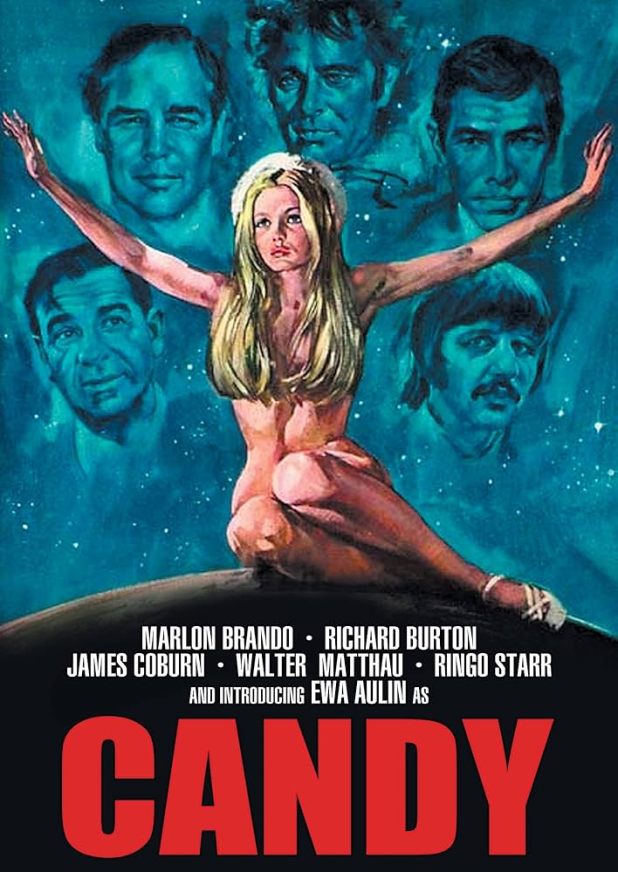
APRIL MOVIE THON 4: Candy (1968)

April 1: Drop A Bomb- Please share your favorite critical and financial flop with us!

I’m obsessed not just by flops but by the late 1960s and early 1970s, when Hollywood wanted to figure out how to get the kids into theaters. Easy Rider was a hit, so they financed movies like The Last MovieHeadBeyond the Valley of the DollsSkidooZabriskie Point and so many more.

This felt like a can’t miss: the novel Candy by Terry Southern and Mason Hoffenberg using the name Maxwell Kenton. They got paid $500 by Olympia Press, the same people who printed the first edition of Lolita. They wrote it chapter by chapter, trading things back and forth. They were amazed that it became a big deal, as Hoffenberg said, “Do you remember what kind of shit people were saying? One guy wrote a review about how Candy was a satire on Candide. So, right away, I went back and reread Voltaire to see if he was right. That’s what happens to you. It’s as if you vomit in the gutter and everybody starts saying it’s the greatest new art form, so you go back to see it, and, by God, you have to agree.”

Candy Christian is a Midwestern girl who just wants to make people happy. Of course, being an eighteen-year-old and gorgeous blonde, most of them want to have sex with her, then own her. She wants to make love to the gardener, but that leads to her father nearly dying from a concussion and adventures that will take her around the world.

Originally, Frank Perry—who directed The Swimmer—was going to make this, and Hayley Mills would play Candy. Her father wouldn’t let her play the role, so Christian Macquand got the rights. He’d just helped Marlon Brando buy his island—Brando’s son was named for him—and that got the great actor on board, as well as other big-time box office names.

In Patrick McGilligan’s Backstory 3: Interviews with Screenwriters of the 60s, Southern said that the director “disappointed me by casting a Swedish for the lead role, which was uniquely American and midwestern. He thought this would make Candy’s appeal more universal. That’s when I withdrew from the film.”

That Swedish girl is Ewa Aulin, who is naturally attractive and had already been in the Tinto Brass giallo Col cuore in gola and Giulio Questi’s Death Laid an Egg. Aulin would only be in one other movie that U.S. audiences may see, Start the Revolution Without Me, before appearing in her husband John Shadow’s Microscopic Liquid Subway to Oblivion and Italian films including The DoubleWhen Love Is Lust, Legend of Blood CastleDeath Smiles on a Murderer and Una vita lunga un giorno. By 23, she had tired of acting, divorced Shadow, and met real-estate developer Cesare Paladino. She had two daughters and became a schoolteacher.

Buck Henry took over the script, and the movie got made.

The film starts with Candy daydreaming in her father’s (John Astin) class; she soon falls for the charms of the poet MacPhisto (Richard Burton), who is too drunk to make love to her. The gardener, Emmanuelle (Ringo Starr), attacks her, and she gives in; when his family finds out — he was about to be a priest — they are attacked by his sisters Lolita (Florinda Bolkan in her first movie), Conchitya (Marilù Tolo!) and Marquita (Nicoletta Machiavelli!). Her father gets a brain injury and she goes off with his brother (also Astin) and his wife Livia (Elsa Martinelli), but not before she’s nearly impregnanted by Brigadier General Smight (Walter Matthau) and lusted after by the man who saves her father’s life, Dr. Abraham Krankheit (James Coburn), and filmed by Jonathan J. John (Enrico Maria Salerno). Oh yeah- the doctor’s nurse is Rolling Stones muse Anita Pallenberg.

She meets many men — a hunchback (Charles Aznavour), a guru (Brando, who its said tried to have sex with her for real on camera) and another guru who enlightens her before its revealed that it’s her father and yes, they have just had sex — and by the end, wanders through a field of hippies and flies into space.

Southern said, “The film version of Candy is proof positive of everything rotten you ever heard about major studio production. They are absolutely compelled to botch everything original to the extent that it is no longer even vaguely recognizable.”

Brando said that this was the worst movie he ever made. But man, this excerpt from Marlon: A Portrait Of The Rebel As An Artist by Bob Thomas is just insane: “Brando, of course, wanted his portion of the script rewritten. The screenwriter was Buck Henry, a gifted young comedy stylist who had written The Graduate for the screen. Brandovisitedt Henry at the Plaza Athenee Hotel in Paris accompanied by the French moneyman for Candy, Peter Zoref, a conspiratorial-looking man who wore dark glasses indoors and out. The two visitors found Henry suffering from food poisoning. Henry tried to defer the conference, but Brando insisted on continuing, even while the writer went to the bathroom. While Henry retched, Brando shouted comments about how the comedy elements of his sequence could be heightened. There was a brief silence from within, and Brando opened the bathroom door to find Henry nearly unconscious, hunched over the toilet. Brando lifted the slender writer into his arms, carried him into the bedroom, and laid him out on the bed. Brando sat beside him and continued reading from the script and making suggestions to increase the hilarity. Zoref remained stolid behind his dark glasses, occasionally puffing on a cigar. A knock came on the door, and a waiter entered to remove the dinner tray. He stopped and surveyed the scene with open mouth: an (alleged) American gangster sitting in a chair like a stuffed figure, a thin corpse stretched out on the bed, a famous movie star sitting on the bed and guffawing over pages he was reading. The waiter slowly turned and walked out the door, closing it quietly behind him.”

This is the kind of movie that today gets one-star hate reviews by hip kids on Letterboxd who can’t be bothered to write much more than a sentence. It didn’t fare that well when it was released, either. But man, it’s a mess, a glorious mess, but one that has Coburn being incredible, famous people acting like morons and Aulin being some kind of android angel who has floated into this movie and bewitched everyone. She married Shadow while making this, a rock star who would one day write the 3D Matt Cimber martial arts movie Tiger Man.

So yeah, it’s a mess, but I love it for that. This is from a time when people were not afraid to fail and would throw money at projects that made no sense. Hollywood emerged from years of musicals and Westerns to try and become cinema, only to fall into blockbusters. But this emerged, a movie shot in France and Italy that looks luscious and yet is dumb throughout, a perfect blend of overindulgence and underwatched.

You can watch this on Tubi.

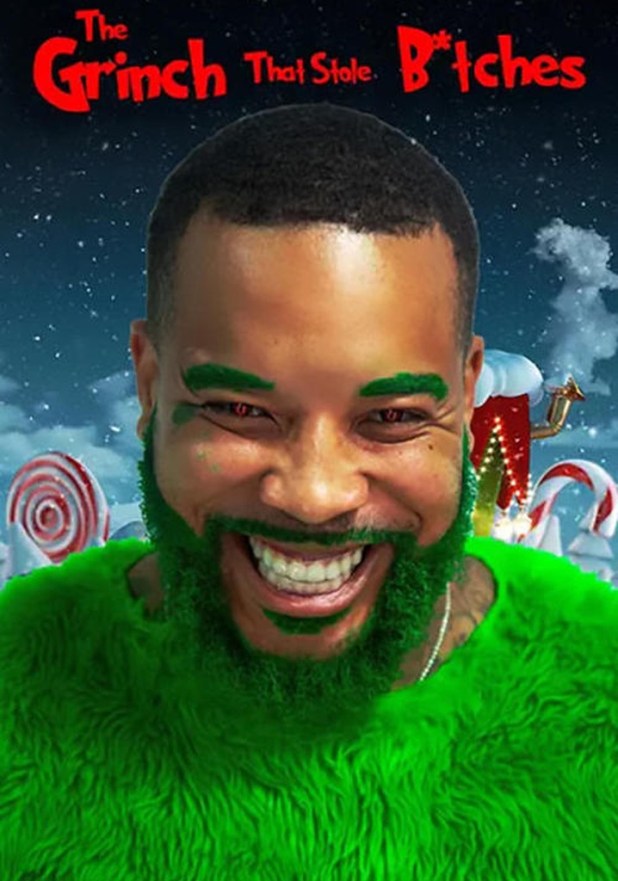
The Grinch That Stole Bitches (2024)

The Grinch (Otis “Money Bag Mafia” Mcintosh) and Santa (Navv Greene) have issues, so the Grinch goes from stealing toys to taking the man’s wife (Christianne “Chrissy Cindy” Jones), and she actually enjoys being with a new man. Or whatever a Grinch is, look, my life has reached the level where my only enjoyment and escape is watching this movie and trying to figure out who it’s for and why anyone other than me would watch it.

Whenever I started to worry that this had no plot, I was rewarded with montage sequences of the Grinch throwing money and women twerking. No notes on that.

I love that this came up as a recommended movie on Tubi, who knows me so well. It’s a minute of plot thrown into a film that feels like several months long and filled with people shouting their dialogue. It also debuted in March, which seems to be the perfect time for a movie set during the holidays, but who am I to question the decisions of the filmmakers? That’s really the least of this movie’s faults. Let’s instead celebrate its best parts, which are almost all curvy black women celebrating the freedom of dance and just taking off their clothes. I wish the Grinch wasn’t a misogynist, but this isn’t the movie where he will learn his lesson. I doubt anyone would want to see that. We should all hope he does better next time.

You can watch this on Tubi.

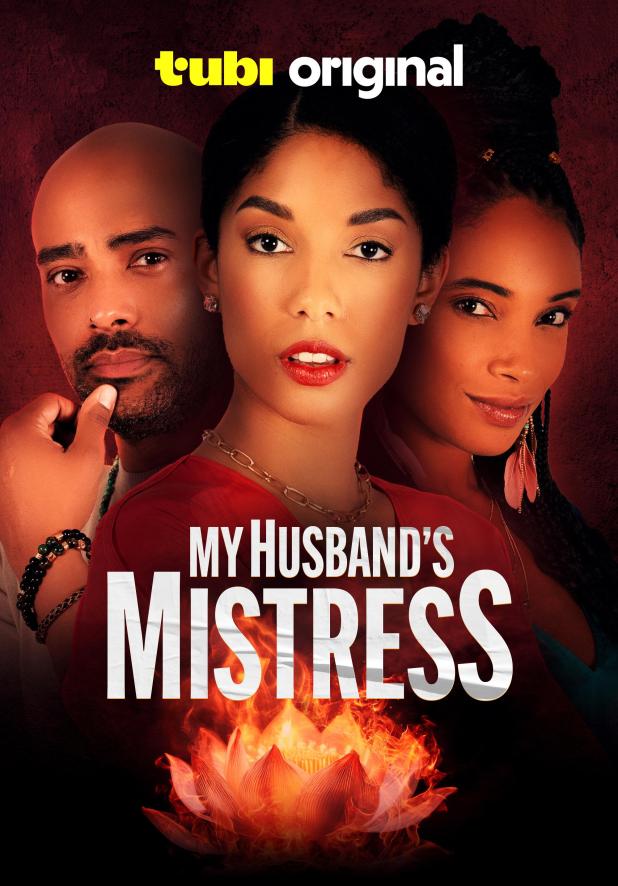
TUBI ORIGINAL: My Husband’s Mistress (2025)

Anna Kent (Raylene Harewood) is the CEO of the company that she started with her husband, COO Brill Cooper (Rainbow Sun Francks). However, he’s been cheating on her with Ophelia Skye (Jessica Thomas), who has discovered an ayahuasca by way of The Substance drug that unlocks the potential of the human spirit. Along with her adopted brother Quan (Christopher Omari), Anna is out for revenge and to save what’s hers.

Directed by Mitchell Ness and written by Juliette Monaco and Emily Pillemer, this has a modern way of looking at the issue: Anna and Ophelia soon learn they have more in common than just both being with Brill. They may be perfect for one another.

That said, no one really cares about each other except the two women. People puke out the elixir and die, Quan gets killed doing Anna’s espionage and podcasters are catty. That said, it’s a Tubi Original out to entertain you with almost no budget. I assume most of the money went to the yogi studio and the Temu activator.

You can watch this on Tubi.

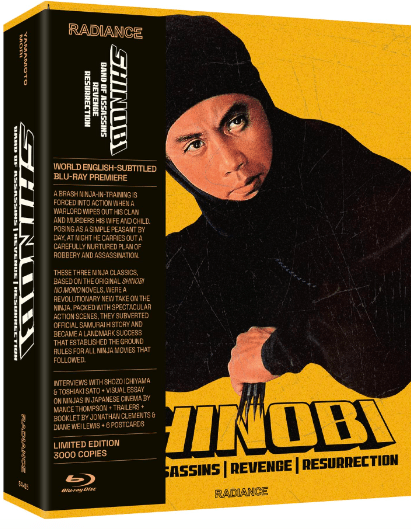
RADIANCE FILMS BOX SET RELEASE: The Shinobi Trilogy (1962,1963)

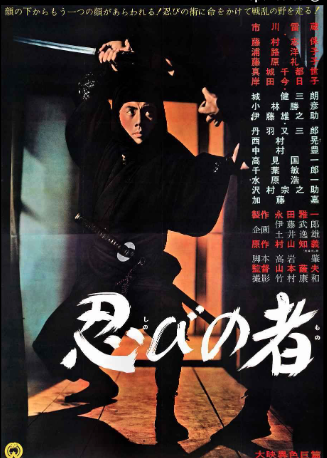
We often think that ninjas only started to exist in the 80s. Yet, in the early 60s, there was a craze in Japan because of the Shinobi no Mono books and these three movies. Written by Tomoyoshi Murayama, these stories were serialized in the Sunday edition of the newspaper Akahata from November of 1960 to May of 1962, with the name meaning “ninja.”

The novels are set during Japan’s Sengoku period and star Goemon Ishikawa, a famous outlaw hero who used his ninja skills to battle the samurai. While the real man and his son were boiled alive in public after their failed assassination attempt on the warlord Toyotomi Hideyoshi, the fictional version has become a Robin Hood-like character, a man with near-superhuman ninja powers at times.

Goemon had already been the subject of several pre-WWII Japanese films- Ishikawa Goemon Ichidaiki and Ishikawa Goemon no Hoji. Still, in the early 60s, when a thief protecting villagers against the rich and powerful would be a theme that resonated with the Japanese, he became a pop culture sensation.

Band of Assassins (1962): Raizo Ichikawa plays Goemon as a young man here, a member of a ninja clan who must constantly worry about being found and destroyed by the samurai. He’s been selected to kill Nobunaga Oda (Tomisaburo Wakayama), which makes the other ninjas jealous. So now, Goemon is nearly a man without a country as he must deal with assassination attempts, double crosses and his mission.

Directed by Satsuo Yamamoto, this turned into the kind of movie that grabbed the attention of Japanese kids. It was intended to be one and done, but by the end, even though only Goemon survives and can escape this world of treachery and violence to have a family, he had to return. Ninjas, a real thing that had disappeared from the world- or is that what they want you to believe? — only to take over pop culture twice in the 20th century.

Revenge (1963): Nobunaga Oda has killed all of the ninjas of the Iga clan, yet he doesn’t know that Goemon has survived. Our hero just wants to build a family and disappear- ninjas are good at part of that- but he’s soon pulled back into combat when his infant son is killed.

Instead of running straight into the bad guys, as most action heroes would, Goemon uses psychological trickery and his ability to hide just about anywhere to drive his enemies crazy. Unlike the first film, where his honor is constantly on the line and he must watch everyone, his goals in this film are much more straightforward: kill the people who ruined his life.

Even though Goemon is boiled alive at the end of this- but not before shouting out the bad guys as way worse thieves than him- there’s still one more movie. How can that happen?

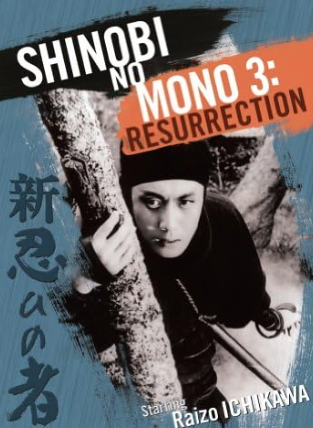
Resurrection (1963): Thanks to Hattori Hanzo (Saburô Date)- yes, the same man who made swords in Kill Bill– Goemon has survived, as he was switched out with another ninja at the last minute. I didn’t see it happen, but that’s just how talented a master ninja can be.

This idea was enough to get director Satsuo Yahamoto to quit the series, which brought in Kazuo Mori to make this for Daiei. It’s revisionist history- perhaps this is where Tarantino got the idea to save Sharon Tate- but in the service of pop culture and film commerce.

Now, he must get the revenge he’s craved for two movies now and take out Toyotomi Hideyoshi (Eijiro Tono). This is more personal and has less swordplay, but I’m sure audiences were ready for more, seeing as how all three of these movies were made over two years.

The Radiance Blu-ray box set of the Shinobi trilogy has digital transfers of each film presented on two discs, made available on Blu-ray for the first time outside Japan. Extras include an interview about director Satsuo Yamamoto with Shozo Ichiyama, artistic director of the Tokyo International Film Festival, a visual essay on the ninja in Japanese cinema by film scholar Mance Thompson, an interview with film critic Toshiaki Sato on star Raizo Ichikawa, trailers, six postcards of promotional material from the films, reversible sleeves featuring artwork based on original promotional materials and a limited edition booklet featuring new writing by Jonathan Clements on the Shinobi no mono series and Diane Wei Lewis on writer Tomoyoshi Murayama. This limited edition of 3000 copies is presented in a rigid box with full-height Scanavo cases and removable OBI strip, leaving packaging free of certificates and markings. You can get this from MVD.

RADIANCE FILMS BLU RAY RELEASE: The Cat (1988)

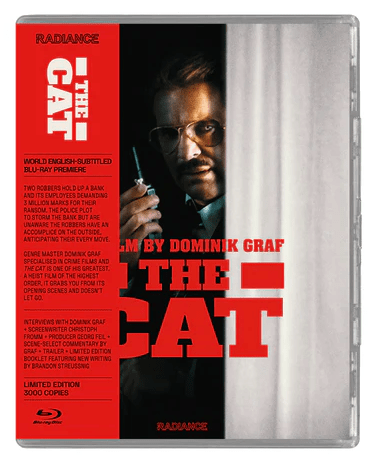
Available on Blu-ray for the first time outside Germany, thanks to Radiance films, The Cat is about a team of bank robbers — Junghein (Heinz Hoenig) and Britz (Ralf Richter) — who hold a bank hostage for 3 million German marks. Yet what the police don’t know is that Probek (Götz George), the true criminal, is hiding outside, directing their every move.

Directed by Dominik Graf and written by Uwe Erichsen and Christoph Fromm, this is a movie is planning and control. Probek thinks he has every angle covered, but he didn’t plan on the bank manager’s wife, Jutta Ehser (Gudrun Landgrebe). She may be even more in control and better at schemes than he is.

Unlike an American heist movie, this isn’t about action. Instead, it’s about the waiting, the moments in-between, the times where tension increases until ready to explode. It does, trust me, but this film has no problem waiting. That makes it so much more different than the robbery films that I am used to.

The Radiance Films limited edition release of The Cat comes inside a reversible sleeve featuring original and newly commissioned artwork by Time Tomorrow, presented in full-height Scanavo packaging with removable OBI strip leaving packaging free of certificates and markings. It has a high definition digital transfer newly graded by Radiance Films and overseen by director Dominik Graf, interviews with Graf, screenwriter Christoph Fromm and producer Georg Feil, scene commentary by Graf, a trailer and new English subtitles. You can get it from MVD.

RADIANCE BOX SET RELEASE: The Bounty Hunter Trilogy (1969, 1972)

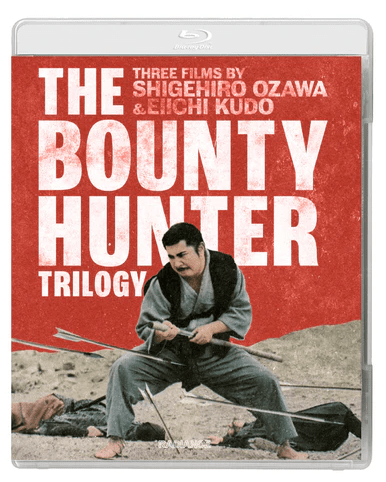
We all know Lone Wolf and Cub in the U.S. Before that, Tomisaburô Wakayama starred in these three films, which combine Italian Westerns with Eurospy for a series of saucy, spicy and delicious dishes.

Killer’s Mission (1969): Directed by Shigehiro Ozawa, this film introduces Ichibê Shikoro, a secret agent/doctor/all-around tough guy who has been hired to protect the only person who can save Japan. Shikoro even has gadgets like any good spy of the time, such as a sword cane, a folding pistol and knives that emerge from his sandals. He’s joined by a female spy who has a comb that doubles as a dart gun!

The Satsuma clan wanted to purchase a thousand rifles from a Dutch ship that would give them a modern edge against their rivals, the Tokugawa, and change the balance of power. Of course, Ichibê Shikoro is more than up to this challenge, even fighting another samurai in a Sergio Leone-inspired duel. Well, Leone stole from Japan first, you know?

I’d never seen any of these films and am frankly amazed by how fun they are, even if the hero never works as a bounty hunter.

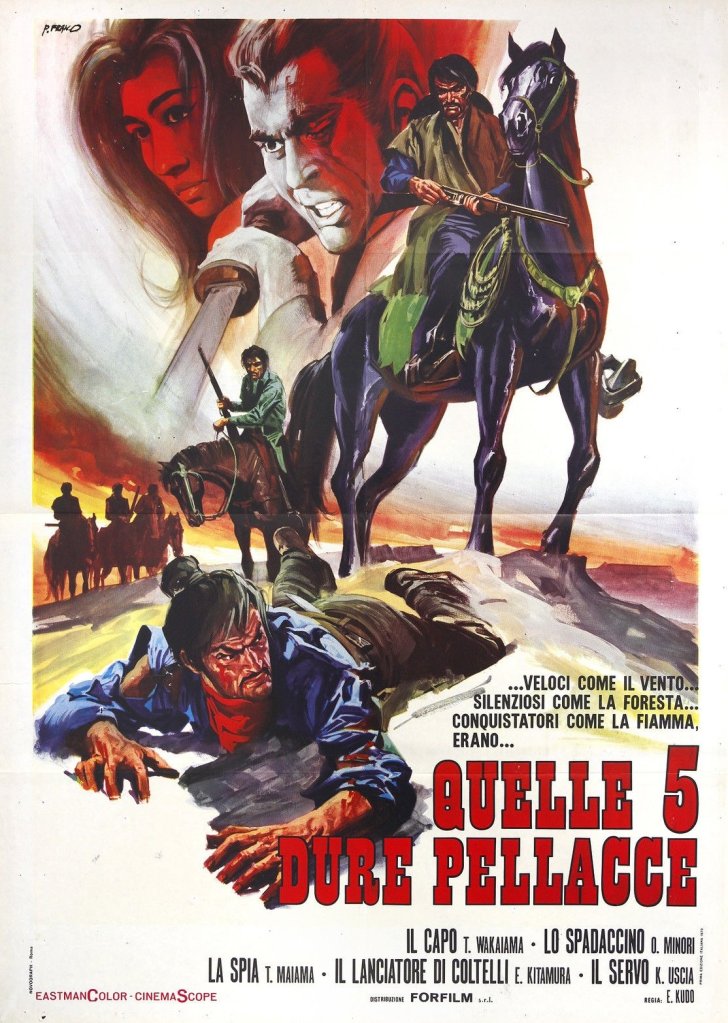
The Fort of Death (1969): Coming out the same year as the first movie, this Eiichi Kudô-directed movie brings back Ichibê Shikoro in the service of the villagers of Enoki Village, who have hired him to stop the elite from taxing them into oblivion.

Seeing as how its hero starts the movie dragging a dead body while on a horse and smoking a little cigar, and it ends with a Gatling gun-powered massacre, this is very much the West going to Italy before coming to Japan. Als,: They brought some ninjas.

This is the kind of film where the bad guys take a dead body of their comrade and throw him like a bomb at their enemies, only to be bested by a massive gun that needs to be cooled by the only liquid left, urine. That said, the only weapon it really needs is Ichibê Shikoro, dual wielding a katana and a six-shooter, somewhere between the West and the East in his own strange time zone, killing everyone in his path, no long a spy, still a doctor, always a bad ass.

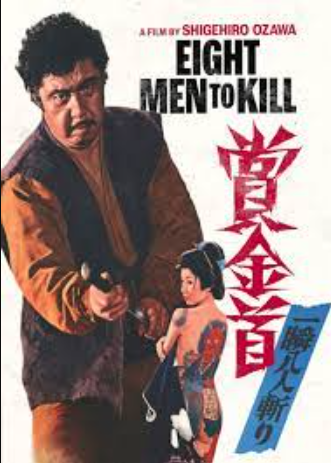
Eight Men to Kill (1972): Three years later, Shigehiro Ozawa would direct the final film in this trilogy. Ichibê Shikoro must find the missing gold in five days before a solar eclipse happens and Japan falls into turmoil again.

Everyone else that he comes into contact with only wants the gold for themselves, making our hero the lone center of morality in a grim and bloody world. How grim? How about at least two scenes where bellies are sliced open to reveal stolen gold, as well as numerous heads, hands and arms all sliced off.

This feels like it mimics the Italian Westerns’ move to darker and more horror-filled ideas before comedy took over. It’s very open about how little its hero cares about the government and how they handle their business; even when the villains pay for their crimes, there’s still very little hope by the end.

This Radiance Films box set has extras including audio commentary on Killer’s Mission by Tom Mes, an interview with film historian and Shigehiro Ozawa expert Akihito Ito about the filmmaker, a visual essay on Eiichi Kudo by Japanese cinema expert Robin Gatto, a series poster and press image gallery, trailers and more. You can get this from MVD.

CLEOPATRA ENTERTAINMENT BLU RAY RELEASE: Dark Sanctuary: The Story of The Church (2024)

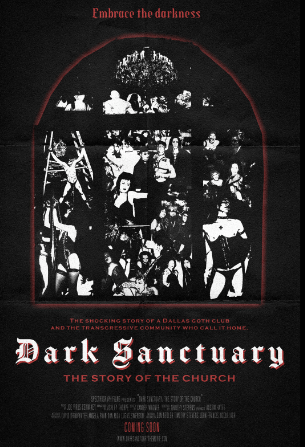
This is a feature-length documentary on the historic Dallas, TX (2424 Swiss Avenue) goth club The Church, one of the longest-running clubs of its kind in the U.S. You’ll meet those who run the place, musicians, local bands, patrons and other people who explain why this place is just so important, as well as its motto of “Enter Without Prejudice.”

There’s a storyline in here with DJ Joe Virus, who went from a local to a national artist, as well as how the club would eventually close after the times of COVID-19, as a big company bought the entire block. Seeing the people whose lives were made by the space come back for one last time is quite emotional.

I always dreamed of places like this, as Pittsburgh had some minor spots — and I got here after The Decade and the Electric Banana were closing up — but nothing like this. If your town has a place with a history and a scene, celebrate it. You won’t know what you have until you lose it.

You can get this from MVD and learn more at the official site.

ARROW VIDEO BLU RAY RELEASE: The Last Video Store (2023)

This took me way too long to see, and wow- it’s perfect.

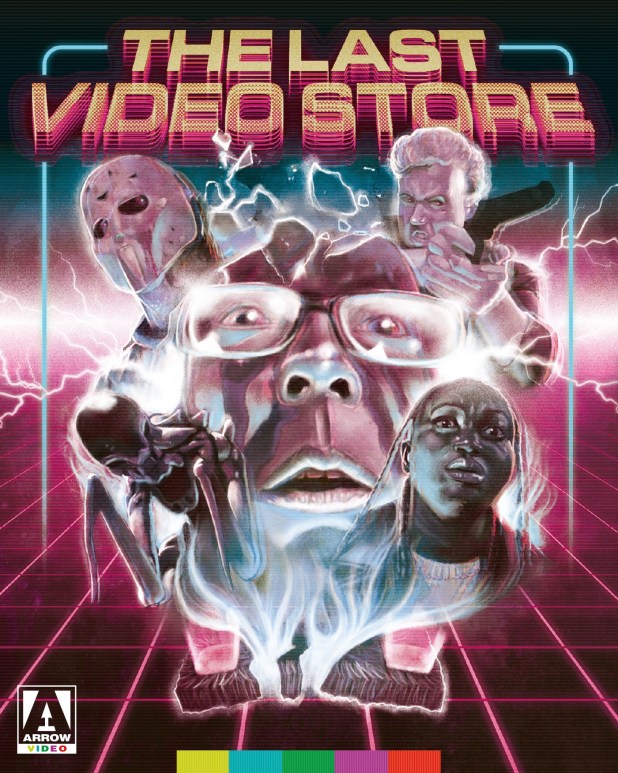
Kevin (Kevin Martin) runs Video Blaster, a rental store whose clientele is slowly dying off. One of his best customers, in fact, has just died, and his daughter Nyla (Yaayaa Adams) has come to drop off his last rentals and find out exactly what the strange black and red glowing VHS her father had is all about.

Then things get crazy.

Directed by Cody Kennedy and Tim Rutherford (who wrote the script with Joshua Roach), this has that cursed tape—The Videonomicon—reanimating the rentals of Nyla’s father: a movie starring action hero Jackson Viper (Josh Lenner), one of the many Castor Creeley (Leland Tilden) Beaver Lake Massacre slasher sequels and an early 90s CGI Predator rip-off. Now, the store is as deadly as so many of the movies inside it and cut off from the outside world.

Steven Kostanski from Astron-6 did the effects. Martin used to run an actual video store, and this starts with a fake Italian movie that I wish I could watch. It is based on The Lobby DVD Shop in Edmonton, Alberta, Canada. There are movies with titles like Preystalker and Warpgate in this, and yes, I would watch both of those, too.

At one point, Kevin says, “I used to get paid to talk about movies with people, but then they stopped coming.” Anyone who regularly visits this site will feel so much of this movie. If you can name more than ten Empire Pictures movies, they pretty much made this movie for you.

The Arrow Video blu ray release of this film has extras including commentary by film critics Matt Donato and Meagan Navarro; a new visual essay by film critic Heather Wixson co-author of In Search of Darkness; a new visual essay by film critic Martyn Pedlar; several short films by Cody Kennedy and Tim Rutherford; clips from the first attempt at making this, behind-the-scenes videos; a trailer; an image gallery; an illustrated collector’s booklet featuring new writing by film critics Anton Bitel and Alexandra West; a reversible sleeve featuring newly commissioned artwork by John Pearson and a double-sided fold-out poster featuring newly commissioned artwork by John Pearson.

You can buy it from MVD.