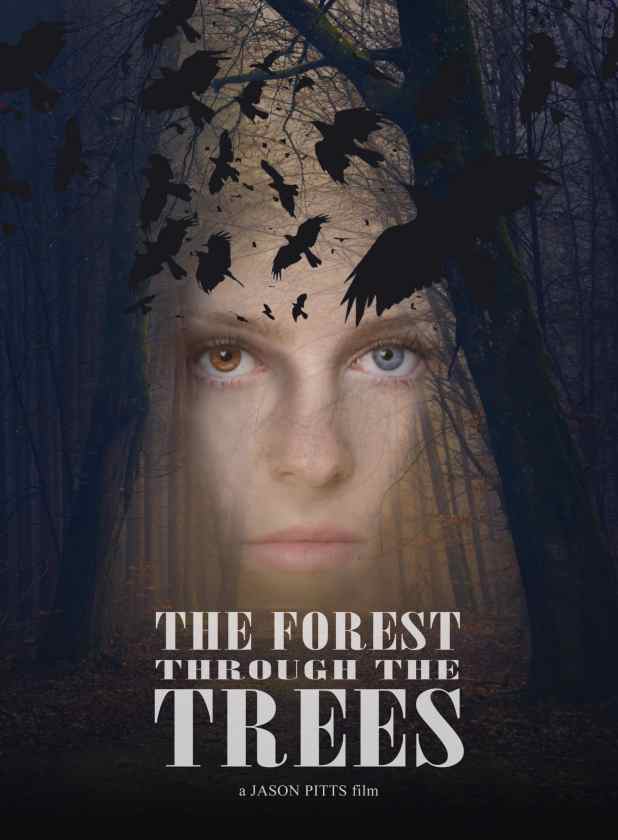
The Forest Through the Trees (2025)

ABOUT THE AUTHOR: Exploitation-film historian A.C. Nicholas, who has a sketchy background and hails from parts unknown in Western Pennsylvania, was once a drive-in theater projectionist and disk jockey. In addition to being a writer, editor, podcaster, voice-over artist, and stand-up comedian, he’s a regular guest co-host on the streaming Drive-In Asylum Double Feature and has been a guest on Making Tarantino: The Podcast. He also contributes to the Drive-In Asylum fanzine and the Horror and Sons website. His most recent essay, “Of Punks and Stains and Student Films: A Tribute to Night Flight, the 80s Late-Night Cult Sensation,” appeared in Drive-In Asylum #26.

I enjoy regional horror films. Indeed, the modern age of horror films was kicked off in 1968 with the release of George Romero’s Night of the Living Dead, which was filmed in Pittsburgh. I’ve been watching a lot of Dixieland microbudget films lately. They often share cast and crew members, and while some are better than others, the biggest thing that they have in common is moxie. Their filmmakers each had a dream of making a film and not only hustled up the money (usually under $100,000), but also finished their films and secured distribution. To that, they have my sincerest congratulations on completing these Herculean tasks. Today, we look at the first film of Arkansas writer/producer/director Jason Pitts, The Forest Through the Trees.

Pitts has fashioned a satanic cult film where a young woman (Annie Sullivan), along with her lover (Alivea Disney) and her stepfather (James Stokes), runs afoul of a demon cult in that forest through the trees. Daughter and stepfather have not been on good terms, especially since the disappearance of the daughter’s mother (Anna Hardwick), who suddenly returned to the cult that controlled her as a young woman. Evincing some larger notes, the film progresses as an existential story of personal sacrifice for each of the main characters, with gory make-up effects and plot twists along the way.

At the screening I attended at the promising new Columbia, South Carolina venue The Babylon Kino, Pitts cited films like Hereditary, Poltergeist II: The Other Side, and Rosemary’s Baby and the TV show Lucifer as influences. While I get those references—particularly the homage to Julian Kane, the creepy preacher with the hat from Poltergeist II—I noticed touches reminding me of Enter the Devil (1972), a regional horror film about a satanic cult in the desert; Ti West’s much-loved 70s throwback film, The House of the Devil (2009); and The Prophecy (1995), with Christopher Walken as the Angel Gabriel on Earth.

Overall, this is an above-average film from a filmmaker whose previous effort was the well-received fan film Vorhees Night of the Beast (2021), where Friday the 13th’s Jason (Stokes) fought Bigfoot (professional wrestler Jacob Southwick). Low budget doesn’t necessarily mean low quality, and Pitts gets strong performances from Stokes, Disney, and Scott Doss, who, with hat, bolo tie, and malevolent cackle, does a grand job channeling the late actor Julian Beck from Poltergeist II. Pitts is a natural with casting and directing actors, and his dialogue generally sounds authentic. 

That said, my biggest issues with the film are pacing and consistency of style. The film runs 107 minutes, which is about 25 minutes too long. (Apart from saving money on shipping film canisters, Roger Corman knew that 82-minute films didn’t usually outstay their welcome.) Now, understandably, a microbudget doesn’t lend itself to big set pieces, and while Pitts does well with his violence and gore, some of which is unsettling, the film is a lot of talk before its neat hellzapoppin’ third act. Doss is so good doing his “we are here for the final sacrifice in three parts” (almost underscoring the padding), but he would have been even more effective with less speechifying.

The film’s technical credits are generally pro throughout—a shout-out to Italian composer Simone Cilio’s effective score—but I wish the film, especially some of the nighttime shots, looked a little more balanced. Though not a hindrance to enjoying it, skin tones, for example, shouldn’t look good in some scenes and like the actors had jaundice in others.

At the end of the day, Jason Pitts and his cast and crew should be proud of what they accomplished for so little money. I wish them well and look forward to their future film projects. 

The Forest Through the Trees from BayView Entertainment, the New Jersey distributor friendly to microbudget filmmakers, will soon be available on streaming services. Support regional filmmaking and check it out. 

Deathpit (2023)

Retired pro-wrestler and MMA veteran Jack “Horsepower” Silver (director, writer and star Greg Burridge, who is also a pro wrestler) has been taken to Deathpit, an underground fighting tournament featuring some of the world’s worst criminals and fighters, like Hammerstone (Bryan Larkin) and Kasparnov (Thomas Dawkins). Horsepower has no idea if what’s happening is happening to him at times, as he’s been hit in the head so many times that his ex-wife once threw in the towel in his last match when he was punched once.

I don’t know Progress Wrestling or the UK indy scene all that well, but I do know that the man playing Kasparov is Cara Noir. A lot of the stuntwork is done by wrestlers, so the fights are the main draw here, and they’re wild, including X-ray moments like a video game. Sure, I may have watched tons of underground fighting movies lately, but this stood out because of its high-energy style and willingness to go insane in its matches.

You can watch this on Tubi.

EFC (2024)

Cassady Jones (Karlee Rose) and Alexa Star (Kathryn Aboya) are about to battle for the Excelsis Fighting Championship title. Still, this fight is about more than just who the better woman is. It may be about the future of women’s MMA. As the women try to prove their fighting ability, Donna (Stephanie Jones), the president of the company, is dealing with corporate battles with shareholder  Frank (Richard Zeppieri) and PR man John (Alex Cruz). No matter who wins the fight, Scarlett (Avaah Blackwell) is waiting to take on the survivor.

The real star is the fight scenes, choreographed by Wayne Wells and Hubert Boorder. Working with director and co-writer Jaze Bordeaux, they elevate a low-budget fight movie. Sure, it’s a somewhat expected story, but when these fights feel like you’re getting grounded and pounded, you’ll forget that and just savor this movie’s gritty look and feel. I was really surprised by how much I enjoyed it!

You can watch this on Tubi.

Champions (1997)

I am a very simple man and Champions — AKA Karate Tiger: The Champions* — is the movie I am looking for. Yes, it’s every underground fighting movie ever — but it has Nikos from the My Big Fat Greek Wedding movies (Louis Mandylor) as William Rockman, the one-time Terminal Combat champion of the world, who quit the sport — it’s UFC — when he killed someone in training. Yes, it’s every underground fight movie you’ve ever rented, but somehow dialed up beyond what it should be.

After Terminal Combat has been outlawed, Max Brito (Danny Trejo, having the best time ever) gathers the champions, like The King (Ken Shamrock) and either takes their wives or kills their brothers, like Rockman’s sibling Ray (Jeff Wolfe), which brings everyone into a tournament to the death that has some wild characters in it, like a Japanese master (Rich Rabago) who doesn’t want to fight a female competitor and then kills her to the silence of everyone watching. Awkward.

There’s a microchip in the head of The King, which Max Brito uses to make him kill! A microchip in the World’s Most Dangerous Man’s head! That’s the only way I can believe that anyone in this can beat him.

Then, this movie doubles down with roles for George “Buck” Flower, Lee Reherman (Hawk from American Gladiators who plays the Jesus-living fighter Steele Manheim), Bobbie Blackford (Sgt. Kimberly Pepatone, who is here to bust the fight ring like Stryker from the Mortal Kombat games), Larry B. Scott (from Revenge of the Nerds), Harrison Young (Senator Able, who has his own prison fighter, Vedder, who is played Cristos, who was in Desperado), Lelagi Togisala (who is Jackal, a trickster who –s poiler — gets stabbed by Vedder), Fabian Carrillo (the Latin Dragon), David Rowe (Mage) and HOLY SHIT Kool Keith playing himself? Dr. Octagon, Dr. Dooom, Black Elvis, Reverand Tom, Mr. Nogatco, Poppa Large, Keith Korg, Rhythm X, Mr. Gerbik, Big Willie Smith, Tashan Dorrsett, Dr. Ultra Crazy…Kool Keith is in this underground MMA movie!?!

Directed by Peter Gathings Bunche and written by George Francisco, Peter McAlevey and Thomas S. McNamara, this is the kind of movie that gives Ken Shamrock a bazooka and has him blow people up real good. If that doesn’t make you feel something good, you’re lost.

You can watch this on Tubi.

* I have to straight up quote Matty from The Schlock Pit — and bow before his knoweldge — who has blown my mind with this: “Champions was released in Germany as the penultimate film in the Karate Tiger franchise: an eleven-strong series of generally unrelated biff-‘em-ups that, a la Italy’s sprawling La Casa horror saga, were retitled and slapped together for marketing purposes. To wit: Karate Tiger = No Retreat, No Surrender (1985); Karate Tiger II = No Retreat, No Surrender II (1987); Der Kickboxer: Karate Tiger 3 = Kickboxer; Karate Tiger IV = Best of the Best (1989); Karate Tiger 5 = The King of the Kickboxers (1990); Karate Tiger 6 = Kickboxer 3: The Art of War(1992); Karate Tiger 7 = To Be the Best (1993); Karate Tiger 8 = Fists of Iron (1995); Karate Tiger 9 = Superfights (1997); Karate Tiger: The Champions = Champions; and American Karate Tiger = Showdown (1993). To further confuse matters, The King of the Kickboxers is also known as Karate Tiger 4 in Hungary; Best of the Best II (1993) is known as the ridiculous sounding Karate Tiger 6: Best of the Best 2 in the Czech Republic and, sometimes, Germany; and Fighting Spirit (1992) is known as Karate Tiger 6 in several European countries.”

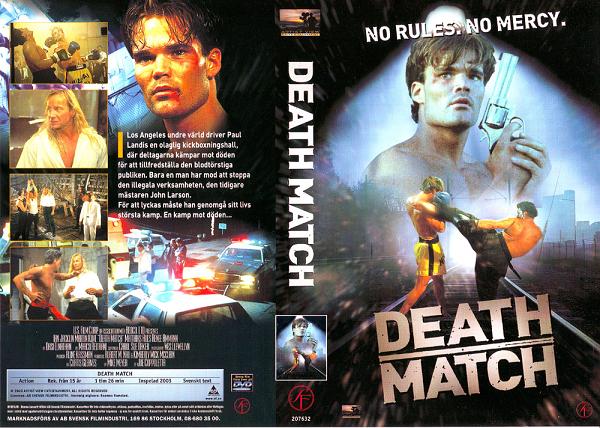
Death Match (1994)

John Larson (Ian Jacklin) has lost a friend to the underground fighting world. Man, the fight clubs from the early direct-to-video 90s continue to make me so happy to watch old films that no one cares about but me. Anyway, Ian Jacklin was a karate champ, and that was enough in 1994 to get him to star in a movie.

Nick Wallace (Nicholas Hill) and John work in physical labor jobs, but there’s no money to be made working on the docks. The union has been on strike, and they’re down on their luck. It’s tough—so tough. So John leaves town, and Nick goes into the fighting world, and that brings John back to save his pal.

Paul Landis (Martin Kove) is a fight promoter who pals around with his main fighter, Mark Vanik (Matthias Hues, who is on the poster instead of the star), who finds them going around and blowing up other mob bosses like Jimmie Fratello (Richard Lynch). Yes, Richard Lynch is in this movie just long enough to reach the 90s video union rules for getting his name in the credits.

With the help of reporter Danielle Richardson (Renee Allman), fight promoter Big Man (Bob Wyatt, the director of Rhonda Sheer’s Tender Loving Care and one of the writers), neighborhood tomboy Tommy (Michele “Mouse” Krasnoo from Kickboxer 4) and Benny “The Jet” Urquidez playing himself, John will search for his missing friend. Is it silly for me to see this as two male couples fighting each other instead of just celebrating that love between them would solve things? This is not unfounded: Kove and Hues’ characters straight up get a massage together and watch the fights like an old couple taking in the theater. Bless them, I want them to be happy.

This has Brick Bronsky, Madusa and Tony “Ludvig Borga” Halme, three pro wrestlers, as bad guys, plus Lisa London (Rocky from Savage Beach), porn star Dick Nasty billed as Peter “Sugarfoot” London in a fight with Ed Neal (who played Lord Zedd), direction by Joe Coppoletta (who did episodes of Knots Landing and Falcon Crest before this movie), a script co-written by Steve Tymon (Fraternity DemonMirror, Mirror III: The Voyeur, John T. Bone’s Dark Secrets, the Ring of Fire movies) and the feeling that this could be a off-brand Capcom beat ’em up (SNK? Irem?) come to life.

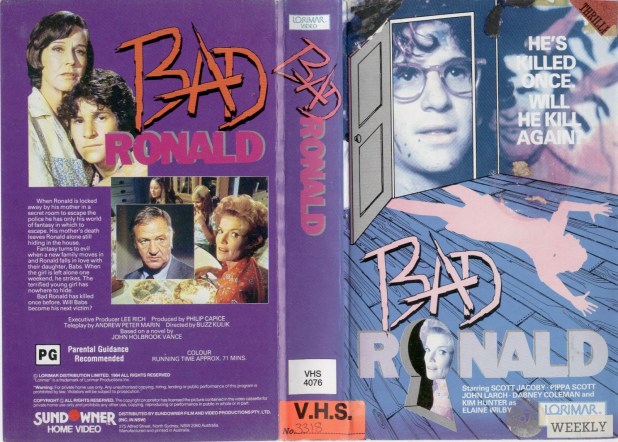
WEIRD WEDNESDAY: Bad Ronald (1974)

The beauty of made-for-TV movies is that they can be way, way weirder than anything you’ll ever see on the big screen. For a blast of pure insanity — as long as you can get your brain to agree with the major reality-bending events you’ll witness — you can’t go wrong with spending a little over an hour with Bad Ronald.

Originally airing on October 24, 1974, on the ABC Network, this film tells the sad tale of Ronald Wilby (Scott Jacoby, The Little Girl Who Lives Down the Lane), a kid who is a great artist and lives in a fantasy world. So far, he’s me at 15, all socially awkward and afraid of girls. Where he is not like me is that his dad left town and never came back, leaving him with an insanely overprotective mother (Kim Hunter, Zira from Planet of the Apes) who has some mystery disease and wants Ronald to go to med school and heal her. That seems like a lot of pressure. Maybe so much pressure that after getting the Heisman and being shut down by Laurie Matthews, the object of his affection, he shoves Laurie’s younger sister Carol. The little girl just keeps verbally abusing Ronald — trust me, I’ve had things twelve-year-old girls say hurt me to this day and gotten over every punch to my face — until he shoves her again, so hard that her head bounces off a concrete block. Boom. She’s dead.

Yep. In the 70s — and perhaps nowhere more so than in a 70s made-for-TV movie — life is cheap.  So Ronald and his mom do what any normal person and normal mother would do — they bury the body, hide the evidence and even hide Ronald inside a concealed room. They hope everything will just blow over — even when the police come by with questions. Nosy neighbors be damned, her boy will be just fine, provided he stops drawing, does his studies, eats right and remembers his exercises.

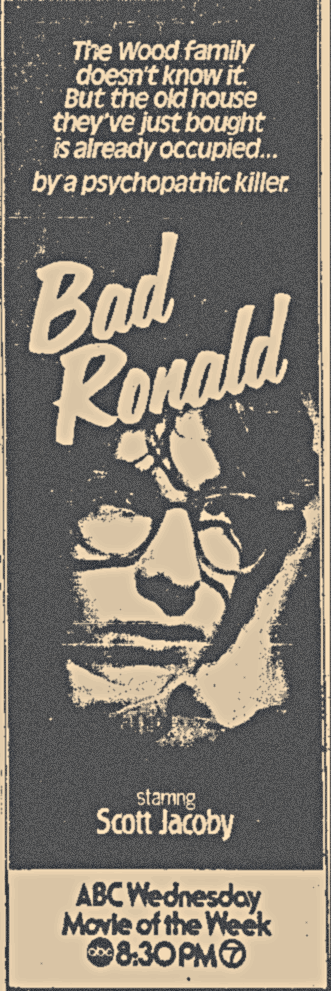
It should work. Except she dies, leaving Ronald alone in the house with all his cans of food. Before you get to the next commercial, Ronald has totally escaped into a fantasy world of princes, princesses and demons. His house is sold to the Wood family — mom, dad (Dabney Coleman of Cloak and Dagger9 to 5Tootsie and so much more) and three sisters — Babs, Althea and Ellen.

Ronald is running out of food and really needs human interaction. Babs becomes the princess of his dreams while her boyfriend, Duane Matthews, becomes his demon. Well, he’s already killed one of Duane’s sisters, and now he’s descended so far into pure mania that who can say what will happen next?

From Ronald murdering the old lady who keeps peeking into the house to his peepholes all over the place, this is a really disturbing slice of TV cinema. There’s a truly great scare when the girls finally see an eyeball inside of those holes. And it’s a nail-biter wondering if they can escape Ronald, who finally makes his play for his princess when the parents leave town.

This is quite the effective little chiller, directed by Buzz Kulik, who was also in the chair for the incredibly famous Brian’s Song. It was remade in 1992 as Méchant Garçon, starring a young Catherine Hiegel. But man — we’re huge Scott Jacoby fans and will stick with the original!

BONUS: You can listen to the podcast we did on Bad Ronald!

Bonus drink!

Closet Case

  • 1 oz. amaretto
  • 1 oz. Jägermeister
  1. Pour together into a shot glass.
  2. Get inside your walls and get very wasted.

WEIRD WEDNESDAY: Autopsy (1975)

Armando Crispino really only did two horror films, 1972’s The Dead Are Alive and this 1975 giallo, which is a shame, as this is a pretty decent entry in the genre. Known in Italy as Macchie Solari (Sunspots), it does indeed feature sunspot footage from space before we see any major murders. And if you’re looking for a movie packed with autopsy footage, good news. It totally lives up to its title.

Simona Sana (Mimsy Farmer, who is also in Argento’s Four Flies on Grey Velvet and The Perfume of the Lady in Black; I am legally and ethically forced to remind you that she is a perfect angel somehow on Earth, a fragile flower of magic and splendor) is a pathology student who is trying to work on a theory about suicides, one that’s disputed by a young priest, Father Paul, whose sister — Simona’s dad’s latest fling — has recently killed herself. It turns out there’s been a whole series of self-killings which are being blamed on, you guessed it, sunspots.

I mean, what can you say about a movie that starts with several of said suicides, like sliced wrists, a self-induced car explosion and a man machine gunning his kids before turning the gun on himself? Obviously, this is a rather grisly affair, with real corpse photos spread — quite literally — throughout the film.

In between all of the gore, corpse penises, two bodies falling to their deaths and crime museums, there’s also Ray Lovelock (The Living Dead at Manchester Morgue) as Simona’s boyfriend, an out there Morricone score and a heroine who hallucinates that the dead are coming back to life.

The plot gets pretty convoluted, but if you’re on this site, you obviously appreciate films like this and will get past it. This is an Italian 70’s murder movie, though, so if you get easily upset about the way men behave, well, be forewarned.

WEIRD WEDNESDAY: Ator the Fighting Eagle (1982)

Let’s list the reasons why this movie made it to our site:

Joe D’Amato directed it. Where do we even start with his filmography? Emanuelle and the Last CannibalsAntropophagusEndgame?

It’s an Italian ripoff of Conan the Barbarian, which means it will be better, worse and more inventive than the movie that inspired it.

It’s written by Michele Soavi (StagefrightThe ChurchThe SectCemetery Man)!

Once, Ator was just a baby, born with the birthmark that prophesied that he’d grow up to destroy the Spider Cult, whose leader Dakar (a pro wrestler who appeared in Titanes en el Ring against Martín Karadagian) tries to kill before he even gets out of his chainmail diapers.

Luckily, Ator is saved and grows up big, strong and weirdly in love with his sister, Sunya. It turns out that, luckily, he’s adopted, so this is only morally and not biologically upsetting. His father allows them to be married, but the Spider Cult attacks the village and takes her, along with several other women.

Ator trains with Griba, the warrior who saved him as a child (he’s played by Edmund Purdom, the dean from Pieces!). What follows are pure shenanigans — Ator is kidnapped by Amazons, almost sleeps with a witch, undertakes a quest to find a shield and meets up with Roon (Sabrina Siani, Ocron from Fulci’s batshit barbarian opus Conquest), a sexy blonde thief who is in love with him.

Oh yeah! Laura Gemser, Black Emanuelle herself, shows up here too.

Ator succeeds in defeating Dakkar, only to learn that the only reason that Griba mentored him was to use him to destroy his enemy. That said, Ator defeats him too, leaving him to be eaten by the Lovecraftian-named Ancient One, a monstrous spider. But hey, Ator isn’t done yet. He kills that beast, too!

Finally, learning that Roon has died, Ator and Sunya go back to their village, ready to make their incestual union a reality. Or maybe not, as she doesn’t show up in the three sequels, The Blade MasterIron Warrior and Quest for the Magic Sword.

Ator is played by Miles O’Keefe, who started his Hollywood career in the Bo Derek vehicle Tarzan the Ape Man, a movie that Richard Harris would nearly fist fight people over if they dared mention it. He’s in all but the last of these films, and while D’Amato praised his physique and attitude, he felt that his fighting and acting skills left something to be desired.

Ator the Fighting Eagle pretty much flies by. It does what it’s supposed to do — present magic, boobs, sorcery and swordfights — albeit in a PG-rated film.

You can watch this on Tubi.

WEIRD WEDNESDAY: The Apple (1980)

The first time I saw The Apple, I was in the throes of losing my job, starting a new company and feeling lost. This movie not only made me feel like I could go on but also inspired me to start writing more about films and why they mattered to me.

You know how everyone thinks Cannon put out some completely crazy movies? If you haven’t seen The Apple (also known as Star Rock), you haven’t seen their full power. Directed by Menahem Golan, this slice of sheer madness is a movie I use to test the resolve of anyone brave enough to watch movies with me.

The genesis of this film begins in 1975. Israeli rock producer Coby Recht was signed to Barclay Records and began to feel distrustful of show business. He worked this into a story with his wife, Iris Yotvat, and brought it to the attention of his longtime friend Menahem. After hearing the demos for the song, the producer/director instructed Recht to go to Los Angeles immediately. They were making the movie.

Yotvat said, “That was marvelous. That was just fantastic to think that it was going to be a movie all of a sudden. It was just amazing.”

It wasn’t going to stay that way.

Recht and Yotvat lived in a villa that Menahem provided, writing six screenplay drafts in three weeks. As those drafts progressed, the story became more comical and less Orwellian. Soon, things were getting corny, out of touch and out of date. If you’ve seen any of the movies that Golan was involved in, you can see how that might be true.

After auditioning thousands of hopefuls, Recht settled on Catherine Marie Stoutdatedhe lead role of Bibi. Who is a singer. Not a dancer, like Stewart. He figured she could learn, but the producers decided to have her voice dubbed.

Tensions only got worse once filming began, as what started as a $4 million movie turned into $10 million and then more. Editor Alain Jakubowicz claimed that Golan shot around a million feet of footage, with six cameras covering every dance number, up to a four-hour rough cut.

The movie got way bigger than its scriptwriters intended. Shooting in West Berlin lasted forever, with a five-day covering opening number, the song “Speed” being filmed at the Metropol nightclub (which held the world record for the biggest indoor laser show), and some scenes were actually shot inside a gas chamber that had killed people during World War II.

Nigel Lythgoe, who later was a big part of American Idol, choreographed the film, saying that some days were “really, really depressing” and others “very, very stressful.” The cast and crew hated the script, but here they were, making the film.

Menahem and Recht’s battles soon got worse. The writer felt he should be in London mixing the songs (the sessions had more than 200 artists involved), but Menahem demanded that he show up at the shoot. The first day he was there, he witnessed the uncut version “Paradise Day” which featured fifteen dinosaurs and a tiger that broke free and escaped. This scene also contained elephants getting their trunks stuck in the set, actors collapsing while wearing a t,oo hot brontosaurus costume and a set that made it near impossible for people to dance on and cameras to move around. Removing this scene makes the Biblical end of the movie come out of nowhere. That’s right. None of this is in the film.

nearlyerine Marie Stewart has stated that nonfor e of this rattled Menahem. In fact, he was convinced that The Apple was going to be embraced: “Menahem was very passionate about what he was doing. He had very lofty ideas about the project. He thought this was going to break him into the American film industry. It had, you know, all the elements that he thought were necessary at that time. It was the early eighties and there were a lot of musicals. And Menahe,m thought that was his ticket into the American film industry.”

So what happened?

The plot is basically Adam and Eve meets Faust. Bibi (Stewart) and Alphie (Georgmeetmour) are contestants in the 1994 Worldvision Song Festival. They’re talented but easily defeated by the machinations of Mr. Boogalow (Vladek Sheybal, Kronsteen in From Russian With Love) and BIM (Boogalow International Music).

The evil leader soon signs the duo but they soon fall victim to the darkness of show business. Bibi is caught up in the drugs and sex and glamour, while Alphie is beaten by cops and nearly dies to save her. He also lives with a woman who is either his mother, lover, or landlady, and no one ever explains to us.

Eventually, they escape and live as hippies, having a child. Mr. Boogalow finds them and claims that Bibi owes him $10 million, but soon God, known here as Mr. Topps (Joss Ackland, The House That Dripped BloodBill & Ted’s Bogus Journey), takes them away in his Rolls-Royce and the Rapture occurs.

There are numerous scenes where people put stickers, called BIM Marks, all over their faces. Everyone has camel toe. And the movie is nearly 100% disco.

The movie premiered at the 1980 Montreal World Film Festival. To say it did not go well is an understatement.

Attendees hated the film so much that they launched giveaway records of the soundtrack at the screen. Menahem was so devastated that he almost jumped off his hotel balcony before being saved by his business partner, Yoram Globus. A similar scene happened at the film’s second premiere at the Paramount Theater in Hollywood.

The director said, “It’s impossible that I’m so wrong about it. I cannot be that wrong about the movie. They just don’t understand what I was trying to do.”

I get it, Menahem. You were just trying to get people to understand the power of love and music and being hippies a full decade after any of that mattered. You didn’t care if anyone else got it. You had a vision. And we’re not talking about any of those critics today. No, we’re talking about you. We’re talking about The Apple.

This is a movie that wears its heart messily all over its spandex crotch. The songs are ridiculous. The dancing is, at times, poor. The story makes no sense at all. You’re lucky to sit and witness it. I can’t even tell you how many times I’ve watched it!

BONUS! You can hear Becca and me talk all about The Apple on our podcast.

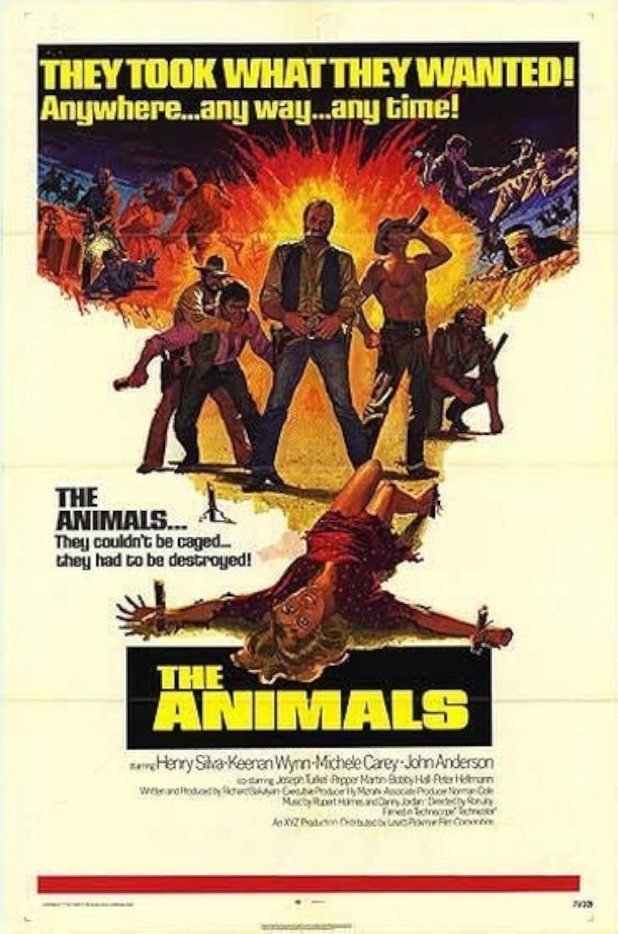
WEIRD WEDNESDAY: The Animals (1971)

Also known as Five Savage Men, this starts with everyone on a stagecoach being killed, other than schoolteacher Alice McAndrew (Michele Carey, The Choirboys), who is assaulted and left for dead by Pudge Elliot (Keenan Wynn) and his henchmen, who include Peyote (Joe Turkel, not tending bar for Jack Nicholson) and Jamie (Pepper Martin). I mean, they crucify her to the ground in the desert before they do it and I get it, it’s a revengeomatic, but in the ways of Michael Winner — this was directed by Ron Joy and written by Richard Bakalyan — that assault goes on so long that we begin to feel complicit in it.

After they depart, Native American Chatto (Henry Silva, who was Sicilian and Spanish) rescues her — why didn’t he jump in sooner? — and not only brings her back to health, he also teaches her how to kill and becomes her lover, which seems kind of odd, but what do I know?

The law, led by Sheriff Allan Pierce (John Anderson), thinks Chatto is behind all of this. You can see where that is going. What you won’t expect is an acid rock soundtrack by Rupert Holmes, who had two hit songs about cheating, “Escape (The Piña Colada Song)” and “Him.” I never knew that he created the AMC series Remember WENN.

You can watch this on Tubi.