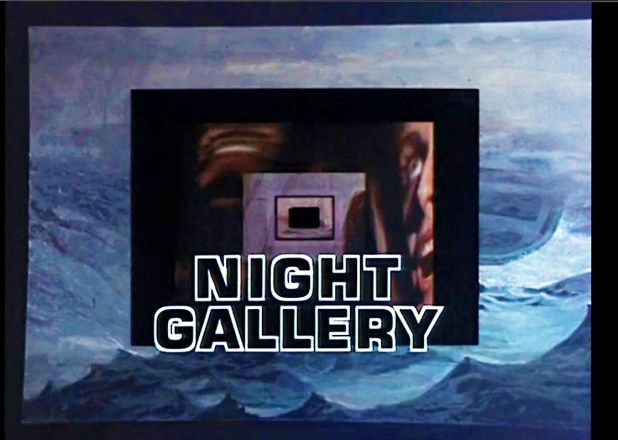
As much as I hate to admit it, this is the last chapter of Night Gallery.
If you thought it’d be an incredibly poignant story from Rod Serling, you’d be remiss.
No, the last thing of the show is…a Jack Laird directed and written black out comedy tale.
“Room for One Less” takes place in a crowded elevator that stops to let in several more people in. A monster (Lee Jay Lambert) points to a sign that says “Occupancy by more than 10 passengers prohibited by law” to the elevator operator (James Metropole), which used to be a thing up until at least the 90s, as my art school had them. The monster has a sophisticated accent when he says, “Quite.” He then blows up the elevator operator.
The end.
Ah, it’s been a journey watching all of the Night Gallery episodes and writing about them for you. Did you have a favorite episode? Did any of these bring back memories for you? This gave me a sense of joy as there is so much good here, as well as some sadness, as by the middle of the second season you can start to see that Serling wasn’t getting to tell the stories that he wanted to. Commerce always conscripts creativity but my memories before now were so rose-lensed that I forgot that even a show that I consider great has moments of not being all so good. That said, the great is enough to forget all of the one minute silly sketches that Jack Laird threw in which prove that sometimes, something extra can ruin the recipe.
EDITOR’S NOTE: Personals was on USA Up All Night on September 25, 1992.
A made-for-TV movie in which a quiet librarian is a by-night femme fatale (Jennifer O’Neill, which is the whole reason why I watched this) who uses the personals to find her victims. Evan Martin (Robin Thomas) is a reporter who gets caught by her and his widow Sarah (Stephanie Zimbalist) must hunt her down.
Personals was directed by Steve Hilliard Stern, who also made Rolling Vengeance and The Park Is Mine. It was written by George Franklin (The Incubus), Arlene Sanford (who went on to direct plenty of projects) and Brad Whiting Jr.
It’s a Canadian made-for-TV erotic thriller without much erotic that originally aired on USA.
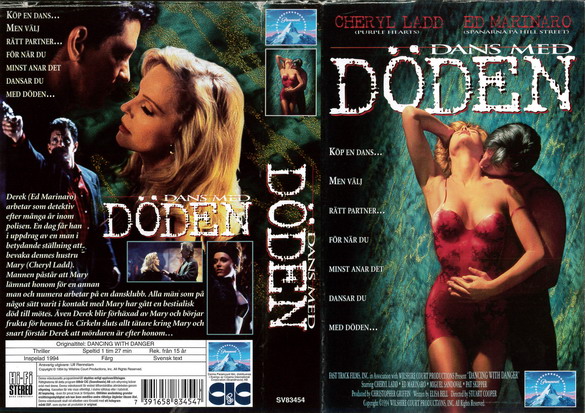
EDITOR’S NOTE: Dancing With Danger was on USA Up All Night on December 30, 1995.
Mary Dannon (Cheryl Ladd) is a taxi dancer in Portland. Not a private dancer, but a dancer for money. Do what you want her to do. You know how it goes. Now, I don’t believe that taxi dancers existed outside of movies by 1994, but who am I to dispute a Cheryl Ladd made for TV movie?
Mary saw a murder in Atlantic City so she moved to Portland and put on her dancing shoes at the Star Brite. Her husband, a rich investment banker named Arthur (Stanley Kamel), has dispatched private investigator Derek Lidor (Ed Marinaro) to find her. Like any ex-cop with a drinking problem, he’s horrible at his job and the plot just happens to him versus him driving any of it forward in a positive manner.
Derek becomes one of the many men who dance with Mary but that dance card is getting less full as her customers start getting killed with scissors, which points to Mary as the killer as she’s training to be a hairdresser. Of course she and Derek get in bed together. All the while, this can’t decide if it’s a noir movie, a parody of those movies or a slasher or an erotic thriller. Everyone smokes. It can’t rain all the time. Neon everything. Hats aplenty for Ms. Ladd.
Directed by Stuart Cooper and written by Elise Bell — who went on to write Vegas Vacation — this movie is a delirious and goofy mess. I kind of love it for trying.
EDITOR’S NOTE: Wheels of Terror was on USA Up All Night on February 12, 1994.
Directed by Christopher Cain, the director of The Next Karate Kid, Pure Country and Gone Fishin’ — as well as the father of Dean — and written by Halloween 4: The Return of Michael Myers writer Alan B. McElroy, this movie is all about the unseen driver of a primer-colored Dodge Charger who is kidnapping, assaulting and murdering young women in Arizona.
Laura (Joanna Cassidy) has just moved to Copper Valley from Los Angeles to raise her daughter Stephanie (Marcie Leeds) in a safer environment. Except, you know, that car drifting around like a shark wiping out young women the same age as her daughter.
She gets a job as a bus driver and the town starts locking itself up after one of Stephanie’s friends, Kim, is found dead, the victim of the car. It goes even further — I say it as we don’t see the driver — and kidnaps Stephanie leading to a bus against sportscar chase that finds a motorcycle cop get obliterated.
This movie understands something that The Car also did. If you want to stop a killer car with an unseen driver, you need to blow it up.
Directed by Timothy Galfas (Black Fist) and written by Jack Laird from a story by Mary Linn Roby, “Die Now, Pay Later” never aired during the original run of Night Gallery. Instead, this and next week’s episode, “Room for One Less” were unaired stories from season 2 added to the syndication package along with episodes of The Sixth Sense. Rod Serling came back to record new introductions for these stories as well as those unconnected stories of the Gary Collins series.
Sheriff Ned Harlow (Slim Pickens) thinks that the death rate in Taunton, Massachusetts is increasing because of the January clearance sale of funeral director Walt Peckinpah (Will Geer). According to Harlow’s wife, Peckinpah has relatives in Salem and may be a relative of a warlock who was burned after the witch trials. But after getting all excited, Harlow’s wife calls the funeral home and yells at him.
The sale continues with the sheriff perhaps being a customer.
This is, as you can guess by Laird being involved, an episode of low quality. Why it’s a half hour is beyond me. Ah well — we should probably just enjoy the good stories and not be so sad about the rough ones.
Just seeing the name of the second story of this episode says to me Jack Laird and I already get a bit upset with it. Maybe I should give it a chance. I mean, there’s only a few episodes left. Actually, this was the last episode that ever aired on May 27, 1973. There are two more episodes that only played in syndication.
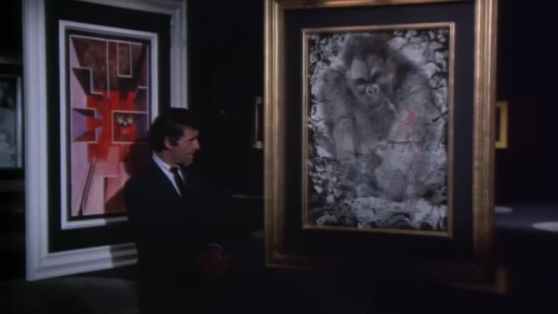
“Hatred Onto Death” was directed by Gerald Perry Finnerman (who mostly worked as a cinematographer and directed this tale and two other TV episodes, one of Moonlighting which he shot 58 episodes of and another of Salvage 1) and written by Halsted Welles (3:10 to Yuma) from a story by Milton Geiger.
Grant (Steve Forrest, Greg Savitt!) and Ruth Wilson (Dina Merrill) come upon a captured gorilla in Africa. Grant and the animal instantly hate each other and just the opposite, Ruth and the gorilla sense something in one another. He brings it back to America to study, despite his wife begging him to set it free.
As he studies the animal at his museum, a colleague named Dr. Ramirez (Fernando Lamas) tells him that he believes that at one point, Grant and the gorilla were enemies. Maybe in another life, they battled before. Ruth tells the gorilla a story of two of his kind battling over a woman. It goes wild and she releases it. This allows Grant to fight his enemy once more.
Maybe I shouldn’t have been so down on the Jack Laird story because this story is really bad. Maybe he can save this episode.
This is how Night Gallery ended its network TV life. With a Jack Laird two-minute blackout sketch called “How to Cure the Common Vampire.”
Directed and written by Laird, it stars Richard Deacon as the Man with the Mallet and Johnny Brown as the Man with the Stake. It has no good joke and is as pointless as you thought it would be.
Look, I love Night Gallery. But perhaps with all the issues of season three, it was best that it died when it did. That’s so hard to admit.
But hey — two more episodes coming! Maybe those will be good.
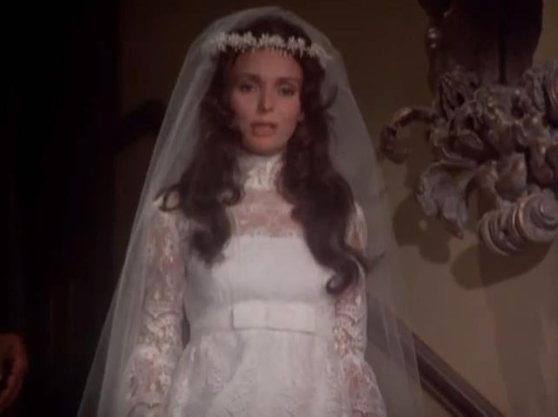
Alec Brandon (Barry Atwater) is about to marry his trophy wife Sheila Trent (Susan Strasberg). He’s rich, he owns a mansion in the West Indies and he has guests coming in from all over the world for their wedding. Well, they were getting married. But Raphael (Alejandro Rey), Sheila’s lover of years past, comes in and takes her away from all this. This won’t stand.
Brandon gets his valet Andrew (Jean Durand) to get him a voodoo doll and right in the middle of lovemaking, red hand marks appear on Sheila’s back. She decides to go back and confront her near-husband and finds that he’s already killed Andrew, who tried to get him to stop attacking her, and is given a ring that can end all of this.
“The Doll of Death” was directed by John Badham and written by Jack Guss from a story by Vivian Meik. It’s not the best Night Gallery story. It’s not even the best doll Night Gallery story. That would be “The Doll.” But still, it does have its charms and Strasberg is good in her role.
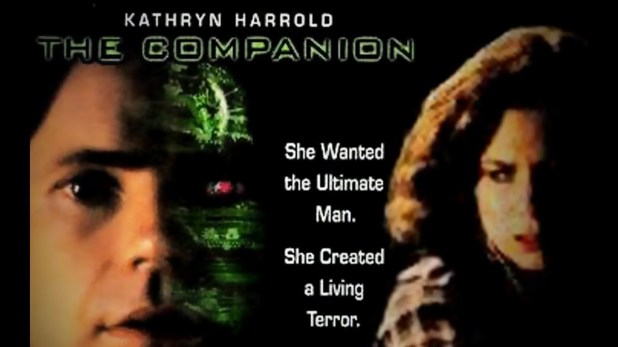
EDITOR’S NOTE: The Companion aired on USA Up All Night on December 31, 1996.
Of all the Terminator clones, who knew that I’d be watching one with Bruce Greenwood — Pike from the later Star Trek movies — as a male companion named Geoffrey?
Romance novelist Gillian Tanner (Kathryn Harold, Raw Deal and Yes, Giorgio) has her agent Charlene (Talia Balsam) inform her that perhaps she should give up men — she just got cheated on by Bryan Cranston! — and get with the future. Yes, she is embracing the fourth point of the Church of Satan’s five-point program for Pentagonal Revisionism: Development and production of artificial human companions: The forbidden industry. An economic “godsend” which will allow everyone “power” over someone else. Polite, sophisticated, technologically feasible slavery. And the most profitable industry since T.V. and the computer.
At first, she’s cold to Geoffrey who is too perfect, too good looking and too willing to cater to her every need. It even puts off her friend Ron Cocheran (Brion James, cast as a reference to Blade Runner?*) and his way too young girlfriend Stacey (Joely Fisher). But when she allows Geoffrey to mess with his programming so that he can become more surprising and therefore her perfect man, Gillian learns that maybe she likes men that are bad for her whether they’re human or machine.
Director Gary Fieder would go on to make Things to Do In Denver When You’re Dead, Kiss the Girls and Don’t Say a Word. You can see he was meant for bigger things when you watch this. It was written by Ian Seeberg, who also wrote and narrated The Naked Peacock, a documentary on nudist camps, and the movie Temptation.
The cast also has James Karen, always a good thing, as the robot salesman, and Earl Boen — as a holographic talk show host — and he was in Terminator, which is a nice reminder that this is referencing that movie.* Plus you get a quick roles for Stacie Randall (Lyra from Trancers 4 and 5), Courtney Taylor (Mary Lou in Prom Night III: The Last Kiss), Brenda Leigh (Scanner Cop) and Bob the Goon himself, Tracey Walter.
It was shot by Rick Bota (who also worked with Fieder on Kiss the Girls), who directed a few movies of his own, including three Hellraiser movies: Hellseeker, Deader and Hellworld. He was also the director of photography for twenty-three episodes of Tales from the Crypt, House On Haunted Hill and Valentine.
The special effects at the end — Scott Wheeler (300, Big Fish, Us, The Mangler, Demon Wind and so many more movies — look really good. Understated and very T800-like, but for a TV movie, it looks great. I had no expectations of The Companion when it started and I ended up really liking it. It feels like the kind of movie that a studio would make today and here it is, a low budget made-fot-TV movie that played on USA.
*Kind words to Matty Budrewicz from the incredible The Schlock Pit site for pointing this out.
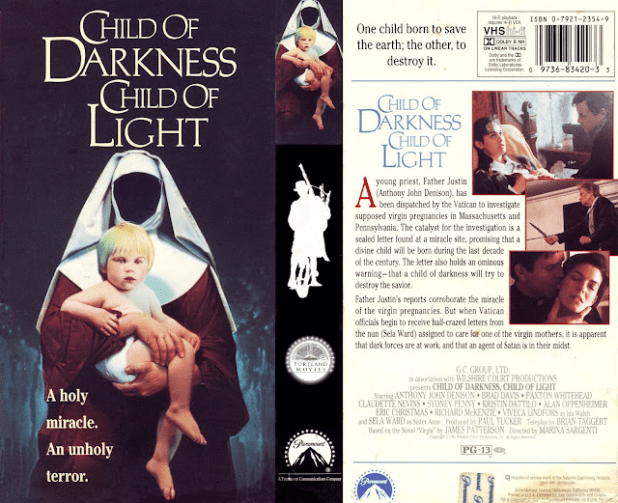
EDITOR’S NOTE: Child of Darkness, Child of Light aired on USA Up All Night on June 11, 1993.
Based on the James Patterson novel Virgin (which has been retitled Cradle and All), Child of Darkness, Child of Light was directed by Marina Sargenti, who made one of my favorite early 90s movies, Mirror, Mirror. It was written for TV by Brian Taggert, who had some solid credits of his own in The Spell, Visiting Hours, Of Unknown Origin, the two V mini-series, The New Kids, Wanted Dead or Alive, Poltergeist III, Deadly Family Secrets and Omen III and IV.
Father Rosetti (Paxton Whitehead) is sent by the Vatican to a small city in Pennsylvania — it’s shot in Portland, so no luck having any Pittsburgh actors in the cast — to investigate a report of an impending virgin birth. He’s injured by bikers and left in a coma, so the Vatican also sends Father Justin O’Carroll (Tony Denison) without telling him that this virgin birth was prophesized by a vision of the Virgin Mary.
O’Carroll meets pregnant 15-year-old teen Margaret Gallagher (Sydney Penne) who is constantly being attacked by people when she claims that she’s having a virgin birth. She’s also able to transfer her visions to people who attack her, giving them mysterious wounds. And oh yeah, polio is back. Locusts show up. You know how that end of the world stuff gets.
The priest also goes ot Boston to meet Kathleen Beavier (Kristin Dattilo), who is also a virgin expecting a baby. Her child? Well, it just might be the Antichrist. And wow! Viveca Lindfors plays her maid. This also has small roles for Brad Davis, Eric Christmas (Principal Carter from Porky’s!), Richard McKenzie (Archie Bunker’s brother Fred), Sela Ward (as a nun, so you know how I felt about this movie) and Brendan Fraser.
It’s a USA TV movie, so let that guide your watching.
Directed by Night Gallery regular Jeannot Szwarc and written by David Rayfiel from a story by Martin Waddell, “Whisper” has Sally Field and Dean Stockwell as Irene and Charlie Evans. He used to work as an architect, but his wife hasn’t been herself. Literally.
Irene and Charlie have moved to rural Mississippi because she channels the personalities of deceased people, a fact that he has just come to understand and deal with. After all, she always comes back and is herself again after being possessed. She’ll always come back to being Irene, he figures, he just loans her out. Right?
One of the spirits in her head is Rachel, a woman who keeps coming back and begins to obsess Irene. She starts referring to Charlie as Johnny and makes him dig up something — a dead child? — buried under some rocks. He goes back to his wife when he’s done but she tells him. “Oh, Charlie, I can’t get back. I can’t get back!”
Is Irene gone forever? Or is she just a victim of mental illness? There are no answers from this Night Gallery.
Three years later, Sally Field would gain more critical praise for another TV program about multiple personalities, Sybil. As for this episode, Szwarc proves why he’s the best director on the program and even has moments of Stockwell narrating directly to camera, as if this is all a dream or a memory.
The third season is rough but as always, when it works — like in “Whisper” — it gets it right.





 B&S About Movies
You must be logged in to post a comment.