UNSUNG HORRORS HORROR GIVES BACK 2025: Lady Beware (1987)

Each October, the Unsung Horrors podcast does a month of themed movies. This year, they will once again be setting up a fundraiser to benefit Best Friends, which works to save the lives of cats and dogs across America, giving pets second chances and providing them with happy homes.

Today’s theme: Unsung Horrors Rule (under 1000 logged views on Letterboxd)

ABOUT THE AUTHOR: Adam Hursey is a pharmacist specializing in health informatics by day, but his true passion is cinema. His current favorite films are Back to the FutureStop Making Sense, and In the Mood for Love. He has written articles for Film East and The Physical Media Advocate, primarily examining older films through the lens of contemporary perspectives. He is usually found on Letterboxd, where he mainly writes about horror and exploitation films. You can follow him on Letterboxd or Instagram at ashursey.

After watching this film, I feel like I need to take a bath in Diane Lane’s open-air bathtub, but for much different reasons than her stalker did.

The year 2025 will go down for many things, some good, some bad, but as far as my Letterboxd stats go, it will be the year I discovered Karen Arthur.

The Mafu Cage, a twisted tale of two sisters starring Lee Grant and Carol Kane, completely blew my mind. Director Karen Arthur really knows how to ratchet up the claustrophobia, leading to some anxiety-inducing scenes. She also knows how to make the small feel big. The Mafu Cage was adapted from a stage play, but Arthur is able to downplay any restrictions found in a play. After watching The Mafu Cage, I had to seek out her debut film, Legacy, an adaptation of a one-woman show depicting a woman’s descent into madness. Talk about unsung, it only has 45 logged views on Letterboxd. 

After these first two films, Arthur became primarily a television director, which had a stigma about it in the 1970s and 80s. If you couldn’t cut it as a film film director, you were shuffled over to television, the perceived inferior media. If television was seen as less than, it surely did not stop her from producing the highest of quality. The Rape of Richard Beck turns the tables on the traditional rape-revenge film, with Richard Crenna earning an Emmy award along the way for his portrayal of a cop who does not play by the rules (or, actually, literally plays by his own set of rules), but finds himself in the wrong place at the wrong time. Speaking of the Emmys, Arthur became the first female to win a Best Director award for an episode of Cagney and Lacey. While television work fills most of her resume, Arthur did have one other feature film in her, the erotic thriller Lady Beware.

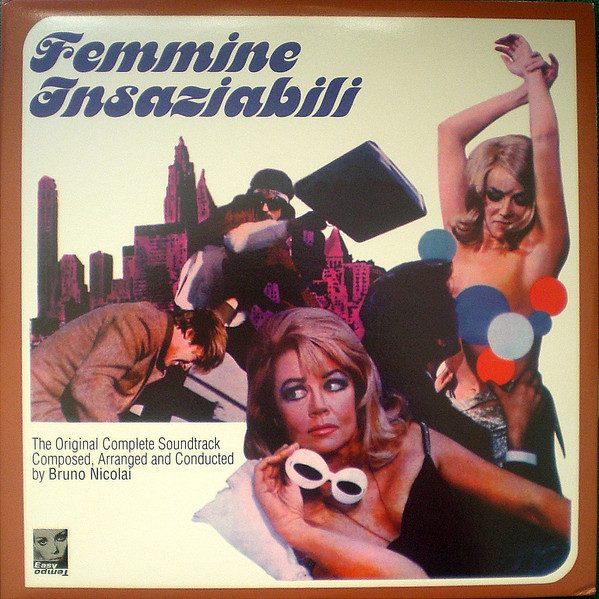
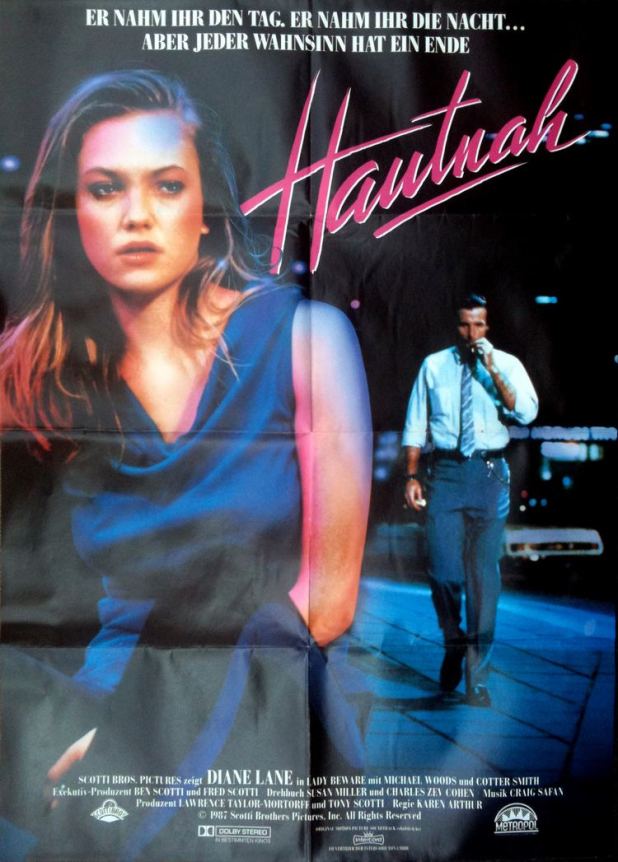
Released about a month before the mother of all erotic thrillers, Fatal Attraction, Lady Beware tells the story of Katya (Lane), an ambitious young woman who does not take no for an answer, nearly demanding a place as the window dresser for a Pittsburgh department store. Katya’s displays prove to be controversial and provocative, but one person whose attention she receives is Jack, a married X-ray technician who begins an unhealthy obsession with Katya, quickly escalating from obscene phone calls to breaking and entering.

Unfortunately, the finished project did not get the approval of Arthur herself. The producers attempted to amp up the exploitative side of the film, including nude scenes of Lane that Arthur says she would not have included. She stated that she considered removing her name from the film (would that have made it a film by Alice Smithee?), but would not because the actors cannot remove their names.

Still, despite being a bit of a mess (side characters are introduced, only to be abandoned, no doubt most of their performance ending up on the cutting room floor), Lady Beware is a very interesting watch. It could have been the performance that elevated Lane from child star to adult actress. She would have to wait almost 15 years for Unfaithful to bring her the attention she deserved all along. 

Lady Beware is currently stuck on VHS, desperately needing restoration from one of these boutique physical media labels. Paging Cinematographe! I think this film would fit perfectly in that collection.
UNSUNG HORRORS HORROR GIVES BACK 2025: Crimson, the Color of Blood (1973)

Each October, the Unsung Horrors podcast does a month of themed movies. This year, they will once again be setting up a fundraiser to benefit Best Friends, which works to save the lives of cats and dogs across America, giving pets second chances and providing them with happy homes.

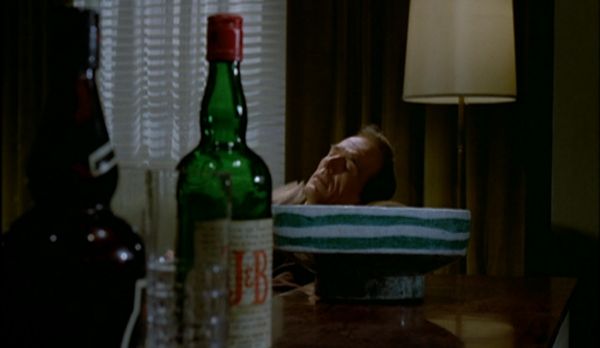
Today’s theme: J &B 

From J&B In the Movies

Las ratas no duermen de noche (Rats Don’t Sleep at Night) was released in the U.S. as Crimson, the Color of Blood and The Man With the Severed Head.

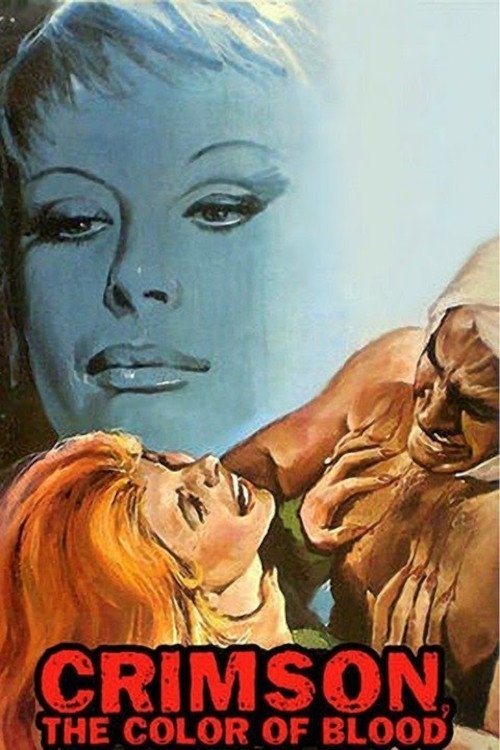
After a jewel heist, Jack Surnett (Paul Naschy) is shot in the head. His gang is smart enough to know that there’s a scientist named Professor Teets (Ricardo Palmerola) who can do some pretty wild surgeries, like a brain transplant. However, they use the brain of a serial killer named The Sadist (Roberto Mauri), going out in the middle of the evening to just chop off his head. And by this amazing procedure, Jack becomes even more violent than he was before.

Directed by Juan Fortuny, who co-wrote the script with Marius Lesoeur and H.L. Rostaine, this film features Naschy in what must have been a dream role, as every time he sees a woman, he has to make love to her. Well, not love. Violent killing maniac love. This has plenty of Eurocult goddesses in it, like Evelyne Scott (AKA Evelyne Deher, she’s also in Shining Sex), Silvia Solar (Devil’s Kiss) and Gilda Arancio (Kiss Me Killer).

More of a crime movie than a horror film, this doesn’t have much Nashy, but it does feature random dance scenes, and when he finally does show up, he’s all wrapped up. But I kind of like that it’s a gangster movie. Head transplants were a big thing in 70s!

You can watch this on Tubi.

UNSUNG HORRORS HORROR GIVES BACK 2025: Carnal Circuit (1969)

Each October, the Unsung Horrors podcast does a month of themed movies. This year, they will once again be setting up a fundraiser to benefit Best Friends, which works to save the lives of cats and dogs across America, giving pets second chances and providing them with happy homes.

Today’s theme: J&B

ABOUT THE AUTHOR: Adam Hursey is a pharmacist specializing in health informatics by day, but his true passion is cinema. His current favorite films are Back to the FutureStop Making Sense, and In the Mood for Love. He has written articles for Film East and The Physical Media Advocate, primarily examining older films through the lens of contemporary perspectives. He is usually found on Letterboxd, where he mainly writes about horror and exploitation films. You can follow him on Letterboxd or Instagram at ashursey.

Stop the press!

I originally had a different film in this slot—Night Angel, which I ended up moving to a different category. The J&B element was not very strong in Night Angel. Just a scene where you can see a bottle on a shelf behind a bar. I realized that, somehow, I did not have a single Italian film on my list this year. When I reviewed a Letterboxd list that so kindly compiled films that feature the iconic Scotch whiskey, I discovered a film I somehow missed when I dove into Alberto De Martino’s filmography last year. Carnal Circuit, a film most definitely worthy of inclusion in any forgotten giallo set.

Alberto De Martino is probably my favorite Italian director not named Fulci. It is a hill I’m willing to die upon. He is probably best known for rip-offs of more successful films. The Antichrist is a rip-off of The Exorcist. Holocaust 2000 is a rip-off of The Omen. I guess you could say Pumaman is a Superman rip-off. Maybe his reputation for knock-offs lessens his cache among cinephiles. If so, it’s their loss. If they take it, toss it, and leave it, as Sir Mix-a-Lot so wisely said, I’ll pull up quick to retrieve it.

Carnal Circuit is an early example of the giallo. No black glove clad killer to be found here. But we do get the trope of a “common” man (not affiliated with the police) entering his sleuthing era, trying to get to the bottom of a murder mystery. In this film, Paolo (Robert Hoffman) is a newspaper reporter who gets caught up in the mystery thanks to a friend from his past, Giulio (Roger Fritz). Thugs are out for Giulio, the current face of an advertising campaign for the International Chemical corporation. But why would anyone want to rough up such a beautiful mug? Turns out that Giulio has made some enemies on his way to the top, as one does. But now Giulio has turned up dead, killed in a vehicle accident. Or was it an accident? Seems as if everyone on the International Chemical board had a reason for revenge against Giulio. But enough to kill? Perhaps his diaries give an answer, and it is up to Paolo to find them on his quest for the truth.

I do have a soft spot in my heart for these giallo films that were made before Dario Argento put his stamp on the subgenre, forever changing the way they are perceived. Carnal Circuit is similar to Fulci’s Perversion Story (or One on Top of the Other). Both films bring their story to California, although Fulci is more interested in framing his tale through the lens of Vertigo. De Martino’s film spends a good deal of its running time slowly revealing the change in Giulio (and seeing how much female flesh he can expose along the way—really putting the carnal in Carnal Circuit).

Unfortunately, the J&B component in this film was no different from Night Angel. Simply a scene where the former spokesperson for International Chemical makes a drunken display at a company party. He stands in front of a bottle of J&B before plummeting to his death out of a window (a missed opportunity for a dummy drop). 

At any rate, this film has been one of my favorite watches of the month, and another piece of ammunition in my battle to champion Alberto De Martino.

UNSUNG HORRORS HORROR GIVES BACK 2025: The President Must Die (1981)

Each October, the Unsung Horrors podcast does a month of themed movies. This year, they will once again be setting up a fundraiser to benefit Best Friends, which works to save the lives of cats and dogs across America, giving pets second chances and providing them with happy homes.

Today’s theme: Unsung Horrors Rule (under 1,000 views on Letterboxd)

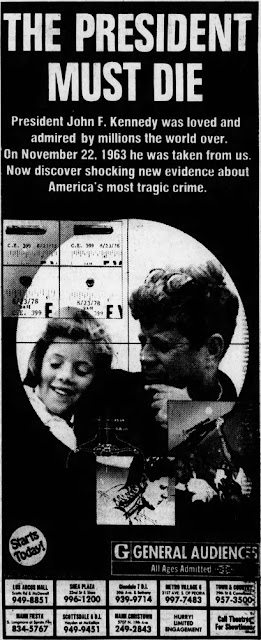
The last documentary produced by Sunn Classic Pictures, The President Must Die, is a fairly groundbreaking film, one that explores the conspiracy theories related to the assassination of President John F. Kennedy.

Urban legend says that it was tested in theaters in Arizona and Virginia in January 1981, but performed poorly. It was ultimately shelved and is now considered a piece of “lost media.” Just a few months later, the real-life assassination attempt on President Ronald Reagan made it an impossible movie to market.

Or so they say.

I interviewed James Conway, this film’s director, for an upcoming issue of Drive-In Asylum and got to ask about this movie, one that has fascinated me for years:

DIA: One last question about that era. What happened with The President Must Die?

JAMES: It was sort of the end of our believing in the market research and testing of ideas. Because when we tested that – making some trailers – it received incredibly high ratings. Everybody wanted to see this movie. We made the movie and did an excellent job. I mean, it’s absolutely authentic based on the time. I flew all over the country, interviewing all these people who you’ll see in the movie, and when it opened, nobody cared. Nobody came to see it.

DIA: In my research, I’ve heard that it was pulled from theaters in the wake of Reagan being shot. Is that true?

JAMES: I know it didn’t perform. I’m not sure about the Reagan thing. 

I’ll tell you a funny story. Though. We moved the company from LA to Park City, Utah when we did Grizzly Adams in 1976 and I moved there as well. I moved back to Los Angeles in 1982, but kept a home there. It’s where I live now, several months a year. 

We did the post-production for The President Must Die in Park City and we’re flying with all the reels to go to LA to do the mixing and have all the boxes with all the reels. And in those days, I don’t know how old you are, but when you used to do sound effects and music, you’d have 30-40 reels for each movie. Each of these boxes had The President Must Die marked on them, ready to be sent on a United Airlines plane to the sound editors in LA.

Somebody who saw the boxes saying The President Must Die called the FBI, and the people who were flying to LA with those boxes were pulled off the plane as soon as they hit the ground. But once they explained what it was, they were let go. But isn’t that fun? (laughs)

At the end of the interview, as I was fact-checking a few things, I told him that this movie was one of my holy grails.

“Do you want to see it?” Conway asked. “Check your email.”

Imagine my joy at hearing the dulcet tones of Brad Crandall again, a voice I figured I’d heard everything from in all of the other Sunn films. Now, he’s setting up the story of JFK and how he was changing America. Unlike so many other conspiracy films, this begins and ends with positivity.

You also have to understand that in 1981, there weren’t many other, as I said, conspiracy films.

Conspiracy wasn’t what it is today. It was in photocopied sheets and by word of mouth. There was no internet. There were just pockets of this information, and you had to hunt for it. A relatively mainstream film espousing the idea that Kennedy was killed by one of the many groups it could have been (in fact, at one point, Crandall says, “Who would want to kill someone as popular as Kennedy?” and nearly answers himself by suddenly naming at least five groups that absolutely hated him and had a motive.

This movie shows the Zapruder film from a time when you couldn’t just look it up on your phone.

The only evidence, for years, that it even existed was a Bantam tie-tin paperback co-written by Sunn’s Charles E. Sellier, Jr.

But it’s real.

In the February 2-3 issue of Parade, an article, “Making Movies the Computer Way,” was published. In it, this film is discussed:

“Once the most popular ideas are collated, Sunn’s research teams are sent out again. This time, the man on the street is asked to help flesh out the concepts. Take, for example, the research conducted for The President Must Die, a docu-drama on the assassination of John F. Kennedy.

“After feeding our data into the computer,” explains screenwriter Brian Russell, “we went with the conspiracy theory – the premise that was closest to what the majority believed.” What if the computer had pinned the blame solely on Oswald? “We would have gone with that angle instead,” Russell says. “We’re interested in drama, not politics.”

(This appeared on Temple of Schlock.)

We all know the Magic Bullet Theory now, probably by heart. But to see a much younger Cyril Wecht discuss it in detail is incredible. What did people in 1981 even think? I mean, what did I think the multiple times I saw Wecht speak live, where he would gather four audience members, create the seating arrangements of Kennedy’s death car (which is now in Michigan).

This is from a time before when our own President espoused conspiracy theories and gave dog whistles to Q-Anon, using it when it benefited his cause and rapidly disposing of it. We’re to care and not care about conspiracy; today it feels as if it’s transitory and can come and go as easily as the wind. How did the ear grow back? Was the election fixed or wasn’t it? Is Project 2025 real or not? Everything is truth and fiction at the same time; feelings and emotions matter more than evidence.

Here is this documentary from a time past Watergate that recognizes that the innocence of the nation — one that had not yet discovered that the Third Reich studied Jim Crow laws as inspiration — was damaged by the deaths of JFK, RFK, Malcolm X and Martin Luther King, Jr., as well as both Nixon leaving the office and Ford nearly being assassinated twice, once by Manson Family member Lynette “Squeaky” Fromme and the second by a radicalized Sara Jane Moore. Crandall even wonders, aloud, if America can ever find hope again.

In the past, you were a kook for believing that the Warren Commission could lie to you (as an aside, I still hate the line in Bull Durham, “I believe Lee Harvey Oswald acted alone,” but then again, Kevin Costner was also Jim Garrison). You were more sane to believe in the Warren’s Single-Bullet Theory, one that argues that “a single bullet struck Kennedy in the back, exited his throat, and then wounded Governor Connally, who was seated in front of him.”

In James Shelby Downard’s “King-Kill/33: Masonic Symbolism in the Assassination of John F. Kennedy,” the conspiracy theorist (artist?) wrote, “Most Americans are beyond being tired; the revelations have benumbed them.”

Downard claimed, way back thirty years or more ago, “Never allow anyone the luxury of assuming that because the dead and deadening scenery of the American city-of-dreadful-night is so utterly devoid of mystery, so thoroughly flat-footed, sterile and infantile, so burdened with the illusory gloss of ‘baseball-hot dogs-apple-pie-and-Chevrolet’ that it is somehow outside the psycho-sexual domain.” I have lived by those words since I read them, as well as his belief that “Only the repetition of information presented in conjunction with knowledge of this mechanism of Making Manifest of All That is Hidden provides the sort of boldness and will which can demonstrate that we are aware of all the enemies, all the opponents, all the tricks and gadgetry, and yet we are still not dissuaded, that we work for the truth for the sake of the truth. Let the rest take upon themselves and their children the consequences of their actions.”

We work for the truth for the sake of the truth.

I may hide inside movies and explore the archaeology of what was lost, but I dream of what could be. This film reminds me of that.

This was an interesting movie to watch in the wake of several political and business-based killings this very year. Much like The Killing of America, the questions asked in this movie haven’t been answered. They probably never will be.

But I’ve solved one of my own conspiracies.

I’ve actually got to see this. Thanks, James.

UNSUNG HORRORS HORROR GIVES BACK 2025: Dracula’s Widow (1988)

Each October, the Unsung Horrors podcast does a month of themed movies. This year, they will once again be setting up a fundraiser to benefit Best Friends, which works to save the lives of cats and dogs across America, giving pets second chances and providing them with happy homes.

Today’s theme: Unsung Horrors Rule (under 1,000 views on Letterboxd)

ABOUT THE AUTHOR: John Connelly is a lifelong genre film fan living in New Jersey. His Letterboxd profile is https://letterboxd.com/johnconn/

Count Dracula has an extensive cinematic family. There are the many illegitimate kin: the Orloks, the Yorbas, Bela Lugosi as both Count Mora and Count Tesla. Five years following the debut of Browning’s adaptation of the Count’s tale, Universal introduced audiences to Dracula’s Daughter, in which Gloria Holden plays a queer-coded offspring. In 1943, Lon Chaney Jr. would play Alucard, the not-so-cleverly-disguised titular scion in Son of Dracula. Even the family dog got his due in ZoltanHound of Dracula. Dracula’s bride(s) show up in many retellings of the story of bad ol’ Vlad, of course. Few stories bother asking what happens to his widows once the ashes have cooled. 

One of the few films to try is Dracula’s Widow (1988). Directed by Christopher Coppola, who was at the time 25 years old and a recent art school graduate. Coppola is, of course, from a family that is very acquainted with both filmmaking and with stories about Dracula. His uncle Francis Ford Coppola would, a few years later, give the screen a lavish interpretation of the Count’s tale. The same year Christopher made Dracula’s Widow, his brother starred in the much more meme-able Vampire’s Kiss. In the time since, Nicholas Cage has produced Shadow of the Vampire, a quite good horror comedy about the making of Nosferatu and starred as the Count in Renfield, a movie that fails as both horror film and comedy but does benefit from his presence.  

Coppola made this film for Dino de Laurentiis, an Italian producer with a colorful history and a career in genre filmmaking spanning decades. According to a social media post by the director, Luarentiis’ main concerns for the film were less than artistic. “(Dino) really wanted as many “Watermelons” (big Russ Meyer-esque breasts) as I could give him.” 

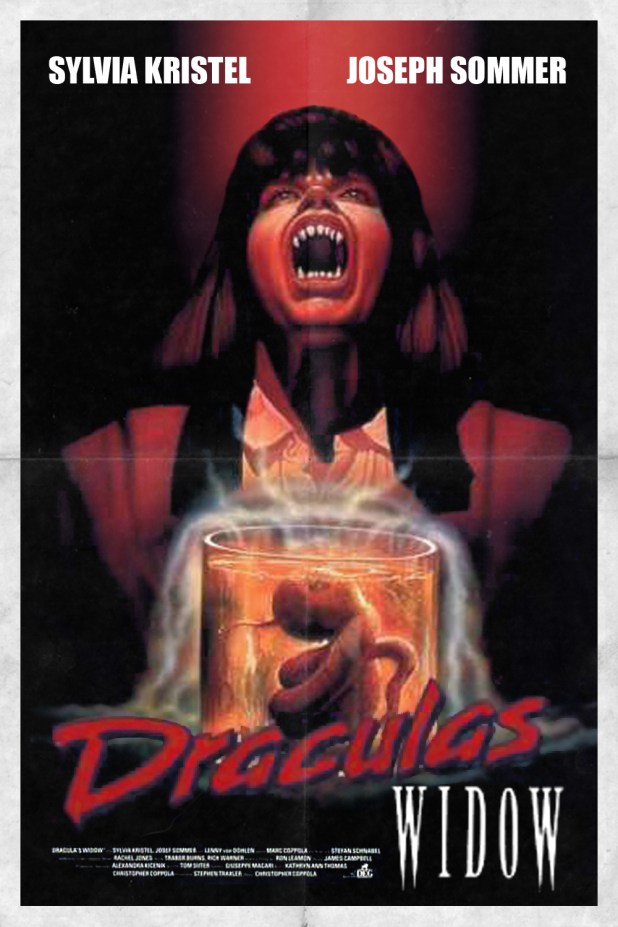
The movie is fairly short on nudity, given that directive. What Coppola gave audiences instead was a strange ode to both classic gothic cinema and film noir featuring plentiful amounts of camp and gore to keep ‘80s horror fans satiated. Dracula’s Widow begins with narration by hard-boiled police Lieutenant Lannon, played by character actor Josef Sommer. Sommer had, a few years earlier, narrated a slightly more critically well-regarded film, Sophie’s Choice. The genre shifts from noir to horror when we are introduced to Raymond Everett, the proprietor of a wax museum. Wax museums as a setting for horror films has a rich history, but to underscore Everett’s devotion to the genre, we see him watching classic silent fright films on a projector after hours. Everett has just imported material for one of his displays from Transylvania. Unbeknownst to him –and, I assume, to Customs—among those items are the remains of the widow Dracula. Those remains do not remain remains long. 

The reanimated Widow, who we learn is named Vanessa, is played by Emmanuelle herself, Sylvia Kristel. And what does Vanessa do when she’s new in town? Why, of course, she goes to a bar where she picks up and devours a generic ‘80s creep (played by yet another Coppola, Marc). Then she returns to the wax museum where she encounters a pair of Wet Bandits-esque burglars, dispatching one. The plot continues to evolve from there, including an ‘80s Satanic cult, the heir to Van Helsing, and a love triangle between vampiric Vanessa, Raymond, and Raymond’s girlfriend Jenny Harker. All of the talent on screen are game, giving at times over the top but never boring performances. The gore effects are provided by Todd Masters. Masters is still working today, having worked recently on Final Destinations: Bloodlines and the less interesting to this readership, Gabby’s Dollhouse: The Movie. His other genre credits include zombie comedy Fido, Tales from the Crypt: Demon Knight, and the original film version of Buffy the Vampire Slayer. 

I first encountered Dracula’s Widow on cable in the late ‘Oughts, and was happy to find it on Tubi recently. As of this writing,  it has 821 logs on Letterboxd. The good news is that I encountered the social media post I quoted above while searching to see if a physical release existed. Apparently, a Blu-ray is in the works.

UNSUNG HORRORS HORROR GIVES BACK 2025: Moebius (2013)

Each October, the Unsung Horrors podcast does a month of themed movies. This year, they will once again be setting up a fundraiser to benefit Best Friends, which works to save the lives of cats and dogs across America, giving pets second chances and providing them with happy homes.

Today’s theme: South Korea

Directed and written by Kim Ki-duk, Moebius has no words, using only vocables like “uh-huh” and “hmm” for character communication. Want to see me get fancy? It also has no non-diegetic sound except for the beginning and the end.

The mother (Lee Na-ra) is upset that the father (Cho Jae-hyun) has a mistress (also Lee Na-ra), so she tries to castrate him. That fails, so she does the same to their son (Seo Young-joo) and eats his severed beenie weenie. Yes, this happens and quite early.

The father decides to research a penis transplant while also teaching his son all about BDSM. As he has no penis, the son is bullied until he participates in the gang assault of his father’s mistress. As he has no penis, he is found not guilty; he makes his way to the mistress’s work, where they have a threesome with the leader of the gang of bullies. A knife gets involved, another penis gets sliced, and then a truck runs over the gang leader’s wang. The mistress likes the son better without a penis, so when the father gives him his in the transplant, that falls away, just in time for the mother to come home. She wants a sexual relationship with the father, which is impossible, but the son’s penis has a mind of its own and gets erect around the mother. The father tries to castrate his son, then kills himself and his wife. The son responds by shooting off his member, then becoming a holy man.

The scary part of all of this is that Lee Na-ra replaced another actress who was slapped multiple times by director Kim Ki-duk, as well as being forced to be in the assault scene that was much rougher than she thought it would be. Four years after these charges, Kim Ki-duk was accused of sexual molestation of his students and actor Cho Jae-hyun was also charged with multiple accounts of physical assault, sexual assault and rape alongside the director.

I didn’t learn about the crimes until after I saw this; it now stays with me for much different reasons.

You can watch this on Tubi.

UNSUNG HORRORS HORROR GIVES BACK 2025: I Saw the Devil (2010)

Each October, the Unsung Horrors podcast does a month of themed movies. This year, they will once again be setting up a fundraiser to benefit Best Friends, which works to save the lives of cats and dogs across America, giving pets second chances and providing them with happy homes.

Today’s theme: South Korea!

About the Author: Parker Simpson is a writer and podcaster focusing on cult films and their social impacts. They currently cohost Where Is My Mind, a podcast focusing on underappreciated films from a variety of genres and countries. They have also held panels, chartered local organizations, and written articles to their blog. When not writing or studying, they like to spend time with their pets and go outside. Check out the podcast Linktree and blog.

I remember watching a trailer for this a few months ago and thinking the serial killer was the aggressor the entire movie. I was wrong.

Anger is an addiction. When someone gets mad, they want to stay mad, even when they tire of it and destroy the lives of others. This can be as small as a petty friend drama, or as large as a full-scale revenge plot. The rampage is unable to be stopped until the person is, at least before wrath consumes them whole.

If you take anything away from 2010’s I Saw The Devil, that may be the smallest and least sensitive reading you could possibly get. Focusing on an intelligence agent’s quest to hunt down the serial killer that murdered his wife, both parties end up in a cat-and-mouse game that affects everyone around them.

The most talked about aspect of the film is its gratuitous violence. This film never lets up its attack, nearly desensitizing the audience until the very final shot, falling into the same vein as other Korean revenge films like Oldboy and Mother. Clocking in at over 140 minutes, it is an endurance test to get through certain scenes involving torture, mutilation, and murder in between lengthy bits centering around character disposition. Some call it torture porn, graphic and tiring; not to sound like the edgelord in the room, but that could be the point. In one’s conquest to exact revenge, you will eventually find the journey for such satisfaction tedious and uninspiring. You may forget what you were even fighting for. Does that mean it’s worth it to go on? I Saw The Devil doesn’t make a particularly compelling argument, showing both parties devolving into insanity and unsavory sadism in a world where there is no good or evil, just wrath, envy, lust, and all of the other sins. 

This point seems to go over many heads amidst the rampant violence against women and lagging pace, not that I don’t disagree; I have yet to see the rest of Kim Jee-woon’s filmography, but many online are quick to point out very few of his films have a favorable view of women. From this one film, it’s important to note the only female characters are shown as helpless, either mourning the death of Kim Soo-hyeon’s wife, Joo-Yeon, or becoming a victim of sexual assault. It fits the killer’s motif, yes, but it’s tiring and even degrading. It makes you wonder what could have been done differently, given the fascinating take on revenge.

I Saw The Devil’s strongest aspect is its visuals. The opening sequence with Joo-Yeon is one of the best cold openings I’ve seen in a long time; the second you see the glimmer in the “Good Samaritan’s” otherwise black eyes, you know what you’re in for: something creepy and unforgiving. Its immaculate cinematography is complemented by a sickly color palette that is simultaneously pale, harsh, and dark. Pretend all the violence was off-screen; you would still walk away feeling nauseous.

Additionally, the performances by the two leads, Lee Byung-hun and Choi Min-sik are mesmerizing, perfectly capturing two psychopaths in a sick loop, hell bent on destroying each other. I see that the former is involved in Squid Game and KPop Demon Hunters – not the plot twist I expected to see after I watched him make the world’s worst Rube Goldberg contraption. Despite both their sorrows and pains, neither express any regret of continuing their little game. And that may be the biggest tragedy of all.

I strongly recommend this to anyone who has seen Oldboy, Lady Vengeance, and Mother, yet somehow not seen this. And if you have not seen any of those titles, this isn’t a bad place to start – just be warned: it’s an intense, polarizing ride that leaves you sick to your stomach.

UNSUNG HORRORS HORROR GIVES BACK 2025: Yongary (1967)

Each October, the Unsung Horrors podcast does a month of themed movies. This year, they will once again be setting up a fundraiser to benefit Best Friends, which works to save the lives of cats and dogs across America, giving pets second chances and providing them with happy homes.

ABOUT THE AUTHOR: Adam Hursey is a pharmacist specializing in health informatics by day, but his true passion is cinema. His current favorite films are Back to the FutureStop Making Sense, and In the Mood for Love. He has written articles for Film East and The Physical Media Advocate, primarily examining older films through the lens of contemporary perspectives. He is usually found on Letterboxd, where he mainly writes about horror and exploitation films. You can follow him on Letterboxd or Instagram at ashursey.

Today’s theme: South Korea!

Filmgoers of Korea: We want Godzilla!

Director Kim Kee-duk: We have Godzilla at home!

Godzilla at home:


When I am making my list of films to watch for challenges, I keep several factors in mind. First and foremost, do I have access to the film I want to watch? There is nothing worse than getting excited about watching a movie, only to discover that it is not readily available anywhere. Next, how long is the movie? For example, I really loved The Wailing (a film that would fit into this category), but I do not have 156 minutes to devote to it in October. I have to get through too many films. Third, you want your list to have a nice variety about it. You don’t want 31 slashers. You need some diversity.

Yongary, Monster from the Deep checks all of the necessary boxes. I own the Vinegar Syndrome 4K (a 4K?) thanks to being a subscriber (a membership I question more and more each year). The film is only 79 minutes long, a blessing. And I can say I threw a kaiju on my list. 

Does the movie have to be good? No. Do I have to like every movie on my list? Absolutely not. Am I glad I watched Yongary? Let’s just say that this 4K is going on my sale pile. 

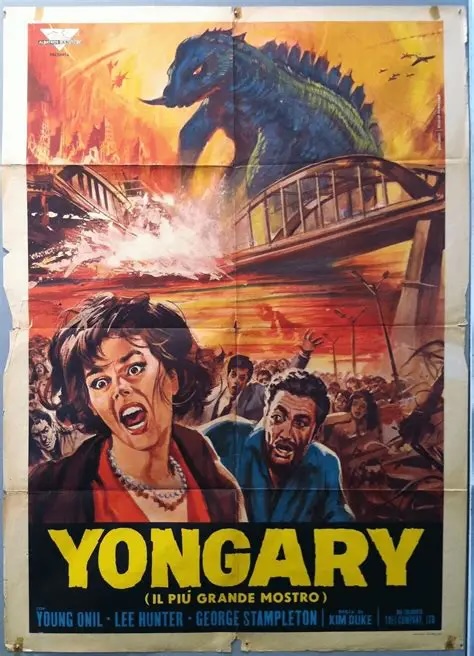
The film has its charms for sure. If you love seeing a guy in a rubber suit stomping around a set of miniatures, this is the film for you. If you want to see a monster dance with a precocious little kid, you are in luck. If you want to see a kaiju die by bleeding out of the rectum into a large body of water, no kink shaming here. But for me, this film will fall into that rare category of a film I did not really care for, would not watch again, but will probably never forget. Especially that last part.

UNSUNG HORRORS HORROR GIVES BACK 2025: Bugged (1997)

Each October, the Unsung Horrors podcast does a month of themed movies. This year, they will once again be setting up a fundraiser to benefit Best Friends, which works to save the lives of cats and dogs across America, giving pets second chances and providing them with happy homes.

Today’s theme: Animal Attack

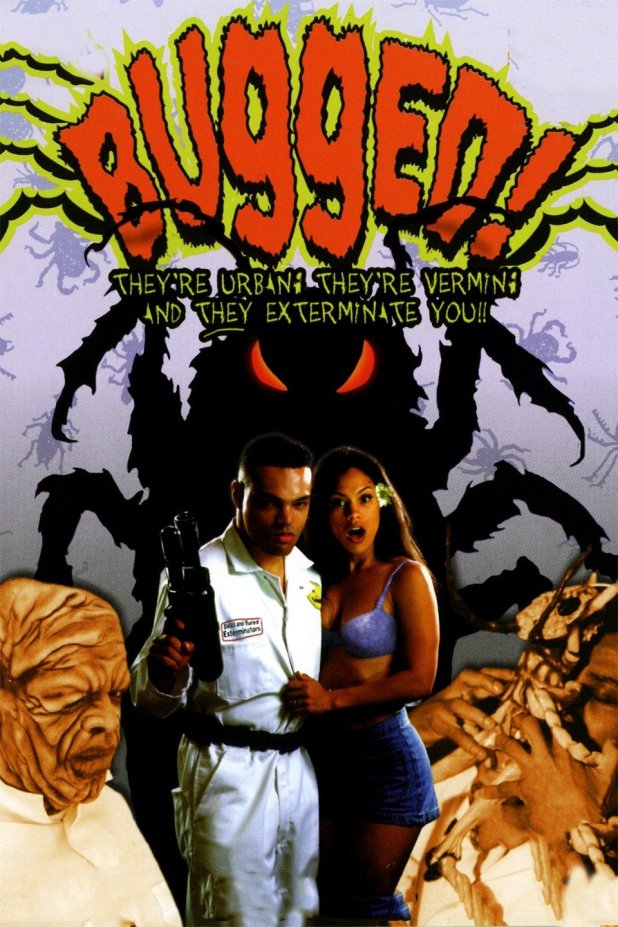
“They’re urban, they’re vermin, and THEY exterminate YOU!”

Ignore the Troma logo at the beginning of Ronald K. Armstrong’s directed, written, produced and starred in insect film and prepare for something great.

Dr. Craig (John Kilgore)’s chemicals have replaced the bug-killing pesticides in the Bugbusters supply room with one that makes the bugs bigger. After all, Dr. Craig did what you never should and pulled a Goldblum. That’s correct — he tested those drugs on himself, turned into a giant bug and then got shot in the face by his lab assistant. Now, bugs are everywhere in the city, and just being an exterminator puts Dave (Armstrong) into danger’s maw — mandible? — as he tries to defest the home and win the heart of Priscilla Basque). Dave’s partner, Steve (Jeff Lee), may screw things up for both his goals before that.

This has an all-black cast, body melting moments, cartoony aspects like how Steve gets flattened at one point, effects that look like they came from the clearance aisle, a rat puppet, evil bugs with human eyes and way more action — and romance! — than this budget would seem to indicate. In fact, every review of this movie — nearly, let’s not get hyperbolic — seemed to make fun of how cheap this looked. Maybe they should look past that and see that this has heart, brains and, well, guts.

UNSUNG HORRORS HORROR GIVES BACK 2025: Prophecy (1979)

Each October, the Unsung Horrors podcast does a month of themed movies. This year, they will once again be setting up a fundraiser to benefit Best Friends, which works to save the lives of cats and dogs across America, giving pets second chances and providing them with happy homes.

Today’s theme: Animals Attack!

ABOUT THE AUTHOR: Adam Hursey is a pharmacist specializing in health informatics by day, but his true passion is cinema. His current favorite films are Back to the FutureStop Making Sense, and In the Mood for Love. He has written articles for Film East and The Physical Media Advocate, primarily examining older films through the lens of contemporary perspectives. He is usually found on Letterboxd, where he mainly writes about horror and exploitation films. You can follow him on Letterboxd or Instagram at ashursey.

Ecology horror boomed in the 1970s. The reason is clear. Environmentalism was becoming a major political talking point. Companies were disposing of their toxic waste without proper regulations. In 1969, the Cuyahoga River in Ohio caught fire due to the amount of chemicals in the waterway. By 1970, Earth Day was established to bring awareness to the fragility of the Earth and its resources. And the Environmental Protection Agency (EPA) was established as a government agency via an executive order by Richard Nixon, later ratified by Congress. You mean there was a time when Republicans cared about the environment and the future of our planet? 

There are of course many films that base its plot around animals running amok, perhaps seeking revenge on the neglect or outright disdain humans have for the environment. Frogs. Bug. Squirm. One word really sums it up.

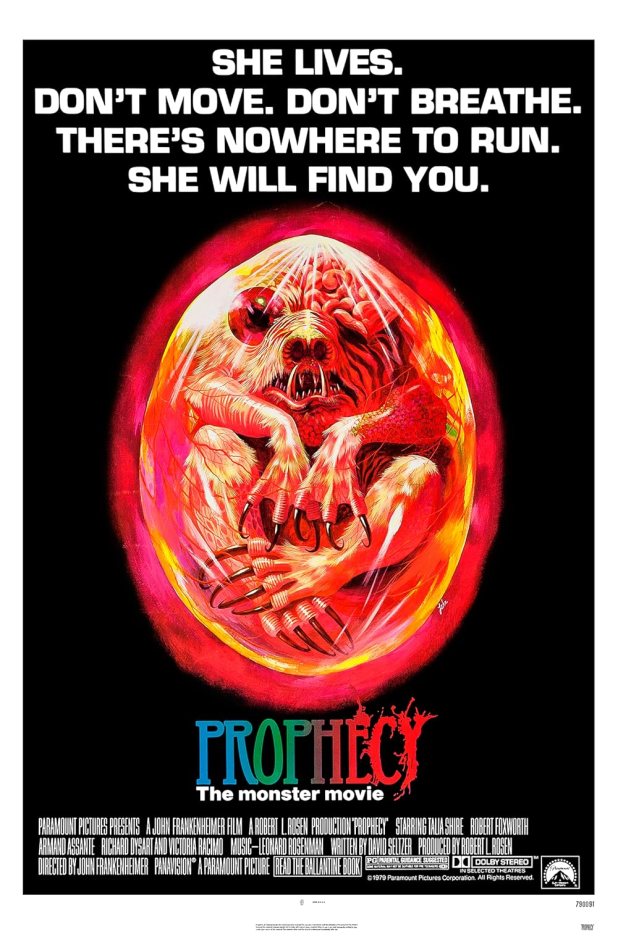
You can add John Frankenheimer’s Prophecy to that list. His film takes the next step, though. Not only is the improper waste management of a capitalistic corporation to blame for the mayhem that ensues, the encroachment of indigenous land plays a major part in the mutation of a bear out for righteous revenge. Although, in retrospect, perhaps casting Armand Assante as the leader of the Native American resistance was not ideal. You have to take social change in cinema one bite at a time, I suppose.

Unfortunately, despite the importance of the story, the film itself is a bit bland, perhaps focusing a bit too hard on the relationship between ecologist Robert Verne (Robert Foxworth) and his cellist wife Maggie (Talia Shire). Maggie recently found out she is pregnant, and Robert is not interested in bringing a child into such a broken world. She has not broken the news to Robert, though, when they go to the area of dispute between the evil corporation and the Native Americans. The situation gets dicier when she realizes she may have exposed her unborn child to the environment that mutated the bear. As much as I love melodrama in my horror film, this story left me underwhelmed.

What left me properly whelmed, though, is the sleeping bag child kill! Is it wrong that I literally laughed out loud when it happened? If laughing at kids getting demolished in movies is wrong, I don’t wanna be right.