April 19: Weird Wednesday — Write about a movie that played on a Weird Wednesday, as collected in the book Warped & Faded: Weird Wednesday and the Birth of the American Genre Film Archive. Here’s a list.
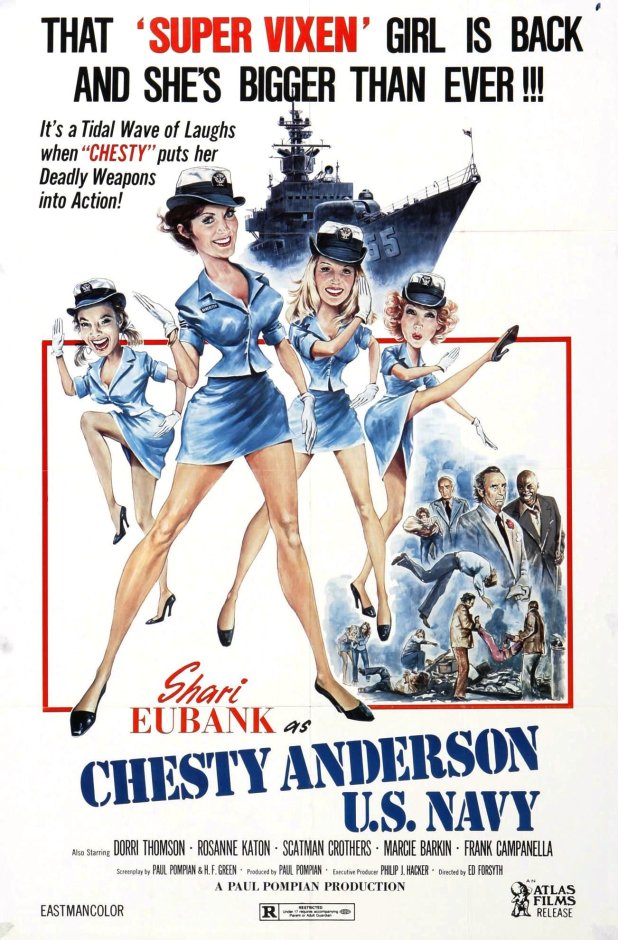
Chesty Anderson is a WAVE (Woman Accepted for Volunteer Emergency Service) in the U.S. Navy and the lead character in a movie that promises that you will see bare breasts. That’s 1976, I guess, and Shari Eubank is the right actress for this. A former cheerleader and homecoming queen at Farmer City High School in Illinois, she only was in one other movie and what a movie: Russ Meyer’s Supervixens. After this movie, she quit acting and moved back home where she became a drama teacher. And she’s a way better actress than most people would be in sexploitation film, but man, Supervixen is your drama teacher? The world is fascinating.
While this movie is a snooze — how can a movie named Chesty Anderson, USN be boring? — it does have a fun cast. It left Scatman Crothers ill-prepared for dealing with Kubrick, as one can only assume every scene is done in one take; I’ll bet there were fewer takes in this all put together than in one scene of The Shining. Timothy Carey is devouring scenery and being a lunatic as a mobster, while Ilsa herself Dyanne Thorne is in this as a fellow WAVE, while Joyce Mandel (Wham Bam Thank You Space Man), Uschi Digard (so many mammary-based movies), Rosanne Katon (Bachelor Party), Marcie Barkin (Fade to Black), Connie Hoffman (The Naughty Stewardesses), Dorrie Thomson (Policewoman) and even Betty Thomas show up. Fred Willard too, as Chesty’s square boyfriend.
Chesty’s sister has been killed after taking photos of Senator Dexter (George Dexter) in drag, which gets organized crime involved. And a man-eating plant is part of the story.
Yet through all this — a movie with all of these people — it’s very PG. And look, I’m not demanding sin, but in a movie with this cast, even the shower scenes could be watched on regular television. It promises you vice and gives you virtue. Well, not much, but you get the point.
Director Ed Forsyth also made Superchick, Caged Men, The Ramrodder and more, while writer Paul Pumpian mostly worked in animation after this and this is the only film for his co-writer H.F. Green.
April 19: Weird Wednesday — Write about a movie that played on a Weird Wednesday, as collected in the book Warped & Faded: Weird Wednesday and the Birth of the American Genre Film Archive. Here’s a list.
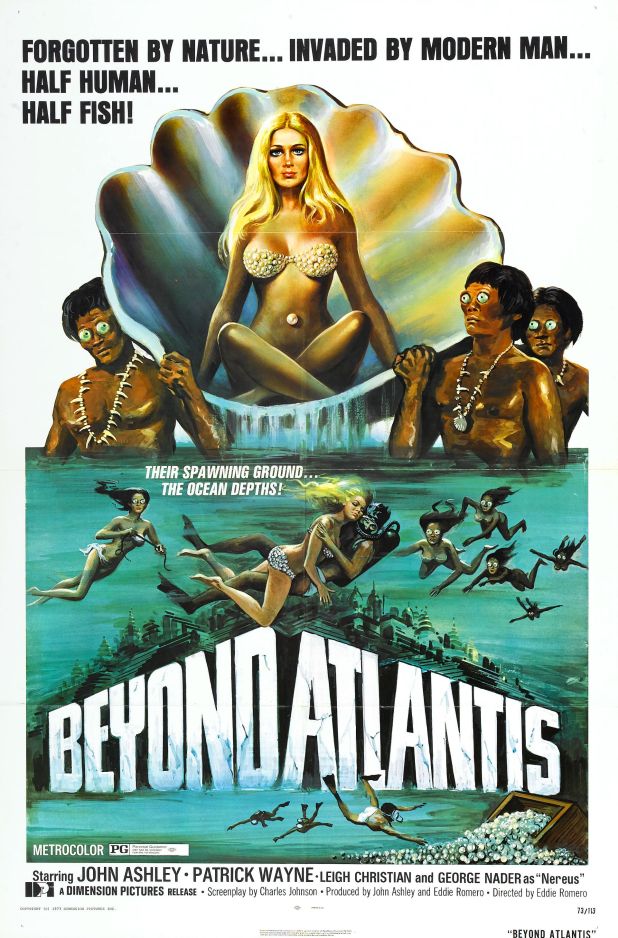
I was loud while watching this movie that my wife had to come to check on me. The sheer delight had overtaken me when East Eddie (Sid Haig) appeared in a movie where gigantic-eyed Atlantean people attempted to keep their undersea world alive thanks to a new queen named Syrene (Leigh Christian), who must constantly sire new children, as decreed by her adopted father Nereus (George Nader).
Eddie is part of a group trying to farm pearls for money which includes what could be the exploitation movies made in the Philippines version of The Avengers: Manuel the Barracuda (Vic Díaz), Logan (John Ashley) and Vic Mathias (Patrick Wayne).
Producer Ashley had the idea that this would be a science fiction version of The Treasure of the Sierra Madre, which is a big idea, while Wayne would only be in the film if it was a family-friendly movie, but it’s also about rebuilding the DNA of a dying world of interbred bug-eyed merpeople, which is a fun juxtaposition.
The underwater scenes are gorgeous and this has way better production values than many movies made in the Philippines. Yet if it had more exploitation — a fact that Ashley believed — I think it would be a more exciting movie.
ABOUT THE AUTHOR: Competing since 2014, Demaras Racing is made up of three committed family members: No. 12 Daniel Demaras, No. 29 Michelle Demaras and Chris ‘#16’ Demaras. They also have an awesome website where they share Fast Films every Friday. Here’s one of them!
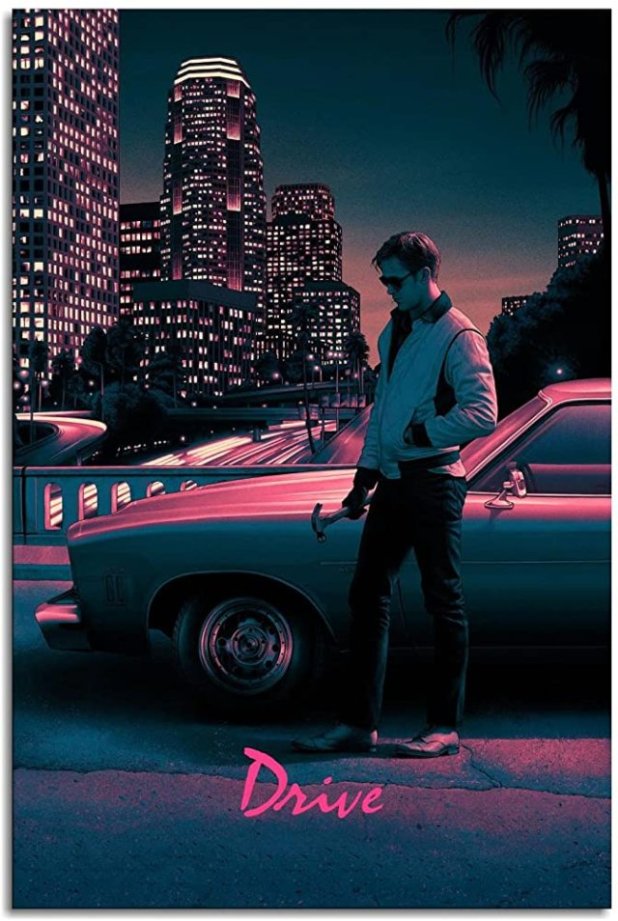
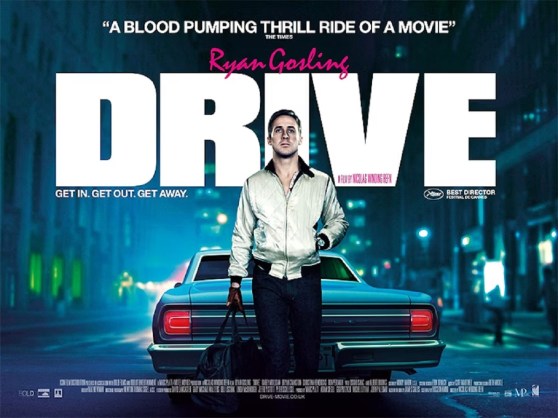
Whoever handled marketing for Drive back in 2011 ran commercials that made this movie look like Ryan Gosling joined the latest installment of The Fast & the Furious.
“A Hollywood stuntman who doubles as a getaway driver at night. He’s icy cool, but his pretty neighbor and her little boy are melting his heart. With a million dollar score, he can finally leave his old life behind. He can outrun the cops, but can he escape his past?”
Audiences were confused. What they saw was a stylish, art-house movie exploring the a character’s descent into madness, disguised as a car flick.
The driver is cold, distant and emotionless. An automaton who’s purpose is to drive. He does it with skill, and very few words. The opening scene sets the tone. The meticulous planning of the driver helps the bad guys escape a robbery, not with his blinding speed, but by outsmarting the cops with his street knowledge, using highway overpasses and tall buildings to hide from the police helicopter. The director attempts to make it clear that the driver is not like the bad guys; he is never in the frame together with them, even when in the getaway car.
The 1973 Chevrolet Chevelle SS ‘hero car’ says a lot about the protagonist. This is not something from the ’69 to ’71 golden years of muscle cars. Many wouldn’t even recognize that this was raced in NASCAR by Bobby Allison and Darrell Waltrip to victories. Far from flashy in primer-grey, it’s a perfect low-key muscle car for a getaway driver.
The title character is a movie stunt driver and part-time getaway driver, but his ‘front’ is as an auto mechanic. Inside his boss’ Shannon’s garage is an incredible array of classic American cars including a 1955 Ford Thunderbird, 1967 Pontiac GTO, 1969 Cadillac Fleetwood Eldorado, 1969 Dodge Charger and 1969 Plymouth Road Runner.
One fateful day, the driver’s pretty, blonde neighbor Irene, and her son Benicio, show up at the garage in their busted Toyota Camry. The movie completely changes, and the pace slows down, as the audience is presented with a character study of a lonely man making a human connection.
The driver is a quiet guy, and expresses little emotion, few aspirations. But his boss Shannon (Brian Cranston from Breaking Bad) has visions of running a race team, now that he has the driver! Shannon wants to borrow $400,000+ from a local gangster (played by Albert Brooks of Taxi Driver fame) and invites him to the track to watch the driver run laps in a turn-of-the-century Chevy Monte Carlo NASCAR.
The movie is stylish; like a hot-pink and baby-blue 80’s version of Taxi Driver and Danish director Nicholas Winding Refn uses non-verbal communication such as music, colour and lighting to set the tone. We learn little about the stoic driver’s backstory, but the audience sees him change as his relationship with Irene and Benicio blossoms. The driver starts believing that he too can have a normal life, and that he can leave his life of crime in the rearview mirror.
In a misguided attempt to ‘help’ his new family, the driver agrees to a million dollar heist. If he can pull this off, he can be free from his criminal life. But everything goes wrong, the driver is double-crossed, and a second action movie scene occurs. In a recreation of the classic chase scene from 1968’s Bullitt, the driver is the hero behind the wheel of a 2011 Ford Mustang GT pursuing the bad guys in their full-size, V8 powered Chrysler 300C, standing in for the iconic Dodge Challenger from the original.
The driver escapes with the loot, and wants to take Irene and her son to start a new life together. But the gangsters he stole the cash from have other ideas, and threaten the lives of the driver’s surrogate family. Rather than helping Irene, the driver has brought the underworld life to her doorstep, endangering the lives of the people he cares for most. What’s a gangster to do?
In full Travis Bickle mode, the driver goes on a vehicular rampage, brutalizing everyone who poses a threat to his loved ones. Much as he wants to be the good guy, the driver is consumed by his dark side to save the girl. It’s easy to see why this movie alienated audiences upon release. Is the driver the hero, or just another villain with a soft spot? Does leaving the blood-stained bag of heist money next to the bodies of his enemies make him better than them? It’s open to audience interpretation whether this is a happy ending or not…but this is definitely not your average action movie.
ABOUT THE AUTHOR: Competing since 2014, Demaras Racing is made up of three committed family members: No. 12 Daniel Demaras, No. 29 Michelle Demaras and Chris ‘#16’ Demaras. They also have an awesome website where they share Fast Films every Friday. Here’s one of them!
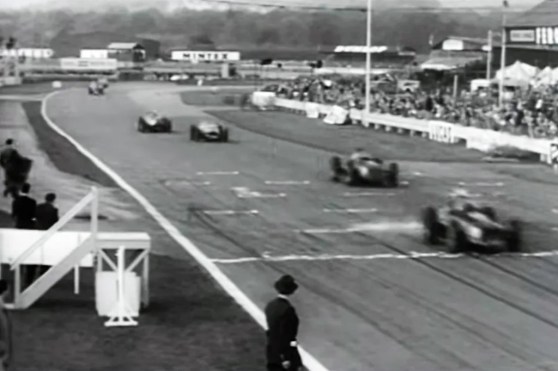
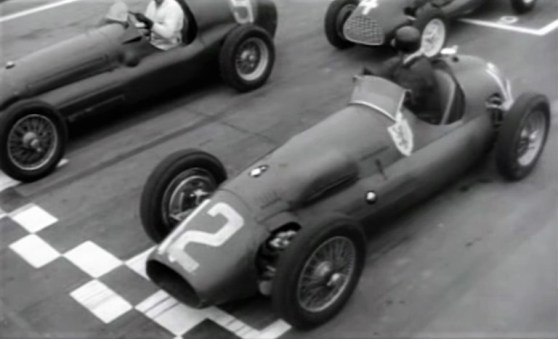
Your eyes do not deceive you. That is the treacherous Don Barzini from The Godfather as a grand prix driver in Mask of Dust. This 1954 British movie was produced by Hammer Films, best known for horror movies like 1957’s The Curse of Frankenstein. Before they found their niche, Hammer Films took footage of the 1953 Formula 1 season, added some melodramatic ‘plot’ to fill up the run time, and created this a car flick that’s truly a B-Movie masterpiece.
Released in the USA as A Race for Life the movie tells the tale of racing driver Peter Wells (silver screen star Richard Conte) a former champion who hasn’t won a race in two years. In the opening scene, Wells hops out of his race car after a practice session (filmed at Goodwood Circuit in England) thinking he’d laid down blistering times, only to be shocked at his slow laps. The pit crew tries to blame the carburetor, but Wells knows the truth… he’s lost his mojo. Wells’ younger, better, faster, stronger teammate even tries to convince the team boss that which is obvious to all; Wells is all washed up.
Fellow racers tell Wells to hang up the goggles. Wells’ hot blonde wife tells him to quit and rambles on about wanting a cottage, a white picket fence, and him not to die. She does not understand that a man like Wells, a superstar racer, cannot quit when he’s down. He must go out on top. Wells needs one more win.
During a race, a rival is critically hurt in a wreck. Wells abandons his car while leading the race, and rushes to the hospital. Team boss is pissed off, and almost fires Wells. Wife is pissed off, and leaves Wells rather than watch him face the same fate.
After 30 minutes of self-doubt and hand-wringing, the filmmakers mercifully added one more racing sequence (possibly shot at Oulton Park). The 1950’s Formula 1 cars take their place as the stars of the movie. Front-engined Ferraris speed around treacherous corners, the tree-lined track looking deadly and devoid of safety measures.
Raw footage of grand prix cars is interspersed with some of the worst phony-baloney onboard shots ever filmed. You can only assume this was the maximum special effects of the day, but gosh, would it have been so hard to put a race car on a trailer, and film Richard Conte from the back of a pickup truck?
In a challenge of man versus machine, the race car spits hot oil at Wells, reminiscent of the flames Mickey Rooney drives through in The Big Wheel. Wells’ feet and legs are burned by an overheating engine. But there’s no quit in Wells! It’s not just a race…it’s a race for his life!
Yeah…corny. But who cares! If you just ignore the ‘acting’ and ‘plot’ you’ll see that this film provides an rare glimpse into open-wheel racing action from the genesis of Formula 1, those earliest years. The film includes racing footage of Sir Stirling Moss and John Cooper behind the wheel. As a piece of preserved history, and not just a B-movie, A Race for Life is a champion!
This great old racing movie can be found on Cult Cinema Classics channel on YouTube.
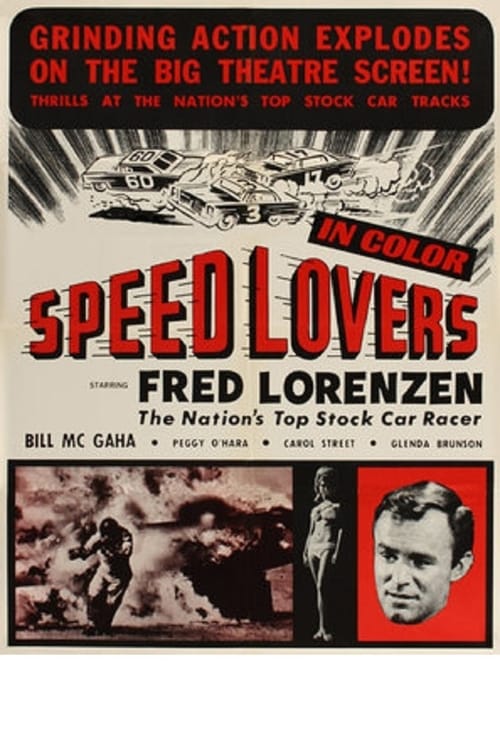
William F. McGaha, co-wrote, directed, produced, and stars in this as Scott, a young car racer who will remind you that he deserves to be on the track to the point that you will absolutely hate him. So yeah, he can do anything except make you love him in this movie.
What this movie does have is a great theme song, “Speed Lovers” by Billy Lee Riley, and also an appearance by the band Randy Little and the Holidays, who rock out two numbers, “You Love Everybody” and “A Living Doll.”
Scott Clayton, the character that McGaha plays, is the son of a famous mechanic and being asked to fix a big race by Atlanta organized crime figure Pinkerton Bentley (David Marcus), who plies him with sodas and go go dancers.
Fred Lorenzen — The Golden Boy, Fast Freddie, The Elmhurst Express and Fearless Freddy — plays himself and at the time, he was a majorstar in NASCAR, winning the following races from 1962 to 1967: the Atlanta 500, the World 600; the Volunteer 500, the Western North Carolina 500; the Mountaineer 300 and the Old Dominion 500 in 1963; the Southeastern 500 at Bristol; the Atlanta 500; the Gwyn Staley 400 at North Wilkesboro; the Virginia 500 at Martinsville; the Rebel 300 at Darlington; the Volunteer 500; the Old Dominion 500 and the Charlotte Motor Speedway National 400 in 1964; the Daytona 500; the Virginia 500; the World 600 and the National 400 in 1965; and the Old Dominion 500 and the American 500 in 1966 and Daytona 500 Qualifier in 1967. In 1963 alone, he made $122,000 in winner’s prizes, a figure which would be $1.2 million dollars in 2023 money. That’s kind of like having Michael Jordan show up in your regional Florida movie.
McGaha would go on to make Bad Girls for the Boys, The Shrink and one of the oddest biker movies ever, J.C., which yes, is about a motorcycle riding Jesus. He wrote this with Fred Tuch, who went on to be an art director for the shows Manimal and Galactica 80 as well as the art director for Pennies from Heaven, the storyboard artist for Mannequin and an illustrator on Blue Thunder.
This is as much a car movie as it is one about people making the dumbest decisions. Like therapist Orianna (Mimi Rogers), who decides to try a technique in which she tries to put Penny (Rachel Miner) right into the trauma she has avoided since her parents died in a car accident. Immersion therapy? I don’t know. I went to art school. But then, while on a road trip with penny, Orianna hits a hitchhiker and instead of calling the police, she decides to give that injured man a ride.
What follows is the hitchhiker stabbing one of their tires and nearly killing them. Well, he goes all the way and murdered Orianna,then wedges the car between two trees and tortures Penny by making her do her breathing exercises and, you know, cutting off one of her toes when he isn’t murdering everyone around her.
Mickey Jones, who teamed with Michael Ironside in the series version of V, and Michael Berryman are in the cast. Directed by Richard Brandes, who wrote the script with Diane Doniol-Valcroze and Arthur Flam (who were also the writers of the vehicular homicide movie Hit and Run and the movie Kill By Inches, which is about a murderous tailor who can’t measure anything properly and thus becomes a killing machine), this movie literally has Mimi Rogers dead in the car for most of its running time. What a role.
Also: the same license plate on the car in this was the plate for Nash Bridge‘s 1970 Plymouth Barracuda, a car that Bridges claimed they only made 14 of. Well, it’s actually a 1971 Plymouth Hemi ‘Cuda, a Plymouth Barracuda with a Hemi V8 and a special design that really was only for one year. According to Hot Cars, this model had not only the distinctive fender gills of this car and the shaker hood from the 1970 edition, but also four headlights and improved taillights. But Nash may have been off on how many there are, as estimates go from single digits to eleven made. Eleven! These things sell for around $3.3 million. So that means the cars for the show were custom-made fakes. There were four cars: a 5.5-liter Barracuda with a shaker hood, two 5.2-liter Barracudas and a 7.2-liter version that were all made by Frank Benetti and his Same Day Paint and Body Shop in Newhall, Los Angeles.
I told you all that about that car because honestly, it’s way more interesting than Penny Dreadful.
Man, no matter who Dennis Weaver is battling — a Manson-like family against his RV-using vacationing clan (Terror on the Beach), the ghost of his dead daughter (Don’t Go to Sleep) or straight-up Peruvian snow (Cocaine: One Man’s Seduction) — I’m always on his side. He has an everyman quality that is so endearing. no matter how rough TV movies make his existence.
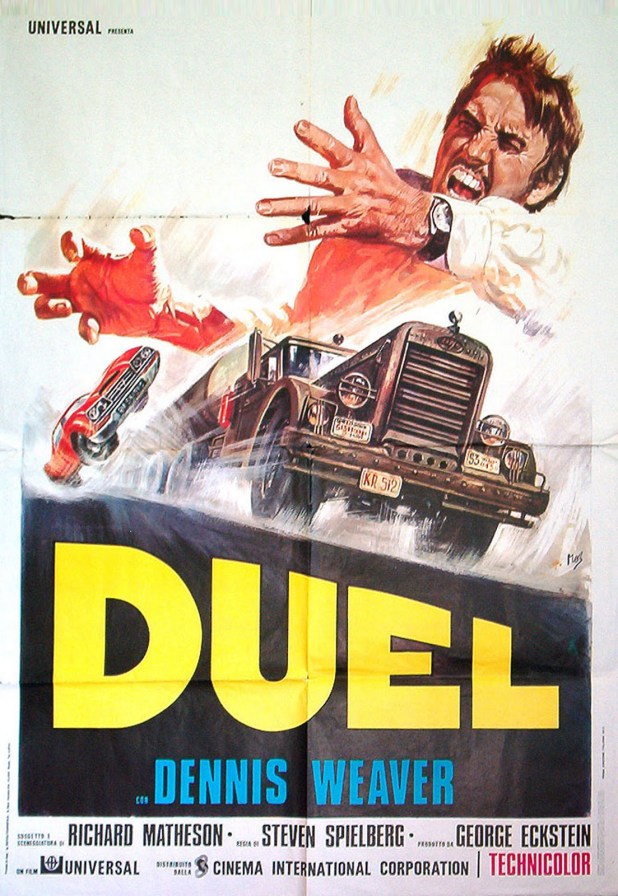
In Duel, the ABC Movie of the Week series for November 13, 1971 — and later an international release in theaters — he’s just a businessman in a Plymouth Valient who upsets the driver — never seen — of a 1955 Peterbilt 281 18-wheeler. It sounds so simple, but that’s what makes it work. There’s little dialogue in the movie with the car and truck pretty much speaking for themselves, as was the intention of its director, a young Steven Spielberg, making his first full-length film after working in series television on shows like Night Gallery, The Name of the Game, Marcus Welby, M.D., Columbo, Owen Marshall, Counselor at Law and The Psychiatrist. Universal signed him to several TV movies, which include Savage and Something Evil before he left TV behind and made The Sugarland Express and the film that would cement his status, Jaws.
Spielberg requested Weaver, as he loved him in Touch of Evil, and even has him use a line from that Orson Welles movie, as he tells the truck driver that he has “another thing coming.”
If you see a version with swearing and more talking, that’s because Universal paid the director to pad it for theatrical release. As for that sound — it seems like a dinosaur — that the truck makes when it dies, it’s the same sound as the shark at the end of the blockbuster Spielberg would later make. He’s said that there is a kinship between the two movies, which are about monsters threatening normal people and the sound effect being used again was “my way of thanking Duel for giving me a career.” It comes from the 1957 movie The Land Unknown.
The other reason this works so well is because of the script by Richard Matheson. He based it on a real story from his life, as a truck tried to run him off the road after a round of golf with Jerry Sohl on the day that JFK was killed. He tried to sell it as a movie for eight years before selling it as a short story to Playboy, where it was published in April 1971. Spielberg said of him, “Richard Matheson’s ironic and iconic imagination created seminal science-fiction stories and gave me my first break when he wrote the short story and screenplay for Duel. For me, he is in the same category as Bradbury and Asimov.”
If you liked this story, so many other Matheson tales have been made into movies: Icy Breasts is his story Someone Is Bleeding, plus there’s The Incredible Shrinking Man, A Stir of Echoes, Ride the Nightmare (filmed as Cold Sweat), The Beardless Warriors (filmed as The Young Warriors), The Comedy of Terrors, The Legend of Hell House, Bid Time Return (filmed as Somewhere in Time), What Dreams May Come, “Prey” which is the “Amelia story in Trilogy of Terror, numerous episodes of Night Gallery and The Twilight Zone, “Steel” (filmed as Real Steel), the “No Such Thing as a Vampire” chapter in Dead of Night, plus the scripts for The Beat Generation, House of Usher, Master of the World, The Pit and the Pendulum, Burn Witch Burn, Tales of Terror, The Raven, The Devil Rides Out, Jaws 3-D, The Night Stalker, The Night Strangler, Dying Room Only, Scream of the Wolf, The Box and so many more. His most filmed story is I Am Legend, which was made as The Last Man on Earth, The Omga Man, I Am Aomega and I Am Legend. He really made his mark in the world with stories that will last forever.
I would dare say that Duel is in the top three of all made for TV movies of all time.
April 17: Party Over, Whoops — Select a movie from 1999.
Dick Maas is known for his Dutch language films like The Lift, Amsterdamned, Flodder, Prey and Sint, but this is in English and finds American pharmaceutical executive Walter Richmond (William Hurt) taking his wife Cathryn (Jennifer Tilly) and their 10-year-old mute ever since a major trauma daughter Melissa (Francesca Brown) to Amsterdam.
Melissa gets lost and sees Bruno Decker (Corey Johnson) kill Simon Van der Molen (David Gwillim), the attorney of her father’s boss Rudolph Hartman (Michael Chiklis) to keep the side effects of a new medication secret. She’s saved by a homeless man named Simon (Denis Leary) but is soon being menaced by Decker and Hartman, as well as Billy Boy Manson (Michael A. Goorjian), a rock star who tries to assault her. And she’s not even a tween yet.
Do Not Disturb flirts with giallo, perhaps not as much as Amsterdamned, with the stranger in a strange land idea of a girl who can only communicate by dry erase board lost in a foreign country. I read a great thought on Maas by Letterboxd user Dan Prestwich, who said that the director makes films that are like a “children’s film except with an R-rating.” He excels when it comes to getting past the plot and all those contrivances and getting down to chase scenes and action.
April 17: Party Over, Whoops — Select a movie from 1999.
This is the first full-length feature to use computer-generated imagery for the synthesis of human visual speech. And yes, it made $36 million dollars on a $12 million dollar budget, but man, I don’t want to hate Bob Clark. Not the Bob Clark who made Black Christmas, Porky’s, Deranged, Deathdreamand Children Shouldn’t Play With Dead Things. Then I remembered that Bob Clark also was the director of Rhinestone even if he also made A Christmas Story and man, life is sad sometimes.
Dr. Elena Kinder (Kathleen Turner) and Dr. Heep (Christopher Lloyd) have figured out that babies are, true to the name of this movie, geniuses that speak in a secret coded language called Babytalk. When they grow up, they lose this knowledge. One of the orphans they have stolen, Sylvester, escapes and meets his twin brother Whit (they are played by Leo, Gerry and Myles Fitzgerald) and gets adopted by Dan (Peter MacNicol) and Robin Bobbins (Kim Cattrall).
Man, this movie makes me sad for Ruby Dee and Dom DeLuise. I mean, Dom was in some horrible films and this makes Munchie, Sextette and The Silence of the Hams look like movies that critics say take big swings and are singular experiences.
Who is to blame for this? Jon Voight.
Jon Voight, the man whose accent in Anaconda was so bad that I demanded he lose his Oscar, had this movie as part of his production company and worked to convince Clark that it was a good idea.
It wasn’t.
There’s also Superbabies: Baby Geniuses 2, which Clark directed and Voight played the final boss in, which there’s also a TV series that only aired in Italy and the Far East, but has gone direct to video and appeared here as Baby Geniuses and the Mystery of the Crown Jewels, Baby Geniuses and the Treasures of Egypt and Baby Geniuses and the Space Baby. I know that someday I’m going to watch these movies because I’m kind of insane and love to hurt myself.
I still love Bob Clark. But man, this movie worked hard to make me despise him.
April 17: Party Over, Whoops — Select a movie from 1999.
How?
Why?
Larry Harmon, one of the writers of this movie, is better known as Bozo the Clown. He was also smart, buying the rights to Bozo from Capitol Records and franchising local Bozo shows in nearly every major U.S. market and in other countries. In 1961, he went even bigger and bought the merchandising rights to the likenesses of Laurel and Hardy, making a cartoon with Hanna -Barbera and performing Stan’s voice (Jim MacGeorge, who played Stan on Get Smart, ended up being Hardy. Yes, that’s kind of weird). He held the rights so long that he was able to make this movie 38 years later.
The co-director and co-writer with Harmon was John R. Cherry III, the former advertising man who created Ernest P. Worrell and directed all of his films. When Jim Varney got too sick to make movies, he decided to make this, a film with the aim of reintroducing Laurel and Hardy to the new millennium.
To play Oliver Hardt, Gailard Sartain (who was in the Cherry-discovered comedy team of Chuck and Bobby with Bill Byrge; they’re also in the Ernest movies). And for Stan Laurel, why not Bronson Pinchot, who was a long way from Beverly Hills Cop by 1999. To be fair — I’m a big fan of Pinchot and see him as someone who never got the opportunity to how what he could do. Just watch True Romance to see him in action.
Somehow, the comedy team is in modern day Florida where they protect Leslie Covington (Susan Danford) from a mummy who wants to destroy her father, archeologist Henry Covington (F. Murray Abraham, who in 1999 was a long way from Amadeus).
Harmon also appears as the owner of Bozoworld, getting all his media into the movie.
Supposedly, the answer to why they are in 1999 is that the characters are the great-nephews of the legendary comedians. Yet why do they sound and act exactly like them? Why do they dress as if they came from a hundred years ago? Do people know who Laurel and Hardy are in this universe? Are they not mindblown that two non-brain addled — well, maybe — adults are dressing and acting like their uncles? Do they have too explain all the time that they are the great-nephews of Laurel and Hardy? Did Laurel and Hardy make love to their mothers in some act of family shame to ensure that the genes would keep passing through the holy bloodline? Are they legacy characters like The Phantomand Starman?
Who is this movie for? Anyone still alive that cared about the characters would be upset that someone else is doing a deep fake of them in real life. And anyone else would have no idea who they are. Does anyone else know that in a short called “Sons of the Desert” Laurel and Hardy were in a fraternity called the Brotherhood of the Nile and that totally means they should encounter a mummy at some point?
This was made in Cape Town, South Africa. This seems like the right place, I guess.





 B&S About Movies
You must be logged in to post a comment.