Many tried to bring this tale of American Airforce pilot and CIA operative Francis Gary Powers to the big screen — an incident that occurred on May 1, 1960. The single-jet engine plane of the title, the U-2, was nicknamed “Dragon Lady” by its maker, Lockheed Aircraft, to work as a high-altitude reconnaissance craft for all-weather intelligence gathering. Flown successfully throughout the late ’50s over China, Cuba, the Soviet Union, and Vietnam, the plane was actually shot down twice: the second time, which resulted in the dealt of pilot Major Rudolf Anderson, Jr., was during the Cuban Missile Crisis in 1962.
Image of ’80s home video VHS repack courtesy of Paul Zamarelli/VHS Collector.com.
In fact, back in 1962, Roger Corman hired Robert Towne (later of Chinatown fame) to whip up a script, I Flew a Spy Plane Over Russia that, thankfully, was never filmed. It took prolific TV producer Charles Fries — who not only brought us the first live-action adaptation of Spiderman (the recut TV pilot became an overseas theatrical hit, reaching #1 in Japan) but also gave us the Star Wars-infused The Martian Chronicles and the witch romp The Initiation of Sarah — to get it on the air on September 29, 1976, for NBC-TV. Fries’s other films? Well, there Cocaine: One Man’s Seduction, Are You In the House Alone?, and Secret Night Caller, just to name a few. He even went theatrical with Amicus’ Tales from the Crypt. Just look at that IMDb page! We could do a month-long tribute on his films alone. And while we haven’t delved deeply into the resume of his Academy Award-winning director (1955’s Marty), Delbert Mann, Mann’s extensive TV resume includes one of the movies we really love around here, the early ’70s possession flick, She Waits.
Lee Majors — Powers’s preferred choice was Martin Sheen! (and Powers had some pull, since this was based on his best-selling paperback, but he lost out to the network) — shot this, his seventh TV movie (including his three, pre-series Steve Austin movies), while working on The Six Million Dollar Man. And while Sheen would be have been wonderful, Lee shines in his role as Powers. Keen eyes of all things ’70s and ’80s TV will notice Noah Berry, Jr. (from TV’s The Rockford Files) as his dad, along with a cast rounded out by Lew Ayers, William Daniels, Nehemiah Persoff, and James Gregory (who worked with Lee on The Big Valley and came to be know for his work on TV’s Barney Miller, but we love him around here for his work as Ursus in Beneath the Planet of the Apes).
You can watch a truncated, 45-minute clip on You Tube.
About the Author: You can learn more about the writings of R.D Francis on Facebook.He also writes for B&S About Movies.
Well, this TV sci-fi’er really is the whole enchilada when discussing the career of Lee Majors, isn’t it?
Colon’d and suffixed as “The Moon and the Desert” when it aired as a two-part episode during its syndication run (and served as its overseas title in some quarters), we meet Steve Austin, an astronaut that’s made three moon landings. During a test flight crash in a space plane prototype, he looses his right arm, left eye and both legs. His friend and personal physician, Dr. Rudy Wells (played by Marin Balsam, who did not return for the subsequent films or series), recruits Austin for an O.S.O project (O.S.I in the series) overseen by Oliver Spencer (played by Darren McGavin; the character and actor did not return for the subsequent films or series): creating a cyborg through the installation of bionic parts onto a human body. As the reluctant astronaut deals with his new body and recruitment as a government agent (he returned to space in few series episodes), he accepts his first mission to rescue a valuable hostage asset in Saudi Arabia.
The TV movie’s high ratings and overseas success quickly justified the production of two more prefixed U.S. telefilms (again, theatrical features overseas): Wine, Women and War and The Solid Gold Kidnapping. The concept then went to series and ran for five seasons from 1974 to 1978. All three telefilms would be reedited into two-part series episodes for its syndication (with scenes being re-filmed with Martin E. Brooks, who portrayed Rudy Wells in the series, and Richard Anderson, who portrayed O.S.I head Oscar Goldman).
Upon the 1978 dual-demise of The Six Million Dollar Man and its spinoff, The Bionic Woman, Majors returned for three more U.S. telefilms/foreign theatricals: The Return of the Six Million Dollar Man and the Bionic Woman (1987), Bionic Showdown: The Six Million Dollar Man and the Bionic Woman (1989; starring wheelchair-and-bionic Sandra Bullock!), and Bionic Ever After (1994).
Multiple Sites.
It all began back in 1972 when Cyborg, Martin Caidin’s best-seller, was optioned for a film adaptation by Harve Bennett for Universal Pictures — and, at first, the film retained the book’s title. Elements of Caiden’s subsequent sequels of the continuing adventures of Steve Austin — Operation Nuke, High Crystal, and Cyborg IV — while not directly adapted, had various elements worked into the subsequent series. (You can read an in-depth review of the book-to-film translation at ManaPop and get the lowdown on all of the wonderful toys inspired by the series at Toys You Had.)
Bennett’s first choice for the title roll was Monte Markham, who worked on Bennett’s previous sci-fi telefilm, 1972’s The Astronaut. To ease the sting of losing the part due to studio executive interference — in preferring Majors’s more experienced pedigree courtesy of his work in the well-received and highly-rated series The Big Valley and Owen Marshall: Counselor at Law — Markham appeared in two episodes as race-car-driver-turned-into-new-and-improved-cyborg Barney Miller/Hiller: “The Seven Million Dollar Man” and “The Bionic Criminal.”
After the 1978 series cancellation, and prior to their production of the three 1987 to 1994 U.S TV movies, Universal cut another another foreign-only theatrical in 1980 from the two-part 1976 episodes, “The Secret of Bigfoot” and “The Return of Bigfoot.” As with Battlestar Galactica before it, which was also cut into three foreign theatrical sequels, Universal licensed several paperback tie-ins based on the series’ episodes. (You can watch the series version of “Secret” at NBC.com with Part 1 and Part 2, as well as “Return” Part 1 and Part 2.)
During our “Lee Majors Week” review of Starlight One, we named dropped the 1969 Gregory Peck sci-fi’er Marooned. So we should mention that film was also based on Caiden’s 1964 novel of the same name. Buck Rogers in the 25th Century fans may have picked up Caiden’s 1995 Rogers sidequel/adaptation, A Life in the Future, in which Buck was refitted with bionic parts.
A big-budgeted theatrical — not only for Steve Austin, but Colt Seavers’s adventures in The Fall Guy — have been ballyhooed for years, with Mark Wahlberg as Austin. This Screen Rant article from May 2020 wraps up the film’s production history. Lee has stated that, if he’s given a significant part with substance, and not just a cameo walk on, he’s willing to be involved in both productions. So, it’s fingers crossed for Lee!
You can watch the 1973 theatrical cut of The Six Million Dollar Man on the FShareTV platform. In 2010, upon the release of the 40-disc, 100-hour DVD box set of the series (hey, it’s only $239.95!), Lee sat down with Vanity Fair for an extensive interview about the series and its lasting pop culture status.
About the Author: You can learn more about the writings of R.D Francis on Facebook. He also writes for B&S About Movies.
Lionel E. Seigel (who wrote many-a-episodes of The Six Million Dollar Man and The Bionic Woman) provided Lee with his third TV movie leading-man role (after 1970’s The Liberation of L.B Jones). Produced by Paramount Pictures for ABC-TV, this is Lee in one of his rare appearances as a heavy, despicable character (that, in my mind as I review his work this week, it seems he didn’t repeat until 1990’s The Cover Girl Murders for the USA Network). Behind the lens is Jud Taylor, which perks up a Trekkies ears (sorry), for his direction of several episodes of Star Trek: TOS; he also gave us many-a-great TV movie, The Disappearance of Flight 412, in particular.
Robert Conrad (he of our Mill Creek fave, Assassin) and Lee Majors star as Eddie and Larry (Eddie’s the nutjob; Larry’s the misguided ne’er do well) who botch a kidnapping by accidentally killing their victim. So, as a consolation, they kidnap three nuns (Jane Wyatt, Carol Lynley, and Lois Nettleton) stranded on a California desert highway. Lee gets second thoughts when he makes an emotional connection with the Nuns and decides to help them escape the crazed clutches of Eddie.
Yes, that’s the same Carol Lynley from the disaster box office bonanza that was The Poseidon Adventure (and The Shape of Things to Come) and Jane Wyatt was, in fact, Spock’s mom. Also look out for an early role from Gregory Sierra (TV’s Sanford and Son and Barney Miller, but always loved around here as Verger from Beneath the Planet of the Apes!) as the cop on the case.
You can watch the full movie on You Tube. It made it to DVD and overseas TV via a deal between CBS-TV and Paramount Studio in the early 2000s.
About the Author: You can learn more about the writings of R.D Francis on Facebook.He also writes for B&S About Movies.
After his 112-episode, 4-year run as Heath Barkley on ABC-TV’s The Big Valley, it was time to see if Lee Majors could carry a feature film. And he did, with this, the screenwriting debut by familiar ’60s and ’70s TV actor Stuart Margolin (we know him best from his support role as Angel Martin, James Garner’s former cell mate, in The Rockford Files). And who’s the director on this? Well, hey, it’s George McCowan — the guy who brought us the nature-run-amuck classic, Frogs and the Canadian Star Wars dropping that is The Shape of Things to Come, as well as a few episodes of the pre-Star Wars venture The Starlost, and too many ’60s and ’70s U.S. TV series to mention.
One of the earliest films — long before the 1979 Oscar Winner, Coming Home — that dealt with the emotional trauma of returning Vietnam veterans, Lee stars as Andy Crocker. He’s a disaffected vet who returns to his Texas hometown to discover his girlfriend was forced into marrying another man, his once successful motorcycle shop is left in ruins, and those he once through were his friends, now turn their backs on him. The campaign against him is led by the town’s queen bee: the mother of his ex-girlfriend.
In addition to this serving as Majors’s film debut, be on the lookout for R&B musician Marvin Gaye (he finished his acting career with Chrome and Hot Leather starring William Smith), country musician and breakfast sausage king Jimmy Dean (who followed up with a role in Diamonds Are Forever), and Righteous Brother Bobby Hatfield, each in their acting debuts. Keen TV eyes and lovers off things character-actor will notice Joe Higgins (from TV’s The Big Valley and The Rifleman, but also Record City and Sixpack Annie!), ’60s six kitten Joey Heatherton (Cry-Baby), longtime Clint Eastwood sidekick and future Commission Gordon Pat Hingle (Rachel, Sweet Rachel), and Agnes Moorehead (TV’s Bewitched, but also of What’s the Matter with Helen? and The Bat!) rounding out the cast.
You can watch The Ballad of Andy Crocker — Stuart Margolin’s screenwriting debut — on You Tube, and watch his latest screenplay, What the Night Can Do, for free on IMDbTV (via your IMDb, Amazon, or Google accounts). We found the original, 1969 trailer to enjoy, as well.
About the Author: You can learn more about the writings of R.D Francis on Facebook.He also writes for B&S About Movies.
Mircoworld is the perfect film to wrap up our “Ancient Future Week” that you’ve enjoyed from April 11 to April 17.
Do you want to know how microprocessors were developed? Do you want to know why those curious # and * buttons were designed for the telephone? Courtesy of this AT&T short film production — and a little narration from Captain Kirk — we learned about our now “Ancient Future” during our middle and high school science classes about the computers that came to amaze us in the ’80s and steal our quarters, then wholly encompass our lives in the ’90s . . . and turned us into social media morons in the 21st century.
Thank you, microprocessor, for ye unleashed the Kardashians and their ilk upon the world and allowed for the coordination of destructive social protests raging across the U.S. in 2020 and 2021.
And it all began 1904, when British engineer John Ambrose Fleming invented the thermionic valve, the first vacuum tube, which made wireless radio technology a reality. Then, in 1971 — a mere 67 years later — Busicom logic architects and silicon engineers Federico Faggin, Ted Hoff, Stanley Mazor, and Masatoshi Shima developed a 4-bit micro-programmable CPU. By 1976, microprocessors developed by Bell Laboratories expanded to a maximum of 8.5K transistors and 64-bits of memory. The Tandy Corporation sold the TRS-80 Model 1 through Radio Shack in 1977. The first emails were sent. Steve Wozniak designed the Apple I. Bill Gates’s Microsoft Corporation introduced an MS-DOS GUI personal computer to the mass market (pirated from Xerox, but that’s another story).
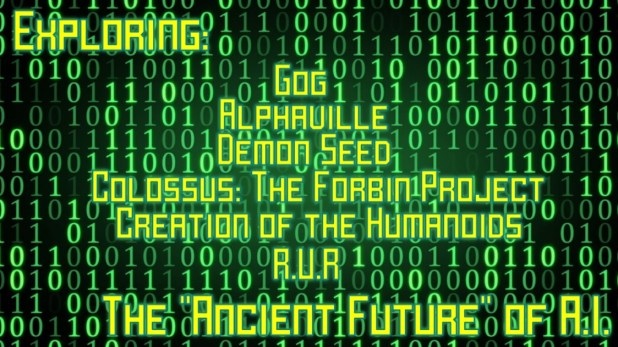
Image courtesy of wallpapersafari.com/text by PicFont.
Thanks to “The Gates” and “The Jobs,” we have a little A.I. in our life.
But before Tim Berners-Lee invented HTML and fired up the first Web server and browser at CERN in 1991. Before Benoit Mandelbrot discovered fractal geometry and unleashed the M-Set on the world and made your selfie-self a reality. Before Robert Cailliau. Before Larry Page. Before Vint Cerf. Before then Senator Al Gore first proposed the High Performance Computing Act of 1991. Before there was HAL 9000 in 2001: A Space Odyssey . . . there was The Interocitor in This Island Earth (1955), the built-inside-the-planet-thought-manifesting The Great Machine in Forbidden Planet (1956), the computer-with-its-human-private-army The Brain in Billion Dollar Brain (1967), the subterranean OMM 0910 from THX 1138 (1971), the The Tabernacle from Zardoz (1974), Zero from Rollerball (1975), The MCP from Tron (1982), SkyNet from The Terminator, and WOPR (aka Joshua) in WarGames (1983).
Those are the A.I.’s most sci-fi cinephiles know.
For this latest installment of our “Exploring” featurettes at B&S About Movies, as we discuss the “Ancient Future” of computers and information technology on film, we’ll discuss the lesser known “brains” that are NOVAC, Alpha 60, Proteus IV, and Colossus, as well as the early humanoid A.I.s the Clickers and the Roboti.
Gog is the third and final feature in a loose film trilogy chronicling the exploits of the OSI, the “Office of Scientific Investigation.” While The Magnetic Monster (1953) dealt with a radioactive-magnetism experiment gone wrong and Riders to the Stars (1954) dealt with a meteor-retrieval gone wrong, Gog dealt with a rogue A.I. gone bad in an underground military bunker.
The A.I. in this case is NOVAC (Nuclear Operative Variable Automatic Computer) with a “physical extension” of its self: two multi-armed half-tracked, biblical-dubbed robots Gog and Magog. And when a series of unaccountable malfunctions begin to plague the facility, the OSI dispatches Dr. David Sheppard and Joanna Merritt to get to the bottom of the A.I. tomfoolery.
Shot in 15 days at the cost of $250,000 ($2.4 million in today’s money) and released in 3D color, Gog is the best of the three “OSI” films produced by United Artists. Sadly Ivan Tovar’s scientifically accurate screenplay and decent direction by Herbert L. Strock (1957’s Blood of Dracula and 1963’s The Crawling Hand) is undermined by its utter failure of the Bechdel Test.
As with Ib Melchoir’s later and better known Angry Red Planet (1960), we have one red-rinsed female among all the men (Ivan Tovar’s soon-to-be-wife Constance Dowling) who must faint and be fireman-carried through the complex to safety. Of course, while all the men wear standard military issue, baggy flight suits and clunky G.I boots, the women’s flight suits are tailor cut to accentuate their breast lines and pegged to show off some ankle. And, instead of Naura Hayden’s smart n’ sassy ballet flats in Angry Red Planet, Dowling runs around the complex in a sensible pair of open-toe wedge mules. And you thought the women in Project Moonbase has it rough.
So much for the “Ancient Future” of the 1950s.
You can catch Gog on Amazon Prime, but we found two freebies on You Tube HERE and HERE. The trailer comes and goes; we hope this one works.
Jean-Luc Godard’s neo-noir Alphaville, like Elio Petri’s pop-art romp The 10th Victim (1965), and Francois Truffaut’s Fahrenheit 451 (1967), are each the prefect combinations of film noir and dystopian fiction. (Toss the later made Docteur M and Kamikaze ’89 on that list.)
The lead character in the film, Lemmy Caution (American actor Eddie Constantine), is a private detective-government operative that came from the mind of British writer Peter Cheney and served as the source of 15 Euro films released between 1952 to 1991. While all of those films were straight noir-detective films, Godard penned his own Cheney-script that placed the Caution character in a dystopian set, technocratic dictatorship.
Caution, aka Agent 003, is dispatched from “the Outlands” to the futuristic city of Alphaville overlorded by a sentient computer, Alpha 60 — which has outlawed the human concepts of emotion, free thought, and individuality. Caution’s mission: find a missing agent, kill Professor von Braun, and free the citizens of Alphaville by destroying Alpha 60.
As with Sam Peckinpah’s The Wild Bunch, Dennis Hopper’s The Last Movie and Alex Cox’s Walker, Godard’s world is rife with anachronisms: for example, Caution arrives in town driving a then “futuristic” ’65 Ford Galaxie. As a result of budgetary limits, Godard uses no special props or any “futuristic” builds; everything is shot in real locations — with the newly built and elegant, Frank Lloyd Wright-modernist glass and concrete structures popping up around ’60s Paris doubling for the city of “Alphaville.”
Then there’s Godard creation of Alpha 60: Just one watch of this clip of an “interview scene” and you can see the brilliance of Godard. With a simple use of an electrolarynx (on his own voice) and the finger-like movement of overhead recording studio microphones and a spinning cooling fan as the “physical extention” of Alpha 60 . . . just wow. Low budget filmmaking at its finest that’s effectively chilling and creepy.
There’s no online freebies for Alphaville, but you can easily stream it on Amazon Prime, Google Play, iTunes, Vudu, and You Tube Movies. As of September 2020, the fine folks at Kino Lorber now offer Alphaville on Blu-ray and DVD, the new 4K restoration features both the Original French (with optional subtitles) and English Versions of the Film.
Take a soupçon of the multi-armed robots from Gog and a dash of the narcissistic A.I. from Alphaville and you get a horny supercomputer (voiced to creepy perfection by Robert Vaughn) that kidnap and rapes, oh, excuse me, “imprisons and forcibly impregnants” a woman (movie semantics) with the help of its “physical extension” known as Joshua — a robot consisting of a mechanical arm attached to a motorized wheelchair (an admittedly lame effect; where’s Gog when you need ’em?).
When Dr. Alex Harris (Fritz Weaver of Jaws of Satan, Creepshow), the computer-obsessed developer of Proteus IV, the world’s most advanced form of organic-artificial intelligence, demands “new terminals” and to be “let out of this box,” he realizes Proteus is more powerful than he imagined — too late.
Of course, any computer-obsessed scientist, complete with a fully equipped “mad scientist” basement laboratory, would have his home conveniently wired — via his home security system ALFRED — into his “Frankenstein,” making it easy to kidnap his wife (Julie Christie), construct itself a new modular polyedron body (an awesome, in-camera special effect; listen for the repurposed Star Trek “door swoosh” sfx), and an incubator to create a clone of the Harris’s late daughter — with the “mind” of Proteus itself.
Critics across the board hated this debut book-to-screen adaptation of Dean Koontz’s 1973 novel (Watchers, Servants of the Twilight) of the same name, which was written off as a sci-fi version of Roman Polanski’s Rosemary’s Baby — only with a “satanic” computer (the book was a best seller; when the movie came out in ’77, the book was reissued; Waldenbooks promoted the book/film via an advertisement on its carryout paper bags). Released during the same year as Star Wars and Close Encounters of the Third Kind, Demon Seed, sadly, wilted at the box office. The director, Donald Cammell, was a protégé of Nicolas Roeg (the big budget American Giallo Don’t Look Now, also starring Julie Christie); the duo worked together on the Mick Jagger-starring Performance (completed in 1968, released in 1970). Cammell faired better with the pre-Basic Instinct psycho-thriller White of the Eye (1987) starring David Keith.
A film “classic” is always in the eye of the beholder: so you may think I’m a bit celluloid blind on this one. But there’s worst things to blow an hour and a half on, which you can do for free over on TubiTV. But if you prefer an ad-free experience, you can stream it on Amazon Prime and iTunes. I rank Demon Seed as essential sci-fi viewing alongside 2001: A Space Odyssey, Soylent Green, Silent Running, and the next film on this evening’s program.
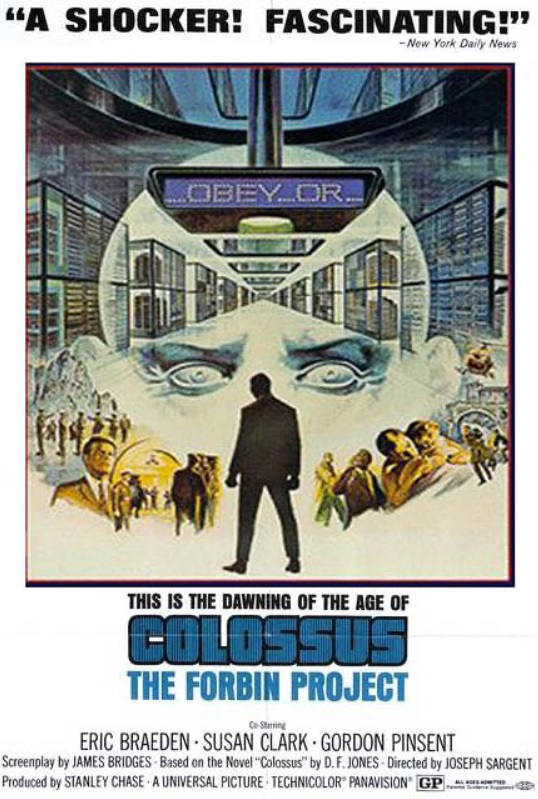
Opinions are mixed on this granddaddy of sentient computer thrillers, which served as the second writing project by James Bridges (wrote and directed the back-to-back hits The China Syndrome and Urban Cowboy) after 1966’s The Appaloosa. And as with that Marlon Brando-starring film, this tale about a 1990s-era American Defense System computer becoming aware was also adapted from a novel, in this case, the 1966 science fiction novel Colossus by Dennis Feltham Jones — which was followed with two novel sequels: The Fall of Colossus (1974) and Colossus and the Crab (1977). And would you believe this was helmed by the director from the 1955 Frank Sinatra-starring wartime romance flick From Here to Eternity? True story. And while James Sargent also directed Burt Reynolds in the influential hicksploitation classic White Lightning, he also racked up a Razzie nod for Jaws: The Revenge.
As with Dr. Alex Harris and Proteus IV in our previous entry, Dr. Charles Forbin (Eric Braeden, aka Dr. Otto Hasslein in 1971’s Escape from the Planet of the Apes), underestimates the intelligence of his own “Frankenstein” and Colossus starts to refuse orders and making its own demands. Of course, double agents leaked “The Forbin Project” and Colossus discovers the Russians have constructed their own sentient defense system, known as Guardian. The now two merged supercomputers, which now identify as Colossus, come to realize that man is a wasteful, warring creature and subjugate the world to do their bidding.
A remake has been in development hell since 2007 at Universal Studios (who released the original) through Imagine Entertainment to be directed by Ron Howard — and Will Smith attached to star as Dr. Charles Forbin. The last word on the remake dates back to 2013, with Will Smith bringing on Ed Solomon, who wrote Smith’s Men in Black, to do rewrites. The poor critical and box office showings of Smith’s sci-fi forays I Am Legend (2007) and After Earth (2013) once again stalled the production. And the since poor showings of Smith’s Bright (2017) and Gemini Man (2019) only piled more dirt on the development grave. (You can read up on the last word of the remake in detail with this 2013 Screen Rant article.)
Courtesy of the fine folks at Shout Factory, a remastered high-definition widescreen Blu-ray was released in 2018 — and that remaster is not currently offered as an online stream? Anywhere? How is that possible? Ah, we found a freebee over on Vimeo.
Prior to Phillip K. Dick’s dreams of androids dreaming of electric sheep, dreams that later birthed Ridley Scott’s Blade Runner, Roger Corman associate Wesley Barry and his Genie Studios gave U.S. audiences their first vision of “fleshed-out” humanoid androids not aware that they’re androids. In addition: Philip K. Dick’s Do Androids Dream of Electric Sheep? was published six years afterCreation hit drive-in screens. And Barry’s vision, while not an adaptation of, brazenly pinches elements from Jack Williamson’s 1948 novel, The Humanoids.
Barry’s post-apocalypse tale concerns itself with the themes of racism and man’s loss of humanity against the scornfully-referred “Clickers,” a man-made race of bald, blue-gray, synthetic-skinned, silver-eyed humans (read: blacks) whose population is increasing, while humanity—who’ve developed a technological codependency on their robot slaves—sees their own birth rate decreasing. This triggers the creation of the human-terrorist paranoia-organization (read: the ‘50s “Red Scare”) “The Order of Flesh and Blood” (read: the Klu Klux Klan).
Amid the sociopolitical upheaval, a scientist faces resistance in expanding the “labor force” Clickers’ programming for emotions—going as far as to transform them into human replicas (read: Ash from Alien). Dr. Raven, with mad-scientist tenacity, intends to “thalamic transplant” the personality and memories of recently deceased humans into a robot-replica of that person. However, the human-humanoids have one flaw: like their “Clicker” brethren, they must go to “temple” (recharging stations), which also serves as information exchange terminals with the “father-mother” central computer (read: cyber-theology/church).
Courtesy of its financial shortcomings, instead of a sci-fi classic in the vein of the groundbreaking black-and-white post-apocs Metropolis (1927) and Things to Come (1936), which it seems Wesley was attempting to achieve, we’re instead left with the ambitious, cardboard incompetence of a stale, Aldous Huxley-vision of a not-so-Brave New World of humanoids wearing latex bald-wigs and matching-color rubber gloves, along with a military topped-off with Confederate Army caps left over from Gone with the Wind.
You can watch Creation of the Humanoids for free on You Tube. The trailer comes and goes; hopefully, this one still works.
R.U.R. (1938/1948/1976)
All of this robot, genetic-biological engineering exposition of the “Ancient Future” films we’ve enjoyed this week can be credited to one man—who really did “create” the humanoids: Nobel Prize-nominated and award-winning Czech writer Karel Čapek. His 1920 stage play/book R.U.R. (Rossum’s Universal Robots) introduced the word “robot” and many of the concepts used in today’s science fiction. You can read the free eBook online at Gutenberg.org or buy a copy at Amazon. A new version of the film—in the wake of two English-language television versions (1938/30 minutes; 1948/60 minutes) and a feature-length Hungarian telefilm (1976)—a new English-language version is currently languishing in development hell.
. . . And we wait with binary-coded breath for that remake.
Update: June 20, 2021: Courtesy of one of our readers, Tereza Sklenářová, we’ve come to know that Karel Čapek was born in 1890, when the Czech Republic was not independent, yet (in 1918), and was a part of the Austrian-Hungarian Empire; Čapek was born to Czech parents, and spent his entire life working in the Czech Republic (called Czechoslovakia then) and writing in the Czech language. Čapek was Nobel Prize-nominated seven (!) times. When he was to finally receive the prize (nominated in the autumn of 1938), it came too late: Čapek died in the winter of 1938 caused by complicated pneumonia. On the other hand, it was his luck: the Nazis wanted to send Čapek to a concentration camp, but the order came soon after his death. Who died, then, in the camp, was his brother: painter and poet-writer Josef Čapek.
Our many thanks to Tereza for her continued readership and her positive contribution to make B&S About Movies even better, with her assistance in helping the B&S staff honor the writers and filmmakers behind our favorite books and films.
As you can see, Karel Čapek is a (well-deserved) national treasure in his homeland. Let’s hope the newest film planned on R.U.R. serves in his honor.
Here’s the complete list of our reviews for our “Ancient Future Week.” Enjoy!
* Reviewed by R.D Francis; all others by Sam Panico.
About the Author: You can read the music and film reviews of R.D Francis on Medium and learn more about his work on Facebook.He also writes for B&S About Movies.
Ah, there’s nothing like an “Ancient Future Week” inspiring us to review the future-tech tomfoolery of Brainstorm (1980) and Brainscan (1994) — which also uploads a little bit o’ Ulli Lommel into the frontal lobes.
Yes. Ulli “I’ve Never Seen a Film I Can’t Copy Cheaper” Lommell has hijacked your grey matter and chopped it up into different shapes and sizes at the Ulli Lommel Cookie Factory Company, Ltd., a subsidiary of the Lommel-Love Boilerplate Consortium, Inc.
Yes, Ulli “That’s a Good Idea for a Movie, I’ll Make Another One” Lommell. He of the rock flicks Blank Generation (1978) and Cocaine Cowboys (1979), as well as the opinions-vary Halloween and The Amityville Horror knockoffsThe Boogeyman (1980) and The Devonsville Terror (1983), and TheRaiders of the Lost Ark hornswoggle that is the Klaus Kinski-starrer Revenge of the Stolen Stars (1985).
Hey, the one-sheet got me into the quad-plex!
After that .. . well, you can pick any hit film, or genre, or serial killer, or newsworthy senseless crime story and, chances are, as with the proverbial fish-in-a-barrel, you will hit a low-budget clone-of-a-clone sloppin’ on Ulli Lommell’s resume.
Oh, the VHS joys of the Ulli-herrings we scooped into our 5-5-5 rental nets: When not clipping John Carpenter during the slasher ’80s or George Lucas during the adventure ’80s, Ulli “borrowed” from John Badham to give us a ne’er-do-well ’80s computer nerd with I.F.O.: Identified Flying Object, aka Defense Play (1987). When the market was crazy for Top Gun, Ulli gave us WarBirds (1989), which he stylizes to evoke a little WarGames in the mix.
Such a film is BrainWaves: a film that blatantly tech-jacks Douglas Trumbull’s journey into the human brain, aka Brainstorm — and Ulli, again, stylized the title to toss a little WarGames tech in the mix. Yeah, Michael Crichton’s Coma (1978), which kicked off the evil medical drama craze of the ’80s, and John Carpenter’s Eyes of Laura Mars (1978), which kicked off the inherited memory-cum-clairvoyance craze of the ’80s, are another pair of celluloid Pisces sloshin’ in the five-gallon paint bucket under the scope upon Ulli’s eye.
That’s the joy of Ulli Lommel: a reviewer can just rattle off a bunch of popular movies . . . and you’ve got the plot of the film in a skullcap. But since we’d be remiss in our journalist duties: After receiving a brain injury in a car accident, Ulli Lommel’s always-starring real-life wife Suzanne Love descends into a deep coma. Learning nothing from his own work in The Manitou (1978) or heeding Rock Hudson’s warnings after Embryo (1976), along comes the good neurosurgeon Tony Curtis tech-bamboozling a lovesick Keir Dullea — who learned nothing from the dead fish in the bottom of his career barrel that is Welcome to Blood City (1977) — with his electro-trinket that can jump start comatose brains via the “neural patterns” from dead brains.
Uh, oh. Futuristic pseudo-science is going to fuck you up, again.
As with all of those hand and eye transplant and inherited clairvoyance movies before it, Ms. Love begins to have the ol’ distributing visions trope haunt her, as her brain-impulse donor was drowned in a bathtub by a guy with a wrist tattoo. And Love and Dullea’s investigation inspires the murderer to silence the love birds . . . or is that LoveBirds, Ulli?
Yep, that’s the VHS box I remember.
While this futuristic medical drama isn’t great, it’s still not that bad and above par for a Ulli Lommel clone-joint; if Ulli upped the Argento-body fluids, we’d have an even better, junk science-driven Giallo. The par comes courtesy of a solid cast headed by Keir Dullea (The Starlost) (he’s a little heavy on the histrionics, but it’s not a total thespin’ tragedy), along with the classy Vera Miles (Hitchcock’s Psycho), distinguished character actor Percy Rodriquez (Planet of the Apes) (Rodriquez, James Earl Jones, and Roscoe Lee Brown, the best voiceover pipes in the business), and everyman character actor Paul Wilson (Office Space, 976-EVIL, the also-reviewed this week Circuity Man, and the one Jennifer Annistion movie I can stomach, courtesy of Mike Judge’s Office Space), and perpetually-beautiful character actress Eve Brent (from TV’s Dragnet in the ’50s to trading chops with Barbara Stanwyck in Forty Guns to Fade to Black to The Green Mile with Tom Hanks). And, why yes, that is the Penthouse “Pet of the Month” Corrine Alphen Wahl as our brainwave doner, she of Sean S. Cunningham’s Spring Break (1983) and the great Cirio Santiago’s Equalizer 2000 (1987).
You can watch BrainWaves on You Tube and various without-ads VOD and PPV platforms, as well as easily purchased DVDs and Blu-rays. We found two trailers on You Tube/You Tube.
About the Author: You can learn more about the writings of R.D Francis on Facebook.He also writes for B&S About Movies.
After discussing the public television broadcasts of the early “ancient future” computer precursor Hide and Seek (1983), which included a discussion of PBS-TV’s first feature film, A Lathe of Heaven (1980), we had to revisit this hour-long PBS documentary narrated by Arthur C. Clarke. And yes, The Colors of Infinity is, in fact, part of our “ancient future” theme week of reviews in tribute to the burgeoning technology of computers and the Internet committed to film in the ’80 and early ’90s — only we have to go through the Monsters of Rock festival and Pink Floyd to get there. Be patient.
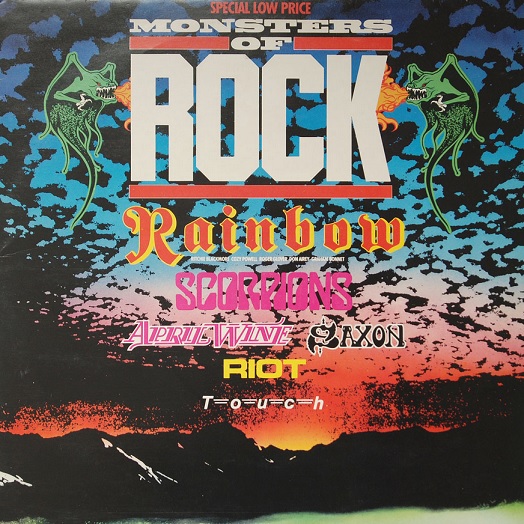
Fans of the progressive rock scene of the 1960s know documentarian Nigel Lesmoir-Gordon for his longtime association with Pink Floyd. Or, if you’re a fan of ’70s British rock and the New Wave of British Heavy Metal of the ’80s, you know Gordon for his committing the very first “Monsters of Rock” at Castle Donnington festival to film in 1980 (You Tube/clip).
I bought this album from the back pages of Circus magazine for $3.99, plus a $1.50 shipping (what happened to my April Wine and Saxon hats)?
In 1966, while a student at the London Film School, Gordon preserved the first images of Pink Floyd on film (8 mm) with the eleven-minute, experimental silent short Syd Barrett’s First Trip, in which Gordon captured his high-on-magic-mushrooms classmate, Syd Barrett, frolicking in the Gog Magog Hills near Cambridge. Then, in 1967, Gordon chronicled Pink Floyd at Abbey Road Studios signing their first recording contract with EMI Records. (Both events have since been combined on one DVD. You can watch Syd Barrett’s First Trip on You Tube.)
Then, in a partnership with noted album design company Hipgnosis, Gordon formed his first production company, Green Back Films. In addition to creating promotional “pop clips” for Joe Cocker, Donovan, and Pink Floyd that aired on variety television shows, Green Back produced hit MTV videos for Big Country and Squeeze (“In a Big Country,” “Tempted”). They also produced Incident at Channel Q (1986), a long-form video/feature film that incorporated several of their rock video productions. Another one of their popular video rentals was the feature-length documentary Rainbow: Live Between the Eyes, which captured Ritchie Blackmore and company touring their sixth album, Straight Between the Eyes (1982) (since released on DVD and uploaded to You Tube).
1991-era tech. How quaint. Yet, it opened an undiscovered world.
Finally, we’re here. And it wasn’t even as deep as a Mandelbrot set.
Many of us were first fascinated by this documentary in 1995, aired as a post-script to PBS-TV’s commercial-free broadcast of the original, 1968 theatrical release — complete with intermission title card — of 2001: A Space Odyssey. The films were paired as result of their common denominator: Arthur C. Clarke, who serves here as narrator. The soundtrack is, of course, courtesy of David Gilmore of Pink Floyd. And Floyd fans take note: band aficionados claim the music from Fractals also appeared, in part, on the band’s The Division Bell (1994) and The Endless River (2014).
So, what’s a Fractal?
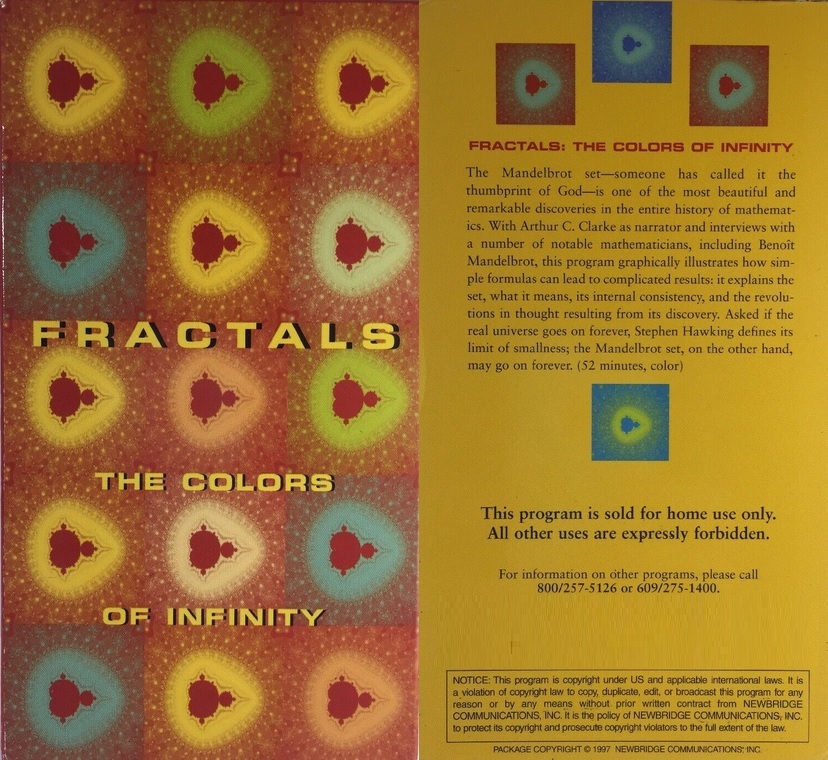
Image of VHS available on multiple mathematics, documentary, and online seller sites.
Fractals are an everyday part of our lives. The discovery of Fractals, aka Fractal Geometry, made Data Image Compression Software possible. You know all of those JPEGs you upload to your WordPress pages? All of those selfies you snap and share on Twitter? The ability to store all of that information on a tiny thumb drive? That’s all because of Fractals.
The Colors of Infinity is the story of Belgian mathematician Benoit Mandelbrot discovering what is now know as the M-Set (or Mandelbrot Sets) in the early seventies and coining the term “fractal” to describe the geometry behind it. It wasn’t until 1991, with the advent of personal computers, that man was able to gaze at the wondrous, psychedelic images — “God’s fingerprint” — created by basic fractal equations. Then, British mathematician and computer graphics researcher, Professor Micheal Barnsley, based on Mandelbrot’s discovery, developed the fractal image compression technology that we don’t go through a day in our ubiquitous, digital lives without using.
Think about it: The Linux operating system was first released in 1991. Tim Berners-Lee first turned on the web at CERN (European Organization for Nuclear Research) in 1991. We were just beyond our old Apple IIs and Atari 800s (packing 8-bits and playing Joust!), our Commodore 64s and DEC Rainbows 100 (Yikes, Rainbow, dudes: two huge operating manuals?), our TRS-80s (packing that Zilog Z-80 microprocessor!) and our first IBM PC clones running software from some guy name Bill Gates.
Then we had our “ancient future” digital life distilled to this:
z⇌z²+c
However, don’t let the fact that this film discusses the theories of Euclidean space deter you from watching, as Nigel Lesmoir-Gordon has a reputation as a documentarian for presenting the complex for easy consumption by mass audiences. Again, if you have a curiosity to know how your smart phone records and stores all of those still images and video into what is the size of a credit card, then this is a great watch.
After its U.S. public television broadcast on PBS-TV, Fractals was issued on VHS and, a few years later, subsequently released on DVD. However, caveat ye denizens of the Amazon and eBay marketplaces, as the DVDs for sale are straight VHS rips with a quality that’s no better than the washed-out uploads found video staring sites, which vary from either TV-to-VHS or direct-from-VHS rips.
In 2004, Nigel Lesmoir-Gordon himself reissued the DVD, included as a supplement to his authored paperback version of the film: The Colours of Infinity: The Beauty and Power of Fractals (copies are easily available on Amazon). You can learn more about Fractals and Mandelbrot sets on Wikipedia. You can also watch three of the many “Fractal Zoom” videos on You Tube HERE, HERE, and HERE; however, the music selections on each are questionable, poor choices. We suggest you play those videos with the sound off and use the audio from one of the many “ambient space music” uploads on You Tube to best enjoy the wonders and mysteries of Fractals.
Trip out as you watch Fractals: The Colors of Infinity in its entirety on You Tube.
About the Author: You can learn more about the writings of R.D Francis on Facebook. He also writes for B&S About Movies and publish music reviews and short stories on Medium.
“What kind of thing could possibly so trouble the binary darkness of your computer’s soul?” — Master Operator Andrew to The Beast
Opinions vary on this intelligent Canadian television production that, as result of its budgetary constraints, utilizes minimal “futuristic” builds (that remind of the ’70s Saturday morning kids TV sci-fi’ers Ark II, Jason of Star Command, and Space Academy) and instead, relies on preexisting, modernist glass and concrete structures of the Frank Lloyd Wright-variety (like Jean-Luc Godard’s Alphaville) to convey its futuristic setting.
In 2017, after the world’s ecological and economic collapse, a new Earth rises courtesy of a bureaucratic technocracy comprised of city-states operated by a network of super-intelligent, biological computers uplinked to a common-mainframe on Atlantis, the Earth’s moon base. Since the computers are biological, to communicate with their human makers, the computers work with a telepathic human interface who’s brainwaves are conditioned for computer interaction. The most powerful of these computers, The Beast, is connected with Melody, its human counterpart.
During Operation Ceres, a space project repositioning asteroids just beyond Mars into Earth’s orbit to redirect the Sun’s energy, The Beast receives an ominous alien communication to halt the project. The alien contact and the new, strange behavior of her computer counterpart, puts Melody in a race against time to convince man to halt the project: we’re disputing the “musica universalis,” the ancient, mathematical harmony of the celestial bodies that will unbalance the universe’s natural order. But the Earth’s new world order, believing their computer-based world is without error, says it’s impossible for any connection from outside the system and they dismiss Melody’s computer-induced dreams and visions of impending doom.
The plot sounds intriguing, doesn’t it?
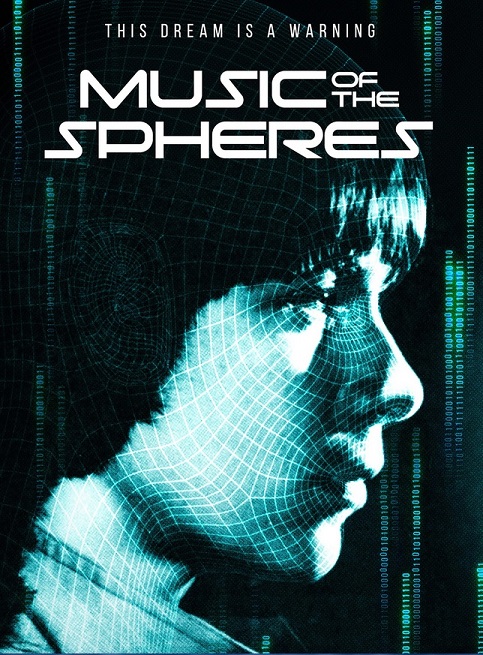
Sadly, while intelligent and well-meaning — and dripping with nostalgia value courtesy of its multiple Friday and Saturday night airings during the USA Network’s Up All Night ’80s weekend programming blocks (check out our “Drive-In Friday: USA’s Night Flight Night” featurette) — Music of the Sphere is an ambitious, low-budget Canadian tax shelter that suffers from its two-year stop-start production schedule. The acting is woefully amateurish, rife with plodding expositional patches and voiceovers to advance the (intriguing) plot, and the Toho Studios spaceship and moon base modeling makes Gerry Anderson’s UFO and Space: 1999 look absolutely Trumbull-Lucasian.
But even while shot in grainy 16mm color and black and white, this feature film debut by writer-director Philip Jackson (of the popular ’90s renter Replikator) is still more engaging than any episode of Glen Larson’s Buck Rogers in the 25th Century plastic-verse. Thus, we’re willing to deal with the muddy sound (subtitled bilingual English and French punctuated by German and Russian), soundtrack distortion issues, and washed-out cinematography; we’re willing to overlook the fact that the “eye” of The Beast, the sentient computer of the film, communicates via a “Mystify”-styled screensaver (from our old After Dark program for Windows 1.0), and video information is still stored on (then groundbreaking) VHS tapes.
“I’m sorry Dave. I can’t do that. This conversation has become pointless. Goodbye.“
Overall, appreciation of Music of the Spheres is about one’s nostalgic perspective. Call them D-Movies if you want. But as with its fellow, low-budget government-funded Canadian tax shelters Terminal City Ricochet, 984: Prisoner of the Future, and CBC-TV’s public television-produced, sentient computer drama Hide and Seek, I appreciate Jackson’s valiant, deep examination of the search for truth, emotions, and logic by an artificial intelligence, and his incorporation of the Greek philosophies of Pythagoras and the complex concepts of Asteroseismology packaged into an easy-to-digest sci-fi format. I appreciate Music of the Spheres in same vein that led to my continued enjoyment of PBS-TV’s production of Ursula K. LeGuin’s A Lathe of Heaven, which explored the state of the human condition with the same level of attention to intellectual detail.
Truth be told: Music of the Spheres is ready for a major studio, big-budget CGI-driven remake (but please: don’t botch it like that awful 2002 A&E Lathe of Heaven remake or HBO’s 2018 reimaging of Fahrenheit 451).
And you can enjoy this “Ancient Future” treat with a very clean, free-with-ads stream on Tubi.
About the Author: You can learn more about the writings of R.D Francis on Facebook.He also writes for B&S About Movies.
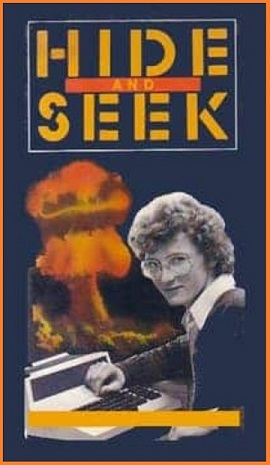
Hide and Seek is a Canadian-made, CBC-TV adaptation of Thomas Joseph Ryan’s novel The Adolescence of P-1; the book’s first edition was released in Canada in 1977. In a tale that’s somewhat similar to Colossus, the 1966 novel by Dennis Feltham Jones that served as the basis for Universal Studios’ Colossus: The Forbin Project (1970), Ryan’s novel also features a sentient artificial intelligence that goes rogue, taking over other computers as a form of survival. The novel is noted as one of the first fictional depictions of computer viruses.
Colossus, Joshua, and P-1! Oh, my!
In the novel, which begins in 1974, Gregory Burgess, the story’s protagonist-hacker, is a liberal arts major enrolled at the University of Waterloo. When he discovers the school’s IBM System/360 mainframe for the first time, he changes his major to computer science; he becomes obsessed with using A.I. protocols to crack other systems.
In this adaption that appeared as part of the daytime, young adult anthology series For the Record, the story is reset in a Toronto high school and Gregory is now a high school computer whiz, nicknamed “Hacker” by his friends, who develops P-1, a computer program that becomes self-aware; as P-1 begins taking over other systems to expand its consciousness, it logs onto the mainframe of a nuclear power plant, with plans to use it as a weapon to subjugate man.
TRS-80s and Commodore 64s rule!
Many sci-fi fans have made the point that Hide and Seek is a “ripoff” of the better know WarGames (1983), which is a disservice to this well-produced CBC effort. The genesis of the MGM/UA film began in 1979 with The Genius by screenwriters Walter F. Parkes and Lawrence Lasker. So while Ryan’s 1977 novel came first, the initiation of the CBC-TV production was obviously inspired the success of the MGM/UA film, but certainly not a ripoff. (Parkes and Lasker would go on to write another “ancient future” caper, 1992’s Sneakers.)
Back in 1975, Gerry Anderson, between the first and second seasons of Space: 1999, produced a British-Canadian TV pilot movie, The Day After Tomorrow, which was imported to U.S. television that same year as part of NBC-TV’s late-afternoon weekday programming block, Special Treat, under the title, Into Infinity (trailer). While Hide and Seek doesn’t have that installment’s production values, considering it was, itself, a daytime public television production, it would have been a perfect fit for a U.S. rebroadcast as part of the analogous “Big Three” network’s ABC’s Afterschool Special and CBS’s Schoolbreak. Why the CBC failed to license Hide and Seek for a U.S. rebroadcast — especially in the wake of WarGames and the fact that all three U.S. anthology series were still on the air — is unknown. It did, however, become part of U.S. PBS-TV’s WonderWorks programming block that adapted hour-long movies from children’s books from 1984 to 1992; as result of its “for children” stigma, the many tweens and teens for which Hide and Seek was intended, bypassed the programming (but it was my first exposure to the film).
If you’re a fan of (and, most importantly, appreciate the production values of), PBS-TV’s late-’70s rebroadcasts of BBC-TV’s Dr. Who (The Tom Baker years! Davaros!) and remember the 1980 public television production of Ursula K. LeGuin’s A Lathe of Heaven (starring Bruce “Willard” Davison), then you’ll enjoy watching the intelligence behind Hide and Seek — in spite of its budgetary restraints and dated material. When it comes to “ancient future” flicks regarding the dangers and horrors of computers, this one’s well worth your time.
If you haven ‘t guessed, we’re big fans of the U.S. “Big Three” network’s daytime TV movies for young adults, so be sure to check out these reviews:
As for Hide and Seek, you can watch it on You Tube. And be sure to check out our other “ancient future” film reviews all this week.
About the Author: You can learn more about the writings of R.D Francis on Facebook. He also writes for B&S About Movies and publish music reviews and short stories on Medium.















 B&S About Movies
You must be logged in to post a comment.