Sri Asih was created in 1953 by RA Kosasih, the father of Indonesian comic books. According to the Bumilangit Cinematic Universe Wiki, this is her origin: “Nani Wijaya, is the daughter of a wealthy family, is a bead of Goddess Sri from the Kahyangan Kingdom. As an adult, Nani works as an agent of the Bureau of Criminal Investigation to defend truth & justice. However, when he struggles, Nani can transform herself into Sri Asih by translating “Goddess Asih!”” This allows her to access her powers as the reincarnation of Dewi Sri, the goddess of rice and fertility still worshiped in Java, Bali, and Lombok islands.
Her powers include strength, speed, durability, flight, duplication, a healing factory and the ability to grow in size. As a BCI agent, she already had martial arts and detective skills, adding to her superhuman powers.
Sri Asih was such a popular character that her first movie, directed by Tan Sing Hwat and Turino Djunaedy, was made a year after her debut. Unfortunately, the first superhero movie made in Indonesia is lost.
This version of Sri Asih is the second installment of the Bumilangit Cinematic Universe, a series of superhero films based on more than 500 comic book characters in the library of Indonesian publishing company Bumilangit, which started with 2019’s Gundala.
Directed by Upi, who co-wrote the screenplay with Gundala director Joko Anwar, this tells the story of the third Sri Asih, who is Alana at the start of the movie (Pevita Pearce). She’s been a fighter for her entire life and had to hold back the rage inside her. That makes sense, as she was nearly killed by the volcano that made her an orphan when she was just an infant.
After being raised by a female martial artist, she becomes an MMA fighter in her adulthood, which brings her into the cage against the privileged Mateo (Randy Pangalila). By the end, she will have to battle one of the top five villains of the BCU — the five commanders of the Goddess of Fire — known as Evil Spirit.
I may not know these characters at all, but I think it’s awesome that other cultures are attempting to leverage their own comic book mythologies. That’s why I hate that people talk down on comic book movies—they are no different than the myths of any culture throughout time—and translate them to the screen and give themselves representation.
This might not have the budget of a Marvel movie, but the fights look better, and the CGI looks just as good. At the end of this movie, there’s even a post-credits cameo. Much like Sri Asih showed up at the end of Gundala, Mandala appears briefly.
For those of us in the U.S., Shout! Factory has the rights to this and will release it this year. Check it out when you can because it’s such an incredible opportunity to learn about the heroes of other places and see them in action.. The series
I watched this film as part of The Bucheon International Fantastic Film Festival (BIFAN). You can learn more at their official site.
There’s a sound—a nearly imperceptible sigh—that my wife makes when a film displeases her. I’ve heard it sitting next to her in quiet theaters, and I know that I don’t even have to ask if she liked the movie.
During this film, I heard it more than a few times.
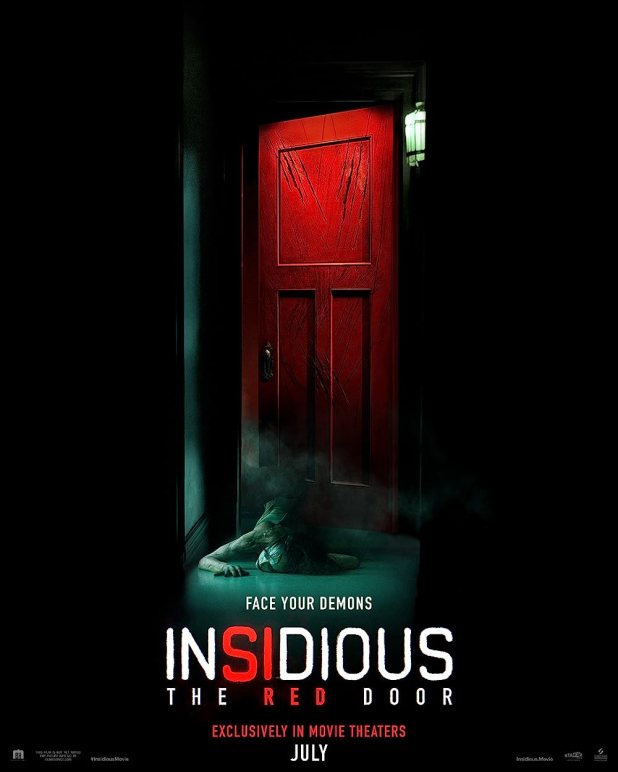
As someone who mainly loves either drive-in era movies, foreign horror or films out to test the audience’s gag reflex with a torrent of upsetting scenarios and body decimation, it took some time for me to begrudgingly respect the ghost and possession cycle of James Wan, starting with 2010’s Insidious, followed by 2013’s The Conjuring and then alternating each year or so between these franchises. Both of these series are marked by his quality eye for direction and some truly well-delivered art direction, something that’s lacking in so many modern horror movies.
But as it goes, franchises get stale. The Conjuring will hit nine movies this fall — and two shorts — while this is the fifth Insidious film. Created by Leigh Whannell (who also worked on Saw and Dead Silence with Wan and directed the underappreciated Upgrade), the first two films center on Josh and Renai Lambert (Patrick Wilson and Rose Byrne) and their children Dalton, Foster and Cali. They’re, as usual in long franchises, the best in the overall series.
A review, for those that haven’t seen the film: Dalton encounters an entity in the attic of the family home and goes into a coma, but is genuinely trapped in a realm past life and death called The Beyond, err, The Further. That place nearly trapped Josh when he was a child, a fact that he learned from his mother Lorraine (Barbara Hershey), and required the help of psychic Elise Rainier (Lin Shaye). Now, she must come back, along with paranormal investigators Specs and Tucker (Whannell and Angus Sampson), and figure out how to rescue the Lambert family.
The events of this movie—and the second, which was predestined based on the shock ending of the original—run deep within every moment of this reimagining, sequel, and restart of the franchise, the first film in the series in seven years.
Spoilers for everything after the trailer…
Directed by Wilson and written by Scott Teems—more on him in a bit—this movie opens with tragedy. Lorraine has died, Josh and Renai have divorced, Dalton (Ty Simpkins, who played the role in the original, and Andrew Astor as Foster) and his father are distant, and Josh seems to have spent the last few years in what he calls a fog. Even an attempt at connecting by driving Dalton to college fails.
While there, the young artist goes through a memory exercise in class and unlocks memories of The Further, drawing the red door at the entrance. Along with his roommate — by accident, she’s played by Sinclair Daniel and is accidentally placed in his dorm — he begins to investigate his ability to astral project and avoid ghosts at frat parties. There is a cute scene where Specs, Tucker and Elaine appear on YouTube.
Meanwhile, Josh attempts to discover why he’s felt lost most of his life. Between a CAT scan gone jump scare and a memory game—also gone jump scare—he finally has to talk to his ex-wife and learn that he once menaced the entire family with a hammer while possessed by Michelle Crane, the Woman in White, and the Lipstick Demon.
Those same entities have trapped Dalton—cue the red room, start “Tiptoe Through the Tulips,” and start the fog—and the father must save the son.
The issue with this movie is what you want it to be. Do you want closure for a family that has dealt with the paranormal and blocked it out of their lives until the act of forgetting it splits them? Or do you want a scary film that takes ordinary people into the frightening unknown of The Further? This film series has always dealt with loss and grief and the missing spaces caused by those gone from our lives — Josh’s father, Elaine’s husband — but this goes further (pardon the pun) by spending nearly an hour in the miserable lives of a family that has failed to connect before it seemingly remembers that oh yes, this is also a possession movie.
Wilson does fine for a first-time director, but it’s a challenging walk emulating the footprints of Wan. I watched the original right after we got home from the theater, and it’s striking how much bigger and richer the first movie is. As for the script, well, Scott Teems has somehow gotten to write a Firestarter reboot, the excoriable Halloween Kills and is now set to write The Exorcist: Believer, all based on a few shorts and some TV work, as far as I can tell. The height of his wit is named a character, Nick the Dick, after a scene in Bachelor Party, and really, that’s the limit of creativity in a film that outright restages scenes from the second movie.
This is less a movie that is out to scare you as a summer thrill ride and more one that brings closure to a family constantly dealing with decades of missing people and trying to process grief. The film that it wants to be is not always compatible with the type of movie it is sold as. It needs defter hands to pull that off, and instead, we are like the characters in The Further, wandering the fog for 90 minutes or so until the lights come on and we can finally go home. The film’s attempt to bring closure to the family’s long-standing issues gives a sense of resolution, even if it’s not always successful.
PS: A man literally screamed out things while we watched this movie, frightened by almost every jump scare, and he wasn’t joking. I hope that if you see this movie, he’s in the audience with you because he’s the best part of the film.
At the height of sheer Q-Anon craziness — I think probably when a shaman in red, white and blue facepaint led an army of people into government buildings, and people defecated on the walls, maybe — people were grasping for straws and pearls and wondering, “How could this happen?”
I’m here to tell you that this has always been here.
In the 1980s, high school me was the same as old me. I was always in black, with long hair, and I only cared about music, movies and studying weird things. As such, I was brought into the Core Group, a team of teachers led by an occult expert cop who studied which students could be worshipping Satan. This group was led by my godmother.
The Satanic Panic wasn’t started by Michelle Remembers, but it felt like it was. The union of Canadian psychiatrist Lawrence Pazder and his psychiatric patient (and eventual wife, but we’ll get to that) Michelle Smith. In the mid-70s, while treating Michelle for depression due to a miscarriage, she confessed to him that she knew that something horrible had happened to her and could not recall what it was. Using hypnosis, Michelle was soon screaming for 25 minutes non-stop and speaking in the voice she had as a child. 14 months and 600 hours later, a conspiracy was found: Michelle’s mother and other citizens in Victoria were members of a worldwide Church of Satan.
At one point, Michelle was part of a ritual that lasted 81 days that Satan himself showed up for, and during that time, she was tortured, raped, witnessed others get killed and was covered with the blood of murdered babies until St. Michael the Archangel, Mary and Jesus appeared, healing all of her scars and blocking all of her memories of the years of Satanic desecration of her body and soul.
None of these stories were challenged, even a decade after, when Michelle and Laurel Rose Willson, who wrote Satan’s Underground about being a breeder for Satanists and having two of her children killed in snuff films, were on Oprah Winfrey and at no moment did Oprah challenge either of them, in 1989. The year, I was repeatedly questioned and challenged and told that I was giving my soul to Satan.
I was a white kid from a small town, and in no way have I ever dealt with racism, sexism, transism or any isms in any other way again. This experience, however, showed me a small, tiny glimpse into what it’s like to know you’re right and everyone is sure you’re wrong based on no facts at all.
By the 80s, Pazder was an occult expert, consulting in the McMartin preschool trial and appearing on a 20/20 segment called “The Devil Worshippers” that stoked the flames of the Satanic Panic. That report claimed that movies like The Godsend, The Incubus, Amityville II: The Possession, Exorcist II: The Heretic, The Exorcist, The Omen and Omen 2 allowed people to visualize and be inspired by the devil. This aired in prime time on ABC, a major cable network. They also refer to The Satanic Witch as a book filled with evil rites. And then, of course, heavy metal. As Anton LaVey was in his era of not speaking to the media, this also has footage taken from Satanis.
As part of the Cult Crime Impact Network, Pazder got into business working with police groups and consulting on Satanic ritual abuse, while lawyers used his book while doing cases, and social workers used Michelle Remembers as their training manual.
According to NPR host Ari Shapiro, “One reason these fictions were so appealing was that they gave people a sense of purpose. They had a mission – to defend the innocent.”
This is what’s happening today. It’s why trans people are grooming children, why Democrats are eating babies, andwhy elections are being seen as conspiracies. Because the truth — the idea that things happen randomly for no reason — is less frightening than Satanism or Q-Anon.
Man, did I digress?
In Satan Wants You, filmmakers Sean Horlor and Steve J. Adams explore the history of Michelle Remembers and what most people don’t know, such as how Pazder and Smith left their families to be together and how the book was debunked. It would be one thing if their sessions led to a book and some press, but it would be another if they kicked off an entire movement.
The directors have stated: ““This is the first time that Michelle’s sister, Larry’s ex-wife, and Larry’s daughter have gone on the record to tell their side of this story. This was a once-in-a-lifetime opportunity to combine all these stories together to reveal the true origins of the Satanic Panic and show how they connect to the Pizzagate and QAnon conspiracies of today.”
This movie must be seen, even if we’ve entered a time when feelings matter more than facts. But did facts ever matter?
This film also found an anonymous source sending Michelle’s actual tapes, which have never been heard until now.
I don’t discount that she went through some trauma. Yet, how many lives were destroyed along the way?
The sad fact is that no one has learned anything. That same refrain of “protecting the children” exists today. And yes, that’s a noble endeavor. But as someone who grew up in a town of 7,500 people that had more than one Catholic priest abusing children in the last fifteen years of my life, Often, the abuser is someone the abuser has known and trusts.
Just like a worldwide Satanic network — paging Maury Terry and The Family, a book that lost a court case to the Process Church over false claims — and a public ritual lasting 81 days seems complicated to swallow, so do all the claims of the far right today.
Back when I was a kid getting grilled over my slasher movie magazines and love of Danzig, I figured, “Well, someday soon, all of these close-minded people will die off, and we can get past racism, and we can learn how to be more open-minded together.” But now, everyone is close-minded. No one seemingly wants to learn. And this movie is a great teaching tool — it’s a must-see, an intense documentary worthy of rewatching — because it happened before, and yes, it’s going on all over again. The message may have shifted, but it’s still the message.
And it’s still wrong.
I watched this film as part of The Bucheon International Fantastic Film Festival (BIFAN). You can learn more at their official site.
EDITOR’S NOTE: The Dunwich Horror was on the CBS Late Movie on May 7, 1973; July 1 and August 28, 1975.
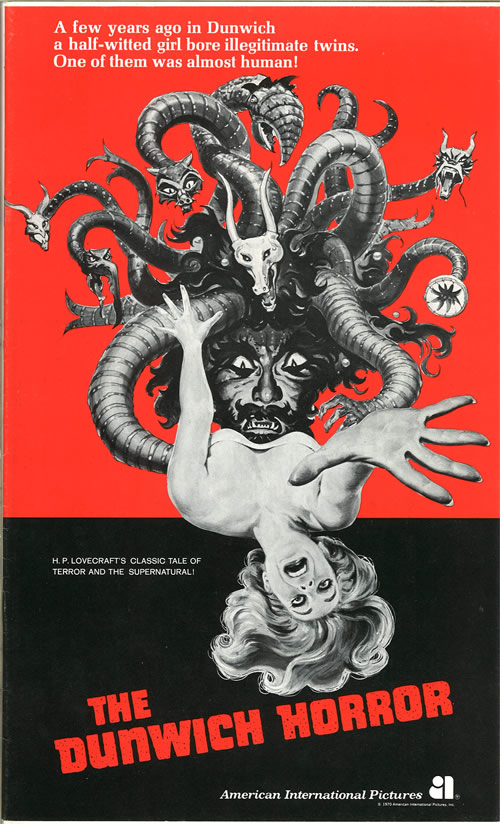
Following the triumph of the Poe movies, Roger Corman and American International Pictures embarked on a series of films inspired by H.P. Lovecraft. The announcement of The Dunwich Horror in 1963, set to be filmed in Italy by Mario Bava and starring Boris Karloff and Christopher Lee, sparked immense anticipation. However, a setback occurred when Dr. Goldfoot and the Girl Bombs failed, causing a delay in the production of this movie.
It took several years to make this movie happen—probably Rosemary’s Baby’s success is one reason why occult movies really started to come out in the early 1970s—and when it was made, Daniel Haller was hired to direct.
Daniel Haller, who started his career as an art director and designed the sets for Corman’s House of Usher and The Pit and the Pendulum, was a perfect fit for the director role. His first movie, Die, Monster, Die!, was based on Lovecraft’s The Colour Out of Space, further solidifying his suitability for this project.
At the Miskatonic University in Arkham, Massachusetts, a setting often used in Lovecraft’s stories, Dr. Henry Armitage (Ed Begley) gives a rare copy of Necronomicon to his student Nancy Wagner (Sandra Dee, breaking her Universal Pictures contract and making her first “adult” movie, so to speak) to return to the library. She’s followed by Wilbur Whateley (Dean Stockwell), a man who hypnotizes her to sneak a glance at the dreaded grimoire. Unlike everyone else in Arkham, Nancy is kind to the man and gives him a ride despite him, you know, staring into her soul.
I mean, maybe she should have because he soon drugs her and convinces her to stay the night inside the horrifying home of his ancestors.
It turns out that within the home, Wilbur’s twin brother from a demon father is waiting and will soon be let loose in town. Wilbur also lives up to all of the townsfolks’ fears as he attempts to sacrifice Nancy to the Old Ones. This leads to a dramatic spellcasting battle between him and Dr. Armitage, a scene heightened by a violent thunderstorm.
EDITOR’S NOTE: Wild In the Streets was on the CBS Late Movie on February 13, 1973 and March 1, 1974.
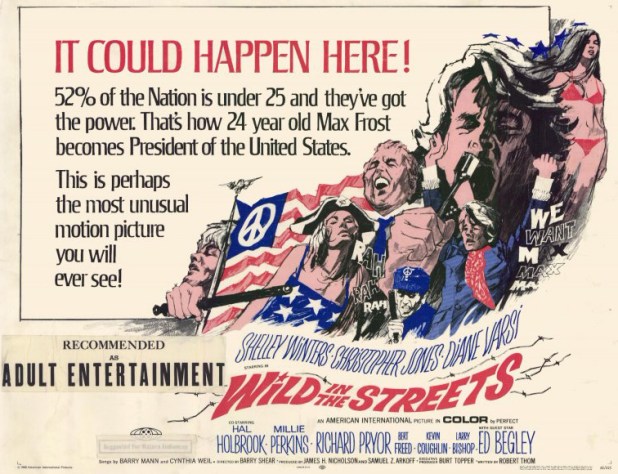
Barry Shear (Across 110th Street) directed, and Robert Thom (Death Race 2000) wrote this youth-oriented movie. Yeah, it’s kind of heavy-handed, but it also has Shelley Winters trying to escape a barbed wire fence in a prison, and I’m all for that.
Rock singer and revolutionary Max Frost (Christopher Jones) leads the Troopers, a band that lives with him in a Beverly Hills mansion. They are 15-year-old guitarist and legal mastermind Billy Cage (Kevin Coughlin), anthropologist Stanley X (Richard Pryor) playing drums, ex-child star Sally LeRoy (Diane Varsi) on backing vocals and hook-handed bass player Abraham Salteen (Larry Bishop) on bass guitar and trumpet. Their song “Shape of Things to Come” would end up coming out in the real world and hitting #22 on the charts; it’s really Paul Wibier and his band The 13th Power.
An entire album of songs would come out, including the song “Fifty Two Per Cent,” which explains to their fans that 52% of the world’s population is 25 or younger. That means that they can rise and take over.
Senate candidate Johnny Fergus (Hal Holbrook) wants to lower the voting age from 21 to 18 and uses Max’s popularity to get some attention. It blows up because Max and the band sing a song called “Fourteen or Fight!” and demand the voting age be lowered to 14. Protests started nationwide, but Max and the Senate candidate came together and announced that the new age should be 15, and Max introduced a new song: “Fifteen and Ready.”
The politician thought the band was done with politics. They’re just getting started.
When a Congressman from Sally LeRoy’s home district dies, the band enters her in the special election because she’s the only one old enough to run. She easily wins, thanks to all the young voters. Fergus’ son Jimmy (Michael Margotta) joins the group, the voting age becomes 14, andteens spike Washington’s water with LSD and send teenage escorts to keep all the senators occupied.
The Grand Old Party gets Max on their side, and he runs for President. Once he wins, he turns on them. Everyone over thirty must retire and be dosed on LSD for life in re-education camps. Fergus tries to bring Max’s parents in (Bert Freed and Shelley Winters) but feels nothing for them. His first political act was exploding their car. He even tries to kill the new President, who soon takes over and rounds up the Fergus family.
Does Max change the world? Yes. He takes the military out of every country, puts actual smart people and computers in charge of the gross national product, ships surplus food to starving countries, breaks apart the secret police and turns America into a hedonistic place. But the problem is that even if the rest of the world is following, now the under-ten kids want to put the old people—those in their twenties, like Max—in camps someday.
After her twin sister Marian hangs herself, Millicent (Sandra Dee) returns home, only to hear Marian – a dancer – tapping across the floor upstairs, footsteps rapping in the room where she left this world.
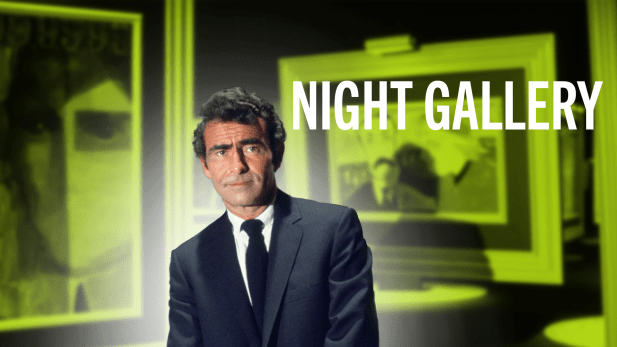
“Specter In Tap Shoes” was directed by Jeannot Szwarc and written by Gene R. Kearney from a story by Jack Laird. After the death of her twin, Millicent is sure that Marian is still here, as she doesn’t just hear her; she smells the smoke from her cigarettes.
Maybe she should just leave. That’s what William Jason (Dane Clark), a property developer who is a mutual friend of Millicent’s pal Sam (Christopher Connelly, soon to depart for Italy), thinks would be best. She’d get closure and away from all the memories.
Millicent keeps hearing her sister’s voice, urging her to hang herself as well. She stops at the last minute and finds William in her sister’s studio. He demands letters that Marion wrote to him, letters that she somehow can discover immediately. She also finds a revolver that she uses to shoot him.
The logical explanation is that the entire house was wired so William could gaslight Millicent just like he did Marion. But then, how did she know where the letters were?
This is a decent enough episode, but as always, Serling writes the better Night Gallery stories. Szwarc does a good job of making the story mean more than it does.
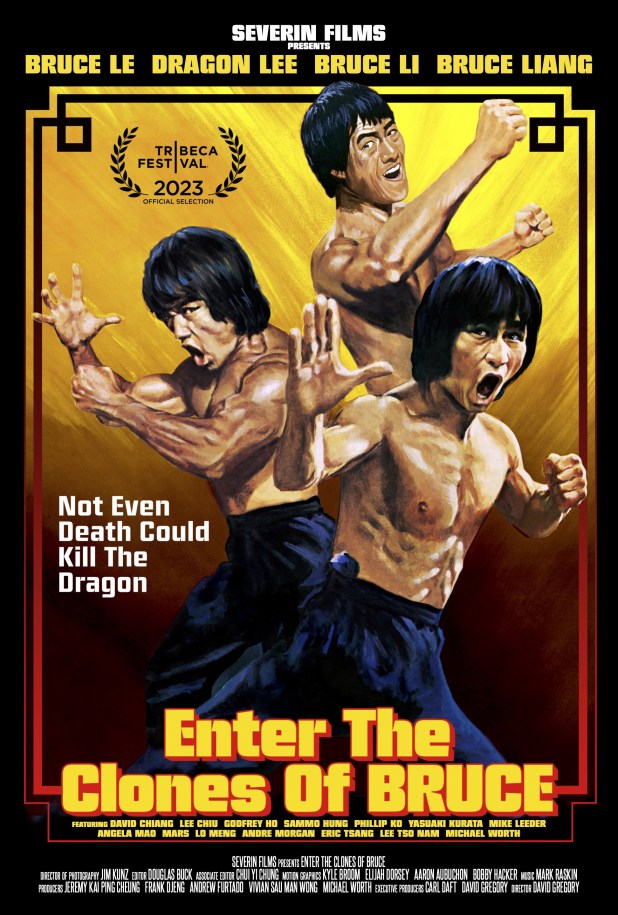
Bruce Lee died in 1973 after four major movies: The Big Boss, Fist of Fury, The Way of the Dragon and Enter the Dragon. Yes, he had been acting since his teens and also appeared on The Green Hornet and worked in Hollywood, but he became a cultural force through those movies. The world of film—more than that, pop culture, martial arts, and cultural identity—were all shaped by a man who died at the age of 32.
Just when the world had started to love Bruce Lee, his sudden departure left a profound void in the cultural landscape.
What happens when the demand exists and there’s no supply?
You invent a supply to fill that vacuum.
Brucesploitation is a truly unique film genre that revolves entirely around one individual. Actors like Ho Chung-tao and Moon Seok transform into Bruce Li and Dragon Lee. The titles of these films are so reminiscent of Bruce Lee’s movies that they even incorporate footage from his funeral. These films, which initially portray the life stories of these actors, often delve into sequels of Bruce Lee’s films or even venture into the realm of pure fantasy, where Bruce Lee can be seen fighting characters like Popeye and Emanuelle in the afterlife.
Directed by David Gregory and featuring contributions from Carl Daft, Frank Djeng, Vivian Wong, and Michael Worth, Enter the Clones of Bruce is a film that not only entertains but also educates. It is a must-watch for those unfamiliar with this unique genre, as well as for those who have delved deep into its peculiar and potent flower.
David Gregory, known for his work on Al Adamson’s life in Blood & Flesh: The Reel Life & Ghastly Death of Al Adamson and the making of The Island of Dr. Moreau in Lost Soul: The Doomed Journey of Richard Stanley’s The Island of Dr. Moreau, brings us another gem. Enter the Clones of Bruce, like his previous works, avoids being overly academic and never ridicules its subject. Instead, it celebrates how Bruce Lee revolutionized the portrayal of Asian men in Hollywood and why his films were so crucial. It also argues that these imitations were perhaps just as necessary in the healing process following the martial arts legend’s death.
The true joy of this film is in hearing from the performers and how it made them feel to become stars while living in the shadow of the man they were impersonating. Like Bruce Le, who was in Shaw Brothers’ Infra-Man before changing his name from Ho Chung-tao and appearing in movies like The Big Boss Part II, Return of Bruce, My Name Called Bruce and many more, including a cameo in Pieces. Or Dragon Lee was once Moon Kyung-seok, the star of The Real Bruce Lee, Kung Fu Fever and Dragon Lee vs. the Five Brothers. Or Bruce Li, who was in Goodbye Bruce Lee: His Last Game of Death and Bruce Lee: The Man, The Myth.
The film also offers a wealth of knowledge from martial arts film experts, including Mike Leeder, Christophe Lemaire, Michael Worth, Christophe Champclaux, and Stephen Nogues. Their perspectives, along with those of director Lee Tso Nam, Golden Harvest producer Andre Morgan, Jean-Marie Pallardy, Uwe Schier, and Aquarius Releasing’s Terry Levene, provide a comprehensive understanding of the genre.
Perhaps one of the most insightful voices is Valerie Sou, professor of Asian studies at San Francisco State University, who explains why Lee meant so much to Asians not just in America but worldwide, as well as his cultural relevance to African-American audiences.
Even better, the film has many of the great martial arts actors of all time, including David Chiang (The 36th Chamber of Shaolin), Lee Chiu (The 8 Diagram Pole Fighter), Mars (Enter the Dragon), Phillip Ko (Heart of Dragon), Lo Meng (The Kid With the Golden Arm), Roy Horan (Game of Death II and the father of martial arts actress Celina Jade), Bruce Liang (The Dragon Lives Again), Caryn White (He’s a Legend, He’s a Hero), Eric Tsang (The Dragon Lives Again), Lo Meng (Five Deadly Venoms), Casanova Wong (Warriors Two), David Yeung (son of Bolo), Angela Mao (I lost my mind when she showed up and got emotional; obviously she was in Enter the Dragon but her films are so inspirational. She even thanks the audience for watching her movies, a charming thing to do); “Black Dragon” Ron Van Clief (Fist of Fear, Touch of Death), Wang Dao, Shan Charang, Japanese actor Yasuaki Kurata (Bruce Lo) and perhaps the greatest cinematographer of fighting ever — as well as a Bruce Lee comedy clone in The Fat Dragon — Sammo Hung.
Another amazing moment is when this film gets not just Joseph Lai but also Godfrey Ho to speak on the traditions of creating products in a demand vacuum. I couldn’t be more pleased with this movie!
Enter the Clones of Bruce does what every good movie about movies should do. It makes you want to watch all of the films in this. I love the stranger examples, like Fist of Fear, Touch of Death and The Dragon Lives Again, but I think Bruce Li in New Guinea might outdo them!
Severin also plans on a box set of Bruceploitation films that will include Challenge of the Tiger, The Real Bruce Lee, Dragon Lives Again, Bruce’s Fingers, Enter the Game of Death, Ninja Strikes Back, Clones of Bruce Lee(a movie that combines Dragon Lee, Bruce Lai, Bruce Le and Bruce Thai) and The Death of Bruce Lee. I’ll be first in line to buy it.
If you’d like to get a head start on the movies in this genre, I’ve compiled a Letterboxd list of the movies the film mentions. Watch them all, scream loudly at the camera and remember, “An intelligent mind is one which is constantly learning.” Or watching movies.
I watched this film as part of The Bucheon International Fantastic Film Festival (BIFAN). You can learn more at their official site.
I watched this film as part of The Bucheon International Fantastic Film Festival (BIFAN). You can learn more at their official site.
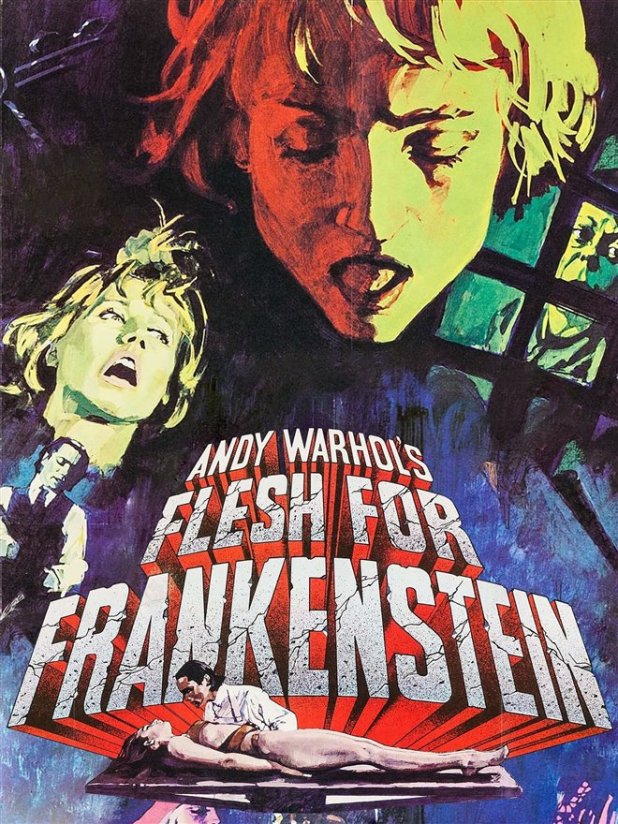
Joe Dallesandro is one of those nexus points for so many movies and parts of culture that I love. Born to a Navy man and a mother who was serving fifteen years in a federal pen for auto theft by the time he was five, Joe went from foster homes to knocking out his high school principal and stealing cars just like his mom. He got shot in the leg, and when his dad took him to the hospital, the cops arrested the fifteen-year-old and sent him to the Catskills, specifically the Camp Cass Rehabilitation Center. He escaped within a few months and made it back to New York City, where he went from nude modeling to being the star of Warhol’s films.
After roles in Lonesome Cowboys, Trash, Heat and Warhol’s two monster films, Joe decided to stay in Europe, where he made all sorts of movies in all the types of genres that I love. Yeah, there’s the American TheGardener, Serge Gainsbourg’s Je t’aime moi non plus, Savage Three, Killer Nun, Madness, Le Marge with Sylvia Kristel and many more. He even shows up somehow in Theodore Rex. Yes, the same man whose bulge is on the front of the Rolling Stones’ Sticky Fingers, and the cover of The Smiths’ first album was in a movie about dinosaur cops.
This is the movie that Joe, who never once gave it away, came to Italy to make with Paul Morrissey.
Baron von Frankenstein (Udo Kier) has made his sister Katrin his wife, yet ignores her as he works to create the perfect human being, going through corpses of men and women to craft his Serbian ideal. You know, when he isn’t literally having sex with the body parts of dead women while shouting, “To know death, Otto, you have to fuck life… in the gall bladder!”
He wants Nicholas (Dallesandro) to be the body of his creature, but he escapes and makes his way to the castle, where he begins to satisfy the Baroness. Once she reveals the fact that she only cares about herself, she betrays him and, in return, is given what she really wants: The opportunity to have sex with the Baron’s creation, who responds by loving her to death. Another even more graphic scene happens when lab assistant Otto literally screws the guts out of the female monster (Dalila Di Lazzaro, Phenomena), causing the angry Dr. Frankenstein to kill him.
I kind of dig that the end of this film echoes both A Bay of Blood and Manson’s quote about “These children that come at you with knives — they are your children” by having the Frankenstein children holding scalpels that they will either use to help or to hurt. The movie doesn’t tell you what happens next.
That A Bay of Blood comparison is easier to make when you realize that one of the kids is played by one of the adorable and murderous kids from that movie, Nicoletta Elmi. In the 70s, if you wanted a frightening Italian red-headed child, you went with Nicoletta, who also appeared in Baron Blood, Who Saw Her Die?, Deep Red and many more. She also played the red-head usher in Demons when she grew up.
Despite his name appearing on this film, Andy Warhol’s contributions were minimal. He may have visited the set once and briefly examined the editing. Perhaps a more involved talent was Antonio Margheriti—Anthony Dawson—who claimed to have directed some of the film. He may have just been there so that the film could claim to be Italian, as it would need a director from the country to obtain Italian nationality for the producers.
I watched this film as part of The Bucheon International Fantastic Film Festival (BIFAN). You can learn more at their official site.
The moments that work in Terrifier are the ones without the gore. Art the Clown (David Howard Thornton) is just walking with a bag of glass, and there are moments in the pizza shop and him on that bike. The disquiet of those moments was so upsetting that I was excited to see where the next movie would go.
Directed, written, edited and produced by Damien Leone, this takes place a year after the first movie. It’s Halloween again, and Art has returned from the dead, killing the coroner, inspecting his body, and seeing The Little Pale Girl, an entity that follows him throughout the movie.
Sienna (Lauren LaVera) and her brother Jonathan (Elliott Fullam) are obsessed with the drawings in their dead father’s sketchbook. While Sienna takes to the angel whose costume she is making for a party, Jonathan loves the pictures of Art and his victims. Their father died of brain cancer, which they claim led to the visions inside his books; that night, a fire wipes out Sienna’s costume, but her sword—a gift from her father—remains.
When she goes to a costume shop to rebuild her wings, Sienna has a panic attack instead of talking to her friends Allie (Casey Hartnett) and Brooke (Kailey Hyman) about Art the Clown’s victim, Victoria Heyes (Samantha Scaffidi, the final girl of the original). She has a nervous breakdown on live TV and murders talk show host Monica Brown.
By day, Jonathan watches Art and The Little Pale Girl play with a dead opossum while Art kills the costume store owner, Allie and Allie’s mother at night. That sentence in no way explains just how far these murder scenes go, some of which feel like they descend into Herschell Gordon Lewis-level gore porn for laughs.
Jonathan shows Sienna and their mother, Barbara (Sarah Voight), the sketchbook, as he has learned that The Little Pale Girl was Art’s first victim, Emily Crane. Jonathan believes their father knew how to stop Art, but his mother destroys the books and slaps him around. There is no need for revenge, as she dies moments later at the hands of Art, who takes the sword and Jonathan.
After a midnight party where Brooke doses Sienna with MDMA, our heroine is lured to the abandoned The Terrifier amusement park ride. There, she is killed by Art and resurrected by an unseen force before killing the clown numerous times to save her brother. One final time, she uses the sword to cut off Art’s head, which is taken by The Little Pale Girl. Moments later, Victoria Heyes gives birth to the living head inside the mental home, setting up the third movie.
Somehow, on a budget of $250,000, this movie made $16.1 million. There was hardly an ad campaign, either. The idea that a film that caused people to pass out and puke definitely had some allure.
I also have no idea why this movie is 2 hours and 18 minutes long, but 15-year-old me would have loved it. 51-year-old me thinks this movie is too long but recognizes that people tend to want to keep playing loud and fast when you’re playing loud and fast. I wish there had never been any information on Art, where he came from, or that he had any special powers, but I’m not making this movie. I’m just watching it. And any movie that has a comedy moment where a killer clown shreds a person and then reappears to pour bleach and salt on them has transcended criticism and just exists on its own.
I watched this film as part of The Bucheon International Fantastic Film Festival (BIFAN). You can learn more at their official site.





 B&S About Movies
You must be logged in to post a comment.