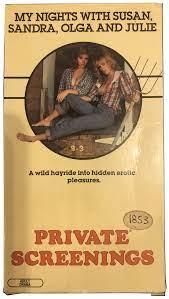
VIDEO ARCHIVES WEEK: My Nights With Susan, Sandra, Olga and Julie (1975)

VIDEO ARCHIVES NOTES: This movie was discussed on the January 31, 2023 episode of the Video Archives podcast and can be found on their site here.

Wim Verstappen and Pim de la Parra were the Wim and Pim of Scorpio Films. They made Blue Movie, which led to the end of the Dutch film rating system for adults. They also made Sylvia Kristel’s first movie, Frank en Eva.

Written by Pim along with Carel Donck, Charles Gormley (who directed the TV movie adaption of the comic book The Bogey Man), David Kaufman and Harry Kümel (the director of Daughters of Darkness), this is the story of the four women in the title. But the driving force — at first — is Susan (Willeke Van Ammelrooy), a model who has grown tired of the fast life and moved to the country. As the title tells you, she lives with Sandra (Marja de Heer), Olga (Franulka Heyermans) and Julie (Marieke van Leeuwen), who always seems to be asleep.

Then Anton (Hans van der Gragt) comes to lure Susan back and things get weird.

I mean, they were weird before. After all, Sandra and Olga just killed an American tourist and buried his body in a lake where it was found by the somehow even stranger Piet (Nelly Frijda) who has taken the body to her shack and started treating it as if it were alive.

Susan and Anton start to fall for one another while Sandra and Olga conspire to get between them and get with Anton.

Oh yeah. Albert (Serge-Henri Valcke) is living inside the walls watching everything.

Pim de la Parra made Obsessions, which was written by Martin Scorcese and scored by Bernard Hermann, so he knows how to do suspense. This is, well, Eurosleaze and I say that in the kindest of ways. It’s a movie about getting the actresses nude and then also having them conspire to commit all sorts of murder.

What I didn’t expect was the use of Stevie Wonder’s “Don’t You Worry ‘Bout a Thing.” Where did that come from?

This was also the final movie that Elisabeth Lutyens would score. She also worked on The SkullThe PsychopathDr. Terror’s House of Horror and Never Take Candy from a Stranger.

None of this makes sense and I wouldn’t have it any other way. How many movies are there were a bunch of worked up women live inside the twists and turns of a maze-like farmhouse and continually taunt the weird lady that lives in the woods while a guy watches them, Bad Ronald style? It is a genre of one.

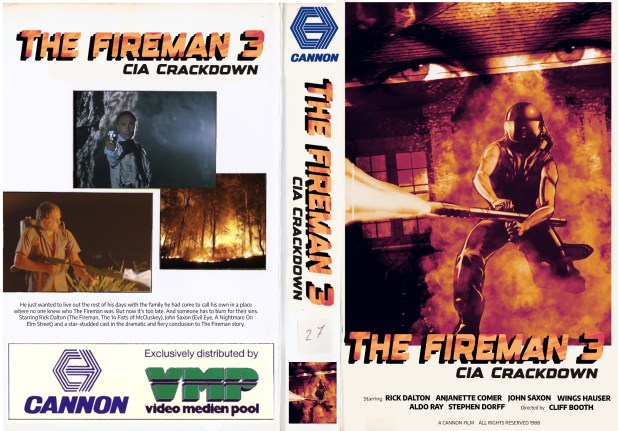
VIDEO ARCHIVES PODCAST: The Fireman 3: CIA Crackdown (1986)

VIDEO ARCHIVES NOTES: This movie was discussed on the May 23, 2023 episode of the Video Archives podcast.

Cannon had a great strategy back when they were making $5 million on a movie just based on the video, TV and foreign sales. It meant that as long as a movie cost around $2 million, they made money. It didn’t even matter if the films did well, as long as they played theaters for a week or two.

That said, they did have some success stories, mostly involving the movies of the two Chucks: Norris and Bronson.

Starting with Death Wish 2, a sequel to a movie made in the previous decade that it seemed like no one — except the fans of Bronson — wanted to make. But when Michael Winner and Bronson teamed up again, it was big box office. Cannon sold the distribution rights to Filmways in the U.S., the company that had just bought American-International Pictures, and figured that a Bronson revengeomatic sequel fit right in with their existing lineup of exploitation classics. Columbia Pictures bought it for international sales — it made $29 million worldwide — and Paramount bought the domestic TV. When the movie came out in February of 1982, it was number one for its opening week and made $16 million in the U.S.

Cannon cashed in.

They also were smart to sign up Chuck Norris after Missing In Action — actually, the second one comes before the first, but that’s a whole different story — became such a hit for them.

These were critic proof movies, ones where it didn’t matter what Pauline Kael said or if Siskel and Ebert picked it as a dog of the week. Bronson and Norris fans would come out and watch their films, rent them when they hit video and watch them again and again on cable.

And for four movies, the two Chucks had another member of the team.

Throughout the 70s, Rick Dalton would mostly show up as a special guest start on shows like Cade’s County and Banacek. Sure, he’s in The Deadly Trackers with William Smith and is amazing as Don Stober in Grizzly. But by and large, his days as a leading man seemed to be over. I remember thinking that he was just a friend of Johnny Carson who would randomly show up on The Tonight Show and make Ed heartily chortle with his stories until my uncle told me all about his cowboy roles.

Yet when Rick got to the 80s, he was able to reinvent himself yet again, combining the nostalgic tough guy act of Bronson and the hard working appeal to the common man of Norris when he made The Fireman for AVCO Embassy 1981. As a Vietnam vet turned cop who learns just how corrupt the NYPD is — but not before they kill his partner, Washington (an impossible young Samuel Jackson) — he decides to go from law enforcement to first responder of sorts, donning a flamethrower and getting revenge by setting most of New York City ablaze. And he’s the good guy in a movie that seems so scuzzy you’d swear Rick was someone who made movies like Ms. 45 and Don’t Go In the House instead of your mom’s first. crush.

It works, though, mostly because the public never forgot that once pulled his actual working flamethrower from The 14 Fists of McCluskey out of his garage to defend his home from some hippies, an act that got the lifelong Democrat a first class trip to visit the Nixon White House. Seeing him use a very similar weapon of death in this has the kind of exploitation edge that makes movie weirdos like me salivate.

Rick believed in this project because it gave him a chance to work with stuntman Cliff Booth, who had doubled for him for years. Rick produced and directed this movie with Cliff handling what he knew best, the action.

You know who loves this movie? You guessed it. Quentin Tarantino. He said, “Cliff Booth in 1979 or ’80, wrote a vigilante exploitation movie for Rick … Rick read it and goes, “We can do this better,” so Rick rewrites it and the two of them are going to produce it, they get the money, and it’s a vigilante movie called The Fireman. The lead character was in the Vietnam War — it’s very similar to The Exterminator  — he became a cop and then he started seeing this whole group of bad apple cops that are killing guys and are completely corrupt. And they end up killing his partner, played by a very young Samuel L. Jackson. The film becomes a real big hit, and that makes Rick, he gets a third career, going into the ’80s, as a straight to video action star.”

Imagine Rick’s surprise when Cannon Films came calling to make another one. Especially because they’d already made a movie that pissed him off, 1984’s Exterminator 2. It felt a bit too close to the movie he. made with Cliff for his taste, so he barely wanted to take a call from two Israelis in tracksuits. Imagine how he felt when the lunch meeting wasn’t at Musso and Franks or Taylor’s Steak House, but instead a hoagie and a bag of chips in their office.

Yet when they told him they could give him $4 million — and that they’d buy the rights to his movie from AVCO Embassy on top of that — he just had to laugh at Menahem’s fast talking ways, not to mention the fact that he drew out a contract on the greasy bag from a local sub shop.

That wasn’t the story he told on Johnny, however. Self-deprecating to a fault, he told the King of Late Night that he saw the Cannon name at the front of Bolero and figured they’d be interested in his movie, saying “I figure if they made that dog turd, they’d make my dog turd.”

Ed McMahon fell off the couch.

At this point, Rick and Cliff were excited to get the sequel signed off and started looking for talent so they could make the movie that they didn’t have the budget to make when they made The Fireman. At first, they went after bigger names with that $4 million budget. If you’re going to make an Arthur Hill action movie, get Arthur Hill, you know? They talked to him, Richard Fleischer (who did Red Sonja instead, to his chagrin), Richard Donner (shoot big) and George Bowers, but then what always happened with Cannon happened. They were flush with Missing In Action and Breakin’ cash when Rick signed his deal, but their next slate of movies wasn’t doing as well.

Who could do the film for less?

Menahem suggested former Bond director Peter Hunt and J. Lee Thompson, but out of respect for Bronson, Rick laughed off the latter suggestion. And he confided in Menahem that if Cliff was forced to work with Michael Winner, he’d probably kill him. It didn’t sound like a joke the way he said it. Sam Firstenberg and Rick had a great meeting, but he walked away telling him, “Why do you want me to make your movie when I’m just going to follow what Cliff did in your first one? You already have your director.”

And that’s how Cliff Booth, once a stuntman, then a second unit guy for exactly one movie ended up directing and writing The Fireman 2. While some fans love the first one more, I love that this seamlessly starts five minutes later — yeah, I bought that bootleg on a Facebook fan group where someone edited both movies together for one long The Fireman experience — and doesn’t lose an ounce of its edge when it moves the action from New York to Texas. And yeah, Donald Pleasence rarely said no to a movie, but this was the kind of movie where he shines (the Halloween influence is all over this; Rick considered Rick Rosenthal as a director until the Halloween II director confessed his intention to make a sequel to The Birds; Rick laughed about that until the movie actually played on Showtime and he just stared, pointing at the screen, beer growing warm in his hand).

And come on. Joe Don Baker hadn’t been that good in a movie since Golden Needles.

Just like Bronson and Norris, Rick took Hollywood by surprise. The Fireman 2 did well for a few weeks in theaters and drive-ins, but was a blockbuster on cable and in the home video market. But for Cannon, well, it was as big a deal as anything they’d made. Golan and Globus called Rick the Saturday after the movie opened, laughing — but perhaps also being serious — as they asked “Can you start shooting on Monday?”

The Fireman 3: CIA Crackdown wouldn’t happen that quickly. Rick wanted the kind of movie that would pay off the series while adding a bit more drama. Sure, it was the third movie, but he didn’t want to make the same movie over and over again.

It was worth the wait.

With Rick writing and starring, as well as an even more confident Cliff behind the camera, the third film throws you a curveball. Eddie Karpinski isn’t using that name anymore. He’s gone into hiding and is now living the kind of existence you could never have predicted after the first two films. Instead of POV shots of him burning muggers, the movie starts with the domestic bliss he’s found with Marisa (Anjanette Comer), a widow with a teenage son named Kirk (Stephen Dorff, a year after The Gate) and a dementia-addled father, Butch (Aldo Ray). They’re living in a fixer-upper on the outskirts of the suburbs and it seems like new developments are being built all around them.

Regency Realty, run by the company’s third-generation scion Dwight Regency (Wings Hauser), keeps making offers for the low middle class homes on our hero’s street. At first, they seem like any other real estate developer. But seeing how their agents are played by Michael Ironside, Robert Davi and Tracey Walter, you pretty quickly figure out that they’re not on the up and up.

Our hero finds out way too late, as his modest home — his reward for two movies of blasting bad guys like Richard Lynch and Billy Drago with napalm — goes up in flames. The cops say it was an accident, the insurance tries to pay it all off and everything is supposed to go away. But with his adopted son trapped in painful rehab, his wife ash and Butch dying a slow death — but not before an emotional scene where he grips The Fireman’s hand and says in his gravely voice, “I always knew who you were. But you were good enough for my Marisa. Now, I want you to be bad enough for her.” — it’s only a matter of time before the flamethrower comes out of its hiding space and the entire subdivison goes up in smoke.

But wait, you might ask. Where does the CIA part of the film’s title come in? It turns out that an agent near retirement named Carmine Bassi (John Saxon, as always, the perfect person for the role; he made this right before he directed the only movie he’d ever direct, Zombie Death House) is sent on a wild goose chase to bring in Karpinski. When he starts to notice that a Salt Lake City suburb is dealing with a rash of arson-based crimes and sightings of a man wielding an M2 flamethrower, he comes running. But by the end of the film, he starts to see no small part of himself in Eddie.

I’m not one of those people who write, “For a Cannon movie, this is pretty dramatic.” After all, it’s the same studio that made Maria’s LoversRunaway Train and gave Cassavetes a good budget to make Love Streams. It’s better than it has any right to be, to be perfectly frank, and it sends off The Fireman to the kind of retirement — and retribution — that he so rightly deserved.

That’s not saying that if Dalton had wanted to make one or two more of these I wouldn’t have bought a ticket, rented the movie and taped it off of HBO, however.

I was talking with Austin Trunick, writer of The Cannon Film Guide Volume I and The Cannon Film Guide Volume IIand as usual with all things Cannon, he blew my mind with an untold story.

“I wanted to send you a quick note to let you know that there was almost more to this saga. There was an ad for The Fireman 4: New Fire in the 21st Century Film Corp spread in Weekly Variety‘s AFM 1991 issue. Well, maybe “ad” is too strong a description — it’s just a title treatment, nothing more, no talent listed, with a dubious note that it was “In Pre-Production – Ready for Delivery Christmas ’91.” That’s all I’ve ever come across for that particular project, and I honestly have no clue if Dalton was involved at all or if Menahem even had the sequel rights at that point. I wouldn’t be shocked in the least if it was one of his typical “let’s announce it now and figure out the details later” sort of deals. Considering the ad didn’t use Dalton’s name to drum up foreign sales, that probably was the case.”

When do we get to see that movie?
Makeup trailer

When two people are brought together from completely different walks of life, it can make for awkward circumstances, especially when they both have their secrets. Sacha (André), an introverted French ex-chef, moves to London to begin his new life as a food critic. Moving into a rented room in a house belonging to Dan (Masheter), a well-respected London stockbroker, the pair are forced into an unlikely friendship. As time goes on and events unfold, Dan attempts to hide his aspirations of becoming a burlesque dancer from the people who perceive him as an alpha male. Despite their differences, can Sacha and Dan become pillars of support in each other’s lives?

Look for Makeup available June 27.

TUBI ORIGINAL: Hidden Exposure (2023)

Sabina Geshem (Liana Liberato, Scream VI) is a dance teacher who once had her own dreams of dancing on Broadway. But that was before the injury and before she got serious with Ramsay Stranger (Jordan Rodrigues), whose business is struggling and who seems like absolutely the worst person for her to pin her hopes and dreams on. When she brings up that he opened another credit card in her name, just as she’s paid off the last one, he makes it her fault.

He assures her that if he can just have a good meeting with Randall Abbott (Richard Kind, who seems like a big star for a Tubi original), all their problems will disappear.

No, that’s exactly where they’ll start.

Randall could care less about Ramsay’s virus solution. Yet their meeting ends up introducing him to the businessman’s daughter Alvy (Rumer Willis) and yes, Ramsay has a type: pale redheads. He starts spending time with his new love interest while continually demoralizing his old one.

There may be hope yet. An old dancing friend named Celine (Stef Dawson, Annie Cresta from The Hunger Games series) who is just getting past cancer learns that Eva Graf Schierling (Lara Wolf) is taking over as the director of dance and she’s been asking where Sabina has been. The opportunity for her to become a dancer on the biggest stage there is still exists.

Ramsay responds to this by telling her that she keeps making the same mistakes, that she’s setting herself up to be a failure and that he wants nothing to do with her any longer. He disappears from her life, which allows her to put her energy into dancing and finally concentrate on herself.

That is, until Celina takes her to a party and she runs into Ramsay, who easily gets her back for a night.

He laughs when she thinks they’re getting back together and explains that he has a whole new life. She decides to see what that life is all about in upstate New York. It’s gorgeous. The people are kind. And no one is kinder to her than Alvy, who is nothing like the thieving force of evil that she expected.

The real problem? Alvy is pregnant. And so is Sabina.

Directed by Todd Bogin, who wrote the screenplay with Omali Jeffers and Frederic J.A. Richter, I really appreciated that this movie strayed from the psycho ex-girlfriend formula to present an ending that is tragic and quite sad. The film looks great, thanks to cinematographer Barbie Leung, who finds great lighting, deep colors and intriguing angles that keep the otherwise seen it before story seeming fresh and vital.

You can watch this on Tubi.

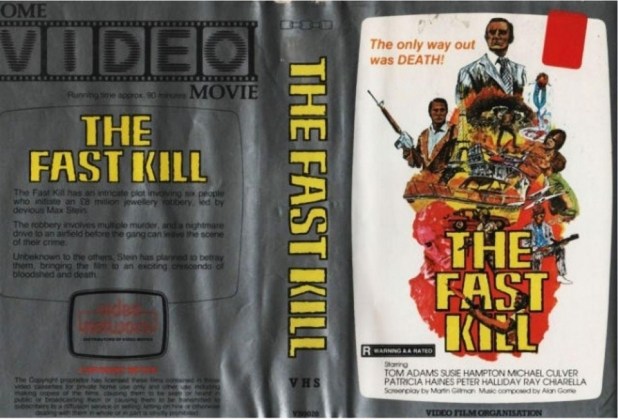
VIDEO ARCHIVES WEEK: The Fast Kill (1972)

VIDEO ARCHIVES NOTES: This movie was discussed on the April 11, 2023 episode of the Video Archives podcast and can be found on their site here.

There are several phases to the career of Lindsay Shonteff. He started making cheap horror like Devil Doll and Voodoo Blood Death before making two Eurospy films — The Second Best Secret Agent In the World and The Million Eyes of Sumaru — a genre he would return to several time, making Spy Story, Undercover LoverNo. 1 of the Secret Service and Number One Gun, usually going back to his Bond character Charles Bind every few years or so. He even had a Shot On Video period, in which he kind of remade Night, After Night, After Night as Lipstick and Blood as well as a post-nuke wandering in the boredom movie called The Killing Edge. Oh yeah! He also made Permissive and The Yes Girls, two sexploitation movies about groupies. And I forgot Big Zapper and the sequel, The Swordsman, which are about the adventures of Harriest Zapper.

Max Stein (Tom Adams) is a ruthless criminal who has put together the perfect team to pull off the perfect crime, which happens in the early part of this movie. What follows is Stein killing off the team as they all fall out from one another. Jeremy Dryden (Michael Culver) is the only member of the gang that might have something close to a soul, but that won’t help you in this dark world of stealing  and selling one another out.

Supposedly, Ingrid Pitt was going to be in this, but her husband George Pinches told her she wasn’t permitted.

Stealing 4 million pounds worth of diamonds was supposed to be the hardest part of this heist. Trust me, that was the easy part.

I would say that Shonteff does well with a small budget, but I don’t think he ever had a decent one to work with.

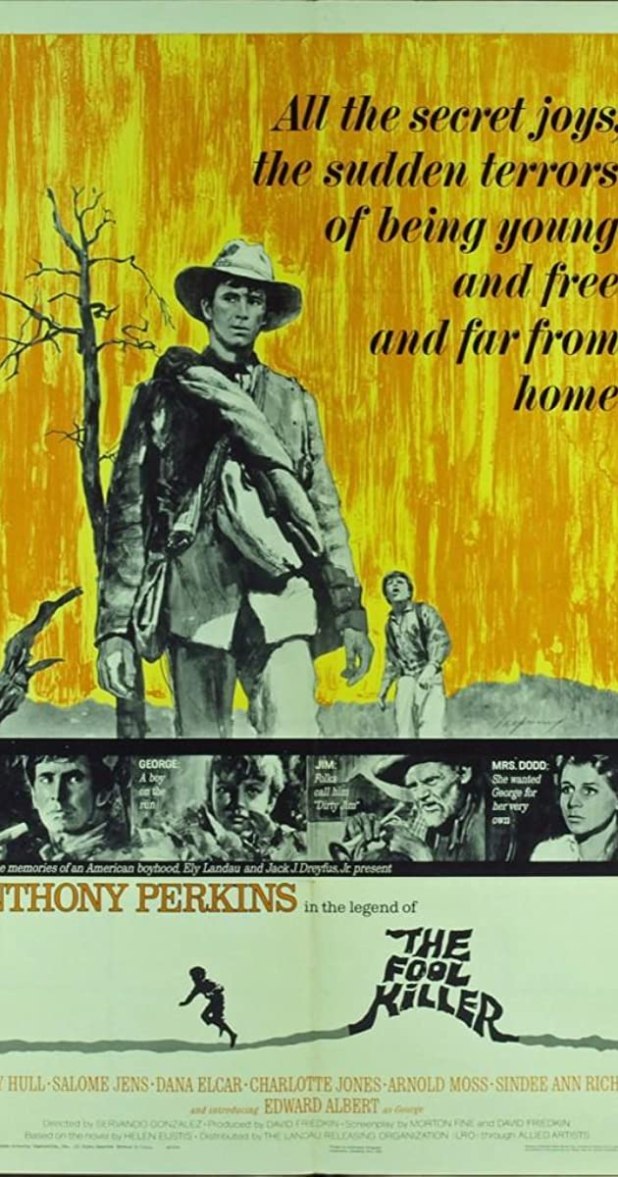
VIDEO ARCHIVES WEEK: The Foolkiller (1965)

VIDEO ARCHIVES NOTES: This movie was discussed on the January 31, 2023 episode of the Video Archives podcast and can be found on their site here.

Servando González directed one of the wildest films I’ve ever seen, El Escapulario, which somehow unites multiple genres and countries of cinema, as well as being folk horror by way of Mexican Catholicism.

Here, somehow, he’s in America and making an adaption of the novel of the same name by Helen Eustis. And, to quote Joe Dante, he’s making the most Night of the Hunter movie that is not Night of the Hunter.

Working from a script by Morton S. Fine (who wrote a lot of TV, as well as The Greek Tycoon) and David Friedkin (who worked with Fine on the show Frontier), González leads George Mellish (Edward Albert) through the desolate post-Civil War landscape of America. After being beat — again — by his foster parents, George has taken for the open dusty road, a place where he meets Dirty Jim (Henry Hull). Jim tells him of a gigantic axe-carrying killer called The Foolkiller who just may be Milo (Anthony Perkins), a man that he meets as he wanders Tennessee.

George thinks he deserves all the slaps and strikes his foster parents have given him. After all, they quote the Bible the whole time. But after hearing that his foolishness — playing with dandelions is nearly a capital offense — is so strong, he wonders if he’s destined to be a victim of the Foolkiller’s blade.

As our protagonist and Milo travel, we see that they both have scars from the figurative and literal wars they’ve fought. There’s also a tent revival which is awe-inspiring in its ferocity, as Reverend Spotts (Arnold Moss) snarls, spits and nearly explodes as he convinces George to make the altar call and drop to his knees before the Lord to stay out of the pits of Hell.

Mexican directors never got the chance to make American movies, but this is much closer to a regional film, shot in Knoxville, that somehow got Tony Perkins on board and gave González the opportunity to make a dark fairy tale of childhood, pain and belief.

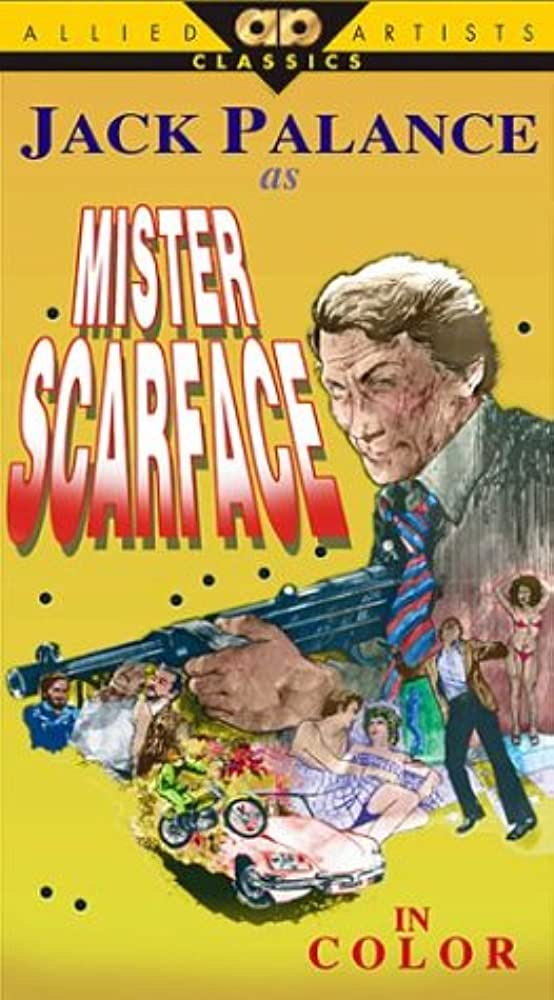
VIDEO ARCHIVES WEEK: Mr. Scarface (1976)

VIDEO ARCHIVES NOTES: This movie was discussed on the January 17, 2023 episode of the Video Archives podcast and can be found on their site here.

Also known as Rulers of the CityThe Big Boss and Blood and Bullets, this was directed by Fernando Di Leo. He started his career mainly being known for his writing, including A Fistful of DollarsFor a Few Dollars MoreMassacre TimeLive Like a Cop, Die Like a Man and so many more. He co-wrote it with Peter Berling, who was often in Kalus Kinski movies before writing a series of conspiracy novels about the Priory of Sion.

Tony (Henry Baer) works as a money collector for Cherico (Edmund Purdom) but he dreams of leaving his life of crime behind and settling on the beaches of Brazil. He decides to fast forward all the hard work of being a henchman by working with Rick (Al Cliver) and Napoli (Vittorio Caprioli) to rob the biggest boss of all, Scarface Manzari (Jack Palance).

It takes its time getting there, with Tony mostly cracking wise, cracking schools and, well, cracking smiles at the many ladies he sees during his days and nights of collecting blood money. He would have never even considered going after Scarface if he didn’t kill Cherico instead of repaying his debt. By the end, our hero has tracked his enemy — actually, his lifelong enemy, even if we don’t get that knowledge for some time — to a slaughterhouse where he wipes out the entire family.

Added bonus: Gisela Hahn (Devil HunterWhite Pop JesusDisco Fieber) is in the cast. And man, Jack Palance is so macho that he even makes a cigarette holder look manly. Like, the same kind of long effete cigarette holder that, let’s say, Cruella de Vil would use.

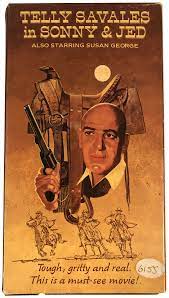
VIDEO ARCHIVES WEEK: Sonny and Jed (1972)

VIDEO ARCHIVES NOTES: This movie was discussed on the January 17, 2023 and January 24, 2023 episodes of the Video Archives podcast and can be found on their site here.

Quentin Tarantino has referred to Sergio Corbucci as the second-best director of Italian westerns, but he didn’t choose to remake any of Leone’s movies, you know?

Corbucci was joined by a veritable posse of writers for this movie, including Sabatino Ciuffini (Super FuzzThe Fourth Victim), Mario Amendola (Cannon’s AladdinThe Great Silence), Adriano Bolzoni (Your Vice Is a Locked Room and Only I Have the KeySilver Saddle), José María Forqué and Ángel Pageo.

Jed (Thomas Milian) robs from the rich, gives to the poor and treats the woman who loves him, Sonny (Susan George), like dirt. She dreams of him marrying her, which he does, but still abuses her. Anyways, he’s on the run from Sheriff Franciscus (Telly Savalas) when he isn’t trying to woo Linda (Rosanna Yanni, Frankenstein’s Bloody Terror) the wife of land baron Don Garcia (Eduardo Fajardo), who has what he really wants: more money.

Look, I get that Rosanna Yanni is buxom and gorgeous, but the idea that Susan George is seen as an ugly duckling quite frankly makes this movie into science fiction.

Actually, it’s difficult to like Jed, because he started his relationship by assaulting Sonny and now he demands that she always stays three feet behind him and even kneel in subjugation to him. She falls in love and cries every time he treats her horribly and you just want to scream at the screen. And this is the hero!

How often can you hear someone call a woman lower than a dog before you start to wish that Telly Savalas blows his brains out?

I mean, this is the movie that George made after Straw Dogs, Did every casting director say, “This movie has a ton of rape in it. Call Susan George?”

That said, the Morricone soundtrack is great and I’m always fascinated by K-Tel Records starting a studio and distributing movies. They started by selling greatest hits albums and products like the Record Selector, the Veg-O-Matic and the Miracle Brush. In 1970, they started bringing foreign films to North America, including Mr. SuperinvisibleShowdown In Little Tokyo and A Reason to Live, a Reason to Die. K-Tel still exists today, but instead of TV sold products, they make their money by outright owning songs like “What I Like About You” by The Romantics, “Tutti Frutti” by Little Richard and “Surfin’ Bird” by The Trashmen.

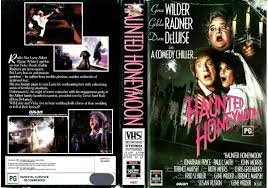
VIDEO ARCHIVES WEEK: Haunted Honeymoon (1986)

VIDEO ARCHIVES NOTES: This movie was discussed on the January 10, 2023 episode of the Video Archives podcast and can be found on their site here.

Haunted Honeymoon was directed and written by star Gene Wilder, who joins his wife Gilda Radner to play Larry Abbot and Vickie Pearle, two radio actors who decide to get married in the castle that was Larry’s childhood home, one filled with the strange members of his family such as aunt Kate (Dom DeLuise), his uncles Dr. Paul (Paul Smith) and Francis (Peter Vaughan) and his cousins Charles (Sir Jonathan Pryce), Nora (Julann Griffin), Susan (Jo Ross) and the cross-dressing Francis Jr. (Roger Ashton-Griffiths).

Dr. Paul has the idea of solving Larry’s on-air panic attacks with shock therapy that will knock them out by basically frightening him to death. He clues everyone — including Susan’s husband Montego the Magnificent (Jim Carter), the butler Pfister (Bryan Pringle), Pfister’s wife Rachel (Ann Way) and even Larry’s ex-girlfriend Sylvia (Eve Ferett) who is now dating Charles.

Then there’s a werewolf!

Wilder wrote this movie the whole way back on the set of Silver Streak and was inspired by The Old Dark HouseThe Cat and the Canary, The Black Cat and the Inner Sanctum radio show. Shot in London at Elstree Studios, Wilder saw this as an attempt to “make a 1930s movie for 1986.”

It went over about as well as you’d think. As Radner struggled with the ovarian cancer that would take her life — she and Wilder would only be married for four years before her sad early end — she wrote “On July 26, Haunted Honeymoon opened nationwide. It was a bomb. One month of publicity and the movie was only in the theaters for a week — a box-office disaster.”

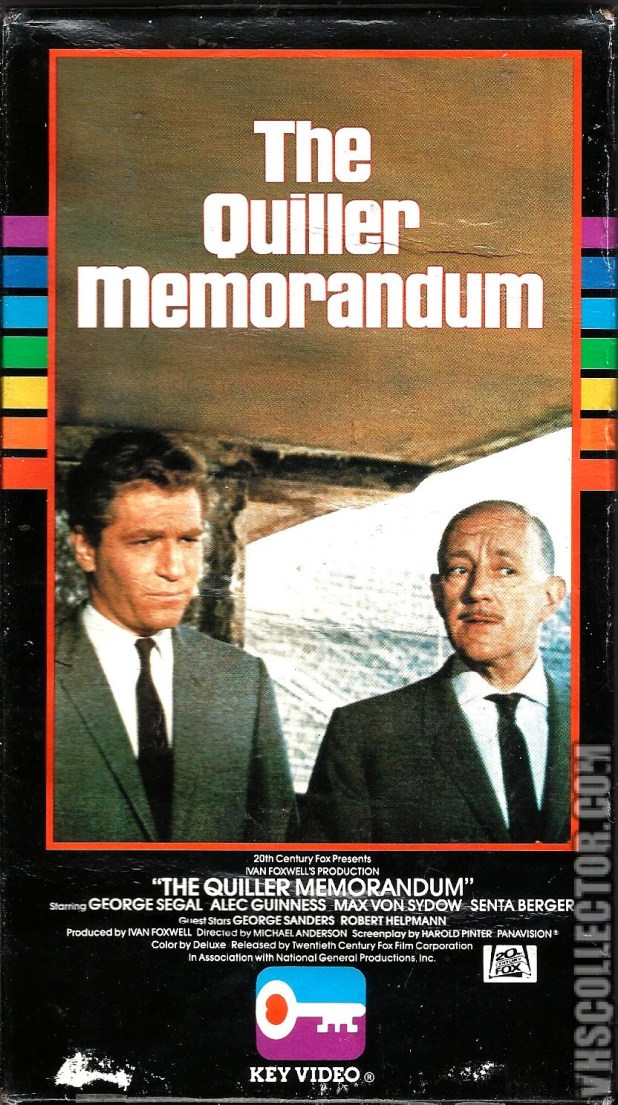
VIDEO ARCHIVES WEEK: The Quiller Memorandum (1966)

VIDEO ARCHIVES NOTES: This movie was discussed on the May 9, 2023 episode of the Video Archives podcast and can be found on their site here.

How we see actors based on our own experience with them is strange.

George Segal is, to me, one of the stars of the sitcom Just Shoot Me!

That’s who I see him as. I realize the tremendous blind spot — which I have been filling — I have by skipping so much of his career.

But wow, it’s a leap to experience him playing a secret agent.

Based on the novel The Berlin Memorandum by Elleston Trevor, this film was directed by Michael Anderson (OrcaDoc Savage: The Man of BronzeLogan’s Run) and written by Harold Pinter.

Two agents have already died as they investigate the neo-Nazi group Phoenix — led by Oktober (Max Von Sydow) — in Berlin. Quiller (Segal) is brought in by his handler Pol (Alec Guinness).

It may have a John Barry score, but this isn’t a Eurospy movie. Yes, it’s a spy movie, but so much of it is spent in the coded conversation about cigarettes that feel more like secretive men finding one another in the park than anything resembling James Bond.

What Eurospy element is in this movie? Senta Berger, Quiller’s perhaps enemy and definitely love interest. She was also in Bang! Bang! You’re Dead!, The Poppy Is Also a Flower and The Ambushers.

As for George Sanders being in this film, his role was so small that his co-stars claimed that they never even saw him on the set.

The major difference between this and nearly every other spy movie of its time is that in those movies, you wanted to be an agent. Watching this, it just seems exhausting. In no way do I want to have to endure the life of Quiller.