MILL CREEK THRILLERS FROM THE VAULT: Before I Hang (1940)

Another in the series of mad scientist movies starring Boris Karloff for Columbia, this was directed by Nick Grinde and written by Robert Hardy Andrews.

Karloff is Dr. John Garth and he’s on trial for mercy killing a friend, predating the right to die controversy by decades. He had been trying to invent a cure for aging but it was too late to give it to the patient. He asks the judge to allow him to live as he’s close to this medication, but he is due to be hung in three weeks. Yet with support from the warden (Ben Taggart) and Dr. Ralph Howard (Edward Van Sloan), he is able to take the blood of an executed murderer and turn it into a serum that reverses the effects of aging just in time to be saved from the gallows.

If you’re wondering, “Will that killer’s blood make Dr. Garth a killer?” you don’t have to wait all that long to find out. He kills Dr. Howard and a fellow prisoner, which looks like he was the hero, and he’s soon released to live with his daughter Martha (Evelyn Keyes).

Dr. Garth then tries to convince each of his elderly friends to let him help them escape the ravages of age. When they refuse, his evil blood takes over and he kills them. Convinced that he could even kill Martha, he runs back to the prison and is killed trying to get back inside, in effect killing himself to protect his friends and daughter.

There are nearly five similar movies in a year starring Karloff as a scientist driven to murder. I’d watch them all and more.

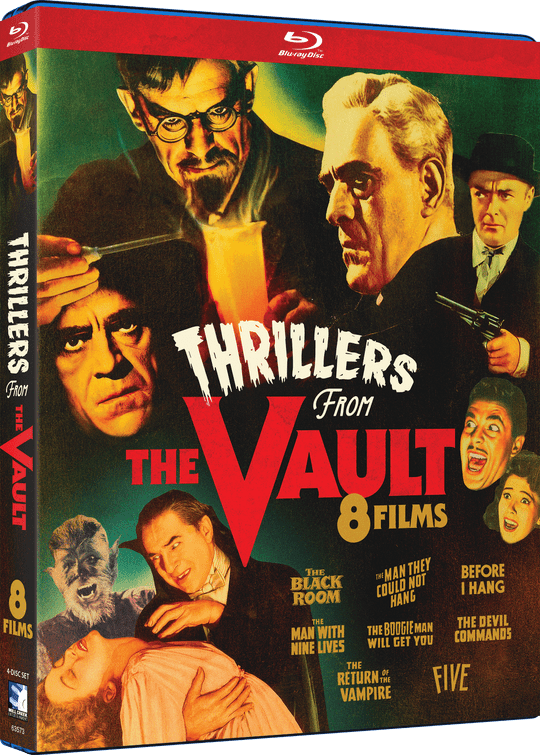
Mill Creek’s Thrillers from the Vault set also includes The Black Room, The Man They Could Not Hang, The Man With Nine Lives, The Boogie Man Will Get You, The Devil Commands, The Return of the Vampire and Five. There’s also a documentary, Madness and Mayhem: Horror in the 30s and 40s. You can get it from Deep Discount.

MILL CREEK THRILLERS FROM THE VAULT: The Man They Could Not Hang (1939)

Directed by Nick Grinde (The Man with Nine LivesBefore I Hang) and written by Kurt Brown (A McKeesport native who was the assistant to D.W. Griffith’s cameraman G.W. Bitzer before becoming a cinematographer; he was the son of comedian and character actor William H. Brown and his mother was Lucille was an actress), The Man They Could Not Hang stars Boris Karloff as Dr. Henryk Savaard, a somewhat mad scientist who has invented a procedure for bringing the dead back to life.

The film begins with him being arrested and about to be executed for murdering a young medical student who volunteered to be killed as part of the testing phase of this procedure. On death row, his assistant Lang (Byron Foulger) signs papers to take possession of the doctor’s body and then he is lynched.

That’s just the start of the movie.

Lang surgically repairs Savaard’s neck and then, like a 1930s version of Dr. Phibes*, he ensures that six of the jurors that convicted him all die by hangings that appear to be suicidal. Only Scoop Foley (Rbert Wilcox) believes that the doctor is still alive and killing everyone who did him wrong. By the point that jurors are being killed every quarter hour, people start to take him seriously.

Virginia Pound — billed here as Lorna Gray — is Savaard’s daughter. She played plenty of comic roles — opposite Buster Keaton in Pest from the West and the Three Stooges in You Nazty Spy!Oily to Bed, Oily to RiseThree Sappy People and Rockin’ thru the Rockies — as well as receiving co-billing in several Republic movies and serials. I love how at the end she holds off all of these important doctors and basically sacrifices herself twice.

After this film, The Man with Nine Lives, Before I Hang and The Devil Commands, Karloff had played basically the same role four times. So when he did a fifth takeoff on the same idea, The Boogie Man Will Get You, it was treated as a parody of this storyline.

Also: Open heart surgery is science fiction in this film.

*One of the victims is killed by picking a phone up and a needle going in their ear to kill them. That’s a total Phibes kill.

Mill Creek’s Thrillers from the Vault set also includes The Black Room, Before I Hang, The Man With Nine Lives, The Boogie Man Will Get You, The Devil Commands, The Return of the Vampire and Five. Each movie has a commentary track — The Man They Could Not Hang has C. Courtney Joyner and Heath Holland — and there’s also a documentary, Madness and Mayhem: Horror in the 30s and 40s. You can get it from Deep Discount.

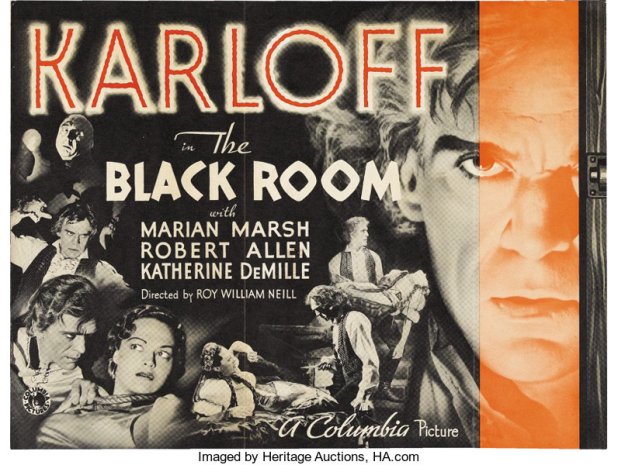
MILL CREEK THRILLERS FROM THE VAULT: The Black Room (1935)

Directed by Roy William Neill  — who gets mystery, after all, he directed eleven of the fourteen Basil Rathbone-starring Sherlock Holmes films as well as early noir like Black Angel — and written by Arthur Strawn and Henry Myers, The Black Room has a prophecy at its center: at some point, the younger brother of the de Berghmann family is cursed to kill his elder in the Black Room of the castle. Hmm — seems like something that would show up nearly forty years later in The Red Queen Kills Seven Times.

Boris Karloff seems to be having the time of his life in this movie, playing the dual role of the kindly Anton de Berghmann and his depraved brother Baron Gregor de Berghmann, who is about as blasphemous as the Hayes Code would allow. After all, he’s known for randomly killing the wives of the simple folk that make up his people.

When servant girl Mashka (Katherine DeMille) disappears, the people have had enough and take their pitchforks and torches to the castle. The Baron claims that he will be leaving forever, giving the kingdom to his more genial and popular brother. As they sign the papers in secret, the Baron leads Anton to his Black Room. By that, I mean he drops him like thirty feet into it and before Anton dies, he sees the dead body of Mashka and plenty more women.

Now, the Baron acts as Anton — even pretending only one of his arms works — and manipulates Thea (Marian Marsh), the daughter of family advisor Colonel Hassell (who also gets killed), into marrying him instead of her true love Lt. Albert Lussan (Robert Allen), who is jailed. Just when there’s no hope, Anton’s dog interrupts the wedding and basically shoves the man who killed his master into the pit that is the Black Room as the Baron is impaled on a knife held in his dead brother’s hand, fulfilling the prophecy.

This was shown often on TV as it was part of the Son of Shock package, along with Before I HangBehind the Mask, The Boogie Man Will Get YouThe Face Behind the MaskIsland of Doomed Men, The Man They Could Not HangThe Man Who Lived Twice, The Man With Nine LivesNight of Terror, The Devil CommandsBlack FridayThe Bride of FrankensteinCaptive Wild WomanThe Ghost of Frankenstein, House of FrankensteinHouse of DraculaThe Invisible Man’s RevengeThe Jungle CaptiveThe Mummy’s Curse and The Soul of a Monster.

It’s a really fun — and fast moving — movie with a huge cast of extras, making it seem like a way bigger movie than it really is.

Mill Creek’s Thrillers from the Vault set also includes The Man They Could Not Hang, Before I HangThe Man With Nine Lives, The Boogie Man Will Get YouThe Devil Commands, The Return of the Vampire and Five. Each movie has a commentary track — The Black Room has Dr. Steve Hoberman — and there’s also a documentary, Madness and Mayhem: Horror in the 30s and 40s. You can get it from Deep Discount.

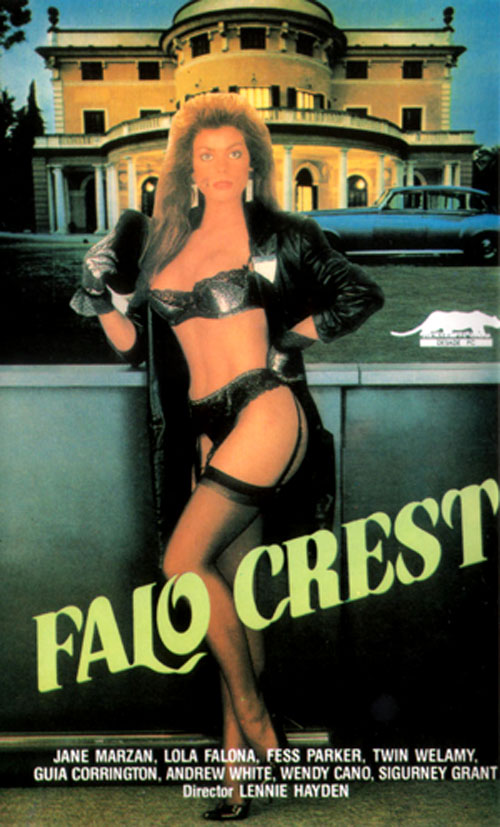
JESS FRANCO MONTH: Phalo Crest (1987)

Not every Jess Franco movie was directed by Jess. I mean, not every Stephen King book is, supposedly. I’ve heard Tabitha King may have written a few of his books or at the very least the central ideas. That’s how strong reltionships work. Well, Lina Romay, Jess’s muse, directed this while he wrote it, composed the music and probably just about anything else that had to get done.

In case you didn’t get it from the title, this is Jess and Lina making Falcon Crest but with porn, just like how Phollastía is Dynasty. Angela Channing (definitely not Jane Wyman) has brought the entire family to the wine fields to share the secret of their success: the wine is mixed with, well, look it’s a Jess Franco movie. It’s mixed with baby batter, so to speak. When mixed with wine, that guy gravy has the tendency to drug people and that’s how Angela takes over her entire family’s will.

In case that wasn’t enough, a small dog licks a man’s ass. I have no idea why this is in the movie, as I don’t remember that ever happening to Lance Cumson, despite his name. Also: incest, in case you were wondering if Franco wouldn’t go down that route.

I have no idea why there’s no Dallas by Jess and Lina. I can only imagine what’s in the oil.

Exclusive interview with Archie Waugh, director of Way Bad Stone

You may have discovered by now that I’m obsessed with shot on video films and finding some of the films in that genre that aren’t as celebrated as the slashers that make up much of the form. One of those movies, Way Bad Stone, fascinates me, as it creates a fantasy world filled with great stunts, captured in camera practical magical effects and a nihilistic bloody ending that has to be seen.

Imagine my surprise that when I was doing research on the movie I learned that the director, Archie Waugh, was born literally one town over from where I call home in Monongahela, PA in the town of Eighty Four. It seemed like fate that I had to reach out and learn more. I was delighted to connect with Archie, who is quite the raconteur and had plenty of amazing insights about a movie that obsesses me.

Images in this interview come from the official Way Bad Stone Facebook page.

B&S About Movies: First off, I’m super excited to meet you. This is a real honor.

Archie Waugh: Thanks, it’s just been very amazing that after 31-32 years, there’s suddenly interest in this thing again. It really came out of nowhere. I started finding links to reviews a few years ago and I sent them to Janne (co-writer Janne Kafka) and she was amused. People got it, you know, which is fun. The movie is either one of those films where you either get it or you don’t.

B&S: There’s also a big demand for Shot On Video movies to be released in better formats now.

Archie: I’ve had several people for the last year or so nagging me: “Do you have any VHS copies left?” Outside of my personal master copy, I really don’t. We unloaded them all at Dragon Con, that’s where that picture of Janne in costume is from. That was my first Dragon Con and we made a lot of friends there that I’m still in touch with, thanks to Facebook.

Janne Kafka at Dragon Con ’91.

B&S: How did you come on board to direct?

Archie: I worked for about 15 years for Manatee County in Florida, which is where we filmed the movie. I ran their government access television channel. I had a degree in theater and communications, plus I was pretty much a self-taught graphic artist. I just happened to get hired for that job at the right time and moved up from a cameraman to running the channel. Most of what I did there was documentary stuff and live broadcasts of county commission meetings, school board meetings, stuff like that. I made my own videos for my own entertainment on my own time. 

I had these friends who were medieval fair performers and I got to see them perform and do swordplay, which is fun to watch live, but wouldn’t it be a lot more fun with blood? You can’t do that with the family audience that comes to the Medieval Fair, so I thought, “What if we make a little movie where you can let loose and they could do all their fight choreography and we can also do special effects?”

Working with a friend of mine, we made a “proof-of-concept” swordfight video that was about nine minutes long. We shot it with a static camera on a tripod, just the two of us.  When we showed it to the fair folks, everyone decided to go for it.

Janne Kafka who plays the female lead and I started writing it.  Her husband, the late Jan Skipper, who played the Wizard Aladar, produced. And then the medieval fair people started dragging all of their friends in. And then I started dragging in friends from the local theater because I realized a lot of these people could not do dialogue, so I needed a few people that could help fill it out. And I think we ended up with 65 people in the movie. (laughs)

B&S: That’s a huge cast for a shot on video movie.

Archie: The $3,000 budget, I would say two-thirds of that was catering. We would do it all day shoot and we’d have to feed everybody and sometimes the shoots would go into the evening. They spent a lot of money on food.
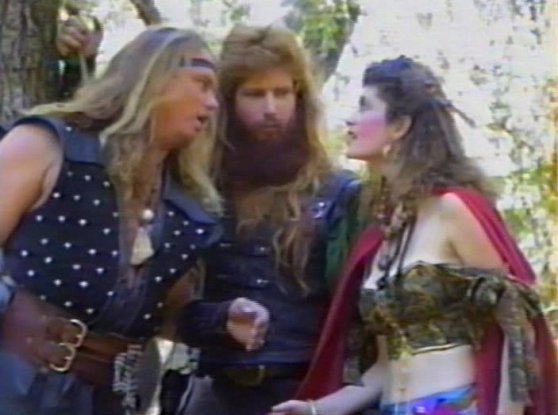
B&S: The costumes had to add up.

Archie: Well, most everybody had or made their own costumes. I see occasional references to blue jeans and tennis shoes in the movie when I read reviews. They’re pretty hard to spot! That never really bothered me if someone was wearing modern clothing. This wasn’t meant to be a for profit project. It was just something we were all doing for fun. And it got out of hand to the point when it was obvious that it was going to run over an hour. It’s like well, we might as well try and do something with this to try and get some of the money back. That’s why we went to Dragon Con to sell it.

B&S: You were selling it pre-internet, too.

Archie: Oh, this was way pre-internet. So it was all you know, word of mouth, friends of friends, that sort of thing.

Beyond making Way Bad Stone, I’d been acting at our local theater for a few years and continued to until the early 2000s. I kind of wore out on doing live theater. I have a terrible, terrible attitude. (laughs) I only wanted to see plays that star me. (laughs)

I’ve done a little bit of almost everything from A Funny Thing Happened on the Way to the Forum to Charley’s Aunt. Believe it or not, I was Billy Flynn in Chicago and I was fucking great! But my signature play is Dracula, which I first did in high school and I’ve directed or acted in six different productions. Van Helsing is my role, I played him when I was 16 and I can still play him when I’m 75.  I think I would have been a great Renfield but I always ended up getting stuck with Van Helsing because nobody else could handle the line load. It’s a very talky role. You’re on stage two-thirds of the play and you never shut up. He’s the driving force in the show, like the emcee in Cabaret, which I’ve played too.  But I got kind of burnt out on live theater and gave it up. 

Are you old enough to remember Chiller Theater?

B&S: Yes!

Archie: “Chilly” Billy Cardille was like my teacher. When I was a kid, I had a little black and white TV that I would hide under the covers when I wasn’t supposed to be up late and watch Chiller Theater late at night. It was actually originally on Saturday afternoons and then they moved into late night in the late 60s. And that’s where I first saw Dracula, Frankenstein, all the Universal Classics. I grew up on him and got to meet him at Monster Bash many years later and tell him what a great influence he was on me. He was a great guy. 

B&S: My introduction was the Crestwood House monster books and Chiller Theater. I miss that time when you didn’t know what was going to be on and when you’d see it again.

Archie:I had tape recordings! I made cassette tape recordings of both Frankenstein and Dracula that I just listened to endlessly until I had them memorized. I would put them on at night when I would go to sleep and just listen to them. You know, that’s why I like the versions of the original version of Dracula that haven’t had music added to it because when you really listen to just the soundtrack, you appreciate how carefully silence and the very few sound effects are used.

You have to understand that when that movie was made, there had never been an American film that had taken the supernatural seriously. All the spooky stories in the 20s and early 30s prior to Dracula end with a criminal or maniac being the person behind it. A supernatural movie was a heavy load to lay on a largely religious audience in 1931. People did scream and were shocked by the movie. There’s no way we can recapture that innocence and naivete that the original audience brought to it, but you have to kind of take that into account when you’re watching it. This was The Exorcist of 1931!
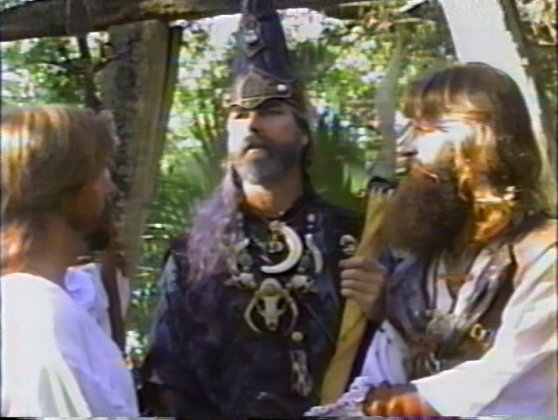
B&S: Back to Way Bad Stone. Is it ever going to be released again?

Archie: We recently sold it to American Genre Film Archive. They’re working on it now and it’ll be coming out in about a year on disc. Twenty years ago, this wouldn’t have happened. Now, there’s a way for any niche genre thing to find an audience.

B&S: My theory is that we’re so used to Hollywood scripts that are frequently a set formula that shot on video films are nearly alien to us now, movies that have no rules at all. That’s why I love your film because everyone was making slashers and you made a sword and sorcery movie.

Archie: So many people were trying to make their first movie then. For some reason, I guess they made horror movies because we all grew up on this stuff. Hell, my first 8mm home movies as a teenager were little ten minute versions of Frankenstein and Dracula! Or they all want to make science fiction films, but it’s like, you’re on a budget for that. You don’t have the technology to make it look like anything other than crap. This was the genre where I felt we could do something that would look okay. We can develop a look for it.

AGFA has the best master tapes, so I imagine that they will go through it shot by shot to clean it up. I have a feeling what they’ll turn out will look better than I’ve ever seen it before. Which is satisfying, but of course, the better you make it look, the more flaws show up. (laughs)  I don’t want it to be like the Sony reissued Godzilla movies where you can suddenly see all the wires you never could before! (laughs)

B&S: What were your influences on Way Bad Stone?

Archie: I liked stuff like Sword and the Sorcerer, Deathstalker and Beastmaster a lot. But I also grew up on peplum films. When I was a kid, that was my Saturday afternoon, watching Hercules or Machiste or whatever they renamed them in the U.S. I appreciated the frank amount of gore that had in them for the time. That’s probably why they disappeared in the early 70s when there was a  fuss about too much violence on television. Those movies kind of disappeared and now they’re surfacing again. You go back and look at them and think, “You know, that’s really really cool.”

The Universal stuff was big for me and so were the Friday the 13th movies, all that sort of thing. You know, we were the first era, from the late 70s through the early 80s, where slasher movies really emerged as a genre. With the exception of Night of the Living Dead, not that many movies were that graphic.  They started getting away with a lot more. I was living in Hollywood in the 70s right out of college and I got to see a lot of them in their rough release cuts. I saw Friday the 13th before Paramount got ahold of it and cleaned it up a little bit. It was definitely a little nastier.

There were fifteen theaters on Hollywood Boulevard then so I saw everything that came out then.

B&S: When you were making Way Bad Stone, was there a moment where you realized that this could be something more than just a movie for fun?

Archie: I’ve always described it as a home movie that got out of hand. Because we really had no more intention to do anything with it other than make it for ourselves. And then once it was shot, I don’t want to go into personalities, but there were let us say some interpersonal conflicts, so to speak. And at one point, I was left to my own devices and left to finish things. There were a lot of voices in my ear, though, that had an idea of what I should do, but I stuck very close to the shooting script as I edited it, which was done with two VCRs.

If I was off by two frames, I’d have to do it again. It was analog and linear with no room for mistakes. That’s why it took so many months to finish the picture. And then at night, I was working on the musical score with Catt Kafka (Janne’s sister) and her husband Don Oliver, both very talented musicians. You can hear my voice singing backup on the end title song, I’m the lead tenor!

We worked on the soundtrack segment by segment and it was all done using a sequencer, a little guitar and somebody laid in a couple of drum tracks. And as I recall the final night, when we did the transfer, it was pretty complicated.

If you recall, VHS had two ways to do audio. You had the linear audio tracks, which were two tracks on either side of the tape. And then you had the hifi track, which is the track that’s actually interpolated with the video and the picture. Well, you can’t edit that but you can edit the linear tracks. And what we ended up doing was re-recording the soundtrack that had all the vocals and the sound effects. That’s me doing the Foley work and doing the best I could with crunchy celery and stabbing heads of lettuce. (laughs)

There was one version that on one track had all the sound effects and on the other track had all the dialogue and live ambiance. So that got mixed down to one track on one side and then we had to dupe it back onto the master tape while live transferring and mixing the music score in one continuous 72-minute take with no mistakes! I think it took us five or six tries in one night. We worked on it until four in the morning until we got it balanced and as right as we possibly could. So then all of the duplicates were made from that master tape. The playback was from the linear audio tracks, not the hifi track. But of course, the audio fidelity is not as good, so you have more hiss and crackle and noise, but that also covers a lot of sins. The wall-too-wall music helped too.

B&S: What makes me love the movie is the last ten minutes. It’s non-stop bloodshed.

Archie: We went through six gallons of stage blood! That was kind of the whole point, the plot was just to get us to there. Everyone wanted to show off their fight choreography. I had to fight a lot with them on how to shoot it and I didn’t always get my way.

The long shots look very stagy to me and I would have liked to have done more intercutting of close-up action. I didn’t get my way on everything because I wasn’t the power player on set, but when I was editing, I was in control. I did the best I could with what I had, which was a total of 22 videotapes of shot footage, as I recall.

If somebody was insane enough, in theory, they could go back to those master tapes — which were in fact shot on Super VHS — and create a better looking copy. But I can’t imagine why anybody would do all that work. I certainly wouldn’t! After almost eight months of doing it the first time I just can’t see me going through that again!

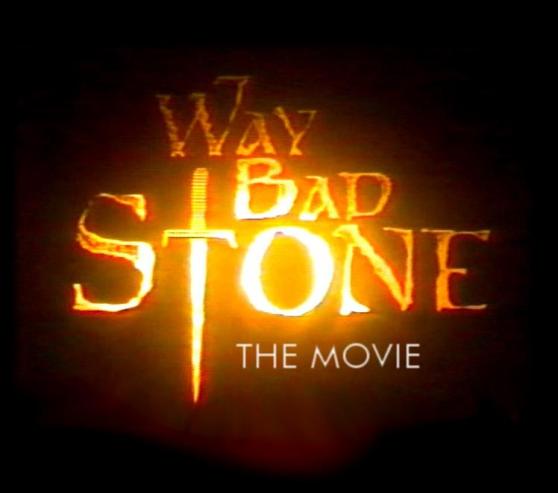
So many of the effects were done in very non-conventional ways. People asked, “How did you do those CGI credits?” There’s no fucking CGI in this! Those were all hand-cut. I designed the lettering myself and hand-drew it! The entire alphabet — capitals and smalls and it all done on a photocopy machine, copying and pasting white text on black and then I lit it with some amber light and shot it with a soft focus filter so that the text looks like it was glowing. I pulled focus to get the kind of zoom-up effect and then a couple of dissolves. Because that was the one thing I could do on that, by freeze framing at a certain point and then fading over the next shot. It was a very primitive technique, but I think it came out looking pretty cool.

The castle shots at the beginning were a toy castle shot against black cardboard with pinholes in it lit from behind to make the stars.  I filmed that on my bedroom dresser!
B&S: Was there a conscious decision of shooting on video over film?

Archie: We never thought about doing it on film. That never even crossed our minds. You know, that would have been $20,000 to do on 16 millimeter!

It was always going to be on video and it was never meant to be 82 minutes long. I had maybe 20-25 minutes in mind. The script kept growing because we decided to put so much backstory in to introduce all the individual characters.

The very first night we filmed the sex scene between the zoftig woman and the really good looking blonde guy that’s humping her. I was figuring the camera angles and I said, “Well, you know, to get this right, we’re just gonna have we got to see your bum a little bit.” And he just ripped his shorts off! (laughs) He didn’t care. I was like, “Oh seriously, this is where we’re going?”

We shot that first scene and it really came out looking kind of amazing. I used to have fog filter on it to give it a soft glow and lots of candlelight. Everybody was so enthused by how that one scene came out that it just kind of took off from there. Then everyone wanted their own scene like that.

The bar scene where the guys were playing that strip game is fun, too. My mom and my late sister are the two barmaids. My mom’s the toothless barmaid. We blacked out a couple of her teeth!  My sister’s the very buxom barmaid that kept leaning over to show off her bosoms. That scene is special to me because she passed away 22 years ago after having leukemia for twenty-some years. She was diagnosed in 1980, she was given two years to live and she lived twenty, so that was a blessing. Oddly, I have a lot of pictures of her, but the only video that I have of her is Way Bad Stone.

B&S: You never had the urge to make another film?

Archie: Not a feature, no. I was so burned out. I realized that I would never want to go through having to do as much work again. There were too many layers of responsibility laid on me, you know, directing, editing and I did all the photography except for the shots that I’m in and those shots I set up ahead of time on a tripod. I even designed the box art.  It was such an ordeal that I couldn’t get the energy together to get another project. If I did something again it would have been three people sitting around the kitchen table talking. It would have been something more like a straight drama than something that involved a lot of production values.

Filmmaking is harder than stage work because of the boredom factor. There’s so much downtime, where you’re waiting around on stuff. And that’s discouraging and you don’t get any reaction. It’s weeks or months later before you see what you did. Whereas if you’re out on stage, you’re hanging by your ass and you’re doing the best you can and you feed off of the audience and you fine tune your performance after a few nights just based on that audience response.

Especially in comedy! You know what they say: Dying is easy. Comedy is hard. (laughs)

JESS FRANCO MONTH: Don Quixote (1992?)

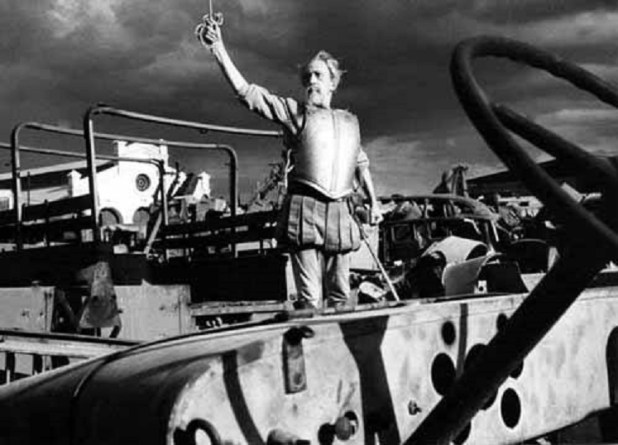
Don Quixote is one of those never finished films that fascinates me. At one point, it was just a half hour show that Orson Welles was making for CBS called Don Quixote Passes By and it would have Quixote (originally Mischa Auer, to be replaced by Francisco Reiguera, Simon of the Desert) and Sancho Panza (Akim Tamiroff, who Welles called “the greatest of all screen actors”) being trapped in 1955. Welles would tell Peter Bogdanovich in a conversation printed in This is Orson Welles, “What interests me is the idea of these dated old virtues. And why they still seem to speak to us when, by all logic, they’re so hopelessly irrelevant. That’s why I’ve been obsessed for so long with Don Quixote, who can’t ever be contemporary — that’s really the idea. He never was. But he’s alive somehow, and he’s riding through Spain even now .” Welles saw Quixote and Panza as eternal ever wandering characters.

CBS disliked what they saw and ended the project, but thanks to money from acting and $25,000 from Frank Sinatra, Welles kept working. After he was removed from Touch of Evil, Welles began working on this story in earnest, even bringing Bad Seed Patty McCormack to Mexico to play a girl who would meet Welles — playing himself — and hear of Quixote and Panza before meeting them in person. By the time the film came back together in Spain — Welles ran out of money and did many projects as a mercenary to raise the funds needed to make the movies he cared about — McCormack was too old and that part of the story was cut.

Shot over the next decade — and more! — in Spain and Italy, the production took so long that a chronically sick Reiguera begged Welles to finish shooting his scenes before he died, which he was able to do before the actor passed in 1969. This ended the principal photography, but Welles never saw a need to finish the movie, saying that the film was “My own personal project, to be completed in my own time, as one might with a novel.” Then he changed gears and claimed it was going to be an essay like F for Fake, as well ideas of the heroes surviving a nuclear war or going to the Moon. Every time he went to Spain, he got new ideas and at one point had a thousand pages of script piled up. Even up until his death, he would discuss the film publically.

The year after Welles’ death — 1986 — 45 minutes of scenes and outtakes, assembled by the archivists from the Cinémathèque Française and supervised by the director Costa-Gavras, played Cannes. And it seemed like that’s all that would ever be seen of this.

Except that life is strange.

What was left of the film was split into several places. Oja Kodar (Welles’s companion and co-writer of F for Fake where she is presented as the daughter of an art forger; never forget “art is a lie that makes us see the truth”) had given some footage to the Munich Film Museum as well as also selling that footage to the Filmoteca Española in Madrid. Welles’ editor Mauro Bonanni had a negative and the two battled for decades until Italy’s Supreme Court forced Bonanni to give his negative to Kodar.

So where does Jess Franco come in?

Well, in 1992, Kodar had already spent years touring Europe in a camper van with the footage, trying to convince several notable directors to complete Don Quixote. All of them said no. Jess Franco said yes and maybe he was a better pick than it seems, seeing as how he was Welles’s second unit director on Chimes at Midnight.

Bonnani had all of the McCormack footage, including a windmill-fighting-style scene where Quixote would fight knights on a movie screen and cut it down, not understanding our modern life. Spanish producer Patxi Irigoyen and Franco had so much footage in so many aspect ratios and formats that the idea of combining all of it and making it not just work but feel like an Orson Welles film seems, well, quixotic.

So Franco wrote new script, hired voiceover actors to do impressions of Welles’s narration and the actor’s voices which don’t match up and then added Welles to the film — using footage from 1964’s Nella terra di Don Chisciotte — as well as windmill images, zooms and jump cuts. Those last two elements are totally Franco and point to his involvement. I wouldn’t be more sure if the film didn’t suddenly zoom into Lina Romay’s spread thighs.

Don Quixote de Orson Welles premiered at the 1992 Cannes Film Festival and everyone hated it. Welles had purposefully mislabeled reels and had no intention of anyone finishing this except for, well, Orson Welles finishing it.

It’s absolutely amazing to me that a movie by perhaps the greatest director of all time was finished by Franco, but that’s why I’m obsessed by his work.

Two different obsessions in one photo.

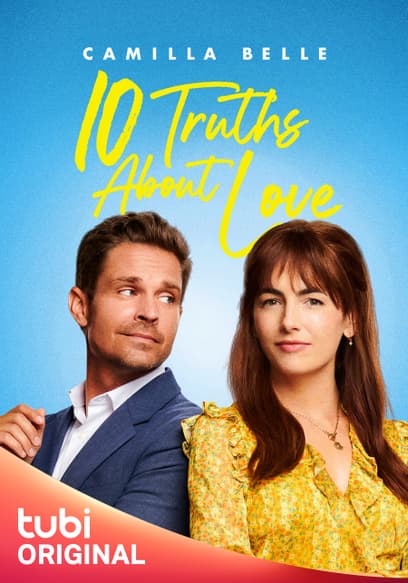
TUBI ORIGINAL: 10 Truths About Love (2022)

This isn’t just a Tubi original. This is the first Tubi original.

In the world of this movie — perhaps it’s science fiction — they still make magazines that are the most important way of information getting out into the world. Spark magazine is where Carina (Camilla Belle) works as a romance advice columnist but she’s unlucky in love. After all, she’s been with a lawyer named Tom (Karn Kalra) for five years and he breaks up with her instead of asking her to marry him. That’s when she meets new writer Liam (David LaFontaine) who offers to help her win him back, but if you’ve ever watched a movie, you realize that they’re meant to be together and there will be a third act that makes you think they won’t but of course they get together.

Camille Belle is a pretty big star for a Tubi film, as she was in Practical Magic when she was young, as well as the remake of When a Stranger Calls and, well, Dirty Dancing 3: Capoeira Nights.

This was directed by Brian K. Roberts, who also made An En Vogue Christmas and The Unauthorized Full House Story. It was written by Shannon Latimer, who has scripted several movies with the words wedding and Christmas and combinations of the two words.

You can watch this on Tubi.

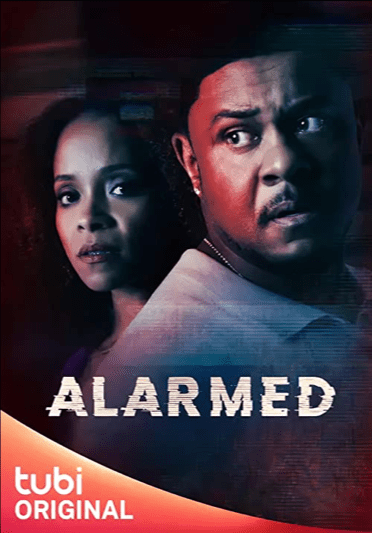
TUBI ORIGINAL: Alarmed (2023)

Janet (Brittany Baker) and Sean (Pooch Hall) have gone from an empty nest to having their son Billy (Chris Whitcomb) move back in after being arrested for hacking government websites. Now under house arrest, he’s just one of the many problems in their marriage. But while their personal life is at a 2, their professional lives are at a 9. That’s because Janet has been promoted to  CEO of Citadel Security, a high-tech security company. So in the hopes of fixing their love life, they go away on a vacation and leave Billy in the house alone.

As you can imagine, this bad idea is why we have this movie.

Using the security system in their home, they can see that Billy has invited a girl named Kat (Angie Campbell) to the house. Yet that security system isn’t flawless. Because you know who he didn’t invite? Hackers Coltrane (David Gere), Martinez (Brendan Kelleher), Andrew (Eric Lutes) and Foggy (Salvatore DelGreco), who quickly attack Billy, shoot Kat and demand that Janet and Sean kill her boss Larry (Eric Allan Kramer) if they want their son to survive.

Director and writer Matthew Kohnen also made Aaah! Zombies!!, a movie that I always scroll past and should really check out. This movie might not break any ground and may be filled with characters making the worst decisions, but it’s well made. Ah, Tubi. You got me again.

You can watch this on — hey I just said it above — Tubi.

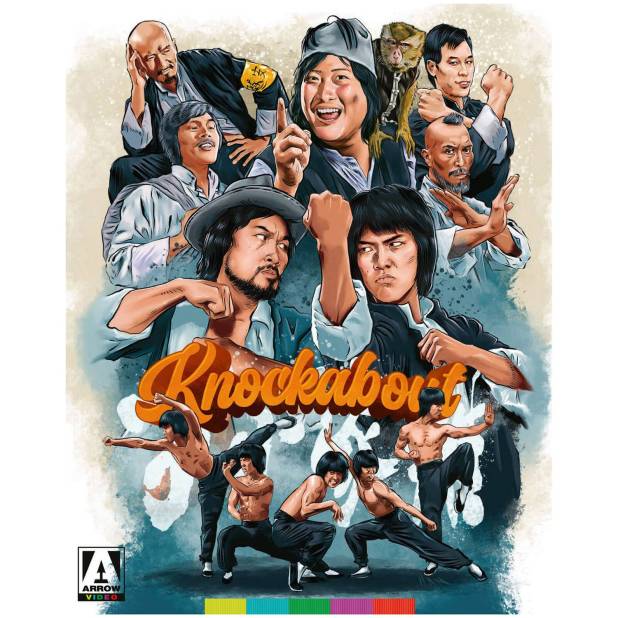
ARROW BLU RAY RELEASE: Knockabout (1979)

Once he established himself as the premier action choreographer in Hong Kong, Sammo Hung directed the Iron-Fisted Monk for Golden Harvest and followed it up with a movie that would give Yuen Baio his first starring role.

Yuen Biao is Yipao while Bryan Leung is Taipao. Things are looking up as they cheat everyone around them with con games, but that’s until they meet Jia Wu Dao (legendary Shaw Brothers fight choreographer Lau Kar-Wing) who decimates them in a two on one fight. They ask him to train them so that they can become great fighters, but Yipao soon discovers that his new mentor is a murderer. When he tries to kill the young man to keep his secret, Taipao takes the fatal strike in his place.

Yipao escapes and wonders how he will ever avenge his brother when he meets a large beggar played by Hung. Will the new monkey style kung fu he’s learned be enough to stop Jia Wu Dao’s snake style?

I kind of love this tagline when this was released in the U.S. as The Jade Warriors: “His name is Samo Hung, Bruce Lee’s fattest contender in Enter the Dragon. Juan Biao is Jackie Chan’s toughest Kung Fu opponent ever. Together Samo Hung and Juan Biao will go up against the odds… And then the evens.” Were they trying to sell Yuen Baio as Latino? Or did they figure no one could pronounce his name?

And no, your ears do not deceive you. This has the theme from The Good, The Bad and The Ugly in it.

The Arrow Video blu ray release of Knockabout has 2K restorations from the original elements by Fortune Star of both the original HK Theatrical Cut and the shorter Export Cut. Commentary on the HK Theatrical Cut is by martial arts cinema experts Frank Djeng and Michael Worth, while the commentary on the Export Cut by action cinema experts Mike Leeder and Arne Venema. It also includes interviews with Hung, Bryan “Beardy” Leung Kar-Yan and Grandmaster Chan Sau Chang (aka The Monkey King), a master of Monkey Style kung fu. There’s also a deleted “Red Room” scene, featuring stars Yuen Biao and Sammo Hung in a teaser promo for the film’s Japanese release and the original theatrical trailer. It comes in a reversible sleeve featuring original and newly commissioned artwork by Ilan Sheady and with an illustrated collectors’ booklet featuring new writing by Simon Abrams and original press materials. You can get it from MVD.

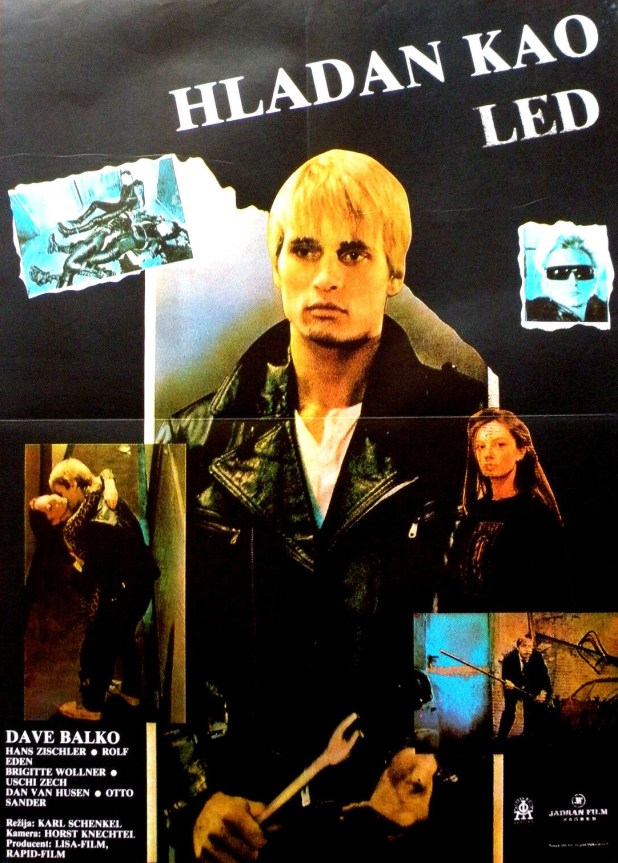
JESS FRANCO MONTH: Strike Back (1981)

I know that Carl Schenkel directed this film, but Jess Franco was on board — uncredited — for help and that’s good enough for me.

Yeah, the director of The Mighty Quinn and Tarzan and the Lost City worked with Franco, but hey, so did Orson Welles on Chimes at Midnight so anything can happen.

Dave (Dave Balko, the lead singer of Tempo, a band on the soundtrack of this movie) breaks out of a juvenile prison by staging his suicide and trying to find his pregnant girlfriend and get revenge on those that did him wrong — like Kowalski (Otto Sander) — and got him sent behind bars. Throughout, this has such a no future feeling — the ending will truly hammer that home — while showing you the New Wave scene in West Germany in 1981. I didn’t know the bands Blixa Bargeld, Rhe Neonbabies, Malaria, Thomas Voburka and Tempo before, but it was cool to discover them through this.

Why should you watch it? Well, there are some punk performances and man, that old Space Invaders pinball machine was awesome, wasn’t it? Also: Brigitte Wöllner, who plays Dave’s lover Corinna, was Playboy Germany‘s Miss August 1980.

Most of all, it makes Berlin seem like infinite death, doom and darkness. Man, that closing scene!

You can watch this on YouTube.