Another Man’s Poison (1951)

ABOUT THE AUTHOR:  Melanie Novak writes about the Golden Age of Hollywood, infusing her weekly movie reviews with history, gossip, and the glamour of the studio era.  You can read her reviews at www.melanienovak.com and follow her on Instagram @novak_melanie or Twitter @MelanieANovak.

Bette Davis needs no introduction, but if she’d lived to write a Twitter bio, it would say something like, “Actress.  Hell-raiser.  Ten Oscar nominations, two wins…should’ve won a 3rd for “Baby Jane” but Crawford campaigned against me.  Did it the hard way.”

She had three great talents:  a willingness to make herself hideously ugly if that’s what the role required, an ability to play gleeful villains who reveled in their wickedness, and a personality so forceful she could make even the worst films a rollicking good time.

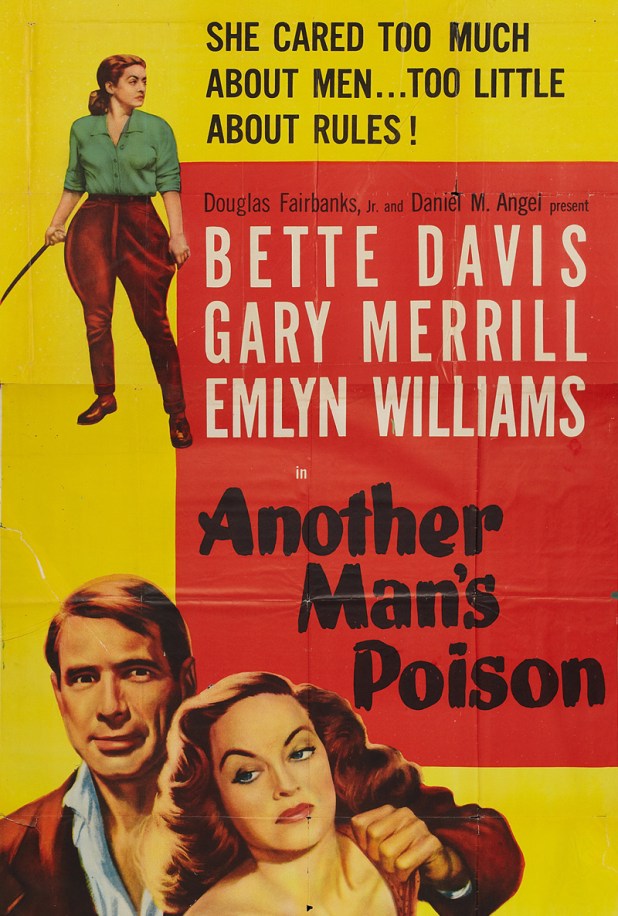
She puts the second two talents to great use in Another Man’s Poison (1951), directed by Irving Rapper (who directed Davis in Now, Voyager (1942) and The Corn is Green (1945)) and co-starring her new husband Gary Merrill, whom she’d met and fallen in love with while making the classic All About Eve the previous year.

Another Man’s Poison served as a honeymoon of sorts for Davis and Merrill, as it was filmed on location in North Yorkshire, England. 

Davis plays Janet Frobisher, a mystery writer who’s been living and writing in a big, drafty house in England.  She’s also having an affair with the much younger fiancé of her secretary, though we suspect she’s motivated by vanity more than love.  Though she tells the townspeople that her husband is nearly permanently away on business in foreign lands, the truth is that she’s run away from him because he’s a criminal.  

When her husband arrives one night on the heels of a bank robbery, threatening her and promising to never grant her a divorce, Janet dispatches the problem as one of the characters in her novels would, by poisoning her husband with a medicine for her horse.

But the real problem arrives with the plot’s first twist—her husband had an accomplice, George Bates (Merrill), who arrives looking for him.  When the local veterinarian arrives to check on Janet’s sick horse, he finds George, who pretends to be Janet’s long-lost husband to explain his presence as he knows police are actively looking for him.

And thus, Janet and George are stuck with one another.  Janet convinces George to help her dispose of her husband’s body, and now both are complicit in the crime.  They have a mirroring cruelty—they both desire and loathe one another.

I’m not going to spoil any of the plot twists—suffice it to say these are two despicable human beings who deserve one another and yet each is increasingly determined to eliminate the other.

Add in a nosy veterinarian, Janet’s young paramour, and you have all the makings of a mess.  The plot escalates in ways that are somewhat silly, but all the fun is in watching Davis and Merrill (who would have a ten-year marriage nearly as violent, passionate, and tempestuous as Janet and George’s relationship) go at one another.  Their escalating cruelty is apt to make you laugh more than flinch, but Davis’ performance foreshadows many of her post-age-forty roles, where she played maniacal villains who were as funny as they were scary.

And if the ending doesn’t surprise you, well, that would surprise me.

It’ll never make a Bette Davis top ten list, but it’s required viewing for true fans.


Sources

Sikov, Ed.  Dark Victory:  The Life of Bette Davis.


Bloodline: Vengeance From Beyond (2010)

Fifteen years ago, Sandra lost her twin sister Giulia in the woods — they have twin telepathy — but after Sandra steps into a bear trap, Giulia is killed by a serial killer named The Surgeon. Years later, he kills himself and takes away any chance that Sandra would ever be reunited with her sibling when he killed himself and took his secrets with him.

Now, she’s a reporter and her partner Marco joins her as they shoot a behind the scenes feature of Klaus Kinki’s latest adult film, which just so happens to be shot at the mansion that once belonged to The Surgeon.

Sandra feels that this will be a way to get over her sister’s death, Marco discovers that he may have a future in porn and oh yeah, the murders start all over again. And perhaps Sandra keeps seeing her sister’s ghost. Then Sandra finds Giulia’s body. So yes, The Surgeon may be back, but now his victims come back from the dead.

Is the movie just an adult film? Or has Kinki decided to start making snuff? Is Giulia’s ghost on her sister’s side? How did The Surgeon survive? Or is it a copycat? Man, a lot of questions!

A post-Filmirage Italian movie that feels like it belongs in the 80s in the best of ways, this even has gore from Sergio Stivaletti and music from Claudio Simonetti and this all pleases me. My quest to find horror made in this century from Italy continues!

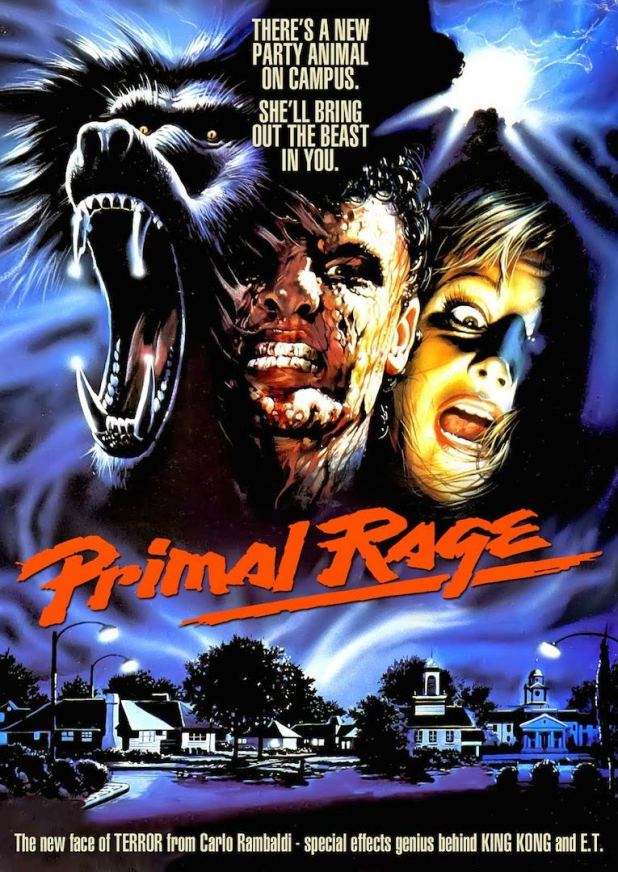
Primal Rage (1988)

Vittorio Rambaldi wrote the script and did the special effects on Nightmare Beach and if you recognize his last name, then you already realize that he’s the son of Italian effects legend Carlo Rambaldi. This was the first movie he directed and he got Umberto Lenzi to write it, which is a great plan, along with James Justice, who used the name Harry Kirkpatrick to write and direct Nightmare Beach but I kind of think he’s also Lenzi, because he also used that name along with Humphrey Humbert, Bob Collins, Hank Milestone, Humphrey Milestone and Humphrey Logan.

A scientist at a Florida university create a rage virus while performing experiments intended to restore dead brain tissue. And then when two college journalists breaks into the campus lab, one gets bitten by an infected babboon and spreads the virus to a gang of rapists dressed like the Cobra Kai on Halloween and a co-ed abortion lover named Debbie (Sarah Bruxton from Nightmare Beach)who all start killing other people on a smaller level as the virus in Lenzi’s Nightmare City.

Man, this movie has it all. There’s Bo Svenson as a scientist! Some of the grossest effects you’ll see in a movie as people drip pus everywhere! A Halloween party with Darth Vader! An Alf doll! Bartles and James wine coolers! An Avoid the Noid poster! Man, this is the most 1988 movie there’s ever been and I just can’t get enough of Italian filmmakers needing to prove it to you that their movie comes from America so badly that it seems like it had to come from another planet.

The music in this really takes it to another level. And yes, the song “Say the Word” also shows up in…you guessed it, Nightmare Beach. Man, they should have just called this one Nightmare Fraternity.

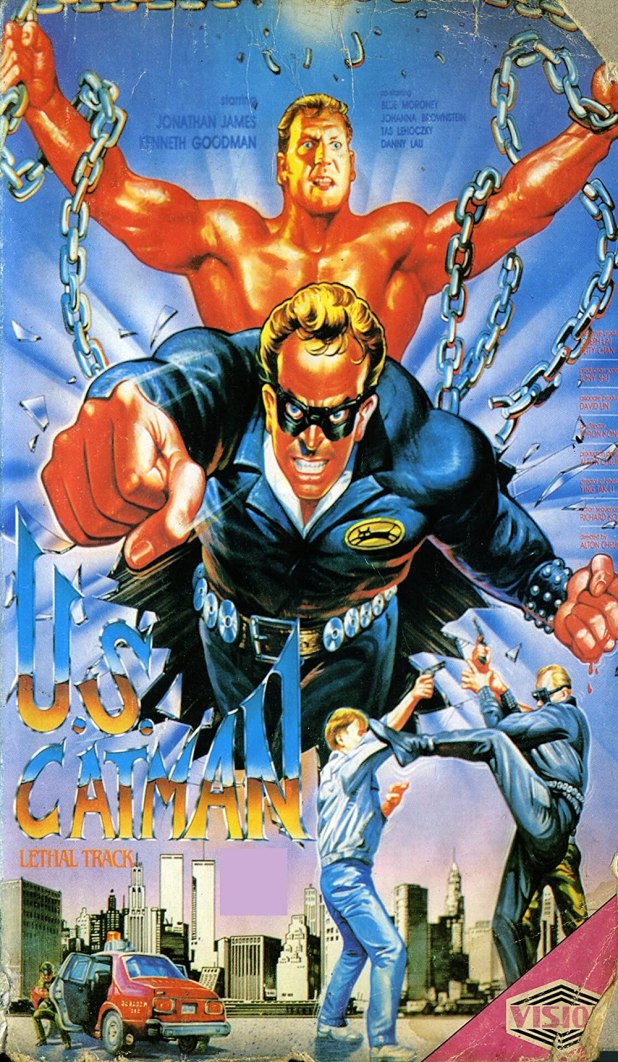
Catman in Lethal Track (1990)

Godfrey Ho.

The Bruno Mattei of Hong Kong.

Making a superhero movie.

It’s about time.

Using the name Alton Cheung, this is the story of Sam and Gus, two dudes just trying to chill and discuss Gus joining the FBI. So when they decide to stip a robbery, of course a radioactive cat scratches Sam and gives all the powers of a cat, which basically entails the ability to scratch up all of the furniture in your house and the need to knock over every drink on the coffee table.

His enemy? Father Cheever, a ponytailed religious zealot who wants to start a utopia.

Look, there’s also another movie about a girl dressed as a man fighting pirates that has nothing at all to do with this movie, sometimes playing all over the story we came here for. Also, who dressed Catman? He’s all in like vinyl dress clothes, like some business guy dressing up for BDSM night at the goth club but he couldn’t find the right sunglasses but found his stepson’s Cyclops mask and said, “I’ll be damned, this completes the look.”

It doesn’t.

There’s also another movie in this series, Catman in Boxer’s Blow, and I have to tell you, I don’t know if I can make it through it. Trust me, I’m going to try.

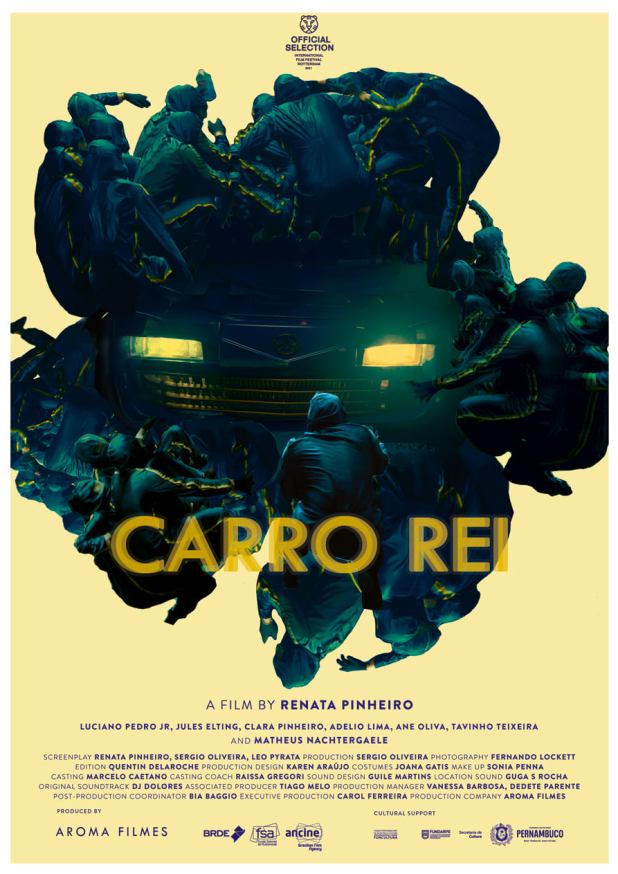
King Car (2021)

EDITOR’S NOTE: We got to see this movie at Fantastic Fest and posted about it on September 28, 2021. Now it’s being released in theaters and on VOD/Digital by Dark Star Pictures. 

Imagine Christine with political messages. Yes, in King Car, Uno — a taxi company owner’s son — is able to speak to cars — because he was born in the back of a taxi — and has become close friends with the vehicle that saved him from a traffic accident as a young child at the cost of his mother’s life.

Uno gives up on cars from that point on, going to college to study ecology until a new law that bans cars over 15 years old from the roads destroys his father’s business. He’s never been close with his dad, but his strange Uncle Ze — the reason behind an argument that led to his mother driving into that fatal accident — harnesses Uno’s ability to speak to the rusted out autos.

Now, Uno is listening to the old cars, hearin their complaints of no longer being allowed on the roads. And he’s found the car that was his friend from childhood and transformed it into something called King Car.

But King Car may have ideas of its own. And this might be the end of humanity.

The technology that Uno and Ze have invented allow lower income drivers to remain on the road. Yet why has Uno turned his back on ecology and embraced the machine?

There’s a lot jammed into the trunk of this film, as if it were packing for a weekend trip and decided that it needed every single suitcase it only stuffed beyond overflowing. There are mechanics who have become possessed and move in synchronized dances. A car spouting rallying cries and fiery speeches within an assembly line. A man who has slowly become more and more part of the machine, running up a hill like an ape seeking a bone. A woman who yearns to make love to King Car. And plenty of socio-philosophical messaging.

Renata Pinheiro — who co-wrote King Car with Sergio Oliveira and Leo Pyrata — has some great ideas in this film that don’t always pay off. You do have to appreciate the audacity, however. There’s promise here, however, despite the need for more focus.

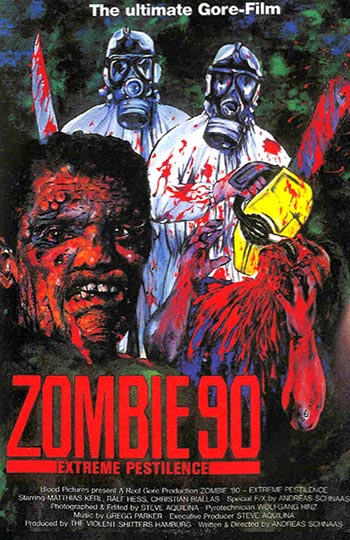
Zombie 90: Extreme Pestilence (1991)

Night of the Living Dead shocked audiences with scenes of ghouls devouring human bodies — actually fried chicken — but I can’t even imagine what would have happened if those audiences sat through Andreas Schnaas’ Zombie 90: Extreme Pestilence.

A military transport carrying untested lethal chemicals crashes into the forest, leading to a dead patient returning from the dead in an operation room. Before long, decimated human beings are turning up and the Extreme Pestilence pandemic has broken out. That’s a nice way of saying zombies and we all know that the only way to kill them is to take out the brain.

The English dub was done as a joke and honestly, it makes the movie. It’s also deeply offensive, but so is this movie, in which no people in wheelchairs, breasts, babies or penises are safe.

It’s not the best zombie movie ever — or even the best gore movie, as it promises — but for those that find its wavelength, it’s pretty entertaining. I mean, it cost $2,000 or less to make, so they definitely got their money’s worth of H.G. Lewis’ looking blood.

Flesh Contagium (2020)

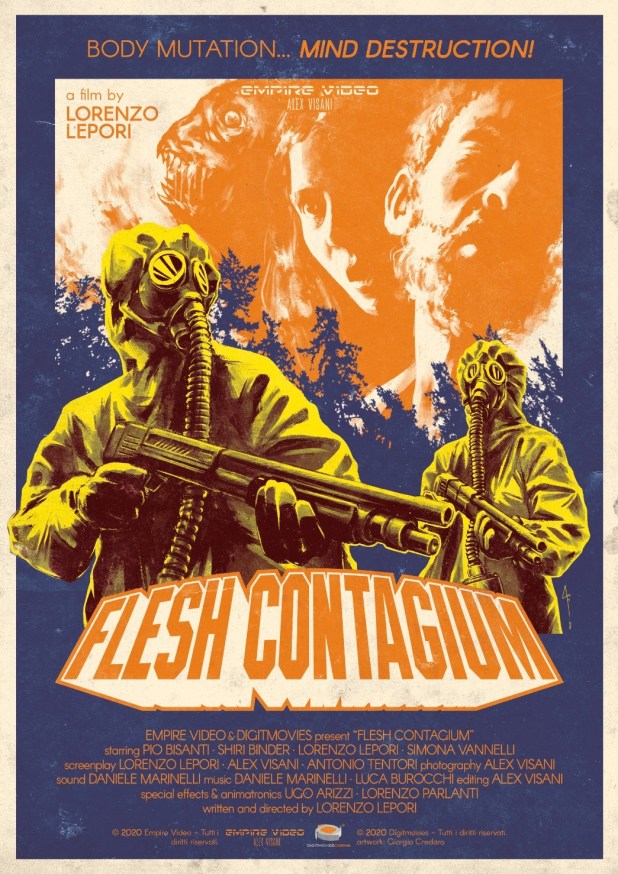
Lorenzo Lepori made the fumetti film Catcomba which made me take notice of him. And man, Flesh Contagium is another great movie from his twisted mind. Made during Italy’s early lockdown — man, remember those days — this movie shows us that in 2029, after a virus has devastated humanity, left the global health infrastructure in ruins and created thousands of mutants.

Now, Executors have been appointed with hunting and killing not only these casualties but every single survivor. Two of those left behind, Helmut (Lepori, who co-wrote, co-produced and directed this too) and Ornella are running from the gas-masked shocktroopers before she alone survives, only. to be taken in by a mad scientist who keeps assaulting her, experimenting on her and pining for his diseased wife.

Sure, there are some emotions and comments on our present condition, but there’s also so much gore. I’d like to believe that Bruno Mattei is still alive or a brain in a jar or an unearthly specter who has come to the makers of this film in a dream and said, “Show them the beauty of grime and gore and do it in the Italian way.”

And they did.

And it was good.

You can get this from Massacre Video.

Ghost Story: Episode 1 “The Dead We Leave Behind”

Originally airing on September 15, 1972, the first episode of Ghost Story has Winston Essex telling us the story of ranger Elliott Brent (Jason Robards).

His wife Joanna (Stelle Stevens) is bored, so he buys her a TV set. But now, all she does is watch her stories and neglects their home. As they argue, Elliot accidentally kills her and buries her behind their cabin. But now, when he turns on that TV, all he sees is her and sees episodes of shows in which she’s been unfaithful to him.

And when the man who she’s been cheating — in video form from beyond the grave — shows up, well, Elliot has to kill him too, right? But after that, when he starts seeing bodies rising from the grave on the screen, things don’t look good at all.

Director Paul Stanley’s career was mainly in television other than the 1959 film Cry Tough, which starred a young John Saxon. This episode came from a story by Robert Sprecht, who created the show The Immortal, and was developed for the TV format by Richard Matheson.

John Kenneth Muir’s Reflections on Cult Movies and Classic TV has a great theory on this episode and how it influenced numerous Stephen King stories from Pet Sematary and The Shining to the “Something to Tide You Over” segment in Creepshow.

Robards — as always — brings up the level of anything he’s in. And Stella Stevens is great in this too. I kind of love how it starts in the middle of their story, which already seems to be spiraling into darkness.

Ghost Story: Pilot Episode “The New House”

Becca and I got obsessed with this show, which lasted for just one season before it was canceled due to low rating. That’s a shame as this show feels like NIght Gallery if it remained all serious and didn’t have the abysmal comedy bits.

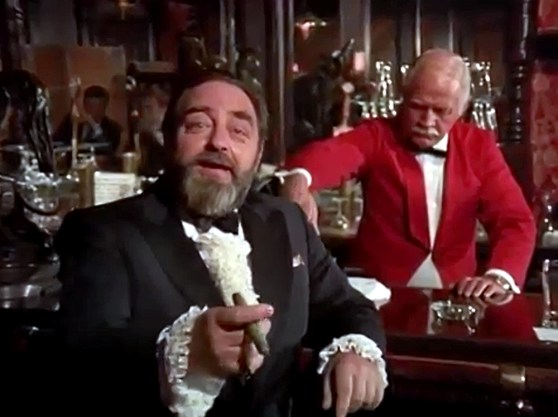
Even better, each episode looks like a movie, thanks to the producing skills of William Castle, and feels like one with Hammer scribe Jimmy Sangster overseeing the stories. It’s hosted by Family Affair star Sebastian Cabot as Winston Essex, who works in the elegant Mansfield House hotel, which is truly the Hotel del Coronado, the same place that Wicked Wicked was shot.

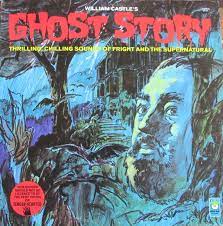
There was even a Peter Pan Records album of the show, which sadly only lasted 22 episodes, which includes a mid-season overhaul of the show’s format. We’ll get to that in a few months, but we thought it’d be fun to post each episode weekly and share it with you.

Originally airing on March 17, 1972, “The New House” has a killer TV movie pedigree, as it was directed by John Llewellyn Moxey and written by Richard Matheson. I mean, this is the team that brought us The Night Stalker.

Barbara Perkins (Betty Anderson from Valley of the Dolls and the maid of honor for the wedding of Sharon Tate and Roman Polanski) and David Birney are a couple that’s just bought a new home. As they wait for their child to be born, they learn that their home was once the site of a lynching and a hanged woman named Thomasina Barros is still there, at least in spirit, seeking new life that will allow it to enter our world. New life like, well, the baby that’s due any day now.

The format of this show is great, as the stories are given a full hour — forty-plus minutes with commercials — and the casts are always stellar, the stories frequently frightening and the sets all share a similar backlot feel. There’s also an orange cat in several episodes, which seems like a theme.

You can check out this episode on YouTube:

Double Trouble (1992)

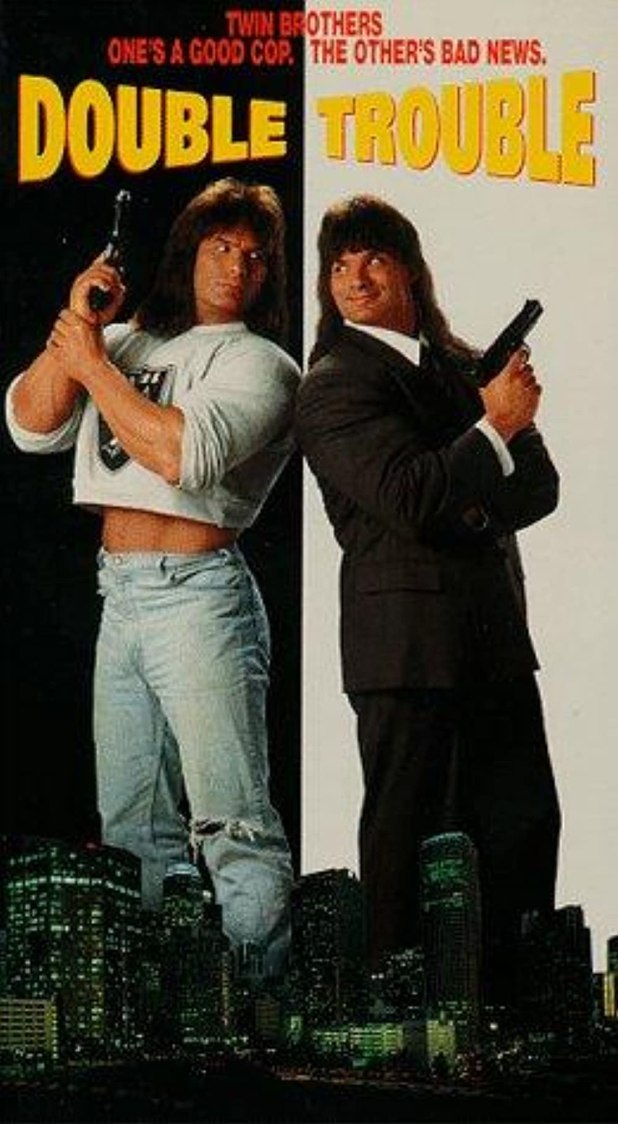
God bless the Barbarian Brothers, Peter and David Paul, and God bless John Paragon, who worked on not just one but two of their movies (he wrote and directed Twin Sitters but only directed this). Here’s, he’s working from a script by Jeffrey Kerns, based on a story by Charles Osburn and Kurt Wimmer, who made the absolutely berserk movies EquilibriumUltraviolet and the Children of the Corn remake that came out in 2020 that nobody realized ever came out (he also wrote Salt, the Point Break remake, The Thomas Crowne Affair remake, Sphere and Law Abiding Citizen).

Peter Jade earns his living as a crook. David Jade is a Los Angeles cop. After the thief of a brother finds the key to opening a safe filled with diamonds, he gets targeted by criminal supervillain Philip Chamberlain (Roddy McDowall!).

The brothers are very Tango and Cash in this, as David wears jeans and Peter wears the finest of suits. Can they get it together and solve the mystery (and avenge the death of David’s partner?)?

The supporting cast in this is worth the price of admission. There’s Star Trek‘s James Doohan as Chief O’Brien. David Carradine as Mr. C, Peter’s prison burglar mentor. Billy Mumy of Lost in Space and “Fish Heads” fame as an assassin. Troy Donahue as a corrupt politician. And lots of other familiar faces like Tim Stack (Son of a Beach), Lewis Arquette (the father of that famous family), Steve Kanaly (Ray Krebbs!), Lynne Marie Stewart (Miss Yvonne!) and video girl Bobbie Brown in a quick role as Peter’s girlfriend.

I have a major soft spot for the Barbarian Brothers. This movie moves quickly, offers plenty of harmless laughs and is kind of like empty calories. It’s not their best movie — I mean, it’s The Barbarians, hands down — but it’s still worth a view.

You can watch this on Tubi.