A Force of One (1979)

Gene Siskel said that it was “just a poor excuse for a lot of fighting.”

Writer Ernest Tidyman* (ShaftHigh Plains Drifter) claimed he only made it so he could buy his mother a house.

Chuck Norris said it was ten times better than his last movie Good Guys Wear Black.

The commercial for this movie was all my grade school class could talk about, breathlessly getting excited about Chuck kicking and spinning and beating on people.

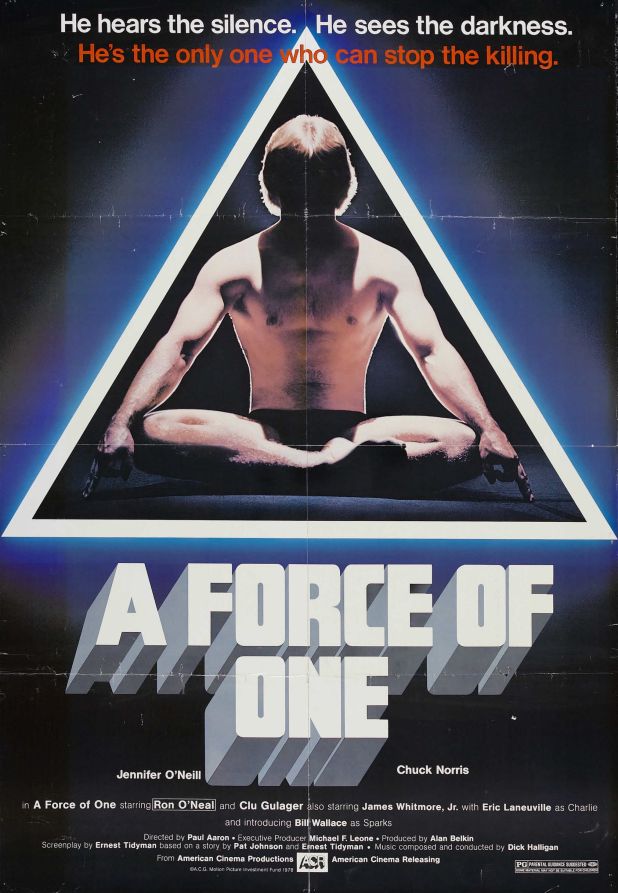
Directed by Paul Aaron, whose stepson Keanu Reeves talked him into making the film, this film presents a world where cops are getting killed, so they turn to Matt Logan (Norris), a karate instructor. One of those narcotics officers, Amanda Rust (Jennifer O’Neill, The Psychic star who was present both when Jon-Erik Hexum accidentally shot himself on the set of Cover Up and when she shot herself in the stomach testing to see if a gun was loaded), believes that one of their own is behind it. She also falls hard for Chuck, who may not be the best actor, but gives an authentic charm as a normal guy who can kick people really hard.

This is a smart movie — no, really — as the cast surrounding Chuck is solid, like Clu Gulager as detective Sam Dunne, who believes that the killer is a martial artist, and Ron O’Neal from Superfly.

A Force of One kicks into major action when Chuck’s adopted son Charlie (Eric Laneuville) is killed, making it personal. Plus, he’s headed into a karate tournament where he’ll get kicked repeatedly by Sparks, played by Bill “Superfoot” Wallace, who was the bodyguard who found the body of John Belushi. And trust me, he kicks really, really hard. You don’t get called Superfoot and half step.

Norris surrounded himself with family in this one, as brother Aaron was the fight coordinator and his son Mike was the skateboarding pizza delivery kid. It works — a movie made in the time when karate was the kind of dastardly heel move in Memphis wrestling, still mysterious in the West, but made approachable by the everyman charm of Chuck.

Called Der Bulldozer in Germany, this movie also has an appearance by Charles Cyphers, who played Sheriff Brackett just one year earlier in Halloween.

In closing, Siskel and Tidyman were both incorrect, while the kids in my class and Chuck were right.

*He co-wrote the movie with stuntman Pat E. Johnson, a 9th degree black belt in Tang Soo Do under Chuck Norris who only has this one writing credit, but did stunts for Jackie Chan (Battle Creek Brawl), Bruce Lee (Enter the Dragon), Norris (this movie), three Teenage Mutant Ninja Turtles films and both Mortal Kombat movies. He’s also the referee in The Karate Kid.

You can watch this on Tubi.

Call Girl of Cthulhu (2014)

Directed by Chris LaMartina (WNUF Halloween SpecialWhat Happens Next Will Scare You) and co-written with JImmy George, Call Girl of Cthulu is all about a virginal young man named Carter (David Phillip Carollo) who is looking for the right girl, who he thinks is Riley (Melissa O’Brien), a prostitute with a strange birthmark on her right ass cheek.

It turns out that she’s being sought by the Church of Starry Wisdom, who see this as a sign that she will become the bride of the Elder God who exists beyond the wall of sleep, Cthulu. Can your protagonist find a way to find true love — or lust — without losing his mind to the tentacled thing that should not be?

Beyond being a love letter to H.P. Lovecraft, it’s also a movie that combines gore, sexploitation and a willingness to really go there. Would it be too far to have a golden shower that melts a man’s face clean off? Monstrous male genitals? Tentacle scenes? Watching this, I get the feeling that everyone in it is still finding makeup and goop and gunk all over themselves even years after they made it.

For a movie that starts light, it gets surprisingly dark, too. And emotional. I’m surprised how much I liked this movie, as I kept waiting for it to fall apart, but that’s when I realized that LaMartina and George being good at making movies is no accident.

You can watch this on Tubi.

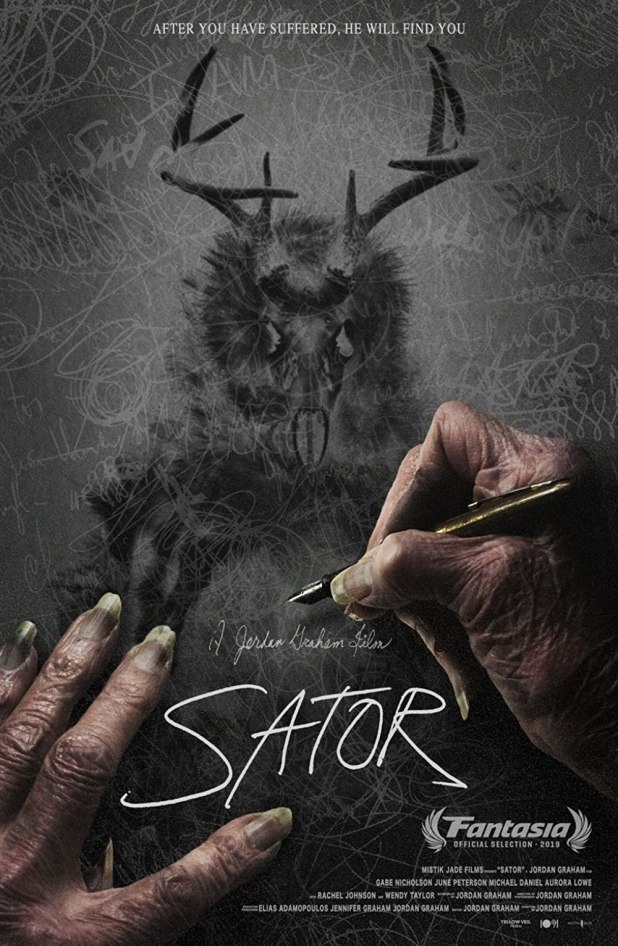
Sator (2019)

Jordan Graham took seven years to make this movie, thanks to the limits of its budget, but he also built the cabin that it takes place in, did nearly every job of making the film and cast his grandmother, June Peterson, who has been haunted by the demon Sator since 1968 in real life, automatically writing a lot of the words that are shown in the film. She spent time in a mental hospital, which makes you wonder if this movie was just exploiting her mental illness or could potentially be the story of a real demon that might, you know if you’re a Christian fundamentalist, be using this movie as a way to get into your mind.

Director, writer, editor, producer, cinematographer and editor Graham told Flickering Myth “In 1968, she brought home an ouija board and conjured up Sator. She then spent the next three months talking with him through something called automatic writings. She sat in a chair with a pen and let Sator speak through her. She wrote thousands and thousands of pages across the course of three months. And then, at the end of those three months, she ended up in a psychiatric hospital.”

Deciding to use her home as a location and having her act in a scene where she’d discuss Sator, she began sharing things she’d never told him. Over the shooting of the film, Peterson’s dementia got worse and she was taken to a care home, where Graham would visit and interview her, as well as study thousands of pages of her automatic writings and a diary where she explained how Sator guided her, using those interviews to write and then rewrite the movie based on what she told him.

In the film, her grandson has disappeared into the woods, obsessed with Sator. Perhaps his grandfather sacrificed himself to the demon, but definitely, there are other followers in the woods, wearing skulls and eventually, the protagonist becomes lost in the timeless world of the woods and the call of a demon.

It’s a slow build, but if there’s a movie that proves that folk horror doesn’t exist simply in the past. The truly frightening thing is that Sator itself is so powerful that even as the ravages of age made Graham’s grandmother forget her family, she didn’t forget the demonic spirit that dominated her life. It makes me wonder if mental illness is real or is demonology or both?

This isn’t a perfect film, but it’s a singular work by an auteur and there are times that it works perfectly and other times that it feels like it’s going nowhere slow and then it rewards your patience. I can see some loving it as equally as I can understand people hating it.

Sadly, June Peterson died before it was finished.

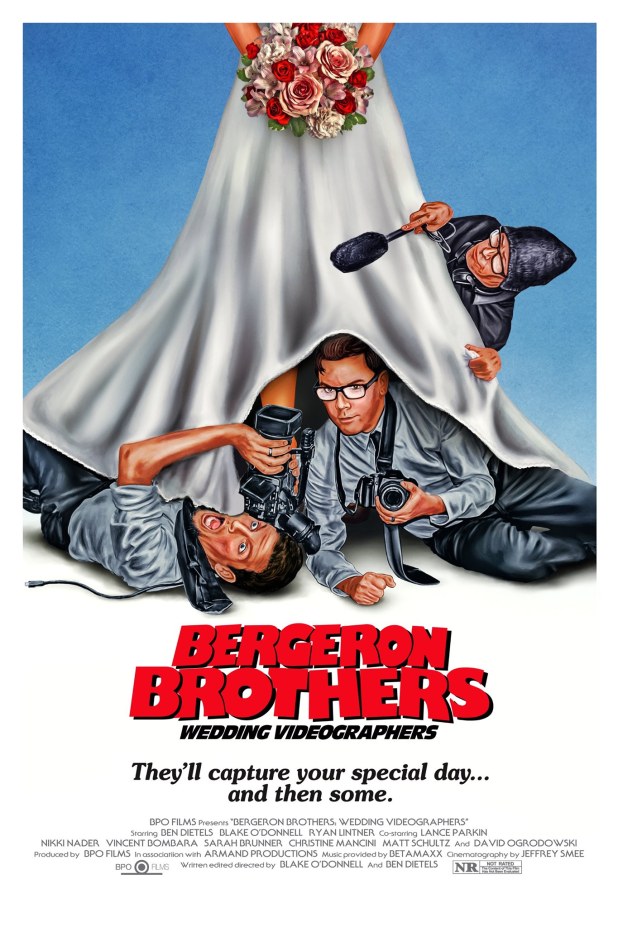
Bergeron Brothers: Wedding Videographers (2021)

You know when you start hanging out with someone and they tell you that they have a band and when you go see them they’re horrible and you wonder, “How can I still be friends when this band is so bad?” and then you just never talk about it and it gets awkward?

Well, Ben Dietels is half of the podcast Neon Brainiacs with his friend Gregg Harrington and they watched Silent Scream and Disconnected with us on the Drive-In Asylum Double Feature and Ben told us about this movie that he made and his taste seems pretty solid, so I was kind of worried if the movie that he co-directed, co-wrote and co-stars in with Blake O’Donnell would play out like that Rage Against the Machine cover band — Rage Against the Machine 2 — that used to practice above us in that storage place in Allentown.

Whew. This movie’s awesome. I feel so good about that.

Flynn and August Bergeron (Ben and Blake) are obsessed with being the best wedding videographers they can be, which means living next to a Pittsburgh toilet in a basement, and non-stop training themselves — and filming themselves — as they prepare for their first wedding. Nothing goes right at all, which is expected, but the emotional story under all the humor was.

I kind of love that the idea of this movie exists, because when you wonder, “How did the guy who shot my wedding learn how to do it?” your mind reels. As for my wife and me, when she got to the altar and asked, “Where’s the guy shooting our wedding?” and I had to quickly explain that he no-showed, the end of this movie rings so true.

And even if I never met Ben, I’d still laugh at this movie for the right reasons.

You can watch this on Tubi.

The Lost Daughter (2021)

ABOUT THE AUTHOR: Emily Fear is a librarian in Western PA. You can hear her weekly on the women’s wrestling podcast Grit & Glitter, available on Spotify, Apple Podcasts and all major platforms.

What defines a horror movie? What characteristics are required, what plot or thematic elements are necessary? Is horror defined by its monsters? Its suspense? Its violence, implied or explicit? Its gore? Its ability to manipulate, disturb, compel or horrify its audience?

The Lost Daughter, Maggie Gyllenhaal’s directorial debut, isn’t bothered by genre definitions. It exists in a murky zone between domestic drama, international intrigue and vacation horror. It plants the audience right in the middle of a dozen variations of tense, yet universally relatable stand-offs: having to interact with strangers on vacation, endless and chaotic fights with small children, conversations with people that suddenly become too intimate too quickly.

These scenes, especially the ones involving small children, are designed to make the audience itch with discomfort. Who hasn’t felt their shoulders tense up at the sound of a toddler’s tantrum, its immediate intensity coupled with dogged, almost-supernatural persistence? Who wouldn’t clutch themselves a little tighter in the presence of vaguely menacing, possibly-organized crime-involved men idling by their car for no reason?

Leda (Olivia Coleman) is on vacation in Greece and becomes entangled with a fellow group of beach goers, a large family with local roots and more than a little sinister energy. Among the family is Nina (Dakota Johnson), a young mother to a three-year old daughter, Elena. Observing the pair invokes memories of her own experiences raising her two daughters, memories more bitter than sweet.

When Elena goes missing, Leda assists in the search, eventually bringing the girl back to her mother – but not without absconding with Elena’s treasured doll. The missing doll causes the girl to collapse into an endless fit – one that extends beyond the afternoon into the following days and nights. 

Leda observes the destructive impact that this has on Nina, but continues to keep the doll regardless, all the while befriending the young woman to the point of intimate confessions from both parties. 

Flashbacks reveal Leda to be a short-tempered, emotionally distant mother, unequipped for the turbulence and neediness of two young daughters. Impulsive reactions give way to deliberate choices that ripple into the present, Leda all too familiar with the lasting unhappiness and suppressed rage of motherhood. 

This would be a punishing slog of a film were it not for the performances. Coleman is, as usual, perfect at making an imperfect character simultaneously deeply relatable and incredibly loathsome. In her creation, Leda is like a poorly assimilating alien creature, awkward at best and carelessly destructive at worst. She can’t feign maternal warmth, but she does emanate a certain understanding to Nina and others, one that clearly says, “I’m not a good person and don’t expect you to be one either.”

There’s a freedom in dropping pretenses that this movie plays with in compelling ways. But what if those pretenses, those little polite acts of social contract, are all that keep the horrors at bay? 

The Lost Daughter is available to stream on Netflix

Fuck the Devil 2 : Return of the Fucker (1991)

Michael Pollklesener is the man — well, maybe kid — who made all of this and played the Fucker, who didn’t survive his first movie, Fuck the Devil, because a VHS tape of Evil Dead II chopped his head off. But this time, a tape of A Nightmare on Elm Street has brought him back to life, thrown an Evil Dead shirt on his decayed body, a rubber mask on his face and acid washed jeans on his bod and sent him out to become invisible, make people puke and kill, baby, kill.

Just imagine: at some point in Germany, someone got a camcorder and said, “Ich möchte einen Slasher-Film machen” and just did it. There’s no deep meaning, just blood and gristle and vomit and chunky stuff and bathtub murder. It also has it’s own theme song when the Casio on demo mode runs out of bossa nova beats.

Is it any worse than the direct to streaming stuff that litters Amazon Prime? At least someone cared when they made it.

You can watch this on YouTube.

Lone Tiger (1996)

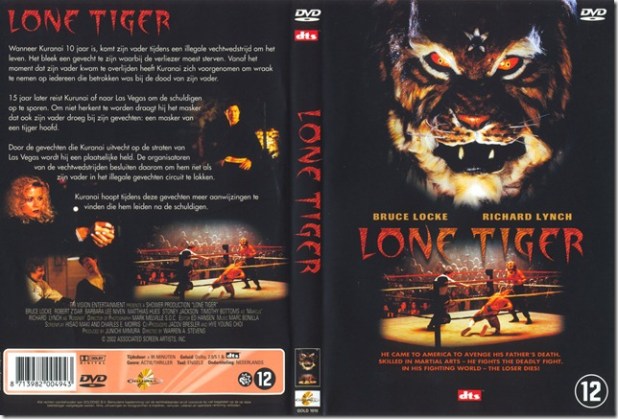
While searching Las Vegas for the man who killed his famous father — a wrestler known for his trademark tiger mask who is totally not Naoto Date, the Tiger Mask of anime and pro wrestling fame, despite this being written by Hisao Maki (Joe vs. JoeBodyguard Kiba), the younger brother of Ikki Kajiwara, who actually did create Tiger Mask — Chuji Kurenai (Bruce Locke, Shang Tsung from the Mortal Kombat: Conquest series and Otomo in RoboCop 3) discovers a world of fighters that battle to the death, which gets in the way of his quest to defeat Dark Tiger (Matthias Hues, Oscar the Lion Tamer in Big Top Pee-wee, as well as Kickboxer 2, TC 2000 and Puppet Master: The Littlest Reich), the pro wrestler who killed his father.

Meanwhile, Bruce Rossner (Richard Lynch) wants him as his main fighter, using money as motivation, as Hisao is taking care of some runaways — kind of like how Naoto Date would take care of the orphange (and to this day, Japanese fans of the manga and anime anonymously donate to childrens’ charities using Date’s name). He asks his main fighter, King (Robert Z’Dar) to train Hisao to be a killing machine, which takes all of one wacky montage.

Somehow, Tomothy Bottoms is in this. Yes, the same Timothy Bottoms from The Last Picture ShowJohnny Got His Gun and The Paper Chase. Then again, this is also the same Timothy Bottoms that was in Total ForceIn the Shadow of Kilimanjaro and The Crocodile Hunter: Collision Course, in which he played President George Bush. The George Walker Bush President Bush.

Warren A. Stevens also directed Dragonfight and Eagles Law, but spent most of his career doing stunts, like Cannon’s Lambada and Super Mario Bros.

As for the movie, well, instead of spending time showing us pro wrestling or fighting to the death, there’s an extended fried chicken eating scene. And the tiger mask of this Nise Tiger Mask is poofy and goofy and the fight scenes seem shot underwater, but then again, seeing Z’Dar spit out fake blood and a character scream, “I love to pee!” are the better parts of the film, so maybe it could have used more fried chicken eating.

You can watch this on YouTube.

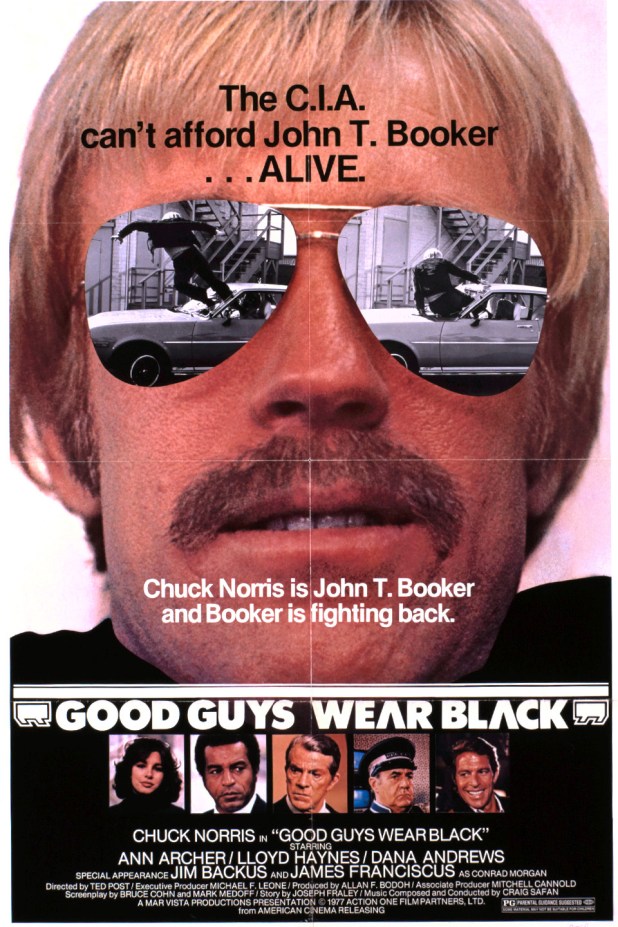
Good Guys Wear Black (1978)

Since his first starring role in Breaker! Breaker!, critics have made light of the acting ability of Chuck Norris, something that he’s taken in stride, because what Chuck lacks in acting ability, he makes up for in hard work.

Chuck told The New York Times, “I was the worst thing in 50 years. Well, I wasn’t good, but my feelings were hurt. I’m not trying to be Dustin Hoffman; I just want to project a strong positive hero image on the screen. I went to Steve McQueen, and he said, ‘In Good Guys you talk too much. Too much dialogue. Let the character actors lay out the plot. Then, when there’s something important to say, you say it, and people will listen. Anyway, you’ll get better as an actor. You should have seen me in The Blob.”

In These Fists Break Bricks, Grady Hendrix and Chris Poggiali share the story of how Norris went from a name in the world of martial arts to small parts in films* to suddenly ruling the box office of the 80s and the TV ratings of the 90s.

He convinced producer Al Belkin to put up $700,000 by telling him, “There’s four million karate people in America. They all know who I am. And if only half of them go to the movie, that’s a $6 million gross on a $1 million budget.” Belkin signed onto Good Guys Wear Black (1978), and told his staff that if it didn’t work out, they’d all be out of a job. It didn’t work out. No one would release the finished film, so Belkin rented out theaters and four-walled it across America. Norris toured relentlessly to promote his film. The result􏰘 $18 million at the box office.

In fact, Hendrix went even further when we interviewed him and asked about his feelings on Norris:

Grady: One of the things I really admire is how hard he works because acting does not come easy to him. He’s gone on record saying that it took him a really long time to get it. But he keeps doing the physical stuff on screen, even though he had a hard time. And you know, his first movie, no one wanted to make a movie with him. But he did it and he hit the road for almost a year and made it a big movie. Second movie, the exact same issue and the exact same hard work. Third movie and so on, until he gets the big studio contract and he walked out because he didn’t want to do the really violent stuff. He wanted young kids to see his movies because he feels like it’s good for them.

The film that he chose for his second movie takes place in the cynical world of the 70s. United States Senator Conrad Morgan (James Franciscus) made a deal to end the war with the North Vietnamese. If Yen will release several CIA agents, Morgan will take out the Black Tigers, a CIA assassination squad, who are sent to their deaths. Only Major John T. Booker (Norris) and four of his men survive the massacre.

Five years later, Booker is a professor of political science and an enemy of the war. Yes, a movie that posits that Chuck can debate the finer points of geopolitics and can romance Anne Archer. Then again, Chuck was quoted saying, “My country wasn’t built on sacrificing people to expedite principles.”

However, the surviving Black Tigers are being killed, as Morgan is to become Secretary of State and the North Vietnamese begin to blackmail him. He thinks that Chuck and his friends are expendable, but we know what happens when Chuck gets upset.

Chuck has some solid support from actors as diverse as Dana Andrews (yes, from the noir classic Laura) and Lloyd Haynes (Room 222) to Jim Backus (yes, Mr. Magoo). And no matter how bad he was in this movie, he was critic-proof.

When discussing how the movie was taken on an old school road show, Chuck would say, ” I traveled with them, opening from cities to hamlets, talking with folks and promoting the film any way I could. Many critics panned that film, but the public embraced it. They filled those theaters and launched my movie career.”

That’s why I love Chuck Norris. He’s not a creation of anyone but himself, someone who was willing to go in front of the MPAA and get the movie changed to a PG rating. And his character in this is supposedly who he is playing when he shows up in The Expendables 2.

And oh yeah — this was directed by Ted Post, so somehow he made a Planet of the Apes movie, a Dirty Harry movie, the giallo TV movie Five Desperate Women and, most essentially, The BabyGood Guys Wear Black was written by Mark Medoff, who also wrote Children of a Lesser God and When You Comin’ Back, Red Ryder, a fact that brings me incredible waves of joy.

*When Bruce Lee invited him to be in Way of the Dragon, Chuck asked of their fight, “Who gets to win?” Bruce laughed and said, “I’m the star.”

You can watch this on Tubi.

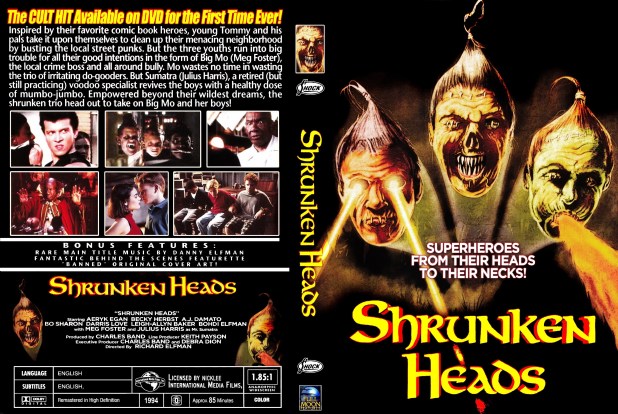
Shrunken Heads (1994)

Writer Matthew Bright and director Richard Elfman made Forbidden Zone, which is quite honestly one of the weirdest movies ever made. So why not try and outdo it?

Well, maybe Charles Band being involved may ensure that this isn’t as delightfully odd as the last movie Bright and Elfman made. But there’s still plenty of strangeness, as nearly everyone in this movie other than the leads were video store employees who won their roles in a contest.

The Vipers street gang led by Big Mo (Meg Foster and her intense and frightening eyes) has finally gotten sick of the three teens who screw with their plans, so they blast them with a shotgun. The newspaper salesman who sells them their comic books, Aristide Sumatra (Julius Harris in his last role; he was Tee Hee Johnson in Live and Let Die as well as appearing in Black CaesarHell Up In Harlem and Hollywood Vice Squad), is a voodoo priest and brings them back to life.

Seeing as how Tommy, Bill and Fredrick are now stuck as floating shrunken heads — I wonder how Tommy’s girlfriend Sally feels, seeing as how she took part in the ritual that saved him — and they use their new superpowers to fight crime make people clean up trash.

It’s a kid movie where kids get gunned down and become flying severed heads.

Maybe it’ll give your children nightmares.

You can watch this on Tubi.

Big Legend (2018)

ABOUT THE AUTHOR: Joseph Perry writes for the film websites Gruesome Magazine, The Scariest Things, Horror Fuel and Diabolique Magazine; for the film magazines Phantom of the Movies’ VideoScope and Drive-In Asylum; and for the pop culture websites When It Was Cool and Uphill Both Ways. He is also one of the hosts of When It Was Cool’s exclusive Uphill Both Ways podcast and can occasionally be heard as a cohost on Gruesome Magazine’s Decades of Horror: The Classic Era podcast.

Bigfoot movies have had something of a renaissance in recent times, and writer/director Justin Lee’s Big Legend is an exciting, welcome addition to Sasquatch cinema. The movie, which had its world premiere on opening night of the Portland Horror Film Festival on June 13, 2018, deftly balances human drama with plenty of monster mayhem, making for a highly satisfying creature feature.

Kevin Makely (Jumper, Stranglehold) stars as Tyler Laird, a military veteran who takes his girlfriend Natalie (Summer Spiro of the Westworld TV series and Oceans Rising) on a camping trip to the Oregon forest where, unbeknownst to her, he plans to propose. Lee does a wonderful job of letting viewers get to know these two characters and invest in them emotionally, and Makely and Spiro have definite on-screen chemistry together, so when a series of tree knocks and other sounds send Tyler investigating, and Natalie is dragged off in her tent by an unseen force, we are fully behind Tyler on his quest to find out what happened that night.

After spending a year in residential psychiatric care supervised by Dr. Wheeler (Amanda Wyss of A Nightmare on Elm Street, Freddy vs. Jason, and The Hatred), Tyler is released. Encouraged by his mother Rita (genre film legend Adrienne Barbeau), he sets out to find out what happened to Natalie, whose body was never found. Deep in the woods, he encounters Eli Verunde (Todd A. Robinson of Deep Dark and All Hell Breaks Loose), a mysterious loner who is there because he wants to see “the big man.” Tyler responds that he doesn’t believe in fairy tales — but he and Eli will soon learn that some myths are based in fact.

The cast is impressive throughout, with Makely and Robinson making a terrific dramatic duo fighting for survival in the wild. Barbeau and fellow genre-film icon Lance Henriksen both give solid turns, as would be expected.

Lee adeptly gives equal importance to dramatic weight and suspense building, putting Big Legend several notches above the typical creature feature. Adrian M. Pruett’s cinematography is stunning, with Oregon wilderness serving as a beautiful canvas from which to work. Jared Forman’s score, rich with pulsating synthesizer and tension-causing strings, is wonderful.

The creature design is terrific, and Lee is not shy about showing it off after some initial classic teasing shots. This Bigfoot is not a timid one, so discerning monster-movie aficionados can expect lots of aggressive behavior from the titular beast.

With Big Legend, Lee has crafted a winning creature feature that delivers plenty of action and tension, but not at the expense of character development. The film has an engaging story peopled with believable characters portrayed by talented actors. Monster movie fans, Big Legend is an entry into the genre that is not to be missed.