Family is a hard thing to deal with. You can’t choose them or change who they are, but only adjust the way that you will deal with them. However, this film’s protagonist Summer Roome has a harder to deal with family than most.
When her driftless younger brother and wayward father reenter her life — along with new knowledge about their past sins — she has to figure out how she fits — or doesn’t fit in at all — with her family.
A spiritual sequel to 2018’s Edge of Town — also by writer/director Christopher Flippo — this film brings back Geoff James, who was Sugar Baby in that movie. Plus, it has one face that horror fans may recognize. Duane Whitaker has been in everything from Hobgoblins — he was Roadrash — to Leatherface: Texas Chainsaw Massacre III, Vice Academy Part 2 and Tales from the Hood.
While an independent film, this movie has heart to spare even if it doesn’t have the budget. It reminds us all that at some point, the children start to become the adults, which is an incredibly difficult transition.
Man, ever since I’ve obsessed over Night Train to Terror, I’ve been searching for a movie that has the same absurdist edge and amateurish energy that feels like a million monkeys had been working a million hours in a million room’s worth of typewriters and this is the alien manuscript that they delivered to us.
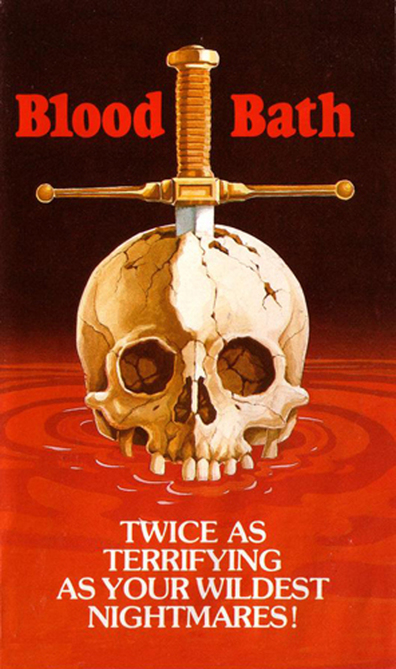
What makes Blood Bath a movie that instantly went to the top of my list was who made it: Joel M. Reed, who may have made only six movies, but one of them was Bloodsucking Freaks*. This film has the same berserk zeal as that film, a movie I rented so many times as a teenager that I really should have been considered for counseling.
Yet unlike that film — which has pretty much full nudity for most of its running time and some of the most aberrant behavior I’ve ever seen — Blood Bath is, well, nearly bloodless. That doesn’t make it any less strange.
Harve Presnell (Wade Gustafson from Fargo) plays Peter Brown, a man who is at once the most Satanic director of all time and also the husband of an actual demon and a New York City cop. The cast of his latest film wants to convince him that the supernatural is real, so they all gather to tell several stories to him that creates the heart of this portmanteau.
From a killer whose big hit goes wrong to a novelist who escapes the drudgery of marriage into a fantasy that doesn’t live up to his dreams, a businessman locked in a vault with the ghost of a black man that he indirectly killed and a martial artist who steals the most important secret of a secret sect of mystics and sells it as part of his strip mall karate classes, none of the stories are going to set you ablaze (then again, the end of the martial arts story is absolute beyond insane, which is exactly what I want this entire movie to be), the stories all kind of pale to the real weirdness of seeing Raymond’s mom Doris Roberts, Andy Milligan stock player Neil Flanagan, Jerry Lacy — who played Bogart to Woody Allen — and a brunette P.J. Soles tying to get with our director protagonist before his half-demon goat boy son goes off.
The art director of this movie, Ron Sullivan, is probably better known as Henri Pachard, the director of The Devil in Miss Jones Part IIand Taboo American Style. One of the actors in this, Sonny Landham, may be better known as both Billy in Predator and a hardcore conservative political career, but he started things off in movies like this (and also doing adult).
This is the kind of movie that has a newspaper headline that shouts “Kung Fu Master Opens Supermarket!” and karate masters — one has no arms and legs — sitting down to eat egg rolls before they battle to the death.
This movie is not well made and that means that to me, it’s beyond perfect. It’s an absolute mess, shot on stages that feel barely put together with doors literally coming off their hinges. It has the kind of heart that today’s endless streaming horror anthologies are missing. I demand more karate in my horror anthologies and films unafraid to be this incredibly odd.
*He also made the Jamie Gillis-starring Night of the Zombies.
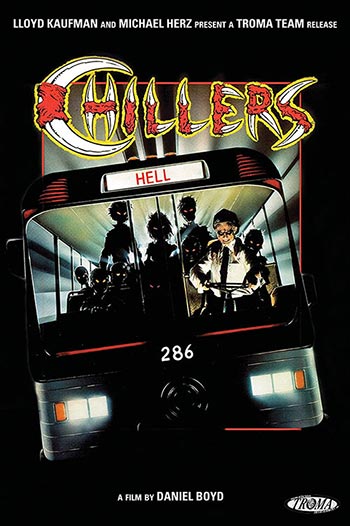
By all rights, a 1987 Troma anthology film should be the worst thing I’ve ever seen, but about midway through Chilers, I felt some level of awe. I was actually enjoying something from my least favorite studio, one that makes Full Moon look like Orson Welles before Hollywood kicked him in the dick.
Now, is it “one of the most horrifying movies ever made” as the artwork loudly screams? No. But “This is on the level of Night Train to Terror in a good way” would sell that movie to, well, an audience of me.
While waiting for their bus in a station that looks like a rec room complete with pinball machines and an Elvis tapestry, five passengers wake up from horrible nightmares and pass the time by telling one another that they had too much to dream last night.
The first story is about a swimmer who had dreams of being a star athlete but can barely qualify for the team. A diver who is coming back from an injury attempts to help her get back in form — and aardvark her in the shower along the way — before she learns all urban legend-style that her flip flopping loverboy has been dead for some time. Instead of that being the reveal — Chillers is nothing if not through — he comes back as a zombie along with everyone else who ever died in the pool, including a guy who dropped a drill into the water and someone who dove in with no water.
Up next, a scout troop hates their leader — except for one boy who is the one telling the story — but he ends up being stranger than someone who demands that everyone call him Wolf. Yes, he’s a killer and every child must pay.
The best story of the lot is about a lonely woman who can’t connect with humanity. Her only relationship is with the anchor of the 11 o’clock news, who she talks to every night through the TV. Somehow, he starts speaking back to her and better still, he ends up being a vampire. Honestly, this story could have been a movie in and out of itself, as the woman slowly gains confidence with each moment she spends amongst the undead.
Then, a young man who is obsessed with those who die young in the obituaries learns that he can bring them back from the other side, but nobody really wants to come back to our world.
Finally, a professor of anthropology decides to teach his students about a Spanish demon that ends up possessing one of his students. And then, the bus arrives, bound for Hell, with all of the villains of every story sitting next to the storytellers in an ending — before the fakeout — that really brings this all together.
Chillers isn’t great. The acting is really bad, the sets are horrible, it barely looks above being shot on video and it has all the energy of a high school play. But actually, it is great in its own way, being exactly the movie you want it to be in spite of the challenges of budget, the studio that produced it and attempting to do so much with so little.
To be perfectly honest, this is exactly the kind of movie that I love.
Director, producer and writer Daniel Boyd made this in six months while moonlighting as a college professor at West Virginia State University. He’s made a handful of movies since — Strangest Dreams: Invasion of the Space Preachers and Paradise Park along with a few documentaries — but he’s succeeded in other ways. As a U.S. Fulbright Scholar, Boyd taught the first filmmaking and screenwriting classes at the University of Dar es Salaam, Tanzania during the ’98-’99 academic year in East Africa. He followed that up by winning a 2002 Fulbright Alumni Award for his work with that university on a pilot program called TeleDrum which teaches filmmaking to American and African students while producing films for international aid organizations. Two of the films that came out of this program, Duara and Sound of the Drum, won awards.
The moment I saw a Rax cup in the background of a scene, I kind of knew that I was going to love every single moment of this movie. I’m debating a new genre of horror: bus station horror. All I have right now are The Similars and this movie, but genres have started with less.
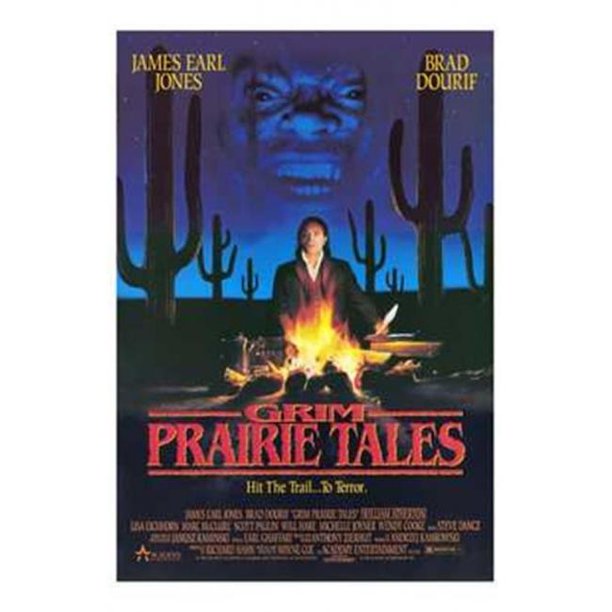
The advantage of a horror anthology is that you can afford James Earl Jones when you’re only using him for a day or so. That’s the trick of Grim Prarie Tales, which as far as I know is the only all-western horror anthology.
Writer/director Wayne Coe often worked as a storyboard artist (Se7en, Dead Man on Campus) before making this film. He’s currently making a movie called We Have Your Kids and planned to make a sequel to this called Grim Prairie Tales: Rescue Party.
Two men meet around the campfire to tell stories, with bounty hunter Morrison (Jones) taking in a body for money and Farley Deeds (Brad Dourif) coming back to see his wife. From a story where a Native American tribe gets revenge against a man who has disturbed their burial ground to Marc McClure helping a pregnant demon woman and a man haunted by someone he killed in a gunfight, the stories all fit the criminally underexplored supernaturally western genre.
There’s also a story about a man forced to become part of a lynch mob. The protagonist is played by William Atherton, who is quite literally the best jerk in the history of movies. The real life Atherton is somewhat suspect too, as he studied Eli Siegel’s aesthetic realism philosophy, which claims that homosexuality is a way of seeing the world that can be studied and changed. Atherton identifies as ex-gay and I’ve noticed that information about this keeps getting taken off of his Wikipedia page.
Regardless, Grim Prarie Tales is an intriguing entry in the horror anthology genre. Then again, I’ve also heard it being placed into the feminist western category and that fits as well.
Unheimliche Geschichten was made by Richard Oswald, the director of a hundred or more movies, including the 1917 adaption of The Picture of Dorian Gray.
This definitely has an interesting connecting story, as a demon, a reaper and the ghost of a prostitute read several short stories. Yes, Death, the Devil and the Harlot literally step out of a painting in a bookstore to start the movie.
“The Apparition” — based on the story by Anselm Heine — tells the story of a man (Conrad Viedt, who also plays Death) checking into a hotel with a woman (Anita Berber, who is the Harlot) who vanishes. No one will admit that she was ever there, nealry driving the man insane. In “The Hand,” based on the Robert Liebmann tale, two men — Veidt and Reinhold Schünzel, who plays the devil — engage in a duel that continues past one man’s death. “The Black Cat” is the Poe story, with Schunzel murdering his wife (Berber) and walling her up. In the film’s take on Robert Lewis Stevenson’s “The Suicide Club,” a detective tracks down a secret society just as they pick him as their next victim. Finally, “The Spectre,” written by Oswald, is about a rich man (Veidt) who pushes his wife (Berber) into an affair.
At one a.m., Death, the Devil and the Harlot return back to their respect paintings, ending Eerie Tales.
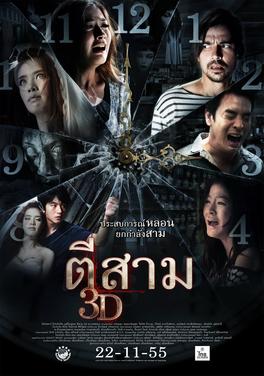
Made in Thailand by directors Patchanon Tummajira, Kirati Nakintanon and Isara Nadee, this film takes its title from the time that the supernatural happens.
In “The Wig,” sisters May and Mint are running the family wig business while their parents travel. They unknowingly buy the hair of a dead woman whose spirit begins to haunt May as she makes it into a new hairpiece. Meanwhile, Mint’s friends are acting up and are all killed by the ghost in various ways, including a harrowing scene where one of their heads has been moved to the wig shelf. For some reason, this section totally hit all of the right notes with me.
The “Corpse Bride” presents a mortician willing to aardvark the dead to save them from an abusive ghost in the afterlife. I mean, I guess that’s what he was trying to do, but it turns out that the dead woman isn’t the angel that she seems to be, no matter how gorgeous her corpse is.
In “O.T.,” two bosses delight in playing pranks on their employees involving fake ghosts, but when they go too far and two of their workforce die…well perhaps they shouldn’t have ever gotten on that elevator.
This movie was successful and had two sequels, 3 AM: Part 2 and 3 AM: Part 3, which also is known as Aftershock. I assume that this movie would have been much more frightening if I saw it in 3D, as it played in theaters with that technology.
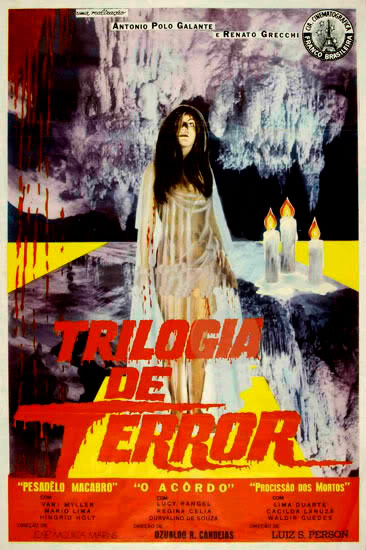
This Brazilian movie creates new versions of stories that appeared on the TV series Além, Muito Além do Além (Beyond, Much Beyond the Beyond): “O Acordo” (The Agreement), “A Procissão dos Mortos” (Procession of Dead), and “Pesadelo Macabro” (Macabre Nightmare).
In the first segment, “O Acordo” (The Agreement), a mother discovers that her daughter has an incurable disease, so she offers her soul to Satan himself. They ask her to bring them back a virgin. This segment was directed by Ozualdo Ribeiro Candeias.
The second story is “A Procissão dos Mortos” (Procession of Dead), which was directed by Luiz Sérgio Person. A young boy’s father is the only person brave enough to face the ghosts that haunt the village.
Finally — and most spectacularly — “Pesadelo Macabro” (Macabre Nightmare) is about a young man who is afraid of being buried alive, which is exactly and to no surprise what happens. This leads to tons of scenes of women being whipped, lizards, bugs and, yes, a premature burial that all feel like they’re the exact kind of bad trip that schoolteachers warned you that those blue acid star temporary tattoos would give you if any drug dealer tried to give you free acid, which I don’t think has ever happened ever. This was directed by José Mojica Marins, who we all know as Coffin Joe, and it lives up to exactly the kind of mania you expect from this man. He was actually the host of the TV show these stories came from for 21 years and sadly, hardly any tapes of them survive.
This is less an anthology film than an attempt to take old Full Moon movies, edit them down and make them into a whole new movie. If you’ve added the same Full Moon movie to your collection because of repackaging, congratulations! You’re one of us!
2000’s Prison of the Dead has been edited down to become “Crypt of the Undead.” This David DeCoteau-directed story, an eccentric rich guy tricks his friends into a reunion by pretending that he’s dead. Somehow, this leads to some undead executioners killing everyone after the adults playing teens play Ouija in an abandoned witches’ prison.
1999’s The Killer Eye is now “Terror of Vision.” Another David DeCoteau movie, this one even had a sequel Killer Eye: Halloween Haunt. To add a bit of spice, this movie is bold enough to recycle the Linnea Quigley shower scene of Creepazoids in the laziest possible manner: it’s playing on the TV in a scene. The main idea of this story is that a doctor is experimenting on male prostitutes by giving them eyedrops that allow them to see the reality beyond death and then he’s shocked when tentacles emerge out of their eyes. There’s also a giant eyeball that enjoys impregnating women, which is a fetish that I’m cynically — and sadly — sure that someone gets all hot under the glasses about*.
1999’s Totem has become “Master of Death.” Guess who directed it**? Six people are trapped in a cabin — they have been brought their by means they don’t understand other than it was an obsession — and three of them will kill the other three by the words of a prophecy. For some reason, DeCoteau was embarrassed by this. He was allowed to direct Voodoo Academy if he directed this film first.
Somehow, even cut down by a third, these movies still seem way too long. I have a weakness for movies where giant eyeballs attack people, so the second story at least held my interest.
*The Japanese invented oculolinctus for us — also called worming — which involves erotically licking your lover’s eyeball. This has led to pinkeye outbreaks.
**If more men are shirtless than women, David is behind the camera. Hey, I’m all for a little more fairness when it comes to onscreen flesh.
One of the many rules of horror that I use to guide my everyday life is that if you get a house in a will, do not go back to your hometown to settle the estate. You will face the supernatural at best, die if you’re lucky or end up in Hell if things go the way they usually do.
Rodger is one of the people who didn’t listen. He’s come back home to settle the affairs of his recently deceased father. Soon, he’s dealing with strange childhood memories about a ghost and those memories aren’t going to stay remembrances for long.
Roger also lost his mother and sister at a young age, so he’s surprised when the diaries he finds show that he was in therapy to get over their loss. Yet he barely remembers things. And while his mother’s equations and his father’s videos guide him, there’s also a twist coming that will change everything.
BJ Verot broke into films doing stunts and when you think about it, isn’t being a director the most daring stunt of all? Good news — he’s survived the attempt and I look for him to jump through all sorts of flaming hoops in the future.
The Return is available on demand from Uncork’d Entertainment.
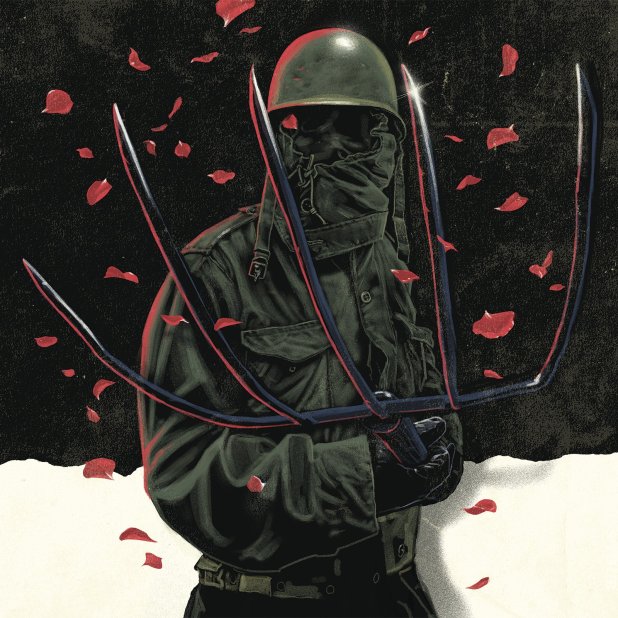
Of all the slashers, The Prowler just may be my favorite. Is it because everyone seems like they’re in some kind of dream? Is it the World War II opening and soldier slasher villain? Or is it because Tom Savini literally went wild with every gory impulse he had? Who can say!
You can watch The Prowler on Tubi with us on Saturday night at 11 PM EST.
Join us and Patrick Walsh from Scream Queenz on the Groovy Doom Facebook page before and after the movie to get ads, cocktails and a lively discussion of the movie.
Here’s the recipe for this week! In tribute to this film’s other title of Rosemary’s Killer, I decided to go Prohibition Era cocktail this week.
Rosemary’s Bee’s Knees
2 oz. gin
.75 oz. lemon juice
.5 oz. rosemary honey syrup
.75 oz. orange juice
To make the rosemary honey syrup, bring a 1/2 cup of water and a 1/2 cup of honey to a boil for five minutes, stirring until the honey dissolves. Reduce heat to low, add five sprigs of rosemary and cook overcovered for half an hour while you stir occasionally. Strain and throw away the rosemary. You may want to do this a day or so before and then place it in your refrigerator.
The rest is easy: just mix it all together in a shaker and shake it up until you see the whites of their eyes pop out. Serve over ice with a sprig of rosemary and some lemon peel, if you’re fancy and going to a post-World War II dance. Just watch out for knives, bayonets and pitchforks.




 B&S About Movies