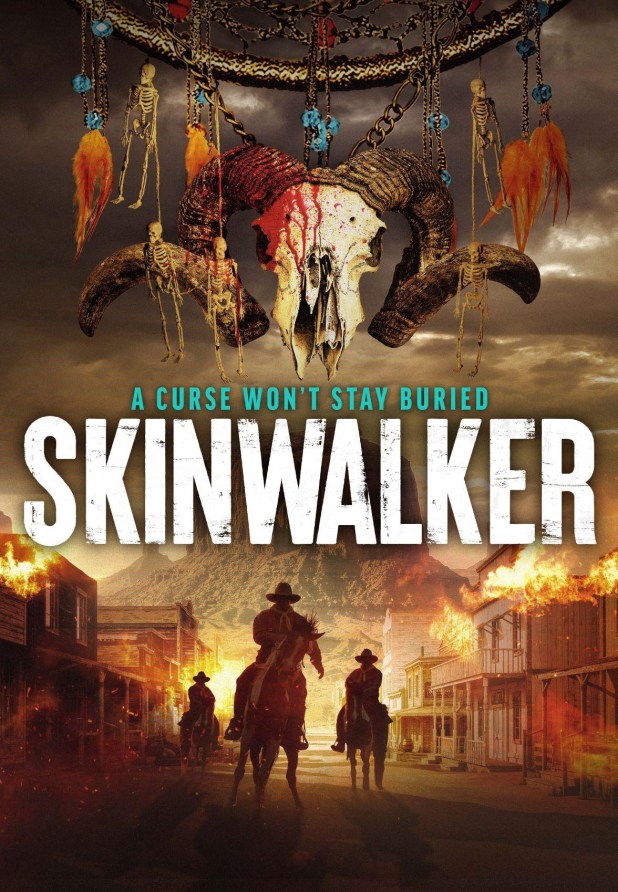
You know what happens when you steal from a Native American burial site? You set loose the Skinwalker, a shape-shifting ancient demon that won’t stop until it gets revenge. Trust me, I live in Mounds Park, a place that has Native American bones directly from my house.
Writer/director Robert Conway also made Eminence Hill, a Western that we reviewed last year. Here, he’s telling the story of the curse that breaks out in 1883 Arizona. In fact, he’s the first to get possessed, as Conway also plays a man named Hugo who gets bit by a snake. The Skinwalker goes from body to body throughout the film, killing everyone from lawmen to criminals alike.
It’s a pretty interesting idea to match demonic possession with the Wild West. While this doesn’t have much of a budget and relies a bit heavily on CGI gore, there’s still plenty to enjoy in this movie.
Skinwalker is available on demand and on DVD from Uncork’d Entertainment.
EDITOR’S NOTE: We originally covered this film on June 1, 2018. Now that Blue Underground is releasing it in a UHD edition, it’s time bring it back and share how you can get this expaned edition.
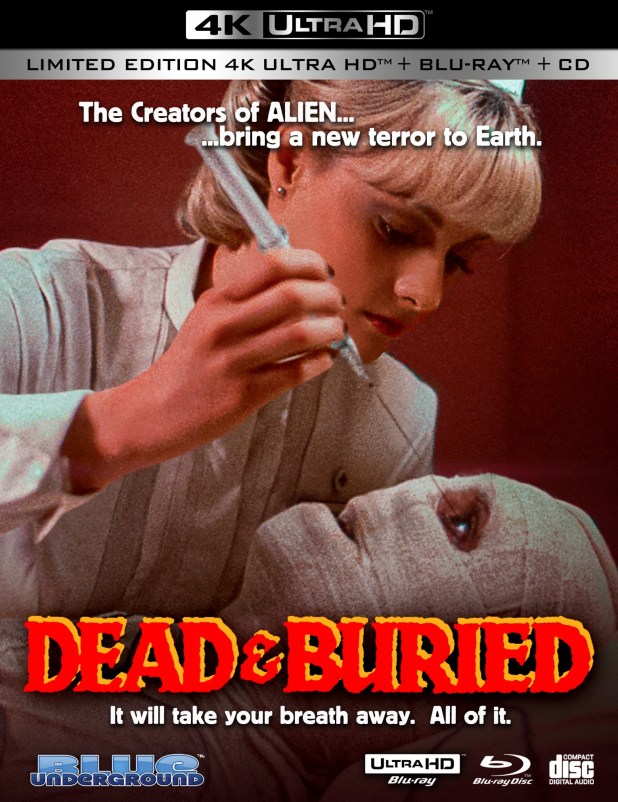
Potter’s Bluff is one of those perfectly gorgeous New England coastal towns. You know, the kind where visitors are beaten, tied to a post and set on fire while people take photos of them. And then, when they survive, nurses stab them right in the eyeball with a syringe.
Dead and Buried was written by the Alien team of Dan O’Bannon and Ronald Shusett and featured Stan Winston special effects, so the poster was justified in shouting, “From the people who brought you Alien…” Unfortunately, those people do not include Ridley Scott, as we have Gary Sherman directing this (he also helmed Poltergeist III). That said, O’Bannon disowned the film, claiming that Shusett had actually written it by himself but needed O’Bannon’s name on the project to get it made. He never made any of O’Bannon’s suggestions before it was produced.
Sheriff Dan Gillis (James Farentino, The Final Countdown) is our hero and he is working with Dobbs (Jack Albertson, Willy Wonka & the Chocolate Factory and TV’s Chico and the Man), the town’s coroner/mortician to solve the murders that have gripped their small town. And with each one, a photo of the murder is found.
As Gillis rushes to a suspected attack, he accidentally hits a man, whose arm is stuck in the grill of his car. The man attacks the sheriff, then takes his arm and runs away. Further research shows that a tissue sample of the man shows that he has already been dead for four months.
The sheriff begins to suspect everyone, including Dobbs, who he learns was fired from his last job for conducting unauthorized autopsies, and his wife Janet (Melody Anderson, Flash Gordon), who has begun to teach witchcraft to her students.
It turns out that Dobbs has learned how to reanimate the dead and that nearly everyone in town — I’m looking at you, Robert Englund — are under his control. He considers himself an artist who improves the lives of the dead after he controls them. Just then, the sheriff notices that his hands are rotting and Dobbs offers to repair him. That’s because he’s been dead all along, as his zombie wife had killed him during sex, a scene he watches as its projected on the wall.
Dead & Buried has a great trailer that it lives up to. While it feels very Carpenter-esque, it lacks the style and verve of his films. That said, there are some interesting touches, such as the director avoiding the color red throughout the film so that the murders would be more shocking.
The new Blue Underground edition has both Ultra HD Blu-ray (2160p) and HD Blu-ray (1080p) Widescreen 1.85:1 feature presentations of the film, plus four different commentaries (director Gary Sherman; Co-Writer/Co-Producer Ronald Shusett and Actress Linda Turley; Director of Photography Steven Poster, ASC; Troy Howarth and Nathaniel Thompson), as well as a great behind the scenes that was actually shot as home movies with comments by the crew; a look at the locations now and then; new interviews with Sherman, composer Joe Renzetti and novelization author Chelsea Quinn Yarbro; plus features on Stan Winston’s FX, Robert Englund and Dan O’Bannon. Plus, this packed release also has trailers, poster and still galleries, location stills, a collectible book with a new essay by Michael Gingold and the Original Motion Picture Soundtrack on CD for the first time ever. You can get this from MVD and it comes in three different covers.
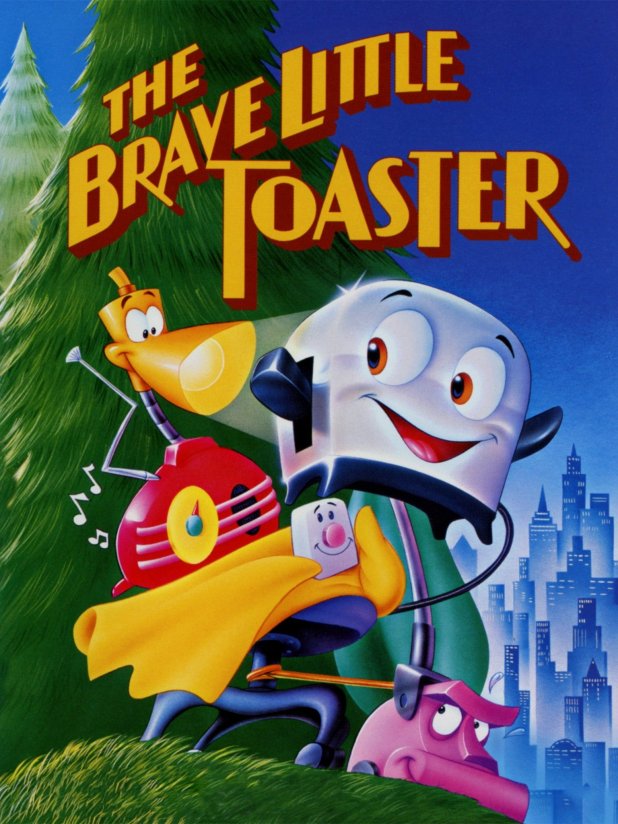
Based on the book by Thomas M. Disch, The Brave Little Toaster was directed by Jerry Rees, who directed thirteen multimedia features at the various Disney theme parks as well as providing the computer effects for Tron.
After animators John Lasseter and Glen Keane finished a short 2D/3D test film based on the book Where the Wild Things Are, Lasseter and producer Thomas L. Wilhite chose this story to be the first CGI animated film that Disney would make. That said, they ran into issues as execs only saw CGI as a cost-cutting measure. Minutes after that meeting, Lasseter was fired*.
Development was then transferred to Hyperion Pictures, which had been created by former Disney employees Tom Wilhite and Willard Carroll, who were able to get funding from Disney, TDK Corporation and CBS/Fox Video.
As Rees was writing the film, he already started casting voices. Most actors that came in for a cartoon role were doing exaggerated reads so he turned to The Groundlings, with many of their members — Deanna Oliver (Toaster), Jon Lovitz (Radio), Phil Hartman (Air Conditioner/Hanging Lamp), Tim Stack (Lampy), Judy Toll (Mish-Mash) and Mindy Sterling (Rob’s mother) — making up the cast, along with Timothy E. Day as Blank and Tony the Tiger voice-over actor Thurl Ravenscroft was cast as Kirby the vacuum cleaner. It also has limited library music and sound design, with the score being recorded by the New Japan Philharmonic conducted by David Newman and nearly all new foley work done throughout the movie.
To animate this feature, a staff of ten people — including Rees and his wife Rebecca, who worked as the directing animator and taught classes to the animators they met — moved to Taiwan. They also had A. Kendall O’Connor on staff as a color stylist. He’d been a member of Disney’s feature animation department since Snow White and the Seven Dwarfs.
Many of the cast and crew members went on to have successful animation careers. Co-writer Joe Ranft became a script supervisor at Pixar. Animators Glen Keane, Kirk Wise and Kevin Lima went on to animate and co-direct The Little Mermaid, Beauty and the Beast, Aladdin and other animated features that brought cartoons back to Disney. Effects animator Mark Dindal directed Disney’s The Emperor’s New Groove and character designer Rob Minkoff directed The Lion King and the Stuart Little movies. Pretty great results for a movie Disney didn’t want all that badly.
This film is pretty much the prototype for a Pixar film. Many of the studio’s most important members, including Joe Ranft and John Lasseter, were involved. It also has so many of the themes that Toy Story would further develop, such as the past being thrown away, a dangerous journey and adult themes appearing within a film for kids. In case you think this is just a theory, the proof is that the number A113, seen in all of Pixar’s films, appears as Rob the master’s apartment number. This number refers to a CalArts classroom that many animators studied in.
For the last two thousand days, a family of appliances has waited for Rob the owner to return home, but on day two thousand and one, they learn that their house has been sold and Rob is leaving them behind. Surely he wouldn’t do that, they believe, so they go out into the world to find him.
They discover a world that no longer wants them, as they aren’t modern any longer and so technology has advanced beyond them. Yet they hope that as Rob moves into adulthood that he can find a place for them, no matter how dangerous the path gets.
The Brave Little Toaster is anything but a children’s film. Being made outside of Disney allowed for dakr moments to be included, as well as a film that is more about the story than creating a toy line. I’m completely comfortable with sharing just how emotional this movie makes me.
*Strangely, The Great Mouse Detective was made with this same technique and no one got in trouble for that.
“WITCH is like the Beatles of Zambia.” — from the film
In the ’70s, Anglo-American-bred heavy-psychedelic progressive rock flourished, not only in the U.S., the U.K, and on the European mainland — but all over the world. The bands were everywhere: even in Japan (Food Brain) and Israel (Atmosphera), to name a few. Even in the landlocked country of the Republic of Zambia in Southeastern Africa. And the nation’s most famous band was the Rolling Stones-influenced, psych-rock flavored (recalling the band’s 1968 to 1974 Beggars Banquet to It’s Only Rock ‘n Roll era), WITCH, the first Zambian band to record and release a commercial album.
Jagari, WITCH’s founding and sole original member, sets out on the road to rediscovery/Utopia Media.
As with Malik Bendjelloul — a Stockholm, Sweden, documentary filmmaker who, upon hearing the music from the two-album career of forgotten Detroit musician Sixto “Sugar Man” Rodriguez for the first time in a Cape Town, South Africa, record shop, became obsessed with discovering what became of the mysterious “Bob Dylan of Detroit” to create the film Searching for Sugar Man — Gio Arlotta — a Milan, Italy-based journalist who, upon hearing WITCH for the first time in 2012, became obsessed with discovering what became of the country’s original-influential “Zamrock” band. So Gio Arlotta, along with fellow fan, Jacco Gardner, a Dutch musician, they set out to Zambia to find their idols.
Their search led to finding the band’s sole surviving member, vocalist Emanyeo “Jagari” Chanda (an Africanisation of Mick Jaggar) (the filmmakers also find the band’s original engineer at the still-in-existence studio where they recorded/pressed their albums). As with the Sugar Man before him, Jagari experienced a career resurgence with his first-ever European tour — by a revived WITCH featuring an international cast of fan-musicians (the Netherlands, Germany, and Switzerland). The keyboardist in the band is Patrick Mwondela, who joined in 1980 — long after Jagari’s departure — and remained with the band until their 1984 demise (he appears on their final two albums; 1980’s Movin’ On and and 1984’s Kuomboka).
The golden-era of the band, in my opinion, are the Jagari years from 1973 to 1976, as the later parts of the band’s catalog transformed from ’70s-styled progressive rock — inspired by the Rolling Stones, Jimi Hendrix, and U.S. funk, James Brown, in particular (and, I feel, to critical disagreements: a pinch of Miles Davis and a soupçon of Santana) — into disco and more traditional Zambian material; bass-oriented Kalindula music, in particular. (You can learn more about the traditional African instruments incorporated by the band at the Atlas of Plucked Instruments.)
In addition to his noted work as a journalist, Gio Arlotta is also a video artist. To that end: Arlotta effectively frames his shots and works as a fluid editor; the film’s animations are equally intriguing with a stellar opening credits sequence (assisted by his co-producer and writer, and cinematographer, Tim Spreng; Spreng made his feature film debut with the Czech Republic romantic-drama, 2013’s All the Lost Souls). Arlotta — as with documentarian Liam Firmager in his earlier celluloid tribute to Suzi Quatro — provides WITCH: We Intend to Cause Havoc with a not just a run-of-the-mill rock documentary or artist preservation quality: it’s a tale about dreams; a tale of how hard work and never giving up hope, eventually, will return bountiful spoils. And that the gift of music is an eternal one.
As with the absolutely stellar The Changin’ Times of Ike White from last year reigniting a rediscovery of the genius of ’70s soul-fusion musician Ike White, this is another time when you drop your hesitations on watching a documentary for your evening’s entertainment — and watch it, as you learn how political upheavals can affect one’s pursuit of music. You also learn that, regardless of borders, musicians experience the same unrealized careers — and are reduced to giving up music for day jobs to support their family; in Jagari’s case: spending long days digging the African wilds for precious stones.
My only reservations with the film is that the African-accent English (remembering Zambia was once a British territory) is difficult to understand. Hopefully, the theatrical and streaming version — unlike the promotional screener I watched — will provide viewers with captioning; captions which will obviously be available on the film’s eventual hard media release. I also feel the film would have benefited from a tighter edit, even at 80 minutes, the proceedings dragged slightly against the hard-to-follow Zambian English. Those personal opinions, of course, vary from viewer to viewer and in no way detract from the power of witnessing a once lost artist rediscovering his past — and experience his forgotten, creative past becoming commercially accepted by the world stage for the first time.
You can enjoy WITCH: We Intend to Cause Havoc on July 13, 2021, available as a world premiere, pre-order rent-to-own at Altavod. After its premiere on that platform, as well as Apple TV, the film will be available on other streaming platforms and hard media.
The film was acquired for international distribution by Utopia Media, which also brought the British rock document on Suzi Quatro, Suzi Q, to the international marketplace. Another of Utopia’s award-winning documents is Martha: A Picture Story, concerned with Martha Cooper, a New York-based, trailblazing female graffiti artist and street photographer.
Utopia is headed by Robert Schwartzman — of the band, Rooney, and a writer and director in his own right — who made his feature film directing debut with the really fine comedy, The Argument, released last September. You can learn more about the launch of Utopia Media with this February 19, 2019, article at Deadline.com.
An essential part of a prog-rock collection/Utopia Media.
You can find the full WITCH discography on You Tube:
* Released as a two-fer CD in 2014 on Now-Again Records. The label — as well as reissuing the remainder of the WITCH catalog in 2011 and 2012 in digital and vinyl formats — also released the 2012 career-spanning compilation We Intend to Cause Havoc.
You can learn more about Emanyeo “Jagari” Chanda and WITCH with “We’re a Zambian Band,” a highly-recommended expose written by Chris A. Smith for the Austin, Texas, publication, The Appendix.
WITCH – Live in London, September 2017
About the Author: You can learn more about the writings of R.D Francis on Facebook.He also writes film reviews for B&S About Moviesand publishes music journalism pieces and short stories based on his screenplays, on Medium.
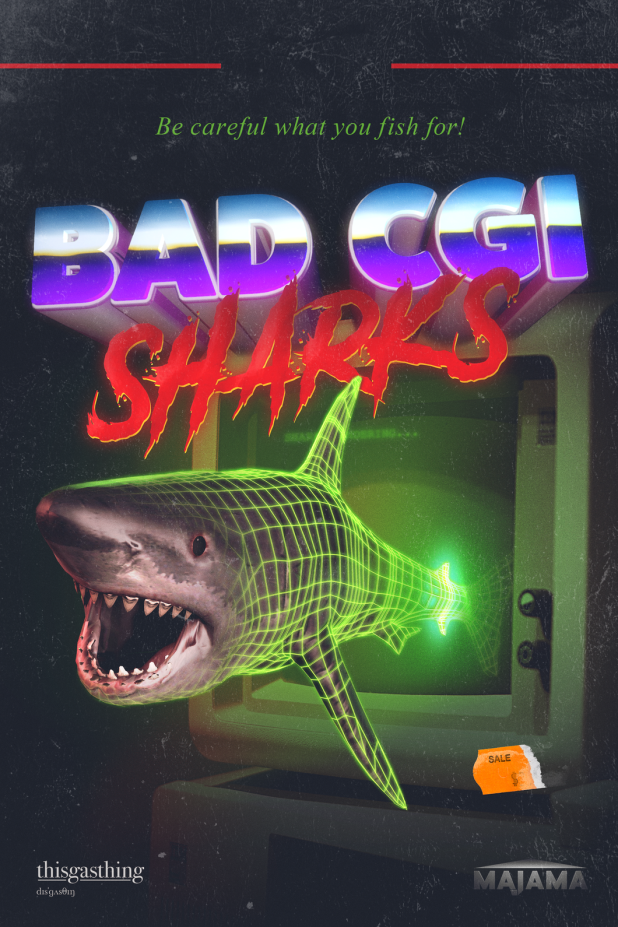
When Bruce the Shark is chasing swimmers, he does not stop to download pornography. CGI Sharks will do this and really take down the speed of your internet. This is a fact that this movie has taught me and now I must pass on to you.
Jason and Matthew are brothers who have been apart for years before reuniting to discuss the shark movie they wrote as children. However, one of the sharks that they created for the film has escaped the computer world and is killing everyone in its path.
This was directed by MaJaMa, who I assume is the combination of three of the film’s actors and writers, Matthew Ellsworth, Jason Ellsworth and Matteo Molinari. Maybe I’ve seen too many direct to streaming shark movies lately, but this hits every cliche of the form — is a shark movie with a CGI apex predator a genre unto itself? — that I just accepted the fact that sharks float through the air because I’ve seen more than one movie where that’s exactly what happens.
If you’ve seen just as many bad shark movies as me, good news. This one is actually pretty fun.
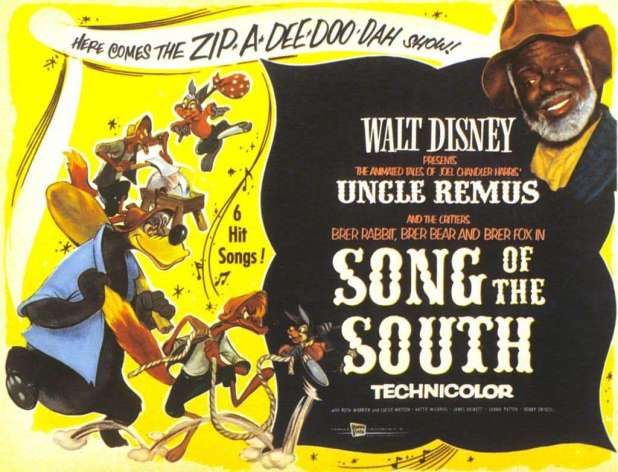
If you ever ride one of Disney’s Splash Mountain rides, you’re seeing the characters from this movie, which has remained locked in the Disney vault — at least in America, as it has been released in Japan, Germany and the UK on VHS and DVD — because in the words of executive chairman and former CEO Bob Iger, Song of the South is “not appropriate in today’s world.”
Let me explain to you how wrong the world once was and pretty much still is. A special Academy Award was given to James Baskett “for his able and heart-warming characterization of Uncle Remus, friend and story teller to the children of the world.” He was the first African-American man to ever win any type of Oscar. But when the movie premiered in Atlanta, the actor was prohibited from attending because the city was racially segregated by law. This wasn’t during the Civil War. This was during your parent’s or grandparent’s lifetimes. (Hattie McDaniel was the first African-American woman to win, be nominated, or even be allowed to attend — and, even then, only with special permission — the Academy Awards, for 1939’s Gone With the Wind).
When the movie was released, Walter Francis White — the executive secretary of the National Association for the Advancement of Colored People (NAACP) — sent newspapers a statement that said, “The National Association for the Advancement of Colored People recognizes in Song of the South remarkable artistic merit in the music and in the combination of living actors and the cartoon technique. It regrets, however, that in an effort neither to offend audiences in the north or south, the production helps to perpetuate a dangerously glorified picture of slavery. Making use of the beautiful Uncle Remus folklore, Song of the South unfortunately gives the impression of an idyllic master–slave relationship which is a distortion of the facts.” He had not seen the film nor realized that it was set after the end of the Civl War. Perhaps a more balanced view came from his fellow NAACP member Norma Jensen who remarked that the film was “so artistically beautiful that it is difficult to be provoked over the clichés, yet it has all the clichés in the book.”
The major issue is that the film features the subserviant status of black characters, the way they dress, their exaggerated dialect and other archaic depections of black people. The stories come from Uncle Remus by Joel Chandler Harris, who was a racial reconciliation activist writer. That doesn’t help the film’s overall tone.
The major thrust of the movie is that a white child named Johnny is inspired by the tales of Bre’e Rabbit, Br’er Fox and Br’er Bear that are told by Remus. His mother doesn’t understand and thinks that the stories are making her son — who is already dealing with the seperation of his parents — too much of a rebel. Uncle Remus attempts to leave the plantation as a result, but when Johnny is hit by a bull, only his the stories and songs of the old man can save his young friend.
The funny thing is that as dated as the movie’s attitudes seemed in 1946, it was still re-released in U.S. theaters as late as 1986, when it seemed incredibly wrong. And while Disney has never released the film on home video in the U.S., it eventually will. That’s because the film will go into public domain in 2039 and Disney will lose all copyright to the film if it is not physically released in theaters, on hoem video or via Disney+.
That said — who knows? I recently watched the film and can see the issues, but when Whoopi Goldberg was made a Disney Legend, she said that she hoped that the movie would be reissued so that people could start a dialogue about it.
Today, characters and songs from the film appear in various Disney media yet children never associate them with this film, which would never be seen if it weren’t for the internet and convention DVD sellers.
I wish there could be an assessment of this film and a discussion of what is wrong about it, while understanding that many of Uncle Remus’ lessons could teach us plenty. But this film remains a media landmine and even the whispers of a home release in 2007 led to controversy and threats of legal action.
You should see it for yourself, make up your own mind and treat everyone with the dignity they deserve. But you already knew that.
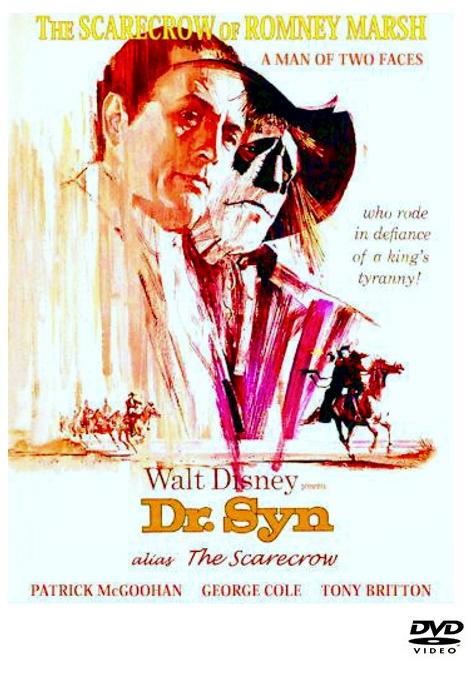
The Reverend Doctor Christopher Syn comes from a series of novels by Russell Thorndike and was inspired by 18th-century smuggling when brandy and tobacco were smuggled into the U.S. to avoid British taxation. The books were originally made as movies in 1937 as Doctor Syn and in 1962 as Captain Clegg, which starred Peter Cushing.
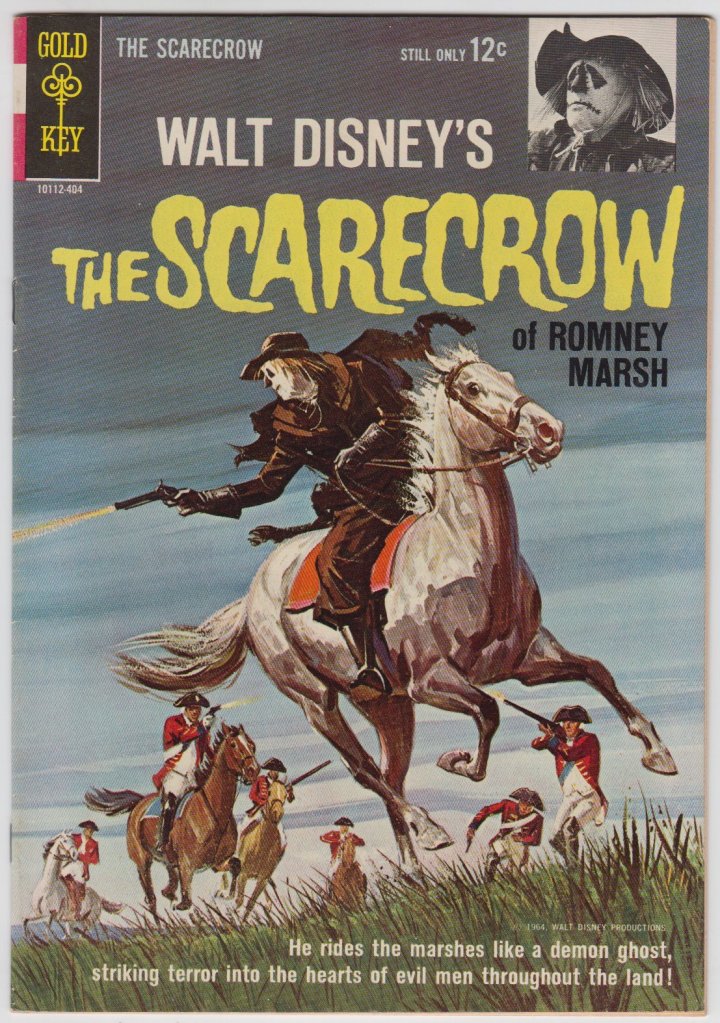
The Scarecrow of Romney Marsh was produced for the Walt Disney’s Wonderful World of Color TV series. Shot on location in England, it was directed by James Neilson, who also made the Disney movies The Moon-Spinners and The Adventures of Bullwhip Griffin.
Patrick McGoohan (The Prisoner) plays Dr. Syn in three different parts, which were all edited together to run in British theaters as Dr. Syn, Alias the Scarecrow on a double feature with The Sword in the Stone.
Dr. Syn, a country priest, leads his rebels against the armies of the King of England, who is enslaving American colonists for his Royal Navy. Think of Zorro in the pre-Revolutionary War and you have a good idea of what this is all about,
The first part of the film deals with General Pugh, who has come to the New World to destroy the smuggling ring of Dr. Syn, who is dealing with a traitor in his midst. Finally, Syn rescues his men from General Pugh before faking his death.
I’ve always been fascinated by Dr. Syn/The Scarecrow, who is nearly a horror movie character within the Disney universe. I was so happy when Disney Adventures magazine started featuring his stories in the 2000s, even crossing his story over with Jack Sparrow from The Pirates of the Caribbean.
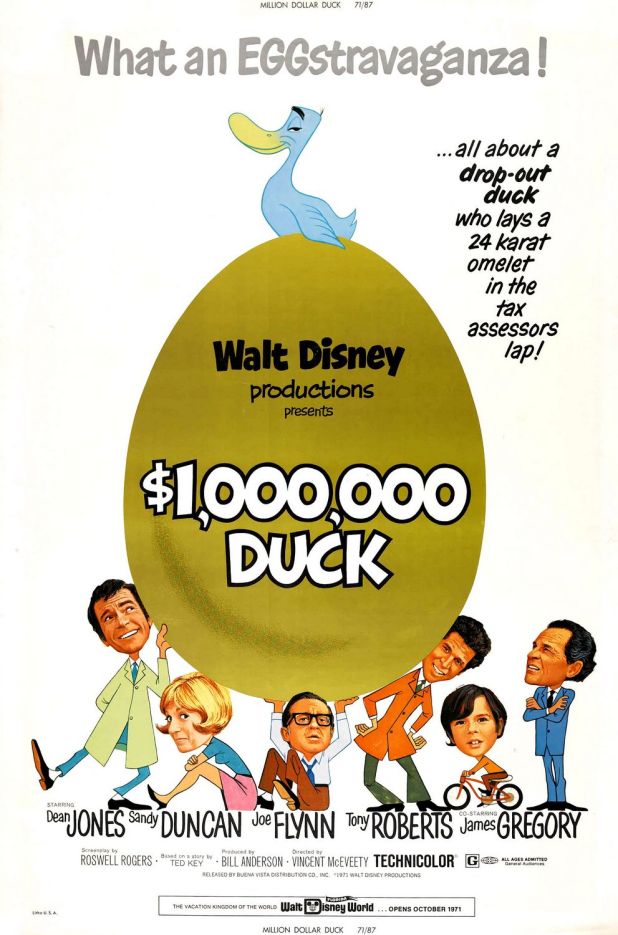
Dean Jones somehow ended his career appearing in St. John in Exile, a wacky stage play of Jesus’ last surviving disciple breaking the fourth wall and yucking it up with a largely religious audience. Up until then, I only thought of Dean Jones as the perptually angry young man of many a Disney movie. Seriously, his entire character is milquetoast white man with a way too attractive wife who has been driven to seething red rage usually because of some intelligent animal or anthromorphic automobile.
This time around, enraged Dean Jones is Albert Dooley, a scientist who is struggling with money woes. Things are so bad that his wife Katie (Sandy Duncan) packs him an entire lunch of just screwed up applesauce, but Albert the duck eats that, gets irradiated and starts laying golden eggs. And oh yeah — Albert’s son Jimmy had wanted a pet, so why not just him a duck that wil soon either die of cancer or gain superpowers? Lee Montgomery never got a few animals and nearly killed a whole bunch of folks, right?
It gets to the point where the golden eggs make Albert rich, so he just cuts his son out of his busy life just in time for Richard Nixon to decide that the duck must be captured to save America.
Gene Siskel only walked out on three movies. One was Maniac, another was Black Sheep and this was the third. Roger Ebert said that it was “one of the most profoundly stupid movies I’ve ever seen.”
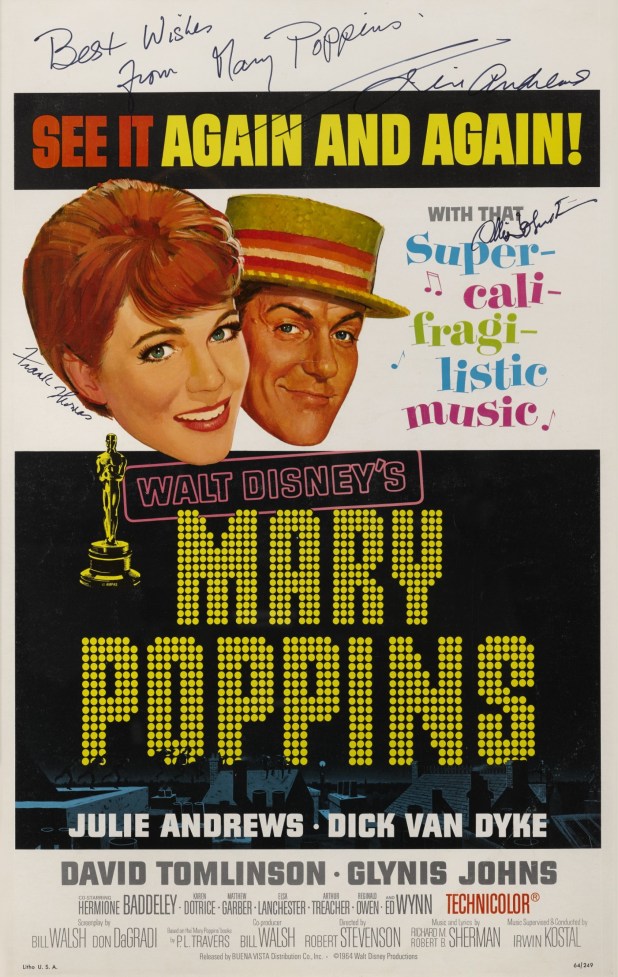
Starting with Johnny Tremain, Robert Stevenson made a career of directing some of the best movies that DIsney made, such as Darby O’Gill and the Little People, The Absent-Minded Professor, That Darn Cat!, Bedknobs and Broomsticks and many more. Of all these movies, Mary Poppins is the best considered.
Beyond being a commercial success — It was the highest-grossing film of 1964 — Mary Poppins received a total of 13 Academy Awards nominations and won five: Best Actress for Julie Andrews, Best Film Editing, Best Original Music Score, Best Visual Effects and Best Original Song for “Chim Chim Cher-ee.” This would be the only time in Walt Disney’s lifetime that he’d see that kind of recognition for one of his studio’s films.
Disney first attempted to purchase the film rights to Mary Poppins from P. L. Travers in 1938. Travers refused, as she didn’t think that a film version would work. For two decades, Disney tried to make the movie until Travers agreed in 1961 with the condition that she receive script approval, finally being listed as the consultant to the film.
She wasn’t a fan of the film, feeling that it cut down too many of the rougher aspects of Poppins, didn’t like the music and truly disliked the animation. The result? She ruled out any further adaptations of the later Mary Poppins novels.
Travers was not invited to the premiere but managed to get an invitation from a Disney executive. At the after-party, she walked up to Disney and loudly informed him that the animated sequence had to be removed. Disney responded, “Pamela, the ship has sailed” and walked away.
While the film is really about the redemption of George Banks as Poppins brings his family together, as I saw this as a kid at the Super 51 drive-in, it was really a chance to get a longer episode of The Dick Van Dyke Show, one of my childhood favorites.
It also had to be some kind of victory for Julie Andrews, who made her feature film acting debut after a successful stage career. She had just dealt with Jack L. Warner, who had replaced her with Audrey Hepburn for the role of Eliza Doolittle in his screen adaptation of My Fair Lady, despite her originated the role on Broadway. It’s pretty amazing to do that — Disney even held up production so she could have her first child — and win the Best Actress Oscar.
If you ever want to see the lasting legacy of this film today, take a ride on the Walt Disney World Monorail System, which this movie paid for. The safety system on all of the train cars is called the MAPO (MAry POppins) safety system and all Walt Disney World Railroad steam locomotives are fitted with a boiler safety device marked MAPO.
How can sharks get into a cornfield? Who would name their town Druid Hills? Why would you let a serial killer sit in the back of your police car? How did Stonehenge get to Kentucky?
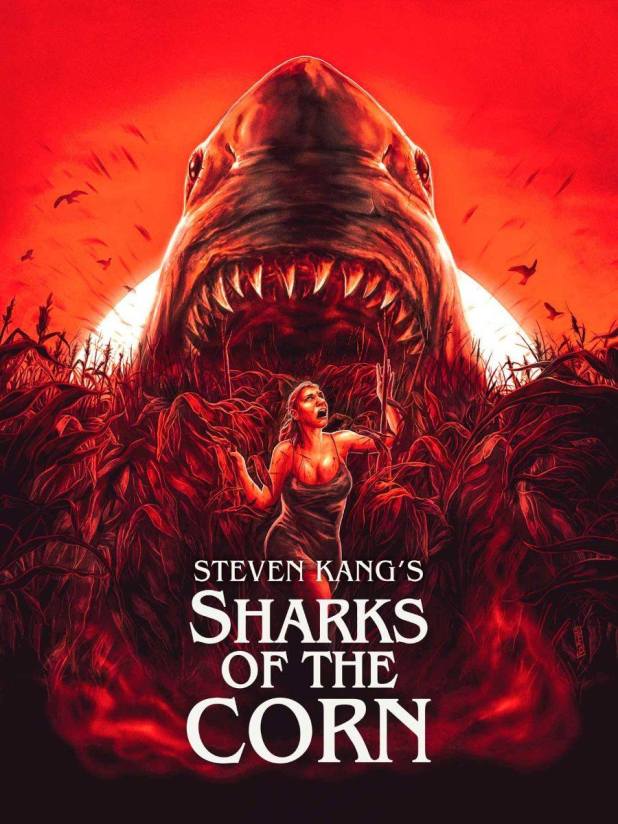
Tim Ritter (Hi-Death is his last movie we reviewed, but his career goes all the way back to Day of the Reaper which was shot for $1,000 in 1984) wrote and directed this one and man, that poster really speaks to me. There’s also a great scene where a computer shows the sharks swimming through the rows of corn and it looks a lot like Frogger. And man, how many lines from Jaws can you get into a movie?
There’s a serial killer named Teddy Bo Lucas, an FBI agent with his own agenda, shark cults, Bigfoot and a scene that has so much surface noise that it sounds like they put more noise over the top of it to hide it, which means that every word was a complete jumble. Also, lots of driving. Also — a child gets killed and sprays blood all over his dinosaur frisbee while his parents hold one another and cry. Also, still more driving around.
I mean, the main character’s name is Sheriff Scheider. If that makes you laugh, then this is completely the movie for you.




 B&S About Movies
You must be logged in to post a comment.