While the rest of the world was losing their mind over The Matrix, David Cronenberg quitely released this movie, a tale of alternate realities that is a way bigger idea inside a way smaller movie.
Sometime in the future, Antenna Research and Cortical Systematics are in a war with one another to make the latest and greatest games for their biotech virtual reality game consoles. These game pods are living and breathing creatures that have UmbyCords that directly connect into anus-appearing bio-ports on the users’ spines.
If you read that paragraph and don’t say, “What?” then this is the movie for you.
The cold war between these two companies is only increasing, where a religious group called the Realists fights for people to stop deforming the nature of reality.
Antenna Research’s game designer Allegra Geller (Jennifer Jason Leigh) is showing off her latest game called eXistenZ when one of those Realists tries to murder her with an organic gun. Her security guard and publicist Ted Pikul (Jude Law) rescues her and together, they go from fixing the broken pod to inserting it into Law’s body to continually going deeper and deeper into the game.
Exactly when the game starts and ends is up to the viewer, but along the way you’ll be treated to more twists, turns and red herrings than several giallo, as well as an astounding setpiece where a disgusting living Chinese appetizer is transformed into a biomechanical weapon.
Inspired by an interview he did with Salman Rushdie, Cronenberg worked with Christopher Priest — who wrote* the novel that The Prestige is based on — to come up with this story. And if you’re wondering, “Is the title just wacky 90’s spelling of things?” The answer is yes and no. The truth is that in Hungarian, the word isten means God, so it’s a play on words. This was also Cronenberg’s first original script since Videodrome, a movie that this has plenty in common with.
And yes, this is totally a cyberpunk film despite not having Ministry on the soundtrack or rock stars in the cast. That’s because the fast food that the main characters eat comes from a restaurant called Perky Pat, a direct reference to Phillip K. Dick’s The Three Stigmata of Palmer Eldritch.
*Priest also wrote the novelizations for Short Circuit and Mona Lisa.
We, the lost analog-cum-celluloid denizens of the (digital) pages of B&S About Movies are here to partake of another one of our “theme weeks,” in this case, all of those “ancient future” computer movies of the ’80s and ’90s that made the Internet more amazing and more frightening than it actually is. For those were the golden days of Hollywood — before thumb drives and clouds — when Tinseltown could dupe us with mere oscilloscopes and strips of magnetic tape — especially when a cute girl is running said scopes and cutting said tape. Hello, hook. Nice to meet you, line and CRT monitor.
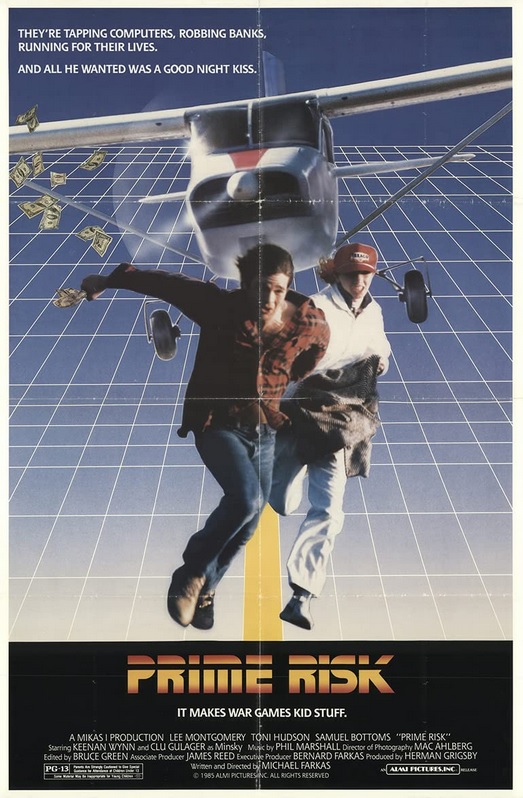
Art Department fail. Would you lay down $3.25 to see this in a theater?
Only 22 at the time of making the film, writer/director Michael Farkas came into his technical knowledge courtesy of his father who worked in IT security; as result, Farkas, compared to us Asteroid and TRON addicts, was a “David Lightman” and knew a hell of a lot more than we did about what made our Apple IIs and Commodore 64s tick. So, while the techno-gobbledygook, knob-twirling, scope-bouncing waveforms, and ticking red-LEDs are dated now, he was cyberhuskin’ then, since the tech was relevant and accurate to the times — hook, line, and cybersnakeoil.
Films like Prime Risk are a byproduct of those pre-AOL days when most of the world lacked computer knowledge beyond their Atari gaming system and quarter-swallowing arcade games. Moi? At the arcade: Defender and Xevious was my jam; I was rockin’ out with Space Defender on my Apple II packing a whopping 64kb of RAM. Who cared how it worked? All we knew is that we could punch in the number “7 7 3 4” into the red-LED displays of our Hewlett-Packard HP-35s and Texas Instrument TI 1200s and, when you turned it upside down, it spelled “H E L L” (calculators of the day used the “open” four, which resembled an upside-down “h”). Hey, my Commodore 64 had a “brain,” it would play 3D Tanx and recite whatever I typed: profanity, of course. So, thanks to our technological gullible intrigue, Hollywood could sell us on the bleeps n’ bloops anyway they saw fit: who knew that, with an (cathode-ray) oscilloscope and some strips of cassette tape, you could rule the world?
How? We weren’t even dialing-up by AOL, yet. We still had to insert a 5.25″ initialization disk to boot the system, Dr. Charles Forbin, be damned.
So, you heard of the tales of Joshua, the “son” of Professor Falken, aka “WOPR,” in WarGames, right? Well, take that movie . . . and recast Matthew Broderick and Ally Sheedy with dream-hunky Lee Montgomery (the all-grown up kid from Ben, the sequel to the original rat movie, Willard) and heart-weeping Toni Hudson (of the well-remembered ’80s comedy Just One of the Guys; the not so well-remembered School Spirit). Then replace Dabney Coleman (who I can always do without) with lovably-cranky Keenan Wynn (Laserblast) as the villain, and toss in a helping of Sam Bottoms (Up from the Depths) and a soupçon of the always-awesome Clu Gulager (Return of the Living Dead, Hunter’s Blood) as doubting-Thomas, good guy FBI agents. And — most importantly — reverse the roles: make the girl the hacker and the guy the ne’er do well “romantic” sidekick. And — even more importantly: instead of stopping nuclear Armageddon, we’re stopping financial Armageddon. Oh, and ditch WOPR for an oscilloscope. . . .
So, are these kiddie-tech proceedings worse than WarGames . . . yet better than the smartass-kid-makes-a-nuclear-bomb box office bomb that is The Manhattan Project?
Yes!
Welcome to the pre-AOL cyberworld of Prime Risk. Pfft. War Games are kid stuff. Hacking computers is Risky Business!
Julie Collins (Toni Hudson) is a still-in-high-school computer engineering genius who applies for a part-time job at a local bank. Of course, this being the ’80s, the head IT job at a bank is a “man’s job.” Julie vows revenge. So, packing 128ks of RAM and an oscilloscope, she deciphers the magnetic pulses from the bank’s ATM machine, converts the electromagnetic cycles into tones, and translates the beeps ‘n boops into PIN numbers. Then, with hunks of plastic and analog tape, she burns off her own ATM cards. And as Julie, along with her cash-strapped-I-hate-my-dad school chum, Mike (Lee Montgomery), they stumble into a Russian plot to crash the Federal Reserve and collapse the U.S. economic system.
So, did you get that? The U.S. economy can be wiped out by mastering the art of magnetic information storage and retrieval — and knowing how to operate an oscilloscope. Is that conveniently-labeled “Remote Jammer Transmitter” on loan from the Batcave?
No freebies on this one, kiddies. MGM owns the rights and Park Circus handles the distribution. So while it’s not available on DVD, you can stream it on Amazon Prime. As such: here’s the unofficial trailer upload; we hope it is still there. . . .
Thanks to incessant HBO replays (Over the Edge!) this forgotten, post-WarGames “ancient future” frolic turned into a well-deserved cult classic. And we have to give Farkas credit: he was the first filmmaker to the marketplace with a teen-tech hero clone, beating out the bigger studio/director WarGames-hopefuls Terminal Entry and Defense Play to the theaters. Courtesy of an extensive, May 2020 interview with writer-director Micheal Farkas at the Australian site Cult Film Alley, you can learn more about the film’s production history. (Anthony Edwards (Top Gun) instead of Lee Montgomery? Darren McGavin (The Night Stalker) instead of Keenan Wynn? Wow. Fascinating film facts, Cult Film dudes!)
Be sure to look for my reviews of Terminal Entry and Defense Play as we continue to roll out our week-long tribute to computer flicks of the ’80s.
About the Author: You can learn more about the writings of R.D Francis on Facebook.He also writes for B&S About Movies.
If you wanted to see an “ancient future” movie directed by a filmmaker who worked on West Side Story (as a script supervisor) and with Elvis Presley on Kid Galahad (as an second assistant director), then this is your movie.
That filmmaker eventually made a film that a Southern California video store clerk later adopted as the name for his home video reissues imprint: the filmmaker was Quentin Tarantino and the movie was ultimate Vietnam revenge flick, 1977’s Rolling Thunder.
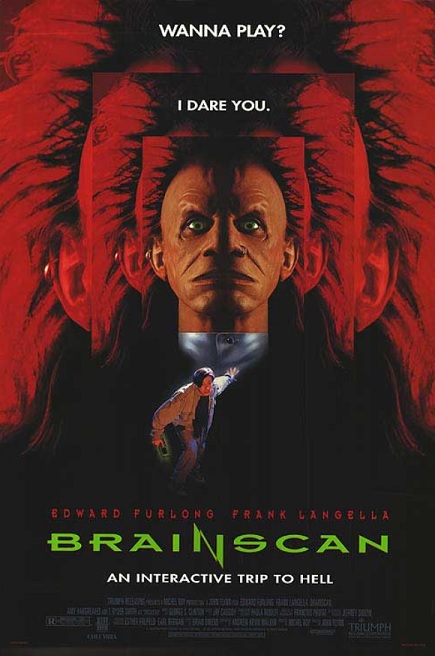
Then that filmmaker made the only other movie that we care about starring Edward Furlong. Well, at least for us hard rockin’ video game lovin’ loners who only rented horror movies and devoured copies of Fangoria (the copy of Fangoria magazine where the faux “Brainscan” advertisement appears is Fangoria issue #95/August 1990).
And we remember that movie, not so much for the fact that John Flynn directed it and “John Connor” starred in it, but that noted session musician and soundtrack composer George S. Clinton scored the film and made it sound like a Halloween sequel. Then there’s the fact that alt-rock and grunge was all the rage at the time, and this time, instead of rockin’ on Guns and Roses, John Connor was into (the cool, but second and third string Seattle bands) Mudhoney and Tad, as well as Butthole Surfers and Primus — and a really cool tune “Shapes” from a 4th string Seattle band, Alcohol Funnycar, and Philadelphia’s they-sound-like-they’re-from-Seattle-but-they’re-not-Nirvana Dandelion with “Under My Skin.”
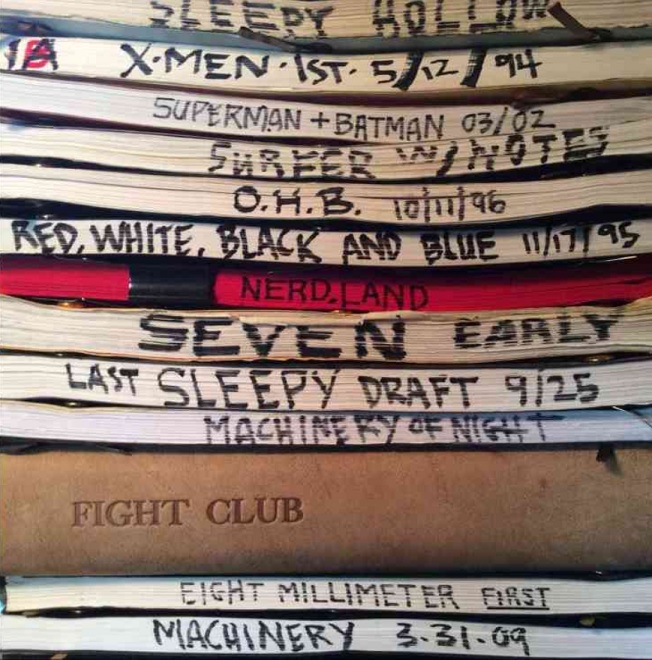
Oh, and some screenwriter from Mechanicsburg, Pennslyvania, out in little ol’ Cumberland County — who wowed us with the noir-slasher Se7en (1995) and gave us the Cage in 8mm (1999) — wrote it. (Check out our “Nic Cage Bitch” career retrospective.) And proving that everyone has to start somewhere in the business: Andrew Kevin Walker’s first job in the business was as a scenic painter on (the utter abysmal) Robot Holocaust (1986). If you know your comics, then you know Walker’s place in the Marvel and DC-verses with his shelved adaptations for Silver Surfer and X-Men, as well as Batman and Superman.
Boy, I can relate. Andrew Kevin Walker QWERTY’ing the midnight oil/image courtesy of The Fincher Analyst.
Okay, enough of the movie and music nostalgia. Now for the behind the scene turmoil.
“Frank Langella is a prince of a guy and a wonderful actor. He really nailed that character. Frank took what was a routine cop part and lent real depth to it. He played against the tough cop stereotype, played it very gently and softly, but there was a subtext of steel. His Detective Hayden character had a very human concern for the boy, but he was going to find the truth. If it meant the destruction of this boy, so be it.”
Okay, but what about Edward Furlong?
“Eddie Furlong was a 15-year-old kid who couldn’t act. You had to ‘slap him awake’ every morning. I don’t want to get into knocking people, but I was not a big Eddie Furlong fan.”
And Andrew Kevin Walker’s script?
“The main interest for me was the Trickster character. The Trickster was the core of the movie and what attracted me to the script. We found this stage actor [T. Ryder Smith] to play the Trickster and he was extraordinary. . . . Walker had thoroughly researched that whole VR scene.”
And that sums it up: We’ve got a great, ominous-appropriate score by George S. Clinton (the whacked musical The Apple, Cheech and Chong’s Still Smokin’). A great soundtrack by then timely-hot grunge-and-not-grunge bands. A great, well-researched script by Andrew Kevin Walker (that gave him his start in the business) directed by John Flynn — in his first horror film — knocking it out of the park. And, as Flynn — and Shock Cinema’s editors pointed out — we have a great villain in The Trickster in T. Rider Smith as “a cadaverous Alice Cooper-like entity who materializes from a CD-ROM computer game.”
Regardless of the problems with Furlong on the set: I think he’s just fine, here (and really good in 1989’s American History X; if that movie was made today, yikes; people would go social media insane over it). But T. Ryder Smith? Just wow and a bag o’ chips. Not since Anders Hove as Radu Vladislas in Subspecies (1991). Sure, The Trickster isn’t a “vampire” in the traditional sense, but I can’t help think Walker was influenced by the Amicus and Hammer vampires of old, as our virtual reality “vamp” is draining the will — the soul — of the user. I see The Trickster as one of the best — right alongside Tom Cruise’s take of Lestat in Interview with the Vampire (1994) — in contemporary film vampires. Is there a little pinch o’ Pinhead from the Hellraiser (1987) franchise, here? Sure. And I always align The Trickster with Sammy Curr (a “backmasked” vampire, if you will) from the “No False Metal” classic Trick or Treat (1986) (now that’s a Groovy Doom Saturday Night Double Feature watch party: Brainscan and Trick or Treat). If Edward Furlong was an aspiring rocker or just a ne’er-do-well metalhead of the Eddie “Ragman” Weinbauer variety. . . .
There’s so much that Andrew Kevin Walker gets right in Brainscan: in fact, everything that the ancient future-cum-erotic thriller Disclosure (Sam and I both take it to task this week; look for them) gets wrong, Walker gets right. Sure, CDs and CD-ROM drives are passé — and you’d be hard-pressed to find a laptop with a CD-drive today . . . well, hell . . . The Trickster spinnin’ those disks on his long finger nails. Just damn. Demi Moore’s evil bitch has nothing on The Trickster. Snake Plissken rippin’ out the analog tape of a K-Mart Kraco cassette of the 1997, John Carpenter-mission-critical variety just ain’t the same. Walker’s script is the prefect amalgamate statement on the Gen-X counterculture’s obsession with rock music and horror movies — an already troublesome mix in itself — colliding with computers and its growing development of violent video games.
Micheal Brower isn’t that far removed from Eddie “Ragman” Weinbauer: both have absentee parents and spend their days in, well, the coolest bedrooms, ever: the kind that only exist in the movies. Only difference: Micheal is ye not plugged into devilish metal music, but the (then) burgeoning world of the Internet and computers — and enthralled by a new subset of that digital-verse: the digitally-created worlds of virtual reality programming.
A mother dead in a car crash. A kid with a permanently disabled leg. A father who escapes into his career. Bullies. One lone friend. And a hot, next door high school classmate that won’t give him the time of day. Childhood trauma. Abandonment. And just plain horny. Perfect pickings for The Trickster because, well, David Lightman is too smart for the VR scam and is starting WW III with a IMSAI 8080. And The Trickster’s already upgraded to a brainfucking Memorex Telex IBM/PC.
Only, Brainscan, the latest in video game technology, isn’t a video game: it’s a murder simulator, a program that encourages one’s most murderous impulses. And young Michael comes to discover: whoever dies in the game, dies in real life. And he’s killed best friend, but Michael’s mind is so scrambled, he doesn’t remember.
The Trickster — what I love about Walker’s character development in ambiguity — is that we don’t know “what” the host of Brainscan is. As Proteus in Demon Seed (1977) before him, is The Trickster a sentient computer program turned flesh or, as with Max Renn in Videodrome (1983) before him, a manifestation of young Michael’s own needs, wants, vices, and desires? Or is The Trickster just a digitized Freddy Krueger who, instead of dreams, uses the information super highway-expressway into one’s skull?
It’s eerie how Andrew Kevin Walker foretells the forthcoming, 1999 Columbine tragedy — with that cauldron of violence spiced with the occult and satanic-panic — that associated the music of shocker-rocker Marilyn Manson and the industrial/goth bands KMFDM and Rammstein as underlying causes. Then there was the liberal reasoning that the home computer-based video games of Doom, Wolfstein 3D, and Duke Nukem were the causes. To that Columbine end: In addition to Walker effectively researching — and getting it right — the burgeoning virtual reality-verse, I wonder if the legal atrocities of the 1986 West Memphis 3 case, and the seminal British metal band Judas Priest “subliminal messaging” (via their 1978 album Stained Class) teens into murder and suicide, which also bit Ozzy Osbourne in the arse by way of the song “Suicide Solution” from his 1980 debut album, Blizzard of Oz, played into Walker’s screenwriting research.
Just a great film all around, Mr. Walker and Mr. Flynn. A true computer and alt-music time capsule. And a foretelling tale of our today’s online gaming and social media addictions. Beware of the true biblical beast. He’s waiting to plug into you.
Hats off for Sam the Bossman devising an “Ancient Future” theme week inspiring me to rewatch this debut work from Andrew Kevin Walker again, all these years later. And shame on me for not searching the B&S About Movies’ database to see that if we already reviewed this film — ugh, we did, courtesy of Sam back in June 2019, when Mill Creek appropriately double-packed Brainscan with another “ancient future” lost bit n’ bytes romp, Mindwarp(1992), from Fangoria Films/Magazine (!) starring Angus Scrimm and Bruce Campbell. (Ironically, The Trickster is a computerized version of The Tallman from Phantasm, right? Too bad T. Ryder Smith didn’t get a franchise out of this, as he is astounding in his role.)
There’s just too many movies to keep track of . . . and so many more to review. At least I caught myself before rehashing Mindwarp, for it ain’t no Brainscan, but it’s still pretty cool. You can watch Brainscan as a free-with-ads stream on the Crackle online service.
About the Author: You can read the music and film reviews of R.D Francis on Medium and learn more about his work on Facebook.
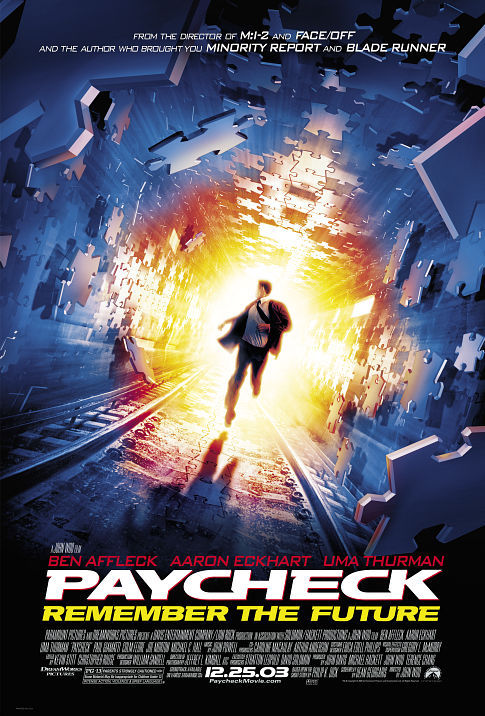
Some rules that I have established of “Is this an ancient future cyberpunk movie?” I will answer some of these to determine the veracity of Paycheck‘s status.
Does it have the title of a Philip K. Dick book but not really have much to do with it?
Yes, it’s based on his story Paycheck which originally appeared in 1953.
Is there a lot of rain?
Not as much as others in the genre.
Does the male hero wear dress clothes and/or a trenchcoat?
It’s a black tie affair.
Do Keanu Reeves, Ben Affleck, Dolph Lundgren or Udo Keir appear in it?
Affleck makes it.
Does the internet do something it can’t do yet, yet look dated AF?
Yes. Also, there’s a discussion of memory sizes, which no speculative science fiction should have, because people brag about their brain holding meg file sizes or less and in 2021, we just say, “Oh. That’s the size of a text message.”
Are Stabbing Westward, KMFDM, Ministry or God Lives Underwater on the soundtrack?
No, but they did have to pay to use “Happy birthday.”
Is it a crappy version of Blade Runner?
Aren’t they all?
Are there numerous Asian-influenced scenes?
It’s less Asian influenced than made by the man who everyone copied by putting a bird on their action scenes, John Woo.
Do people use future terms that make no sense?
Yep.
Are there a lot of whirring sound effects?
Always.
Do people stare at the camera as it moves through a neon-lit strip club?
Often.
Are there rock stars in it?
No, sadly.
Is there a feral child?
I kind of wish there was.
When this was made, Paycheck was Ben Affleck’s biggest check, earning him $15 million. When asked why he starred in the film, he responds “The answer lies in the title.” He also lobbied to change his character from a Yankess to a Red Sox fan.
Woo was trying to make a Hitchcock-style movie and get away from what he was known for and Affleck begged for a Mexican standoff scene and got his way.
Affleck plays reverse engineer Michael Jennings, who analyzes the tech of his clients’ competitors and then improves it. He keeps his clients’ intellectual property safe by repeatedly having his buddy Shorty (Paul Giamatti) wipe his brain clean. Now, he’s stuck in a conspiracy with only clues from his past self to guide him, which is a lot like Total Recall, another Dick story turned film.
Now that he’s made a machine that predicts the future — then made himself forget — past Ben wants future Ben to stop that machine from falling into the hands of CEO James Rethrick (Aaron Eckhart), who is using a fake version of our hero’s love interest Rachel Porter (Uma Thurman) to get him to reveal the secrets he’s learned.
Affleck won a Golden Raspberry Award for Worst Actor for his performances in this movie, Gigli and Daredevil, going on Larry King Live to accept and break the award, which was auctioned off and paid for the hall rental for the following year’s award show.
Michael Crichton is the storytelling engine behind so many of the Ancient Future genre that we’re talking about all this week, someone who was ahead of his time at one time and now, we can look back at his films and say, “Wow, that future sure got old.”
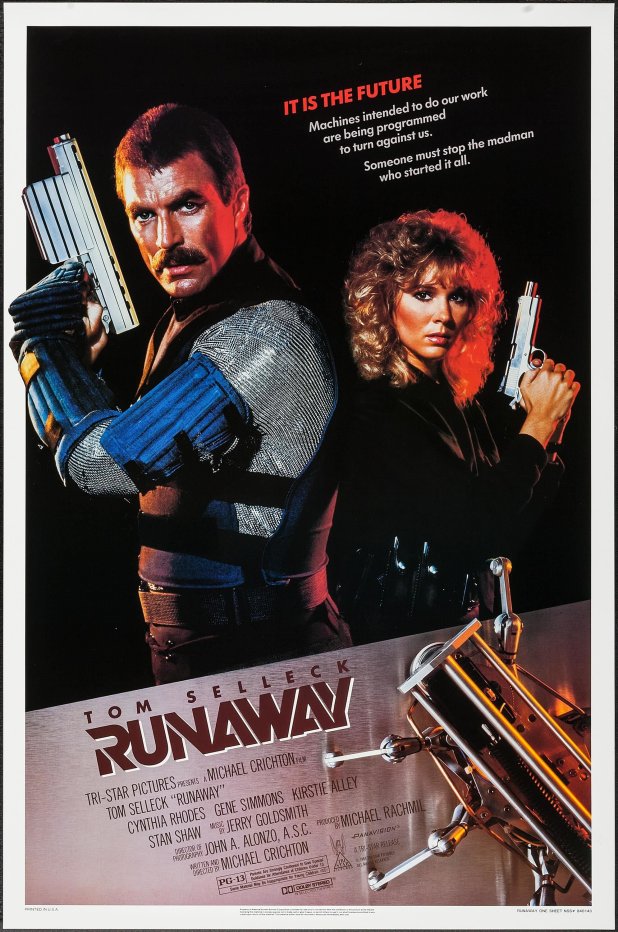
Before he was doing ads about reverse mortgages where he has to outright tell you that this scam is not a scam, Tom Selleck ruled the world, turning down Indiana Jones for Thomas Magnum and then making this movie where he played Sgt. Jack R. Ramsay, an expert at stopping robots and machines gone wrong or “runaways.”
He used to be a real cop, but his fear of heights caused him to pause, which let a criminal escape and a family to get killed. The on the beat police look down on his robotic patrol, but his new partner Karen (Cynthia Rhodes, Penny from Dirty Dancing) is super into it. And now there’s an actual homicide by robot and untrackable computer chips and an evil genius named Dr. Charles Luther (Gene Simmons, of course) behind it all.
He’s out to kill an ex-lover (Kirstie Alley) who is trying to sell his inventions to the highest bidder. I mean, she’s right to do so, because he’s made some stuff that doesn’t even exist 37 years later, like bullets that lock onto their targets and have cameras on them to guide them to kill whomever they target.
The end of the film has the battle we’ve always wanted, Selleck vs. Simmons, on a skyscraper under construction guarded by robotic bugs that spit poison.
And in the middle of all this tech, G. W. Bailey gets his Police Academy role as Lt. Harris from started early as the chief of police.
Crichton didn’t just write this one. He directed it, too. He did the same for Pursuit, Westworld, The Great Train Robbery, Looker, Physical Evidence and Coma, which had a small part for Selleck.
For all the fun I make of these old tech films, this one was pretty on the ball when it came to predictions of today. Sure, we don’t have bullets like that, but we do have robot vacuum cleaners, the Internet, voice-activated computers, social media, retinal identification, drones, laptops and police officers armed with semi-automatic guns.
What’s really interesting about Runaway is that it was the favorite movie of Romanian dictator Nicolae Ceausescu, who brought up Tom Select and his character from this movie numerous times during the 1989 trial that led to his execution.
When the net meets sex . . . you’re screwed. — the tagline that never was
“A feather is sexy. A whole chicken is erotic. A rooster will get you into the kinky. Are you into poultry, Nick?” — the greatest line Catherine Trammel never spoke
While the “video nasty” was our analog-rental de rigueur in the ’80s, it was the titillation of the psuedo-Giallo* and faux noir plotting of the “erotic thriller” that was our fashionable, digital-rental in the ’90s — and their bastardized, low-budget “after dark” soft-core variants of ne’er-do-well successful surgeons, kinked detectives, and tool-literate, hunky-handyman drifters were our required Cinemax/Showtime cable-viewing. Call those ’90s eroticisms what you will: a sexed-up ’50s detective thriller, or an ersatz-porn or a non-psychosexual Giallo of the ’70s, but the genre captured the creative pens of Hollywood and the contractual clauses of A-List talent agents. The first leading man to answer the call to . . . ahem, for the sake of keeping this review clean, we’ll just say, “arms,” for modern Hollywood’s new take on the likes of Double Indemity (1944) was Michael Douglas.
Double Indemity (1944) vs. Basic Instinct (1992).
Can you hear Micheal Douglas salivating Fred MacMurray’s line, “That’s a honey of an anklet you got there, Ms. Dietrichson,” as a widowed Barbara Stanwyck gives him a hint a vagina? Or Fred MacMurray substituting the p-word in lieu of “anklet,” as Babs remembered the anklet, but forgot the undergarments? Ain’t no men in the ’90s gazing at any anklets, baby: the days of Ricky and Lucy Ricardo and Rob and Laura Petrie bunking down in nightstand-separate twins beds are long since over: bring on the WAP. For these are the days that it’s societal acceptable for Cardi B. and Megan Thee Stallion performing a pseudo-lesbian stripper show on national network TV to mass applause and cheers and for musical tributes to the vagina to rise up the charts to Grammy recognition and acclaim.
During that short-lived sex-noir genre of the early ’90s — that crossed Antonioni’s Blow Up (1966) with Bertolucci’s Last Tango in Paris, while adding a soupçon of the Golden Age of Porn’s Deep Throat (1972) and a smidgen of Argento (the faux-noir detective had to start his sex-spiral, somewhere) — the son of Kirk Douglas (Saturn 3) was the crowned king of the bare-bottom courtesy of the one-two box-office hip-thrust of (the lighter fare) Fatal Attraction (1987) (and the amped-up) Basic Instinct (1992). But while Adrian Lyne and James Dearden’s sex frolic was a hit, Glenn Close’s (Ol’ pop, with his Austin Powers-imitation anytime it cable replayed: “It’s a man, baby!” and “What man in is his right mind would cheat on Anne Archer with Glenn Close!”) Alexandra “Alex” Forrest was no match for Sharon’s Stone’s Catherine Tramell — courtesy of that notorious Eszterhas-cum-Verhoeven scene in the police interrogation room. And ol’ Cat was no rabbit-boiling wrist-silting shirking violet: Cat was a full-on Giallo bi-ice picker possessed with Lucio Fulci’s and Umberto Lenzi’s eyeball trauma fetishism.
Ladies and gentleman: we have our blue-print for the “erotic thriller” of the ’90s.
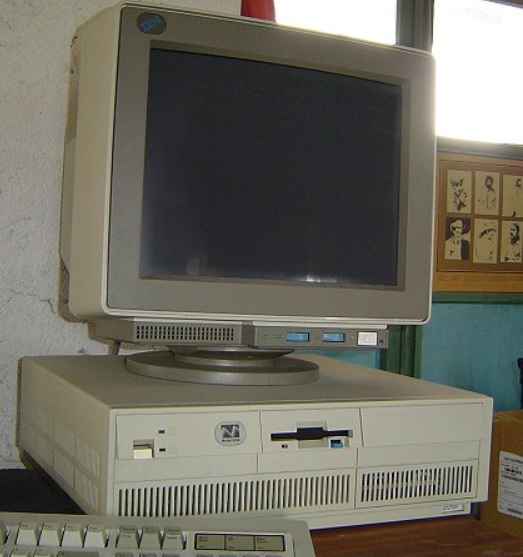
Art department fail: they should have ran an image of a binary bits and bytes curtain in those dead white spaces.
And the pants fell and the legs opened with one Eszterhas-clone after another: Sea of Love (1989) (Okay, that’s more of the Fatal Attraction-variety, but Pacino!), A Kiss Before Dying (1991) (Argh! Don’t sex-remake noir classics!), Poison Ivy (1992) (Eh, if you’re into Drew.), Single White Female (1992) (Standards-and-practices lesbian lore), Color of Night (1992) (Bruce Willis begins his career spiral.), Consenting Adults (1992) (Alan J. Pakula? Dude, you directed Klute and The Parallax View, not to mention scoring Oscar gold nods three times? Why did you do it?), Sliver (1993) (Oh, Sharon, it does not strike twice; the worst of the bunch.), Body of Evidence (1993) (Oh, Madonna! Why, Willem Dafoe. why?), Indecent Proposal (1993) (Robert Redford? Don’t worry, Demi’s returning. . . .), The Last Seduction (1994) (The most underrated of them all!), Jade (1995) (David Caruso quit NYPD Blue, for this?), Showgirls (1995) (Eszterhas and Verhoeven return for a match-made-in-box office-hell.), Wild Things (1998) (Denise Richards ain’t no Sharon Stone.), and The Bondage Master (1996) (the no-one-knows Japanese V-Cinema classic that gets it oh-so-right and is the requisite B&S About Movies “erotic thriller,” if we must pick one.).
It’s curtains for you, Mr. Sanders!
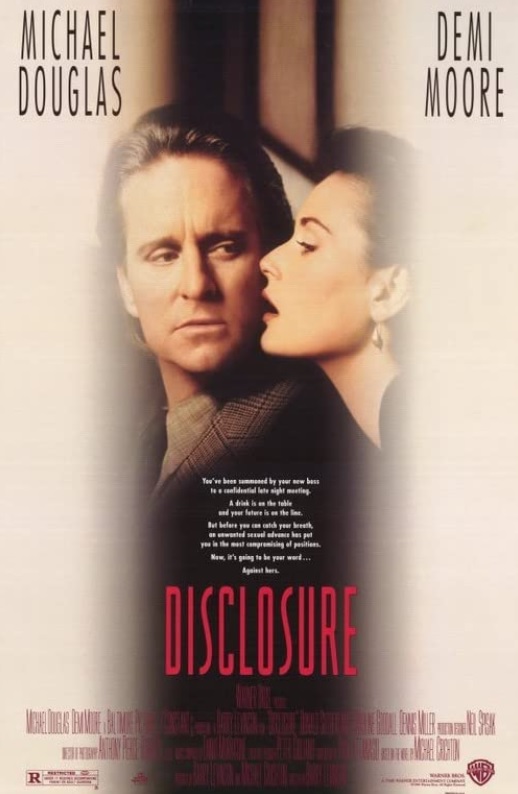
But for this latest installment of one of B&S About Movies’ patented theme weeks — this week, it’s “ancient future” — we picked the third film of Micheal Douglas’s sexual triumvirate — and, if you’re keeping track: tres for Demi with Indecent Proposal and Showgirls — Disclosure.
Oh, Hollywood, your fascination with the erotic was only matched by your kid-in-the-Radio Shack tomfoolery when you told us the Internet — with a single keystroke — could do anything. You warned of a world were hacks were as easy as a car service or food delivery app-touch away. It would be a world where the introverted and the shut-in; the malcontent bookworm and the bullied brainiac, would lord over the extroverts, telecommuting over phone lines and cyberpunking us as they open their hearts and souls on cyberchats to their digital lovers and digitally-ordered pizzas while us mere analog fools had physical sex and called-in our pepperoni pies.
For it was a time when the thumb drive was not a yet a twinkle in your Commodore 64-eye; it was an epoch-prediction that computer discs would become the linchpin of our existence; when CD-ROMs were lucrative; a world were malevolent hackers were out to erase identities and steal lives, manufacture rap sheets, alter job records, or murder you by infiltrating airline software and crashing your plane. Those who understood Basic HTML and navigated mainframes would master your domain!
Welcome to the world of Disclosure: a world where the clumsy erotic collides with the cyber stupid.
The Review
Tom Sanders (Michael Douglas) pines for a lucrative career promotion as the President of the CD-ROM division (which we now know: he’d be out of job, since you’d be hard-pressed these days to find a laptop with a drive), in lieu of his less-prestigious production line manager gig at DigiCom. Alas, when his company’s merger is about complete, everyone is shocked to learn that ready-to-retire founder Bob Garvin (Donald Sutherland) promoted-transferred the Malaysian-based Meredith Johnson (Demi Moore) — Sanders’s old girlfriend — to the Seattle main office for the job. And, in a role reversal that would never make it through the studio development stages in our post-#MeToo environs: she sexually forces herself on him. And when Sanders rebuffs the advance, her hell-hath-a-woman scorned response for career damage control is to accuse him of sexual harassment. And with a scandal of that magnitude jeopardizing the merger, “to hell with friendship” says Bob Garvin: he sides with Meredith because, it’s always money over friendship. Always. The fact that she’s incompetent and used cheap Malaysian slave labor to jam chips-by-hand instead of by-robot-arm into motherboards, which slowed down the production line stats for Tom and caused him to be passed over, well . . . Meredith is hot and Sutherland, we think, got a “boink” in the deal.
Tom Sanders is screwed . . . or is he?
Thanks to ’90s computer technology, he’s not.
He has DigiCom’s new Virtual Reality Database at his disposal: DigiCom is about to give us a world where we need keyboards no more; monitors are passe; touch screen and wireless technology never was. For now, we simply slip on a wired visor and pair of gloves to enter a digital cathedral of vaulted ceilings and virtual-lit transepts; a digital diocese with narthex after narthex of chambered file rooms rife with VR-cabinets that open with the glance of an eye and, if you’re lost amid the bites and bytes, you can call on an “Angel” to help you glide through the binary codes to save your ass and burn your foes.
Welcome to computer technology and corporate espionage circa 1994: a digital realm where tech giant DigiCom got so much so wrong and so much of what they developed is out out-of-date. There are the clunky mobile phones. The awkward navigation of an in-house e-mail application bogged down with jumbo-sized icons, a spinning “E” screen saver, and giant, unfolding envelopes every time you open an email. The inability — of a cutting-edge tech company that developed a VR-cathedral file cabinet — to trace anonymous emails — mails with espionage Intel that can jeopardize the company’s merger. Oh, DigiCom. How can a company so “cutting edge” develop VR-cathedrals, yet not improve on the design of giant CRT monitors? All this from a tech giant with engineers that decided ditching a WYSIWYG click-and-drag mouse-interface for a visor and gloves to retrieve files made perfect sense. No thanks, DigiCom. It’s Doug Engelbart’s mouse over Tom Sanders’s cathedrals for the win: I’ll just stick to the ol’ Windows Explorer directory tree.
Imagine if Sandra Bullock had to go through all of this VR-catherdal hokum to order a pizza when that HMTL-world she mastered became ancient history future.
Wow, now I’m hungry! Time for me to slip on my brain-computer interface (from Douglas Trumbull’s Brainstorm**) and jam-a-chip into the back of my head (à la Circuitry Man**). I need to order food for my chess date with Hal. Oh, that reminds me: I better log onto the IBM terminal and invite Colossus over (from Colossus: The Forbin Project). Yeah, ol’ Cal already knows, it’s just a social (media) formality.
* We LOVE our Giallo at B&S About Movies, which we blew out in grand style with our “Exploring: Giallo” examination, rife with our reviews to over 70 films. We also discuss ol’ Hal and Colossus, and their “ancient future” brethren, with our “Drive-In Friday: Computers Take Over the World” featurette.
** We’re unpacking Brainstorm and Circuity Man this week.
About the Author: You can learn more about the writings of R.D Francis on Facebook. He also writes for B&S About Movies and publish music reviews and short stories on Medium.
Sure, the internet existed in 1995 but in no way did it work like it does in this movie, which is perhaps most memorable for positing a world in which Dennis Miller has seen Sandra Bullock’s intimate parts and for also giving us the best pizza ordering site we’ve ever seen.
I’ve also realized that I watch a ton of Sandra Bullock movies — I wish I knew her well enough to call her Sandy — and she eats a lot in them. This video confirmed my theory.
United States Under Secretary of Defense Michael Bergstrom commits suicide after being informed that he has HIV. This ignites a tech-thriller where Angela Bennett (Bullock) never leaves the house and works, communicates and even orders food — seriously, that pizza ordering scene! — online. In 1995, this was considered the future. In 2021, after a year of living with a pandemic, it’s life.
After a vacation to Cancun, Bennett discovers that a backdoor she stumbled upon is part of a conspiracy and that the net itself has erased her from existence. Before you know it, she’s sleeping with hired killers and trying to get her life back while realizing that maybe she should have gone outside every once in a while.
This movie sums up the “ancient future” genre in the way that the internet looks dated yet can do things that it struggles to do today. Also, despite being someone who never goes outside and doesn’t care about how she looks, Bullock remains gorgeous. Such is Hollywood.
You may remember the direct-to-video sequel directed by this movie’s director Irwin Winkler’s son Charles. But did you know this was a TV series? Yep. It starred Brooke Langton — who was in the basic cable all the time double feature of The Replacements and The Benchwarmers — as Angela.
Now, you may ask, is this a cyberpunk film? Well, it has one reference. Angela’s drink of choice is a mix of gin and vermouth with a pearl onion instead of an olive. That’s a Gibson, a reference to one of the creators of cyberpunk, William Gibson.
Editor’s Note: As of August 2021, you can now watch The Inheritance as a free-with-ads stream on Tubi.As of Winter 2022, it’s appearing on several, U.S.-based Smart TV channelsas a free-with-ads stream.
The most enjoyable aspect of today’s indie-streaming films (they’d be direct-to-video back in the analog days of VHS and DVD) and indie distributor shingles like Uncork’d Entertainment is that U.S. audiences are treated with European films — this one from the Ukraine (in English) — that we would otherwise not see on U.S. theater screens and most likely miss on the shelves of our local, back-in-the-day Blockbuster Video.
As with most indie streamers, the budget on this haunted house horror is tight: $500,000. Unlike most indie streamers, the creative team behind it is not of the usual, inexperienced, first-timer variety not adept with the Canon Reds — or shooting on iPhones. As a producer, Chad Barager brought us The Woods (2013), Dark Harvest (2016), and Bitter Harvest (2017); here, Barager makes his feature film writing and directing debut. His co-director and writer, Kevin Speckmaier, has worked as an assistant director on TV’s syndicated Highlander (loved it), USA Network’s The Dead Zone (again, plus Anthony Micheal Hall is great in it), and numerous Lifetime and Hallmark movies (a couple of those cherished B&S About Movies X-Mas flicks). The Inheritance also serves as his feature film debut in the writing and directing chairs.
Latvian-born Natalia Ryumina is a multilingual British actress (including Latvian, Russian, and Ukrainian), who we’ve haven’t seen much on U.S. streaming shores, but amid her 20-so film and decade of credits, you may have seen her best known film, Soldiers of the Damned (2015). American (Indiana) born Nick Whittman made his business bones as a stuntman and transitioned as an actor with the National Geographic/FX series Mars (2016 – 2019); The Inheritance is his leading man debut. (Do you have Apple TV? You can watch Mars for free on that platform.)
So, with that front-of-and-behind-the-camera-pedigree, it’s not a surprise that The Inheritance walked away with a “Best Actress Award” for Natalia Ryumina at the 2020 Paris Art and Movie Awards: for an actor is only as good as the script, the film, and the other actors around them. It’s a tale about Sasha and Peter as they head off to Europe to collect on Sasha’s inheritance: a regal mansion. She soon comes to discover dark family secrets of the paranormal variety in her Ukraine family manor’s walls.
And that’s all I have to say about that, Forrest. This is that one time I am not plot-spoiling the beats. Just watch his film. I loved it and just can’t spoil this one, not this time.
The Inheritance premiered at the Catalina Film Festival on September 18, 2020. You can watch The Inheritance On-Demand and DVD in North America on April 13, 2021 from Uncork’d Entertainment. Producer Firepower Entertainment also gave us the five-episode mini-series Chernobyl (2019) staring the always welcomed Jared Harris and the always great Stellan Skarsgard.
Disclaimer: We were provided a screener by the production company’s P.R firm. That has no bearing on our review.
About the Author: You can learn more about the writings of R.D Francis on Facebook.He also writes for B&S About Moviesand publishes short stories and music reviews on Medium.
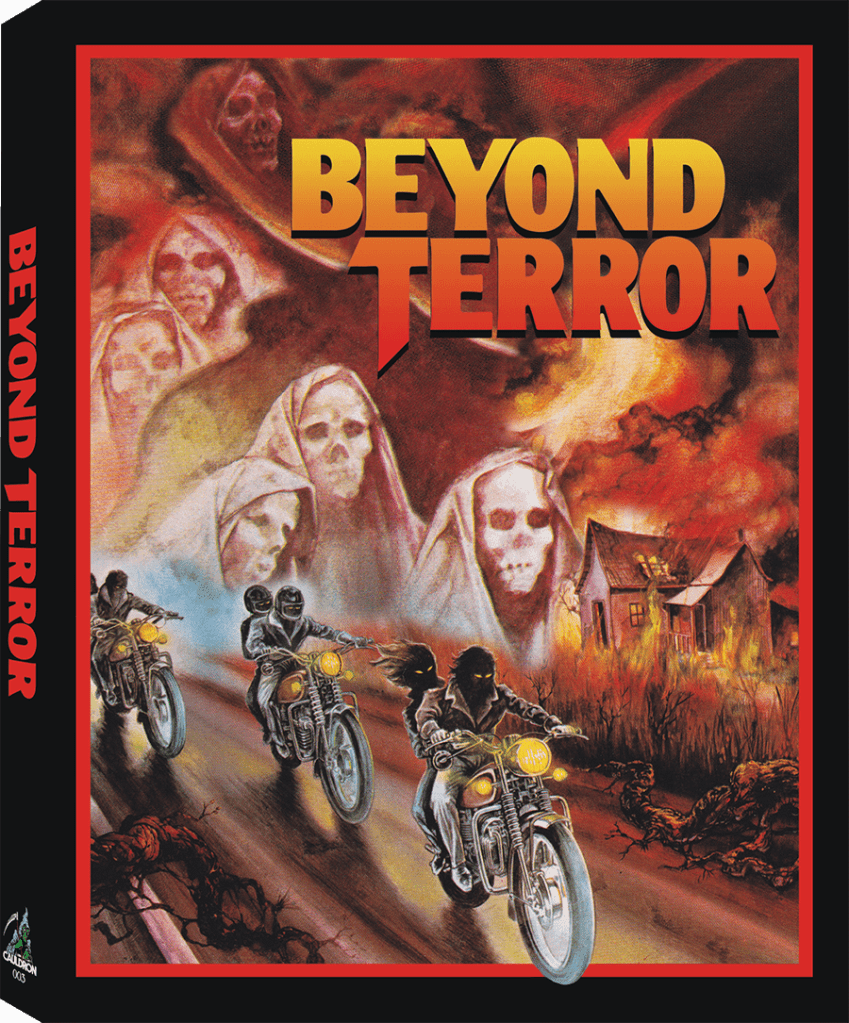
Cauldron Films has put our four movies* and as far as I’m concerned, they’re four for four.
Written and directed by Tomás Aznar, this Spanish biker/slasher/occult freakout thrilled me with every single frame. It starts with one of a group of robbers posing as a prostitute before she brutally knifes a man, then she joins three others to rob a bar.
Taking a middle-class couple hostage and holding out in the home of an old woman and her grandson, they act just like you’d expect a home invasion biker gang to behave, killing everyone in their path when they’re not screwing in churches.
Before they kill her, the grandmother prays to Satan to destroy the bikers and from there on, they see ghastly visions of her dead grandson, you know, when they’re not having sex and killing more people or being chased by Ossorio-like Templars through a desiccated chapel. Oh yeah — there’s also supposedly a fortune guarded by those very same Blind Dead-ish mummies in thecatacombs beneath the ruins.
It’s packed with menace, gore, sex and meanness — exactly the kind of Eurohorror that always played well over here. It has that glorious shot on film soft darkness that I love so much, as well as drugs, shootouts and a final twenty minutes that are a delirious thrill ride.
Más allá Del Terror was never released ever in the United States until now and I have no idea why.
You can right that wrong by grabbing a copy from Cauldron Films. The limited edition slipcase version may be sold out, but there’s another edition coming soon. We’ll update this post when that happens.
We’ve been receiving a lot of great streamers from South America, as of late. The animated apocalypse of Lava and retro-apoc’in of Scavenger, both from Argentina, really impressed us with their up-against-the-budget class and style. Now we have this Chilean import, shot in Terman de Chillan , that we are grateful Uncork’d Entertainment imported without dubbing, leaving the Spanish intact (with English subtitles).
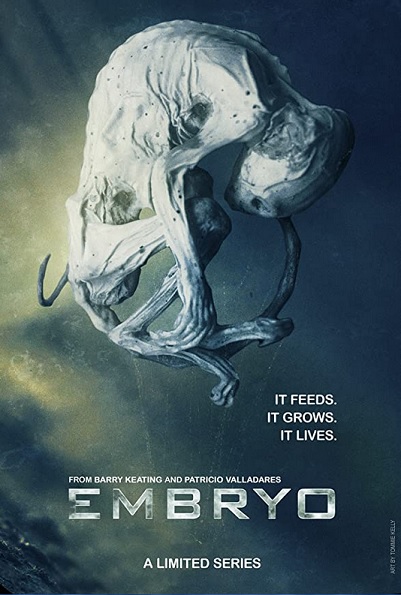
While The X-Files and The Blair Witch influences are obvious — as well as H.P Lovecraft (see Nicolas Cage’s Color Out of Space) — in this sci-fi horror tale, this latest offering from director Patricio Valladares (the 2011 actioner Toro Loco and the 2012 horror Hidden in the Woods; 2016’s Vlad’s Legacy and 2017’s Robert Englund-starring Nightworld) is not the least bit trope-ridden.
Sure, you’ll reflect on Alien, with its xenomorph impregnation, but since this is B&S About Movies, and this Chilean effort is a low-budgeter, we’re leaning to the sloppier-gooey Inseminoid as our comparison. And there’s a little bit of Cronenberg’s “body horror” flicks injected as well. Valladares efficiently pulls his tale together as a semi-film-cum-SOV camcorder “found footage” narrative that presents an alien abduction portmanteau of three alien-abduction tales. The creator behind Embryo is Barry Keating, a writer who gave us a pretty cool Euro-shot, Monty Markham sci-fi’er, The Rift(2016).
Campers in the Chilean countryside woods of Snowdevil Mountain, known for its extra-terrestrial mysteries, run afoul of otherworldly beings; one of the beings abducts and impregnate Kevin’s girlfriend, Evelyn. As her “child” rapidly grows inside her, the need to satiate her lust for flesh and blood grows, in kind. When she attacks a doctor, Kevin takes Evelyn on the run — and tries to unravel the “found footage” mystery, with a cop investigating the disappearances and rapes on their trail — as they try to find someone to remove “the thing” that’s taking over her body and mind. Tentacles and alien semen caressing human bodies, and flashbacks from 2020, to 2008, to 2012, ensues — with Patricio Valladares accomplishing a lot on very little.
You’ll be able to stream Embryo as a VOD or purchase as a DVD and Blu-ray in North American via Uncork’d Entertainment on April 6, 2021.
Disclaimer: We were sent a screener by the distributor’s P.R firm. That has no bearing on our review.
About the Author: You can learn more about the writings of R.D Francis on Facebook.He also writes for B&S About Moviesand publishes short stories and music reviews on Medium.










 B&S About Movies
You must be logged in to post a comment.