The Savage Cinema set from Mill Creek just keeps on rolling this week, bringing to us not only some NASCAR, but former racer turned country star Marty Robbins, who sang “El Paso” and “Honkytonk Man.”
Three brothers — stock car driver Marty (Robbins playing himself), mechanic Del (John Ashley, the man from Blood Island) and revenue agent Steve — all have their issues. Marty is trying to be a star, Del wants to be Marty and Steve is busting some moonshiners.
Del tries to out do his brother to prove himself to his girlfriend Sue (Gigi Perrau, The Cool and the Crazy) and the gang ends up almost killing them all. Meanwhile, Connie Smith and the Stonemans play a whole mess of songs.
The entire film was independently made in Nashville, Tennessee. John Ashley told Trash Compactor, “Marty was a terrific fellow and a great singer, and I was a big fan of his. He was a stock car racer, loved stock cars, and the producers had put this thing together. They said to me that this was going to be his motion picture debut, and they needed me to play his brother and basically carry the movie. So I went down there for six or seven weeks.”
This was directed by Will Zens, who also made Trucker’s Womanand Hot Summer in BarefootCounty, two Joe Bob Briggs-approved redneck movies.
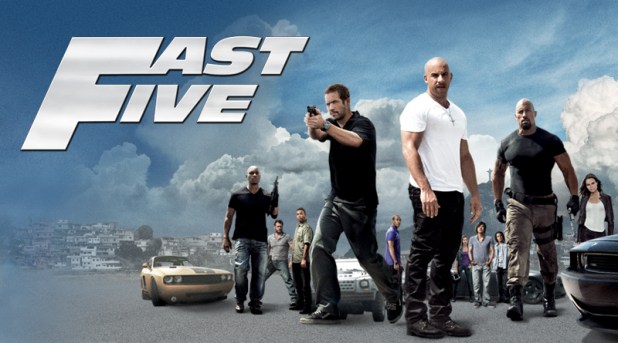
Somehow, the street gang from the first film has become almost like G.I. Joe in these movies. This film — the fifth as you can tell by the title — tells the story of Dominic Toretto (Vin Diesel), Brian O’Conner (Paul Walker) and Mia Toretto (Jordana Brewster) as they steal $100 million while being pursued by U.S. Diplomatic Security Service agent Luke Hobbs (Dwayne “The Rock” Johnson). This is the film that moved from street races to big action scenes and fans went wild.
The film starts by having Dom busted out of prison by the gang and ends with the Rock showing that he just might join these guys, which includes Tyrese Gibson as Roman Pearce, Ludacris as Tej Parker, Matt Schulze as Vince, Sung Kang as Han Lue and Gal Gadot as Gisele Yashar.
This is also where the movies start feeling bloated, pushing themselves past a two-hour running time. The other criticism is that women barely have names and are just sex objects in these films. Hell, they don’t even tell you what Gal Gadot’s character’s name — Gisele — is for the entire movie!
One of the good things is that these films have minimal CGI and rely mostly on practical effects for the car stunts.
Also — that scene where they found out that Letty is alive? Michelle Rodriguez didn’t know anything about it until she saw the movie in a theater.
Savage Cinema promises you biker movies and it delivers on them. Such is the joy of a Mill Creek box set. While you may often find things that you had no idea you needed, by and large, if the cover art has an alien or a motorcycle, you may get at least 30% out of the films inside about what was promised. Those kind of odds get you into the Hall of Fame, at least in Cooperstown.
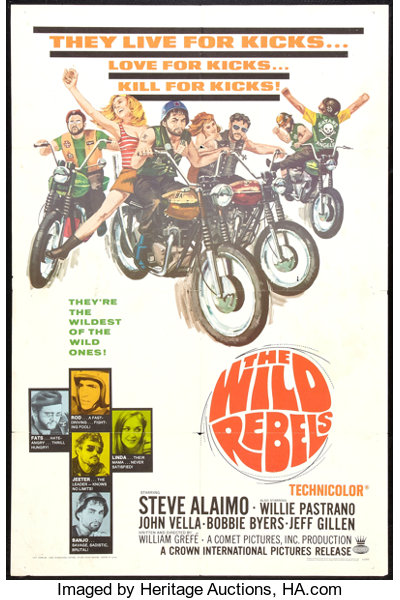
William Grefe came right out of the Florida swamps and demanded that you watch his films. He was second unit on I Eat Your Skin before unleashing films like Mako: The Jaws of Death, Death Curse of Tartu and Stanley, a movie in which a young man menaces Alex Rocco and Marcia Knight with snakes.
Rod Tillman (Steve Alaimo, whose life took him from being in the Redcoats, whose song “Mashed Potatoes” hit #75 on the Hot 100, hosting Dick Clark’s Where the ActionIs and even owning TK Records, who dabbled in the Miami bass scene) is a stock car racer out of cash. He sells everything he owns and enters Swinger’s Paradise where he does nothing if not swing. Actually, that’s where he meets Satan’s Angels, a biker gang who needs a getaway driver for a con they have in mind.
They are Banjo (Willie Pastrano, who held the unified world light heavyweight boxing titles (WBA, WBC, The Ring) from 1963 until 1965), Fats (Jeff Gillen, yes, Jeff from Children Shouldn’t Play With Dead Things and the director of Deranged: Confessions of a Necrophile, as well as Santa Claus in A Christmas Story), Linda (Bobbie Byers, the voice of Johnny Sokko in Voyage Into Space) and Jester (John Vella, who played for the Oakland Raiders).
The cops try and get Rod on their side too, but he’s all into Linda, who claims she doesn’t do the crimes for the financial prize, but for the kicks. It all ends up in a lighthouse shootout between the cops, the bikers and our hero, who is caught between both sides.
Featuring real-life members of the Hell’s Angels and a Tampa garage rock band known as The Birdwatchers — you know, for the kids — this movie is probably amongst the best on this set. It also has, I can assure you, motorcycles in it.
You can either watch this on YouTube or see the Mystery Science Theater 3000 version on Tubi.
“I’m gonna give you an engine low to the ground . . . an extra thick oil pan to cut the wind from underneath you. It’ll give you thirty or forty more horsepower. I’m gonna give you a fuel line that’ll hold an extra gallon of gas. I’m gonna shave half an inch off you and shape you like a bullet. I’ll get you primed, painted and weighed, and you’ll be ready to go out on that racetrack. Hear me? You’re gonna be perfect.” — Harry Hogge, crew chief and car builder
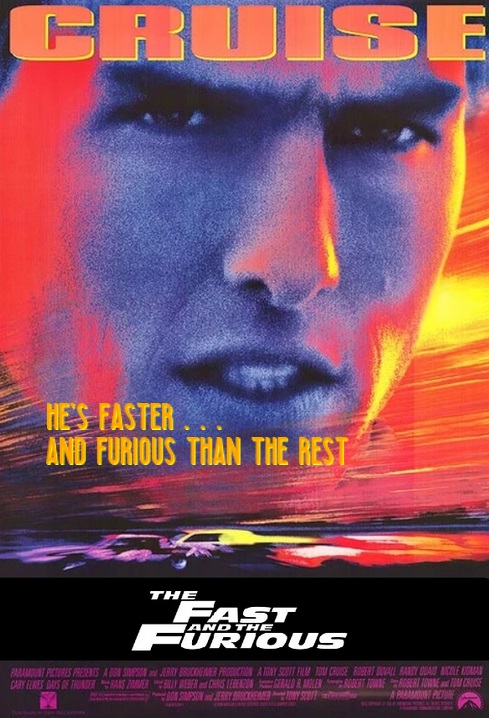
If only Harry had said, instead of, “You’re gonna be perfect,” said, “You’ll be fast and furious.”
What might have been . . .
Mock poster by R.D Francis/F&F logo property of Universal/typeface overlay via Pic Font
Tom Cruise gets respect in this neck of the Allegheny woods. He wanted to be the next Paul Newman. He wanted to become Steve McQueen. And unlike Quentin Tarantino’s Rick Dalton in Once Upon a Time in Hollywood, by golly, Tom Cruise became our generation’s Paul Newman and Steve McQueen. And, as with his idols—car racing enthusiasts who wanted to make their own race car movies—that kid adorned in a pair of Wayfarers that slid across the floor in his socks and into our hearts, wanted to run with the fast and the furious: he wanted to make his own version of Winning and Le Mans. And, and by golly, he did it.
Luckily, for the ticketing-going masses, Tom Cruise reined his “need for speed” (of the four-wheeled variety, anyway) until he broke through and became an official, A-List movie star. For if Cruise would have followed up Risky Business or (to keep it in a “sports” context) All the Right Moves—during the period when he was developing his career and not choosing roles but being cast in roles, like the burgeoning careers of James Caan and James Garner—with a race car flick, he would have been cast in the likes of the lower-budgeted road rallies that were Red Line 7000 and Grand Prix.
And Cruise’s racing endeavors could have been worse.
What if Cruise made a racing flick directly after his first leading man role in Losin’ It (remember in 1983: he made a movie with Shelley Long and Jackie Earle Haley)? We would have gotten the process-shot, rubber burning fiestas that were Fabian and Frankie Avalon’s Fireball 500, The Wild Racers, and Thunder Alley. And thank the celluloid gods of the analog ethers that Cruise didn’t aspire to be a “double threat” and a be singer—and only lip-synched to Bob Seger’s “Old Time Rock ‘n’ Roll”—or we would have ended up with Elvis Presley’s process-shot racing n’ singing extravaganzas Viva Las Vegas, Spinout, and Speedway*. (Oh, man. What if Eddie Murphy—considering his skills as a singer and Elvis mimic—did a remake of Richard Pryor’s 1977 NASCAR race car flick, Greased Lightning?)
“We gotta win this race.”
What might have been . . .
When reflecting on how Cruise turned Mission: Impossible into a franchise: If The Fast and the Furious—the franchise we’re paying tribute to this week—had been developed at Paramount Pictures instead of Universal Studios, would we have laid down our coin for Tom Cruise as an illegal road racer?
And if not that ticket, would we have bought a ticket to see him as Frankenstein?
No, not the Universal monster one. The New World Studios one: Tom Cruise optioned Roger Corman to set up a big-budgeted remake of 1975’s Death Race 2000 at Paramount. Sadly, amid scripting problems and the usual executorial testosterone splashing, the deal fell apart and ended up on the Universal lot. Then end result: Instead of (finally!) a dark, brooding tale about a futuristic transcontinental road race—one that jettisoned Paul Bartel’s hokey-satire of the original—that adhered to the serious, sociopolitical insights of Ib Melchoir’s short story . . . we ended up with a bunch of check-the-screenwriting-boxes trope-prisoners racing around in a circle on an island. And who in the hell let Joan Allen on Terminal Island?
. . . And now the Death Race franchise is four films deep—with a different “Frank” (and actors as Frank) for each subsequent (direct-to-video) film that carries an addendum that the film is a prequel, sidequal, etc. to the first film (and that the first film was actually “prequel,” ugh, to the ’75 original, argh!), as it races further and further and further away from Melchoir’s initial vision. The end result—at least for those of us weaned on the video fringes off the teats of Norman Jewison and Roger Corman: Death Race ‘08 was Rollerball ’02 all over again. Neither were Lays emulsified-potato chips like their superior forefathers: once was enough. And thank the analog lords that the Rollerball reboot wasn’t turned into a direct-to-video franchise. (Can you believe that director John McTiernan went to federal prison for making a false statement to an FBI investigator over illegally wiretapping Rollerball’s producers? He went to prison for Rollerball?)
And that brings us back to the film we’re supposed to be reviewing: Days of Thunder. (I know, Sam. I know. At least there won’t be a Seinfeld reference.)
Come, on now. You’ve seen it. We’ve all seen it. (Yes, even you: the underground, VHS-loving indie purveyor who Facebook-hangs with the B&S About Movies crew on Saturday Nights (at 8 P.M on Groovy Doom: shameless plug) to watch double features about worms and Linda Blair being abused.) And even if you didn’t hit the multiplex, you caught Cruise’s race epic via one of Ted Turner’s endless TNT replays as you couch-surfed and channel-grazed on a lazy, Cheetos-dusted Sunday afternoon. And, if you’re financially well-to-do, you watched Days of Thunder on yer fancy, upper-tiered Showtime or HBO subscriptions—as you couch-surfed and channel-grazed on a lazy, Doritos-crumbed Sunday afternoon. So don’t deny it: you embraced the Cruise like the mainstream-everybody else.
While this Tony Scott-directed and Tom Cruise-produced racing epic is vastly superior to the Caan and Garner romps and the bigger-budgeted Newman and McQueen films in all of its related film disciplines, we basically have the same film: a spunky racer with talent, but too much attitude, aspires for NASCAR fame—and finds romance and competition on the asphalted, gladiatorial oval. (For isn’t this all just Charlton Heston in Ben Hur with cars instead of horse-drawn chariots?)
So, speaking of testosterone splashing: Producers Don Simpson (wrote Aloha, Bobby and Rose, Cannonball) and Jerry Bruckheimer (The Rock, Bad Boys) along with director Tony Scott (Tarantino’s True Romance), and sometimes screenwriter Robert Towne, all went Alpha-male over how to set up shots. Fully-built and ready-to-roll sets were torn down and rebuilt because they “weren’t right.” The hormone and anabolic steroid-stew flowed so deep that the long-idling (sorry) crew members accumulated enough overtime pay to go on vacation for a full four months after filming was completed.
What was the end result?
Crtics pounced on the film for its stock plot, two-dimensional characters, and poorly written dialogue and called it out for being a Top Gun clone, sans planes and sky and lots of cars and asphalt. Roger Ebert, while giving the film three out of four stars, still took the film to task, calling it the Tom Cruise Picture, since it resembled the “10 Point Formula” employed in his previous films The Color of Money and Cocktail (it’s actually “9 Points,” but he came to revise it to include the “Dying Friend” trope). Mind you now, we are talking about Robert Towne here: the guy who wrote The Last Detail, Marathon Man, and friggin’ Chinatown. There’s whole chapters in screenwriting books dedicated to Towne’s brilliance. That’s Ebert for you: he takes no prisoners. (Sigh, I miss you Gene and Roger: you and Dr. Who and The Star Hustler made PBS worthwhile.)
And what did “The Q” think: “Days of Thunder is the movie Grand Prix and Le Mans should have been . . . it has the fun of those early AIP movies.”
And will we ever get a Quentin Tarantino racing epic starring a back-on-top Rick Dalton? We wait with Cheetos-stench bated breath.
Uh, oh.
Sorry, Sam. Actress Kathleen McClellan, aka “Good Naked, Bad Naked” girl from Seinfeld (“The Apology”) kissed Tom Cruise in Days of Thunder. (In the “winner’s circle,” I think; she was once the Skyy Vodka Girl <ahem>, Sam.)
It always comes back to Seinfeld. And Vodka-spiked movie-theme drinks. One Thunder Cruise Lemon Squeeze, comin’ up!
Anytime a film comes down the pipe that’s directed by an ex-rock video director or somehow connected to a musician, Sam passes that flick my way. (Grazie, amico mio.) And if it’s a forgotten, classic flick that I am reviewing for an “Exploring” or “Drive-In Friday” featurette, or a tribute week — such as, for example, reformed porn-turned-rock video director Gregory Dark giving us the radio romp Night Rhythms during our “Radio Week”* — rest assure that review will be music trivia top-heavy (or bottom heavy, as the case may be).
Such is this review for Roger Corman’s Death Race 2050.
Now, I know what you’re thinking: This is a week dedicated to the films — and the rip-offs and the precursors (such as Corman’s own 1954 film, The Fast and the Furious) — to the 21st century Fast & Furious franchise. Death Race is a franchise unto itself. And what does this have to do with rock music? Is this another one of your reviews, R.D, rife with tangents and non-sequiturs that have nothing to do with reviewing the actual film itself?
Yep. Strap on your feedbag.
So, we all know the backstory on how we ended up with 1975’s Death Race 2000, right: How, long before Corman dreamed up the DR: 2050 version, the first “sequel” to Death Race 2000 was actually 1978’s Deathsport. And the reason Corman made either film was because he wanted a “futuristic action sports film”*+ in the drive-ins to take advantage of the publicity surrounding 1975’s Rollerball starring James Caan (oddly enough, of Red Line 7000). And that Corman optioned “The Racer,” a dark, short story by Ib Melchoir about the Transcontinental Road Race (The Angry Red Planet, Robinson Crusoe on Mars, Journey to the Seventh Planet, Planet of Vampires**). And under the satirical thumb of Paul Bartel, stripped away all of the dread that made Rollerball great and, instead, gave us a live-action version of Hanna-Barbera’s ’60s cartoon, The Wacky Racers?
What you may not know: After working with Universal Studios on a deal to license The Fast & the Furious title for their burgeoning action franchise, Corman and Universal came together again as result of the studio also turning Corman’s Death Race 2000 into a theatrical reboot and profitable, direct to home-video franchise. (At one time the project was at Paramount with Tom Cruise producing and starring: we got Days of Thunder, instead.)
The idea for the 2050 sequel came to fruition when an Italian journalist interviewing Corman commented The Hunger Games shared a similar (camp) cinematic style, as well as the social and political themes explored in Death Race 2000. So Corman reached out to Universal, who produced Paul W. S. Anderson’s 2008 remake, with a plan to bring back the dark, sociopolitical satire of the original — and the killing of pedestrians. Universal was on board: the studio co-produced the film that became Death Race 2050 with Corman’s New World for the home video streaming market.
As is the case with most “sequels” (see Escape from New York vs. Escape from L.A., The Evil Dead vs. Evil Dead II: Dead by Dawn, and Phantasm vs. Phantasm II), Corman took no chances and stuck to the architecture of the 1975 film, albeit with higher quality, CGI-enhanced production values.
It’s the year 2050 and America is controlled by the United Corporations of America, a corporate government ruled by The Chairman (a pseudo-Donald Trump well-played by the always awesome Malcolm McDowell; it’s all about the hair). As with the world of Rollerball in the year 2018: the government has devised The Death Race: a violent, bloody road race that runs from Old New York to New Los Angeles as a form of brainwashing entertainment — and as a form of population control: drivers score points for killing pedestrians and any travels stupid enough to be on the road during the game. And the “Jonathan E.” of the game — the half-man half-machine Frankenstein (a very good Manu Bennett, who you know as Azog the Defiler in the Hobbit film trilogy) — is thrust into political intrigue by his rebel spy navigator.
Is it loud . . . but stupid? Is it uber cheesy (more so than the original) . . . but tasty? It is it campy and crazy? Do we get the delight of Yancy Butler instead of the brood of Jennifer Lawrence? Is it as frantically unhinged as anything Allan Arkush, Paul Bartel, and Joe Dante put together for Roger Coman? YES to all! It’s a pure ’70s drive-in exploitation homage to the movies that we love here at B&S About Movies. And we hope to see more from the director. . . .
Okay, now for the rock ‘n’ roll connection we teased earlier:
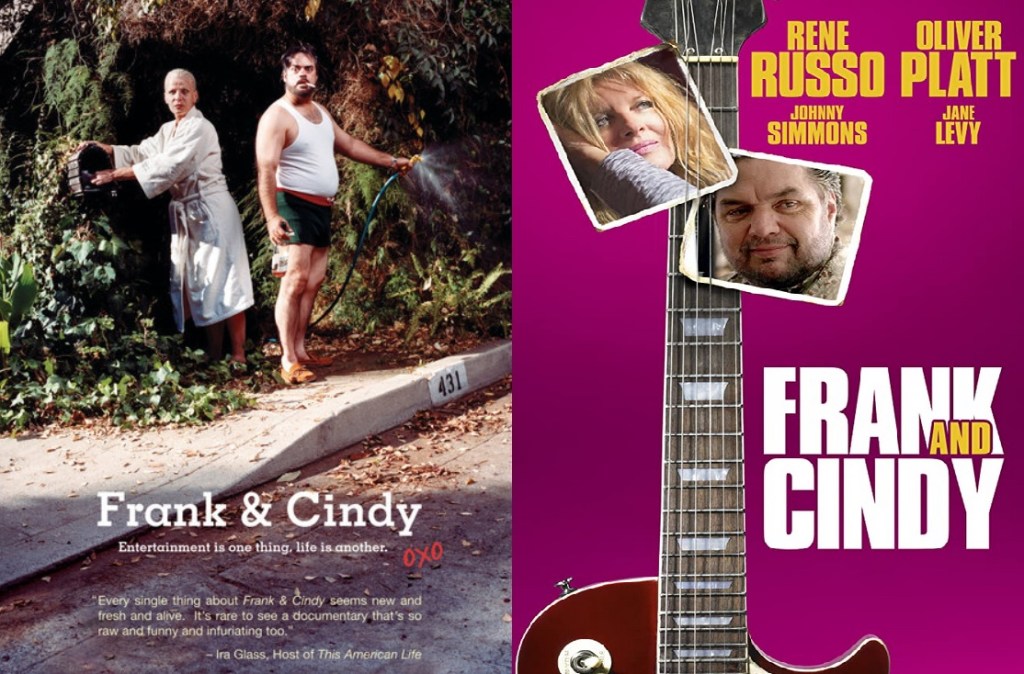
Who did Corman entrust this sequel-cum-reboot to? The step-son of a washed-up, one-hit wonder ’80s musician. A successful editor, cinematographer, and screenwriter with several shorts and documentaries to his credit, G.J. Echternkamp (who also co-starred on ABC-TV’s How to Get Away with Murder), walked away with several “Best Director” awards for his feature film debut, the 2007 documentary Frank & Cindy, that tells the story of his blonde bombshell of a mother and his step-dad, Frank Garcia, an alcoholic, ’80s one-hit wonder musician who, out of love-pity, Cindy lets live in her basement. Frank was the bassist in the band OXO, who scored a 1983 U.S Top 30 hit with “Whirly Girl.”
And based on the success of the documentary, and the successful airing of a documentary of its production on the Showtime docu-series This American Life (Season 1: Episode 4), the story became a 2015 comedy starring Oliver Platt as Frank Garcia and Rene Russo as Cindy.
What’s that? You say you don’t remember “Whirly Girl” or OXO? Well, good for you. You didn’t spend countless hours wasting away in front of MTV.
But perhaps these (embedded) clips from their American Bandstand appearance (Frank is the one in the green one-piece jumpsuit) or their appearance on Solid Gold will warm those analog cockles. And yes, we found a copy of their highly-rotated MTV video. . . .
Oh, and get this: Cynthia Brown and Frank Garcia got jobs — as well as their son, G.J. Echternkamp — working for Roger Corman after he was impressed with the 2007 film. Which leads us back to: Death Race 2050!
And so ends another rock ‘n’ roll celluloid adventure from the analog ethers. Send all of your complaints to Sam. For it was his dreaming up a “Rock ‘n’ Roll Films Week” (that ran Sunday, July 19 to Sunday, July 25) and a “Fast & Furious Week” (now running from Sunday, August 2 to Saturday, August 8) that blessed — or cursed — you with this review.
Sam, you’re an OCD-lovin’ movie packrat, brother. Love ya, man.
About the Author: You can learn more about the writings of R.D Francis on Facebook.He also writes forB&S About Movies.
* Be sure to join us for our “Exploring: Radio Stations on Film” roundup overflowing with links to all of our reviews of movies set inside radio stations.
*+ There’s more “Deadly Game Shows” to be had with our review of Elio Petri’s granddaddy of ’em all: 1965’s The 10 Victim, which includes links to all of the deadly sports films you love.
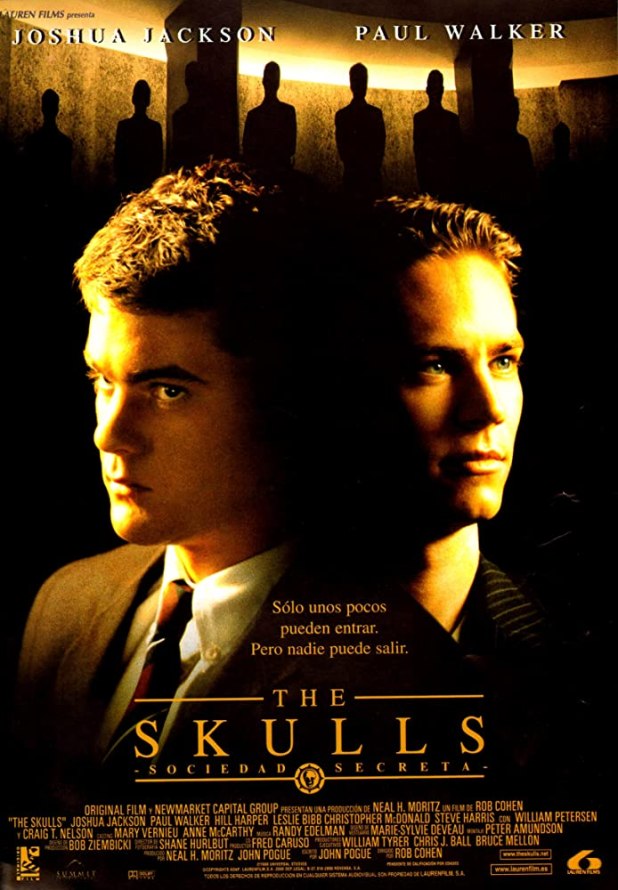
You know when a conspiracy theory — like Yale University’s Skull and Bones student society — becomes true? When Hollywood makes a movie about it. Here’s the real conspiracy. This movie is pretty much the 1970 made-for-TV movie The Brotherhood of the Bell. That said, this is where Rob Cohen met Paul Walker, so that’s how this movie has ended up in the middle of our The Fast and the Furious theme week.
Walker is Caleb Mandrake, a name that only exists in movies, and Joshua Jackson is Luke McNamara. They’re the two newest members of The Skulls, which prepares its members through war. It barely takes any time for this alignment to cause Luke’s best friend Will (Hill Harper, CSI: NY) to stop talking to him. But hey — he feels like he needs an edge to stay with his rich girlfriend Chloe (Leslie Bibb).
Speaking of CSI, William Petersen plays the leader of the inner circle and Caleb’s dad is played by Craig T. Nelson. They’re powerful because of the group and will crush anyone who gets in their way.
Another conspiracy: this movie was shot in Toronto and not Yale. Imagine being from that city and seeing your landmarks all over this movie and someone saying, “No, that’s really America.”
They made a whole bunch more of these — well, OK, two more — that went direct to video. Rob Cohen went to Harvard, so he was probably in a group just like this that allowed him to keep making films after xXx and Stealth.
Someone on IMDB noticed this — and I thought it was funny — that every Skull gets a watch for their left hand. Which means they are all right handed. At least they don’t show them masturbating in a coffin while other members watch. Not that I know tons of Skull and Bones stories or anything.
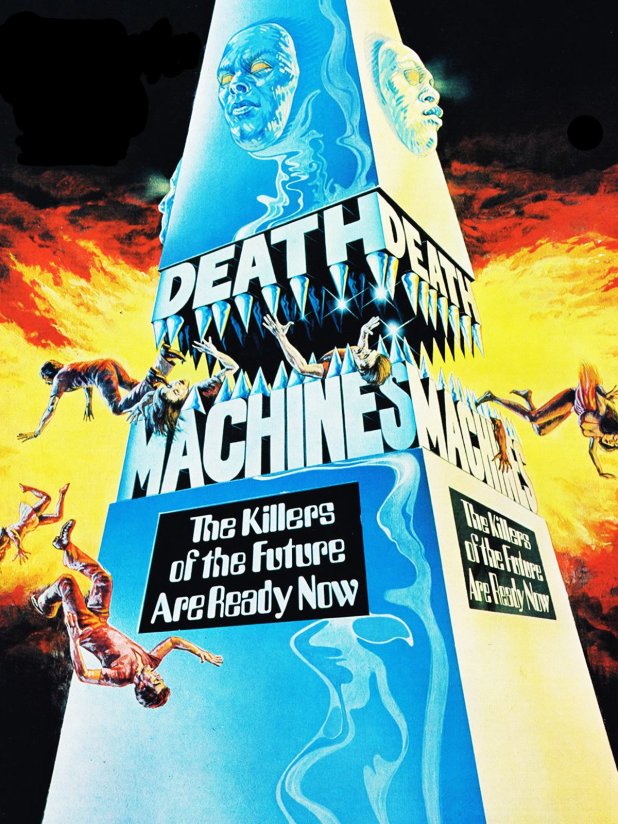
The Savage Cinema set has motorcycles. It has stock cars. It has dynamite coffins. And now, it has death machines. The poster for this movie has always fascinated me and now the time has finally come to see if it lives up to the insane promise of the painting that hawked its wares.
Madame Lee has gathered three martial arts masters, now and forever known as White Death Machine (Ron Marchini, who is also in Omega Cop and Karate Cop), Asian Death Match (Michael Chong, Kinjite: Forbidden Subjects) and Black Death Machine (Joshua Johnson, The Weapons of Death) after she injects them with a mysterious formula that makes them her commandable karate fighting soldiers.
There’s a green-faced cop named Captain Green. A good guy who loses his hand, gets his ass kicked in a bar fight and still gets the girl. Bikers who bother zombie killers when they just want to eat burgers and talk to old men about God. A mysterious mastermind in the shadows. Dudes getting thrown off buildings. And a distributor — yes, our friends at Crown International Pictures — that wanted a science fiction angle for a movie about evil martial artists shot in Stockton, CA.
I have no idea what was in that zombie juice, but it makes street fighters impervious to bullets. This was all a passion project of Paul Kyriazi, who also made Ninja Busters. There’s also a cop named Lt. Clay Forrester, who is no relation to Gene Barry or Trace Beaulieu.
This movie doesn’t make any sense and you’re either going to be bored into oblivion by it or love it like the lover who broke your sixteen-year-old heart and you never quite got over her. There is no in-between.
If you want to see it for yourself, you can do no better than the blu ray release that Vinegar Syndrome has put out. Freshly restored in 4k from its original Techniscope camera negative and featuring brand new interviews with its director and stars? I never thought I’d see the day. You can also check this out on Amazon Prime.
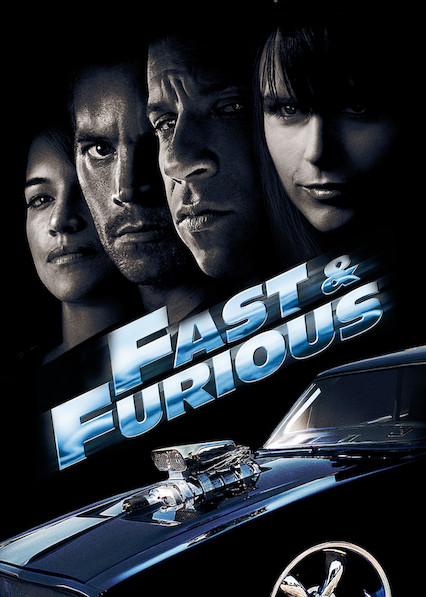
Finally, eight years after The Fast and The Furious we get a direct sequel. This time, Brian O’Conner (Paul Walker) and Dominic Toretto (Vin Diesel) must work together again to avenge the murder of Toretto’s lover Letty Ortiz (Rodriguez) and apprehend drug lord Arturo Braga (John Ortiz).
It’s rare that a series of movies finally finds itself in the fourth installment, much less gets that many chances. But here you go — these movies really start becoming beloved right here.
Sung Kang shows up as Han Lue, Dominic’s right-hand man, bridging the last Japanese side of the franchise, while also introducing Gal Gadot as Gisele Yashar, a liaison for the evil Braga. Laz Alonso also shows up as Fenix Calderon, Braga’s right-hand man who murders Letty and sets this whole movie’s story arc in motion.
This movie paved the way — pardon the road pun — for the other movies in this series. In fact, it outgrossed The Fast and the Furious: Tokyo Drift in its first weekend.
Of course, Letty wouldn’t stay gone long. But we’ll get to that soon enough.
EDITOR’S NOTE: Back when COVID-19 felt like a thing that may not last all that long, circa March 7, 2020, we talked about this movie. It’s in the Savage Cinema set, so now it’s back. I still have no idea what a sidehacker is.
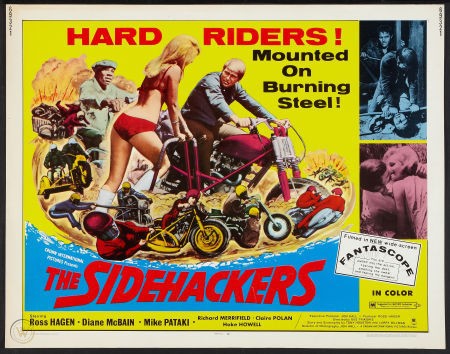
What the hell is a sidehacker?
It’s racing motorcycles with sidehacks, which is a sidecar with a rail but no sidewalls or seat. As the bikes race, the passenger rides and tilts around curves. Sidehacking is also known as sidecarcross or sidecar motocross racing. The fact that it has a movie made about it doesn’t astound me. After all, I’ve watched movies about arm wrestling (Over the Top, Hands of Steel) and even games that don’t really exist like BASKetball and The Game from The Blood of Heroes.
Surely I can make it through a movie about side hacking, I thought. But man — what a ride. I nearly wiped out.
Ross Hagen, who was in Supercock, The Devil’s Eight and Alienator (amongst many others), plays Rommel, who is a bike mechanic who dreams of sidehacking stardom. That’s a thing, I guess.
He runs into JC (Michael Pataki!), another sidehacker who is abusive to everyone in his gang, including his girl Paisely, who promptly tries to seduce our hero. Or protagonist. Or guy we’re supposed to get behind. He turns her down, JC beats her up and blames Rommel and then the gang all descends on our man and his lady Rita (Diane McBain, Wicked Wicked).
Robert Tessler, a stuntman who formed Stunts Unlimited with Hal Needham, is in this, as is the writer of the film Tony Huston (he also would write The Hellcats) and Hoke Howell (Humanoids from the Deep).
This was directed by former Broadway dancer — and husband of Goldie Hawn — Gus Trikonis, who also brought The Evil, Moonshine County Express, Nashville Girl, Take This Job and Shove It and Supercock to the big screen.
It ends as all biker movies must, with the hero killed for no good reason. Ah 1969, when the kids had given up on life.
You can watch this with help from Mystery Science Theater 3000 on Amazon Prime and Tubi.
I have no idea why this is on the Savage Cinema set from Mill Creek, but man, when has anything these box sets have on them make any narrative sense? “We have all these Crown International movies and some maniac, somewhere, someday, is making a Letterboxd list about these movies no one other than he cares about!” I love you, Mill Creek. I do.
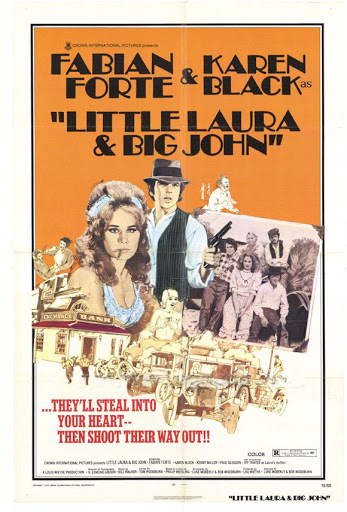
Back in 1929, John Ashley murdered a Seminole trapper named Desoto Tiger and dumped him in the site of what would someday be the Hoover Dike. Days later, in Miami, he sold some of those furs and got caught, but was repeatedly allowed to escape custody. So yeah, he was the first white man jailed for killing a Native American. But no one took it seriously and, go figure, he did a whole bunch of others crimes, including piracy on a British colony in the 1920’s, of all things. He also joined with Laura Upthegrove to become white trash heroes, defying banks and the government until he was jailed.
Their story gets even crazier, as Upthegrove married a member of Ashley’s gang named Joe Tracy in order to avoid testifying in his trial for murdering a taxi driver. Ashley then planned to rush the jail, act like he was saving Tracy and then planned to kill him in a fit of jealousy. So she todl the law, who killed everyone involved after handcuffing them and pretty much executing them in a move that was completely against the law.
Upthegrove hid out for a few years until she got in an argument with a man trying to buy moonshine from her. She ended up drinking Lysol and dying. Her mother decided that she was better off dead, so she never called for help.
Fabian Forte plays John and Karen Black plays Laura, so whoever casted this movie knows my heart. Ross Kananga, who is also Seminole, plays Tiger. Kanaga is the man who did the stunt where James Bond jumps over the alligators in Live and Let Die, getting 193 stitches before filing was done. He’s also where Yaphet Kotto’s character gets his name from. Also, Paul Gleason from The Breakfast Club, one of film’s greatest jerks, is the sheriff.
Luke Moberly, who was in the art department for Sometimes Aunt Martha Does Dreadful Things, wrote and directed this. It was the only film he’d ever direct. It was made in 1969 and didn’t come out for four years. It also has a debt to 1967’s Bonnie and Clyde, but you probably figured on that. Fabian’s other gangster flick inspired by Bonnie and Clyde’s success was A Bullet for Pretty Boy, about Charles Arthur “Pretty Boy” Floyd.
There’s no free or pay streams, but you can view the sign-in trailer on You Tube.





 B&S About Movies
You must be logged in to post a comment.