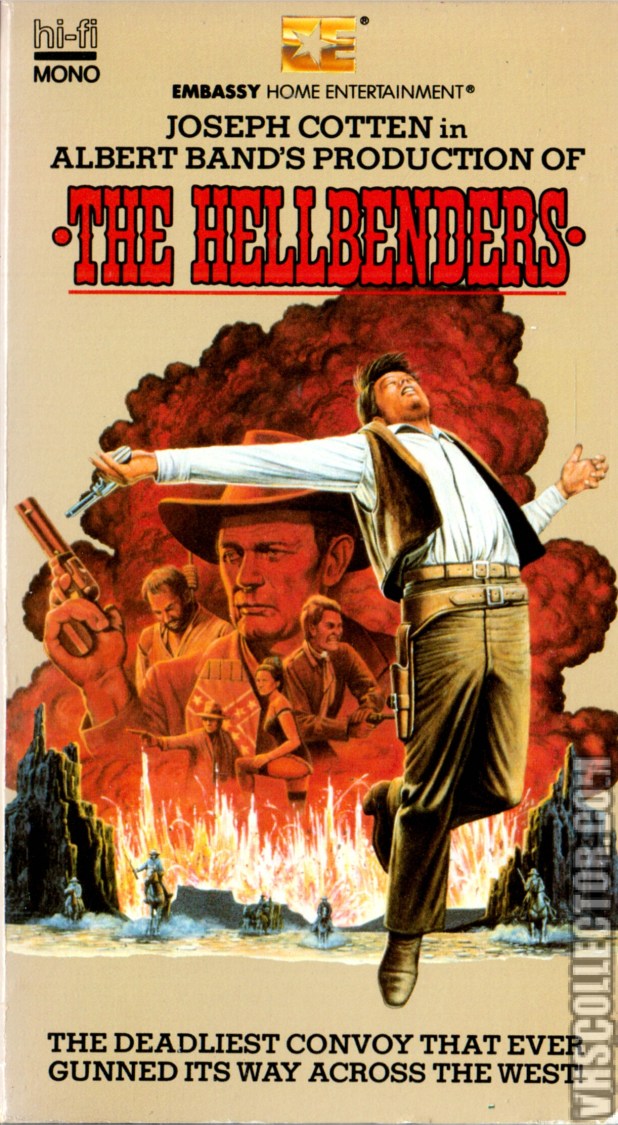
Colonel Jonas (Joseph Cotten) has led the Hellbenders through the Civil War and he refuses to give in at the end of the battles. He takes his sons Ben, Nat and Jeff on a continuing campaign of massacres, killing Union soldiers as they move money and placing their treasure inside a coffin.
Even the love and devotion of Clare (Norma Bengell) is not enough for Jonas, who wants more power, more destruction and well, just more.
There’s a fabulous score by Ennio Morricone — that goes without saying — and Sergio Corbucci’s direction, which guides another Italian Western that is all about darkness and despair. Cotten is one of my favorite actors of all time. Even in a small picture, he makes something wonderful. This is no small picture.
ABOUT THE AUTHOR: Phil Bailey is a long time photographer and film writer, who doesn’t actually hate everything, but has no fear of being a contrarian. Follow at Twitter at @stroke_midnight or on Facebook at https://www.facebook.com/philbaileyphoto
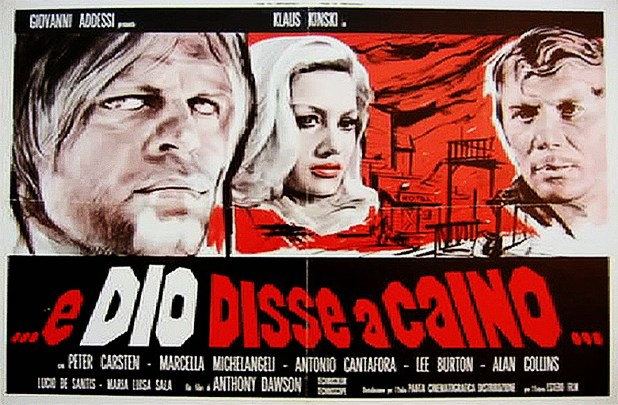
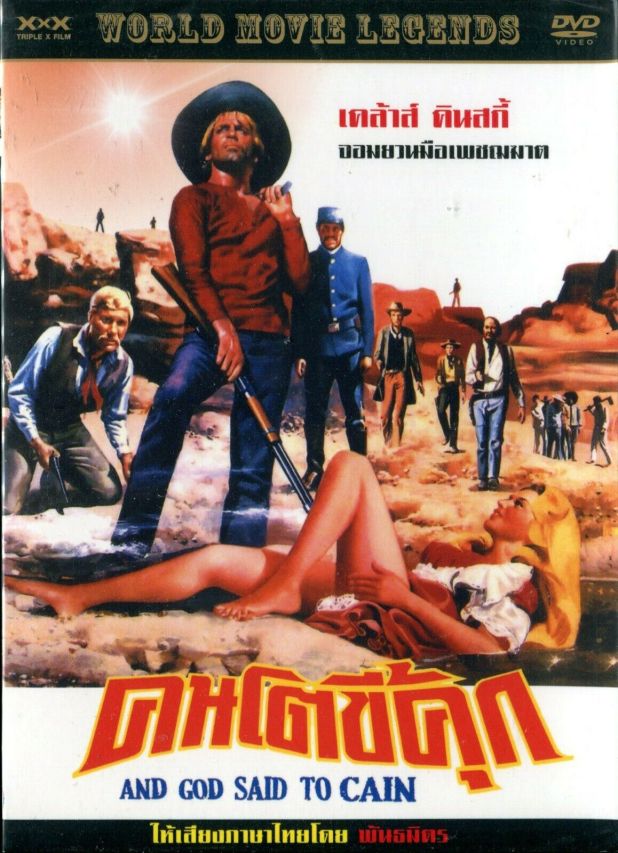
Like so many of his contemporaries in Italian cinema, Antonio Margheriti worked in numerous film genres including science fiction, peplum, and spy adventures, but he is mostly fondly remembered as one of the greats of creating atmospheric gothic horror movies. Castle of Blood, The Long Hair of Death and The Virgin of Nuremberg are some of the horrors directed by Margheriti who was frequently Americanized as Anthony Dawson. And God Said to Cain was not the director’s only Euro-Western but it is his best-known thanks in no small part to its star Klaus Kinski and the unusual gothic atmosphere Margheriti surrounds his simple tale of revenge.
The film opens in a rock quarry where a number of prisoners swelter in the blazing sun turning large rocks into small ones One of the prisoners, Gary Hamilton has just been granted clemency and wastes no time in returning home with a new rifle and a thirst for revenge against the men who framed him and stole his house, gold, and even his wife. After a few brief expository scenes, the film gets down to business. Hamilton sends word to Acombar (Peter Carsten) that he is coming for him. To complicate matters Acombar’s son has just arrived home and a storm is moving in. During this storm, Hamilton moves through the town taking out Acombar’s men. The sandstorm, howling winds, and constant clang of the church bell creates a huge amount of tension in Acombar and his men, as well as members of the audience.
The film is obviously made on a minuscule budget with Margheriti using the storm set-piece as an excuse to hide all the townspeople not vital to the plot. Margheriti knows what he has to work with and uses it to full advantage. It doesn’t hurt to have Klaus Kinski’s chiseled features and deep blue eyes who was most likely part of the package to secure financing and distribution as “Italian” movies were rarely solely funded with just Italian Lira and several countries would pool resources to make these films which is why you have a German star, making an Italian western, in Spain. Margheriti leans heavily on his horror director’s bag of tricks to keep a plot of one-man murder spree going without side plots, characterization, or much in the way of dialogue. As the film unfolds Kinski becomes increasingly spectral, utilizing his surroundings including the aforementioned church bell as a weapon in the film’s most memorable scene. Margheriti’s taste for the gothic also shines in numerous touches that would be right at home in any of Margheriti’s standard gothic horrors, most notably the gorgeous mirrored parlor set complete with candelabra adorned grand piano. Any cult film fan knows where the final showdown is going to take place once they see all those mirrors. The often spectral figure of Klaus Kinski weaving effortlessly through light and shadow, including through catacomb-like tunnels beneath the town. In these tunnels, Kinski and Margheriti evoke the spirit of Lon Chaney’s Phantom of the Opera more than a standard cowboy hero/anti-hero as he dispatches all who stand in his way of a showdown with the man who wronged him.
The mix of horror and western in And God Said to Cain is not going to be to everyone’s taste as neither genre is fully satisfied, but in a sea of forgettable copycat Euro-Westerns, and hell this one is nothing original in the plot and is essentially a remake of Salvatore Rosso’s A Stranger in Paso Bravo, but Margheriti brings his own weirdness to the film giving it lift over the endless disposable films being cranked out of the Italian studios before they abandoned the old west and went all-in on gialli in the wake of Dario Argento’s The Bird with the Crystal Plumage.
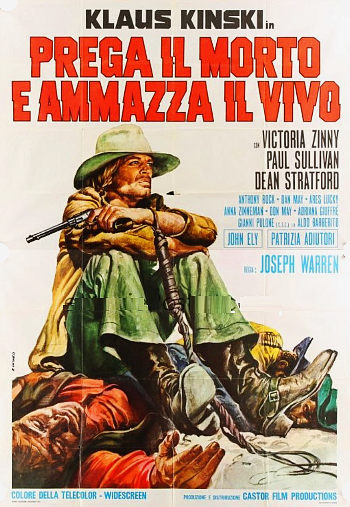
This movie has so many titles — Pray to Kill and Return Alive, To Kill a Jackal and Renegade Gun — but I went with the one closest to the original Italian title (Prega il Morto e Ammazza il Vivo).
It’s directed by Giuseppe Vari, who brings something artistic to every movie beyond just straight exploitation. As Joseph Warren, he made the giallo Who Killed the Prosecutor and Why? He also a very early zombie movie, 1963’s peblum War of the Zombies, as well as Urban Warriors and Sister Emanuelle, in which Laura “Black Emanuelle” Gemser renounces her sexual sins and becomes a nun until a spoiled rich girl (Mónica Zanchi) reawakens her lust just in time for an escaped murderer (Gabriele Tinti, husband to Gemser) to hide out amongst the nuns. Whew!
Dan Hogan (Klaus Kinski) and his gang have made off with $10,000 from a stagecoach and are due to meet at a saloon on the Mexican border. As the men wait for his girlfriend to bring their money to them, they encounter John Webb, who has killed the man who was to be their guide to Mexico. He asks for half the money to take them, but in truth, he’s wanted to pay back Hogan for years.
Writer Adriano Bolzoni (A Fistful of Dollars, Minnesota Clay, The Mercenary, Your Vice Is a Locked Room and Only I Have the Key) infused this movie with a film noir edge, with Kinski’s character making his first appearance is similar to Edward G. Robinson’s first appearance in Key Largo.
Seeing as how this is number sixteen on Quentin Tarantino’s top twenty Italian Westerns of all-time list, it’s not a stretch to say that this movie directly inspired The Hateful Eight.
You can watch this on YouTube.
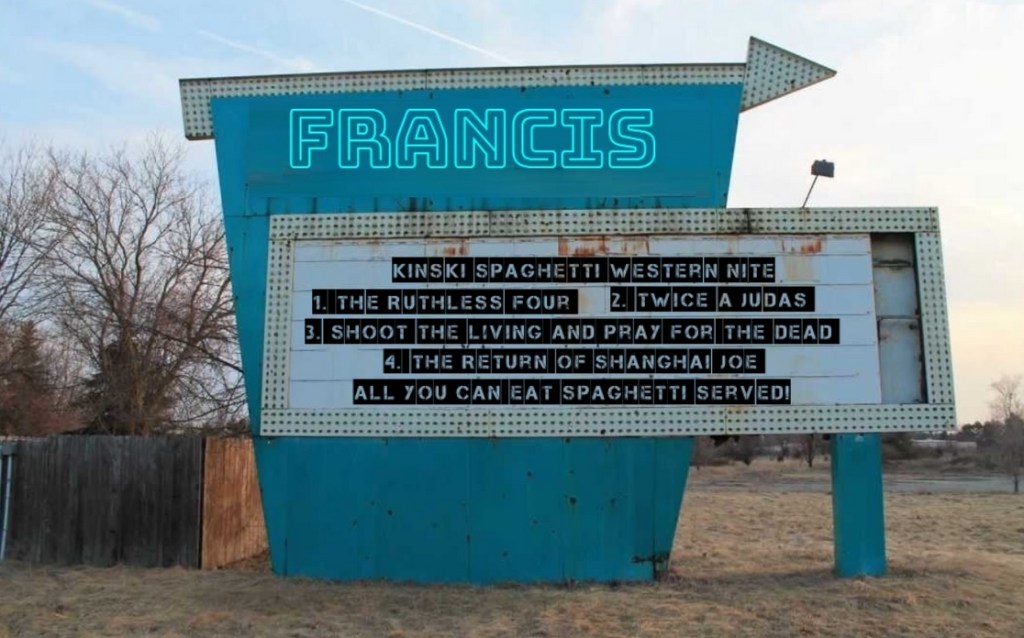
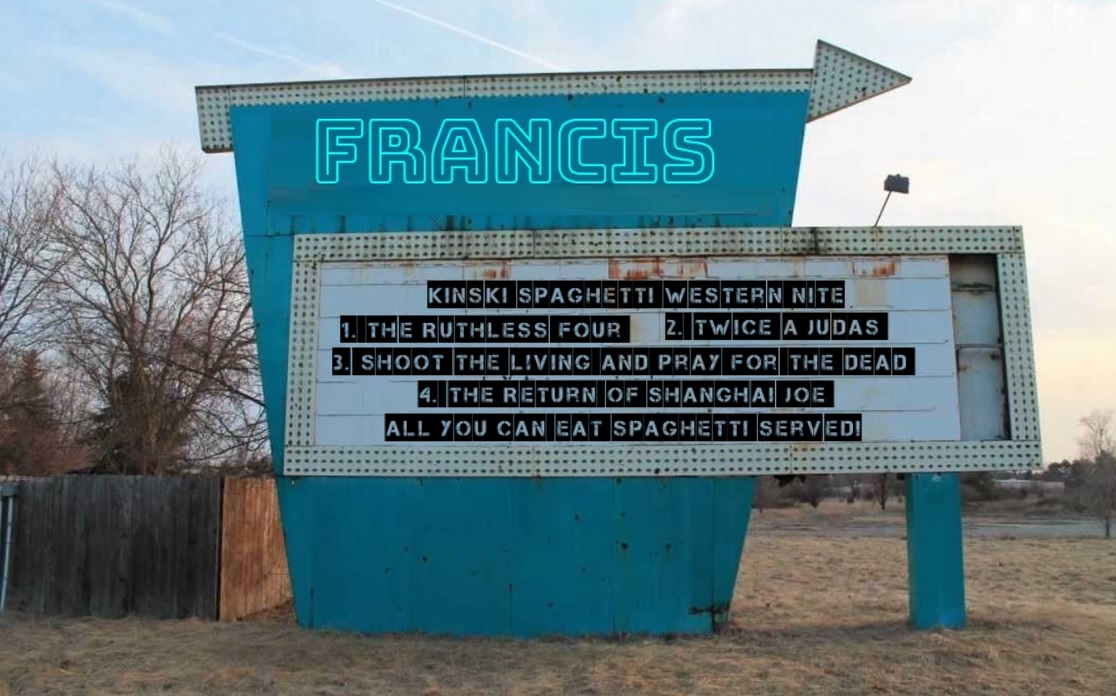
Don’t forget! We did a Klaus Kinski spaghetti westerns blowout for a “Drive-In Friday” featurette that runs down the mad German’s entire shoot ’em up resume. Join us, won’t you? We give full reviews — with a different insight to Shoot the Living — and new reviews to The Ruthless Four and Twice a Judas.
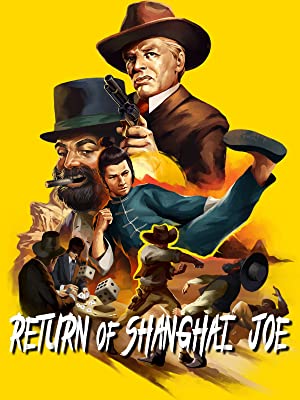
Bitto Albertini directed one of my favorite Eurospy films, Goldface, The Fantastic Superman, as well as both Black Emanuelle and Yellow Emanuelle. Here, he has a new actor as Shanghai Joe — Cheen Lee instead of Chen Lee — and has brought back Klaus Kinski in a new role as land baron Pat Barnes.
Honestly, Kinski is the only reason to watch this, as he lords over every scene and makes it his. This film sticks more to comedy than the strange all over the place insanity of the first movie, which makes this disappointing.
There’s also a bad Bud Spencer ripoff snake oil salesman. So yeah. I barely made it through this. I’m going to warn you now, the theme song from this will get stuck in your head and damage your will to live.
Don’t forget! We did a Klaus Kinski spaghetti westerns blowout for a “Drive-In Friday” featurette that runs down the mad German’s entire shoot ’em up resume. Join us, won’t you? We give full reviews — with a different insight to The Return of Shanghai Joe — and new reviews to The Ruthless Four and Twice a Judas.
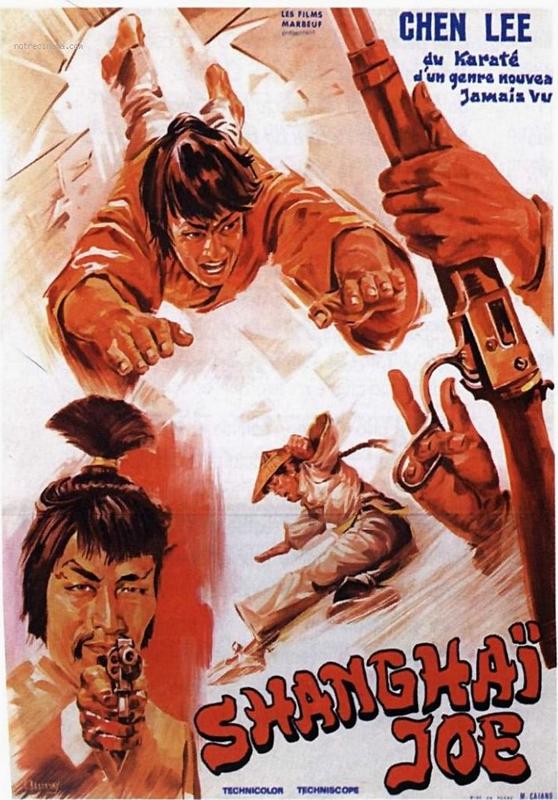
According to the Spaghetti Western Database, lead actor Chen Lee may have been a Japanese karate instructor, but according to director Mario Caiano (Eye In the Labyrinth), he worked in a laundry, not in a dojo, and was picked because he looked like a young Dustin Hoffman. Some think his real name was Mioshini Hayakawa, which is Japanese, not Chinese. That said, if that being racist — not knowing the difference between two countries nearly 1,900 miles away from one another — then this movie is not for you.
Seriously, nearly every race gets denigrated in this movie audibly and physically. Luckily, Shanghai Joe ends up killing every single offender.
Shanghai — or Chin Hao — has come to this country and instead of finding whatever it is he’s looking for — he has tattoos much like Kwai Chang Caine — he’s found that aforementioned racism and a love interest in Cristina (Carla Romanelli, Fenomenal and the Treasure of Tutankamen, The Lonely Lady).
Our hero’s skills as a fighting man make their way to cattle rancher Stanley Spencer (Piero Lulli, Kill, Baby…Kill!), who is really enslaving Mexicans to do his work. That means that the bad guys decide to kill him, but none of them can get it done.
Spencer ends up hiring four different killers, much like video game bosses, to do his work for him. There’s Tricky the Gambler (Giacomo Rossi Stuart, The Night Evelyn Came Out of the Grave), Pedro the Cannibal (Robert Hundar, Sabata), Buryin’ Sam (Gordon Mitchell, who improvised and sang the song “Chin-Chin Chinaman” while carrying a shovel to try to kill Shanghai) and Scalper Jack (an astonishing Klaus Kinski, who is obsessed with hair and you genuinely fear for the life of Romanelli in their scene).
Finally, Mikuja, the only person who has the same martial arts technique and tattoo as our hero, is hired to kill him. Their battle may not be a fight on the order of a Shaw Brothers technical battle, but it’s still fun.
This movie is incredibly strange, because every time I thought it was going to be normal, it would go from slapstick to our hero plucking out a bad guy’s eye and blood spraying all over the place. It’s closer to a horror film set in the West with martial arts than a straight-up Italian Western, but it’s better for that difference.
Django Kill…If You Live, Shoot! is unlike any Italian Western that you’ve ever seen, somehow being all at once a Western, a splatter movie and some surrealism too. If you’re going in expecting the normal themes of a loner at war with an uncaring world, sure there’s some of that. There’s also way more than you could ever expect.
There’s a reason for that. It’s written and directed by Giulio Questi, whose films are never normal, from his script for The Possessed to the positively deranged Death Laid an Egg and Arcana, which pretty much ruined his directing career and kept him out of movies for almost a decade until he made some TV movies in the early 1980s, a place that allowed him to keep making films until as late as 2011, three years before his death.
Man, I don’t know where to even begin with this one.
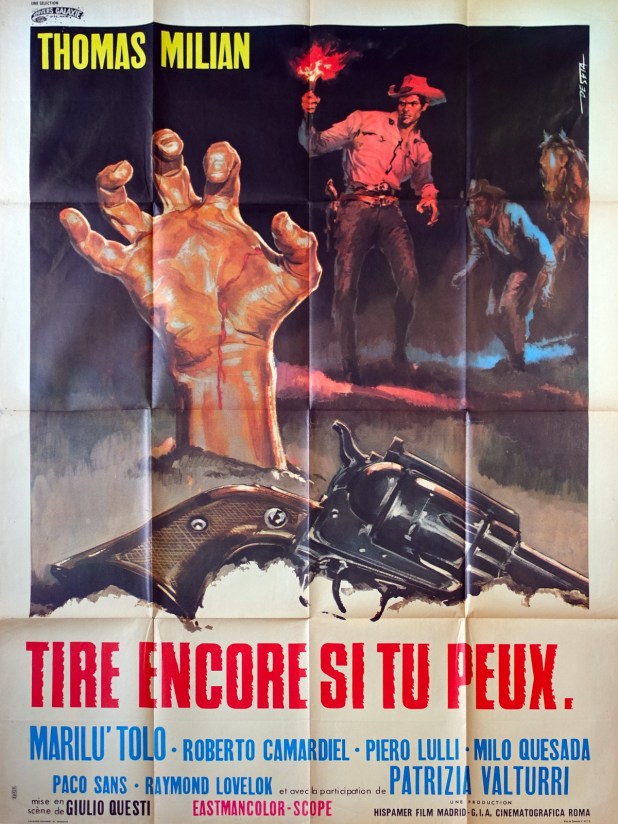
Two medicine men discover a man known only as The Stranger (Tomas Milian, Don’t Torture A Duckling) who remembers attacking a Wells Fargo wagon and splitting the gold with his partner Oaks (Piero Lulli, the sheriff in My Name Is Nobody) before getting shot in the back. The Native Americans tell our protagonist that they have melted down what is left of the gold into bullets and that they want to follow him on a hunt to what they call The Unhappy Place.
The Unhappy Place ends up being a town full of maniacs who lynch Oaks’ gang. The villain barricades himself in a saloon before The Stranger finds him and wounds him before the townspeople tear him apart to get to the gold bullets. Meanwhile, as a shocked Stanger and the medicine men try to bury what’s left of the gang, the townspeople argue over what’s left of the gold.
Foremost amongst the weirdness in this town is the homosexual rancher with a hate-filled parrot Sorrow (Roberto Camardiel, Arizona Colt), who will kill anyone in his way to get the treasure. His men even crucify our hero and torture him with vampire bats (!) and scalp one of the medicine men.
What can you say about a movie where people desire gold so much that it ends up melting them while an entire town watches before our hero rides away alone, followed by children using string to distort their faces?
This is a baffling, fascinating entry in the world of the Italian Western, one that would be great even without the Django title. It’s also the movie debut of Ray Lovelock, who plays the doomed Evan.I haven’t even gotten to the psychedelic editing yet!
This is one of the strangest and yet most gorgeous Italian Westerns I’ve seen. A definite recommendation.
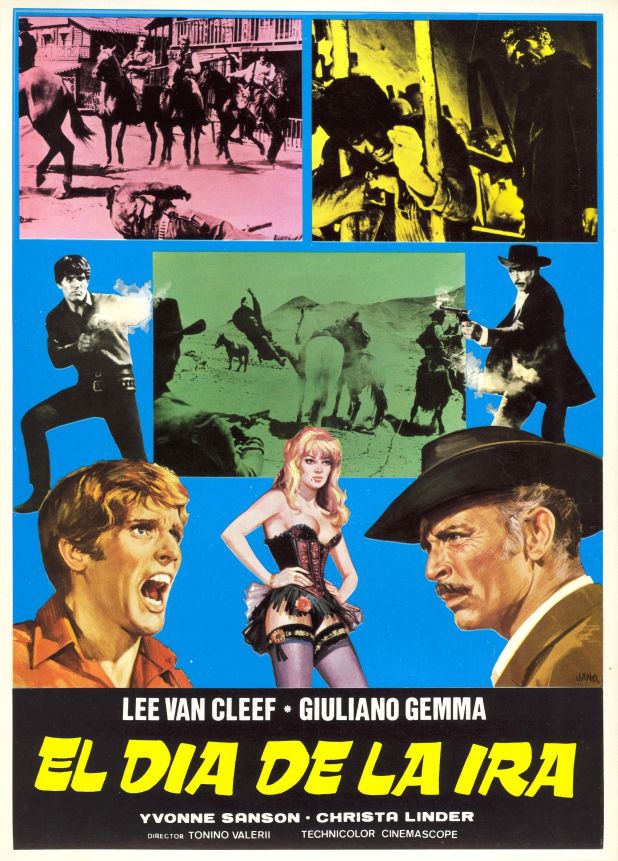
We already discussed Tonino Valerii’s My Name Is Nobody early this week. He also made this film with Lee Van Cleef, a face that Western audiences associate with the Italian Western.
Here, he plays Frank Talby, an aging gunfighter who starts to teach the rules of the life to Scott Mary (Giuliano Gemma, who will always be known as Ringo). However, the life of constant death may not be the right life for Scott, as Murph tries to teach him. The end of this movie is sobering; there is no real triumph in the death that he unleashes.
Come for the Western action; stay for the story and the Riz Ortolani score (you can hear some of it in Django Unchained). This film is an interesting counterpoint to Valerii’s later Nobody. It also features Al Mulock (who died in spectacular fashion in Leone’s The Good, The Bad and The Ugly; when he killed himself by diving out of his hotel window in full costume while making Once Upon a Time In the West, Leone famously yelled, “Get the costume, we need the costume.”) and German actress Christa Linder, who was in Fulci’s Dracula in the Provinces.
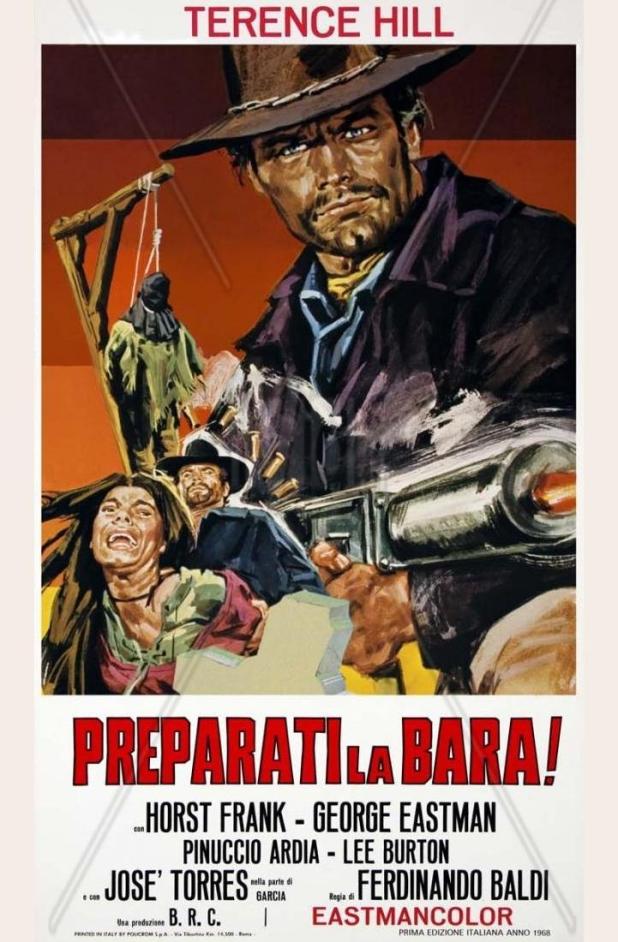
Ferdinando Baldi is a decent Italian Western director. I enjoyed what he did with Tony Anthony across several movies, including the wild 3D movies Comin’ At Ya! and Treasure of the Four Crowns. Here, he’s throwing his hat into the Django ring to make another movie that kind of, sort of has something to do with the seminal Western hero.
That said, this is a semi-official, legitimate follow-up, as it was originally intended to star Franco Nero and it was co-written by Django co-writer Franco Rossett.
Django is wounded while his wife is killed as the gold transport that he has been hired to watch over is assaulted by David Barry (Horst Frank, The Cat o’ Nine Tails), a man who he thought was his friend.
Our hero has a great plan by pretending to be dead and becoming the hangman of the town. He saves all of the victims of Barry and organizes them as a gang of dead men, but Garcia, one of the first men he saved, screws it all up when he kills Django’s army of bad guys and goes for the gold himself.
Even when Django is lured to the graveyard where his empty grave is and forced to dig it back up so Barry and his men can kill him, I thought that this was it. Then I forgot what was inside Django’s coffin — that machine gun.
Eagle-eyed B&S About Movies readers will have already spotted George Eastman in this film, his third Django movie that he made within the first two years of his acting career.
Following the success of the Bud Spencer and Terence Hill films in the mid 70’s, this was re-released with a comedic soundtrack. And in France, it was redubbed as a Trinity film. I have no idea how they made this funny, because it’s a pretty dark film.
If you listen to the soundtrack and wonder, “Where have I heard this before?” that’s because the song “Last Man Standing” was sampled by Danger Mouse for the Gnarls Barkley song “Crazy.”
Gary Hamilton (Klaus Kinski!) is released from ten years of hard labor with a pardon for a crime he didn’t commit, so he does what any insane character played by Kinski would do. He sets out to kill everyone who ever did him wrong.
Kinski wants Acombar, his former friend who set him up, dead. He has to go through the man’s son (Antonio Cantafora, Baron Blood) to do it, as well as the Acombar’s wife Maria, who was once his lover. He’s helped by the people of the town who hate his enemy, as well as his knowledge of the Native American burial grounds.
This is less Western than horror film, with Kinski’s character nearly a ghost, continually followed by gusts of winds and tolling bells as he returns to get his bloody vengeance.
While there are similarities to another Margheriti film Vengeance, this is very nearly a remake of Salvatore Rosso’s A Stranger in Paso Bravo, which was made just a year before. This one, however, is unafraid to let the gruesome side of violence be seen.
The original story for both was written by Eduardo Manzanos Brochero, but the screenwriter for this was Giovanni Addessi, who also produced the movie.
You can watch this on Tubi, but I’d like to warn you that the quality of the print is pretty bad.
I’ve been really looking forward to this film and it did not disappoint.
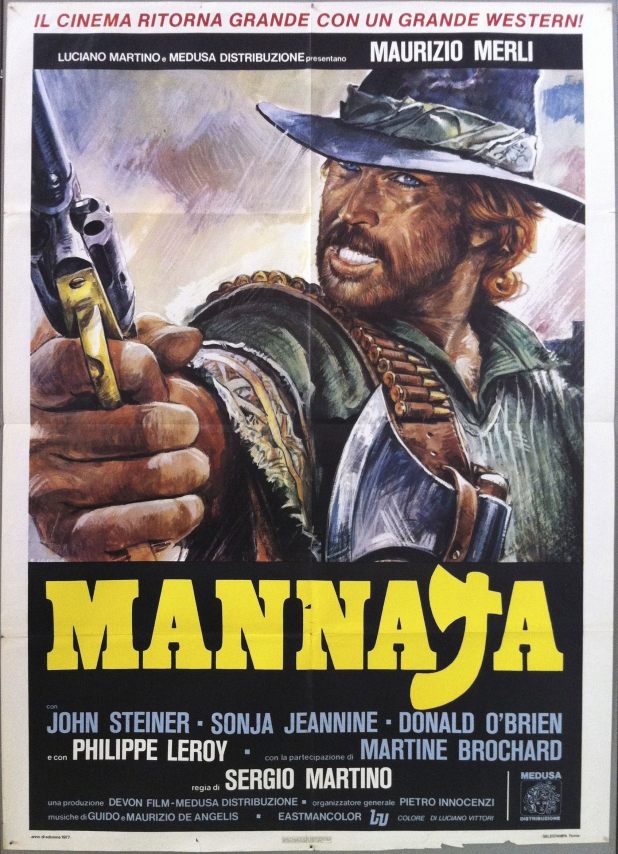
Maurizio Merli (Violent Rome) stars as Blade, a bounty hunter who favors a tomahawk as his weapon. After all, Mannaja means hatchet. I have no idea why they didn’t just call him that instead of Blade. Anyhow, our hero comes to the mining town of Suttonville with Burt Craven (Donald O’Brien) as his captive, but he just wants to kill mining boss Ed McGowan, who he blames for the death of his father.
However, when he meets the man, he’s in a wheelchair and “not worth it.” However, he will take the man’s money and decides to rescue the man’s daughter from Theo Voller (John Steiner), who is really working with her to take over the mine. They kill a prostitute who is in love with Blade right in front of him and bury him up to his neck in the desert, leaving pins in his eyes to force them open, blinding him. He’s rescued by Craven, even after he took that man’s hand. Now, that vengeance that Blade has always been looking for will finally be his.
This movie stands out — not just for its prog soundtrack (which sounds a lot like the music in Keoma) by Guido & Maurizio De Angelis (Oliver Onions!) — but for the foggy ending and the sheer weirdness of the proceedings. It doesn’t feel like any other Italian Western you’ve seen and credit is due to Martino.
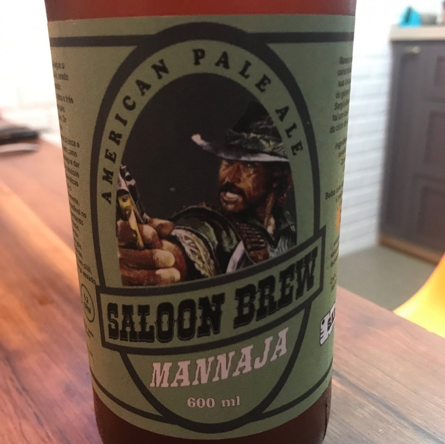
Someday when we can travel, I want to drink at Saloon Brew in Brazil. They feature a different Italian Western star on every one of their bottles. A good cold Mannaja would be perfect right now.
Speaking of that theme song, let me share the lyrics with you: “You’re alone. A solitary man. And when the sun goes down, your memories back around with you and your heart is breaking down. This here was your father’s land. Nothing bad, you can’t pretend. You love justice and you love peace. When the time will come to kill, to destroy who loves to kill and your hand will stop the axe and your conscience will be satisfied. Yes. You’re a good man, no one will put you down. Your feel is right, down worry man. Keep going, you know the way. That’s the right way. Keep going. You’re alone. A solitary man.”
I loved every single second of this. If only all movies could make me this happy. Also, this has more fog than The Fog but less than Conquest, because no more can ever have that much fog.
 B&S About Movies
You must be logged in to post a comment.