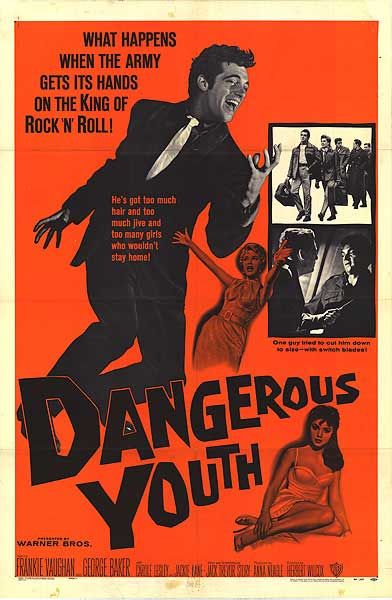
A British rock and roll movie? Sure, why not. Tough gang leader and wannabee rock star Dave Wyman (“Mr. Moonlight” Frankie Vaughan) escapes the Liverpool slums — five years before The Beatles would release “Love Me Do” — for military service. Somehow, someway, it turns out that the army life is the life for him. But we wouldn’t have a movie if things didn’t take a turn.
The camp bully kills Dave’s best friend, which means that according to the law of the street, Dave needs to take revenge. He’s also in love with his singing partner, which complicates his need for vengeance.
Look for Hammer star Michael Ripper, as well as David McCallum in his first role. But yeah, for a week of movies all about music, this barely qualifies. You have my apologies.
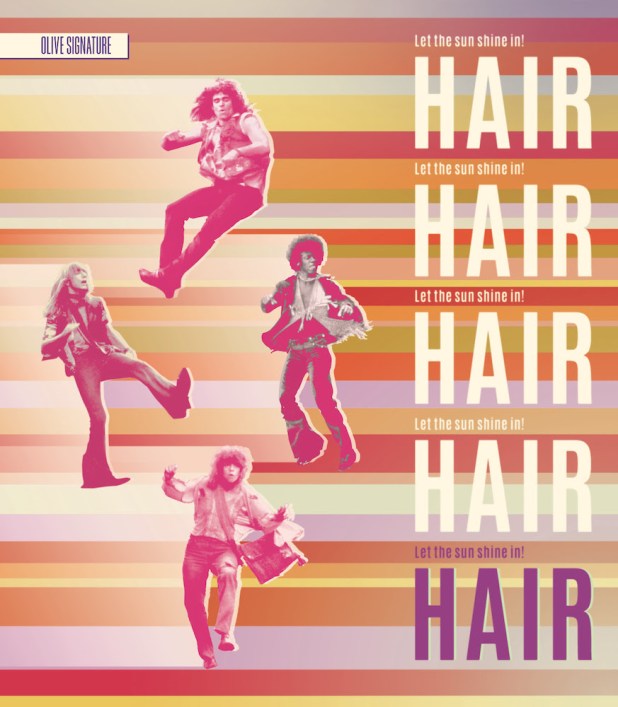
Made nearly a decade after this play took Broadway by storm in 1967, Milos Forman created his own vision of the stage play, working alongside Michael Weller (they would also collaborate on Ragtime). The changes they made are minor — Claude is a Vietnam War draftee instead of a hippy and Sheila is a high society girl — and major — the focus on the film is the peace movement instead of just the hippy antics and the ending is completely different. Many of the songs from the stage version were omitted as well.
Gerome Ragni and James Rado, who wrote the original play along with composer Galt MacDermot, would go on to say, “Any resemblance between the 1979 film and the original Biltmore version, other than some of the songs, the names of the characters, and a common title, eludes us.”
Hair focuses on Claude Hooper Bukowski (John Savage, The Deer Hunter) and George Berger (Treat Williams, Night of the Sharks) as they deal with the country attempting to handle the Vietnam War, as well as the people in their orbit. There’s Sheila Franklin (Beverly D’Angelo, The Sentinel), Jeannie Ryan (Annie Golden, who was in the 1977 revival of this show), LaFayette “Hud” Johnson (Dorsey Wright, The Warriors), Woof Daschund (Don Dacus, who has been in Chicago and Badfinger), Hud’s fiancee (Cheryl Barnes, who sang backup for Leonard Cohen along with Laura Brannigan), Sergeant Fenton (Richard Bright, Cut and Run), as well as roles for Ellen Foley (who sang “Paradise by the Dashboard Light” with Meat Loaf), Miles Chapin (Richie from The Funhouse), Broadway star Laurie Beechman, Nicholas Ray (yes, the director of Rebel Without a Cause), Michael Jeter from TV’s Evening Shade, Renn Woods (who sings one of the play’s best-known songs, “Aquarius,” she’s also in The Jerk) and an uncredited David Rose as The Acid King. Rose wrote one of the most famous songs of all time — “The Stripper.” Oh yeah! And the Vietnamese girl singing on “Walking In Space” is an uncredited Betty Buckley, Miss Collins from Carrie.
NBC must have been watching this movie, because eventually Nell Carter and Charlotte Rae would be starring in sitcoms on their network, yet they only get cameos in this film.
Olive Films has given this movie a new HD restoration, as well as plenty of extras, such as audio commentary by assistant director Michael Hausman and actor Treat Williams, featurettes with the surviving actors and interviews with choreographer Twyla Tharp, editors Lynzee Klingman and Stanley Warnow, and production designer Stuart Wurtzel. There’s also “Artist, Teacher, Mentor: Remembering Milos Forman,” a remembrance with director James Mangold (Walk the Line) and an essay by critic Sheila O’Malley.
I expected this film to be incredibly dated, yet at the end, as a huge throng of people ran toward the White House singing “Let the Sun Shine In,” I was overcome with emotion. We’ve been protesting for more than half a century and while forward progress has happened, it sure doesn’t feel like it today. Forman’s film remains vital if it can impact me so.
You can order this blu ray from Olive Films, who were kind enough to send a copy our way.
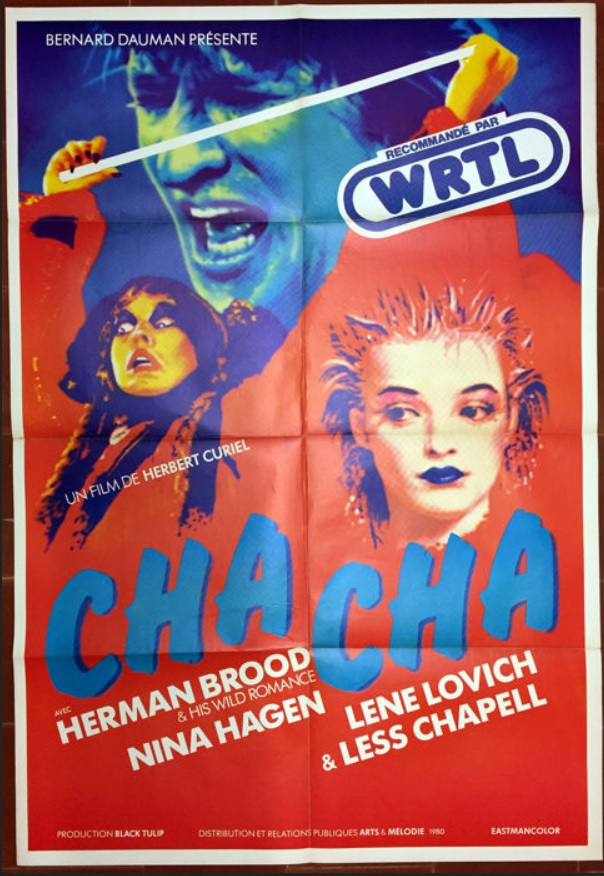
Cha Cha served as a multi-media film and soundtrack collaboration by the then romantically-linked couple of Dutch rocker Herman Brood (1979 U.K./U.S. Top 40 new wave hit with “Saturday Night” by his band Wild Romance) and East German musician-actress Nina Hagen (1982 new wave hit with “Smack Jack”), along with Detroit, Michigan-born and London-transplanted Lene Lovich (1979 U.K./U.S. new wave hits “Lucky Number” and “New Toy”).
Since each were at the top of their Euro-chart popularity, it lent to their ability to get their — what isn’t so much a fluid, narrative work, but an art film comprised of a series of vignettes strung together by a series of musical performances — passion project made. Think of 1975’s The Rocky Horror Picture Show crossed with the Richard Hell-starring Blank Generation from 1980 by Ulli Lommell (BrainWaves with Keir Dullea, The Boogey Man with Suzanna Love), and you have an idea of what you’re getting into.
Courtesy of catawiki.es (Spain)
Yes. The words “art film” should give you pause; this one is purely for the uber fans of the musician-stars of the film. You’ll also need additional patience as the film’s dialog bounces between English to Dutch to German; and its amateur student film vibe doesn’t help matters. The “plot,” such as it is, set against Amsterdam’s punk/new wave scene, is part documentary (voiceovers and interviews, natch) and part narrative film — with the cast starring as themselves; Brood is “the star” of the film: a bank robber who wants to “go straight” and believes the path to righteousness lies in his becoming a rock ‘n’ roll star.
Also featured in the film are the notable Dutch new wave bands Phoney & the Hardcore (“Suicide“), the Meteors (“Teenage Heart“), and White Honey (“Nothing Going On In the City“). (While not commercial radio hits on par with Brood’s, Hagen’s, and Lovich’s works, they were popular spinners on U.S. college radio stations and new wave clubs at the time.)
In the end, if you want to revisit the ’80s new wave era — or visit it for the very first time — Cha Cha serves as a fun time capsule of the lost MTV video era.
You can enjoy a pretty clean rip of the full movie on You Tube (it’s been there for 8 years, so it safe to say it’s not going away anytime soon). You can also listen to the full soundtrack on You Tube as well; you can access a detailed track listing at Discogs. You can learn more about Herman Brood in the 1994 Dutch rock documentary Rock ‘n’ Roll Junkie (you can watch the 15 minute television promotional video and 90-minute feature length theatrical on You Tube) and Nina Hagen in the 1994 English document (very arty and avant-garde, natch) Nina Hagen = Punk + Glory on You Tube.
About the Author: You can learn more about the writings of R.D Francis on Facebook. He also writes for B&S About Movies.
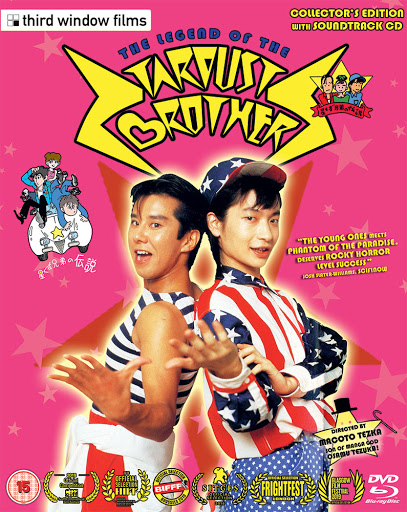
1985. Japan. Macoto Tezka (son of “The God of Manga” Osamu Tezuka) meets musician Haruo Chicada, who has already made a soundtrack to a movie that does not exist. Inspired by The Rocky Horror Picture Show and Phantom of the Paradise, along with the chance to work with some of Japan’s hottest bands, Tezka and Chicada would join up with a creative team that also included Lupin the 3rd creator Monkey Punch and directors Kiyoshi Kurosawa and Daihachi Yoshida.
They harnessed lighting and put it in a bottle that was lost at sea, as nobody really spoke of this movie for around thirty years, both in Japan and here in America.
We were missing out.
Punk rock rebel Kan and new-wave crooner Shingo are already broken up when we met them, former members of The Stardust Brothers, the greatest band of all time. What came between them? A girl? Their manager? Or are they making their lyrics the sad truth to their real lives? “Once you reach No. 1, you just go down.”
Look, any movie that has a cameo by UWF founder Akira Maeda and is dedicated to the memory of Winslow Leach is going to be a film that I’m going to proclaim to the heavens.
As is often the case with the movies that I love, the press savaged this movie. Tezka told Japan Times, “People are watching it with fresh eyes now, and I’ve had lots of positive comments. But I wonder about how I could have taken those ideas further, and all the films I might have made, if people had responded like that at the time.”
This is a movie in love with film, with music, with being young and being incredibly strange. Idol culture is fascinating and never more so when it is shown in this movie, which I urge you — yes, you reading this! — to watch right now. After all, this is “a movie that has traveled light years to find you.”
There was a 2016 sequel to this — Hoshikuzu Kyôdai no Aratana Densetsu — that I have to now track down. As for this film, it’s available to buy on Vimeo.
For four decades, the masked and mysterious sound and video collective known as The Residents have not just made music. Or art. But some form of commerce that creates art that feeds commerce with music. It’s complicated. So who is under the giant eyeball masks? What inspires those songs? And what makes fans get so obsessed that they end up creating their own bands inspired by the masked ones?
Luckily for viewers, The Residents’ management company, The Cryptic Corporation, gave the filmmakers unprecedented access, not only to the band’s video and audio archives, but to the musicians who have played with them before as well as a front-row seat on their 40th anniversary tour.
Members of Devo, Primus, Ween, Talking Heads and Pinback also appear, discussing how their bands and The Residents cross over with one another. The Residents — like the above bands and other sonic collectives like Negativland — have never existed to make music for everyone. But for those that are ready for their message, they have become auditory messiahs, inspiring not just fandom but further creation.
The Residents have always existed under N. Senada’s “Theory of Obscurity,” which states that “an artist can only produce pure art when the expectations and influences of the outside world are not taken into consideration.” His Theory of Phonetic Organization further states, “the musician should put the sounds first, building the music up from [them] rather than developing the music, then working down to the sounds that make it up.”
Some say N. Senada was a Bavarian composer. But then you realize: his name means “in himself nothing.” So while he may have been inspired by someone — perhaps Harry Partch or even Captain Beefheart, who inspired the masked ones in the way they did the same for so many — it seems that the man whose laws govern them was probably created by them too.
Like I said, it’s complicated. And I like it that way.
That’s right, in 1979, we found out that “every year young people disappear.” This PG-rated movie — yes, it still surprises us — is a favorite of Becca, who is actually coming on the show this week. Here’s a drink to enjoy during it.
Slausen Family Lemonade
3 oz. coconut rum
1 can coconut water (12 ounces)
2 lemons
Dash of simple syrup
Ice
This one is super simple. Make lemonade by juicing the lemons (if you’re in a pinch, you can just use pre-made lemonade). Simple syrup makes a sweeter taste than just plain sugar.
This recipe is coconut-rich. So if you want less of a good thing, use water instead of coconut water. Me, I added a dash of Coco Real to make it even more coconutty. Is that a word?
If you want to get really wild, use shaved or crushed ice. The colder this one is, the better. Also, you don’t ever need to drink during the movies, so you can make this without the rum.
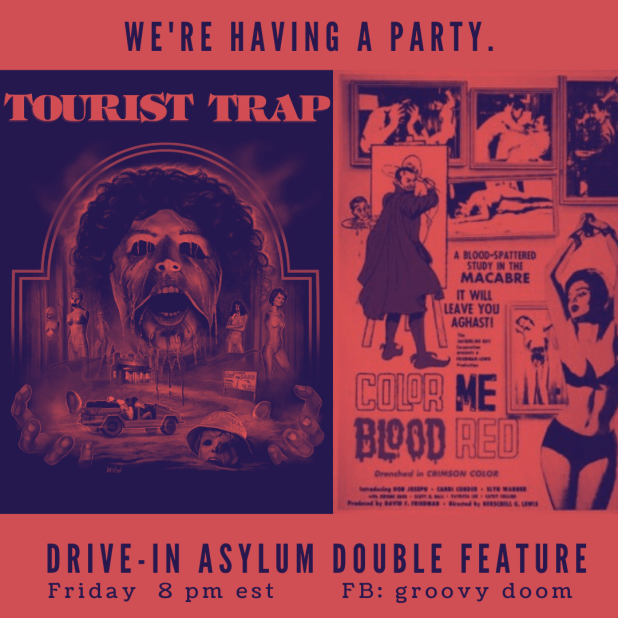
To follow this strange movie, let’s turn to Herschell Gordon Lewis! Color Me Blood Red!
You’re going to need something, well, red to drink during this. We’ve got you covered.
Bloody Adam (based on this recipe, fixed as there were some strange measurements)
1 oz. vodka
1 oz. gin
1/2 oz. cherry vodka
3 oz. club soda
Splash of grenadine
Maraschino cherries (to taste)
Ice
Fill your glass with ice until about half full.
Pour in vodkas and gin, then top with club soda.
Slowly add grenadine and cherries, as well as cherry juice to taste (and for how much “blood” you want in your cocktail).
Don’t forget — if you want to attend, Saturday night at the Riverside Drive-In in Vandergrift, PA will be a showing of The Carand Christine! We’ll be there. Will you?
Despite this being a movie about Pennsylvania, my hometown of Pittsburgh got lumped in with Erie, a city 127.8 miles away. They showed Club Laga. Roboto and Graffiti, but that was about it, to be honest, outside of some still photography. Yes, despite two hundred interviews made for this film, the Steel City got the shaft. That’s alright. We’re kind of used to it.
This was made by Loren W. Lepre, who I am sure I was in the same ECW shows at Viking Hall as him, judging from his biography on IMDB. It’s great that someone made a movie about this, but basically, if you sat at Gooski’s and someone screamed at you about bands that they liked and no one else knows, this would be the same thing, minus the attitude, overwhelming cigarette smoke and oh yeah, we can’t go to bars any longer because we live in a nightmare hellscape.
“Hey, just wait a minute there, you smug and pretentious, know-it-all pseudo-film critic . . . what’s this disaster-suspense drama doing in the middle of a “Rock ‘n’ Roll Week” of reviews? This is just a knockoff of Dirty Harry crossed with Earthquake, and instead of Clint Eastwood’s police inspector, we get an amusement park safety inspector. And while George Segal is pretty cool in the role, he’s no Dirty Harry Callahan.”
“Well, don’t forget that George is teamed with Richard Widmark as FBI Agent Hoyt.”
“Uh, no. Sorry. Still not Dirty Harry Callahan.”
“Well, do the factoids that Rollercoaster not only has a rock ‘n’ roll connection, but a connection to Pittsburgh and Star Trek as well, Mr. Critic of critics?”
“No, not really. But you’re going to ramble about it anyway. I’m going to go take a piss. Later, dude.”
Critics of critics. God, how we love ’em at B&S About Movies. . . .
So, the connection to Star Trek comes courtesy of director James Gladstone, who directed the classic September 1966 episode, “Where No Man Has Gone Before,” you know, third episode of the first season that served as the second series pilot when the first pilot, “The Cage” (starring Jeffrey Hunter as Kirk), failed . . . you know Gladstone’s episode: Gary Lockwood (2001: A Space Odyssey, Earth II) and Sally Kellerman (the original “Hot Lips Hoolihan” in the theatrical version of M.A.S.H) obtained psychic powers after the Enterprise crossed The Great Barrier. And, as we learned, courtesy of B&S’s Chief Cook and Bottle Washer, Sam, in his review of 1974’s Cry Panic, James Gladstone directed that John Forsythe-starring TV movie written by Jack B. Sowards who, in turn, came up with one of the greatest tales of Federation folklore: the Kobayashi Maru, a no-win scenario for new Starfleet captains that was first brought up in Star Trek II: The Wrath of Khan.
Gladstone also directed the ’70s duplex favorite, When Time Ran Out (1980), an Irwin Allen-produced disaster-suspense boondoggle about an island volcano. That film reteamed Paul Newman and William Holden from the disaster bonanza The Towering Inferno and Ernest Borgnine and Red Buttons from the water epic The Poseidon Adventure. And Gladstone, along with producer Jennings Lang (Airport ’75, Airport ’77, The Concorde : Airport ’79, as well as Play Misty for Me, Slaugtherhouse Five and The Nude Bomb!!), previously worked together on Swashbuckler (1976), Universal’s forgotten “pirate comedy” flop starring Robert Shaw from Jaws. (Yep, Lang also did the one that started it all: Earthquake.)
The plot of Rollercoaster was described by Gladstone as more of a Hitchcockian cat and mouse story than as the disaster movie it was marketed; Segal concurred: he saw it as a well-structured, Hitchcock-styled action-adventure, combined with Universal’s (“Sensurrond”) technology. And Rollercoaster was, in fact, the fourth film in the studio’s “Sensurrond” oeuvre: the aforementioned Earthquake, the WWII epic Midway (1976), and the theatrical version of Battlestar Galactica (1978).
The film stars Timothy Bottoms (Up From the Depths! Thank you, Charles B. Griffith for that duplex classic!) as a mad bomber blowing up the nation’s rollercoasters to extort a million dollars from a Chicago-based amusement amalgamate. Now, if you’re keeping track, that is pretty much the plot of Dirty Harry — only with the mad bomber replaced with an assassin, and Georgy-boy not slingin’ a .357 and quipin’ one-liners. And if it all sounds like Speed, with Dennis Hooper’s “mad bomber” blowing up a bus-for-bucks (which is just Die Hard on a bus), then it probably is.
“Hey, man. I’m back from my piss. And one hell of a loaf-pinch. You’re still rambling? Did you get to the rock ‘n’ roll part, yet? Time’s a-wastin’. I need to go do my yard work.”
Ugh. Critics of critics, again I say. . . .
Anyway, as for the Pittsburgh connection: Mine and Sam’s beloved Kennywood Park out in West Mifflin in Allegheny County was originally set as the location for the film’s opening “crash” segment. When the park got cold feet at the last minute, producer Jennings Lang reset the scene for “Wonder World” at Kings Dominion outside of Richmond, Virginia. (This extended interview, seen below, with King’s Park Manager, Dennis Speigel, who also starred in the film, tells it all.)
The Rock ‘n’ Roll Part!
So, do you remember during your MTV youth, the quirky “Cool Places” that featured the annoying and least-attractive member (well, opinions vary) of the then hot the Go-Go’s, Jan Wiedlin? Well, you might recall that wasn’t a Jan Wiedlin solo tune: it was the lone U.S. Top 50 radio hit by Sparks, which was featured on their twelfth studio album, In Outer Space (1983), issued by Atlantic Records.
Anyway, Spark’s previous label, Columbia (the band burnt through six deals over the years), decided a great way to promote their new signee was by casting them in movie and feature the planned singles of “Fill ‘Er Up” and “Big Boy“(the official single upload) from their mutual debut, Big Beat (1976; produced by Rupert Holmes . . . yes, the “Escape (The Piña Colada Song)” dude). Sadly, the genius of the Columbia promotions department didn’t work: after one more flop album, 1977’s Introducing Sparks, the label dropped the band. And here’s the big scene doing “Big Boy” from the film.
If you look closely at their “big scene,” you’ll notice that album’s ex-Tuff Dart Jeff Salen on guitar (“(Your Love Is Like) Nuclear Waste” and “All For The Love of Rock and Roll“), along with ex-Milk and Cookies (You Tube) bassist and drummer Sal Maida and Hilly Micheals. And since we’re talking MTV: You’ll recall Hilly Michaels had his own MTV video hit, “Calling All Girls,” from his solo debut, Calling All Girls (1980). As with Columbia pushing Sparks via film, Warners also failed to break Micheals to a mass audience by placing tunes from the album in the uber-obscure (flop) Robby Benson (The Death of Richie) rock flick, Die Laughing (“Shake It and Dance“), and Chevy Chase’s Caddyshack (“Something’s On Your Mind“).
Coco for Sparks!
Okay, so this is where Sam just says, “F it,” and lets me free range across The Point, gushing in gaiety over the quirky, they’ll-never-be-The Cars-no-matter-how-much-the-label-wishes-it-so Sparks. But I say “bollocks” to the industry: I love Sparks!
It all began for the Los Angeles Mael brothers with their ahead-of-its-time new wave precursor, Halfnelson (“half nelson,” get it?). The band featured the likes of Earle Mankey (later of the Pop and 20/20), his brother, Jim (later of the alt-rock chart-topping Concrete Blonde), along with Leslie Bohem and David Kendrick of L.A.’s Bates Motel. With fellow Bates Motel/Sparks’ members Jim Goodwin and Bob Haag, the quartet became the Gleaming Spires. Their new wave hit, championed by Rodney Bingenheimer (The Mayor of Sunset Strip), “Are You Ready for the Sex, Girls,” appeared on the soundtracks to The Last American Virgin and Revenge of the Nerds.
Halfnelson signed with Bearsville (home to Foghat, Todd Rundgren’s Utopia, R.E.M clones the dB’s, and NRBQ), with Rundgren producing. After one belly flop of an album, the label wanted a name change (their moniker was “dumb and confusing” per the label) and reissued the album. Three ignored albums later, Sparks were signed by “fan” Muff Winwood (Steve Winwood of Traffic and Blind Faith’s brother) to Island. So off to England Sparks went, to ride that country’s then hot “glam” wave, where they fit right in with the likes of David Bowie (his long time producer, Tony Visconti, produced them), T.Rex, Mud (Never Too Young to Rock), and Slade (Slade In Flame).
Then, when glam became passe in the U.K. under the rise of punk rock and the Maels didn’t fit in with that Sex Pistols-inspired scene, they returned to the U.S., where hard rock was on the rise in a post-Van Halen world. And Columbia’s brain trust had Sparks make a “big rock move” for two more albums. And that “move” led to Sparks’ appearance in Rollercoaster — a role that the Brothers Mael described in a September 2006 Mojo interview as “the biggest regret” in the career of Sparks.
Regret? I went screaming from the duplex to find used Sparks albums at the local used record store. Hey, at least Columbia converted one person into a “Sparkhead” via the film.
And how is this not on TubiTV, considering it’s been re-released on Blu by Shout Factory (Thank You!!!), who has their own Tubi channel? No online stream, either? Not even on Amazon Prime? What the hell! Well, we found this — as a commenter dubbed it — “Glaucomavision” copy (you’ll get the joke when you open the link) on You Tube, for those of you that have never experienced the wonder of the members of Sparks fleeing the shrapnel of a rollercoaster.
Yeah. I love this movie.
About the Author: You can learn more about the writings of R.D Francis on Facebook.He also writes forB&S About Movies.
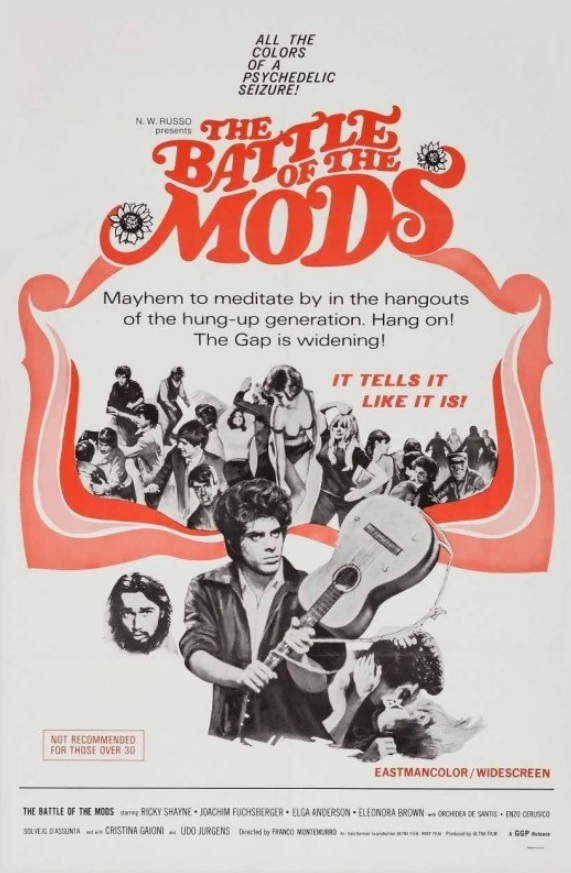
If you’re a fan of the Who — and watched or listened to their 1973 rock opera Quadrophenia — you’re up to speed on the two warring British youth subcultures known as the Mods and the Rockers that came to worldwide notice courtesy their numerous, violent confrontations in mid-1960’s London. And you know about their roots in the frames of Marlon Brando’s The Wild One (1953) and the music of Eddie Cochran and Gene Vincent.
And Euro-cinema knew good fodder for a script when they seen one.
So Ennio De Concini, who wrote more than his fair share of sword n’ sandal and spaghetti westerns, and director Franco Montemurro (internationally known for 1962’s The Police Commissoner and 1964’s Divorce Italian Style), came up with a story about a Liverpool gang war between the Mods (who dress in the latest fashions and style ala Gene Vincent) and the Rockers (adorned in a ’50s greaser style ala Marlon Brando). Ricky Fuller (Euro musician Ricky Shayne), the son of a wealthy businessman, is a Mod musician who, after a bloody a gang fight that leaves his girlfriend dead, flees Liverpool for Rome — and he starts an affair with his father’s mistress.
La battaglia dei Mods
A 1970 Radio Luxemburg “Golden Lion” award-winning singer, Ricky Shayne (aka George Albert Tabet) was born to a Lebanese oilman and his mother, a French-born painter, in Beirut, Lebanon. After moving to Paris at the age of 15, he began his music studies; with a move to Italy at 17, he began his recording career and, courtesy of his cinematic good looks, quickly found acting work. In 1965, he co-starred in an Italian rock flick Altissima pressione (Highest Pressure). He quickly transitioned into leading man roles with the 1966 German rock film Siebzehn Jahr, blondes Haar (Seventeen Years, Blond Hair) and the 1967 Italian rock flick Una ragazza tutta d’oro (A Girl All In Gold). Of course, all of the films featured Ricky’s latest hits, with the The Battle of the Mods featuring his tunes “Uno dei Mods” (“One of the Mods”), along with “No No No No” and “Crazy Baby I Got You” (which also served as the film’s alternate title).
American classic rock aficionados came to know Ricky Shayne by way of the American pop band Stories, fronted by Ian Lloyd (1973 U.S. #1 “Brother Louie“). In lieu of importing Ricky Shayne to the States via his 1971 European smash hit single “Mammy Blue” (the German language version hit #7 in that country; the French language version hit #8 in France, the English language version hit #1 in Argentina and Brazil, and the Top 10 in Belgium and Japan), the song was re-recorded by Stories, who placed it in the American Top 50 — and proved to be the last hit by the band. Shayne, meanwhile, became a U.S citizen in 1975, but continued to hit the European charts with a variety of singles while starring in European film and television roles. Now, at the age of 76, he still performs in Eurasia as part of nostalgia package tours.
While a quick search of Ricky’s music on You Tube will turn up a wide array of his singles, here’s his original 1971 version of “Mammy Blue” to enjoy (alternately titled with one “m” or two, depending on country of release.)
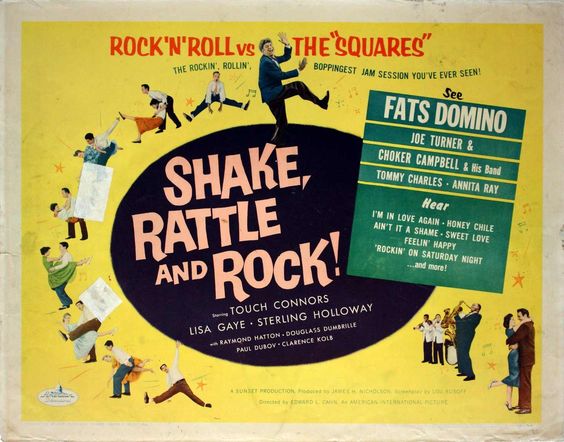
Edward L. Cahn made everything from Our Gang shorts to It! The Terror from Beyond Space and The Four Skulls of Jonathan Drake. He also made this “rock ‘n roll vs. the squares” movie that features Fats Domino and Big Joe Turner.
Playing on a double bill with Runaway Daughters, this was but the start of American-International Pictures reaching out to the teens or more like reaching into their wallets. Most of the films follow the Arkoff Formula:
Action (exciting, entertaining drama)
Revolution (novel or controversial themes and ideas)
Killing (a modicum of violence)
Oratory (notable dialogue and speeches)
Fantasy (acted-out fantasies common to the audience)
Fornication (sex appeal for young adults)
You get a pre-Mannix Mike Connors, Lisa Gaye (who is also in Rock Around the Clock), “fifth Marx Brother” Margaret Dumont and plenty of actors who’d been around Hollywood since before sound was in movies. No matter. The real action here is when the kids defend rock and roll against the old timers in a TV trial.
In 1994, this movie was remade as part of the Rebel Highway series of AIP remakes on Showtime. The new version, directed by Allan Arkush, featured Renee Zellweger in the lead and appearances by Howie Mandel, Max Perlich, the R&B band For Real, Gerrit Graham, John Doe, Riki Rachtman, Nora Dunn, Mary Woronov pretty much playing Ms. Togar from Rock ‘n Roll High School, P.J. Soles playing a square with the last name of Randall (who I sure hope isn’t Riff all grown up) and Dick Miller.



 B&S About Movies
You must be logged in to post a comment.