Drive-In Friday: Fast & Furious ’50s Style Night

Thank the celluloid gods of the analog netherworlds for giving Sam the idea to commemorate the Fast & Furious franchise, thus granting the opportunity to go ’50s hot roddin’ rock n’ roll crazy with this week’s Drive-In Friday tribute.
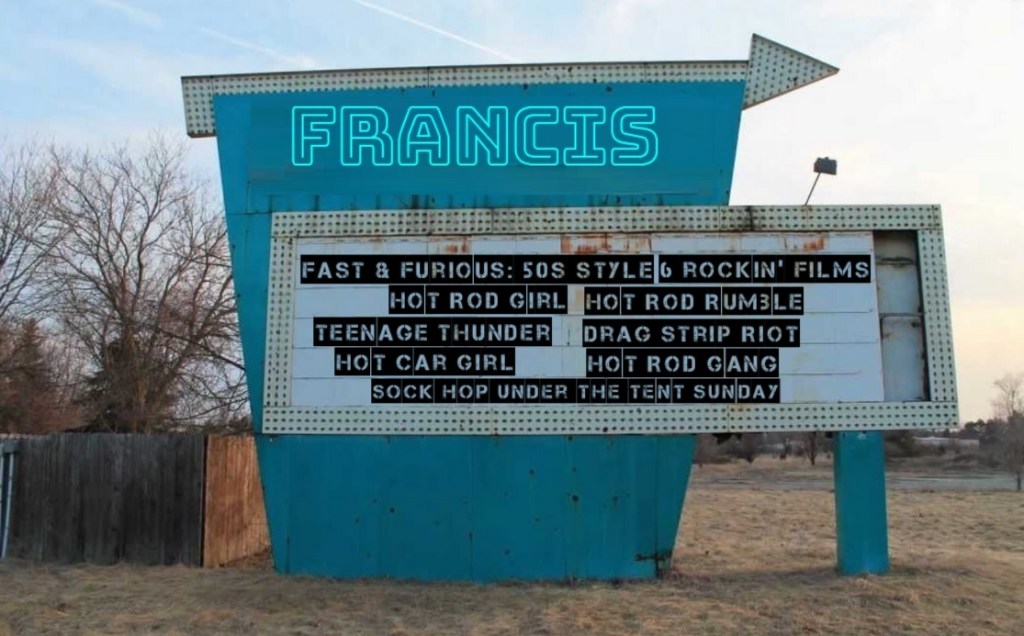
Vin Diesel lookalike autograph signing under the tent Friday!

Tonight’s show takes me back to the days when AMC was still known as “American Movie Classics” and aired actual “classic movies,” most importantly, their American Pop! programming block that ran Saturday Nights from 10:00 p.m to midnight from 1998 to 2003.

To say American Pop! carried a USA Network’s Night Flight* aroma is an understatement, courtesy of its programming roster that featured 1950s and 1960s rock n’ roll-oriented films augmented with classic trailers, music videos cut form period musicals, drive-in movie ads, and old drive-in snipes urging you to “visit the snack bar.” The purpose of the programming block was to ramp an AMC-affiliated 24-hour cable channel . . . that never came to fruition.

Ugh. Heart broken by progress, once again.

Oh, and you can thank — or blame — screenwriter Stewart Stern and director Nicolas Ray for these F&F precursors, for each aspire to emulate the film that started it all: the 1955 juvenile delinquency classic, Rebel Without a Cause. But if you’re looking for social commentaries about clueless parents battling the moral decay of American youth, you best go watch a copy of Richard Brooks’s Blackboard Jungle (1955), instead. And if you’re having Marlon Brando flashbacks ala The Wild One (1953) . . . and if all the “teens” look like 30 year olds, they probably are.

So, alright, gang! Let’s get fast n’ furious, crazy baby! Let’s rock to that hot rockin’ beat, daddy-o!

Movie 1: Hot Rod Girl (1956)

CHICKEN-RACE . . . ROCK ‘N ROLL . . . YOUTH ON THE LOOSE! . . . ARE THESE OUR CHILDREN? . . . Teen-age terrorists tearing up the streets!”

Now if that fine slice-o-copywritin’ doesn’t inspire you to pony up to the cracklin’ speaker and firin’ up that ol’ bug coil, then nothing will.

As with the plot of most of the Fast & Furious knockoffs of century 21: After his kid brother dies in an illegal street race, a champion drag-racer quits racing. When a new hotshot racer comes to town, he’s forced back into racing to retain his title.

Way to splash that testosterone, guys.

The “Natalie Wood” bad-girl, aka the Hot Rod Girl, who plays the two drag racin’ dopes against each other, is Lori Nelson (co-star of the 1957 rock n’ delinquency flick Untamed Youth with Mamie Van Doren), and the cop on the case is . . . Chuck Connors from Tourist Trap? And one of the “teen” thugs is a 23-year-old Frank Gorshin, aka The Joker of TV’s Batman fame, in his acting debut.

IMDb poster link.

Movie 2: Hot Rod Rumble (1957)

“DRAG STRIP SHOCKS! PISTON-HARD DRAMA! ROCK ‘N ROLL LOVE! . . . A scorching story of the slick chicks who fire up the Big Wheels!”

Hey, dad! It’s more rival car clubs and vehicular homicide via illegal street racing with a poor, misunderstood youth being set up for murder. Oh, and there’s always a heart-toying bad-girl adding to the hot rod drama, in this case, (hubba-hubba) actress Leigh Snowden who — by name alone — makes me feel funny, you know like when you take a Garth Algar-climb up the rope in gym class. Leigh’s other claim to fame: the third Gill-man/Black Lagoon movie that no one cares about: 1956’s The Creature Walks Among Us.

IMDb poster link.

Movie 3: Teenage Thunder (1957)

“Young love and teenage kiss . . . hot rods and hot tempers.”

As you can see, the copywriters were having a bad day marketing this James Dean-light knockoff. And you’d think cloning the epitome of teen juvies would lead to bigger roles . . . but not for Chuck Courtney: by the turn of the ’60s he was down to background work as a soldier on Spartacus and as a crewmember on TV’s Voyage to the Bottom of the Sea.

He stars as the misunderstood and motherless (typical 27 year old playing an 18-year-old) Johnnie Simpson who lives with his every-criticizing father (see Jim Backus’s in his role as Jim Stark) and Aunt Martha (because aunts are always named “Martha” in the movies). Of course, Johnnie’s family is poor and he can’t afford a fancy hot rod . . . or even a rat rod. But Maurie Weston (hey, that’s Robert Fuller from TV’s Emergency! and Walker, Texas Ranger!), the local town bully-cum-rich kid, has as a set of smokin’ wheels . . . and Jim’s waitress-girlfriend (Melinda Bryon; appeared in 1948’s Kiss the Blood Off My Hands with Burt Lancaster) notices. Yep, Jim’s gotta race for the girl.

Johnnie, my advice: there’s other babes to score at the sock hop. You’ll never win with girls who like the bad-boy. Never. Even when they look like Leigh Snowden.

IMDb poster link.

Ugh. Another trailer embed bites the dust. Why?

Intermission . . .

Back to the show . . .

Movie 4: Drag Strip Riot (1958)

“Murder at 120 miles per hour!”

Now you’re talkin’ Mr. Copywriter. And yes, Mr. Art Director: illegal street racing jousts between Corvettes and Triumph motorcycles is exactly what we want on a poster!

This one has it all: In addition to bike vs. car battles, we have a climatic fishing spear fight scene on the beach, we have (hubba-hubba alert) an on-the-way-up Connie Stevens (of the rockin’ juvie potboilers Young and Dangerous, Eighteen and Anxious, and The Party Crashers issued in ’57 and ’58), and an on-the-way down Fay Wray (do we have to mention her iconic role; she was also in ’56s Rock, Pretty Baby!).

The teen tempers boil when the cleancut members of a sportscar club (complete with sweaters and slacks, natch) runs afoul of a motorcycle gang and it results in the death of one of the instigating bikers. And now they’re out for revenge.

The double hubba-hubba alert comes courtesy of the resident bad-boy chasing femme fatale played by Yvonne Lime, who’s traveled the rockin’ asphalt before in High School Hellcats, Speed Crazy (also a hot rod flick), and Untamed Youth.

IMDb poster link.

Movie 5: Hot Car Girl (1958)

“She’s hell on wheels . . . and up for any thrill!”

Seems Mr. Screenwriter dipped the pen into the Shakespearian ink; for this is Othello with hot rods.

Duke (Richard Bakalyan; you’ve seen him across his 150 TV credits into the early ’90s) and Freddie (John Brinkley, who’s traveled this rockin’ road before in Hot Rod Rumble, Teenage Doll, and T-Bird Gang) finance their hot roddin’ lifestyle by stealin’ cars n’ strippin’ auto parts for a fence. When they, along with Duke’s girl, Peg (June Kenney, also of Teenage Doll, but also of 1959’s Attack of the Puppet People and Roger Corman’s Sorority Girl), are goaded into a road race by the resident bad-girl, Janice (Jana Lund, also of High School Hellcats with Yvonne Lime, Elvis Presley’s Loving You, and the rock flick classic, Don’t Knock the Rock . . . but since this B&S About Movies: it’s all about Frankenstein 1970 for our Lundness), a motorcycle cop dies. Let the frames and double crosses, blackmailing and betrayals begin, Desdemona.

Oh, almost forgot: Bruno VeSota is in this as Joe Dobbie (seriously). What ’50s and ’60s film wasn’t the Big V in? Yep, there he is in Attack of the Giant Leeches, A Bucket of Blood, and The Wasp Woman . . . but also of the early rock flicks Daddy-O, Rock All Night, and Carnival Rock. It is actors like you that gives our lives at B&S meaning, Mr. VeSota. We bow to you, sir.

IMDb poster link.

Movie 6: Hot Rod Gang (1958)

“Crazy kids . . . living to a wild rock n’ roll beat!”

But the “beat” is sung by John Ashley and Gene Vincent???

The ’32 Ford Roadsters as speedin’ fast n’ furious in this tale regarding the trials and tribulations of John Abernathy III, a poor little rich kid who jeopardizes inheriting his father’s wealth with his on-the-down-low, second-rate Elvis crooning with his buddy, Gene Vincent, and his illegal hot roddin’ career. The bad-girl who screws it all up for John is the devilish Lois Cavendish (Jody Fair, best remembered for 1958’s The Brain Eaters, but did the juvie-rock flicks Ghost of Dragstrip Hollow, Girls Town, High School Confidential, and The Young Savages with Burt Lancaster).

And those breasts! Yikes. They’d impale a frail lad like me. No, really.

IMDb poster link.

Hey, those foil hot dog and burger wrappers don’t pick up themselves. And we’ll see you Sunday under the tent for the sock hop! It’ll be a crazy time, dad! (And Leigh Snowden will break my heart, as she goes off with the leather-jacketed and pot smoking Johnny . . . who subsequently abandons her on a bus bench in the middle of nowhere. Guess who comes to her rescue? The heart wants what the heart wants . . . and it’s always bad.)

* We previously paid tribute to the USA Network’s Night Flight with a recent, four-movie Drive-In Friday featurette.

About the Author: You can learn more about the writings of R.D Francis on Facebook. He also writes for B&S About Movies.
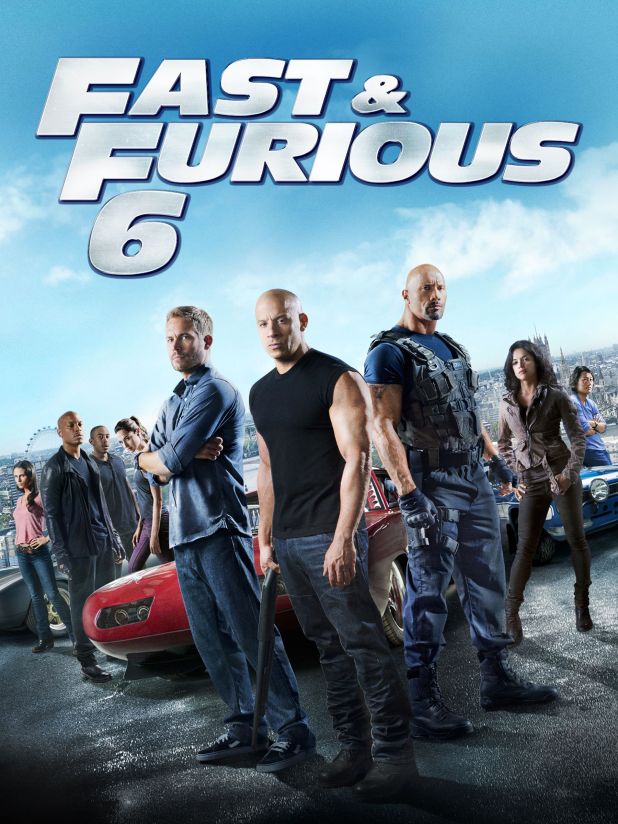
Fast & Furious 6 (2013)

After the last film moved away from street racing to more heist movie, this film moves the series into spy adventure, or as I have asked before this week, “When did this little street gang become G.I. Joe?” You can follow a similar path with the Saints Row series of video games, which somehow again went from small street gang in a turf war to being the leaders of the free world, superheroes and battling in Hell.

This movie is also two hours and ten minutes long, so plan accordingly.

After the big score of the last film, the family has settled down around the world. Dom (Vin Diesel) is with Elena (Elsa Pataky, Giallo) while his sister Mia (Jordana Brewster) and Brian (Paul Walker) have had a son. Gisele (Gal Gadot) and Han (Sung Kang) are in love, while Roman (Tyrese) and Tej (Chris “Ludacris” Parker) are living the high life. As for Luke Hobbs (Dwayne “The Rock” Johnson), he and Riley Hicks (former MMA star Gina Carano) are keeping tabs on former SAS special ops soldier Owen Shaw (Luke Evans, Clash of the Titans), who may have the supposedly deceased Letty Ortiz in his gang.

Hobbs promises amnesty to Dom and his crew if they help him take down Shaw. The fact that Dom can reunite with his dead lover only adds to the urgency of the mission. All manner of double crosses occur, but at the end, everyone ends up in the old Los Angeles house saying grace over a meal. One hundred cars gave their mechanical lives for this film.

The end of this, however, introduces Deckard Shaw (Jason Statham), as he seemingly murders Han in the events of The Fast & The Furious: Tokyo Drift.

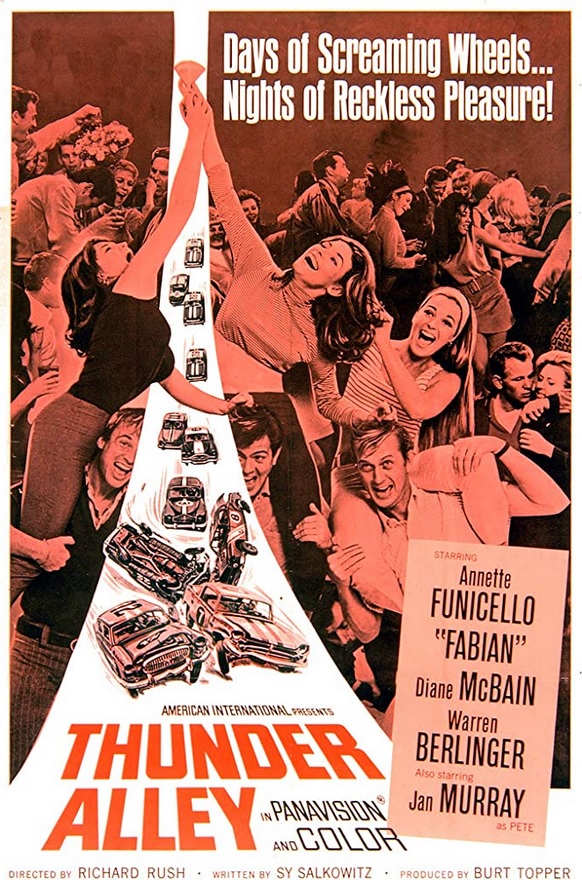
Thunder Alley (1967)

So William Asher (who took a slasher ’80s shot with Butcher, Baker Nightmare Maker) did a pretty good job with Fireball 500, Fabian’s first racing flick for the Roger Corman stable — and it made bank. So it was decided to get Fabs behind the wheel of the “real star” of that movie once again: the 1966 Plymouth Barracuda customized by George Barris (The Batmobile, The Monkeesmobile, The Munster’s Koach) dubbed Fireball 500.

That planned film, Malibu 500, became this fourth movie (after Rebel 500 was also rejected) — after Hell’s Angels on Wheels with Jack Nicholson (on his way to Easy Rider) — directed by Richard Rush (of one of my dad’s favs: Freebie and the Bean!). And yeah, as with most race flicks: we have another racer causing an accident that places his career — and love life, since he can’t drive — in jeopardy. Does it all sound like the romantic polygons from Red Line 7000, where everyone is trying to bed everyone? Yep. Is this just an ol’ A.I.P. beach movie minus the sand and plus the asphalt? Yep.

So Fabian’s stock car racer Tommy Callahan is forced to join Pete Madsen’s (Jewish “borscht belt” comedian Jan Murray?) thrill circus to make a buck after his blackouts cause a fatal accident that gets him thrown off the circuit. Ah, but career redemption is to be found in his romance with Madsen’s daughter Francie (Annette Funicello), as he teachers her boyfriend, Eddie Sands (ubiquitous ’70s and ’80s TV actor Warren Berlinger), everything he knows about stock car racing. Then Eddie has to go and romance Tommy’s lady, Annie Blaine (Diane McBain, of Spinout with Elvis and later, Maryjane with Fabs). And, you know the next part of the story . . . as Sam, the chief cook and bottle washer at B&S Movies would say: “a fierce rivalry on the track between Tommy Callahan and Eddie Sands, ensues.”

And I have to add: “The discovery of an old childhood trauma that causes the blackouts, ensues.”

So, let’s get to the meat (or is that rubber) of the matter: Is this better than Fireball 500? Thanks to all of the stock car racing footage already shot by producer Burt Topper during the course of three years that Rush was forced to cut into the film, yes, as process shots in racing flicks, simply put, sucks exhaust vapors. Is it better than Fabs third racing romp, The Wild Racers? Hella-no. That Grand Prix-instead-of-stock cars romp is the best of Fabian’s three A.I.P. fast and furious rubber romps. But as with anything Corman touched — between tight budgets and pre-sale deals — Thunder Alley made bank. So A.I.P. hired Rush to direct Psych-Out and The Savage Seven.

Oh, the film’s true claim to fame: The song “Riot in Thunder Alley” by Eddie Beram also appears in Quentin Tarantino’s Death Proof. Now, if we can only convince The Q to give Fabian the same touch he gave to John Travolta and get Fabian back on the screen.

I can’t think of one my favorite actors more deserving.

You can watch Thunder Alley on You Tube. Here’s the trailer on Daily Motion.

About the Author: You can learn more about the writings of R.D Francis on Facebook. He also writes for B&S About Movies.

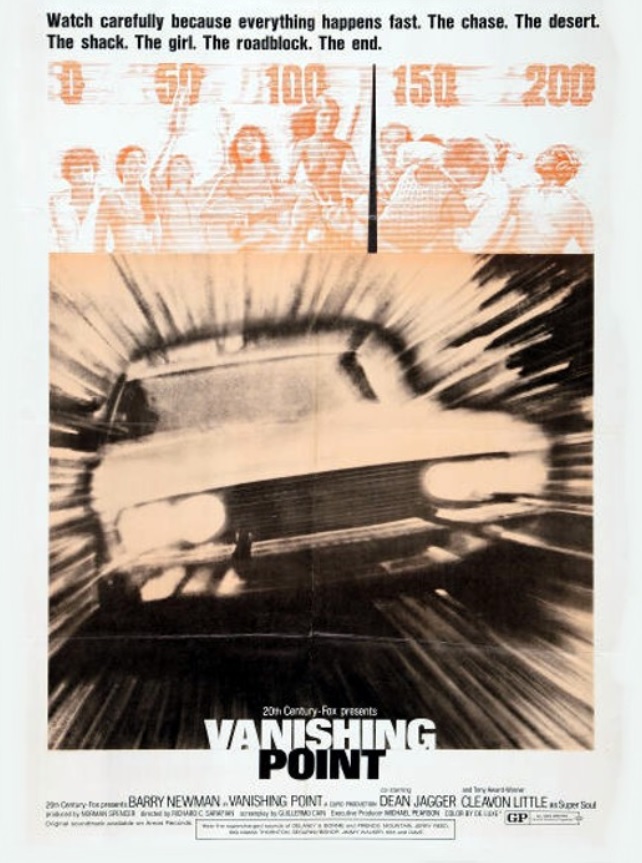
The Existential and the Furious: Part 3: Vanishing Point (1971)

Author’s Note: Yeah, we know you’ve seen them before and know them well. But we’ve got some movie “Easter Eggs” in these reviews. Thanks for revisiting the classics with the B&S gang, where we coddle the obscure and the forgotten films of the VHS, UHF, and Drive-In yesteryears.

This 20th Century Fox tale reminds a lot of Elektra Glide in Blue, United Artists’ 1973 existential road flick entry about a disgraced biker-cop (Robert Blake) produced-directed by James William Guercio, who managed and performed with the Beach Boys and produced several albums for ’70s pop-meisters Chicago (who appear in the film). We also had Vanishing Point on the short list for “Radio Week,”* thanks to Cleavon Little’s blind DJ. While it was bumped for that week—but it’s prime fodder for “Fast and Furious Week.” Thank god for Dodge Chargers. . . .

Kowalski (Barry Newman) is a Vietnam veteran, disgraced ex-cop and former professional road racer of motorcycles and stock cars. To cope with his personal demons, he lives on the open road as a driver for a car delivery service. Before heading out on his next assignment—transporting a supercharged 1970 Dodge Challenger from Denver to San Francisco—he scores a hit of speed and makes a bet with his drug-pusher that he can make the trip in 15 hours.

As the police follow in hot pursuit, Kowalski becomes a folk hero to the roadside eccentrics and Vietnam-war worn masses, thanks to the on-air updates of the cross country chase by a blind DJ “Supersoul” (Cleavon “The Prince of Darkness” Little of FM) on KOW, an 50,000-watt R&B/Soul station broadcasting across Nevada, Utah and parts of Colorado and California. (Little’s engineer—an unaccredited role—is John Amos of TVs Good Times, but youngins know him for his work in Die Hard 2: Die Harder and Coming to America.) (And, is it just me, or is Outside Ozona a slasher version of Vanishing Point? That’s not critical insult, but a kudos.)

Yeah, we love this movie, but this movie also really wants to be the next Easy Rider, with its replacement of Steppenwolf by way of the equally biker-acceptable Mountain with “Mississippi Queen,” along with the counterculture band Delaney, Bonnie & Friends (see the history of Eric Clapton and Fleetwood Mac), who also appear in the film as a singing group at a religious revival caravan.

There’s no online streams, but Blus, DVDs, and used VHS-tapes are available on Amazon to watch Vanishing Point. . . .

So, we teased you about the two “sequels” to Easy Rider . . . but did you know their was a remake to Vanishing Point? It’s okay. No one does. Join us tomorrow, August 7 at 6 pm, for more tales of the fast and the furious . . . and the vanishing . . . with Vanishing Point ’97.

How much is this film loved? It has die-cast cars!

Get ’em at Greenlight Collectibles!

About the Author: You can learn more about the writings of R.D Francis on Facebook. He also writes for B&S About Movies.
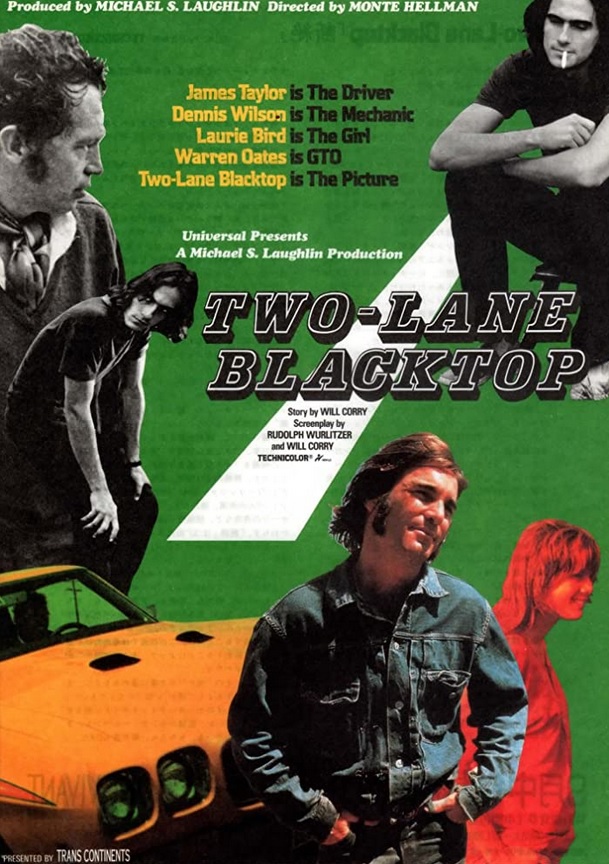
The Existential and the Furious: Part 2: Two-Lane Blacktop (1971)

Author’s Note: Yeah, we know you’ve seen them before and know them well. But we’ve got some movie “Easter Eggs” in these reviews. Thanks for revisiting the classics with the B&S gang, where we coddle the obscure and the forgotten films of the VHS, UHF, and Drive-In yesteryears.

This Universal Studios tale in which the bikes of Easy Rider meet the Dodge Challenger of Vanishing Point was on the short-list for our “Rock ‘n’ Roll Week” tribute (ran Sunday, July 19 to Saturday, July 25) of films as result of ex-Beach Boys drummer Dennis Wilson starring as the “Mechanic” and ‘70s soft rocker James Taylor as the “Driver.”

But wait! There’s those celluloid bonus points, since this is directed by Monte Hellman, who made his directorial debut with Roger Corman’s Beast from Haunted Cave (1959)—a relationship that lasted for several films over fifteen years. And Hellman gave us Silent Night, Deadly Night III: Better Watch Out (another “unwanted sequel,” ala Phil Pitzer’s Easy Rider: The Ride Back, that’s actually better than you think, as result of the Hellman touch), and he executive-produced Reservoir Dogs. So, courtesy of that Corman lineage, Hellman’s not giving you a typical Universal picture. This is an A.I.P-styled romp that’s not for the mainstream cinema folks.

As with Wyatt and Billy’s biker travels, Two-Lane Blacktop is an existential road trip into metaphorical ambiguity—only from inside the cockpit of a Black 1955 Chevy 150. Unlike most major studio buddy-road adventures, this one’s void of exposition to the point of silence: the Chevy’s passengers are perfunctory to the story, operating more like “parts” to the car than actual people.

As the stoic duo travels across country entering impromptu and legalized dragstrip races, they pick up the hitchhiking “Girl” (Laurie Bird, who became Hellman’s girlfriend), meet a homosexual hitchhiker (Harry Dean Stanton, later of Alien and Repo Man), and a New Mexico to Washington D.C. “pink slip” challenge is made by “GTO” (Warren Oates), an insecure braggart who discover a vicarious purpose through the freedom-lives of the Chevy’s “internal parts.”

Regardless of its rock-star casting, neither Wilson nor Taylor provide music to the film and no Easy Rider-styled soundtrack was ever released. The film does, however, features songs by the Doors, Arlo Guthrie, and Kris Kristofferson. Lori Bird, in a James Dean-tragic life, only made three films: two with Hellman, the other being Roger Corman’s Cockfighter (1974; also with Warren Oates), and in Woody Allen’s Annie Hall (1977; as the girlfriend to Paul Simon’s character). Coming to live with Simon’s musical partner, Art Garfunkel, she committing suicide-by-pills in his apartment at the age of 26.

There’s no online streams, but Blus and DVDs (co-issued by Universal through Criterion Collection and Anchor Bay) and used VHS-tapes are to be found on Amazon.

My buddy Eric, as with Easy Rider, takes me to task with this movie as well: “Duke, your idea of “classics” sucks ass,” he tells me. According to him—a car nut, mind you—”nothing happens.” “It’s like watching a stoner version of Seinsuck.” (Sorry, Sam!)

Friends and film, huh? It’s not so bad: chicks and film is worse.

About the Author: You can learn more about the writings of R.D Francis on Facebook. He also writes for B&S About Movies.

UPDATE: Out in the social media ethers, reader Jake Garrett schooled us on this fun car flick fact: The ’55 Chevy in Two-Lane Blacktop is the same car as Bob Falfa’s in American Graffiti. Did you know that? We didn’t. Hey, we’re big enough to admit that we don’t know all of the film trivia out there. Thanks, Jake! See, positive, kind comments on our reviews and messages via our “contact” page, work — and get you plugged in reviews (if you want to be “famous,” that is!).

The Existential and the Furious: Part 1: Easy Rider (1969)

Author’s Note: Yeah, we know you’ve seen them before and know them well. But we’ve got some movie “Easter Eggs” in these reviews. Thanks for revisiting the classics with the B&S gang, where we coddle the obscure and the forgotten films of the VHS, UHF, and Drive-In yesteryears.

While The Fast and the Furious franchise began as crime caper flicks that transitioned into spy flicks of the xXx variety, there’s no denying Universal Studios’ “big engine” is rooted in the rock ‘n’ hot-roddin’ juvenile delinquency flicks of the ’50 (we have a “Drive-In Friday” night this week covering a few of those films), the biker-centric counterculture flicks of the ’60s, and revin’-car flicks from the ’70s (reviews for a whole bunch o’ them this week!).

For long before the good intentions of Paul Walker’s LAPD officer Brian O’Conner’s law-enforcement soul was drugged with the scent well-weathered leather, hot metal and oil, and the scent of a Mitsubishi’s exhaust (R.I.P., Mr. Peart), Easy Rider was the godfather of them all—and that celluloid patriarch brought forth two sons. . . . And those sons were fruitful and multiplied with the ’70s “big engines” of Dirty Mary, Crazy Larry (also starring Peter Fonda) and Gone in 60 Seconds (no, not that one, the 1974 one!).

In between, there was this cop movie called Bullit that starred some guy named Steve McQueen toolin’ around in a 1968 Mustang Fastback going head-to-head with a 1968 440 Magnum Dodge Charger. And they slipped “The Duke” (of all people) into the cockpit of a souped-up 1973 Pontiac Firebird Trans Am “Green Hornet” in McQ. But we were diggin’ Roy Scheider in his 1973 Pontiac Ventura Sprint in The Seven-Ups. And let us not forget: Producer Philip D’Antoni is the guru of rubber who gave us memorable car chase sequences in not only The Seven-Ups and Bullit, but The French Connection, as well. Then, for a twist, instead of a souped-up muscle car, Robert Blake slipped onto a 1970 Harley touring cycle for the “motorcycle cop” version of Easy Rider: 1973’s Electra Glide in Blue.

Released in 1969, Easy Rider became a counterculture epic that set the pace for the early ‘70s car chase classics to come: Two-Lane Blacktop and Vanishing Point (as well as Electra Glide in Blue)—regardless of the transportation and “mission” of their protagonists’ “trips,” each film equated the open road with freedom of the soul.

Wyatt and Billy (Peter Fonda, who became a biker icon courtesy of Roger Corman’s 1966 biker epic, The Wild Angels, and Dennis Hopper, who was able to get financing for his 1971 ego-boondoggle The Last Movie as result of Columbia Studios raking in $60 million worldwide on a $400,000 budget) embark on a western-without-horses motorcycle trip across America from California to New Orleans for a drug deal (instead of gold prospecting or stage coach robbing). Along the way to make their “big score” they meet up with communal hippies (in lieu of Indians), partake of drugs and sex, and frolic about New Orleans (in lieu of say, Dodge City, Kansas, or Virginia City, Nevada) in a Seinfeldian “a movie about nothing” existence (sorry, Sam; quoting my buddy Eric’s take on the movie)—and it all comes to an end by way of the ubiquitous, hippy-hatin’ rednecks (the Indians got ’em).

Jack Nicholson stars as Wyatt and Billy’s gold-football helmeted sidekick: ACLU lawyer and jail cellmate, George Hanson (the trio first collaborated on The Trip, Roger Corman’s 1967 stoner flick written by Nicholson; who did his own biker flick, 1967’s Rebel Rousers, which was released post-Easy Rider fame, in 1970), music Svengali Phil Spector (The Big T.N.T Show) stars as “The Connection,” and future MTV video queen Toni Basil (“Hey, Mickey!”) also appears in a minor role (she worked with Nicholson on the Monkees’ Head). The soundtrack—inspired by the successful use of pop and rock music for 1967’s The Graduate— features music by Steppenwolf (who also provided music to another psychedelic film, 1969’s Candy), the Band, the Byrds, and Jimi Hendrix.

You can watch this everywhere, pretty much, but it streams on Amazon Prime.

Ah, Easter Eggs: So, did you know Easy Rider was followed forty years later by an unofficial sequel? Two, in fact. It’s okay. No one does. Join us tomorrow at 12 noon and 3 pm for more tales of the fast and the furious . . . with Easy Rider: The Ride Back and Me & Will.

About the Author: You can learn more about the writings of R.D Francis on Facebook. He also writes for B&S About Movies.
SAVAGE CINEMA: Hell on Wheels (1967)

The Savage Cinema set from Mill Creek just keeps on rolling this week, bringing to us not only some NASCAR, but former racer turned country star Marty Robbins, who sang “El Paso” and “Honkytonk Man.”

Three brothers — stock car driver Marty (Robbins playing himself), mechanic Del (John Ashley, the man from Blood Island) and revenue agent Steve — all have their issues. Marty is trying to be a star, Del wants to be Marty and Steve is busting some moonshiners.

Del tries to out do his brother to prove himself to his girlfriend Sue (Gigi Perrau, The Cool and the Crazy) and the gang ends up almost killing them all. Meanwhile, Connie Smith and the Stonemans play a whole mess of songs.

The entire film was independently made in Nashville, Tennessee. John Ashley told Trash Compactor, “Marty was a terrific fellow and a great singer, and I was a big fan of his. He was a stock car racer, loved stock cars, and the producers had put this thing together. They said to me that this was going to be his motion picture debut, and they needed me to play his brother and basically carry the movie. So I went down there for six or seven weeks.”

This was directed by Will Zens, who also made Trucker’s Woman and Hot Summer in Barefoot County, two Joe Bob Briggs-approved redneck movies.

You can watch this on YouTube.

Fast Five (2011)

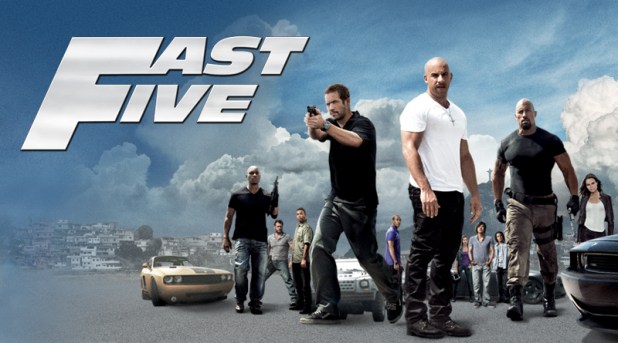
Somehow, the street gang from the first film has become almost like G.I. Joe in these movies. This film — the fifth as you can tell by the title — tells the story of Dominic Toretto (Vin Diesel), Brian O’Conner (Paul Walker) and Mia Toretto (Jordana Brewster) as they steal $100 million while being pursued by U.S. Diplomatic Security Service agent Luke Hobbs (Dwayne “The Rock” Johnson). This is the film that moved from street races to big action scenes and fans went wild.

The film starts by having Dom busted out of prison by the gang and ends with the Rock showing that he just might join these guys, which includes Tyrese Gibson as Roman Pearce, Ludacris as Tej Parker, Matt Schulze as Vince, Sung Kang as Han Lue and Gal Gadot as Gisele Yashar.

This is also where the movies start feeling bloated, pushing themselves past a two-hour running time. The other criticism is that women barely have names and are just sex objects in these films. Hell, they don’t even tell you what Gal Gadot’s character’s name — Gisele — is for the entire movie!

One of the good things is that these films have minimal CGI and rely mostly on practical effects for the car stunts.

Also — that scene where they found out that Letty is alive? Michelle Rodriguez didn’t know anything about it until she saw the movie in a theater.

SAVAGE CINEMA: The Wild Rebels (1967)

Savage Cinema promises you biker movies and it delivers on them. Such is the joy of a Mill Creek box set. While you may often find things that you had no idea you needed, by and large, if the cover art has an alien or a motorcycle, you may get at least 30% out of the films inside about what was promised. Those kind of odds get you into the Hall of Fame, at least in Cooperstown.

William Grefe came right out of the Florida swamps and demanded that you watch his films. He was second unit on I Eat Your Skin before unleashing films like Mako: The Jaws of DeathDeath Curse of Tartu and Stanley, a movie in which a young man menaces Alex Rocco and Marcia Knight with snakes.

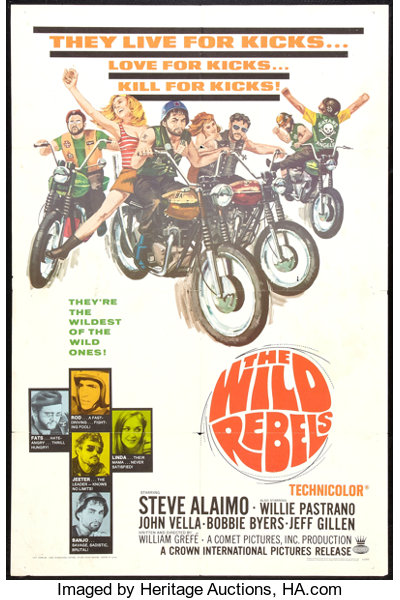
Rod Tillman (Steve Alaimo, whose life took him from being in the Redcoats, whose song “Mashed Potatoes” hit #75 on the Hot 100, hosting Dick Clark’s Where the Action Is and even owning TK Records, who dabbled in the Miami bass scene) is a stock car racer out of cash. He sells everything he owns and enters Swinger’s Paradise where he does nothing if not swing. Actually, that’s where he meets Satan’s Angels, a biker gang who needs a getaway driver for a con they have in mind.

They are Banjo (Willie Pastrano, who held the unified world light heavyweight boxing titles (WBA, WBC, The Ring) from 1963 until 1965), Fats (Jeff Gillen, yes, Jeff from Children Shouldn’t Play With Dead Things and the director of Deranged: Confessions of a Necrophile, as well as Santa Claus in A Christmas Story), Linda (Bobbie Byers, the voice of Johnny Sokko in Voyage Into Space) and Jester (John Vella, who played for the Oakland Raiders).

The cops try and get Rod on their side too, but he’s all into Linda, who claims she doesn’t do the crimes for the financial prize, but for the kicks. It all ends up in a lighthouse shootout between the cops, the bikers and our hero, who is caught between both sides.

Featuring real-life members of the Hell’s Angels and a Tampa garage rock band known as The Birdwatchers — you know, for the kids — this movie is probably amongst the best on this set. It also has, I can assure you, motorcycles in it.

You can either watch this on YouTube or see the Mystery Science Theater 3000 version on Tubi.


Days of Thunder (1990)

“I’m gonna give you an engine low to the ground . . . an extra thick oil pan to cut the wind from underneath you. It’ll give you thirty or forty more horsepower. I’m gonna give you a fuel line that’ll hold an extra gallon of gas. I’m gonna shave half an inch off you and shape you like a bullet. I’ll get you primed, painted and weighed, and you’ll be ready to go out on that racetrack. Hear me? You’re gonna be perfect.”
— Harry Hogge, crew chief and car builder

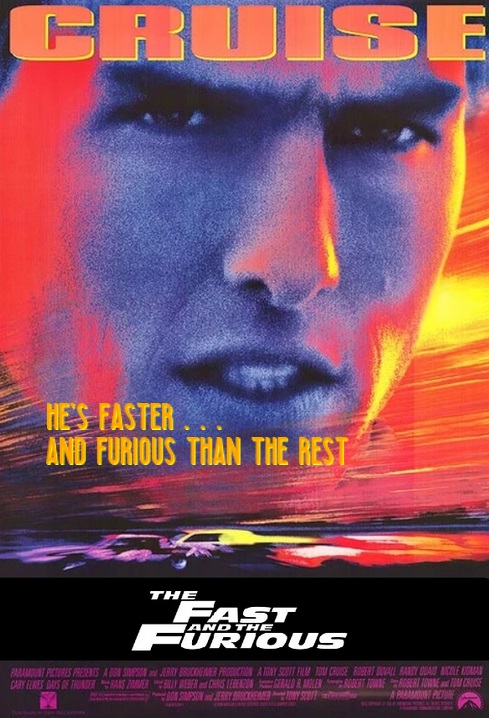
If only Harry had said, instead of, “You’re gonna be perfect,” said, “You’ll be fast and furious.”

What might have been . . .

Mock poster by R.D Francis/F&F logo property of Universal/typeface overlay via Pic Font

Tom Cruise gets respect in this neck of the Allegheny woods. He wanted to be the next Paul Newman. He wanted to become Steve McQueen. And unlike Quentin Tarantino’s Rick Dalton in Once Upon a Time in Hollywood, by golly, Tom Cruise became our generation’s Paul Newman and Steve McQueen. And, as with his idols—car racing enthusiasts who wanted to make their own race car movies—that kid adorned in a pair of Wayfarers that slid across the floor in his socks and into our hearts, wanted to run with the fast and the furious: he wanted to make his own version of Winning and Le Mans. And, and by golly, he did it.

Luckily, for the ticketing-going masses, Tom Cruise reined his “need for speed” (of the four-wheeled variety, anyway) until he broke through and became an official, A-List movie star. For if Cruise would have followed up Risky Business or (to keep it in a “sports” context) All the Right Moves—during the period when he was developing his career and not choosing roles but being cast in roles, like the burgeoning careers of James Caan and James Garner—with a race car flick, he would have been cast in the likes of the lower-budgeted road rallies that were Red Line 7000 and Grand Prix.

And Cruise’s racing endeavors could have been worse.

What if Cruise made a racing flick directly after his first leading man role in Losin’ It (remember in 1983: he made a movie with Shelley Long and Jackie Earle Haley)? We would have gotten the process-shot, rubber burning fiestas that were Fabian and Frankie Avalon’s Fireball 500, The Wild Racers, and Thunder Alley. And thank the celluloid gods of the analog ethers that Cruise didn’t aspire to be a “double threat” and a be singer—and only lip-synched to Bob Seger’s “Old Time Rock ‘n’ Roll”—or we would have ended up with Elvis Presley’s process-shot racing n’ singing extravaganzas Viva Las Vegas, Spinout, and Speedway*. (Oh, man. What if Eddie Murphy—considering his skills as a singer and Elvis mimic—did a remake of Richard Pryor’s 1977 NASCAR race car flick, Greased Lightning?)

“We gotta win this race.”

What might have been . . .

When reflecting on how Cruise turned Mission: Impossible into a franchise: If The Fast and the Furious—the franchise we’re paying tribute to this week—had been developed at Paramount Pictures instead of Universal Studios, would we have laid down our coin for Tom Cruise as an illegal road racer?

And if not that ticket, would we have bought a ticket to see him as Frankenstein?

No, not the Universal monster one. The New World Studios one: Tom Cruise optioned Roger Corman to set up a big-budgeted remake of 1975’s Death Race 2000 at Paramount. Sadly, amid scripting problems and the usual executorial testosterone splashing, the deal fell apart and ended up on the Universal lot. Then end result: Instead of (finally!) a dark, brooding tale about a futuristic transcontinental road race—one that jettisoned Paul Bartel’s hokey-satire of the original—that adhered to the serious, sociopolitical insights of Ib Melchoir’s short story . . . we ended up with a bunch of check-the-screenwriting-boxes trope-prisoners racing around in a circle on an island. And who in the hell let Joan Allen on Terminal Island?

. . . And now the Death Race franchise is four films deep—with a different “Frank” (and actors as Frank) for each subsequent (direct-to-video) film that carries an addendum that the film is a prequel, sidequal, etc. to the first film (and that the first film was actually “prequel,” ugh, to the ’75 original, argh!), as it races further and further and further away from Melchoir’s initial vision. The end result—at least for those of us weaned on the video fringes off the teats of Norman Jewison and Roger Corman: Death Race ‘08 was Rollerball ’02 all over again. Neither were Lays emulsified-potato chips like their superior forefathers: once was enough. And thank the analog lords that the Rollerball reboot wasn’t turned into a direct-to-video franchise. (Can you believe that director John McTiernan went to federal prison for making a false statement to an FBI investigator over illegally wiretapping Rollerball’s producers? He went to prison for Rollerball?)

And that brings us back to the film we’re supposed to be reviewing: Days of Thunder. (I know, Sam. I know. At least there won’t be a Seinfeld reference.)

Come, on now. You’ve seen it. We’ve all seen it. (Yes, even you: the underground, VHS-loving indie purveyor who Facebook-hangs with the B&S About Movies crew on Saturday Nights (at 8 P.M on Groovy Doom: shameless plug) to watch double features about worms and Linda Blair being abused.) And even if you didn’t hit the multiplex, you caught Cruise’s race epic via one of Ted Turner’s endless TNT replays as you couch-surfed and channel-grazed on a lazy, Cheetos-dusted Sunday afternoon. And, if you’re financially well-to-do, you watched Days of Thunder on yer fancy, upper-tiered Showtime or HBO subscriptions—as you couch-surfed and channel-grazed on a lazy, Doritos-crumbed Sunday afternoon. So don’t deny it: you embraced the Cruise like the mainstream-everybody else.

While this Tony Scott-directed and Tom Cruise-produced racing epic is vastly superior to the Caan and Garner romps and the bigger-budgeted Newman and McQueen films in all of its related film disciplines, we basically have the same film: a spunky racer with talent, but too much attitude, aspires for NASCAR fame—and finds romance and competition on the asphalted, gladiatorial oval. (For isn’t this all just Charlton Heston in Ben Hur with cars instead of horse-drawn chariots?)

So, speaking of testosterone splashing: Producers Don Simpson (wrote Aloha, Bobby and Rose, Cannonball) and Jerry Bruckheimer (The Rock, Bad Boys) along with director Tony Scott (Tarantino’s True Romance), and sometimes screenwriter Robert Towne, all went Alpha-male over how to set up shots. Fully-built and ready-to-roll sets were torn down and rebuilt because they “weren’t right.” The hormone and anabolic steroid-stew flowed so deep that the long-idling (sorry) crew members accumulated enough overtime pay to go on vacation for a full four months after filming was completed.

What was the end result?

Crtics pounced on the film for its stock plot, two-dimensional characters, and poorly written dialogue and called it out for being a Top Gun clone, sans planes and sky and lots of cars and asphalt. Roger Ebert, while giving the film three out of four stars, still took the film to task, calling it the Tom Cruise Picture, since it resembled the “10 Point Formula” employed in his previous films The Color of Money and Cocktail (it’s actually “9 Points,” but he came to revise it to include the “Dying Friend” trope). Mind you now, we are talking about Robert Towne here: the guy who wrote The Last Detail, Marathon Man, and friggin’ Chinatown. There’s whole chapters in screenwriting books dedicated to Towne’s brilliance. That’s Ebert for you: he takes no prisoners. (Sigh, I miss you Gene and Roger: you and Dr. Who and The Star Hustler made PBS worthwhile.)

And what did “The Q” think: “Days of Thunder is the movie Grand Prix and Le Mans should have been . . . it has the fun of those early AIP movies.”

And will we ever get a Quentin Tarantino racing epic starring a back-on-top Rick Dalton? We wait with Cheetos-stench bated breath.

Uh, oh.

Sorry, Sam. Actress Kathleen McClellan, aka “Good Naked, Bad Naked” girl from Seinfeld (“The Apology”) kissed Tom Cruise in Days of Thunder. (In the “winner’s circle,” I think; she was once the Skyy Vodka Girl <ahem>, Sam.)

It always comes back to Seinfeld. And Vodka-spiked movie-theme drinks. One Thunder Cruise Lemon Squeeze, comin’ up!

* Yeah, you’re darn tootin’ we reviewed all of Elvis’s racing flicks!

About the Author: You can learn more about the writings of R.D Francis on Facebook. He also writes for B&S About Movies.