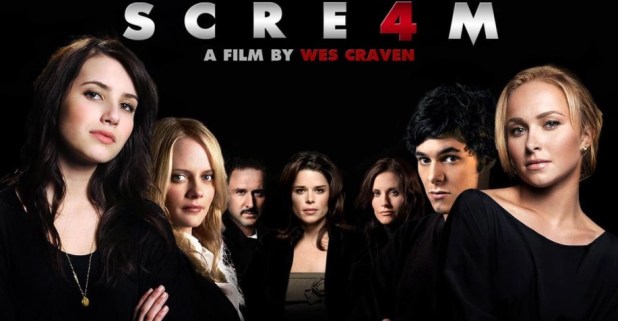
Scream 4 (2010)

Despite there being no Scream movies for a decade — and no Ghostface murders in the universe of the films — there had been tons of Stab films, to the point that they’d become a joke. Sidney (Neve Campbell) had moved on to write books.

While the film skewers studios, the studio behind it — oh hello, Weinsteins — played with this movie so much that the original ending, which started with Sidney being stabbed and the ending, which set up a sequel where she would have amnesia and be stalked by the killer of this film, were both thrown out. Kevin Williamson was upset, but after so many go arounds with Dimension Films, what do you expect?

Sidney returns to on the fifteen anniversary of the murders, just in time for them to start all over again. Meanwhile, there’s a Stabathon showing other installments in the film within a film (look for Anna Paquin, Kristen Bell and others in cameos in bits directed by Robert Rodriguez) and a publicist (Allison Brie) who lured our heroine home just for publicity.

Emma Roberts from American Horror Story and Scream Queens plays Jill, Sidney’s cousin and there’s a whole new group of movie-quoting teens, including Hayden Panettiere and Rory Culkin.

Craven and Williamson had both hoped for a fifth and sixth film, but the movie didn’t do well and, sadly, Craven would pass on in 2015 (this was his last film). There was an MTV series without Williamson’s involvement, but supposedly a new film is on its way.

Life moved along as these films were made. In the first Scream, Cox and Arquette flirted. In the second, they were dating. The third was filmed just as they came back from their honeymoon. And they were separated by the time this one was finished.

For a film that’s critical of remakes and torture porn, it’s ironic that Craven produced recreated versions of Carnival of SoulsThe Hills Have Eyes and Last House on the Left, with that last film pretty much creating the torture porn blueprint.

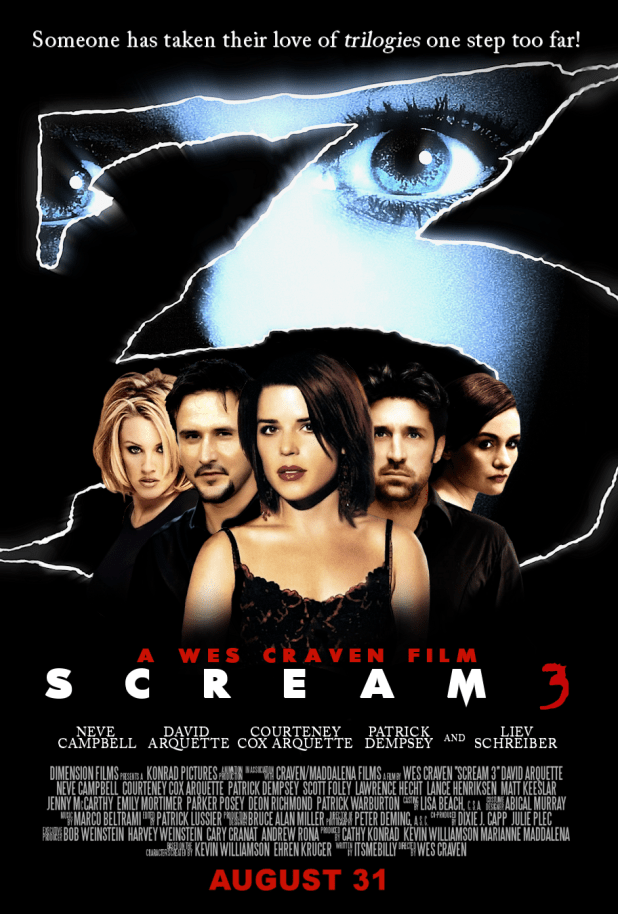
Scream 3 (2000)

Writer Kevin Williamson had created a five-page outline for two sequels to Scream when selling his original script, hoping that one film could become a franchise. Ehren Kruger, who wrote the American versions of The Ring threw out most of those notes. He’d finish script pages the day they were shot, which led to Wes Craven rewriting them so that the characters would at least resemble who they were in the first two films.

This being a Wes Craven movie, it’s at this point of the write-up that I discuss that “production was troubled with script rewrites, occasions when pages were only ready on the day of filming, and scheduling difficulties.” Did Wes ever have a movie go smoothly?

Following the Columbine High School massacre and increase worry about the impact of violent media, the script kept getting toned down. Supposedly, there was even a version where Matthew Lillard would return as Stu Macher, having survived the first film and using high schoolers to attack Sidney from prison. What they ended up with was a movie within a movie about Stab, the film version of the movie we watched in 1996.

Detective Mark Kincaid (Patrick Dempsey) contacts Gale Weathers (Courtney Cox) to discuss the murder of Cotton Weary (Liev Schreiber) and his girlfriend Christine (Kelly Rutherford, who while being known to many from Melrose Place also played a salesgirl in Phantom of the Mall: Eric’s Revenge when she was just starting her career). She decides to go to Hollywood to learn more about the story and visit the set of Stab 3, a film based on the Ghostface killings. It’s also where Dewey (David Arquette) is working as an adviser.

Sidney (Neve Campbell) is trying to hide out as a crisis counselor, but all the calls start again and she’s pulled back to the set where most of the cast of the movie — not Scream 3Stab 3 — get killed, like Tom Prinze (Matt Keeslar, who left acting behind to teach urology), Sarah Darling (Jenny McCarthy), Jennifer Jolie (Parker Posey), Angelina Tyler and Tyson Fox.

I do have to say, having Posey play Cox was a genius idea and one of the few bright spots to this film (she even wore the same green dress Cox wore in the first movie), along with the conceit that someone in Hollywood pushed the original murderers over the edge. The house where this film ends is the same domicile as Halloween H20.

The film never had a test screening, with the cast and crew seeing the movie for the first time at its premiere due to worries that spoilers would ruin the movie. Craven also shot three different endings, so they didn’t know how the movie would wrap up.

Roger Ebert would call out the reason why I disliked this movie so much. For a series that started as a smart send-up of slasher tropes, things really were rote by this point. He’d write, “The characters are so thin, they’re transparent. They function primarily to scream, split up when they should stick together, go alone into basements and dark rooms, and make ironic references to horror cliches and earlier movies in the series.”

That said, Wes Craven and Roger Corman show up, as does Lance Henriksen and Jay and Silent Bob, earning this movie a mention on our list of Ten Movie Crossovers.

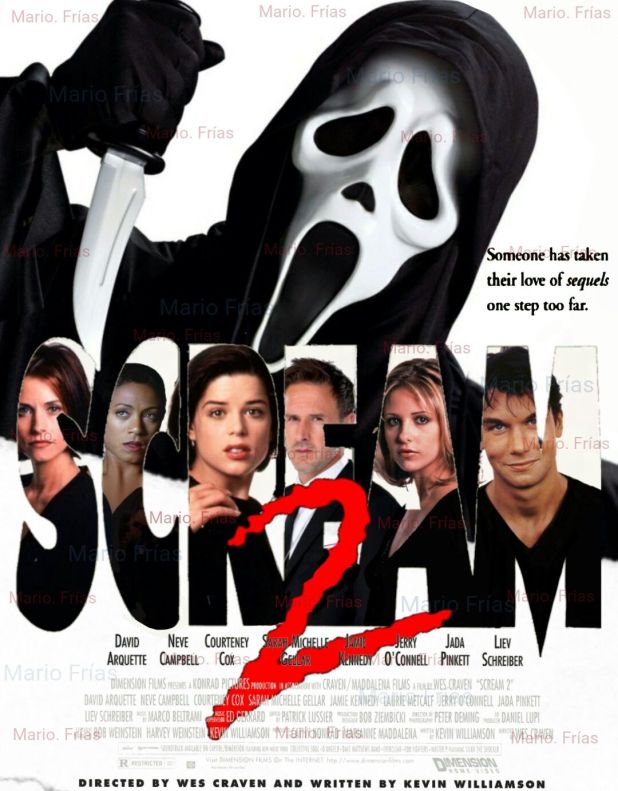
Scream 2 (1997)

ABOUT THE AUTHOR: Jim LaMotta is one of Pittsburgh’s premiere wrestling announcers, as well as a great writer. This article originally appeared on Steel City Underground. You can follow Jim on Twitter.

Earlier this year, I did a write-up on the original Scream film, analyzing how a movie designed to spoof the horror genre actually revived it back into the main stream after the tired cliches of the previous generation. Ironically, as much as Scream flipped the script with the Ghost Face killer, it followed at least a portion of the slasher playbook with an almost immediate sequel, which is what I’m going to discuss here during the week dedicated to the 90s and 2000s of horror.

The 1997 version of Scream made its debut in theaters less than a year after the original, requiring a quick production time throughout the middle of the year, but as he showed with his work later for the WB’s Dawson’s Creek, writer Kevin Williamson was forward-thinking after he finished the script for the original. Prior to Scream’s release or the massive success it had, Williamson already developed the concept for a sequel that would take main character, Sydney Prescott to college. The work put into the next phase of the franchise paid off, as the Ghost Face was the highest-grossing horror film of its time and the turn around time allowed Dimension Films to strike while the iron was hot and a rejuvenated audience anticipated the next chapter of the Woodsboro cast. With legendary director Wes Craven signed on again, and the pieces of the puzzle nearly assembled because Williamson’s work set up for continuity, the stars of the original cast were back to see who would survive this time. But, would the Ghost Face stumble in his sequel the way so many of his slasher peers had before him?

The challenge of a sequel based on a franchise that wants to mock or spoof the major players of the industry is to not became a caricature of itself. If the Ghost Face exploited the success of the original without substance or quality then its legacy among slashers would be short-lived. Another nod to and a way to poke fun at at the horror industry, the opening scene finds the fictional movie Stab set to premiere to tell the story of the Woodboro murders that played out in the original Scream production. Not surprisingly, the audience at the theater is bloody thirsty, as dozens  of movie goers are dressed as the Ghost Face, seemingly with less interest in the narrative and more focused on the gore, perhaps a subtle statement about the expectations of society?

We find Jada Pinkett Smith and Omar Epps, who starred in 1994’s Juice alongside Tupac before he began an eight-year run on the Fox series House throughout the mid-2000s, on a movie date. Epps’ jokes about Stab aren’t received well and Jada opts to go to the concession stand while he takes a bathroom break. With several “Ghost Faces” lined up in the rest room, there’s a sense that you don’t know who is who, a form of foreshadowing to set up the suspense for the film. Omar never made it through his restroom trip, as he was stabbed in the ear, and the killer takes his jacket to return to the theater next to Jada, who unknowingly finds herself in danger with a masked figure sitting next to her that she doesn’t realize isn’t her boyfriend that left a few minutes earlier. Again, the unknown danger is a theme of the film. Seconds later, Jada gets stabbed and staggers onto the platform of the movie screen before she dramatically collapses as her death is the conclusion of the opening sequence.

Next, Sydney, in her college dorm room, is woken by a phone call with the mysterious voice on the other end of the line. Immediately, Syd shuts it down as a prank call with the use of her trusty caller ID and writes it off as hype around the release of Stab. Her roommate, Hallie, played by Elise Neal, who went onto to numerous roles in film and television, including The Hughleys series and the Hustle and Flow film, attempts to invite her to a sorority party that night. Just as Syd deflects the chance to attend the pretentious gathering, a fellow student tells the roommates to check the news, where they see the broadcast about the previous night’s murders at the Stab premiere. Sydney instinctively ask where her pal Randy is, the film buff that correctly proclaimed the rules of horror during Ghost Face’s original spree and survived because of it. With reporters buzzing around campus, it was no shock to find Randy in film class, as the group of students discussed violence in movies, an aspect that was listed as a motive for one of the original Ghost Face killers. Still staying true to the original formula to poke fun at the horror genre, the conversation shifts to the thought that sequels are subpar films in an actual sequel. More than just the irony of the debate, this scene introduces the audience to some of the new cast with the addition of Mickey, CiCi Cooper, and a cameo by Josh Jackson, the kid that was Charlie in the Mighty Ducks before this and would go on to take a role in Williamson’s Dawson’s Creek after it.

Sydney is there to meet Randy after class, but he dismisses the connect between the new murders and those from Woodsboro before Jerry O’Connell swoops in to meet with the two friends. The Vern of 1986’s Stand By Me is grown up as Sydney’s boyfriend, Derek and the two head off to lunch. After the introduction of new faces, we are greeted by some familiar characters as Courtney Cox’s Gale Weathers is never far behind the trail of blood to get the scoop on the story. As Gale is ready to get the inside information, she was pestered by rookie reporter Debbie Salt, and she gives the “cut throat” reporter a taste of her own medicine as she was faced with unwanted questions about the murders as the tables were turned when she was asked for a quote for a story. As Syd and her friends finish lunch, another familiar face pops up as she rushes to hug Deputy Dewey, who now walks with a slumped posture and without full use of his right arm thanks to the injuries he sustained in Woodsboro.

After Dewey tells Syd he asked the local sheriff if he could hang around temporarily to make sure she’s  safe, the reunions continue as Gale greets her with the camera rolling and reveals Cotton Weary, Lev Schreiber’s character, is there to be interviewed with her for the first time since his name was cleared in her mother’s death. In true tabloid style, Gale surprised Sydney with this meeting, something that Weary was unaware of, and Syd decks the reporter with a right hand for the second movie in a row. More than emphasizing Gale is still out for the story despite the near-death scenarios in Woodsboro, these sequences bring the old gang together, while new characters are involved, and following the premise, all of them are potential victims.

With Sydney and Hallie at the sorority party mentioned earlier, Sarah Michelle Gellar’s CiCi Cooper is back at the sorority house as a designated driver, leaving her alone in the house. She’s greeted by the typical Ghost Face phone call and the usual chase ensues before she was stabbed and tossed from the balcony, crashing to the pavement below. There’s nothing ground breaking about the action of the scene, but it’s pivotal to the narrative because it lets the Woodsboro crew know that the Stab murders weren’t just random acts of violence at the theater. At the scene of the crime, Debbie Salt was there to record the gory details when Gale arrives, still brushing off the amateur. The sorority sisters ooze insincerity toward Syd before news of the incident at the house sends the party flocking to the bloody spectacle down the street. This was another indirect example of the public’s fascination of violence.

When Derek was waiting on the porch, Syd goes back into the empty party to get her coat and the phone rings. She attempts to walk away but is drawn back to answer it, greeted by the same mysterious voice that tormented her in Woodsboro. After a short, but tense verbal exchange, Derek is locked outside while the killer pursues Syd inside the house. Finally, Derek gets through a side door and charges inside to confront the knife-wielding manic, while Dewey runs to check on Sydney. Despite the limited use of his arm, Dewey goes to look for Derek, who he finds slashed on the arm. At the hospital, with her friends there for support, Sydney waits for Derek to get bandaged up, and Mickey asked why he went back into the house, prompting her to wonder if another killer boyfriend is stalking her.

While Dewey and Randy munch on ice cream, they review possible suspects, which gives Randy a chance to run down the rules of the horror sequel, something that adds another layer to the narrative because it gives the audience elements to consider as the movie progresses as to who might be the killer now. At the same time, Syd is at theater practice and becomes hysterical when she thinks she saw the Ghost Face on stage. Moments later, Derek pops up again to meet her after practice, but she finds it too suspicious and asked him for some distance. He agrees and leaves dejected. Post-ice cream, Dewey and Randy met up with Gale in the park when she gets a call from the distorted voice. As the trio patrol the park to find someone with a cell phone, Randy is put on the phone with the killer to distract him while Dewey and Gale begin grabbing the clunky 90s phones from those sitting in the park. Randy backs up toward Gale’s news van, another example of the unknown danger that is near him. The killer snatches him inside the van and bludgeons him.

After Randy’s body is discovered, Syd is in the library when she’s confronted by Cotton Weary, who offers her a Dianne Sawyer spot along with $10,000 as payment, but when she declines, Weary is almost obsessive with his insistence on the media attention. Thankfully, her bodyguards intercept him and he was detained at the police station, but released. However, the incident certainly makes it seem possible that Weary might be more dangerous than we first thought. Outside of the station, Gale is bombarded with questions from reporters again, another example of the tables being turned with her as the subject of unwanted inquiries. Her and Dewey find common ground in their pursuit of the killer and decide to check her news camera for any leads on the footage. With the campus on curfew, they find an empty film room to view what clues the candid footage might provide. The tension between them boils over and in a moment of relief from the murder spree, they kiss, but before things can move forward, there’s an impromptu screening of footage projected of the previous victims, which meant that someone else was in the auditorium. The Ghost Face appears in the projector room, prompting Dewey to hobble up the stairs in pursuit. When Gale heads for cover, she almost accidentally runs into the killer, as a suspenseful cat-and-mouse game plays out with the music for added drama. Dewey finds himself in a sound proof booth still searching for the killer when he gets blindsided and stabbed, collapsing against the blood-stained glass of the booth.

At the same time, Sydney and Hallie are put into a car with the body guards that were assigned to her, presumably to be taken to a safe location, but as you might expect, they experience a detour. The car crashes and the killer is there, stabbing Hallie before Syd escapes. Another escape saw Gale look for a way to get out of the film building when she runs into a bloody Cotton Weary, claiming he found Dewey on the floor. Not buying it, the reporter bolts for the exit, running to the nearest pay phone to call the authorities. Debbie Salt was on the line to call in her next story, but Gale snatches the phone away from her to call her help, naming Cotton Weary as the killer.

We find Sydney sprinting toward the theater building, anywhere familiar that might be a safe haven for her. On stage, she finds Derek tied to a symbol, seemingly helpless. As she frantically tries to untie him, the Ghost Face killer appears on stage and suggest that Derek might be in on the plan. The killer unmasks to reveal it was Mickey, the deranged film student that wanted to be the star of his own mystery. Mickey continues to imply that Derek is his accomplice, which Syd begins to believe until he shoots Derek, proving his innocence. Mickey goes on to explain his motive, not to get away with murder, but rather to become infamous with a trial that garners national coverage. Mickey wants to gain notoriety from the typical question, do films cause violence? But, Mickey couldn’t have done all this alone so he was his partner in the killing spree?

Reporter Debbie Salt emerges from the stage, but Sydney recognizes her as Mrs. Loomis, the original killer’s mother. Mrs. Loomis found Mickey online and funded his tuition at Syd’s college and assumed a new name in a plot to get revenge on the girl that killed her son. While Mickey looks forward to the press coverage he will receive, Mrs. Loomis has other plans, shooting him to set up her own plot, pin the murders on Mickey and escape unnoticed. Just as Sydney and the unbalanced newspaper reporter face off, Cotton Weary joins the gathering and must decide if he saves Syd or sides with the reporter that claims she can get him TV appearances. During the tense showdown, Syd finally agrees to Weary’s request for a Dianne Sawyer interview and he shoots Debbie Salt, saving Sydney in the process. Injured, Gale shows up and the trio conclude the dramatic sequence. Before the credits roll, we see that Dewey survived and taken for help and Syd tells the crew of reports to talk to Cotton, who finally gets some press coverage.

I always found the conclusion of the movie to be a little flimsy because while they are a few hints at why Mickey suggest who the killer might be, he’s not necessarily a major character throughout most of the film so there’s not really a shocking revelation for the final scene. In a similar fashion, there’s some foreshadowing about Debbie Salt, but she also a relatively minor role in the narrative. It makes sense why Mrs. Loomis would seek revenge, but again, there wasn’t a lot known about her even throughout both films. Still, the film built suspense well and was well-received, both by critics and at the box office. The sequel ranked in $172 million, just a little less than a million dollars less than the record-setting revenue of the original film.

REPOST: Scream (1996)

EDITOR’S NOTE: This article originally ran on March 4, 2020. It fits right into the 90’s movies that I’ve tried to avoid vibe of this week, so please enjoy. It was written by wrestling announcer Jim LaMotta and originally appeared on Steel City Underground. You can follow Jim on Twitter.

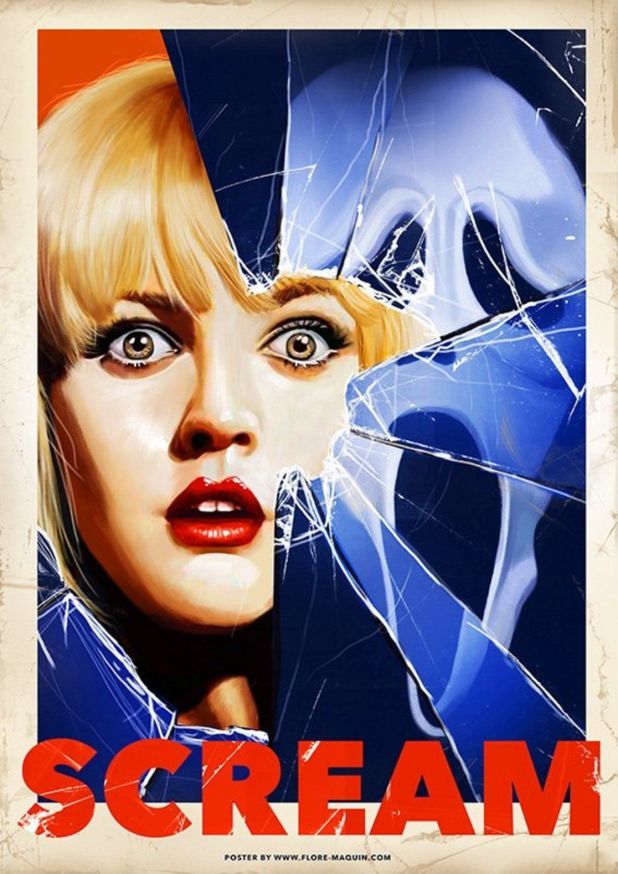
After I penned an article about the Robert De Niro directed A Bronx Tale and received some positive feedback from it, I thought I’d take the opportunity to write about the horror genre, the film category that has a lot of coverage on this site. The decision for this was partially a coincidence, as for whatever reason, the Showtime channels on Comcast have shown this franchise on a semi-regular basis for the past few months, and I found myself finding different layers within the film, as random viewings accompanied recent insomnia.

However, the decision to actually write this analysis was made because the film was based upon a spoof of the cliches that littered horror films of that era. Directed by Wes Craven, Scream’s 1996 release mocked and outright defied the rules of the previous generations. While Wes Craven will always be famously linked to the Nightmare on Elm Street series, his work spanned decades, as he wrote and/or directed projects as far back as the 1970s with the original Last House on The Left and The Hill Have Eyes or something as recent as the latest installment of the Scream franchise. Point being, Craven knew the horror playbook and also knew how to manipulate the perceived cliches of the genre.

Wes Craven had his status solidified before Scream was ever green-lit for production by Dimension Films, but writer Kevin Williamson, who later went on to write for the WB’s Dawson’s Creek and more recently a TV Scream spinoff, got his break with the teen slasher production. Williamson was able to weave an unpredictable tale of suspense that hadn’t been seen in quite some time for horror films when Scream hit the big screen, and Craven’s flare to build tense moments made for a successful combination.

Despite Scream’s intention to spoof the stale cliches of horror flicks, the opening scene was key because it told the audience immediately that regardless of its ability to mock the overused tactics of previous eras, this was definitely not a comedy. As is often seen in teen slashers, the typical beginning of the film found Casey Becker, played by Drew Barrymore, watching TV as she made popcorn on a Saturday night while her parents had plans for the evening. The phone rings, a foreshadow of sorts for what becomes a red flag later and when Becker answers, an almost distorted voice seemingly tries to charm her with a series of questions, including the famous, “what’s your favorite scary movie” inquiry that becomes a theme of the film. As the unknown caller continues to prod away at the teen, who forgets the popcorn on the stove, the conversation escalates to become more aggressive. Eventually, the teen is shocked to see her boyfriend duct taped to a chair on the patio as the mysterious voice insist she play a game to save his life. When she incorrectly guesses Jason as the original killer in the Friday films instead of Mrs. Vorhees, the athlete bound on the patio is gutted. In typical horror fashion, a struggle ensues as the Ghost Face killer stalks Barrymore’s character. After Becker makes it outside, the place where the audience usually tells intended victims to run to escape, she’s stabbed and strangled before a well-placed kick gives her a final chance of survival. As Becker’s parents return home, she’s within distance of them, but can’t scream for help because of the damage to her neck. The emphasis on the brutality of her death reinforces that this movie isn’t designed to be a comedy. As the flames from the stove rise and smoke surrounds the living room, the Beckers frantically try to find their daughter in the house. When Mrs. Becker picks up the phone to call for help, she can hear the final moments of her daughter, who still clutched the cordless phone prior to her murder.

That opening scene implied that the known star, Barrymore was one of the main characters of the movie, but the death of a familiar face in the opening scene sent the message that none of the cast was guaranteed survival.

In contrast, the next scene finds Sydney Prescott, played by Canadian actress Neve Campbell, who worked on the Party of Five series both before and after Scream’s success, pecking away at the keyboard in front of a very-90s clunky computer screen as she finishes her homework. How Sydney is presented in this scene really sets the tone for her character and how it evolves throughout the narrative. She’s dressed in a white nightgown with a ponytail that almost emphasizes her innocence and naive nature. She hears a noise outside her window and background music makes it appear that she might be the next victim, but instead, her boyfriend, Billy Loomis springs up into the window to visit her. Syd’s father, who planned to take a business trip that week, nearly catches this impromptu meeting before Sydney deflects him. Loomis is a rebellious type because his mom left the family quite some time ago, and his edgy nature somewhat conflicts with Sydney’s concern for his visit. Loomis is an obsessed horror fan and mentions the lack of excitement of movies edited for television before he implies that he wants to get physical with Sydney. Loomis’ comparisons create a rather odd vibe around his character, but Syd trusts him and agrees to a kiss with a sense of enthusiasm. As the teens land on her bed surrounded with stuffed animals, another aspect of her innocence, Loomis quickly progresses from kissing to an attempt to put his hand up her nightgown before she halts the interaction. As the two kiss again, Billy plans to scale back down from the window before Syd quickly opens her top for brief flash and a short laugh, as it was her way to express intimacy.

The following day when Sydney makes her way to school, the fictional town of Woodsboro is buzzing with the news of the two slain teens. News cameras and reporters surround the school as Syd and her friends discuss the gory incident. This conversation introduces the viewers to a portion of the main cast, which automatically translates to possible victims for the killer. Loomis is there with Syd, his best friend and fellow horror enthusiast, Stu sat next to Tatum, Syd’s best friend, and finally, Randy, the film buff that works at the local video store. Remember those? Upon Stu and Randy’s speculation on the grisly details, Sydney leaves after she became uncomfortable with the situation, and Loomis looks at his pal in disgust.

When Sydney makes her way home and confirms her plans with Tatum that night, which will see her spend the night at her friend’s house so as not to be alone during her dad’s business trip, she tunes into news coverage of the murders. This scene reveals that her mom, Maureen Prescott was murdered nearly a year earlier after an affair with Cotton Weary, played by Liev Schreiber, who is known for his work in the lead role of Ray Donovan. Sydney saw someone leave her house the night of the murder and her testimony led to Weary’s conviction in what was assumed to be a closed case. When the phone rings, Syd is greeted by the same voice that called Casey Becker and the conversation lures her onto the porch, again the place the audience typical tells a possible victim to run to safety. The voice on the phone claims to know details about her mom’s death, and the infuriated teen slams the front door in a rage as she returns to the house, locking the door behind her. The irony of what transpires next is that while she was outside, she actually allowed the killer to sneak in and her only option when confronted with the knife-wielding maniac is to run upstairs to her bedroom, where she successful barricades the door and send a message for help using the previously mentioned clunky computer. The killer disappears from view and almost instantly, Billy Loomis jumps into view through her window again. There wasn’t enough time for him to ditch the costume and get up to the window, right? But, a cell phone, also a bulky device at the time, drops from his pocket, making it at least possible that he was the one on the phone a few minutes earlier.

Sydney is so shaken that she doesn’t know what to believe so she bolts to the front door and when she opens it she finds local officer, Dewey Riley startled with the evidence of the Ghost Face mask he found outside. Loomis is detained and questioned, proclaiming his innocence, as Dewey tells Syd that there’s no record of her dad checking into his hotel for the business trip. Before she and Tatum can leave the police station, “cut-throat” tabloid reporter, Gale Weathers storms Sydney for an exclusive quote. Weathers received a right hook for her troubles after an offer to send the teen a copy of her upcoming book, which doubted if Cotton Weary actually committed the murder of Maureen Prescott. Dewey is Tatum’s brother and escorts them home, where she commends Syd for her right hook. A call for Sydney takes her to the phone where the ominous voice informs her that not only was Loomis not responsible for the earlier struggle, but also that Weary was the wrong suspect. With Loomis still detained at the police station, he couldn’t have made the call so who was the voice on the phone?

Sydney was terrified with the revelation and hangs up, prompting the lovable dork, Dewey to storm into the hallway in his underwear with his gun to protect the family. After Loomis’ cell phone revealed that he didn’t make the call to Sydney, news of the attack made the rounds at her school and some students were running around the halls with the Ghost Face costume. This outraged principal Henry Winkler, who threatened to expel the students, cutting up the mask in the process of his verbal reprimand. Sadly, the same scissors were used to murder the principal when The Fonze had an encounter with the Ghost Face killer later that day.

As Courtney Cox’s Gale Weathers tries to flirt with Officer Dewey for possible information on the murders, Randy is visited at the video store by Stu and the two discuss the status of the case. Randy rants about the rules of horror and how those in Woodsboro are ignoring the patterns that have emerged in the case. Stu defends Loomis, asking why he would want to murder his own girlfriend, and suggests that Neil Prescott could be responsible since his location is unknown. Randy is confronted by Billy and the cleared suspect lists the reasons that the film buff might be the killer, creating his own scenarios based on the movies that he’s a fan of at the video store. In yet another example of foreshadowing, this scene was referenced toward the conclusion of the movie.

The unsolved murders cause the police to enforce a curfew and with the students’ earlier exit from school, Stu plans a party for his friends. The house party brings a few dozen friends together to watch Halloween, and Gale stakes outside in her news van, hoping to get a tip so that she can be the first to report the story. With Tatum there with Stu, Sydney attempts to enjoy some time with her friends and Dewey parked outside the party to guard her. During the viewing of the John Carpenter classic, Randy (Jamie Kennedy) rants again about the rules of horror, including that sex can make someone a target as it eliminates a character’s purity. In the middle of his public service announcement, the phone rings and Randy receives the news that principal Fonze was hanging from a goal post at the school stadium. Most of the party rushes from the house to witness the gory spectacle, leaving only the main group of friends still there. In the commotion of the group exit, Tatum is murdered by the killer in the garage, hanging from the dog door in the garage door. Unaware of this, Randy continues to watch the film as Stu tells his guests goodbye at the door. Almost on cue, Billy shows up at the door and asked to talked to Syd since the two haven’t spoken more than a brief conversation at school since her accusation landed him in the interrogation office at the police station. The two go upstairs to talk and Syd feels bad about wrongly accusing her boyfriend of the previous attack.

Up in the room, Loomis comforts Sydney as she expresses her frustration with the circumstances of her mom’s death. Eventually, Syd tells Billy she wants to be intimate with him and as the two undress, Sydney is wearing a white bra, a final sign of her innocence. After she sheds the bra, perhaps her only shield against becoming a target, Dewey and Gale find Neil Prescott’s car abandon down the street from the house. After Syd’s intimate encounter with Loomis, it’s almost as if her naive nature was relinquished, as she questioned who he called when he was at the police station, prompting him to claim that he called his dad, but Sydney explains that she saw the sheriff call his dad. Billy backpedals to explain that he didn’t get an answer when he called, but for the first time throughout the film, Loomis looks thrown off by the unexpected line of questioning. As the two finish getting dressed, the Ghost Face killer emerges and stabs Billy, who collapses in a heap on the floor.

Without the wall of virginity to protect her, Sydney is fair game for the killer and a chase ensues through the house and down the street. When she escapes a close call with the blade, she finds herself back in front of the house, with both Randy and Stu claiming that the other is the murderer. She slams the front door, leaving both of her friends outside as they both plead for her help. In the chaos, Dewey is injured, and Gale crashes her news van. Billy, who was thought to be dead just minutes earlier, stumbles down the stairs and takes the gun from Sydney to protect her from the possible killer outside. Loomis lets Randy in before he shoots him, sending the movie aficionado crashing through a table in the entryway. Loomis then reveals that his injuries from the earlier attack are phony and quotes a famous line, “We all go a little mad sometimes” from the Hitchcock classic, Psycho.

Stu went through the side entrance of the kitchen and as Sydney asks for help, Stu uses the voice altering device to tell her about the surprise. In the final scenes, Loomis explains that his mom left his family because Maureen Prescott had an affair with his father. As a part of a plan for revenge, Billy and Stu murdered her and framed Cotton Weary, who she also had an affair with after Mrs. Loomis left the family.

These scenes reveal just how cleaver Williamson’s writing had to be to plant enough seeds along the way for the revelation of the killers to be a surprise and this conclusion also logically ties together the events of the movie. There had to be two killers because it allowed for the Ghost Face to be in the same place as Billy, and created questions about what a motive would be for each character. In that early scene when Syd thought she heard a noise and it was Billy at the window, she was unknowingly letting danger in the house. When Stu suggested Sydney’s father as the killer at the video store, it was because that was his plan, as the pair of psychotic teens plotted to frame Neil Prescott the same way they framed Cotton Weary. While Billy was motivated by revenge, Stu simply wanted to play out the scenarios in the films he idolized, further stirring up the question, do films cause violence?

Stu brings Neil Prescott in the kitchen where he’s duct tapped and plans evidence in his pocket. Billy and Stu begin stabbing each other to stage their story of unintended survival, but they become too focused on their demented plan to realize that Gale survived the news van crash and was back to attempt to help. After her rescue was halted, another struggle takes place with Loomis trying to strangle Syd, who eliminated Stu just minutes earlier when she dropped a TV on him. With Billy as the only one left to finish his plan, he raises the knife to kill Sydney, but he’s intercepted by a bullet from Gale Weathers, as the reporter remembered to take the safety off this time. Ironically, the reporter was the one to save Sydney, who tends to her father still duct tapped and the wounded Randy on the floor. As the sun rises, Gale is back to her job, on location of another blood bath, while Dewey is wheeled to an ambulance. Sydney and the majority of the main cast survived despite a film that manipulated the perceived rules of horror.

As much as Scream mocked the stale cliches that saw the decline of the genre in the previous era, it also rejuvenated slash films as well, earning $173 million at the box office to become the most successful slasher movie at the time with just a $14 million budget. Ironically, similar to the franchises it mocked, Scream had its share of sequels, with the latest installment of Scream 4 in 2011. There’s news of an eventual Scream 5 release, and the argument could be made that the Ghost Face killer carved its own niche alongside other horror icons like Jason, Michael Meyers, etc. While ironic, it probably shouldn’t be all that surprising that Scream, the movie that was meant to point out the recycled storylines of horror, became somewhat of the things it mocked, as the franchise still plans to release a film nearly 25 years after the original. One of the most interesting things to note is that horror sequels are often panned by the critics for flimsy and unoriginal plots, but the audience still flocks to the box office. The 2018 release of Halloween didn’t offer much in furthering the story of the deranged Michael Meyers, but it raked in nearly $255 million dollars. So, the horror genre might find itself lacking the depth of a Humphrey Bogart performance, but from a business perspective, it’s still successful.
Pervertissima (1972)

The gorgeous Françoise (Maelle Pertuzo, no relation to the Françoise in director Jean-Louis van Belle’s other film, The Lady Kills) has been hired by a tabloid to do a report on “Love in Paris.” That means that we’re treated to a mondo within a narrative film as she works as an exotic dancer, a prostitute and even takes journeys to sapphic saunas and freelove masked balls.

However, she soon goes from sunbathing and beating up some dude with twigs for money to meet up with Dr. Vilard who is turning real human skin into superhuman love dolls ready to help him rule the world. You know a doctor is mad when he shoots up before he makes beautiful people mate to make a master race. I mean, there are other signs, too.

Club Sexy from The Lady Kills — and a photo of that film’s star Carole Lebel — both make appearances here, making this some form of spiritual sequel while being the loosest film I’ve seen, a movie that doesn’t even attempt to make sense.

Which is to say — this is awesome.

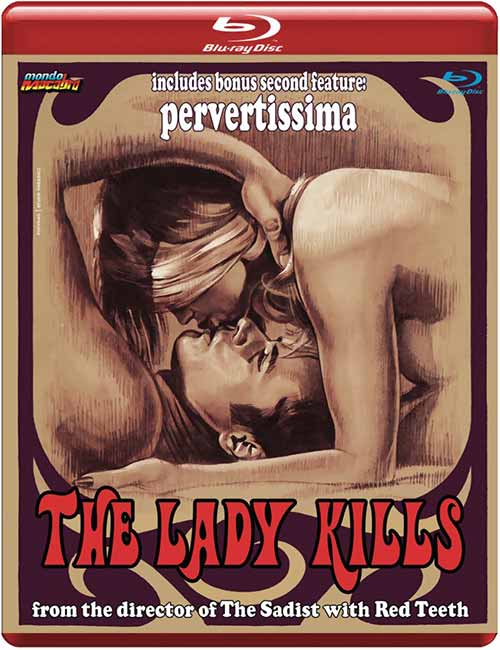
This is on the same blu ray as The Lady Kills and only Mondo Macabro would put out something this fantastic. I love that they find movies that I’ve never heard of and make them look better than they ever have before. I would say they are doing the Lord’s work, but we all know that God wants nothing to do with the movies they release.

You can get this from the absolutely great people at Mondo Macabro, who were kind enough to send us a copy of this film.

The Lady Kills (1971)

Françoise Frémond (Carole Lebel, Two Weeks In September, The Golden Claws of the Cat Girl) is killing her way across Europe, leaving horrible men’s dead bodies behind. Keep in mind this movie was made before Ms. 45 or I Spit On Your Grave or even Thriller: A Cruel Picture and offers a similar blast of female revenge violence set to a psych-rock freakout soundtrack.

After a pop-art style assault by several men, Françoise spends the rest of this film tracking each of them down and killing them all in various ways. There’s also high fashion, the aforementioned swinging electric jazz and nudity that juxtaposes the feminist revenge narrative because at heart, this is still an exploitation movie.

You can get this — along with Pervertissima, which was also made by director Jean-Louis van Belle — from the amazing folks at Mondo Macabro, who were kind enough to send us the blu ray for review and understanding enough to know that it won’t impact our review.

Beyond the new 2K transfer for both movies, you’ll also get a “Who is Jean Louis Van Belle?” documentary featurette and introductions for each film by Belgian film expert Christophe Bier. This film is a must-have, as it has never been remastered, restored and available on home video anywhere in the world ever before.

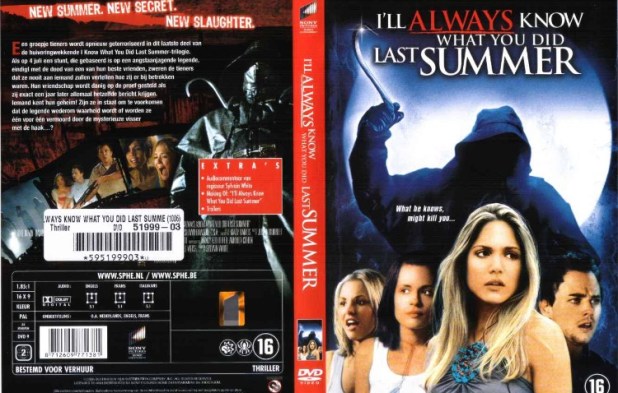
I’ll Always Know What You Did Last Summer (2006)

Despite the ending of the last film teasing you with another chapter in the lives of Julie James and Ray Bronson, the time between films was too long for everyone in the eight years between installments — and Sylvian White was brought in to replace original director Damon Santostefano (Bring It On Again, the Fangoria Scream Greats videos). He also directed the movies Stomp the YardThe Losers and Slender Man, a film that pretty much disappeared upon release.

A year ago, Amber, Colby (David Paetkau, Final Destination 2), Zoe (Torrey DeVitto, Pretty Little Liars), Roger, and P.J. prank their entire town, who all know the legend of the Hook (or Fishman) from the first two films. However, instead of landing safely on a mattress, P.J. is impaled. Everyone believes that the Fishman killed him and the kids make a pact — learning nothing from the last two movies — to keep all of this a secret.

Fast forward and Amber is the only one who left town, with Colby giving up a scholarship and Roger a suicidal drunk. Oh yeah — and someone has waited twelve months to start texting her, “I know what you did last summer.”

This series follows the Vorhees formula by making its killer a supernatural force by the third film while also Myers formula by getting Don Shanks to play the slasher.

After three movies, we have the same ending each time. In the first movie, the Hook jumps through a shower door to attack Julie. He pulls her under a bed in the second. And in the third, despite escaping the danger of the film and garnering our sympathies as a final girl, Amber’s jeep breaks down and we see the Hook coming for her. You could see this as setting up a sequel while I see it as a film that cares absolutely nothing for its main characters and wastes all of the worry that you just invested in them by casually throwing them away in such quick fashion.

I Still Know What You Did Last Summer (1998)

Written by Trey Callaway instead of Kevin Williamson (who was busy with writing  Dawson’s Creek, The Faculty, Halloween H20 and Scream 3 while directing Teaching Mrs. Tingle), this sequel takes the survivors of the first film — Julie (Jennifer Love Hewitt) and Ray (Freddie Prinze Jr.) — and places their relationship in peril with Julie away at college and their lives all over again when her roommate Karla (Brandy) wins a vacation to Bahamas, despite getting the trivia question wrong.

If you think, hey, this is all a trap, now you know why a hook handed killer has never menaced your life. At least I hope.

This film has more in common with the inspiration for Lois Duncan’s original I Know What You Did Last Summer, as a new boy comes between everyone. That woudl either be Will (Matthew Settle) or Tyrell (Mekhi Phifer).

The funniest part of this for me is that Jack Black has a cameo — before Jack Black became a thing — as a stoner that works on the vacation island. His part is every drug reference in movies ever, a totally unbelievable part, all played by someone who would soon be on the A-list. Speaking of cameos, look, there’s Jeffrey Combs! And hey! They’re watching Curse of the Demon, making you wish you could shut this movie off and watch that superior movie!

Somehow, director Danny Cannon was still permitted to make movies after Judge Dredd. He’d follow this film — which was a big success — with work on CSIGotham and Pennyworth.

This is also one of three — maybe four — movies that i watched over this young adult week where someone was trapped inside a tanning bed. How did this trope show up in so many films? Who was first? Man, now I have something new to write about.

I Know What You Did Last Summer (1997)

Lois Duncan’s I Know What You Did Last Summer was first published in October 1973. Duncan wrote several books that featured young girls in trouble, including Summer of Fear, which was made into a TV movie directed by Wes Craven.

She got the idea for the book when her daughter Kerry told her that she and her best friend had unknowingly been courted by the same boy. She wondered if the boy had deliberately done this, creating a different personality for both of them, and worked his way into their lives to drive a wedge between them. She later read a story about a hit-and-run and put together the story that became the novel (and the loose inspiration for this film).

Sadly, Duncan’s life became tragic after the unsolved murder of her youngest daughter Kaitlyn. Her last horror novel would be Gallows Hill — which filmed for TV as 1998’s I’ve Been Waiting for You  — after which she’d concentrate on non-fiction works about her daughter’s case, psychic phenomena and books for kids, like Hotel for Dogs (which was also a movie). Before her death in 2016, ten of her best-loved books would be reissued and modernized with new covers and bits added about modern technology.

She would tell Absolute Write that very same year that she was upset with this take on her book: “I was appalled when my book, I Know What You Did Last Summer, was made into a slasher film.  As the mother of a murdered child, I don’t find violent death something to squeal and giggle about.”

Screenwriter Kevin Williamson had already had success with Scream, which made him the go-to writer for teen horror. He took the source novel, added some inspiration from growing up the son of a fisherman and added the urban legend — stay tuned for these movies — of The Hook to create a new trope of kids who try to wish away the past. for what it’s worth, the poster originally said “from the creator of Scream” until Miramax sued Columbia Pictures.

Unlike the aforementioned Scream, this movie is very much an old-fashioned slasher, despite its initial lack of blood. A throat slashing and the crab factory death were added after the initial cut was viewed to add more danger, as was the character in danger all over again post-script, which would become a thematic inclusion for all entries in this series.

For those that argue these things and wonder, “Is it a giallo?” I opine that it is more on the side of slasher. Yes, there are gorgeous people in it, but there’s a marked lack of fashion, music and, to be honest, the strangeness that that genre is imbued with. That said, the hook-carrying bad guy very much does feel like he belongs there.

The story takes place in Southport, North Carolina. Julie James (Jennifer Love Hewitt),  Helen Shivers (Sarah Michelle Gellar), Barry Cox (Ryan Phillippe) and Ray Bronson (Freddie Prinze Jr.) are on their way to the beach late at night on one of their last summers together before college pulls them apart when an event unites them all. They hit a pedestrian and instead of allowing their lives to be ruined, they dump the body in the ocean.

By the way, the mountain road that they are driving along is the exact same highway from Hitchcock’s The Birds.

The issue is that their lives are all changed by that one evening with only Julie able to escape the town and go to college. When she returns, the notes that say, “I know what you did last summer,” and the gaslighting campaign begins.

Jennifer Love Hewitt became a big deal from this film, beyond her fame from Party fo Five, even singing the song “How Do I Deal” on the soundtrack. She’d appeared with Jamie Lee Curtis in House Arrest earlier that year and when Curtis was filming nearby, she came over to wish her luck on her first role as a scream queen and would be a consistent visitor to the set.

Director Jim Gillespie would move on to make Eye See You/D-Tox, a Stallone film of which we have much to say. Just check out this link.

While actually written before Scream, when studios wanted nothing to do with slashers, the success of that film allowed for this one, while making it seem like a rip-off. Such is Hollywood.

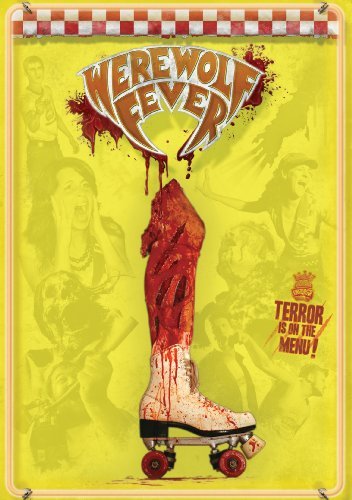
Werewolf Fever (2009)

How does one get the werewolf fever? What are the symptoms? Is there testing for it? Should we wear a face mask around those that have it? These are all important questions, so I’ll give you one answer: do not eat any werewolf meat.

Donny the delivery boy is the low man on the Kingburger Drive-In totem pole. Yet when he’s bit by a strange animal while out delivering burgers, he finally has a chance at revenge.

Look, you’re only going to give an hour of your life to watch Brian and Mark Singleton’s labor of lupine love. Brian wrote and directed it, while Mark produced it and plays Ronny, Donny and the Werewolf. How can he fight himself? Well, you’ll just have to watch this.

The Kingburger Drive-In is an actual drive-thru restaurant in Renfrew, Ontario. It might not have a website or Facebook page, but it does have a 4.8 out of 5 score on Facebook and 4.5 on Google reviews, so they must be pretty decent. I mean, just watching this, I could see how those kids on the way to the Grand Canyon were dying to, pardon the pun, wolf down some of those burgers.