For four decades, the masked and mysterious sound and video collective known as The Residents have not just made music. Or art. But some form of commerce that creates art that feeds commerce with music. It’s complicated. So who is under the giant eyeball masks? What inspires those songs? And what makes fans get so obsessed that they end up creating their own bands inspired by the masked ones?
Luckily for viewers, The Residents’ management company, The Cryptic Corporation, gave the filmmakers unprecedented access, not only to the band’s video and audio archives, but to the musicians who have played with them before as well as a front-row seat on their 40th anniversary tour.
Members of Devo, Primus, Ween, Talking Heads and Pinback also appear, discussing how their bands and The Residents cross over with one another. The Residents — like the above bands and other sonic collectives like Negativland — have never existed to make music for everyone. But for those that are ready for their message, they have become auditory messiahs, inspiring not just fandom but further creation.
The Residents have always existed under N. Senada’s “Theory of Obscurity,” which states that “an artist can only produce pure art when the expectations and influences of the outside world are not taken into consideration.” His Theory of Phonetic Organization further states, “the musician should put the sounds first, building the music up from [them] rather than developing the music, then working down to the sounds that make it up.”
Some say N. Senada was a Bavarian composer. But then you realize: his name means “in himself nothing.” So while he may have been inspired by someone — perhaps Harry Partch or even Captain Beefheart, who inspired the masked ones in the way they did the same for so many — it seems that the man whose laws govern them was probably created by them too.
Like I said, it’s complicated. And I like it that way.
That’s right, in 1979, we found out that “every year young people disappear.” This PG-rated movie — yes, it still surprises us — is a favorite of Becca, who is actually coming on the show this week. Here’s a drink to enjoy during it.
Slausen Family Lemonade
3 oz. coconut rum
1 can coconut water (12 ounces)
2 lemons
Dash of simple syrup
Ice
This one is super simple. Make lemonade by juicing the lemons (if you’re in a pinch, you can just use pre-made lemonade). Simple syrup makes a sweeter taste than just plain sugar.
This recipe is coconut-rich. So if you want less of a good thing, use water instead of coconut water. Me, I added a dash of Coco Real to make it even more coconutty. Is that a word?
If you want to get really wild, use shaved or crushed ice. The colder this one is, the better. Also, you don’t ever need to drink during the movies, so you can make this without the rum.
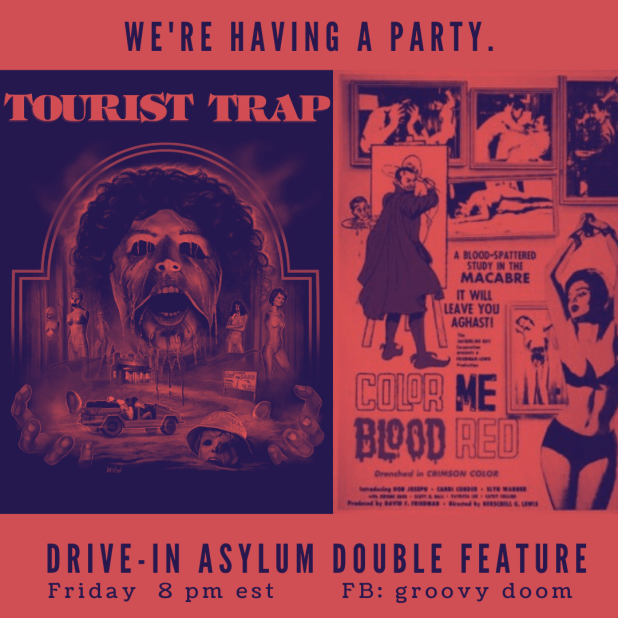
To follow this strange movie, let’s turn to Herschell Gordon Lewis! Color Me Blood Red!
You’re going to need something, well, red to drink during this. We’ve got you covered.
Bloody Adam (based on this recipe, fixed as there were some strange measurements)
1 oz. vodka
1 oz. gin
1/2 oz. cherry vodka
3 oz. club soda
Splash of grenadine
Maraschino cherries (to taste)
Ice
Fill your glass with ice until about half full.
Pour in vodkas and gin, then top with club soda.
Slowly add grenadine and cherries, as well as cherry juice to taste (and for how much “blood” you want in your cocktail).
Don’t forget — if you want to attend, Saturday night at the Riverside Drive-In in Vandergrift, PA will be a showing of The Carand Christine! We’ll be there. Will you?
Despite this being a movie about Pennsylvania, my hometown of Pittsburgh got lumped in with Erie, a city 127.8 miles away. They showed Club Laga. Roboto and Graffiti, but that was about it, to be honest, outside of some still photography. Yes, despite two hundred interviews made for this film, the Steel City got the shaft. That’s alright. We’re kind of used to it.
This was made by Loren W. Lepre, who I am sure I was in the same ECW shows at Viking Hall as him, judging from his biography on IMDB. It’s great that someone made a movie about this, but basically, if you sat at Gooski’s and someone screamed at you about bands that they liked and no one else knows, this would be the same thing, minus the attitude, overwhelming cigarette smoke and oh yeah, we can’t go to bars any longer because we live in a nightmare hellscape.
“Hey, just wait a minute there, you smug and pretentious, know-it-all pseudo-film critic . . . what’s this disaster-suspense drama doing in the middle of a “Rock ‘n’ Roll Week” of reviews? This is just a knockoff of Dirty Harry crossed with Earthquake, and instead of Clint Eastwood’s police inspector, we get an amusement park safety inspector. And while George Segal is pretty cool in the role, he’s no Dirty Harry Callahan.”
“Well, don’t forget that George is teamed with Richard Widmark as FBI Agent Hoyt.”
“Uh, no. Sorry. Still not Dirty Harry Callahan.”
“Well, do the factoids that Rollercoaster not only has a rock ‘n’ roll connection, but a connection to Pittsburgh and Star Trek as well, Mr. Critic of critics?”
“No, not really. But you’re going to ramble about it anyway. I’m going to go take a piss. Later, dude.”
Critics of critics. God, how we love ’em at B&S About Movies. . . .
So, the connection to Star Trek comes courtesy of director James Gladstone, who directed the classic September 1966 episode, “Where No Man Has Gone Before,” you know, third episode of the first season that served as the second series pilot when the first pilot, “The Cage” (starring Jeffrey Hunter as Kirk), failed . . . you know Gladstone’s episode: Gary Lockwood (2001: A Space Odyssey, Earth II) and Sally Kellerman (the original “Hot Lips Hoolihan” in the theatrical version of M.A.S.H) obtained psychic powers after the Enterprise crossed The Great Barrier. And, as we learned, courtesy of B&S’s Chief Cook and Bottle Washer, Sam, in his review of 1974’s Cry Panic, James Gladstone directed that John Forsythe-starring TV movie written by Jack B. Sowards who, in turn, came up with one of the greatest tales of Federation folklore: the Kobayashi Maru, a no-win scenario for new Starfleet captains that was first brought up in Star Trek II: The Wrath of Khan.
Gladstone also directed the ’70s duplex favorite, When Time Ran Out (1980), an Irwin Allen-produced disaster-suspense boondoggle about an island volcano. That film reteamed Paul Newman and William Holden from the disaster bonanza The Towering Inferno and Ernest Borgnine and Red Buttons from the water epic The Poseidon Adventure. And Gladstone, along with producer Jennings Lang (Airport ’75, Airport ’77, The Concorde : Airport ’79, as well as Play Misty for Me, Slaugtherhouse Five and The Nude Bomb!!), previously worked together on Swashbuckler (1976), Universal’s forgotten “pirate comedy” flop starring Robert Shaw from Jaws. (Yep, Lang also did the one that started it all: Earthquake.)
The plot of Rollercoaster was described by Gladstone as more of a Hitchcockian cat and mouse story than as the disaster movie it was marketed; Segal concurred: he saw it as a well-structured, Hitchcock-styled action-adventure, combined with Universal’s (“Sensurrond”) technology. And Rollercoaster was, in fact, the fourth film in the studio’s “Sensurrond” oeuvre: the aforementioned Earthquake, the WWII epic Midway (1976), and the theatrical version of Battlestar Galactica (1978).
The film stars Timothy Bottoms (Up From the Depths! Thank you, Charles B. Griffith for that duplex classic!) as a mad bomber blowing up the nation’s rollercoasters to extort a million dollars from a Chicago-based amusement amalgamate. Now, if you’re keeping track, that is pretty much the plot of Dirty Harry — only with the mad bomber replaced with an assassin, and Georgy-boy not slingin’ a .357 and quipin’ one-liners. And if it all sounds like Speed, with Dennis Hooper’s “mad bomber” blowing up a bus-for-bucks (which is just Die Hard on a bus), then it probably is.
“Hey, man. I’m back from my piss. And one hell of a loaf-pinch. You’re still rambling? Did you get to the rock ‘n’ roll part, yet? Time’s a-wastin’. I need to go do my yard work.”
Ugh. Critics of critics, again I say. . . .
Anyway, as for the Pittsburgh connection: Mine and Sam’s beloved Kennywood Park out in West Mifflin in Allegheny County was originally set as the location for the film’s opening “crash” segment. When the park got cold feet at the last minute, producer Jennings Lang reset the scene for “Wonder World” at Kings Dominion outside of Richmond, Virginia. (This extended interview, seen below, with King’s Park Manager, Dennis Speigel, who also starred in the film, tells it all.)
The Rock ‘n’ Roll Part!
So, do you remember during your MTV youth, the quirky “Cool Places” that featured the annoying and least-attractive member (well, opinions vary) of the then hot the Go-Go’s, Jan Wiedlin? Well, you might recall that wasn’t a Jan Wiedlin solo tune: it was the lone U.S. Top 50 radio hit by Sparks, which was featured on their twelfth studio album, In Outer Space (1983), issued by Atlantic Records.
Anyway, Spark’s previous label, Columbia (the band burnt through six deals over the years), decided a great way to promote their new signee was by casting them in movie and feature the planned singles of “Fill ‘Er Up” and “Big Boy“(the official single upload) from their mutual debut, Big Beat (1976; produced by Rupert Holmes . . . yes, the “Escape (The Piña Colada Song)” dude). Sadly, the genius of the Columbia promotions department didn’t work: after one more flop album, 1977’s Introducing Sparks, the label dropped the band. And here’s the big scene doing “Big Boy” from the film.
If you look closely at their “big scene,” you’ll notice that album’s ex-Tuff Dart Jeff Salen on guitar (“(Your Love Is Like) Nuclear Waste” and “All For The Love of Rock and Roll“), along with ex-Milk and Cookies (You Tube) bassist and drummer Sal Maida and Hilly Micheals. And since we’re talking MTV: You’ll recall Hilly Michaels had his own MTV video hit, “Calling All Girls,” from his solo debut, Calling All Girls (1980). As with Columbia pushing Sparks via film, Warners also failed to break Micheals to a mass audience by placing tunes from the album in the uber-obscure (flop) Robby Benson (The Death of Richie) rock flick, Die Laughing (“Shake It and Dance“), and Chevy Chase’s Caddyshack (“Something’s On Your Mind“).
Coco for Sparks!
Okay, so this is where Sam just says, “F it,” and lets me free range across The Point, gushing in gaiety over the quirky, they’ll-never-be-The Cars-no-matter-how-much-the-label-wishes-it-so Sparks. But I say “bollocks” to the industry: I love Sparks!
It all began for the Los Angeles Mael brothers with their ahead-of-its-time new wave precursor, Halfnelson (“half nelson,” get it?). The band featured the likes of Earle Mankey (later of the Pop and 20/20), his brother, Jim (later of the alt-rock chart-topping Concrete Blonde), along with Leslie Bohem and David Kendrick of L.A.’s Bates Motel. With fellow Bates Motel/Sparks’ members Jim Goodwin and Bob Haag, the quartet became the Gleaming Spires. Their new wave hit, championed by Rodney Bingenheimer (The Mayor of Sunset Strip), “Are You Ready for the Sex, Girls,” appeared on the soundtracks to The Last American Virgin and Revenge of the Nerds.
Halfnelson signed with Bearsville (home to Foghat, Todd Rundgren’s Utopia, R.E.M clones the dB’s, and NRBQ), with Rundgren producing. After one belly flop of an album, the label wanted a name change (their moniker was “dumb and confusing” per the label) and reissued the album. Three ignored albums later, Sparks were signed by “fan” Muff Winwood (Steve Winwood of Traffic and Blind Faith’s brother) to Island. So off to England Sparks went, to ride that country’s then hot “glam” wave, where they fit right in with the likes of David Bowie (his long time producer, Tony Visconti, produced them), T.Rex, Mud (Never Too Young to Rock), and Slade (Slade In Flame).
Then, when glam became passe in the U.K. under the rise of punk rock and the Maels didn’t fit in with that Sex Pistols-inspired scene, they returned to the U.S., where hard rock was on the rise in a post-Van Halen world. And Columbia’s brain trust had Sparks make a “big rock move” for two more albums. And that “move” led to Sparks’ appearance in Rollercoaster — a role that the Brothers Mael described in a September 2006 Mojo interview as “the biggest regret” in the career of Sparks.
Regret? I went screaming from the duplex to find used Sparks albums at the local used record store. Hey, at least Columbia converted one person into a “Sparkhead” via the film.
And how is this not on TubiTV, considering it’s been re-released on Blu by Shout Factory (Thank You!!!), who has their own Tubi channel? No online stream, either? Not even on Amazon Prime? What the hell! Well, we found this — as a commenter dubbed it — “Glaucomavision” copy (you’ll get the joke when you open the link) on You Tube, for those of you that have never experienced the wonder of the members of Sparks fleeing the shrapnel of a rollercoaster.
Yeah. I love this movie.
About the Author: You can learn more about the writings of R.D Francis on Facebook.He also writes forB&S About Movies.
If you’re a fan of the Who — and watched or listened to their 1973 rock opera Quadrophenia — you’re up to speed on the two warring British youth subcultures known as the Mods and the Rockers that came to worldwide notice courtesy their numerous, violent confrontations in mid-1960’s London. And you know about their roots in the frames of Marlon Brando’s The Wild One (1953) and the music of Eddie Cochran and Gene Vincent.
And Euro-cinema knew good fodder for a script when they seen one.
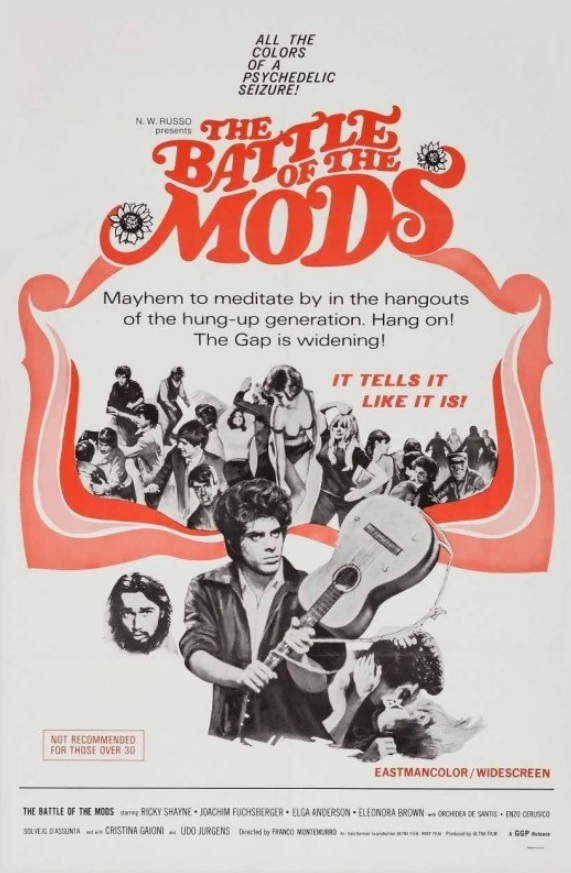
So Ennio De Concini, who wrote more than his fair share of sword n’ sandal and spaghetti westerns, and director Franco Montemurro (internationally known for 1962’s The Police Commissoner and 1964’s Divorce Italian Style), came up with a story about a Liverpool gang war between the Mods (who dress in the latest fashions and style ala Gene Vincent) and the Rockers (adorned in a ’50s greaser style ala Marlon Brando). Ricky Fuller (Euro musician Ricky Shayne), the son of a wealthy businessman, is a Mod musician who, after a bloody a gang fight that leaves his girlfriend dead, flees Liverpool for Rome — and he starts an affair with his father’s mistress.
La battaglia dei Mods
A 1970 Radio Luxemburg “Golden Lion” award-winning singer, Ricky Shayne (aka George Albert Tabet) was born to a Lebanese oilman and his mother, a French-born painter, in Beirut, Lebanon. After moving to Paris at the age of 15, he began his music studies; with a move to Italy at 17, he began his recording career and, courtesy of his cinematic good looks, quickly found acting work. In 1965, he co-starred in an Italian rock flick Altissima pressione (Highest Pressure). He quickly transitioned into leading man roles with the 1966 German rock film Siebzehn Jahr, blondes Haar (Seventeen Years, Blond Hair) and the 1967 Italian rock flick Una ragazza tutta d’oro (A Girl All In Gold). Of course, all of the films featured Ricky’s latest hits, with the The Battle of the Mods featuring his tunes “Uno dei Mods” (“One of the Mods”), along with “No No No No” and “Crazy Baby I Got You” (which also served as the film’s alternate title).
American classic rock aficionados came to know Ricky Shayne by way of the American pop band Stories, fronted by Ian Lloyd (1973 U.S. #1 “Brother Louie“). In lieu of importing Ricky Shayne to the States via his 1971 European smash hit single “Mammy Blue” (the German language version hit #7 in that country; the French language version hit #8 in France, the English language version hit #1 in Argentina and Brazil, and the Top 10 in Belgium and Japan), the song was re-recorded by Stories, who placed it in the American Top 50 — and proved to be the last hit by the band. Shayne, meanwhile, became a U.S citizen in 1975, but continued to hit the European charts with a variety of singles while starring in European film and television roles. Now, at the age of 76, he still performs in Eurasia as part of nostalgia package tours.
While a quick search of Ricky’s music on You Tube will turn up a wide array of his singles, here’s his original 1971 version of “Mammy Blue” to enjoy (alternately titled with one “m” or two, depending on country of release.)
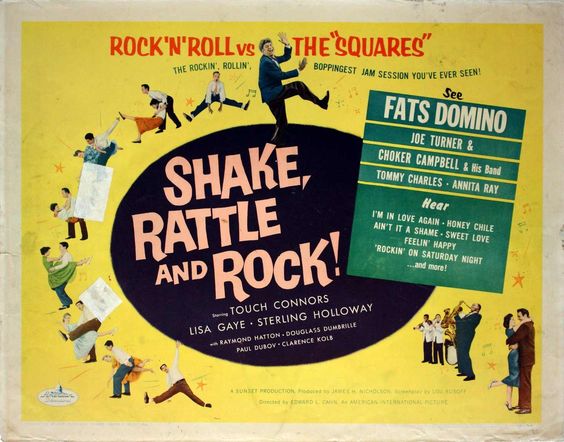
Edward L. Cahn made everything from Our Gang shorts to It! The Terror from Beyond Space and The Four Skulls of Jonathan Drake. He also made this “rock ‘n roll vs. the squares” movie that features Fats Domino and Big Joe Turner.
Playing on a double bill with Runaway Daughters, this was but the start of American-International Pictures reaching out to the teens or more like reaching into their wallets. Most of the films follow the Arkoff Formula:
Action (exciting, entertaining drama)
Revolution (novel or controversial themes and ideas)
Killing (a modicum of violence)
Oratory (notable dialogue and speeches)
Fantasy (acted-out fantasies common to the audience)
Fornication (sex appeal for young adults)
You get a pre-Mannix Mike Connors, Lisa Gaye (who is also in Rock Around the Clock), “fifth Marx Brother” Margaret Dumont and plenty of actors who’d been around Hollywood since before sound was in movies. No matter. The real action here is when the kids defend rock and roll against the old timers in a TV trial.
In 1994, this movie was remade as part of the Rebel Highway series of AIP remakes on Showtime. The new version, directed by Allan Arkush, featured Renee Zellweger in the lead and appearances by Howie Mandel, Max Perlich, the R&B band For Real, Gerrit Graham, John Doe, Riki Rachtman, Nora Dunn, Mary Woronov pretty much playing Ms. Togar from Rock ‘n Roll High School, P.J. Soles playing a square with the last name of Randall (who I sure hope isn’t Riff all grown up) and Dick Miller.
This is purely a British film steeped in nostalgia for the short-lived British glam rock movement that spawned the likes of David Bowie, T. Rex (“Bang a Gong“), and Sweet (“Little Willie“), and to a lesser extent — at least for U.S. audiences — Mud (“Tiger Feet“), Slade (“Cum on Feel the Noise“), and Suzi Quatro (of the recent document retrospective, Suzi Q).
Like any Beatles flick or British Invasion film romp starring the likes of Cliff Richard and the Shadows (1966’s Finders Keepers), Herman’s Hermits (1966’s Hold On!), and Freddie and the Dreamers (1967’s The Cookoo Patrol), a rock band on tour finds itself in hijinks — with rock ‘n’ roll under attack by the establishment and a rock ‘n’ roll club in danger of being closed down.
To that end: In a “future” set in late 1970s, the establishment has banned rock ‘n roll from television. So a young rocker (British television acting mainstay Peter Denyer) leads the charge against the ban by organizing the biggest rock groups in England to perform at a benefit concert.
Of course, David Bowie, Marc Bolan (of T. Rex), Sweet, Slade, and Suzi Quatro will have none of this amateur cinematic foolishness, so we have to settle for the lesser “stars” of the glam era with the likes of Mud and the Glitter Band (Gary Glitter’s backing band, out on their own), along with the Rubettes — and guest appearances by Peter Noone of Herman’s Hermits (trying to eek a living in a post-British Invasion world) and Midge Ure (later of Ultra Vox) with his glam band, Slick.
This is the type of film with nary a plot, the “action” consists of the old slap stick standby of a food fight in a roadside diner, and lots — and LOTS — of musical numbers padding out the film for its whopping one hour fifty minute running time. The cast is rounded out by members of, get this, the prestigious Royal Shakespeare Company — and beware the bushy mutton chops and sharply-cut side burns — and of the outdated vaudevillian comedy groans presented by British comedians Freddie Jones and Max Wall (insert sad trombone “wah-wah-wah” sfx here.)
However, if you want to trip down the ’70s glam rock memory lane of your youth, or you if want to first educate yourself on the era with a glam primer, there’s not another film quite like this glittery mess of a train wreck of a film.
To say I love this movie is an understatement.
Overseas readers can stream this via Amazon Prime U.K., but we found you a free, three part upload on You Tube HERE, HERE, and HERE. Ha! It’s infectious! I got Sam the Bossman to watch: here’s his take. Yes, it depends which print you watched and where, back when: this came out in 1975 and 1976. Glam, of course, was out by 1976, and punk was on the rise. . . .
About the Author: You can learn more about the writings of R.D Francis on Facebook. He also writes for B&S About Movies.
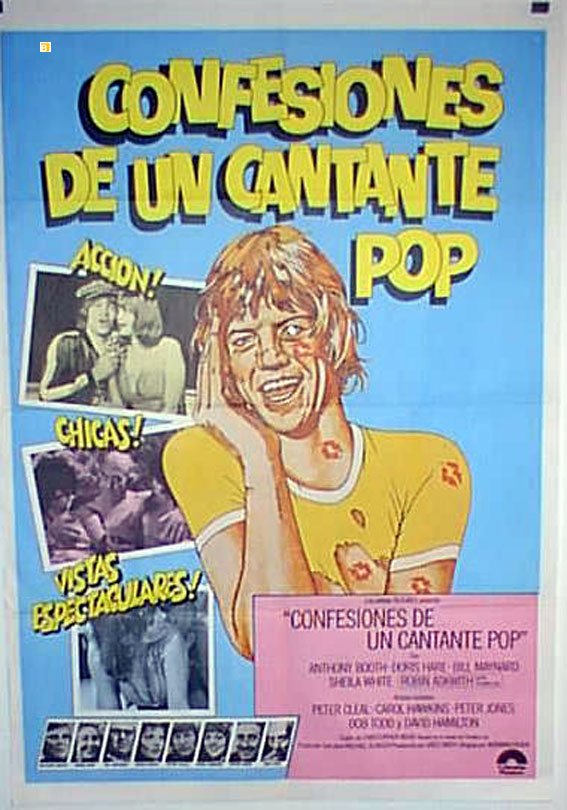
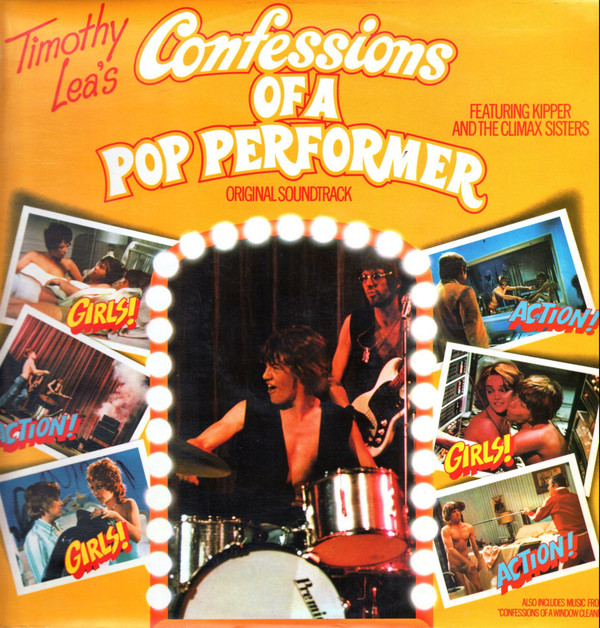
Part of the four-part series of British Confessions sex farces, this installment focuses on Timothy Lea (Robin Askwith, Four Dimensions of Greta), who is trying to make it in the world of pop music as he joins the band Kipper while remaining a window washer.
Seriously — this movie is a Benny Hill-ish romp that I don’t think would play well with today’s audiences. You can guess how much I enjoyed it.
Keep an eye out for appearances by future Darth Vader David Prowse, Rula Lenska (Queen Kong), Benny Hill girl Helli Louise, Rita Webb (Frenzy), Richard Warwick (If….), Benny Hill and Spike Milligan straight man Bib Todd and a fake band called The Climax Sisters.
This was the only movie in the series to get a sound track record on Polydor, featuring songs from the first movie, Confessions of a Window Washer, as well as dialogue. It’s also the only original script not based on one of Christopher Wood’s books.
This movie tied another movie for Worst British Film of 1975 by Sight & Sound. That movie? The Rocky Horror Picture Show.
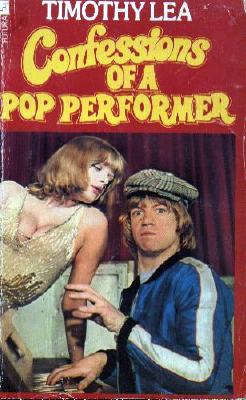
There was also a paperback, which has a great cover.
Norman Cohen took over for the first film’s director Val Guest (The Quatermass Xperiment ) after Guest’s wife wouldn’t let him on set with all the near-nude women. Cohen was a great pick, as he’d already worked on two mondos, The London Nobody Knows and London In the Raw.
Who would expect that a big budget movie based on an Archie Comic and Hanna-Barbera cartoon would end up being a movie so willing to bite the hand that feeds and presents a world where the world of pop music is all one giant conspiracy to sell you things? While it’s selling you things, of course.
Yet despite being savaged by critics back and bombing at the box office at the start of this century, this movie feels more relevant today than nearly anything else that played theaters in 2001. It’s skewering of consumerism is, if anything, even more relevant today. And man, the songs are catchy.
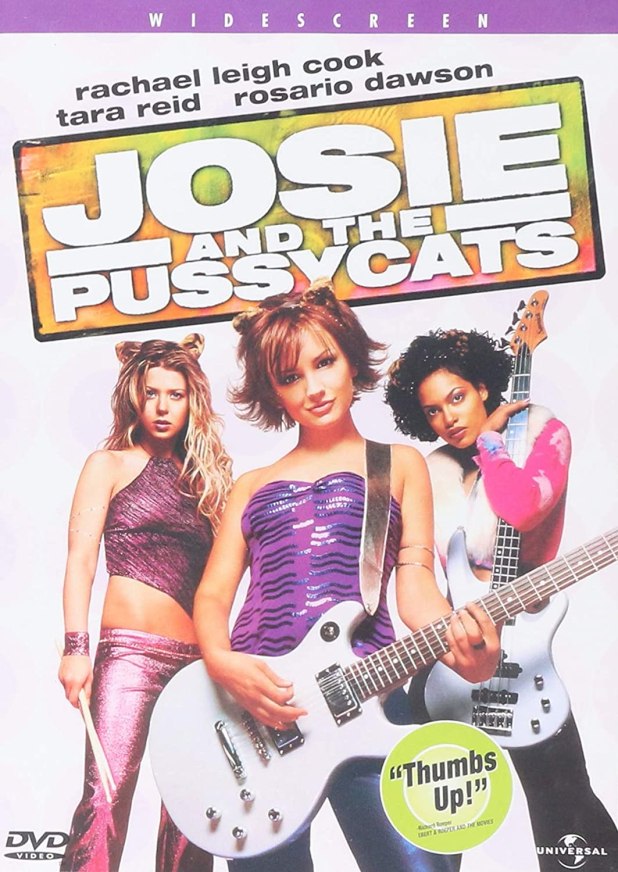
Josie McCoy (Rachael Leigh Cook), Melody Valentine (Tara Reid) and Valerie Brown (Rosario Dawson) are the Pussycats, who have been selected to replace DuJour, the latest and hottest band, but also one who have learned that this is all a big scam on the kids. They pay the price when their plane goes down over Riverdale.
Now, Wyatt Frame (Alan Cumming) and Fiona (Parker Posey) have promised the one world government that her new band won’t need to be killed via drug overdose and will get the job done — or else Carson Daly will wipe them out on the set of Total Request Live.
There are so many products placed in this movie that it becomes virtual overload, yet none of them were paid for by the actual companies. They were all placed there by the filmmakers and there are around 73 different products in this movie.
Those songs I mentioned — that’s Kay Hanley from Letters to Cleo singing — make this movie even better.
Deborah Kaplan (who is married to Breckin Meyer, who has a cameo in this movie) and Harry Elfont wrote and directed this movie. They’ve worked together on plenty of other films, including A Very Brady Sequel, Can’t Hardly Wait, The Flintstones in Viva Rock Vegas, Surviving Christmas, Made of Honor and Leap Year. However, this would be the last movie they’d direct.
The title for this film is a translation of Burzum’s fourth album. Do you not know who Burzum is? You may walk away from this movie — with no past knowledge of black metal — believing that sole member Varg “Count Grishnackh” Vikernes is a pretty intelligent, level-headed fellow. Then you remember, “Oh yes. He stabbed his rival Øystein “Euronymous” Aarseth twenty-three times and also was broken out of jail by white nationalists. Yet — you can find plenty of photos of me wearing Burzum shirts, if you look on social media. And I own all the albums. And, well, I have no easy answers when it comes to black metal.
That’s a cop out. I get it.
If you think that gangster rap — with it’s need to prove who was real and who was fake, leading to actual murder — is crazy, you’re about to get an awakening. This film may jump around a bit to give you a balanced accounting. That said, it’s a million times better than the excoriable Lords of Chaos.
Once upon a time, in the basement of what would one day be a Benetton, a bunch of people would meet to talk about bands they liked. And that turned into a contest to see who could be legit and the most evil. As these things turn out, things went a bit far. The kind of far that involves murder, burning churches and intercine warfare, which ended up with — as we began — Varg and Euronymous proclaiming that they would kill one another.
Pretty much everyone in the scene gets a part, like Mayhem vocalist Per “Dead” Ohlin, who lived up to his nickname and whose suicide supplied a ghoulism album cover photo as well as supposed jewlery made from his skull fragments. Perhaps Fenris from Darkthrone comes off the nicest of anyone in this, as he seems like someone who genuinely just loves music.
The thing I dislike most about this movie is the sound and editing. They had the opportunity to get interviews with some people that have been very difficult to track down and yet, you can barely hear them at times and the imagery on screen rarely matches up. It’s incredibly frustrating.
That said, I was shocked that Bård “Faust” Eithun appeared, despite only being seen in shadow. After stabbing Magne Andreassen outside Lillehammer’s Olympic Park, he spent almost ten years in jail. One of his many bands, Thorns, put out several influential demos and their lone 2001 album is incredible.




 B&S About Movies
You must be logged in to post a comment.