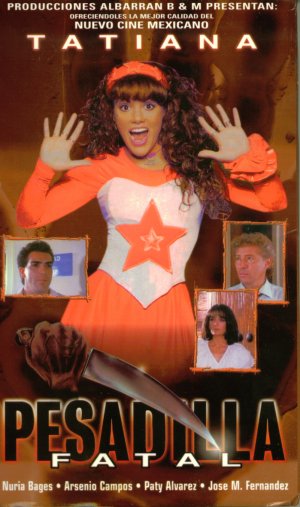
Tatiana — a Mexican singer and actress who came to my attention for her magnificent rendition of “Chicos” in Vacation of Terror 2 — also made this film, where she plays a blind woman named Marisol whose father has been killed. Even worse, the killer is now after her.
Directed by René Cardona III (who made the original Vacation of Terror), this film features a killer with a Freddy-like glove of knives. He (or she) nearly kills Marisol with it in the beginning and continually uses it to get closer and closer to taking our heroine out.
There’s a lot of Marisol acting like she can’t see and stumbling around while the knife-gloved killer tries to end her life. She’s so perky and innocent and nice that you’ll be rooting for her — and this film — no matter what.
Happily, a steady diet of Mexican 1980’s VHS era films has proved that I still have the capacity to be upset by movies.
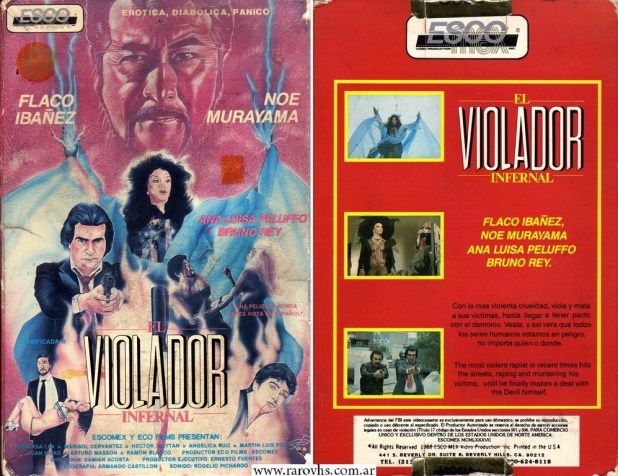
1988’s El Violador Infernal (The Infernal Rapist) is the kind of movie that saw Fulci’s roughest film and said, “Yeah, but what if the killer was the main character and he sniffed coke and we ripped off Shocker?”
Carlos (Noe Murayama, who came from Japan to Mexico with his dentist father and ended up being a character actor in tons of movies) is the main character, who is about to die in the electric chair when Satan herself (Ana Luisa Peluffo, who was in Vagabundo en la Lluvia and one of the first mainstream Mexican stars to appear nude in films; her career stretches from 1948 to 2014 and here, she was already sixty years old), who is a fabulous older woman dressed and shot in the way that only telenovela characters and the finest drag queens dream of being filmed.
She tells him that if he wants to live, he must sexually assault people, kill them and then carve 666 into their bodies. She seals the deal by firing laser beams out of her eyes and blasting his brain into the body of a drug dealer. These are the kinds of scenes that I keep rewinding and watching before sending them in the middle of the night to Bill fromGroovy Doom like some kind of insomniac zombie fiend.
I mean, she promises him quite literally “all the drugs.”
His first kill is the drug dealer’s best friend, who he first overdoses on a bad batch of heroin, then, just when you’re thinking, “I hope he doesn’t have sex with that guy’s dead body,” that’s exactly what he does before repeatedly stabbing the man and carving the number of the beast into his freshly defiled ass. Seeing as how this is shot with wacky synths and with a lead who it’s difficult to tell if this scene is making him laugh, cry or come, this movie starts in a bewildering fashion and does not let up.
For some reason, the cops can’t catch a criminal who has come back from the dead, uses his real name and tells people what he is about to do and basically goes after every woman who works at the same beauty salon. He’s able to make them float, surround them in fog and kill them one by one, yet none of them say, “Girl, don’t go out with Carlos El Gato. He’s bad news.”
Eventually, El Gato screws up and doesn’t carve seis seis seis into an asscheek quick enough, which leads to Satan flinging him off a roof after he shrugs off numerous cops shooting him.
Wow. Obviously, Mexican films of this era had no budget to go with their utter lack of morality. It’s amazing to me that this movie even exists. I learned of it by wanting to see what other films that Princess Lea, who is also in Intrepidos Punks and La Vanganza de los Punks, was in. I can only imagine what other indignities she would suffer in her other films after this one.
Note: Just because I wrote about the Herschell Gordon Lewis goes to Mexico direct to video sleazefest doesn’t mean that I condone sexual violence toward men and women. Obviously, if you know me or have read any of my writing, you know where I stand on these issues. Yet in today’s society, I feel like I have to make some form of disclaimer to let you know that I find the behavior in this film — as well as others I’ve mentioned — abhorrent. Now let’s all treat each other with respect and empathy while loving really bad movies.
Juan López Moctezuma only directed six films. La Mansión de la Locura, known in the U.S. as Dr. Tarr’s Horror Dungeon, To Kill a Stranger, El Alimento del Miedo, Welcome Maria, the mind-destroying Alucarda and this film. Some people are able to make a legacy with very few films. In my book, Moctezuma is one of them.
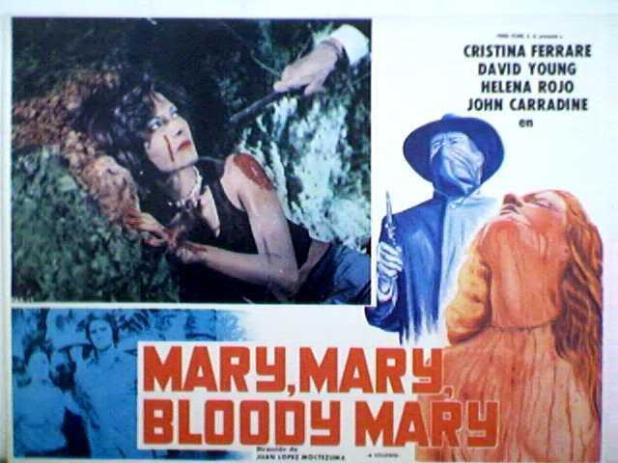
Mary Gilmore (Cristina Ferrera, who was once married to John DeLorean and a model before her acting career; she’s since become a TV host and cooking expert on other talk shows) is an American artist searching for something in Mexico. Her van breaks down on the way and she’s surprised by a homeless guy named Ben (David Young, Nightbreed, Poor Devil), who offers to help her in the morning. She agrees and while she sleeps, she dreams of the last man she murdered.
Yes, Mary is something like a vampire, but she must use drugs to slow her victim down as she gains no real powers from her vampirism. In fact, unlike the typical movie vampire, she can move freely in the day. I was reminded of Martin here, as the only magic of this curse is the overwhelming need to destroy and kill. Often, the people that Mary destroys have given her kindness, like the art dealer (Helena Rojo, Más Negro Que la Noche) who she seduces or the old fisherman who offers to teach her. They get drugged and slashed and stabbed instead of what they expected.
Meanwhile, a bandaged man is stalking Mary, killing other women and trying to run her down with his car. If that wasn’t bad enough, Ben is wanted for the murder of the fisherman. No one would suspect our heroine, after all.
Things come to a head when the masked man attacks Mary at a party, which leads to a chase with the police behind them. One of the inspectors is killed and just as Mary is about to devour Ben — who she had earlier drugged for just such a purpose — the masked man (John Carradine) reveals that he is her father. His face has rotted away and he explains that this is what the disease does. He must kill her before she is taken the same way that he is.
Ben wakes up and kills the father with the dead policeman’s gun. Mary begins him to leave and he keeps embracing her. As the camera moves above the scene, we see that she has consumed both of the men’s blood.
At the close, the police believe that the dead masked man is the one responsible for all the killing. This leaves Mary free to drive away and continue her travels.
There’s so much to love here. The painting that Mary has done of her father is a portrait of him as Dracula. There’s also something interesting about how she is the destroyer of so many lives, yet creates with her artwork.
This is the kind of movie that plays with the paradigm I’ve discussed so much: the difference between grindhouse and art house. A scene that should be pure exploitation, like the lesbian bubblebath scene, transforms into sheer artistic bliss (and bloody murder). Carradine feels like he stepped straight out of an Italian giallo. And the young lovers on the run in a foreign country film feels New Hollywood. It is all of those things and more.
Moctezuma has never failed to surprise and delight me.
I found this one on Tubi and it’s directed by Cesar Miguel Rondon. Honestly, there’s not much info on this one, which came out 28 years before The Curse of La Llorona.
It’s shot on video and looks like a telenovela — not a bad thing — and concerns a fishing village named La Vela. There, Ismael lives with his wife Cayita and their son, but his weakness as a man finds him in bed with Carmelina, who has the power of witchcraft.
Not a single one of the three featured actors in this movie claim it on their IMDB pages. You have to love this simple description that Pongalo gives to this movie, totally spoiling so much of it: “One day, Ismael decides to return to the side of his wife and son. Carmelina invokes her powers and begins her revenge … Ismael dies.”
Whew. This isn’t the worst movie I’ve watched as of late, but it’s close.
This week, we have two more movies that are nearly impossible to eat during. Yes, if you have helminthophobia, scoleciphobia or vermiphobia, this week’s show is not for you!
Up first is Juan Piquer Simón’s 1988 infested opus, Slugs. Black slugs spawned from the disposal of toxic waste have infiltrated the water supply of a small town, but no one wants to listen to scientists. Oh man — the director of Pieces making a bug movie? You know it.
Here’s something to drink during it.
Naked and Crazy Frozen Slugs (based on this recipe)
2 oz. vodka
3 oz. pineapple juice
1/2 oz. blue curacao
3 oz. seltzer
Gummy worm ice cubes
You can make the ice cubes as simple or complicated as you want. If you want some more blue or green color, simply pour Gatorade or your favorite fruit-flavored drink into an ice cube tray. Then, drop in a few worms per cube. Freeze in advance.
In your cocktail shaker, toss in vodka and pineapple juice with some ice. Shake until chilled.
Place wormy ice cubes in the glass of your choice, then top with your mix. Then, top with seltzer (or your favorite sparkling water) and blue curacao.
NOTE: For the non-alcohol lovers out there, you can use Torani brand blue curacao-flavored syrup here and skip the booze.
If you have any appetite left, you won’t for long. Up next is the 1976 crawler Squirm. We’re going to make a special drink to go with it, too.
Pour tequila and lemon juice together and swirl around in a glass.
Rim a glass with salt, then pour both mixes together. Enjoy, but watch out for worms.
BONUS: If you’re not into alcohol — or just want to celebrate one of the weirder scenes in this movie — here’s how to make an egg cream, which features into the plot.
New York Style Egg Cream (taken from this Food Network recipe)
3 tbsp. chocolate syrup
1/4 cup milk or half and half
Club soda (to taste)
Pour chocolate syrup and your dairy of choice into a glass.
While beating it hard with a fork — watch your mind, dirtball — slowly add club soda until the glass is nearly full.
BONUS: Ultra special secret recipe for those who read all the way!
This one is really simple. Get a small plastic storage container, fill it with some gummy worms and cover them with some vodka. Put them in the refrigerator and stir every once in a while. Within two days, the booze should be completely evaporated. Beware — these are strong.
Let’s get this out of the way. This is a movie made by maniacs who have nothing less than the goal of decimating your sanity. View this movie at your own peril.
René Cardona — who also brought us La Momia Azteca contra el Robot Humano — originally crafted this movie, which was remixed for American audiences by K. Gordon Murray, known as the “King of the Kiddie Matinee.” Ever wondered why Santo was called Samson in the U.S. dialogue? You can thank Murray, who also provides the near-manic voiceover for this film.
On Christmas Eve, Santa prepares for his big night, as always. He plays his organ while children all over the world sing. They hope to glimpse him as they leave his Toyland castle in space.
If you’re already wondering why anyone would change Santa’s basic character beats, buckle up. Have have some Christmas magic for you?
In Hell, Satan tells Pitch, his main demon, to go to Earth and make kids hate Santa. Why? Who knows — we wouldn’t have a movie otherwise.
Pitch asks five kids to help him enrage Santa Claus. Four of them are complete assholes — three brothers who like to start shit and Billy, the son of wealthy but absent parents. They break some windows, but Pitch fails to talk Lupita, a poor girl, into stealing the doll she wants. An angry Santa watches from space with the help of his magic telescope and children’s helpers. Remember that part of Santa’s songs?
Santa also has a device that allows him to watch children’s dreams, further creating a police state only dreamed of by elves on shelves and Tom Cruise in Minority Report. Lupita dreams of adult-sized dancing dolls demanding that she learn how to steal.
The three brothers then break into Billy’s home and steal his toys. They then have the temerity to write to Santa and tell him they have been good all year, but his voice takes over their minds and informs them that he can see everything.
Let me see if I can process what happens next: Santa can attract everyone because of his most trusted henchman, Merlin the Wizard. No, not Ringo Starr from Son of Dracula. No, this friend of Saint Nick gives him sleep powder, a flower that allows him to disappear, a magic key that will open any door on Earth and mechanical reindeer. But oh no — the three evil boys are plotting to enslave Santa. Enslave Santa — that’s how dark this movie is ready to get.
Want to get really dark? One of Santa’s helpers, Pedro, is played by an actor named Cesáreo Quezadas, who was also known by the stage name Pulgarcito, thanks to appearing in the popular film of the same name. This would be like us calling Bela Lugosi Dracula for the rest of his life. He often played plucky orphans, but as he hit puberty, his acting career suffered, leading to him holding up a shoe store in 1971. After some time in jail, he got married and had four kids, but ended up leaving his wife for his secretary, Claudia, and having two kids with her. Those two boys, Gridley and Guillermo, found a video of their father having sex with their stepsister, Mariana. He’s still in jail today, over a decade later.
Remember Lupita? She and her mom pray that she gets not just one baby doll but two — one of which she will give to Baby Jesus, which is kind of like when you ask your parents for money so you can buy them a gift at the Santa shop at school, and all they get is a piece of shit covered with glitter or a cheap screwdriver set that you wonder why they never use.
Santa just wants to get gifts to everyone on Earth, but Pitch keeps screwing with him. And Billy? His parents go out to eat and just leave him all alone. Santa helps out there and even has time to give the three bad kids coal after they try to steal his sleigh.
Pitch is finally lucky enough to empty all of Santa’s dream powder, and then the jolly old man drops his magic flower. He’s fucked. A dog chases him up a tree, and the devil’s majordomo calls the fire department to come so everyone can see Santa and ruin his magic. Merlin helps our hero escape and blasts the demon with a fire hose.
Don’t worry about Lupita. She gets her doll as Santa goes back to his castle. Whew.
This movie won the Golden Gate Award for Best International Family Film at the 1959 San Francisco International Film Festival. I can only imagine that this was one of the early LSD experiments and not a film festival based on artistic merit.
This movie has so many insane ideas that it’s difficult to summarize. From learning that demons primarily eat hot coals to the fact that every child who works for Santa must wear a racist costume that denotes their country of origin (all Japanese children wear kimonos, and all Americans are cowboys), this is a movie brimming with barely concealed menace.
But here’s what’s really weird: Even though Santa has modified all of his children’s countries, none of them know anything about their countries of origin. What is happening?
This is how Santa can be everywhere at once: he is from the Fifth Dimension, and, as we all know from reading Grant Morrison comics, that is the dimension of imagination. Therefore, as a fifth-dimensional being, Santa can see the reality of our dimension and do things that would break our minds if we contemplated them for so long — just like I am doing when I write this. I am putting your brain in danger right now by forcing you to reason with the fact that the physical properties that ground us in the Third Dimension can be pushed beyond the infinite. Merry Christmas.
Santa Claus can also feel physical pain when his mechanical manifestations are hit with rocks. This makes even less sense. Why, in a world where Lucifer constant is constantly murdering him, would Santa put himself in such mortal peril?
This is a movie that raises more questions than it answers. You ask, “Where does Santa come from?” Knowing that he comes from the North Pole, you are shocked to learn that everything you know — including the universe and its laws are governed — is a lie. This movie is meant to keep children occupied, whether on TV or in the movie houses where it ran yearly for three decades while parents try to get a merciful break. However, a central point of the film is for parents to stop ignoring their children, so any child ignored in such a way will have to feel lost in the maelstrom of emotional pain that this movie wields like a scalpel.
I get this for watching Santa Claus vs. the Devil at 4 AM. Pure pain, questions that chatter at my mind and the slowly evolving knowledge that this motion picture could have only been created by the eldritch powers of the Ancient Ones who wait for us Behind the Wall of Sleep, where their madness will infect our souls and cause our children to eat their way from their wombs.
This movie is giving me flashbacks to our month of Eurospy films, seeing as how like many of those films this is a multi-nation production, uniting the worlds of Mexico and Peru.
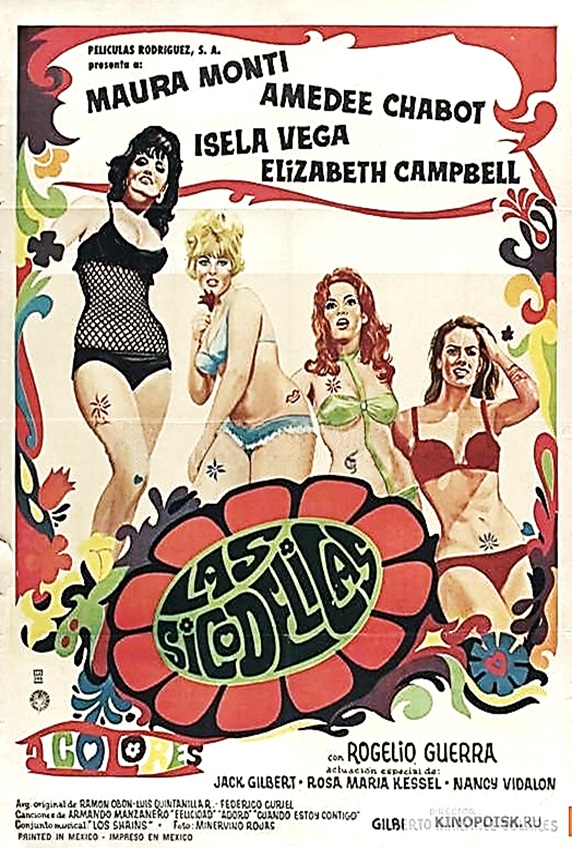
Mireya (Maura Monti, who was The Batwoman in La Mujer Murcielago), Adriana (Amadee Chabot, Murderers’ Row) Patricia (Elizabeth Campbell, Martesia from El Planeta de las Mujeres Invasoras) and Dalila (Isela Vega, The Snake People) met in reform school before being adopted by a millionaire named Aunt Ermentrudis (Tamara Garina, Darker Than Night).
She employs her girls at Seguros Internacionales de Proteccion, an insurance company that serves only the most powerful. If people screw them over or even decide to stop using their services, she sends the girls out to murder them and then uses her funeral home to hide the evidence.
That’s a great plan until private detective Arsenio Junker Tres Alas starts snooping around after dating Adriana. And now things are further murked up by the fact that Aunt Ermentrudis has ordered the death of rock star Ringo Peniche, who is Delila’s boyfriend!
In 1987, writers Luis Quintanilla and Ramon Obon created a direct to video remake called Adorable Criminals.
The best review I can think of for this came from Letterboxd reviewer Lencho of the Apes, who said, “Remember that movie Russ Meyer made at Disney Studios? Me neither, but that’s what this is.”
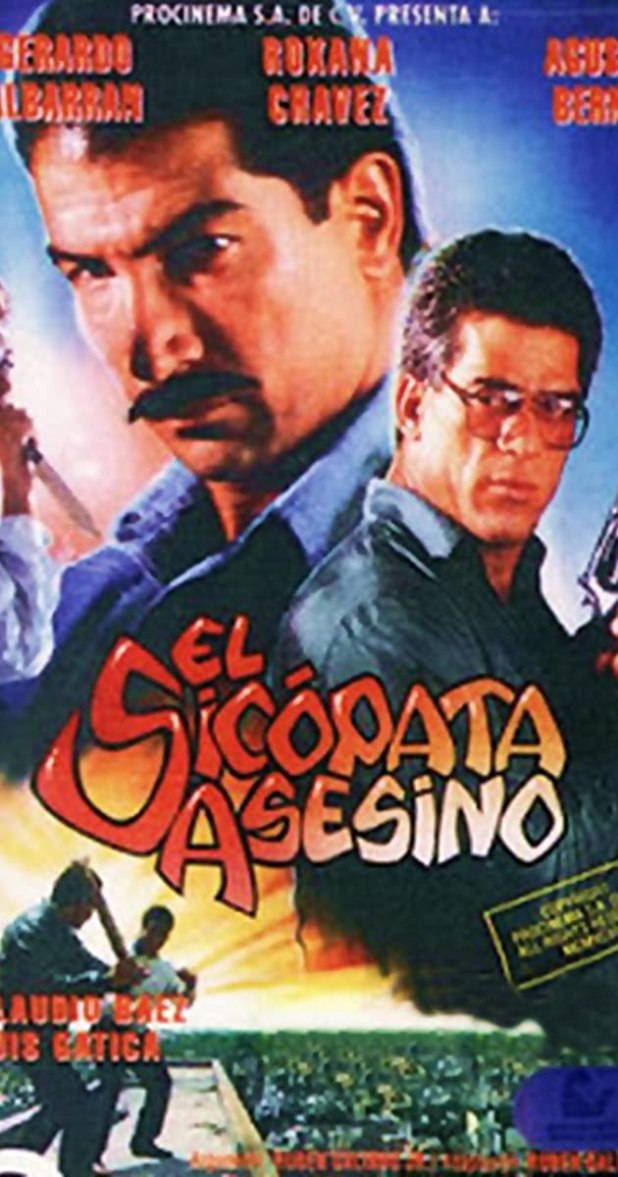
Ruben Galindo Jr. made Don’t Panic, Cementerio del Terror andLadrones de Tumbas, all movies more than worthy of praise. This is a mix of a cop film, a slasher and some occult themes, as the killer is a psychiatrist who is able to influence the minds of his patients.
This feels more like an Americanized direct to video cop on the tail of a killer with something extra — The First Power, if you need an example — which here ends up being mental powers.
Sadly, this movie does not live up to the first three of Galindo’s films that I enjoyed so much. But I’m not giving up on him, especially when he has movies like Mutantes del Ano 2000, where a giant mutant rat runs while in a teacher’s house, and Resucitare Para Matarlos, where a bullied kid learns how to kill all the soccer players once he comes back from the dead.
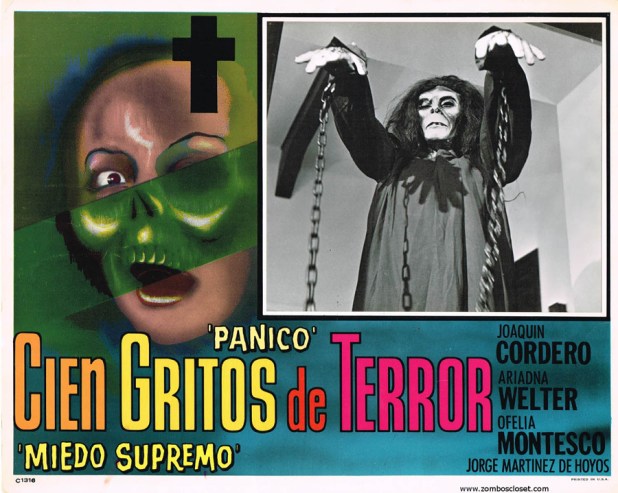
There are two stories here in this Mexican portmanteau. The first, Panico — hey, how about that title — is about a man (Joaquin Cordero, Dr. Satan) who wants to leave his wife for his new lover, but things are not that simple. The second is Miedo Supremo, which is about a man trapped alive in a burial crypt who discovers that he is not alone.
Translated as 100 Cries of Terror, this film is very much an Edgar Allen Poe movie. Director Ramon Obon also wrote The Living Coffin, another movie of Mexico’s Golden Age. Sadly, he died not long after making this movie, the first he directed.
There was a plan in 2014 to remake this movie with Reversal director JM Cravioto. It never was made and I’m probably one of the few people who is still wondering if it will happen.
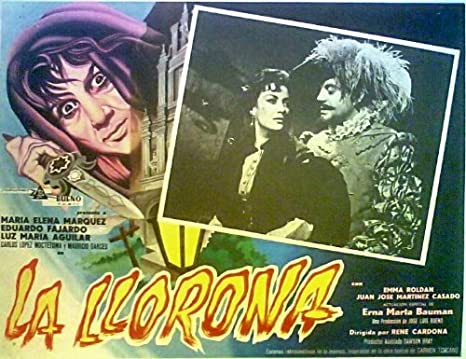
Rene Cardona directed this take on the Crying Woman of Mexican legend. It starts with newlyweds being told the legend and flashes back to the origin of the story, where a woman named Luisa is spurned by her husband for not being pure Spanish. She kills their children before being put to death. The reason the story is being told to them? Because the bride is a descendent of the conquistador who wronged Luisa. Now, his entire family has been cursed to die violently.
I’ve joked that every few years, we get a new and worse retelling of this legend. Luckily, this is one of the better versions, with an ending filled with some genuine fright and doom. When viewed by modern audiences, it will seem slow and like a stage play, but to me, that was part of its charm.





 B&S About Movies
You must be logged in to post a comment.