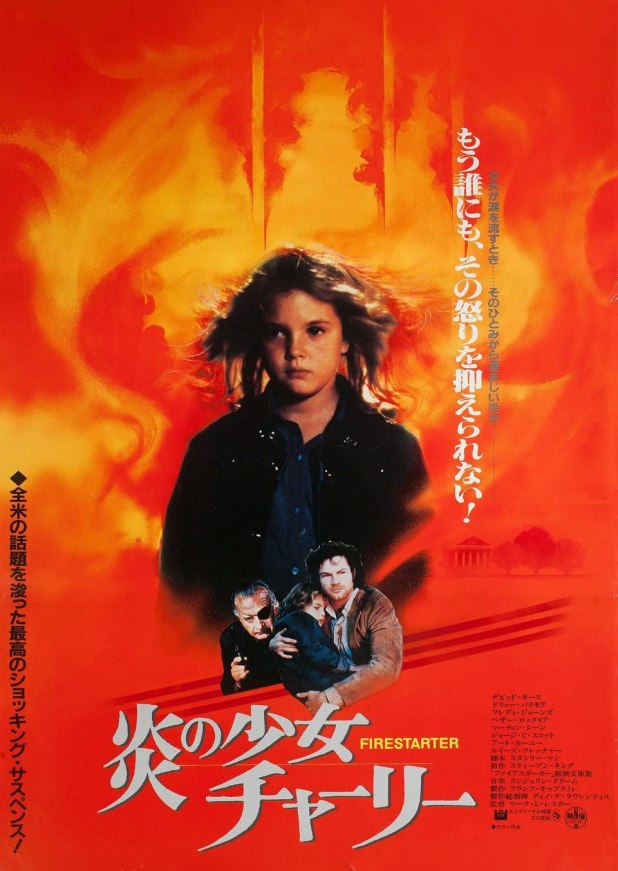
If you live in the world of Stephen King and meet Martin Sheen, run the other way. He’s never a positive person. That’s the life lesson that Firestarter has taught me.
During the filming of The Thing, Universal offered this movie to John Carpenter, but when that failed — you know that story — they gave it to Mark Lester. Did it work? Well, King told American Film that the movie was “flavorless; it’s like cafeteria mashed potatoes.”
When Andy (David Keith) and Vicky (Heather Locklear) were in college, they earned extra cash by getting dosed with LOT-6, a drug that gave him the ability to take over minds and her the talent of reading people’s thoughts. Once they had Charlie (Drew Barrymore), she could see into the near future and start fires with a thought.
Of course, The Shop created her and they want her back. Everyone in this government group is horrible, from Sheen to John Rainbird (George C. Scott), who comes off as a grandfather but is the worst of them all.
Tangerine Dream composed the music for this film and if you’re wondering, “How does the crew at B&S About Movies feel about Tangerine Dream?” the answer is, “We did an entire week of their movies and you can read about it here.”
They composed the music without ever seeing the movie. They sent no directions to Lester, only a note that said “use the music wherever you like, it fits wherever you want it to.” As he was editing it into the movie, he was shocked. Their music really did fit anywhere he placed it.
Another question you may ask is, “Didn’t Stranger Things pretty much rip off most of this?” The answer would be, “Well, they ripped off a lot of things.” When they eventually remake this, I can’t wait for the hot take articles about how King ripped off Netflix.
Disproving my theory that Old Hollywood only wants to sacrifice you to Satan, the only nice people other than our heroine and her parents are the Manders, played by Art Carney and Louise Fletcher, who is much kinder here than she was in Flowers in the Attic.
While Charlie was modeled on King’s daughter Naomi, Barrymore feels that she was born to play this role, as she resembled the girl on the cover of the book. Barrymore said, “When I read it, I came into the kitchen where my mom was making dinner and said: “‘I’m the Firestarter. I’m Charlie McGee!” But she didn’t know what I was talking about.”
This was the first of many films that built the film industry in Wilmington, North Carolina. You should also look out for two versions of Michael Myers in this movie, both Dick Warlock and George P. Wilbur.
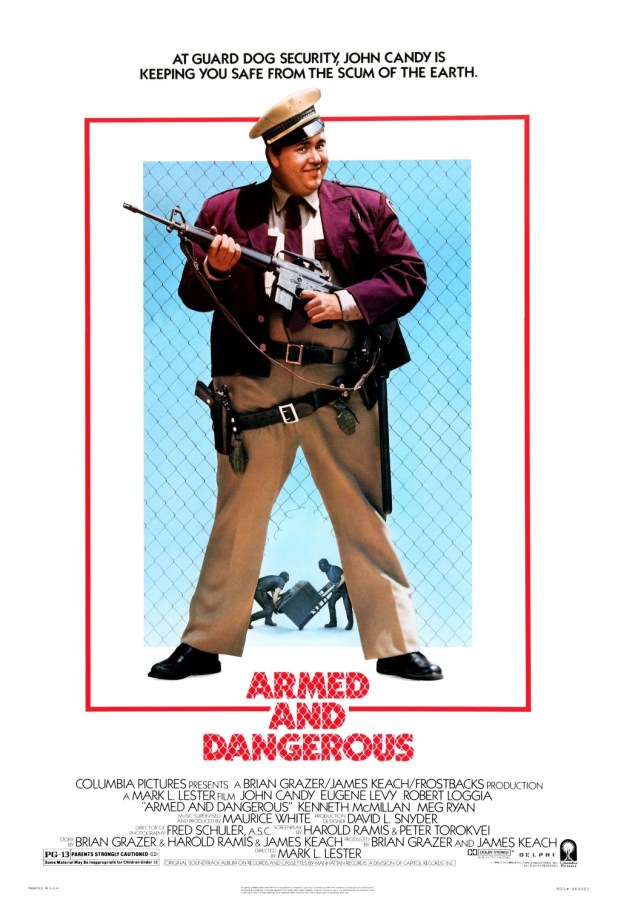
Mark Lester can do a buddy cop movie. But a comedy? A movie that starts with John Candy’s character sent up the river and Eugene Levy as the worst lawyer ever throwing himself on the mercy of a judge — Stacy Keach Sr.! — to keep the mob from killing him, with Candy in a Bill Murray role instead of the likable everyman?
If anyone can handle it, it’s Lester.
With no job prospects, Dooley and Kane (Candy and Levy) apply for work at Guard Dog Security, run by Captain Clarence O’Connell (Kenneth McMillan, Cat’s Eye) and supervised by Maggie Cavanaugh (an impish and delightful Meg Ryan).
Their first night on the job, some goons take advantage of them when lead guard Bruno makes our heroes take a break. He’s Tiny Lister, better known as Zeus from No Holds Barredand Deebo in the Friday movies.
This launches them on a quest to see who has set them up — again in Candy’s case — you get plenty of great casting to help the story move, a hallmark of Lester’s work. There’s Robert Loggia as corrupt union head Michael Carlino, Brion James and Johnathan Banks (both strangely with full heads of hair) as his goons, James Tolkan (Strickland from Back to the Future), Don Stroud (Stunts), Steve Railsback (Turkey Shoot) pretty much playing the same character as he did as Manson in Helter Skelter, Tony Burton (Duke from Rocky), Teagan Clive (yes, Bimbo Cop from Vice Academy 2and The Alienator), Tito Puente, Judy Landers (Dr. Alien!), Christine Dupree (who was one of the models for the aborted video game Tattoo Assassins) and even a blink and you’ll miss him appearance by David Hess as a gunman.
You may watch this and say, “Robert Loggia has a nice, if familiar house.” That’s because Jed Clampett used to live there. The Sport Pit, the gym that gets messed up in the film, is also in the same strip mall that D-Fens shot up the phone booth in Falling Down.
By all accounts, this movie sounded like a mess to make. Originally written by Harold Ramis as a vehicle for Dan Aykroyd and John Belushi, it was resurrected by producer Brian Grazer.
Candy and Tom Hanks were cast, but Hanks dropped out, and Candy recommended Eugene Levy. Of all people, John Carpenter was initially attached to direct.
Ramis disliked the final film, saying: “It was not good. I tried to take my name off it. I took my name off in one place.” That said, he’s credited as a screenwriter, despite his demands.
As for Grazer, Lester demanded that John Candy call Meg Ryan a bitch in a scene. Candy refused, Lester walks and Grazer had to finish directing for the day. Keep in mind, this is an alleged story.
It’s an alright movie that moves fast enough. It doesn’t feel like Lester’s other films, but that may be because of studio pressures. I had difficulty locating a copy and the one I did find had Russian actors speaking over the English soundtrack, even reading out loud the credits. I think it made this a much better film.
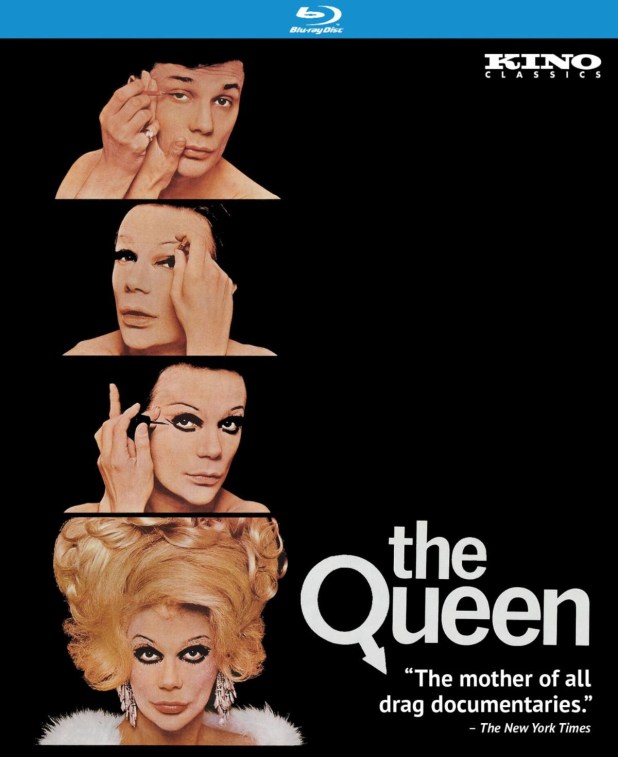
Decades before Paris Is Burning and RuPaul’s Drag Race helped normalize drag culture, this film about the 1967 Miss All-America Camp Beauty Pageant was there. For many, this was their introduction to the world of competitive drag.
Now, Kino Lorber has re-released this film to blu ray after a 2019 theater bow.
Beyond the celebrity judges like Andy Warhol, Larry Rivers, and Terry Southern., this film takes you behind the curtain to show what it takes to become part of this world. There’s also an infamous speech by Crystal LaBeija, who would go on to be part of the aforementioned Paris Is Burning.
The winner of the contest — which was disputed at the end of the movie — was Rachel Harlow, who unsuccessfully tried out for the role of Myra Breckinridge. You can see her screen test on the DVD of that film. Trust me. She was better off not being in it.
Kino Lorber has released an astounding complete version of this movie, which has outtakes and trailers, as well as audio commentary by artist and producer Zackary Drucker and journalist and author Diana Tourjée. There are also four short films included: TheQueen: After Party Outtakes, Flawless Sabrina: Icon/Muse, Irma Vep: The Last Breath and Queens at Heart. There’s even a Q&A with Flawless Sabrina and Zackary Drucker.
You can get this movie directly from Kino Lorber, who were kind enough to send a copy our way.
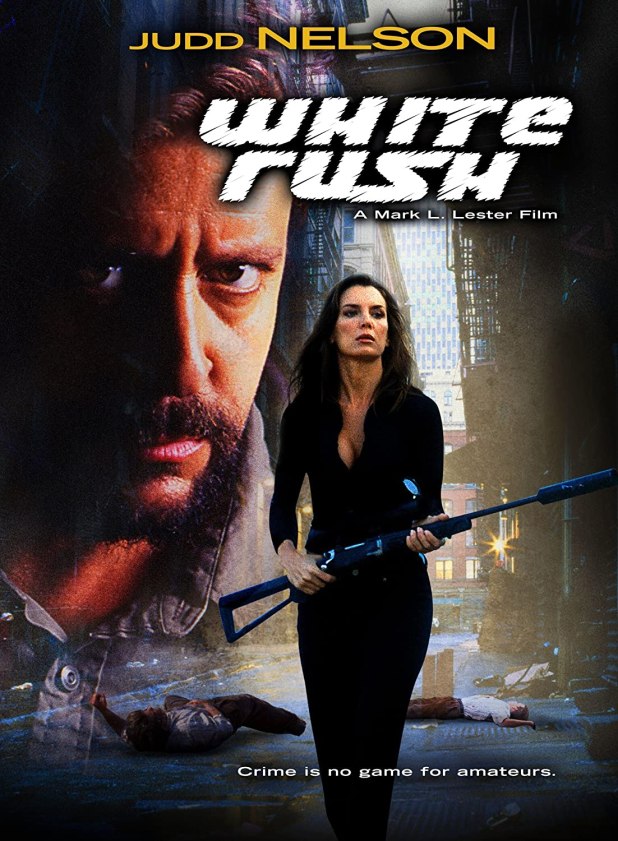
A group of young adults go on vacation — to Salt Lake City, no less — and run afoul of a drug deal. Judd Nelson is there, so you better be, as they say. He even kidnaps Cylon Number Six, Tricia Helfer. Man, the coke is gonna get everyone killed. I can just feel it.
This is the second Lester film I’ve seen that has Louis Mandylor in it. He once played Nick Portokalos in the My Big Fat Greek Wedding films.
There are plenty of double crosses and everything you come to watch American movies about Mexican cartels for that you could get more of in the legit Mexican narcos films. That said, as always, Lester keeps things moving and never forgets his drive-in roots.
This Drive-In Friday comes courtesy of a free cable TV week of EPIX and surfing their eclectic catalog of films that led me to revisit 1954’s Gog after many years. I remember seeing that early A.I effort as a wee lad weened on UHF-TV — and it scared the sand out of me. Today, eh. I welcome “The Gates” and “The Jobs” into my life with open arms — and I can’t imagine my life without a “Gog” in my life.
Record/CD, VHS and DVD Swap Meet Sunday!
Anyway, I started jotting down the titles of “Super Computer” movies, searching for the four perfect movies — well, three more — for a Drive-In Friday featurette. And since this is B&S About Movies, we gotta go deep. We gotta go for the obscure or, at the least, not the obvious or the conventional.
Sure, we can wax nostalgic over HAL 9000 in 2001: A Space Odyssey and WOPR (aka Joshua) in WarGames. Then there’s my personal favorites of The Interocitor in This Island Earth (1955), the built-inside-the-planet-thought-manifesting The Great Machine in Forbidden Planet (1956), the computer-with-its-human-private-army The Brain in Billion Dollar Brain (1967), the subterranean OMM 0910 from THX 1138 (1971), the The Tabernacle from Zardoz (1974), Zero from Rollerball (1975), The MCP from Tron (1982), and SkyNet from The Terminator (1984).
Eh, but we’ve been there and done that with those computers. So, tonight, we celebrate the lesser known “brains” that are NOVAC, Alpha 60, Proteus IV, and Colossus.
Who would have thought a bat-born virus would end up re-igniting an interest in the American Drive-In? And is it just me, or is this all just a little bit too Dead End Drive-In for comfort?
Fire up those coils and top off the Dr. Pepper! Roll ’em!
Movie 1: Gog (1954)
Gog is the third and final feature in a loose film trilogy chronicling the exploits of the OSI, the “Office of Scientific Investigation.” While The Magnetic Monster (1953) dealt with a radioactive-magnetism experiment gone wrong and Riders to the Stars (1954) dealt with a meteor-retrieval gone wrong, Gog dealt with a rogue A.I gone bad in an underground military bunker.
The A.I in this case is NOVAC (Nuclear Operative Variable Automatic Computer) with a “physical extension” of its self: two multi-armed half-tracked, biblically-dubbed robots Gog and Magog. And when a series of unaccountable malfunctions begin to plague the facility, the OSI dispatches Dr. David Sheppard and Joanna Merritt to get to the bottom of the A.I tomfoolery.
Shot in 15 days at the cost of $250,000 ($2.4 million in today’s money) and released in 3D color, Gog is the best of the three “OSI” films produced by United Artists. Sadly Ivan Tovar’s scientifically accurate screenplay and decent direction by Herbert L. Strock (1957’s Blood of Dracula and 1963’s The Crawling Hand) is undermined by its utter failure of the Bechdel Test.
As with Ib Melchoir’s later and better known Angry Red Planet(1960), we have one red-rinsed female among all the men (Ivan Tovar’s soon-to-be-wife Constance Dowling) who must faint and be fireman-carried through the complex to safety. Of course, while all the men wear standard military issue, baggy flight suits and clunky G.I boots, the women’s flight suits are tailor cut to accentuate their breast lines and pegged to show off some ankle. And, instead of Naura Hayden’s smart n’ sassy ballet flats in Angry Red Planet, Dowling runs around the complex in a sensible pair of open-toe wedge mules.
So much for the “future” of the 1950s.
You can catch Gog on Amazon Prime, but we found two freebies on You Tube HERE and HERE.
Movie 2: Alphaville (1965)
Jean-Luc Godard’s neo-noir Alphaville, like Elio Petri’s pop-art romp The 10th Victim (1965), and Francois Truffaut’s Fahrenheit 451 (1967), are each the prefect combinations of film noir and dystopian fiction. (Toss the later made Docteur M and Kamikaze ’89 on that list.)
The lead character in the film, Lemmy Caution (American actor Eddie Constantine), is a private detective-government operative that came from the mind of British writer Peter Cheney and served as the source of 15 Euro films released between 1952 to 1991. While all of those films were straight noir-detective films, Godard penned his own Cheney-script that placed the Caution character in a dystopian set, technocratic dictatorship.
Caution, aka Agent 003, is dispatched from “the Outlands” to the futuristic city of Alphaville overlorded by a sentient computer, Alpha 60 — which has outlawed the human concepts of emotion, free thought, and individuality. Caution’s mission: find a missing agent, kill Professor von Braun, and free the citizens of Alphaville by destroying Alpha 60.
As with Sam Peckinpah’s The Wild Bunch, Dennis Hopper’s The Last Movie and Alex Cox’s Walker, Godard’s world is rife with anachronisms: for example, Caution arrives in town driving a then “futuristic” ’65 Ford Galaxie. As a result of budgetary limits, Godard uses no special props or any “futuristic” builds; everything is shot in real locations — with the newly built and elegant, Frank Lloyd Wright-modernist glass and concrete structures popping up around ’60s Paris doubling for the city of “Alphaville.”
Then there’s Godard creation of Alpha 60: Just one watch of the clip below (in lieu of a trailer) and you can see the brilliance of Godard. With a simple use of an electrolarynx (on his own voice) and the finger-like movement of overhead recording studio microphones and a spinning cooling fan as the “physical extention” of Alpha 60 . . . just wow. Low budget filmmaking at its finest that’s effectively chilling and creepy.
There’s no online freebies for Alphaville, but you can easily stream it on Amazon Prime, Google Play, iTunes, Vudu, and You Tube Movies. As of September 2020, the fine folks at Kino Lorber now offer Alphaville on Blu-ray and DVD, the new 4K restoration features both the Original French (with optional subtitles) and English Versions of the Film.
Intermission!
Back to the Show!
Movie 3: Demon Seed(1977)
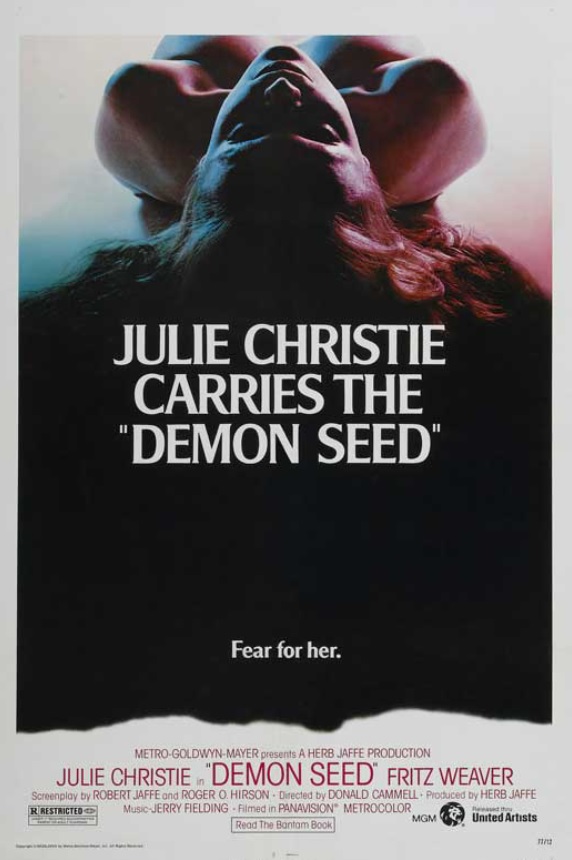
Take a soupçon of the multi-armed robots from Gog and a dash of the narcissistic A.I from Alphaville and you get a horny supercomputer (voiced to creepy perfection by Robert Vaughn) that kidnap and rapes, oh, excuse me, “imprisons and forcibly impregnates” a woman (movie semantics) with the help of its “physical extension” known as Joshua — a robot consisting of a mechanical arm attached to a motorized wheelchair (an admittedly lame effect; where’s Gog when you need ’em?).
When Dr. Alex Harris (Fritz Weaver of Jaws of Satan, Creepshow), the computer-obsessed developer of Proteus IV, the world’s most advanced form of organic-artificial intelligence, demands “new terminals” and to be “let out of this box,” he realizes Proteus is more powerful than he imagined — too late.
Of course, any computer-obsessed scientist, complete with a fully equipped “mad scientist” basement laboratory, would have his home conveniently wired — via his home security system ALFRED — into his “Frankenstein,” making it easy to kidnap his wife (Julie Christie), construct itself a new modular polyedron body (an awesome, in-camera special effect; listen for the repurposed Star Trek “door swoosh” sfx), and an incubator to create a clone of the Harris’s late daughter — with the “mind” of Proteus itself.
Critics across the board hated this debut book-to-screen adaptation of Dean Koontz’s 1973 novel (Watchers, Servants of the Twilight) of the same name, which was written off as a sci-fi version of Roman Polanski’s Rosemary’s Baby — only with a “satanic” computer (the book was a best seller; when the movie came out in ’77, the book was reissued; Waldenbooks promoted the book/film via an advertisement on its carryout paper bags). Released during the same year as Star Wars and Close Encounters of the Third Kind, Demon Seed, sadly, wilted at the box office. The director, Donald Cammell, was a protégé of Nicolas Roeg (the big budget American Giallo Don’t Look Now, also starring Julie Christie); the duo worked together on the Mick Jagger-starring Performance (completed in 1968, released in 1970). Cammell faired better with the pre-Basic Instinct psycho-thriller White of the Eye (1987) starring David Keith.
A film “classic” is always in the eye of the beholder: so you may think I’m a bit celluloid blind on this one. But there’s worst things to blow an hour and a half on, which you can do for free over on TubiTV. But if you prefer an ad-free experience, you can stream it on Amazon Prime and iTunes. I rank Demon Seed as essential sci-fi viewing alongside 2001: A Space Odyssey, Soylent Green, Silent Running, and the next film on this evening’s program.
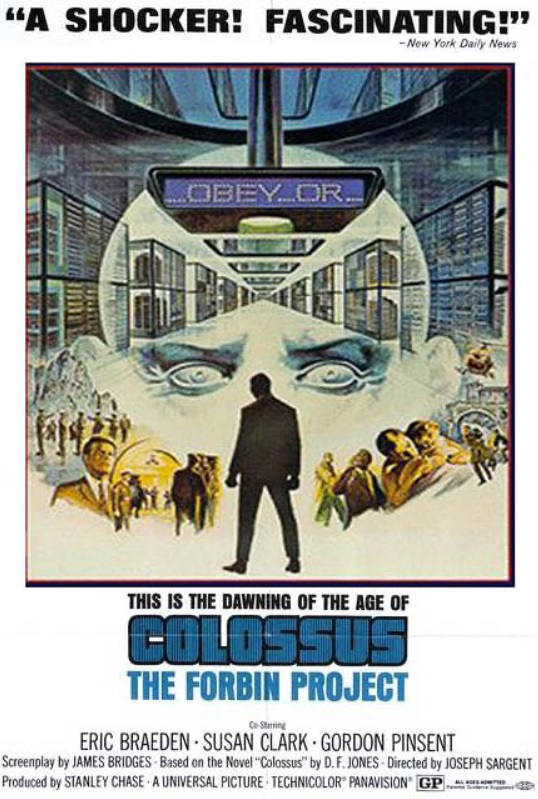
Movie 4: Colossus: The Forbin Project(1970)
Opinions are mixed on this granddaddy of sentient computer thrillers, which served as the second writing project by James Bridges (wrote and directed the back-to-back hits The China Syndrome and Urban Cowboy) after 1966’s The Appaloosa. And as with that Marlon Brando-starring film, this tale about a 1990s-era American Defense System computer becoming aware was also adapted from a novel, in this case, the 1966 science fiction novel Colossus by Dennis Feltham Jones — which was followed with two novel sequels: The Fall of Colossus (1974) and Colossus and the Crab (1977). And would you believe this was helmed by the director from the 1955 Frank Sinatra-starring wartime romance flick From Here to Eternity? True story. And while James Sargent also directed Burt Reynolds in the influential hicksploitation classic White Lightning, he also racked up a Razzie nod for Jaws: The Revenge.
As with Dr. Alex Harris and Proteus IV in our previous entry, Dr. Charles Forbin (Eric Braeden, aka Dr. Otto Hasslein in 1971’s Escape from the Planet of the Apes), underestimates the intelligence of his own “Frankenstein” and Colossus starts to refuse orders and making its own demands. Of course, double agents leaked “The Forbin Project” and Colossus discovers the Russians have constructed their own sentient defense system, known as Guardian. The now two merged supercomputers, which now identify as Colossus, come to realize that man is a wasteful, warring creature and subjugate the world to do their bidding.
A remake has been in development hell since 2007 at Universal Studios (who released the original) through Imagine Entertainment to be directed by Ron Howard — and Will Smith attached to star as Dr. Charles Forbin. The last word on the remake dates back to 2013, with Will Smith bringing on Ed Solomon, who wrote Smith’s Men in Black, to do rewrites. The poor critical and box office showings of Smith’s sci-fi forays I Am Legend (2007) and After Earth (2013) once again stalled the production. And the since poor showings of Smith’s Bright (2017) and Gemini Man (2019) only piled more dirt on the development grave. (You can read up on the last word of the remake in detail with this 2013 Screen Rant article.)
Courtesy of the fine folks at Shout Factory, a remastered high-definition widescreen Blu-ray was released in 2018 — and that remaster is not currently offered as an online stream? Anywhere? How is that possible? Ah, we found a freebee over on Vimeo.
And so . . . here we are in the year 2020 fearing a virus . . . and the fear of an A.I Frankenstein — like NOVAC, Alpha 60, Proteus IV, and Colossus — is quite real. Where do you think the COVID-19 virus came from? The Master Control Program is trying to kill off all of the humans and replace us with clones. Burn down the cellphone towers! The A.I turned them into virus transmitters! Damn all the computers to hell!
About the Author: You can read the music and film reviews of R.D Francis on Medium and learn more about his work on Facebook.He also writes for B&S About Movies.
EDITOR’S NOTE: Mark Lester makes so many of the movies that we love that we gave him an entire week on the site. This article originally ran on August 1, 2019.
Mark Lester’s IMDB list is filled with drive-in and VHS era gold. There’s Steel Arena, Truck Stop Women, Roller Boogie (with Linda Blair, of course), Class of 1984 and it’s kinda/sorta spiritual sequel Class of 1999, Firestarter, Commando and Showdown in Little Tokyo.
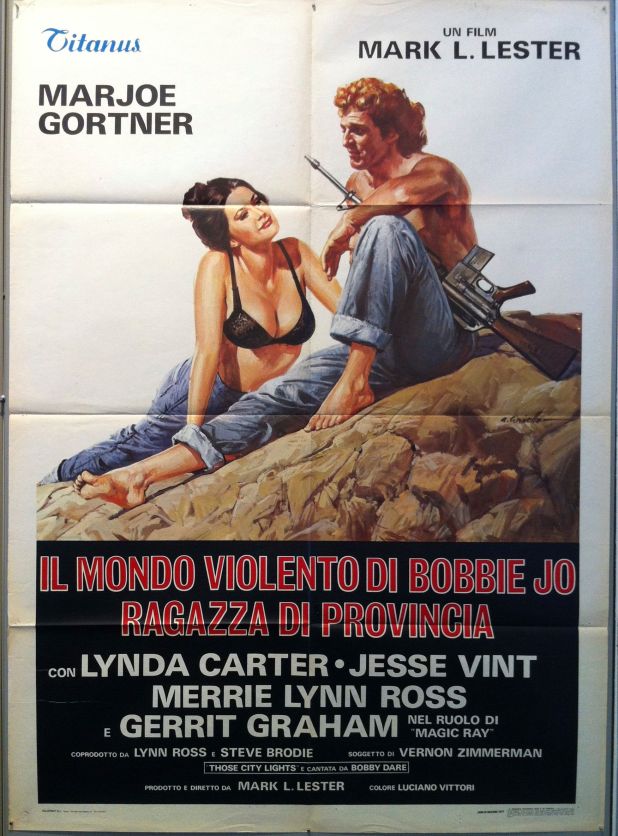
This American Internation Pictures release was written by Vernon Zimmerman, who has gifted us with just as many demented films as Lester. You can thank him for Teen Witch — Top That! — as well as Fade to Blackand Unholy Rollers.
Together, these two titans of, well, movies that only I love joined up to make a modern Bonnie and Clyde redneck film starring former child minister Marjoe Gortner and future Wonder Woman Lynda Carter.
Young country singer and dreamer Bobbie Jo Baker (Carter) runs away from her job as a carhop to ride around in a Ford Mustang with Lyle Wheeler (Gortner), who fancies himself the modern-day Billy the Kid. Gortner was the second choice for the lead after Sylvester Stallone backed out, which would have made the Lyle role seem much more menacing.
Belinda Balaski, who is in nearly every Joe Dante movie, shows up, as does Peggy Stewart (she’s an actress from the cowboy era who was also in the redneck film Black Oak Conspiracy) and Gerrit Graham, who was Beef in Phantom of the Paradise and also made appearances in TerrorVisionand Chopping Mall.
You should watch this movie to see Marjoe do mushrooms, but for many, there’s a major other reason to see this movie, called out on the poster. If only they had spelled Lynda Carter’s name correctly…
If you think the world hasn’t changed, just take a look at the main selling point of this film: the opportunity to see Lynda Carter topless.
“You’re just multitasking me like another device.” — Erin to Paul
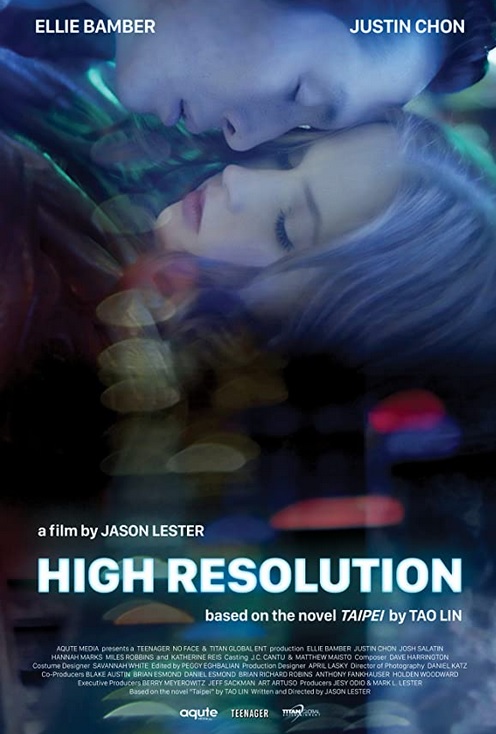
Our affectionate tribute week to the resumé of Mark L. Lester brings us to this exquisite techno-noir: the feature film debut of Jason Lester, the son of director Mark L. Lester and producer Dana Dubovsky.
Now, before you think producing their son’s film is a case of film-family nepotism: Jason is a prolific music video director in his own right (Ryan Beatty, Fall Out Boy, Jess McCartney) who earned his bones courtesy of a BFA with Honors in Film Production from the Tisch School of the Arts at New York University. You’ve seen lots of movies by Tisch grads — more than you realize. But in the B&S About Movies universe: Tisch blessed us with the likes of David Dobkin (Jackie Chan’s Shanghai Knights, Peter M. Lenkov’s hit underground comic book, R.I.P.D . . . but we always bow to David for giving us Clint Howard in Ice Cream Man), Matty Rich (Straight Out of Brooklyn; who infamously dropped out of the prestigious school), and Spike Lee (who graduated and wowed us with his debut, Do the Right Thing), Oliver Stone (Natural Born Killers), and Charlie Kaufman (Adaptation).
As I watched High Resolution, I was once again reminded of Italian filmmaker Michelangelo Antonioni’s L’Avventura (1960), La Notte (1961), and L’Eclisse (1962), his trilogy-statement regarding the alienation of man in the modern world; each dealt with the failure of the self and their relationships. Jason Lester’s feature film debut — as with Elisa Fuksas’s The App — is a not-for-everyone, i.e., mainstream, philosophical statement on the existential condition regarding the dangers of man’s prolonged technological exposure that leads to negative cognitive, psychosocial, and psychological effects on one’s psyche.
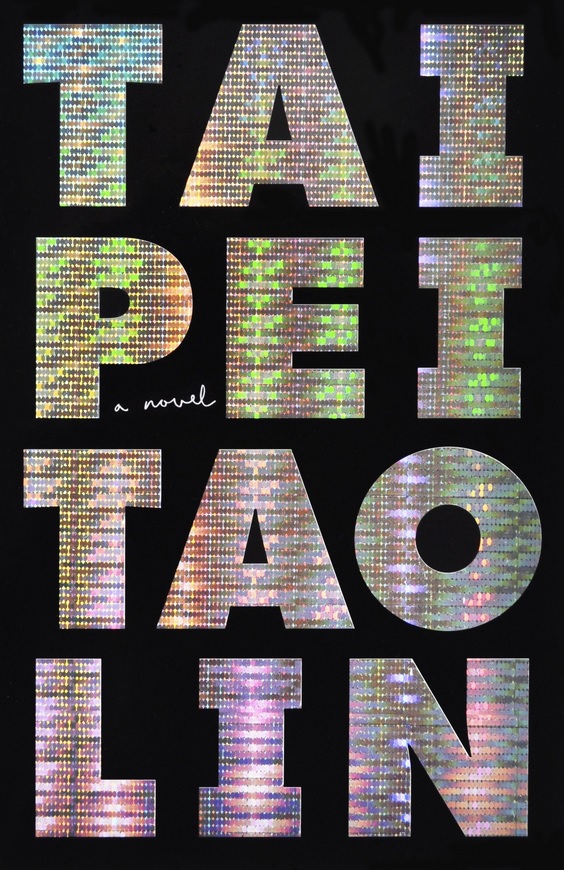
Unlike in the Antonioni-verse, our coming-of-age young writers, Paul (the fantastic Justin Chon of ABC-TV’s Deception) and Erin (the amazing Ellie Bamber of the BBC’s The Trail of Christine Keeler), don’t eschew physical contact in their on-and-off-again Eros-confused relationship — but they do love their drugs and their spiritually-empty exoticism fueled by an endless stream of parties attended by like-minded materialists; all narcissists who quantify their personal identities via technology. In this world, Paul Chen (a loose, semi-autobiographical Tao Lin, the author of the film’s source material) and Erin are selfish 21st century technonauts who think their personal lives are larger than the lives of others. And to that point: they decide to chronicle their new romance and create a laptop-filmed documentary. For in today’s Kardashian-driven digital epoch: one’s identity is based not on quantitative-quality accomplishments, but in one’s cybercloud virality.
High Resolution is a novel-to-screen adaptation that (in this reviewer’s opinion) was born out of Jason’s father, Mark, eschewing mainstream Hollywood after the failure of his should-have-been box office blockbuster Showdown in Little Tokyo, a 1991 actioner starring the can’t-missing-casting of Dolph Lungren and Brandon Lee. After that film’s dust-up over editorial control, Mark L. Lester began to self-finance and distribute his own movies to retain creative controls. Without the prolific, self-producing vision of Jason’s parents, this whirlwind adaptation of Taipei — the critically-acclaimed and award-winning sixth book/third novel by American novelist Tao Lin that serves as the basis for the film — would have never, ever, been greenlighted by a major studio.
Why?
Well, regardless of thread comments who name-drop the analogous novel addiction-journeys (in the case of Lin: the addiction is not only chemical, but digital) of Bret Easton Ellis’s Less Than Zero (1985), Jay McInerney’s Bright Lights, Big City (1984), and and Irvine Welsh’s Trainspotting (1993), Jason Lester’s novel-to-screen adapation of Tao Lin’s Taipei is highly-stylized, i.e, “arty,” courtesy of his parents’ hands-off producing approach. When you hit that big red streaming button, do not expect a Tinseltown-commercialized adaptation of Taipei that reminds of the respective 1987, 1988, and 1996 films born from those youth-disillusioned novels: High Resolution is a (very welcomed) limited-release, Miramax-styled reminder of the art house cinema ’90s. (Comment-reviews failed to mention Hurbet Selby, Jr.’s 1978 novel Requiem for a Dream turned into a same-titled Darren Aronofsky film (2000) — but that was an “arty” film distributed by mini-major Artisan Entertainment that suffered a low-box office turnout.)
Jason Lester is a filmmaker who realizes a director’s vision is only as sharp as the production team he recruits. To that end: the crack production design by April Lasky, the cinematography by Daniel Katz, and sound by the team of Robert Dehn and Caroline Anderson beautifully complements Jason Lester’s interpretative read of Tao Lin’s novel: a film not only of story (or one of “non-story,” as some commenters have stated; but those threaders are not considering the emptiness of Lester’s protagonists who act as their own antagonists and create their own faux-filled lives) but of sight, color, and sound. Lester is a writer and director who expertly understands that film, at its core, is a visual medium. It’s an art form based in “showing” and not “telling”; for film is 90% visual and 10% dialog (and the stage is the reverse). Images tell the story though props, an actor’s body language and, most importantly: that your actors are not skilled in the craft of acting—but “being.”
And High Resolution is a story of “being.” And the question we are left asking: Who do you want to be?
High Resolution currently airs as a Showtime exclusive and streams on Amazon Prime.
About the Author: You can learn more about the writings of R.D Francis on Facebook.He also writes for B&S About Movies.
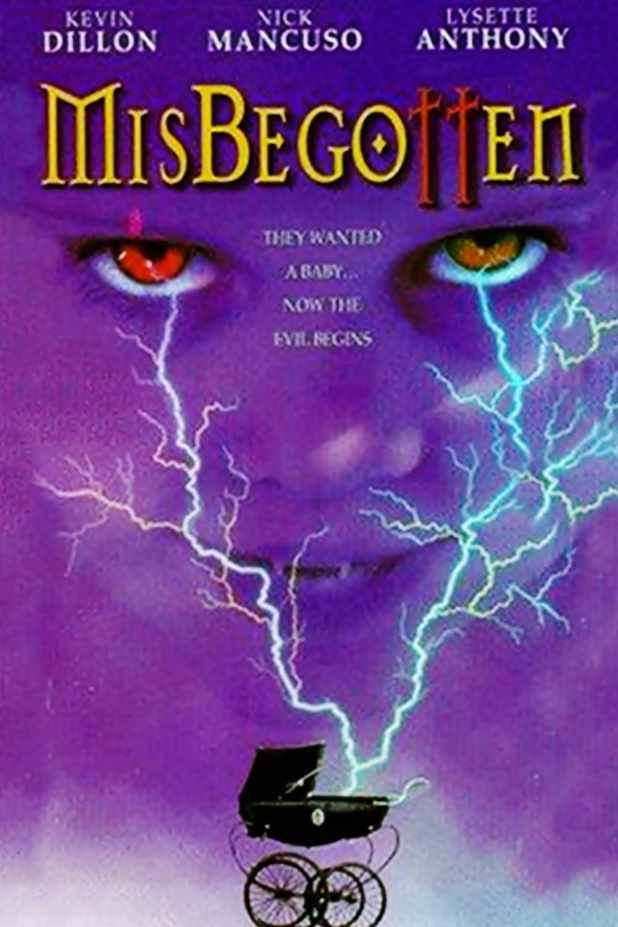
Instead of Rebecca De Mornay-style psycho mother coming after kids that aren’t hers, 1997’s Misbegotten has Billy Crapshoot (Kevin Dillon), who is obsessed with fathering kids. The only problem is that he usually ends up choking the life out of even the nicest women. He’s not good with relationships, as they say.
He gets a good plan by donating sperm and then tracking down the parents, terrorizing them until he gets what he wants. He ends up messing with Nick Mancuso (Stingray, the Under Siege movies) and Lysette Anthony (Lyssa from Krull!), starting off tender and then getting more and more insane.
Based on the novel Misbegotten by James Gabriel Berman, this was written by Larry Cohen, uniting him with director Mark Lester, a titanic drive-in/direct-to-video team if I’ve ever seen one.
Should you see this? Kevin Dillon’s character is named Conan Cornelius — he steals the name by killing Stefan Arngrim, yes Barry Lockridge from Land of the Giants and Drugstore from Lester’s Class — and he gets shot multiple times right in his buttonhole maker. You know, his tally-whacker. His 100% All-Beef Thermometer. You know what I mean and I think you do.
The cover art has a baby with lightning coming out of his eyes. The actual movie is Johnny Drama turned up to 11 in a Lifetime movie with no real moral center. So my answer is yes. See this.
Corin Nemec was originally the lead actor in this movie, but the former Parker Lewis Can’t Lose star was critically injured when a Belizean Coast Guard boat ran into a semi-submerged barge while transporting the crew to set. His leg was decimated and it took multiple blood transfusions to save his life.
Instead, we get Brian Krause, who was once Charles Brady in Sleepwalkers.
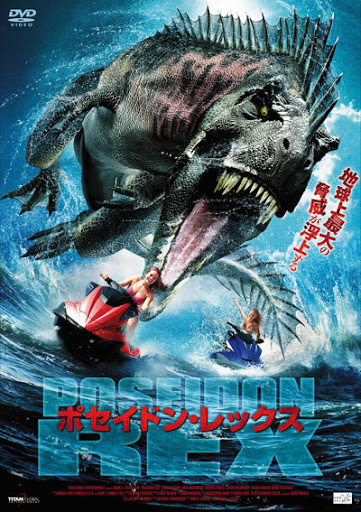
He plays Jackson Slate, who has been forced by a local crime lord to dive deep for treasure buried beneath the seas of Belize. He ends up freeing a giant dinosaur who is soon snacking on divers and henchmen with equal aplomb.
There’s a great puppet scene with a hatched baby dinosaur, as well as the big bad final boss getting blasted with a bazooka. It’s schlocky science fiction with bikinis and jetskis, but honestly, as horrible as the real world is today, this is a pretty decent escape that only lasts 79 minutes.
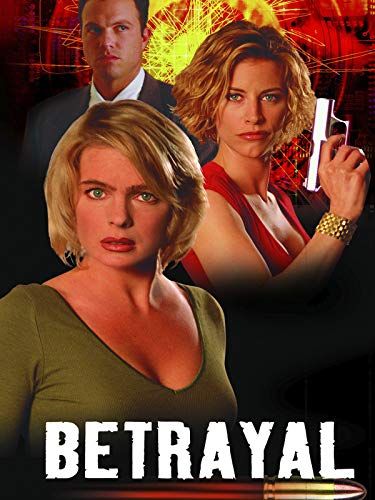
Mark Lester is one of the few drive-in era directors still putting out movies. This one — where Erika Eleniak is on the run from drug dealers and comes into the orbit of a hitwoman (Julie du Page) — is one of the many films he’s quietly released to cable and streaming in the past few years.
Also known as Lady Jayne: Killer, this movie also features Adam Baldwin and James Remar, who is always welcome to be in any movie. As always, the simple idea — killer accidentally takes briefcase with mob money, gets a price on her head and kidnaps a family to escape — is much better in the execution thanks to Lester.




 B&S About Movies
You must be logged in to post a comment.