Gamera Super Monster (1980)

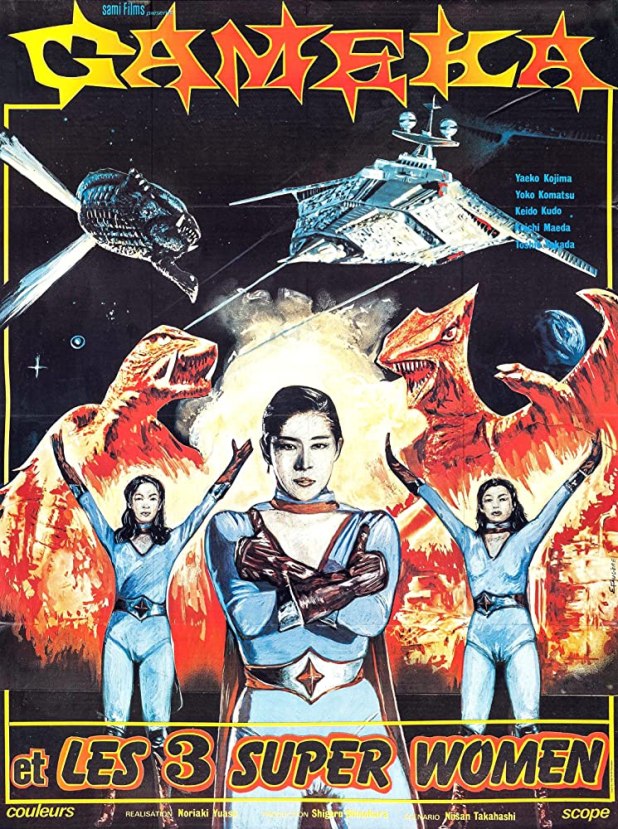
The first Gamera film in nine years — following Gamera vs. Zigra — this is somehow the strangest of all the movies. That’s an accomplishment.

This entire movie is made up of recycled footage from the entire Gamera film series, as well as Space Battleship Yamato and Galaxy Express 999. This was an attempt to help Daiei get out of financial trouble. Bad news: the film failed to succeed at the box office and Daiei still had to file for bankruptcy six months later.

So they did what the Japanese do best. They kill off Gamera at the end.

Yes, the alien Zanon has come to enslave Earth and even the three Spacewomen, Earth’s defenders, can’t stop him. You know who can? A little kid. As always.

By the way — Mach Fumiake, who portrays the Spacewoman Kilara, was a pro wrestler.

That kid has a connection to Gamera, so he takes us back in time through all the films, as Gamera battles Gyaos, Zigra, Viras, Jiger, Guiron and Barugon before sacrificing himself to save the Earth from Zanon.

Depressing? Yeah. I can’t tell you how many times I’ve watched a Japanese film that ends this way and I end up thinking about it for years.

There is a funny scene where Gamera smashes up a Godzilla billboard. But this is the end of the so-called Showa Gamera era and there would not be another film with the giant turtle for fourteen more years until Gamera: Guardian of the Universe was made.

It’s sad. There’s no Gamera theme song. Only two minutes of new Gamera footage. And yeah — Gamera dying. You don’t need to be depressed. But I still found the YouTube link for you.

Writers needed!

Are you socially isolated and have time on your hands?

Don’t be bored. Don’t stressed. Write for us.

We’re looking for writers for our site.

You can email us at bandsaboutmovies@gmail.com or reply to this post.

April is James Bond and spy month. Share your thoughts on any of these films!

May will have Police Academy (and ripoffs) week, movies with wrestlers, TV movies, giallo and docs and mondo.

If you don’t want to work in any of those weeks, you can always pick four movies and share a drive-in post with the world.

Here’s hoping we can help you pass the time!

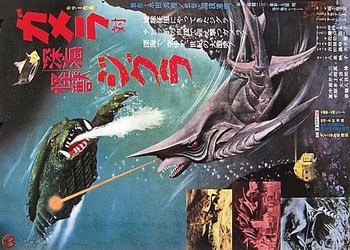
Gamera vs. Zigra (1971)

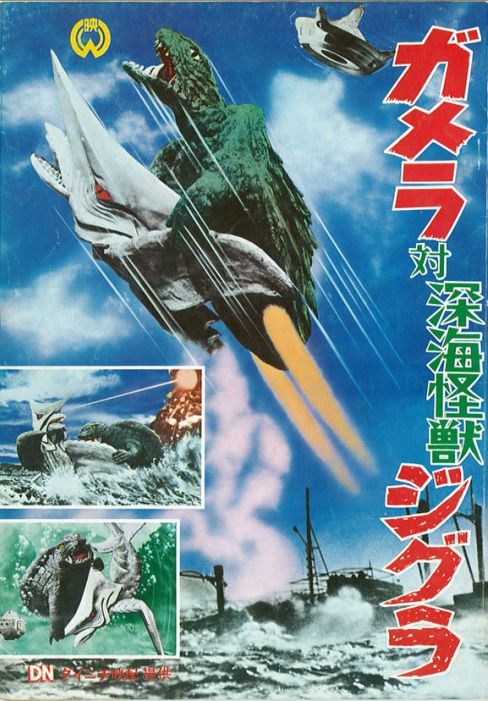
Shortly after Gamera vs. Zigra was completed, the film’s production studio, Daiei Film, went bankrupt. As a result, the film was distributed by another company called Dainichi Eihai. It only cost around $97,000, which is pretty amazing (Around $621,000 in today’s money).

This time, Earth is under attack by aliens. Well, we’re under attack by aliens again.

The Zigrans have enslaved a female astronaut to do their bidding and have a monster named Zigra which can stop the cellular activity of Gamera, who sinks to the bottom of the ocean. Luckily, the children, some dolphins and a bathysphere come to the rescue.

This movie has one of my all-time favorite Gamera moments, as the giant turtle uses a giant rock to play his theme song on the fins of Zigra before setting the beast on fire, because as we have all learned, Gamera does not play.

This would be the last Gamera movie for nine years, which is a shame. I knew none of  this as a child, as I began watching these movies probably in 1977 and had no idea of their history. I wouldn’t have seen this one anyway, as it’s the only original Gamera film to not be released in the U.S. It wouldn’t come over here until the VHS era.

Gamera vs. Jiger (1970)

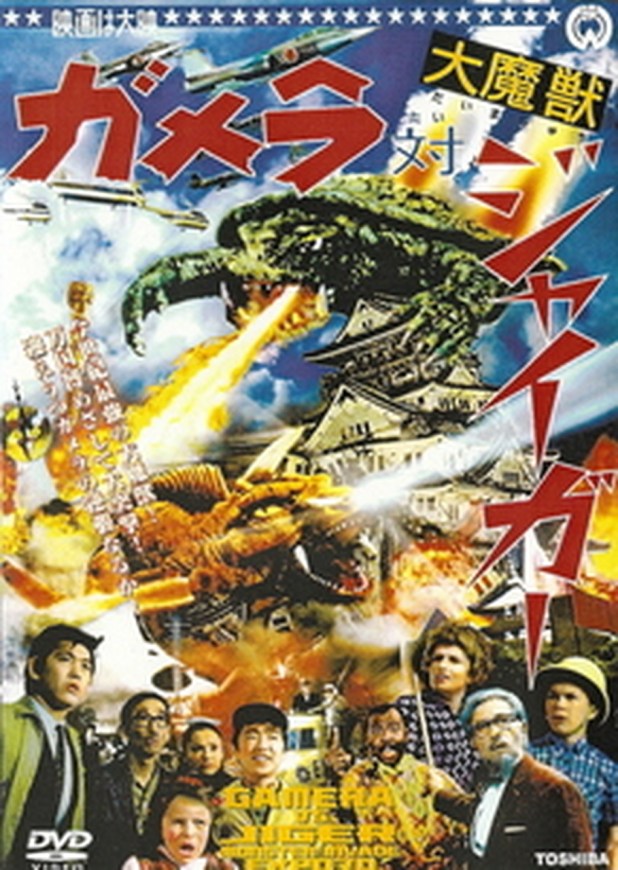
Known as Gamera tai Daimajū Jaigā in Japan, or Gamera vs. Giant Devil Beast Jiger, this is the sixth Gamera film. In the U.S., it was released straight to television under the name Gamera vs. Monster X.

The American version contains stock footage from Gamera vs. Guiron and Gamera vs. Barugon to extend the movie’s release time.

As Japan gets ready for Expo ’70 in Osaka, they decide to take a mysterious status called the Devil’s Whistle off an island. Gamera tries to stop them, but they take it anyway. It makes everyone sick and insane that goes near it.

The sound that the Devil’s Whistle makes Jiger go crazy too, so the beast comes down and starts taking out everyone in its way, as well as using its spiked tail to mess up Gamera. It also has a spiky bulbed tail that lays an egg — and eventually a baby Jiger — inside Gamera’s lungs.

That baby looks like a cute version of Jiger, but damn if those little Japanese kids don’t go inside Gamera and kill that infant with static from their walkie-talkies. The scientists then use big speakers to keep Jiger busy while the kids go back inside the giant turtle and jump-start his heart.

In their final battle, Gamera uses telephone poles like earplugs — man, these movies are inventive — and he smashes Juger’s tail, finally making her weak enough to destroy.

Despite the increasingly low budgets and bad effects, Gamera movies remain willing to embrace pure insanity. Isn’t that what we’re all looking for anyway?

Gamera vs. Guiron (1969)

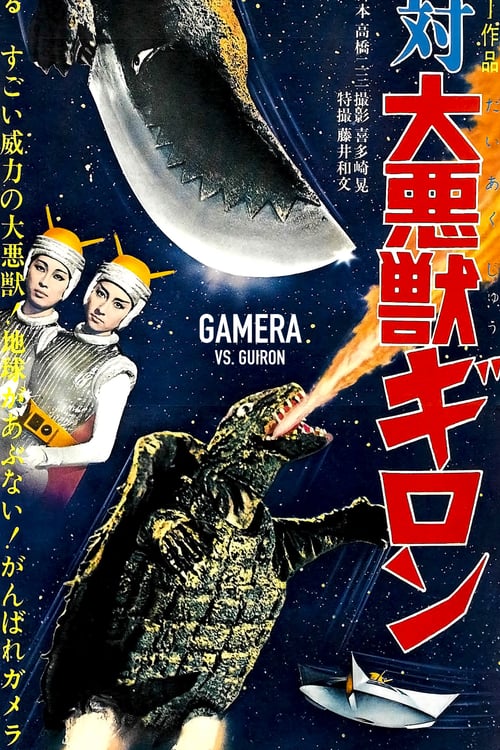
Gamera tai Daiakujū Giron was released in the U.S. — on TV only — as Attack of the Monsters. At this stage in the Gamera series, the special effects are starting to not feel so special and there’s even more padding than in past films. But you know, Guiron looks so awesome — he has a giant sword nose and throws shuriken from around his eyes — that I can’t help but love this movie.

Two boys find a flying saucer and are taken on an adventure into space, where Gamera magically appears and rescues them from an asteroid field. But then, they go into hyperspace and a new Gyaos appears to attack their ship. That’s when Guiron shows up and slices that beast — which just gave Gamera so much grief — into small little bits, even beheading it, which seems way too far for what is supposed to be a kiddie film.

It turns out that the Space Gyaos are all over this planet called Terra, which is on the other side of the sun. Somehow, those scientists — some of the dumbest smart people in the world are in the Gamera movies — have never found their planet.

There are also twin alien women named Barbella and Florbella who control Guiron, who eventually gets out of control and cuts their spaceship in half. Florbella then kills the injured Barbella, explaining that useless members of their society are euthanized. What is she, in charge of the stock market?

Finally, Gamera does what you’ve wanted him to do all along: he slices that monster in half. Yes, unlike Godzilla, Gamera straight up eviscerates and annihilates his foes. Gamera would just heat blast them. Nope. Gamera is like, “You’re not getting up from this one.”

You can watch this on Vudu and Amazon Prime.

Gamera vs. Viras (1968)

This film was released in the U.S. as Destroy All Planets, which may have been a ploy to make people think it was Destroy All Monsters, perhaps the greatest of all Toho monster battles.

This time, Gamera is defending our planet from aliens. He starts off by destroying one of their ships, but not before an entire planet declares that he is their enemy.

The aliens come back to Earth and learn Gamera’s one weakness: he loves children. They kidnap some kids and force him to do their bidding, but before long, he’s broken loose and is battling all of the aliens at once, who have combined their form into the menace known as Viras.

Daiei was in financial trouble, so this movie suffers from a smaller budget than previous films. But this is where the idea of Gamera protecting kids from aliens and monsters began. Yet it’s also the first of the series to use flashbacks from past films to pad the running time. This will get much, much worse as Gamera would battle on.

There was also an agreement with AIP that an American kid had to be in the movie. They couldn’t find any kids that could speak Japanese, so the studio cast Carl Craig, whose father was an army soldier stationed in Japan, despite Carl having no acting experience.

You can watch this on Tubi and Vudu. You can also download it on the Internet Archive.

Gamera vs. Gyaos (1967)

This movie was released in the U.S. by American International Television, who renamed it Return of the Giant Monsters.

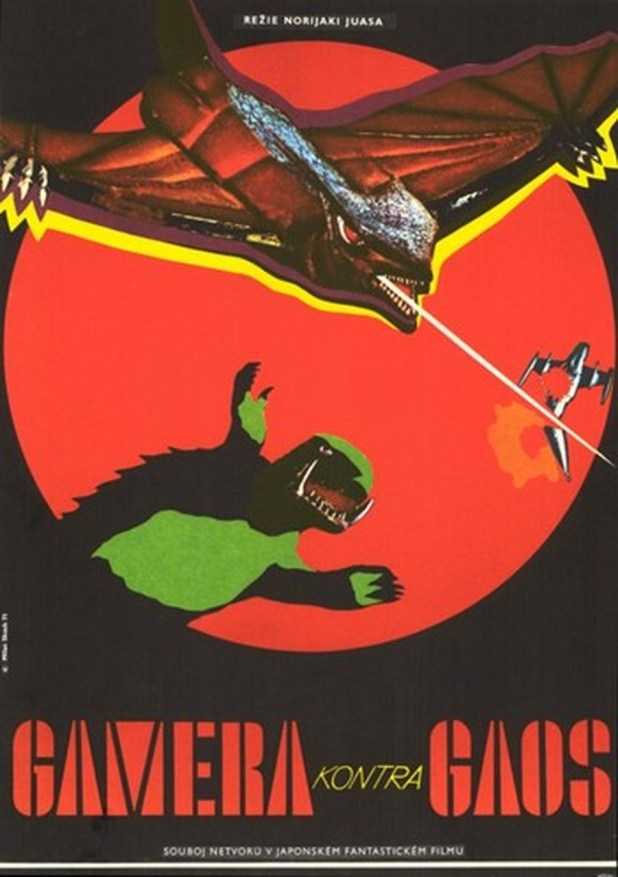
It all starts when a series of volcanos go off, attracting Gamera, who enters one of them. This reveals a new monster, Gyaos, named for the sounds he makes. It looks like a giant bat and has wind powers, which he uses to decimate the Japanese Self-Defense Force.

Gyaos is a formidable opponent, as he has beams that cancel out Gamera’s fire breath. He’s also willing to bite off his own toes to save himself from Gamera’s fierce fangs. It takes Gamera dragging Gyaos into one of those volcanos to kill him.

This film presents a world where money is more important than the lives and needs of the poor, even in the face of a monster ready to kill all of them with no prejudice. Yes, Gamera vs. Gyaos remains a lesson for our time, even as it features men in rubber suits beating each other up.

You can watch this for free on Tubi and Vudu, or on YouTube below:

Gamera vs. Barugon (1966)

Known as War of the Monsters in the U.S. thanks to its English-language dubbing by American International Television, the second Gamera film has twice the budget of the first and realizes what they should have known all along: Gamera isn’t the villain. He’s the good guy and ready to defend children against more dangerous kaiju.

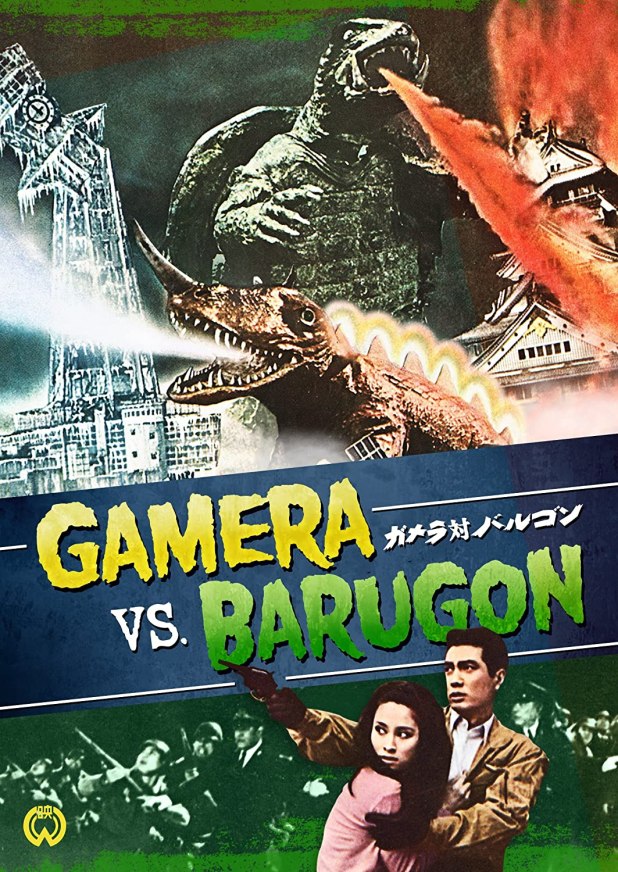
Those dumb scientists and their Z Plan rocket didn’t count on a meteorite letting Gamera escape and come back to Earth. Meanwhile, three ex-soldiers invade a cave — a scorpion kills one and treachery another — before bringing an opal to the surface. And that jewel? It’s an egg. And it’s hatching.

It becomes a lizard called Barugon, who can breathe freezing gas and launch rainbow rays from the seven spines on its back. These are all weapons that can do great damage to our turtle protector.

How do you defeat an undefeatable monster who freezes our hero again? Mirrors and drowning. Yes, Gamera straight up holds Barugon’s head under the waters of Lake Biwa.

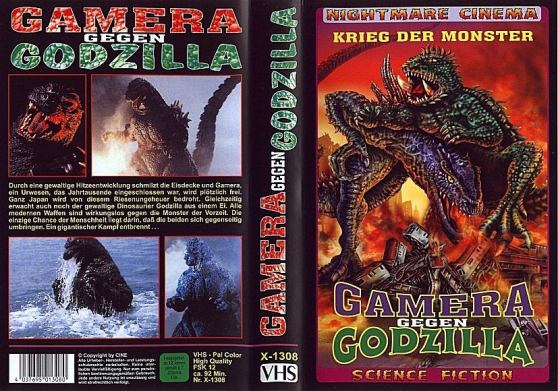
In Germany, they screwed up the translation and call Gamera Barugon and Barugon Godzilla. Those versions are titled Godzilla, der Drache aus dem Dschungel (Godzilla, the Dragon from the Jungle), Godzilla, Monster des Grauens (Godzilla, the Monster of Horror) and Gamera vs. Godzilla.

You can watch this on Tubi and Vudu. You can also download it from the Internet Archive.

Gamera (1965)

I’ll come clean. As a kid, I liked Gamera more than Godzilla. Sure, Daiei Film Studios was just following the success of Toho’s kaiju superstar, but I always felt a kinship to a monster who could just withdraw into his shell. Gamera was, after all, a friend to all children. And man, I wanted to be his best pal.

Originally released on November 27, 1965 in Japan, a re-edited version with new footage was released the following year in the U.S. as Gammera the Invincible. It was the only movie in the series to get a theatrical release in this country.

Over the Arctic, a nuke blows up and awakens a prehistoric giant turtle that just so happens to have big tusks. That’s Gamera, but he’s no friend to anyone at this point.  He can also breathe fire, which he does to blow up an American jet real good.

These scientists that he battles are pretty much morons. They’re smart enough to come up with freeze bombs, but they think that if they get him on his back, he’ll die of starvation. So Gamera just pulls all his arms and legs inside his shell and starts spinning around like a UFO.

This movie will also teach you that turtles are not even. They’re just turtles.

Back to those scientists. A whole bunch of Russian, Japanese and American ones invent this thing called Z Plan. You know what it is? They put Gamera in the nose cone of a missile and send him to Mars, all excited about how their scientific ways have triumphed over idealogy.

It’s a crock of turtle shit.

You know what’s really awesome? This movie was originally going to be called Dai Gunju Nezura (The Great Rat Swarm), but all of the real rats that were going to run over the miniature city got fleas.

This is the only Gamera movie where he doesn’t fight another monster and also the singular black and white film in the series. He’s also a good guy in every movie after this.

You can watch this at the Internet Archive and imagine a young Sam losing his mind screaming, jumping all over the TV room, so happy to see a turtle fly.

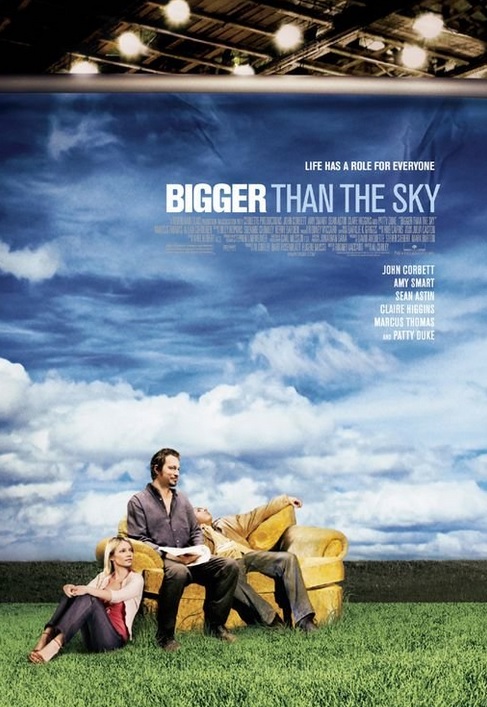
Bigger Than the Sky (2005)

No way are you going to click on this review. No way. So I’ll have to force your hand: this movie is connected to Rick Van Ryan, the acidic metalhead from the ’80s rock flick favorite Incident at Channel Q. Now if that doesn’t make you want to read this film review . . . well, I’ll just have to hang up my laptop, take an online preacher course and, with laser-printed certificate in hand, open a 501(c)(3) “church” and save the world: for I have failed as a writer. Hey, as Richard Pryor’s Daddy Rich says, “There’s a good place in this world for money: it’s right here in my pocket.”

Watch the trailer.

Peter Rooker (Belgium actor Marcus Thomas of the John Travolta bomb The Forger; the better Kill the Irishman with Val Kilmer and Christopher Walken) is a man with zero confidence, stumbling through life in Portland, Oregon. He perpetually laments to his closest confidant, his sister, about his “boring personality, job, and life.” And he can’t understand why his girlfriend dumped him?

Pining for a “sense of belonging,” Peter spots a posting for open auditions at the Portland Community Theater for their production of Edmond Rostand’s neo-romantic play Cyrano de Bergerac: if he can only get a part, albeit a small one, it would fill the emptiness. So, with zero acting experience, not only does Peter land a part—he’s cast as Cyrano. Now, if you know your Cyrano, you know it’s a story of a life rife with myth and invention and, with the cast in dual roles, life begins to imitate art. Eventually, Peter learns not to believe in the green and materialism, but to believe in himself and accept the kindness of others, in this case, his theatre mates, who show him the art of living is in the giving, not the wanting.

To quote a line from Cyrano: “You’re a genuinely good man, Peter. There aren’t many of you left.”

If you’ve a person who loves the performing arts, worked in community theatre or donated your skills to a local film school (or a non-com radio station) this charming film—with its spot on characterization of actors who do it for the love of the craft and not for fame and fortune, will resonate. If you’re not familiar with that world and you’re anti rom-com, you’ll most likely slag all of the various film disciplines.

Bottom line: Al Corley shines as a director and works his way around a $750,000 budget with aplomb; it sadden me that this was Corley’s only fictional feature film. He did, however, make his directing debut with Last Dance (yes, after the Donna Summer smash disco song; aka “Letzter Tanz,” aka “Nackte Tanzlust” in its homeland), a 1994 feature-length, German-produced television docudrama combining interviews, actor re-creations and stock footage to examine the lives of the nighttime denizens who haunted Manhattan’s famed disco Studio 54. And Corley was the right man for the job: he worked as a doorman and concierge at the club.

Rounding out Corley’s affable and reliable cast are John Corbett (you know who he is: Aidan Shaw from Sex and the City; because your girlfriend made you watch) and the always likeable you-want-to-kiss her “love interest” Amy Smart (of the new cable TV recycling favorite Just Friends starring a fat n’ geeky Deadpool), along with Sean Astin (Lord of the Rings franchise), Claire Higgins (the Hellraiser franchise), and the always divine Ms. Patty Duke (The Amityville Horror franchise; we explored it in full, here).

Screenwriter Rodney Patrick Vaccaro’s big screen debut was the romantic comedy Three to Tango (1999) starring then “hot” TV’s Friends Matthew Perry and the he-can-do-anything-and-is-great-in-everything-and-elevates-it-to-the-next-level Dylan McDermott (awesome in Hardware and awesomer in The Clovehitch Killer).

And did you know that Vincent Spano (another “Dylan McDermott”)—yes, Mark, the BB gun shootin’, dirt bikin’ badass from the 1979 juvenile deliquent classic Over the Edge—starred in a romantic comedy with Patricia Heaton of TV’s Everybody Loves Raymond? He did. And Vaccaro wrote it: The Engagement Ring (2005).

Vaccaro’s recently teamed with director Dustin Nguyen (Harry Truman Ioki from Johnny Depp’s 21 Jump Street, TV’s Seaquest DSV and the Pam Anderson syndicated series V.I.P; he’s since directed several Vietnamese-language films) and screenwriter Richard Wenk (Bruce Willis’s 16 Blocks, the Jason Statham remake of The Mechanic, Jack Reacher: Never Go Back, The Equalizer film franchise) on the now-in-production, English-language action flick, The Last Mission (as of November 2021, that project is still in its pre-production stages).

Bigger Than the Sky recently made its free 2020 streaming debut—with limited commercials—courtesy of Vudu. As of 2021, it’s now available as a free-with-ads stream on Tubi. However, if you prefer an ad-free experience, it is still available — and well-reviewed with four and a half user-stars — on Amazon.

About the Author: You can read the music and film reviews of R.D Francis on Medium and learn more about his work on Facebook. He also writes for B&S About Movies.