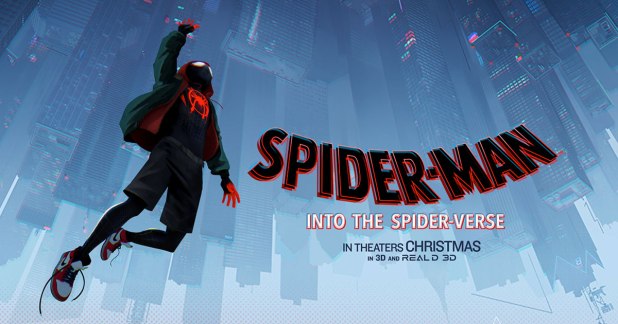
The thing I hate about superhero movies is the origin story. After a multitude of Spider-Man stories, do we really need another retelling of his origin? That’s the first — of many — things that Spider-Man: Into the Spider-Verse does right. Much like how Grant Morrison retold Superman’s beginnings in one page in All-Star Superman, this movie tells you everything you need to know within one minute and goes right into the action. It expects you to know the expected, but then once it makes you feel comfortable, it tears the rug out from under you.
Here’s the low down for those of you that don’t read comics: there’s more than one reality and more than one version of Spider-Man, who may not always be a man. Written by Phil Lord and Christopher Miller, who left Solo due to creative differences, this movie is pure joy from start to finish. If you know and love the characters, it’s so amazing to see them treated properly on the big screen. And if you don’t, it’s so much fun to meet all new versions of a character you already love.
Beyond the Spidey you know and love, there’s Miles Morales, a gifted teen who struggles to fit into a new school. He loves Spider-Man, is often at odds with his parents and looks up to his uncle Aaron. While working on graffiti, he’s bit by a radioactive spider and suddenly has the same abilities as his hero.
After a tragic incident when the real Spidey battles the Kingpin as that baddy tries to uses a particle accelerator to bring back his lost wife and son, Miles must take on the mantle of a hero while working alongside the Spiders of other dimensions: Spider-Gwen, Spider-Man Noir, Peter Porker the Spectacular Spider-Ham, and Peni Parker and SP//dr.
The voice talent in this movie is absolutely amazing: Lily Tomlin is the best Aunt May ever, Nicholas Cage steals the show as Spider-Man Noir, who is from a world where it’s always black and white and smells like rain and it was great to hear comedian John Mulaney as Spider-Ham.
There’s so much of this movie that perfectly translates the language of comics in a way that few films have succeeded in accomplishing. Ang Lee’s The Hulk came close, but the animated styles of this film are constantly moving and even more alive than real action.
It’s also the first time I’ve seen a teenage world in a superhero movie that feels vibrant and now. Nothing feels fake, phony or forced about the school scenes. And the music is just as powerful as the film.
Of all the Stan Lee cameos in the Marvel films, the one here feels the most organic and perfect. It brought a tear to my eye when he sold Miles the costume and told him that all the costumes eventually fit. Kudos to the producers for remembering both Lee and Steve Ditko at the film’s end.
In case you didn’t pick it up, I give this movie my highest recommendation. While Infinity War may be the best Marvel movie ever, you need to have seen every single Marvel movie ever to get that. This is the kind of film that Becca could watch and enjoy without needing to open a single comic, which is just how she likes it. It’s not only the best animated movie I’ve seen this year, it may be the best movie overall.
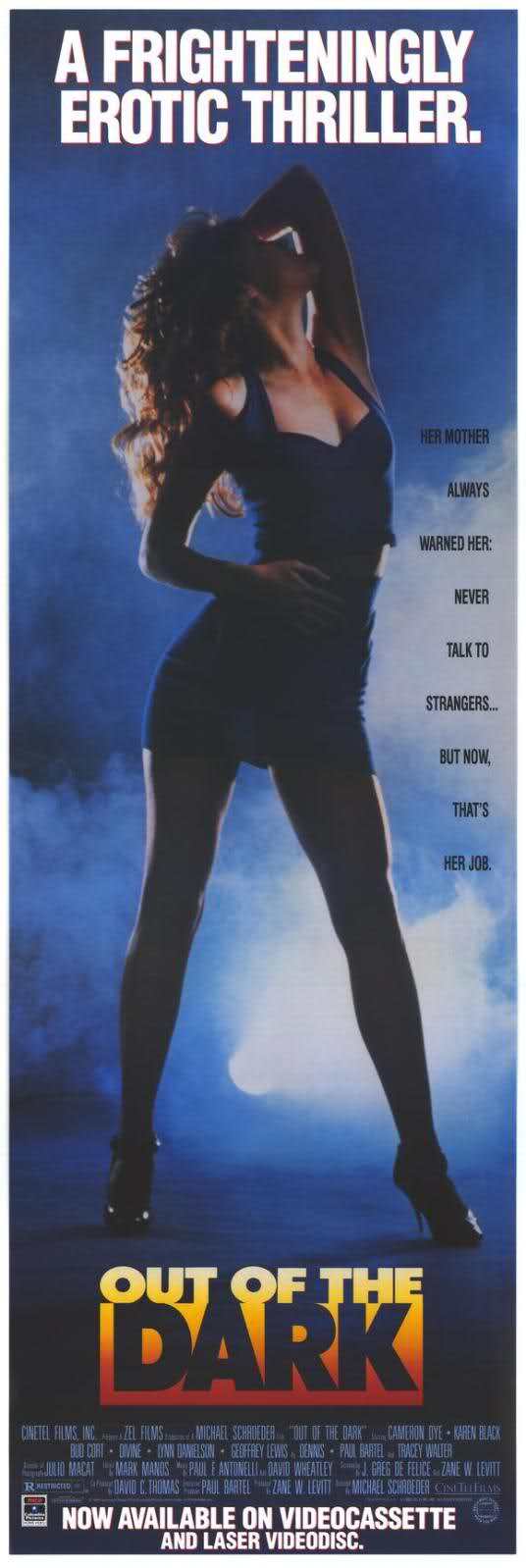
You have no idea how excited I was when this Americanized giallo showed up on Amazon Prime. It’s short on directorial finesse, but it’s packed with talent and weirdness. I also think I may have spent two or three hours in the Hollywood no-tell motel that shows up an hour into this one (my early 20’s were a little crazy, to be honest).
Karen Witter (Playboy Playmate of the Month in March 1982 and ex-wife of Two and a Half Men creator Peter Lorre) is Jo Anne, one of the ladies of Suite Nothings, a phone sex line. Yes, these things once existed in the 1980’s, a decade where a movie could be called 976-Evil and everyone knew what the storyline conceit was.
Ruth (Karen Black!) is in charge of them all, but when they start dying off one by one, the police have to get involved. Lt. Meyers (Tracey Walter, BOB THE FUCKING GOON from Batman) and McDonald (Silvana Gallardo, Rosasio the maid from Death Wish 2) start looking for the killer, who everything thinks is Bobo, a regular caller who finishes quickly and states that “no one can handle nipples better than Bobo.” One wonders if he is the notorious Howard Stern regular!
All manner of celebrities — well, to movie weirdos like me — show up: Divine out of drag as a detective, Tab Hunter, Geoffrey Lewis (Juliette’s dad!), Bud Cort and Paul Bartel (who was an executive producer, too)!
Here’s a weird bit of synchronicity: Karen Mayo-Chandler, who plays one of the telephone girls in this one, also appeared in the phone related horror films Party Line and 976-EVIL 2: The Astral Factor. She was also the girlfriend of Jack Nicholson (and Tracey Walter was in nine movies with his buddy Jack, so one assumes that these things are all related).
Trust me — this isn’t a great or even good movie. But I was entertained. Then again, at 4 AM on a Saturday night, my standards are even lower than usual. But hey — you can watch this on Amazon Prime.
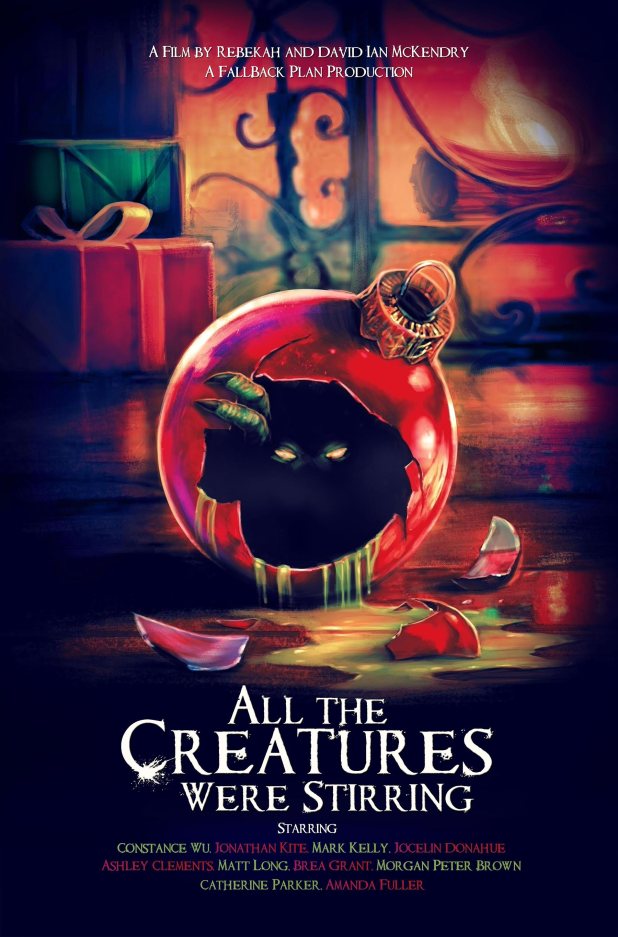
An awkward Christmas Eve date leads a non-dating couple into a strange theater where they’re forced to confront an assemblage of odd and scary Christmas tales — from a boring office party livened up by murder to stalkers, demons, aliens and more. All the Creatures Were Stirring offers a portmanteau take on holiday horror.
The first full-length film written and directed by David Ian and Rebekah McKendry, this tale starts in the theater, where Max and Jenna go on their first date, a production of a play with the same name as this movie. Each of the tales takes on a common theme — an office party, last minute shopping, hating the holidays — and spin them into a darker theme. Here are the stories:
The Stockings Were Hung: An office Secret Santa (shot in the warehouse of Blumhouse) turns into a game of death.
Dash Away All: A man is locked out of his car on Christmas Eve and is trying not to give his wife any ammunition to say he’s ruining Christmas. However, when he meets a van full of two girls and an ancient evil, he’ll wish that he’d stayed in the store.
All through the House: A neighbor that hates Christmas continually sees how he’s going to die by the end of the night.
Arose Such a Clatter: A reindeer gets his revenge.
In a Twinkling: Constance Wu (Crazy Rich Asians) shows up in this tale of aliens trying to understand the holidays.
The stories — other than The Stockings Were Hung and Dash Away — never really seem to go anywhere once their premise is set up. Even the wraparound gives no real resolution. There’s the setup and the sort of ending, but like so many of the modern crop of anthology films, the whole is nowhere near the sum of its parts. Filmmakers should look back to Amicus Productions, where each story often felt strong enough to be its own film.
This was a fine bit of background music while I was finishing holiday preparations, but in no way was satisfying. Consider it the appetizer before you watch a much better holiday horror film.
Simon isn’t going to have a good Christmas. He’s bullied by his fellow classmates and the janitor, who throws spackle at his face. Oh yeah — his parents have also been kidnapped in Africa and the French government isn’t going to negotiate with the people who did the deed. Yep, it’s enough to make you take your friend Élodie and sneak onto a flight to Rovaniemi, where of course Santa Claus lives in Lapland. If you’re ready to drink in all that you’ve read above, you are ready for the kind of Christmas film that caused my wife to say, “Well, it looks like you’ve finally found your movie to post on Christmas day.”
The kids find Santa the only way they know how: deliriously wandering through the snow until they pass out. Then, they meet the fairy that works with Santa, who looks a lot like the teacher who forgot them at the airport and never acknowledged that they were missing. Basically, as soon as they are safe, Élodie takes Santa’s puppy and goes to see a child eating ogre. It’s kind of like Adam and Eve by way of Adam and Eve vs. the Cannibals.
When the kids finally escape thanks to Santa and go to Christmas Mass, no one even realizes they were missing. Oh yeah — Santa was also in Africa trying to free Simon’s parents. Seriously. Also, this might be a French movie, but everything is shot with English words in the classrooms and in the songs.
This whole movie feels like a vehicle for Karen Cheryl, who plays both the schoolteacher and fairy. Her songs sound like a maniacal melange of 1980’s pop, kind of like “99 Luftballoons” played at Chipmunk speed. Ironically, the first edition of this film’s soundtrack was quickly taken out of stores because Cheryl didn’t ask for permission from her producer if she could appear in the film or sing on the soundtrack. Soon, the album was re-recorded with singer Tilda Rejwan.
This is probably the only Santa Claus movie I’ve ever seen where he’s almost eaten by an alligator. So I guess it has that going for it. It’s also the kind of mind-altering movie that people say, “I was watching this movie that I couldn’t deal with and didn’t finish, but it felt like the kind of thing you’d put on and make me watch.”
Christmas is nearly here. It’s the most wonderful time of the year — unless you accidentally play one of these movies at your holiday gathering. Don’t say we didn’t warn you — these are guaranteed bah humbug films.
1. Santa Claus vs. The Martians: There has never been a Christmas movie so insidious, nor a holiday ditty so devoted to making you want to murder yourself (although “Wonderful Christmastime” by Paul McCartney comes close). And because I love Christmas so much, I shared that song above. Watch for a young Pia Zadora!
2. Silent Night, Deadly Night: Does your season need a little bit of Santa Claus killing nuns in it? Good news, chum. We’ve heard your wish and have delivered it. Go for the sequel too and Shout! Factory will throw in a doll of the killer Santa!
3. Santa and the Ice Cream Bunny: A lot of parents wonder how old their children should be before they tell them the truth about Santa. Here’s an easier way to do it: make them watch this movie. They won’t ever talk about Kris Kringle ever again.
4. Gremlins: In 1984, parents took their kids to see the adorable Gizmo and then learned that they’d have to explain that daddy wasn’t going to die at Christmas. Blame Joe Dante.
5. Christmas Evil: John Waters said this about this movie: “I wish I had kids. I’d make them watch it every year and if they didn’t like it, they’d be punished.”
6. Elves: Dan Haggerty plays an alcoholic homeless ex-cop Santa who battles elves and incestual Nazis. Have yourself a merry little Christmas!
7. Black Christmas: Somehow, the same director who made a movie that has become a Christmas tradition in many homes also made this one, a movie that has become a holiday tradition in the homes of absolute maniacs. This is as dark as the season gets. The remake isn’t as good, but it does have a mother making love to her son who is yellow because of a liver condition, so there’s that.
8. Santa Claus vs. The Devil: Forget everything you ever knew about Santa. This movie is about to destroy everything you ever believed or held dear, with evil children and demons out to ruin the holiday and Merlin coming to the aid of St. Nick. There is absolutely no way that I can prepare you for this movie. You know when someone has a traumatic life event and people act like they understand but they don’t and everything said is just empty, awkward and poorly chosen words? That’s anyone talking to me who hasn’t endured this film.
9. Kirk Cameron’s Saving Christmas: If there’s a war on Christmas, consider this the opposition’s mother of all bombs. This is a movie so poorly rated that its star suggested that a pagan conspiracy was behind its bad buzz. The fourth wall is so broken by this film that all you can do is blankly stare at the screen and try and salvage what’s left of your sanity while an EDM cover of “Angels We Have Heard On High” brings the spirit of dance to everyone at Kirk Cameron’s holiday gala. Even writing these words gave me flashbacks and stomach pain.
10. Santa Claus The Movie: John Carpenter was originally going to direct this movie. While you ponder just how sad it is that we never got to see (and hear, just imagine his version of a carol) that film, we’ll always have this. And this is the kind of movie that schools show to kids on the day before vacation begins, the day that feels like an eternity before the holiday gets here and gives way to the crushing ennui of the January and February months where nothing good or happy happens. Also: The Big Lebowski plays Santa.
Looking for more? There’s also Don’t Open Until Christmas, a movie filled with Santa Clauses being murdered; Santa’s Slay, which features Bill Goldberg battling Robert Culp and Sint, the horrifying tale of Sinterklaas and the coverups that have kept holiday murders a secret.
Here’s a Letterboxd list full of the good and bad Christmas films we’ve watched.
Finally, a Christmas wish. I’m looking for a translated copy of 3615 code Père Noël, a French film that was supposedly the inspiration for Home Alone, but only if the child in the film was obsessed with American action movies and was going up against a murderer. Can you help? And what are your favorite movies to watch for Christmas?
You know how you can tell how scuzzy 1979’s Play Motel is? I had a hard time finding a SFW poster to share along with this article. The giallo genre has the tendency to veer toward the seamier side of the tracks, but this one jumps into the filth, rolls around on it and then never takes a shower.
Patrizia and Roberto (Ray Lovelock, The Living Dead at Manchester Morgue, Murder Rock) are a married couple who’ve just stayed at the Play Motel, a no-tell motel where couples meet up for “adult encounters.” Kind of like DJ Island, the swinger’s club on the outskirts of my hometown where the high school English teacher who told me I’d never become a writer overdosed on Viagra in the hot tub.
They discover the body of Maria Longhi, a famous man’s wife, in the trunk of their car. After calling the police, they discover the body has been moved. Following giallo tradition, our heroic couple decides to help the police with the case.
We get to see some of the scenes within the Play Motel, like a couple where the man dresses like the devil and his lover dresses like a nun. There’s some blackmail too, along the way. Just where the film seems like it’s becoming a mystery story, it decides to throw in a ten-minute long love scene. To the shock of the film’s leads, the producers inserted hardcore scenes into the film upon release, which I’ve only seen in one other giallo — The Bloodsucker Leads the Dance, which also features Patrizia Webley. There’s also an appearance by adult star Marina Hedman, whose debut mainstream film was in Lucio Fulci’s My Sister-in-Law, opposite giallo queen Edwige Fenech.
Is it any surprise that this film comes from Mario Gariazzo, the deranged mind behind the most morally repugnant rip off of The Exorcist I’ve ever seen — that’s a compliment — Enter the Devil?
If there’s one nice thing you can take away from Play Motel, it’s the theme song. Seriously, it sounds like the most demented Wings song ever. It really feels like it comes from a completely different movie!
Want to see this for yourself? You can grab the blu ray from Raro Video or watch it on Shudder.
When I was 16 years old, I probably watched Phantasm II every single day. Honestly, I was completely obsessed with the film and its gliding metal spheres that promised destruction every time they whizzed past the screen. At that stage of my life, I hated where I was and couldn’t wait to be where I was going. Its nihilistic tone and brutal violence suited me just fine. In fact, when I finally watched the original film, I found it silly and stupid by comparison.
Now that I’m in my 40’s, I can see how totally stupid sixteen year old me was.
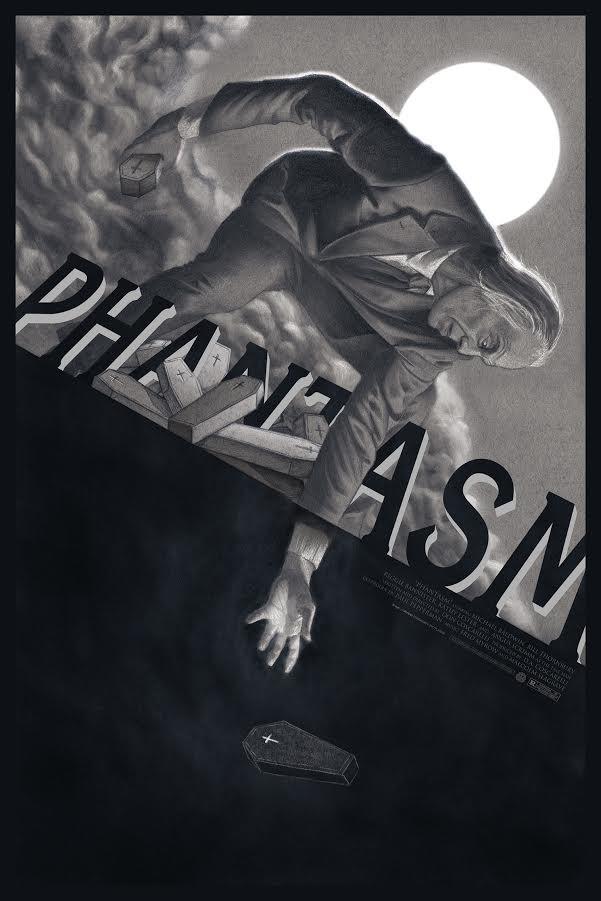
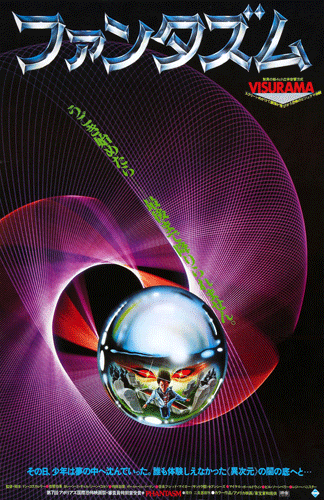
Phantasm (1979)
Directed, written, photographed, and edited by auteur Don Coscarelli, the original Phantasm makes much more sense if viewed less as a linear film and more as a collection of imagery, a “complete movie” to use the words of Fulci.
However, if we were to look at the basics of the story, they’d concern the evil Tall Man (Angus Scrimm), an undertaker who comes from a red dimension where he transforms dead people into dwarf zombies and commands an army of flying metal spheres. He’s obsessed with a young boy named Mike (Michael Baldwin), who is trying to convince his brother Jody (Bill Thornbury) and friend Reggie (Reggie Bannister) that their town is being taken over.
Sure. It’s kind of about that. It’s also a surrealistic rumination on how teenagers see death and the worry that they won’t be there for those they love. Or worse, that those they love won’t be there for them.
This is the kind of movie that has a villain who can also become a woman, the Lady in Lavender, who transforms back into the Tall Man at the moment the men orgasm. There’s some strange commentary at play here, right? It also has fortune tellers who tell you that fear is the killer, characters dying and coming back and characters that lived actually dying and chopped off fingers filled with yellow blood being transformed into winged monsters that can only be stopped by garbage disposals. And it’s also the kind of film that can completely stop the narrative for everyone to play “Sitting Here at Midnight.”
For all the narrative and psychological questions that Phantasm raises, I often wonder: exactly what kind of ice cream man wears a leather vest over his uniform?
This initial offering also introduces a trope that will endure for the rest of the series: at the end, when it seems like everything is making sense,nothing does and the villains end up exploding out of a mirror or from hiding, dragging our heroes back into the void.
I’ve watched Phantasm at least once a year since my first viewing and each time I watch it, I am struck by its strange power. Unlike so many of today’s independent movies, it looks and feels like a big budget film, except it’s been beamed to Earth from another dimension.
Phantasm is available on Shudder along with commentary by Joe Bob Briggs.
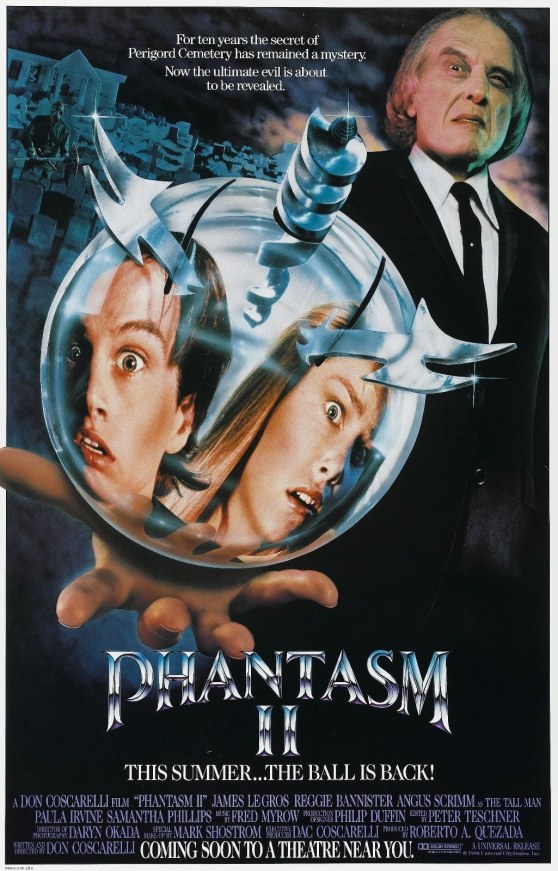
Phantasm II (1988)
Liz Reynolds is a young woman who has a psychic bond with Mike, the hero of the first film, as well as the Tall Man. She finds them in her nightmares, where she begs for Mike to save her before her grandfather dies and is taken away by the villain.
We then see how Mike escaped the end of the last film — Reggie saved him by blowing up the house, but our hero has been institutionalized from seven years. He then must convince Reggie that the Tall Man really exists. He learns when the Tall Man blows up his entire family (yes, this movie has two exploding houses within minutes of one another).
It’s time for a road trip — not the last they will take — that takes them to Périgord, Oregon. Liz’s grandfather dies and her sister Jeri disappears. The priest who does the funeral knows all about the Tall Man, so he desecrates the body which rises anyway.
On their way to Périgord, Reggie picks up a hitchhiker named Alchemy who looks like a ghost they saw earlier. This is where you learn the lessons that Reggie will never learn for the rest of the series: never pick up hitchhikers, never sleep with strange women and every girl who will actually have sex with you is really the Tall Man.
Regardless, Liz arrives at the mortuary where she learns that her grandmother is now one of the Tall Man’s lurkers (she was taken by her grandfather, who we can also assume is part of the Tall Man’s crew). The priest gets killed by a ball, which is always nice. And then one of the saddest moments in the Phantasm series happens: the Tall Man blows up Reggie’s Hemicuda.
What follows are plenty of guns (a quad-barrelled shotgun!), a chainsaw battle, more spheres, the portal to the Red Dimension and the Tall Man pumped full of embalming fluid, which causes him to melt all over the place.
Alchemy has taken a hearse, but she’s really the Tall Man, killing Reggie (again, but of course, not really) and Mike and Liz convinced they’re trapped in a dream. The Tall Man utters the best line of the movie: “No, it’s not!” before pulling them through the back window.
While the lowest budget Universal film of the 1980’s, they also exerted a lot of control over the film. The, well, phantasmagorical style of the first movie was asked to be toned down with a more linear plotline and character voiceovers. Honestly, any time you hear a voiceover in a film, you should read that as a note from the producers saying, “No one will understand this if we don’t spell it out to them.”
Plus, no dreams were allowed in the final cut and a female romantic lead was created for Mike. And most distressing, Universal wanted to recast both leads but allowed A. Michael Baldwin and Reggie Bannister (neither of them had acted in the nine years in between the films, with Reggie actually working at a funeral home as an embalmer) to audition for the roles they originated. Big of them. Coscarelli was allowed to keep one of them in a Sophie’s Choice and went with Bannister, casting James Le Gros in Baldwin’s place. Seriously, were the Universal executives supervillains? That’s some crazy thinking there.
Actually, the Tall Man has plenty of great lines here, like “You think that when you die you go to Heaven… you come to us!” This movie pretty much dominated my teenage years and nothing that followed it would ever top it. But hey — they took three chances trying.
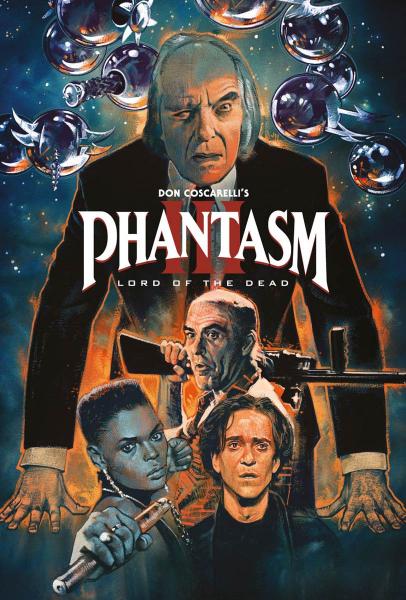
Phantasm III: Lord of the Dead (1994)
Universal Studios was going to put this out in theaters before differences with Coscarelli, yet the direct to video release of this film was in the top 100 rentals of that year — ah, the magic days when video rental could help a movie succeed!
Right after the end of the last film, the Tall Man comes back from the Red Dimension just as the hearse with Liz and Mike in it explodes. Reggie finds that Liz is dead and saves Mike from the Tall Man by threatening to set off a grenade. The Tall Man just laughs and says that he will come from Mike when he’s well again. This takes two years of hospital time, as he wakes up after a dream with his brother Jody and the Tall Men in it. The minute he wakes up, his nurse turns into a demon with a ball inside her skull.
Soon enough, the Tall Man is back, transforming Jody into a sphere and taking Mike with him, sending Reggie on a road trip. He ends up in a small town where three gangsters — somehow this movie becomes The People Under the Stairs for a bit — throw him into the trunk of his car but are thwarted by Tim, a young kid who has been fighting the forces of the Tall Man.
Of note, Tim’s house is the same house from House!
Much like how Princess from The Walking Dead comic has to be directly influenced by Alma from Warriors of the Wasteland, the way Carl Grimes dresses seems like too much of a coincidence when we see Tim in the film.
Reggie and Tim make their way to a mausoleum where they team up with Rocky, a tough woman who is good with nunchakus. They follow a whole bunch of hearses to the Tall Man’s base, where they rescue Mike and use the portal to cut off the Tall Man’s hands, which of course become monsters.
Mike then talks to his brother who is now a ball and learns that the Tall Man is making an army to conquer every other dimension, using human brains inside his spheres and shrunken down dead people as his slaves. “There are thousands of them!” yells Mike as the Looters wheel in Tim, who is saved at the last minute by Jody, still a metal ball. Whew!
Reggie and Rocky arrive just in time to shoot the Tall Man with a spear and liquid nitrogen just as a gold ball emerges from his head. Reggie destroys that as everyone learns that Mike also has a gold ball inside his head that turns his eyes silver. He warns Reggie to stay away from him and leaves with his brother, still a ball.
Rocky leaves just as Reggie is pinned to the wall by a ton of spheres. Just as Tim tries to save him, the Tall Man comes back to say, “It’s never over!” and pulls Tim through a window.
There was an alternate ending filmed where Reggie and Tim travel to Alaska, where they bury the Tall Man’s gold sphere in the ice and leave a plaque over it that says “Here Lies The Tall Man – R.I.P.” Reggie then exclaims, “Now, all we have to worry about is global warming” as they leave.
As a rule, the less money the Phantasm films have in the budget, the better they generally are. This one is considered the roughest by fans as it deviates so much from the storyline. I’d argue that these films have no real storyline and are all over the place, necessitating the use of stimulants any time you try and watch them.
You can watch this on Shudder with Joe Bob Briggs commentary.
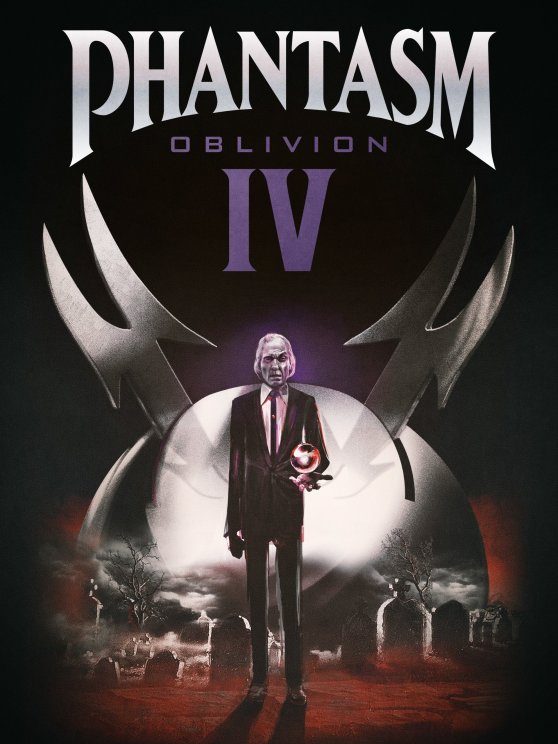
Phantasm IV: Oblivion (1998)
This one opens right where the last one ended, with Mike leaving town and Reggie trapped. The Tall Man lets him go to play one last game while the ball form of Jody becomes human long enough to tell Reggie that he has to search for Mike.
Reggie saves a woman named Jennifer from some of the Tall Man’s soldiers and just when it seems like our ice cream dude is finally about to get lucky, her breasts rip apart to reveal two silver balls — yes, really this happens — before Reggie uses a sledgehammer and his tuning form to stop her.
Mike has flashbacks to his younger days — using footage shot during the original Phantasm that was never used — to try and determine who the tall man is. He tries to kill himself, only to be stopped by the Tall Man. He escapes through a gateway where he meets a kindly old man named Jebediah Morningside, who looks exactly like the Tall Man (the old lady on the porch is supposed to be the fortune teller from Phantasm).
Then, Mike learns that he can move things with his brain. Jody finds him just in time to escape the Tall Man again.
Reggie arrives in Death Valley, fighting off some dwarves as Mike and Jody reappear, yet Mike tells him not to trust Jody. Mike and Jody then go through another gate back to Jebediah’s house, where they learn how he created the first interdimensional gate and became the Tall Man, who chases them back to another cemetery where Jody turns on his brother. Mike kills his brother with a sphere he built out of car parts and runs from the Tall Man.
If at this point your head is spinning from reading this, imagine watching it. This installment tries hard to keep the crazy narrative shifts from the beginning, constantly shifting the questions when you think you have all the answers.
Mike and Reggie use the car sphere and the hearse’s motor, now an interdimensional bomb, to destroy the Tall Man, who of course emerges seconds later from the gate, unharmed. He reveals that he is one of many as he removes the gold sphere from Mike head and leaves. Reggie arms himself and jumps through the gate, just as Mike has a memory of them riding in his ice cream truck together.
This installment’s budget was minuscule when compared to the last two Phantasm films. In fact, if you look at inflation, it was shot on a lower budget than the original. That’s why so many scenes are set in the desert. And the film wasn’t afraid to call in some favors, like the swarm of spheres, which was created by fans and KNB cutting Coscarelli a break on the cost of their effects.
Sadly, this movie could have been even bigger. Roger Avery, who co-wrote Pulp Fiction as well as Silent Hill, is a super fan of the Phantasm Series and suggested an epic ending called Phantasm 1999 A.D. This post-apocalyptic film would also star Bruce Campbell but cost way too much to get made in the pre-Kickstarter world.
Here’s the synopsis from IMDB, which will make you crestfallen that we never got this sequel: “The year is 2012 and there are only three U.S. states left. Between New York and California is the wasteland known as the Plague Zone. Unfortunately, the evil Tall Man controls that area. Since many people are dead, the Tall Man is able to make thousands of dwarf slaves for his planet daily in the Mormon Mausoleum. Besides him, the other residents are “baggers,” human-like creatures that are infected by the Tall Man’s blood, the dwarves, and, of course, the silver spheres, all trying to break out of the barrier that contains them and into the real world. A group of hi-tech troops are sent in to destroy the red dimension where the Tall Man gets his power. Reggie follows so he can find Mike after a series of nightmares he had. Will they be able to finally destroy the Tall Man for good?”
There’s one awesome scene in this one, where the Tall Man chases Mike down Wilshire Boulevard in Los Angeles, which is completely deserted, an effect achieved by shooting it on Thanksgiving morning.
Oh yeah — where is Tim? The kid who ended up being a main character in the last film was to have been eaten by the dwarves in this one, but the budget kept that from being filmed.
You can also watch this one with Joe Bob Briggs on Shudder.
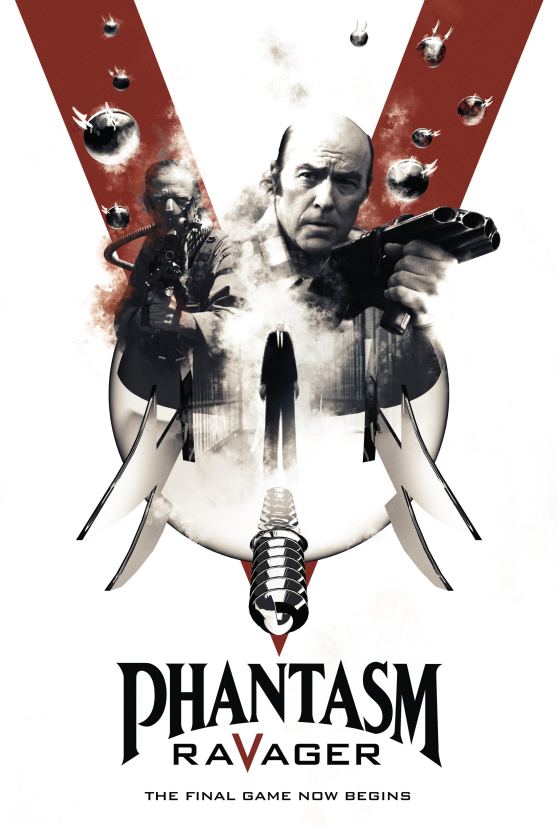
Phantasm: Ravager (2016)
Directed by David Hartman and produced by Coscarelli, this final sequel was done in secret and announced a few months before it was released. It’s the final word — one imagines — in the series, as it ends at least Reggie’s story. Or maybe it doesn’t. It’s hard to tell with Phantasm.
In development since 2004, this one starts with Reggie still hunting the Tall Man. Or perhaps he’s suffering from dementia in an assisted living facility. Or perhaps he’s at a farm where a potential love interest and everyone but him get killed by the Tall Man’s spheres. Or maybe he’s in a hospital in the 1860’s and there to die alongside Jebediah before he became the Tall Man or maybe even in a reality where he never becomes the Tall Man. And oh yeah, the Lady in Lavender shows up again.
The Tall Man then meets Reggie in 1979, where he tells him everything that will happen and offers to save his family if he never gets involved. He replies that he’d rather be loyal to his friends Mike and Jody.
My favorite part of this one is the gigantic spheres that are battling whole cities as Mike leads a hi-tech future squad (shades of the Avery script) against the Tall Man’s forces. Reggie has been in a coma for ten years (shades of Mike in Phantasm II) and now, the Tall Man has taken over the world.
The ending is up for debate: does Reggie die in the real world? Is that a dream? Is the reality where Reggie, Mike and Jody — joined by heroic dwarf Chunk and the surprise return of Rocky from Phantasm III — continue to fight the Tall Man’s gigantic spheres the truth? Are all of them?
As Reggie himself said when he was on with Joe Bob for the Shudder marathon, “Well, it’s Phantasm.” Eventually you have to stop asking questions and just enjoy. I guess it’s just nice to see everyone together again, no matter if the last film doesn’t live up to what it could be.
You can — you guessed it — check this one out on Shudder with Joe Bob Briggs.
In case you didn’t know, the Star Wars character Captain Phasma was named for this movie and Star Wars: The Force Awakens director J.J. Abrams is such a big fan of the film he personally oversaw the new cleaned up version of the original film.
So many movies can cite Phantasm as an influence — Poltergeist 2, A Nightmare on Elm Street, One Dark Night and the TV series Supernatural has its protagonists drive around in a black muscle car…kind of just like Phantasm.
Its influence can also be felt in the world of metal, as Tormentor covered the theme, and the line “The funeral is about to begin, sir” has been sampled by the bands Splatterhouse, Marduk and Mortician. You can also hear the band Entombed play the theme at the end of their song “Left Hand Path.”
Someday, someone is going to get the idea to make an entirely new Phantasm. But it won’t be so strange and it won’t be so special. Until that time comes, we’ll always have five movies — one awesome, a few ok and a few stinkers that I still love — to enjoy. And remember: “If this one doesn’t scare you, you’re already dead!”
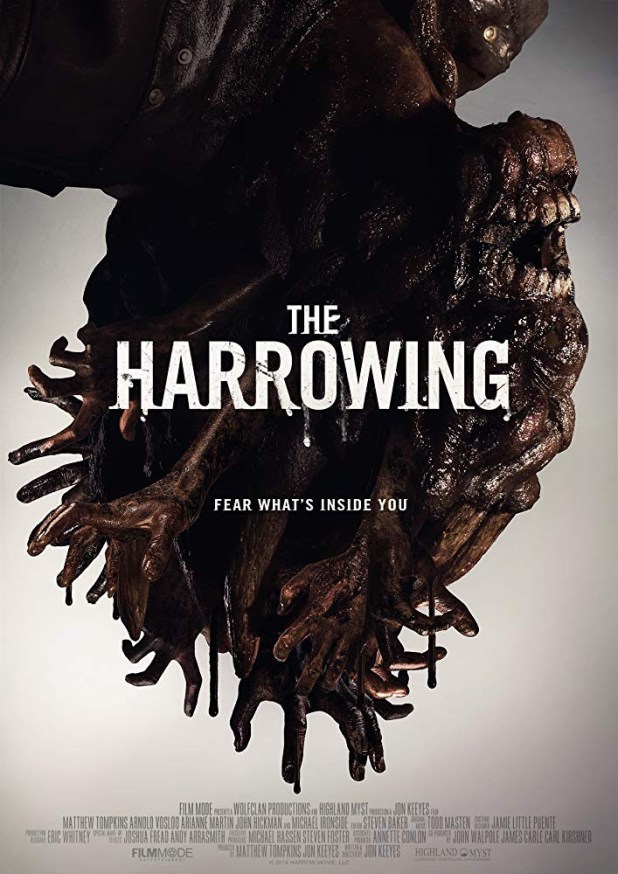
Vice detective Ryan Calhoun (Matthew Tompkins, Sicario) is one of the best cops on the force. But after his partner is ritualistically murdered, his need to discover the truth takes over his life, sending home to a hospital that becomes his own private hell.
Even worse, Calhoun is suspected of the murder. Going undercover in a mental hospital, he tries to keep himself sane while remembering his life — he’s married, he’s a good cop and demons can’t be real. He learns that nothing is — or isn’t — the way he believes it is. Yes, that sentence is confusing but so is the life our hero is about to plunge himself into.
The Harrowing has some star power, with Arnold Vosloo from the Mummy films and Michael Ironside. I really liked the film’s look and how it gets progressively grimier and weirder as we get closer to the inevitable conclusion. It’s very Shutter Island but that isn’t a bad thing. I mean, that movie didn’t have demons with branches and blood spraying out of their heads.
Want to watch it for yourself? It will be available on VOD and On Demand Christmas Day.
DISCLAIMER: I was sent this movie by its PR team, which has no impact on my review.
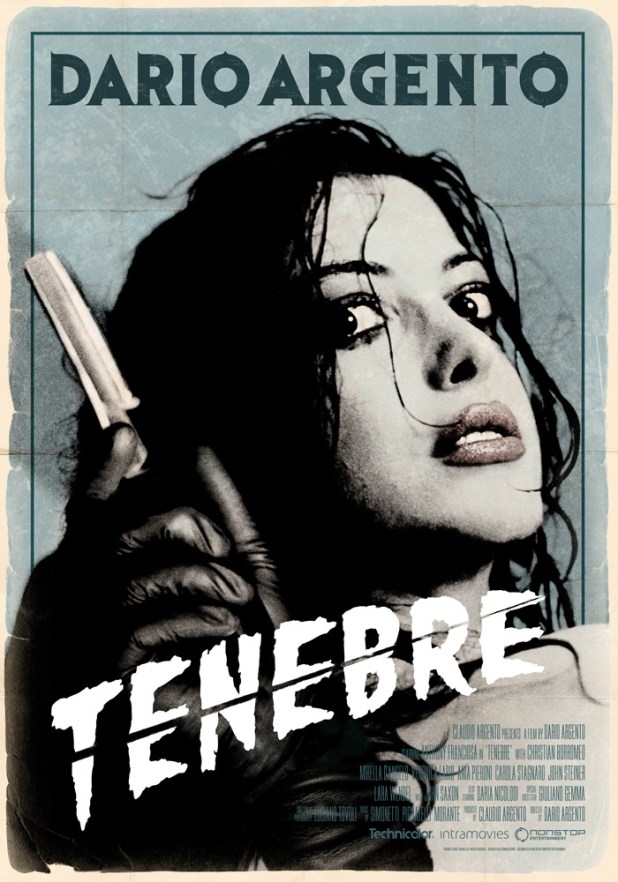
By 1982, Dario Argento had moved beyond the constraints of the giallo genre he had helped popularize and started to explore the supernatural with Suspiria and Inferno. According to the documentary Yellow Fever: The Rise and Fall of the Giallo (which is on the Synapse blu ray of this film), the failure of Inferno led to Argento being kindly asked — or demanded — by his producer to return to the giallo with his next film.
Tenebre is the result and while on the surface it appears to be a return to form, the truth is that it’s perhaps one of the most multilayered and complicated films I’ve ever seen. And while I’ve always believed that Phenomena is Argento’s strangest film — a girl who can talk to bugs befriends a monkey to battle a cannibal child in a foreign country — I have learned that Tenebre just might be even stranger.
To start, Argento intended for the film to be almost science fiction, taking place five years after a cataclysmic event, in a world where there are less fewer people and as a result, cities are less crowded and the survivors are richer. Argento claims that if you watch Tenebre with this in mind, it’s very apparent. While he only hinted that the survivors wanted to forget some mystery event, in later interviews he claims that it takes place in an imaginary city where the people left behind try to forget a nuclear war.
In truth, this could be an attempt to explain why Argento decided to show an Italy that he never had in his films before. Whereas in the past he spent so much time showing the landmarks and crowded streets that make up The Eternal City, he would now move into a sleek futuristic look, a Rome that exists but that films had never shown its viewers before. This pushes this film away from past Argento giallo such as his animal trilogy and Deep Red, as well as the waves of imitators that he felt undermined and cheapened his work. There is no travelogue b-roll time wasters in this movie — the actual setting is there for a reason; stark, cold and alienating.
Argento had started that he “dreamed an imaginary city in which the most amazing things happen,” so he turned to the EUR district of Rome, which was created for the 1942 World’s Fair, and intended by Mussolini to celebrate two decades of fascism. Therefore, more than showing a Rome that most filmgoers have never seen, he is showing us a Rome that never was or will be; a world where so many have died, yet fascism never succumbed.
Instead of the neon color palette that he’s established in Suspiria or the Bava-influenced blues and reds that lesser lights would use in their giallo, production designer Giuseppe Bassan and Argento invented a clean, cool look; the houses and apartments look sparse and bleached out. When the blood begins to flow — and it does, perhaps more than in any film he’d create before or since — the crimson makes that endless whiteness look even bleaker.
Tenebre may mean darkness or shadows in Latin, but Argento pushed for the film to be as bright as possible, without the shadowplay that made up much of his past work. In fact, unlike other giallo, much of the plot takes place in the daytime and one murder even takes place in broad daylight.
Again, I feel that this movie is one made of frustration. As Argento tried to escape the giallo box that he himself had made, he found himself pulled back into it in an attempt to have a success at the box office. In this, he finds himself split in two, the division between art and commerce.
As a result, the film is packed with duality. There are two killers: one who we know everything about and is initially heroic; another who we learn almost nothing about other than they are an evil killer. Plus, nearly everyone in this film has a mirror character and soon even everyday objects like phone booths and incidents like car crashes begin happening in pairs.
Peter Neal (Anthony Franciosa, Julie Darling) is set up from the beginning of the film as the traditional giallo hero: he is in a foreign place, deaths are happening all around him and he may be the inspiration or reason why they’re happening. He has more than one double in this film, but for most of it, his doppelganger is Detective Giermani. The policeman is a writer himself and a fan of Neal’s work, claiming that he can never figure out who the killer is in his books. Their cat and mouse game seems to set up a final battle; that finale is quick and brutal.
This conversation between the two men sums up the linguistic battle they engage in throughout the film:
Peter Neal: I’ve been charged, I’ve tried building a plot the same way you have. I’ve tried to figure it out; but, I just have this hunch that something is missing, a tiny piece of the jigsaw. Somebody who should be dead is alive, or somebody who should be alive is already dead.
Detective Germani: Explain that.
Peter Neal: You know, there’s a sentence in a Conan Doyle book, “When you have eliminated the impossible, whatever remains, however improbable, must be the truth.”
This last sentence is of great interest to me when it comes to giallo. Normally, these films are not based upon Sir Arthur Conan Doyle, but instead, use Edgar Wallace as a touchpoint. They are also filled with red herrings and nonsensical endings where the impossible and improbable often becomes the final answer to the mystery.
Even the movie’s plot is split in half and mirrors itself. This next sentence gives away the narrative conceit of the film: the murders are solved in the first half, belonging to Christiano Berti (John Steiner, Shock), a TV critic who interviews Neal. The second murders are all Neal’s, who uses an axe instead of a straight razor, and his crimes are personal crimes of passion that aren’t filled with the sexual aggression of Berti’s; they are quick and to the point. Much of giallo is about long, complicated and ornate murder, as well as trying to identify the killer. As the film goes on, with the main killer revealed and the murders becoming less flashy, it’s as if Argento is commenting on the increasing brutality of the genre he helped midwife.
The movie itself starts with the book Tenebre being burnt in a fireplace with this voiceover: “The impulse had become irresistible. There was only one answer to the fury that tortured him. And so he committed his first act of murder. He had broken the most deep-rooted taboo and found not guilt, not anxiety or fear, but freedom. Any humiliation which stood in his way could be swept aside by the simple act of annihilation: Murder.”
That’s when we meet Neal, an American in Rome, here to promote his latest work of violent horror, Tenebre. This bit of metafiction is but the first bit of a film that fuses the real and fictional worlds. Joined by Anne (Fulci’s wife Daria Nicolodi) and agent Buller (John Saxon!), Neal begins his press tour.
Before he left, Neal’s fiancée Jane vandalized his suitcase. And moments prior to him landing in Rome, a shoplifter (Ania Pieroni, the babysitter from The House by the Cemetery) who stole his book has been murdered by a straight razor, with pages from said book — again, Tenebre — stuffed into her mouth. Neal has received an anonymous letter proclaiming that he did the murder to cleanse the world of perversion.
Throughout the film, we see flashbacks of a man being tormented, such as a woman chasing down a young man and forcing him to fellate her high heel while other men hold him down. Later, we see the stereotypical giallo black gloved POV sequence of her being stabbed to death.
Next, one of Neal’s friends, Tilde and her lover Marion are stalked and killed. This sequence nearly breaks the film because nothing can truly see to follow it. In fact, the distributor begged Argento to cut the shot down because it was meaningless, but the director demanded that it remain. Using a Louma crane, the camera darts over and above the couple’s home in a several-minutes-long tracking shot. Any other director would film these murders with quick cuts between the victim and listener in the other room or perhaps employ a split-screen. Not Argento, who continually sends his camera spiraling into the night sky, high above Rome, across a maze of scaffolding; a shot that took three days to capture and lasts but two and a half minutes. In one endless take, the camera goes from rooftop to window, making a fortress of a home seem simple to break into; it’s as if Argento wanted to push the Steadicam open of Halloween to the most ridiculous of directorial masturbation. It’s quite simply breathtaking.
Maria, the daughter of Neal’s landlord, who is presented to us as a pure woman (much of giallo, to use Argento’s own words in Yellow Fever: The Rise and Fall of the Giallo, is split between the good girl and the bad woman), is killed when she discovers the killer’s lair. Neal mentions that Berti, the TV personality, seemed obsessed with him and his words echoed the letters from the killer. As Neal has now become the giallo hero, he must do his own investigation, taking his assistant Gianni (Christian Borromeo, Murder Rock) to spy on the man. They discover him burning photos that prove he is the killer.
As Gianni watches, Berti says, “I killed them all!” before an axe crashes into his skull. Whomever the second murderer is, the young man can’t recall. He finds his boss, Neal, knocked out on the front yard and they escape.
That night, Neal and Anne make love, the first time this has ever happened between the two. And the next morning, Neal leaves his agent’s office and discovers his fiancée Jane is secretly sleeping with someone he once considered his best friend.
Giermani asks Neal to visit Berti’s apartment, where they find that the dead man was obsessed with the writer, but don’t discover any of the burnt evidence. The idea that someone could become so obsessed with your work that they’d kill comes directly from Argento’s life. In Los Angeles in the wake of Suspiria‘s surprising international success, an obsessed fan called Argento’s room again and again. While those calls started off nicely enough, by the end, the fan began explaining how he wanted “to harm Argento in a way that reflected how much the director’s work had affected him” and that in the same way that the director had ruined his life, he wanted to ruin his. Argento hid out in Santa Monica, but the caller found him, so he finally went back to Italy. He claimed that the incident was “symptomatic of that city of broken dreams.”
Back to the real story — or the movie story — at hand: Neal decides to leave Rome. Jane receives a pair of red shoes, like the ones we’ve seen in the flashbacks. Bullmer is waiting for Jane in public before he is murdered in broad daylight. And then Neal’s plane leaves for Paris.
Gianni, however, is haunted by the fact that he can’t remember the crime. He returns to Berti’s apartment and it all comes flooding back to him. This moment of visual blindness — and eventually recovery — suggests that Gianni will be pivotal in the resolution of the film and become a hero; ala Sam in The Bird with the Crystal Plumageor Marcus in Deep Red. Not so in the world of Tenebre, as he’s killed within moments.
Argento’s callbacks to his past films are not complete — Jane enters her apartment and walks past a sculpture, again directly and visually recalling The Bird with the Crystal Plumage. She’s called Anne and has a gun, so one assumes that she now knows that she’s not the only unfaithful one in her relationship. An axe shatters the scene and the window as Jane’s arm sprays blood everywhere, almost like some demented surrealist painting. This scene was the cause of numerous cuts with Italian censors and the uncut version still packs plenty of punch.
A quick note — for a movie where Argento was supposedly answering his critics that his work had become too violent and anti-female — the fact that he answers them with an inversion of even more gore and dead women is either the most metacomment of all time or he truly does not give a fuck.
Inspector Altieri enters and is also killed, revealing Neal as the murderer. Anne and Giermani arrive, just in time for Neal to testify to killing Berti and everyone afterward before he slits his own throat.
The flashbacks return and we realize they were Neal’s. While Argento never outright shows it in the film, the girl in the flashbacks was played by transgender actress Eva Robin’s (who got her name from Eva Kant from Danger: Diabolik and the author Harold Robbins), so this further adds to the mirrored theme, as one of Neal’s foremost sexual experiences was not just one of humiliation, but of sublimation and even the greatest heterosexual male fear, penetration. That repressed memory of his childhood sexual trauma and revenge, for some reason unlocked, restoked the bloodlust that he had kept in check for years.
As the detective returns inside, we’re gifted with one of Argento’s most arresting pieces of imagery: as Giermani studies the murder scene, his body contains the shape of Neal, who had faked his death. As he looks down and moves out of frame, the killer is revealed. In essence, the inverse doppelganger is revealed. Brian DePalma, a director who trods the same psychosexual violent domain as Argento, used –stole? — a similar shot in his 1992 film, Raising Cain.
Neal waits for Anne to return. When she opens the door, she knocks over the metal sculpture that referenced Argento’s past work and the sculpture impales the killer. This sequence was copied nearly shot for shot in Kenneth Branagh’s Dead Again, a movie just as influenced by Argento’s work, but also one that would receive much more critical praise.
Surrounded by unending horror, Anne simply screams into the rain, unable to stop. This is another meta moment that we can view on multiple levels:
A. Her character is reacting to the hopelessness of the film’s climax in the only way she has left.
B. Nicolodi, like the other Italians in the film, had little to no character to work with. Frustrated, she bonded with lead actor Franciosa over Tennessee Williams plays, leading to her husband Argento growing increasingly jealous as filming progressed (the couple would split three years later). Therefore, her screams are a genuine reaction to the hopelessness she was feeling for real and took the entire crew by surprise.
C. Asia Argento, the daughter of Dario and Nicolodi, has stated that this scene and her mother’s commitment to it, would prove to her that she should be an actress. As she matures in age, it’s notable that Argento’s films make a shift toward female protagonists (and even Asia in that lead role in his movies Trauma, The Stendhal Syndrome, The Phantom of the Opera and the final film in the SuspiriaThree Mother’s cycle, The Mother of Tears).
I’ve written nearly three thousand words on this film and feel like I could type so many more. It strikes me on so many levels. According to the audio commentary on the Tenebre blu ray by Kim Newman and Alan Jones, one of Argento’s reoccurring theme is that art can kill. You can take this literally — certainly the sculpture at the end ends Neal’s life — or you can see how the darker art gets, the more it impacts the life of its creator (see Fulci’s Cat in the Brain and Craven’s New Nightmare for variations and mediations on this same theme).
Here, the critic Berti’s obsession with the creator Neal’s work compels him to kill in homage to the writer. Is this Argento’s metacommentary that critics — who have never been kind to his work — can only aspire to slavish devotion to his themes and no new creation of their own? That said, the artist isn’t presented as much worthier of a person. He believes that his violent acts of fiction and violent acts of reality are one and the same, all part of the same tapestry of unreality. When he’s finally confronted by what he’s done, all he can do is yell, “It was like a book … a book!”
The second event in Argento’s real life that informs this film comes from a Japanese tourist being shot dead in the lobby of the Beverly Hilton while the director stayed there. Combined with a drive-by shooting that he saw outside a local cinema — which has to feel like a killing outside of a church to a devotee like Argento — the sheer senselessness of murder in America was another reason that Dario left the country.
He would later remark, “To kill for nothing, that is the true horror of today … when that gesture has no meaning whatsoever it’s completely repugnant, and that’s the sort of atmosphere I wanted to put across in Tenebre.”
I can see some of that, but for someone who has presented murder as works of art — perfect preplanned symphonies of mayhem — the stunning realization that real life death is ugly and imperfect must have punched Argento right in the metaphorical face.
You can watch Tenebreon Shudder or order the Synapse blu ray, which is packed with features, including the American Unsane cut, the Yellow Fever: The Rise and Fall of the Giallo documentary and more.
I could take these movies to a used store, I could just take them to Goodwill but you and I know that physical media is awesome and must be preserved and shared and loved.
So this Christmas — I’m giving away eleven movies!
These will be random giveaways and here’s how you can win!
Please share this post on social media. If you want to share it on more than one platform, Merry Christmas!
Comment on it below with your favorite movie we’ve reviewed.
Get ready to win big.
I’ll get these out right after the holiday to the lucky winners!
You’ll get one of these movie collections — it’s gonna generally be a shitty DVD and not a fancy blu ray with a few exceptions — unless you already have the movie. I alone will be the arbiter of the films as they are sent!
Here’s what you could win!
SET ONE: Stephen King (and Goldie Hawn) lovers (Needful Things– MGM DVD, Misery – MGM DVD, Overboard)
SET TWO: For the kids, kind of! (The Baby– Severin blu ray, The Muppets Take Manhattan, GI Joe: Spytroops)
SET THREE: Disasters (Deep Blue Sea, Final Destination and Earthquake)




 B&S About Movies
You must be logged in to post a comment.